



Risk Management for Prediction Market Traders
Overview #
Risk Management for Prediction Market Traders
The complete framework for protecting your capital in binary event contract trading — position sizing, bankroll management, exit strategies, and the unique risk characteristics that make prediction markets different from every other asset class
Why Risk Management Is Different in Prediction Markets #
Every asset class has its own risk profile. Stocks can fall 50%, bonds can default, options can expire worthless. But prediction markets have a characteristic that makes them unique among traded instruments: every contract will be worth either $1.00 or $0.00 at settlement. There is no partial outcome, no "it kind of happened." Binary resolution creates both opportunities and hazards that require a distinct approach to risk management.
The hazard: a single position can go to zero quickly and irrevocably. Unlike a stock that might recover from a news-driven 30% drop, a YES contract on an event that didn't happen settles permanently at $0.00. There is no waiting out the storm.
The opportunity: the maximum loss on any position is precisely defined the moment you enter. A YES contract purchased at $0.45 can lose no more than $0.45 per share. Unlike futures or leveraged instruments, there's no margin call, no unlimited downside risk, no gap-open risk beyond your initial investment.
The complete framework for protecting your capital in binary event contract trading — position sizing, bankroll management, exit strategies, and the unique risk characteristics that make prediction markets different from every other asset class --- Every asset class has its own risk profile.
This guide provides the complete risk management framework for prediction market trading — adapted for binary outcomes rather than continuous asset prices.
The Foundation: Bankroll Management #
Bankroll is your total trading capital dedicated to prediction markets. Every risk management decision flows from how you protect and grow this bankroll.
The Core Rule: Never Risk More Than You Can Afford to Lose Entirely #
Prediction market positions can go to zero. This isn't a theoretical risk — it's the designed outcome for losing positions. Your bankroll must be capital you could afford to lose completely without affecting your financial security, emergency fund, or life obligations.
For new traders: start with a small dedicated bankroll ($200-$1,000) that represents genuine risk capital. Do not fund prediction market trading with savings, emergency funds, or money you'll need within a year.
The 2-5% Rule: Maximum Position Size Per Trade #
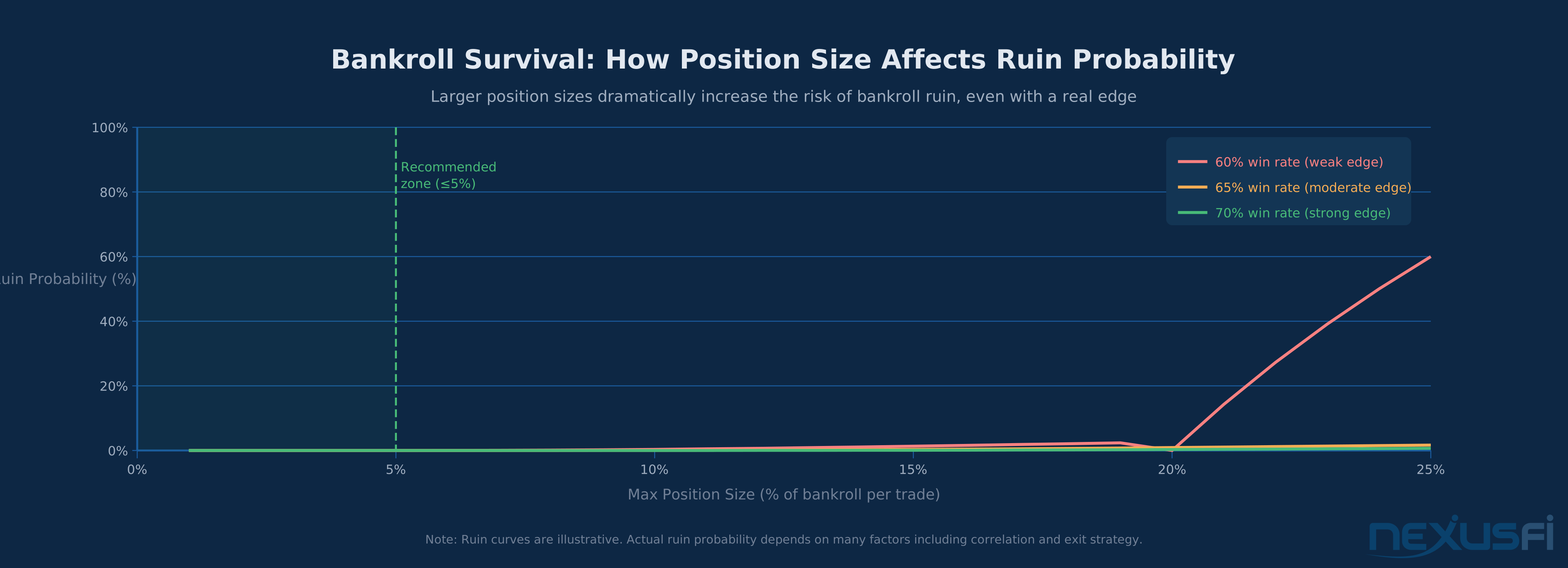
Experienced prediction market traders limit individual positions to 2-5% of bankroll per trade. This rule exists because:
- Complete loss is realistic: A $0.70 YES contract that settles NO loses 70% of the position value. A 5% bankroll position becomes a 3.5% bankroll loss — survivable. A 20% bankroll position becomes a 14% loss — damaging.
- Compounding works both ways: Consistent 3-4% per-trade risk allows 25-30 concurrent positions without catastrophic correlation risk. Consistent 20% per-trade risk means 5 concurrent losing positions wipes the bankroll.
- You need volume to realize edge: Probability edge expressed over many trades. Sizing positions too large means you run out of bankroll before edge has time to manifest.
Starting framework for new traders:
- Bankroll: Your dedicated prediction market capital
- Maximum position per event: 2% of bankroll for high-probability events (70¢+ contracts)
- Maximum position per event: 3% of bankroll for 50-70¢ contracts
- Maximum position per event: 1% of bankroll for speculative low-probability events (<30¢)
- Never exceed 5% on a single trade regardless of conviction level
Kelly Criterion: The Math Behind Optimal Sizing #
The Kelly Criterion provides a formula for calculating the mathematically optimal position size given your probability estimate and the odds. It's the most principled bankroll management tool for binary outcomes.
The Kelly Formula for Binary Markets #
For a prediction market position:
Kelly% = (P_est - P_market) / (1 - P_market) (for YES positions)
Where:
- P_est = your estimated probability of YES
- P_market = the current YES contract price (market's implied probability)
- Kelly% = the fraction of bankroll to risk
Example: You estimate a 70% probability on an event priced at 55¢ (55% implied probability):
- Kelly% = (0.70 - 0.55) / (1 - 0.55) = 0.15 / 0.45 = 33.3%
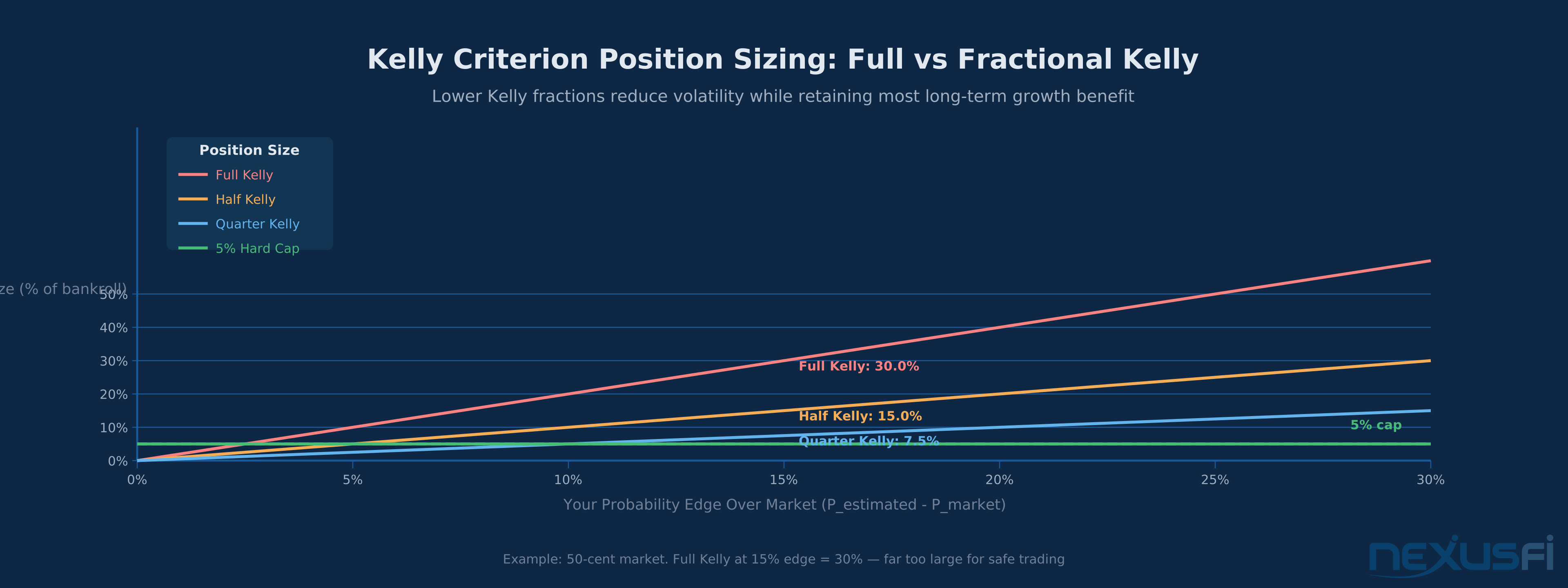
Full Kelly would suggest betting 33.3% of your bankroll. This is almost certainly too large for prediction market trading.
Why Full Kelly Is Too Aggressive #
The Kelly formula maximizes long-run expected log-wealth. It's mathematically optimal only if:
- Your probability estimates are perfectly calibrated (they aren't)
- You can bet infinitely many times (you can't)
- Your edge is consistent across every bet (it isn't)
In practice, full Kelly creates enormous variance. Two consecutive wrong calls at full Kelly sizing can devastate a bankroll.
Recommendation: Use Half-Kelly or Quarter-Kelly
Half-Kelly (50% of the Kelly recommendation) and Quarter-Kelly (25% of Kelly) are the standard approaches for serious prediction market traders:
- Half-Kelly: Reduces variance much while retaining most of the growth benefit
- Quarter-Kelly: Conservative, prioritizes capital preservation over growth
- Cap at 5% per position: Regardless of Kelly output, never exceed 5% per trade
For the example above (Kelly = 33.3%):
- Full Kelly position: 33.3% of bankroll — too large
- Half-Kelly: 16.7% — still potentially too large
- Quarter-Kelly: 8.3% — approaching the reasonable range
- Capped at 5%: 5% — appropriate for most traders
When Kelly Breaks Down #
Kelly sizing assumes edge is real. If your probability estimates are systematically wrong — overconfident, based on flawed reasoning, or missing key information — Kelly will improve your bankroll destruction.
Calibration before sizing: Before trusting Kelly outputs, track your probability estimates and actual outcomes over at least 50 trades. If your "70% confidence" calls win 50% of the time, your estimates are systematically overconfident and your Kelly fractions are overstated.
Position Sizing for Binary Outcomes: A Practical Framework #
Beyond Kelly, here are practical position sizing rules adapted for Kalshi, Polymarket, and Robinhood:
The Price Point Adjustment #
Higher-priced contracts (near $1.00) risk more absolute dollars per share but have lower probability of going to zero. Lower-priced contracts risk less per share but are more likely to expire worthless.
Share count math:
- If max position size = 2% of $1,000 bankroll = $20
- At 50¢ contract: buy 40 shares (40 × $0.50 = $20) — max loss = $20
- At 80¢ contract: buy 25 shares (25 × $0.80 = $20) — max loss = $20
- At 20¢ contract: buy 100 shares (100 × $0.20 = $20) — max loss = $20
The dollar risk is identical regardless of contract price when you size by dollar amount rather than share count.
The exception — near-certainty contracts: If you're buying a 95¢ contract, you're risking 95¢ to make 5¢. Your edge must be enormous in probability terms to justify this. Most new traders should avoid trading contracts above 85¢ until they understand the asymmetric return profile.
Correlated Events: The Hidden Risk Multiplier #
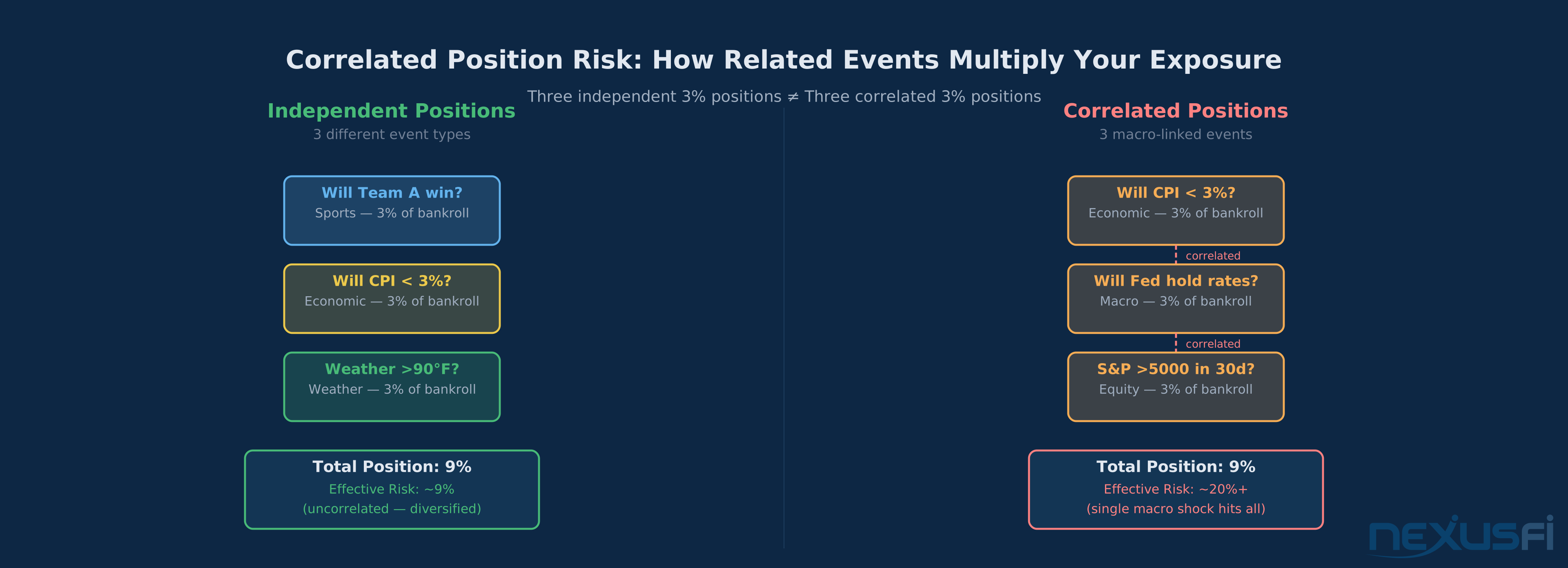
The 2-5% rule per position assumes positions are reasonably independent. When multiple positions are correlated — when a shared underlying factor affects all of them simultaneously — your effective risk is much higher.
Example of correlated risk: You hold YES positions on:
- "Will unemployment be below 4.5%?" (50¢)
- "Will the Fed hold rates at FOMC?" (65¢)
- "Will S&P 500 be above current level in 30 days?" (48¢)
These three positions are heavily correlated with macroeconomic conditions. A major negative economic shock would likely move all three against you simultaneously. Your "3 positions × 2% = 6% total risk" is misleading — the correlated risk is much higher.
Correlation management rules:
- Never more than 15-20% of bankroll in correlated events
- Macro, geopolitical, and political events within the same country are often correlated
- Treat sector-specific events (oil price, specific commodity) as a correlated cluster
- Explicitly track correlation clusters in your trade log
Exit Strategies: When and How to Close Positions #
Binary markets don't allow traditional stop-loss orders — markets simply exist until settlement. But you can actively manage exits by selling your position in the open market before settlement.
The Pre-Settlement Exit Framework #
When to sell early (take profit):
- Probability has moved much in your favor: If your entry probability estimate was 60% and the market now prices it at 80%, you've captured most of your theoretical edge. Exit and redeploy capital.
- Capital opportunity cost: A position you entered at 40¢ that's now at 75¢ has a 25¢ gain per share. That capital, if freed, could be deployed in a new opportunity. Calculate whether holding to settlement ($1.00, another 25¢ gain) is better than deploying in a new edge trade.
- Information asymmetry has resolved: You entered because you had an information advantage. If that advantage has now been priced in by the market, your ongoing edge is zero. Exit.
When to exit early (cut loss):
- Your thesis is broken: You believed the Fed would hold rates; news broke that they're considering emergency action. Your thesis is wrong — exit quickly before the market fully reprices.
- Better opportunity exists: If your capital is committed at a small edge and a larger edge opportunity appears, consider exiting the smaller position (even at a small loss) to fund the better trade.
- Information arrived that you didn't anticipate: Unexpected data, news, or events that materially change the probability. Don't anchor to your entry price — anchor to the current expected value.
What not to do:
- Don't hold just because you're down: The market's current price is always the most accurate estimate of probability given all known information. A 30¢ YES contract you bought at 50¢ reflects real information that the event is less likely than you thought.
- Don't wait for settlement to exit losing trades: Holding a 10¢ YES contract when you believe the event has a 5% chance keeps your capital locked for no expected gain.
- Don't set mental target prices without a plan: "I'll sell if it hits 80¢" only works if you actually execute when the price reaches 80¢. Define the rule in advance and follow it automatically.
Trailing Stop Equivalent for Binary Markets #
Traditional trailing stops don't exist on most prediction market platforms. But you can implement a functional equivalent:
Manual trailing approach: When a position moves favorably, periodically review whether the current market price is within your acceptable remaining edge. If the market now prices what you own at 85¢ and your maximum probability estimate is 92%, you have only 7 cents of remaining potential gain. Is that worth maintaining the capital commitment?
This isn't automated, but reviewing open positions daily and applying this reasoning is effectively a trailing stop.
Bankroll Preservation Under Drawdown #
Drawdowns are inevitable. Even excellent traders with genuine edge will face losing streaks — both because probability math produces runs of losses and because probability estimates are imperfect.
Understanding Drawdown Math #
A series of losses feels catastrophic but follows predictable probability math:
- At 70% win rate (on 50¢ contracts), you'll still lose 3 in a row roughly 2.7% of the time
- At 60% win rate, 4-loss streaks happen roughly 2.6% of the time
- At 55% win rate, 5-loss streaks happen approximately 1.8% of the time
These aren't bugs — they're features of probabilistic outcomes. The question isn't whether losing streaks happen, but whether your bankroll survives them.
The Half-Bankroll Warning Rule #
If your bankroll drops to 50% of its starting value, stop taking new positions immediately. This forced pause serves several purposes:
- Requires you to analyze whether drawdown reflects bad luck or genuinely wrong probability estimates
- Prevents emotional trading from compounding losses
- Creates a mandatory review of your methodology before additional capital is risked
During the pause:
- Review your last 20+ trades with actual outcomes
- Calculate your realized win rate vs. expected win rate
- Identify systematic biases in your probability estimation
- Determine whether to continue with the same methodology or adjust
Position Sizing Through Drawdown #
During a drawdown, reduce position sizes. This is counterintuitive — many traders want to "make it back" by sizing up. This logic is wrong for two reasons:
- Past losses don't affect future probabilities (the gambler's fallacy)
- Sizing up when your bankroll is depleted reduces the number of trades you can withstand before ruin
If your $1,000 bankroll has dropped to $700, your 2% maximum position is now $14, not $20. Respect the percentage, not the dollar amount.
Hedging in Prediction Markets #
Hedging — taking an opposing position to reduce risk — is available on prediction markets, but with important constraints.
Same-Market Hedging (Selling Your Position) #
The simplest hedge is selling the position you hold. If you own YES at 50¢ and the market moves to 70¢, you can sell your entire position, locking in gains. If you sell half, you've reduced your exposure while retaining upside.
This is more hedge than most traders need.
Cross-Market Hedging #
Some Kalshi markets are economically related. For example, if you hold a large YES position on "Will the Fed raise rates?" you might hedge with a NO position on a correlated market like "Will the 10-year yield be above X%?"
Cross-market hedging requires sophisticated understanding of correlations and adds transaction costs. For most new traders, simply reducing position sizes is more effective than complex hedges.
The Correlation Warning #
Cross-market hedging can fail spectacularly if the assumed correlation breaks down. Markets that seem correlated in normal times may diverge dramatically during crises. True hedges are difficult to construct in prediction markets — focus on position sizing instead.
Specific Risk Considerations by Market Type #
Economic Data Markets (CPI, Fed Rate, Jobs) #
Key risks:
- Data revisions after initial release (markets settle on initial release)
- Unexpected outlier readings
- Coordinated positions by informed traders before release
Risk management: Economic data markets often have high liquidity and tight spreads but can move violently on release. Size positions conservatively before data releases; consider closing before the release if holding overnight.
Political and Electoral Markets #
Key risks:
- Polling error (polls can systematically misstate probabilities)
- Black swan events (unexpected candidate actions, news)
- Resolution criteria complexity (certification timing, contested results)
Risk management: Political markets require wide probability uncertainty bands. If you think probability is 65%, treat it as a range of 55-75% when sizing. Extended holding periods tie up capital through volatile news cycles.
Sports Markets #
Key risks:
- Injury information you don't have
- Sharp bettor activity that moves markets before you
- Emotional bias (trading your team)
Risk management: Sports markets are fast-moving and susceptible to inside information advantages. Best practice for new traders: avoid sports markets until you understand why the market prices differ from the odds you're seeing elsewhere.
Weather and Climate Markets #
Key risks:
- Forecast error propagation (3-day forecasts are more reliable than 10-day)
- Local vs. official measurement location differences
- N/A risk (events not meeting defined thresholds)
Risk management: Weather markets have complex technical content. Only trade when you have clear research advantage (local knowledge, meteorology background).
The Psychology of Binary Risk: Avoiding Common Traps #
The Overconfidence Trap #
Binary markets attract confident thinkers who believe they've analyzed the situation correctly. But prediction market prices often reflect the aggregated views of very informed market participants. Unless you have genuine information or analytical advantages, the market is often more correct than you.
Calibration habit: For every trade you enter, write down your confidence percentage. Track actual outcomes. If your 70% confidence trades win at 65%, you're well-calibrated. If they win at 50%, you're systematically overconfident.
The Sunk Cost Trap #
A position at 20¢ that you bought at 60¢ represents a 40¢ unrealized loss. The sunk cost trap is holding this position because "it already went against me so much." The correct analysis: if the event has a 20% probability (implied by the 20¢ price), your position is currently fairly valued at 20¢. If your probability estimate has also revised down to near 20%, exit. If your estimate remains much above 20% and you have evidence for why, hold.
The Hot Hand Trap #
Three consecutive winning trades don't mean your probability estimation is better than when you started. Pattern-seeking is a human cognitive bias that generates noise in trading. Each trade should be evaluated on its merits; recent track record doesn't change the mathematics of a new position.
Building Your Risk Management System #
Effective risk management isn't a set of rules you consult occasionally — it's a systematic process:
Before every trade:
- Calculate position size using 2-5% rule
- Run Kelly calculation and apply half-Kelly cap
- Identify correlated positions and check cluster limits
- Estimate breakeven probability net of fees
During every trade:
- Set a mental (or written) exit price for profit-taking
- Set a scenario-based exit trigger ("if X happens, exit regardless of price")
- Note any new information as it arrives
After settlement:
- Record: trade ID, entry price, probability estimate, outcome, actual return
- Calculate realized return vs. expected value
- Track cumulative calibration (estimated vs. actual win rates)
Monthly review:
- Analyze win rate by market type
- Review largest losses for lessons
- Adjust methodology if calibration is poor
- Recalibrate position sizes if bankroll has changed much
Summary: The Risk Management Principles #
- Max 2-5% of bankroll per position — binary outcomes can go to zero; scale so
- Use Half-Kelly or Quarter-Kelly — full Kelly is too aggressive for imperfect probability estimates
- Track correlated clusters — cap correlated group exposure at 15-20% of bankroll
- Exit when thesis breaks — don't anchor to entry price, anchor to current expected value
- Size down in drawdown — protect bankroll, don't chase losses
- Calibrate consistently — track your estimated vs. actual probability rates
- Never size up on conviction alone — more confidence doesn't justify violating bankroll rules
Risk management isn't about being timid. It's about ensuring you remain in the game long enough to allow genuine edge to manifest in results. A trader with real edge and proper risk management will outperform a trader with real edge and poor risk management — consistently and much.
Knowledge Map
References This Article
Articles that build on this topicCitations
- — Kelly Criterion Prediction Markets: Complete 2026 Guide
- — Polymarket Bankroll Management: Kelly Criterion Guide
- — Prediction Market Risk Management: Protect Your Capital
- — Risk Management Strategies for Prediction Markets
- — Trailing Stop Strategies for Prediction Market Exits
- — Risk Management for Event Contracts
- — Position Sizing in Prediction Markets: The Kelly Criterion Guide