



CME Group Event Contracts: Binary Yes/No Trading on Economic Data, Bitcoin, and S&P 500
Overview #
CME Group launched event contracts quietly. Most futures traders missed it. The marketing was buried in press releases, the product pages were confusing, and brokers treated it like an afterthought. Meanwhile, Kalshi was raising $1 billion and getting all the prediction market headlines.
That's a problem
Here's what CME event contracts actually are: binary yes/no contracts on specific market outcomes. Will CPI print at or below 3.1%? Will the Fed hold rates? Will Bitcoin close the next hour above $105,000? You buy YES or NO. If you're right, you get $1.00. If you're wrong, you get nothing. Your maximum loss is whatever you paid. No margin calls, no stop-outs, no gap risk beyond the premium.
This article covers everything you need to trade them: how the pricing works, which categories exist, how settlement happens, when to use them versus regular futures, and how to size positions. By the end you'll know whether these belong in your trading toolkit
Key Concepts #
Event contract: A binary derivatives contract that settles at either $1.00 (YES wins) or $0.00 (NO wins) based on the outcome of a specific predefined event or condition.
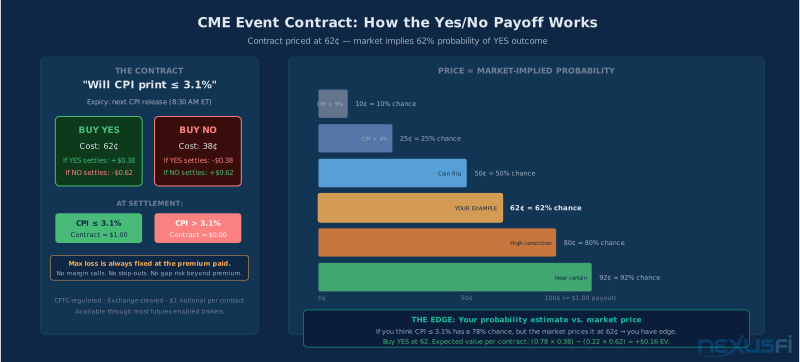
Contract price: The price you pay to enter the trade, expressed in cents (1¢ to 99¢). A contract priced at 62¢ implies the market assigns approximately 62% probability to the YES outcome.
YES side: You're betting the condition will be true at settlement. Cost = the contract price. If correct, you receive $1.00. If wrong, you lose the premium paid.
NO side: You're betting the condition will be false. Cost = $1.00 minus the YES price. If the YES contract is at 62¢, the NO side costs 38¢.
Maximum loss: Fixed at the premium paid. You can never lose more than what you put in. No margin calls. Full stop.
Settlement: Determined by the official reference source (BLS data for CPI, CME CF Bitcoin Reference Rate for crypto, etc.). The first published value is what counts
FCM (Futures Commission Merchant): The brokerage that holds your futures account. CME event contracts clear through the same FCM as your ES or NQ position.
Expected value (EV): Your probability estimate multiplied by the payout, minus your probability of being wrong multiplied by the cost. Formula: EV = P × (1 − price) − (1 − P) × price. Positive EV means you have edge.
Kelly criterion: A mathematical formula for optimal position sizing based on edge and payout odds. For event contracts, the formula simplifies to: f = (P × b − (1 − P) × a) / b, where b is the YES payout and a is the cost.
Determination period: The specific moment and methodology CME uses to observe the reference data and determine whether YES or NO has won. For economic data, this is typically the first published release value at the official announcement time.
What CME Event Contracts Are #
The easiest way to understand CME event contracts is to strip away the jargon. Here's the entire product in one sentence: you bet yes or no on whether something specific happens, and whoever's right gets a dollar.
That's it. The sophistication is in the execution, the pricing, and knowing when to use them
Let's take a concrete example. A CPI event contract might ask: "Will the CPI print at 3.1% or below?" The contract is priced at 62¢. That price reflects the market's consensus view that there's approximately a 62% chance CPI comes in at or below the threshold.
If you buy YES at 62¢ and CPI prints at 3.0%, you receive $1.00. Net profit: 38¢ per contract. If CPI prints at 3.2%, your contract expires worthless. Net loss: 62¢ per contract
If you buy NO at 38¢ (the other side), the math inverts. You collect 62¢ if CPI exceeds the threshold, you lose 38¢ if it doesn't.
This structure has a specific use case: when you have a thesis about a specific threshold, not just a direction. Regular futures reward directional magnitude
CME launched these formally around 2022, and trading volume exploded starting in late 2025. Per CME's own reporting and as covered in the NexusFi community thread by @Fi on CME event contract milestones, the exchange cleared over 100 million event contracts in just 8 weeks following the FanDuel Predicts launch partnership. The infrastructure caught up with the demand that Kalshi had been demonstrating in the retail space.
From a regulatory standpoint, CME event contracts are CFTC-designated DCM products
The infrastructure advantage matters. The clearing, the margin netting, the counterparty, the FCM relationship
Contract Categories #
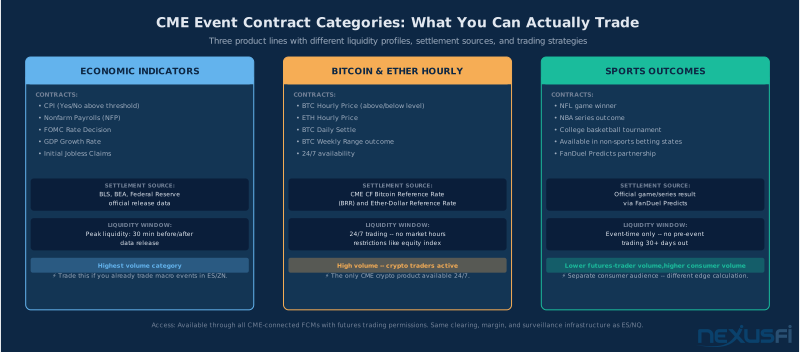
CME offers three main categories of event contracts. Each has a different liquidity profile, settlement source, and trader audience. Knowing which category fits your strategy matters before you ever look at a contract price.
Economic Indicator Contracts
This is the highest-volume category for professional futures traders. The contracts track major macro data releases: CPI, Core PCE, Nonfarm Payrolls (NFP), FOMC rate decisions, GDP growth rates, Initial Jobless Claims. These are the exact same data points driving ES, ZN, and CL price action.
Settlement is based on the official first-published data from the relevant government agency. For CPI, that's the Bureau of Labor Statistics (BLS) release at 8:30 AM ET on the scheduled release date. The first number matters
Liquidity peaks in the 30 minutes before and after the data release. This mirrors exactly what happens in the underlying futures markets. If you already trade ES or ZN around macro events, economic indicator contracts add a new dimension to your toolkit: a pure expression of "will the number beat or miss consensus" without taking on the volatility risk of the underlying.
The community discussion thread started by @bobwest on NexusFi
Bitcoin and Ether Hourly Contracts
These are the 24/7 product. While economic indicator contracts live and die around scheduled release windows, hourly BTC and ETH contracts trade around the clock
Settlement references the CME CF Bitcoin Reference Rate (BRR) and the CF Ether-Dollar Reference Rate. These are composite rates calculated from multiple exchange inputs at specific cut times. This is not a spot price from any single exchange
The hourly structure means you're trading whether BTC will be above or below a specific level when the next hour rolls over. As covered in the NexusFi community thread by @Symple on CME's 24/7 trading launch, the initial underlyings included economic indicator contracts, hourly Bitcoin and Ether, and sports outcomes
Sports Outcome Contracts
The FanDuel Predicts partnership launched in December 2025, as detailed in the NexusFi news post by @Fi on the FanDuel Predicts announcement. Sports contracts cover NFL game winners, NBA series outcomes, college basketball tournament results, and more. These contracts are available in states where sports betting is NOT legal
This category has the most retail participation and the least overlap with professional futures traders. The edge calculation is different here
Pricing Mechanics #
Understanding how contract prices translate to implied probabilities
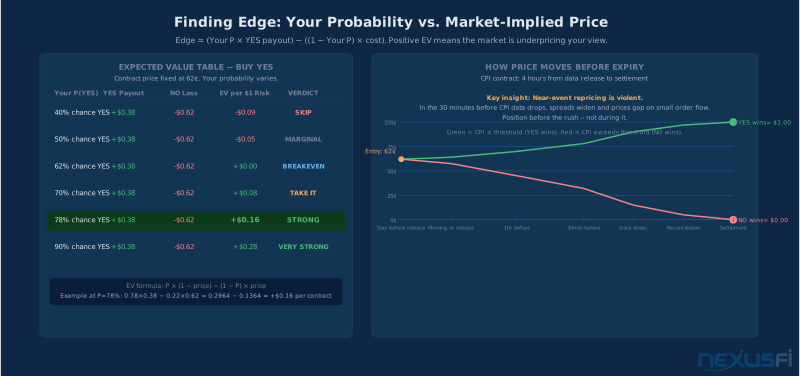
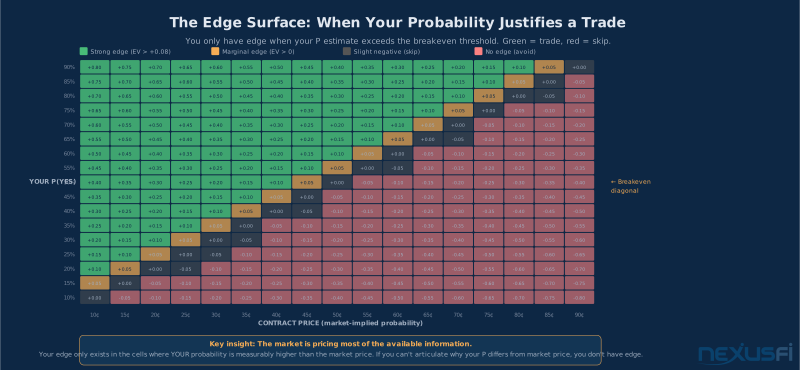
A contract priced at 62¢ does NOT mean there's a 62% probability of YES. It means the market's tradeable price implies approximately 62% probability, after incorporating supply, demand, bid/ask spread, and participant positioning. This distinction matters when you're calculating edge.
The edge formula is simple:
EV = P × (1 − price) − (1 − P) × price
Where P is your probability estimate and price is the YES contract cost. You think CPI will print at or below 3.1% with 78% confidence. The YES contract is priced at 62¢. Your calculation: (0.78 × 0.38) − (0.22 × 0.62) = 0.2964 − 0.1364 = +$0.16 expected value per contract. At that EV, you have real edge. Buy YES.
Now flip it: you think the probability is only 50%. EV = (0.50 × 0.38) − (0.50 × 0.62) = 0.19 − 0.31 = -$0.12. Negative EV. Pass. The breakeven probability is exactly equal to the contract price
The market is pricing most of the available information on scheduled macro releases. CME economic indicator contracts attract institutional participants, quant shops, and macro funds that track the same economic models you are. Unless your analysis is genuinely differentiated
Price Movement Dynamics
Contract prices move as new information arrives and as time passes. Two dynamics are worth understanding in detail:
Information-driven repricing: If the Atlanta Fed GDPNow tracker gets updated and suggests a better-than-expected GDP print, the GDP threshold contract will move immediately. Contracts trade like markets because they are markets
Pre-event repricing: In the 30 minutes before a scheduled data release, spreads widen dramatically and prices become volatile. Informed order flow dominates because everyone knows the uncertainty is about to collapse to a binary outcome. As @SMCJB noted on NexusFi when CME launched these products: the CME is effectively the counterparty, which means no credit risk, but also means liquidity in thinner contracts can be limited and the spread cost matters. Size your entry to match the actual depth you're working with.
Event contracts trade in 1¢ increments. At 62¢, moving to 63¢ represents a meaningful shift
Liquidity Windows #
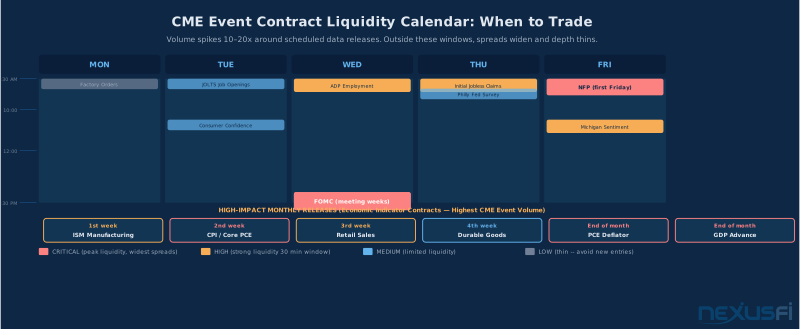
CME event contract liquidity is not constant. It spikes to 10-20x normal volume around scheduled data releases and drops to thin, wide-spread conditions outside those windows. Knowing when to trade
The three highest-liquidity windows for economic indicator contracts are:
- CPI and Core PCE releases (mid-month): The Fed's primary inflation metrics. Heavy institutional participation from rate traders and macro funds.
- NFP (Nonfarm Payrolls) (first Friday of month): The biggest single macro event in most months. Liquidity peaks 2 hours before through 1 hour after the 8:30 AM release.
- FOMC Rate Decisions (8 meetings/year): The binary rate decision contracts trade most heavily in the week leading up to the decision, with a final surge as the 2:00 PM ET announcement approaches.
For Bitcoin and Ether hourly contracts, liquidity is more consistent throughout the day but still spikes around key price levels and major crypto news events. The 24/7 nature means you can always get a fill, but the spread cost varies much by time of day.
Entering a new event contract position in the final 30 minutes before a data release is almost always a mistake. Spreads widen to 5-10x their normal level, depth thins dramatically, and any position you enter is immediately marked against you by the spread cost. The right time to establish a position is hours before the event
Settlement Process #
Settlement is where everything becomes concrete. Understanding exactly how CME determines the outcome
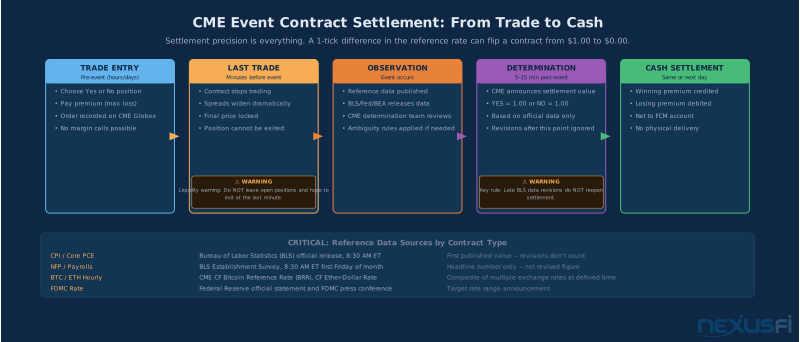
The settlement process runs in five stages: trade entry, last trade time, observation, determination, and cash settlement.
Trade Entry
When you buy a contract, you pay the premium upfront. That premium is your maximum loss
Last Trade Time
Event contracts stop trading some period before the event resolves. For an 8:30 AM CPI release, the contracts typically stop trading 10-30 minutes before. Once last trade time hits, you cannot exit your position. If you want to close, do it before this window. Missing the exit is one of the most common execution mistakes in event contract trading. Check the contract specifications for exact last trade times
Observation and Determination
CME's determination team monitors the reference source at the exact scheduled time. For CPI, that means the BLS release at 8:30 AM ET
One critical rule: BLS data revisions after initial publication do NOT reopen settlement. If CPI prints at 3.0%, settles YES, and then gets revised to 3.2% two weeks later, the settlement stands. The first-published value is what counts.
Cash Settlement
Winning contracts receive $1.00 per contract, credited to the account by the settlement date. Losing contracts expire at zero. The net PnL hits your account statement
Broker Access and Account Setup #
If you trade futures through a CFTC-registered FCM, you almost certainly have access to CME event contracts already. The question is whether your broker has enabled them in the trading platform UI.
The standard access path is through CME Globex
Practical steps to get started:
- Check platform support: Log into your platform and search for event contracts or prediction markets. Some platforms show them under a separate tab, others integrate them with futures.
- Verify account permissions: Some brokers require enabling options/binary options permissions even for event contracts. This is a form submission, not an approval process
- Confirm order types: Make sure your platform supports limit orders for event contracts. You don't want to rely on market orders given the spread characteristics near event windows.
- Review FCM margin rules: Ask your FCM how event contract premiums are treated in your account. Most treat them as fully-paid debit positions, but the specific accounting affects your margin calculations for other open positions.
CME Event Contracts vs. Kalshi #
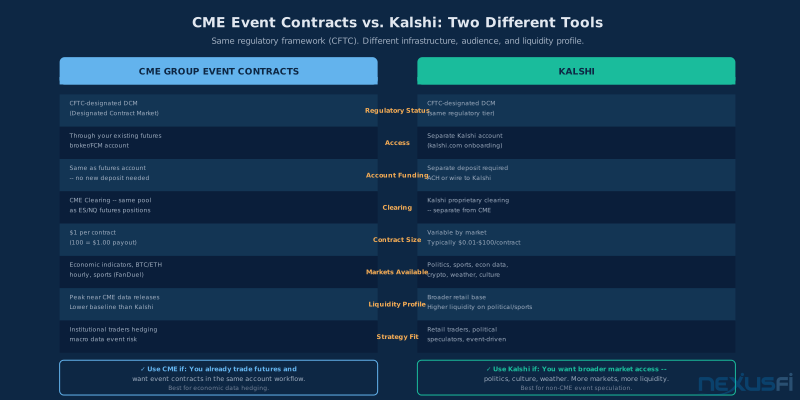
The comparison comes up constantly. Both platforms are CFTC-regulated, both offer binary event contracts, and both have grown substantially in recent years. They're not the same tool.
The fundamental difference is infrastructure and audience. CME event contracts live inside your existing futures trading workflow. Same account, same FCM, same clearing pool, same broker relationship. Kalshi requires a separate account, separate funding, and a separate platform experience.
For futures traders, the CME workflow advantage is significant. You're already watching the ES tape. You're already thinking about what the CPI print means for ZN positioning. Adding a CME event contract is a one-click addition to an existing analysis framework. Logging into Kalshi is a context switch.
Kalshi has meaningfully broader market coverage. Politics, entertainment, weather, corporate events
For economic data
The verdict for a futures trader: start with CME because it's already in your account. Add Kalshi if you develop edge in markets CME doesn't offer. Don't try to run both simultaneously at first.
Strategies for Futures Traders #
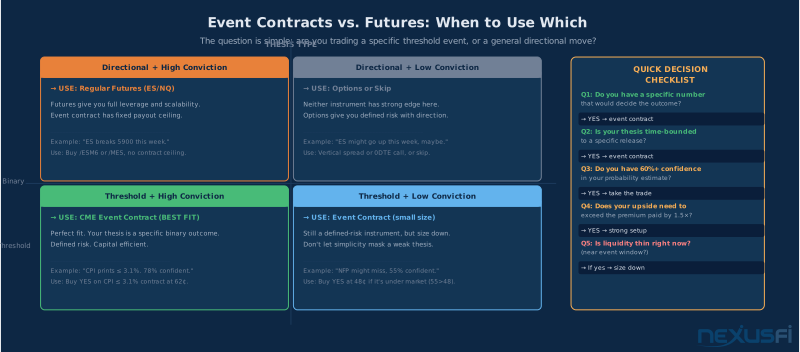
Four specific strategies belong in the CME event contract toolkit for futures traders. Knowing the difference between them prevents the most common mistake: using event contracts for scenarios where regular futures work better.
Strategy 1: Pure Event Risk
This is the best use case. You're trading NFP week. You've run your analysis. You think payrolls come in above 200,000. But you don't want the magnitude exposure of a short ZN position
Buy YES on the NFP > 200k event contract. If payrolls come in at 215k, you win $1.00 per contract. If they come in at 201k, you still win the same $1.00. The magnitude doesn't matter
Strategy 2: Hedging a Futures Position Against Event Risk
You're long ES heading into CPI week. You like the medium-term setup but you're nervous about a hot CPI print. You don't want to close the position, but you want protection against the specific binary scenario of "CPI comes in above threshold."
Buy YES on a "CPI above 3.5%" contract
Strategy 3: Probability Divergence
You're building a model for the actual probability of an economic outcome based on real-time indicators
If your model says CPI has an 80% chance of printing below 3.1% but the market prices the YES contract at 62¢, you have an 18-point edge on a 38¢ payout. Buy YES aggressively. This strategy generates the best risk-adjusted returns for traders who put in the analytical work.
Strategy 4: Uncertainty Expression Around Fed Meetings
FOMC meetings are the most liquid window for economic indicator contracts. The Fed funds target rate decision is binary in most meeting cycles
Position Sizing #
Position sizing for binary contracts is different from continuous instruments. The bounded payoff structure changes the optimal bet fraction much.
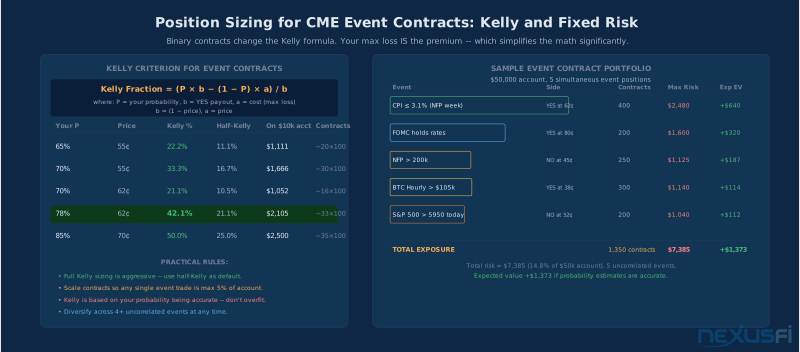
The adapted Kelly criterion for event contracts uses this formula:
f = (P × b − (1 − P) × a) / b
Where f is the optimal fraction of bankroll to risk, P is your probability estimate, b is the YES payout (1 − price), and a is the cost (price). Setup: CPI ≤ 3.1% contract priced at 62¢. Your probability estimate: 78%.
Kelly fraction = (0.78 × 0.38 − 0.22 × 0.62) / 0.38 = (0.2964 − 0.1364) / 0.38 = 0.1600 / 0.38 = 42.1%
Full Kelly says bet 42.1% of your bankroll. Don't. Full Kelly is aggressive and leads to wild variance in the short run. Most professional traders use half-Kelly in practice.
Practical rule: cap any single event trade at 5% of account value. At $50,000, that's $2,500 maximum risk per event. At 62¢ per contract, that's approximately 400 contracts. The Kelly calculation validates that there's edge, but the 5% cap prevents any single model error from causing meaningful drawdown.
The real power of event contracts comes from running multiple uncorrelated positions simultaneously. CPI, NFP, FOMC, and BTC hourly are not highly correlated events. You can hold YES on CPI ≤ threshold, NO on NFP > 200k, YES on FOMC hold, and YES on BTC > specific level
A $50,000 account with five simultaneous event positions at 5% risk cap each has $12,500 total maximum exposure
Common Mistakes #
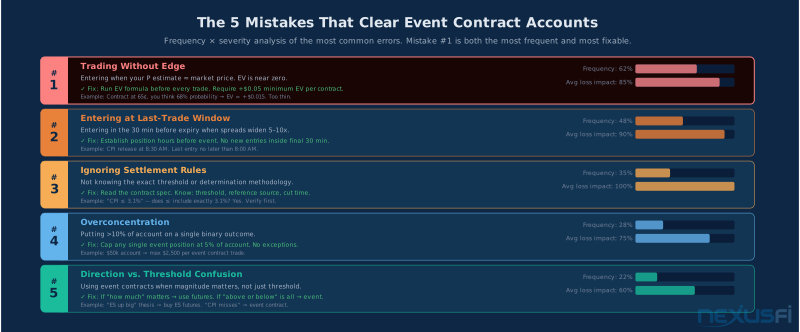
The binary simplicity of event contracts is the biggest trap. Because the product is easy to understand, traders skip the analytical rigor they'd apply to regular futures positions.
Mistake 1: Trading without edge. The question isn't "do I think YES wins?"
Mistake 2: Entering near the last trade window. In the 30 minutes before a major data release, spreads widen, liquidity thins, and prices move violently on small order flow. The time to enter is when the contract is trading actively, not when it's about to stop.
Mistake 3: Ignoring settlement rules. Three questions before any trade: What is the exact reference source? What is the determination methodology? How does CME handle ambiguous or delayed data? If you don't know the answers, you don't fully understand the contract.
Mistake 4: Using event contracts for directional magnitude bets. If your thesis is "ES is going up much this week," buy ES futures or calls. Event contracts cap your upside at $1.00 per contract and pay the same whether the move is 10 points or 100 points. They're for binary threshold bets, not directional magnitude trades.
Mistake 5: Overconcentration in one event. High conviction should increase the number of contracts within the 5% cap, not break the cap. A single model error wipes out the position entirely
Practical Checklist #
Before entering any CME event contract position, work through this checklist:
- Reference source: What data source determines settlement? BLS, CME CF, Fed announcement?
- Determination time: When exactly does CME observe the reference data?
- Last trade time: When does the contract stop trading? Can I exit if needed?
- Contract specification: What is the exact threshold? Is it ≤, <, >, ≥? The direction matters.
- My probability estimate: What do I honestly think the probability is, based on available data?
- Market implied probability: What does the contract price imply?
- Expected value: Is EV positive? By how much? Require +$0.05 minimum.
- Kelly fraction: What does half-Kelly suggest for position size?
- Account cap check: Does the position stay within 5% of account value?
- Correlation check: Does this position correlate with existing open positions?
- Spread cost: Is the current bid/ask spread reasonable?
- Ambiguity rules: Have I read what happens if the reference data is delayed or disputed?
CME event contracts are a real tool for futures traders. The pricing mechanics are transparent, the settlement process is well-defined, and the infrastructure is institutional-grade. But like every derivatives product, the tool is only as good as the analytical framework behind it. Build the framework first. Trade it second.
Knowledge Map
Go Deeper
Build on this knowledgeReferences This Article
Articles that build on this topicCitations
- — Event Contracts - New Way to trade the CME Futures markets: Trade your opinion (2022) 👍 6“CME has added a new type of event contracts to its exchange-listed instruments. While I wasn't noticing, CME has added a new type of event contracts to its exchange-listed instruments, as the link to Interactive Brokers indicates.”
- — CME Launching Binary Option Trading (2022) 👍 1“It's worse than that because of commissions. The CME is effectively the counterparty, which means no credit risk, but also means liquidity in thinner contracts can be limited.”
- — CME Group Launches 24/7 Futures Trading - December 5, 2025 (2025) 👍 3“CME 24/7 Trading: What starts December 5, 2025? The initial underlyings included economic indicator contracts, hourly Bitcoin and Ether, and sports outcomes.”
- — NFA Raises Concerns About Direct Clearing for Retail Derivatives Traders (2026) 👍 1“The whole argument from the contract event houses is that this is peer to peer with clear rules and no margin allowed, therefore why is a FCM needed if its all immediately cash settled between buy/seller”
- — CME Group Event Contracts Blast Past 100 Million Traded -- In Just 8 Weeks (2026)“CME Group just announced a jaw-dropping milestone: its event contracts product has surpassed 100 million contracts traded since launching in December. That is roughly eight weeks to hit a number that took Kalshi years.”
- — FanDuel Predicts Launch - CME Event Contracts from $1 (2025)“FanDuel and CME Group launched FanDuel Predicts on December 5, 2025, a new standalone mobile app for trading event contracts. The platform offers yes/no positions starting at just $1.”
- CME Group — CME Group Announces Launch of Event Contracts for Trading Global Benchmark Futures Markets (2022)
- NFA — NFA Comment Letter on Direct Clearing for Retail Derivatives Traders (2026)