



CFTC Regulation of Prediction Markets: Legal Framework for Event Contracts in the U.S.
How prediction markets went from legal gray area to federally regulated exchanges — and what CFTC oversight means for traders in 2026.
Overview #
The Commodity Futures Trading Commission (CFTC) is the federal agency that regulates prediction markets in the United States. Understanding CFTC oversight matters for prediction market traders because it shapes which contracts are legal, how platforms operate, and what protections (and restrictions) apply.
This article covers how the CFTC regulates prediction markets, what Kalshi's designation as a Designated Contract Market (DCM) means in practice, the regulatory events that shaped today's environment, and what the 2026 regulatory environment looks like for traders.
The Iowa Electronic Markets (IEM), run by the University of Iowa, was the first US prediction market, receiving a CFTC no-action letter in 1993 allowing it to operate without full registration.
The CFTC's Jurisdiction Over Prediction Markets #
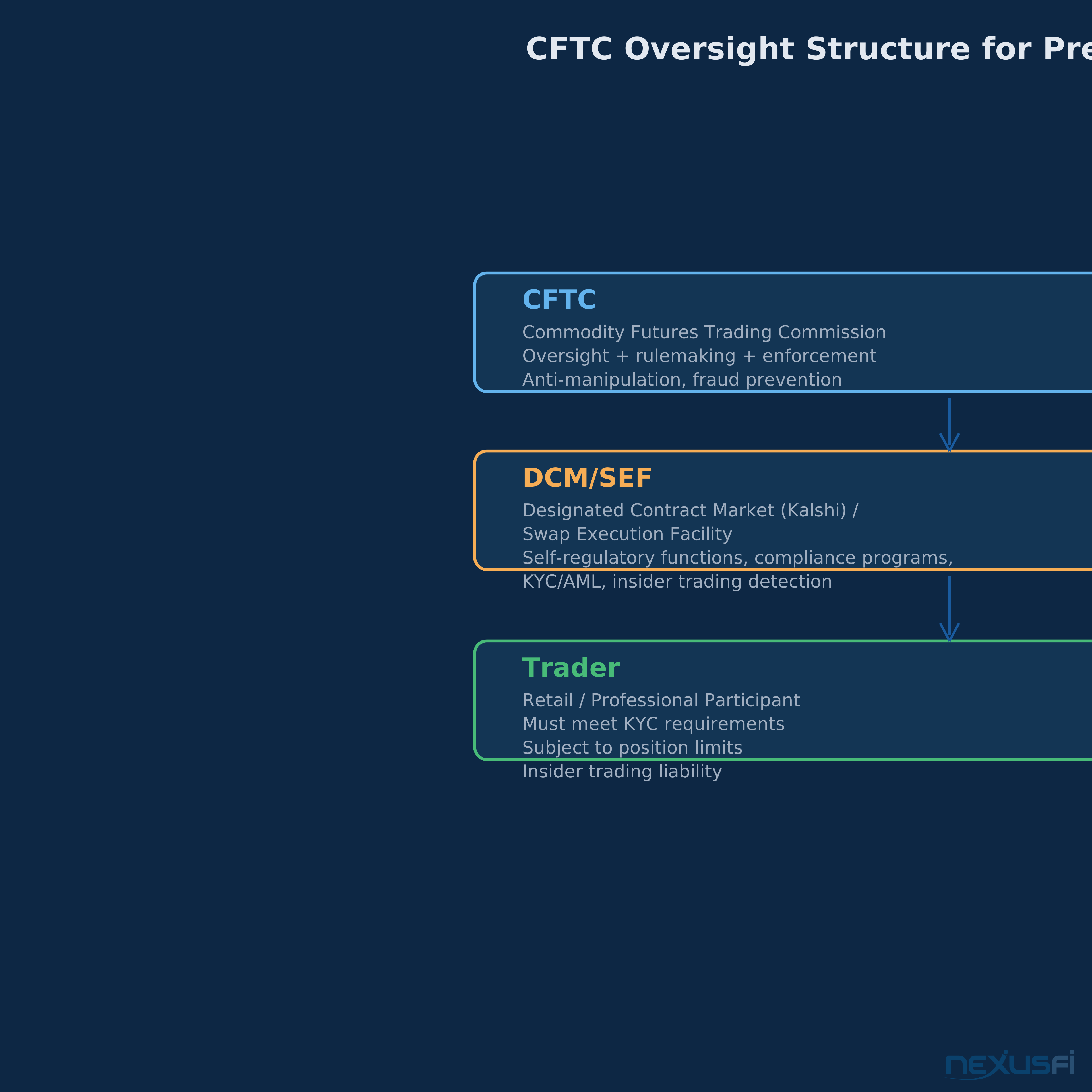
The CFTC regulates commodity futures and swaps under the Commodity Exchange Act (CEA). Prediction market event contracts fall under CFTC jurisdiction because they are treated as commodity futures or swap agreements depending on their structure.
The key regulatory designations that prediction market platforms can obtain:
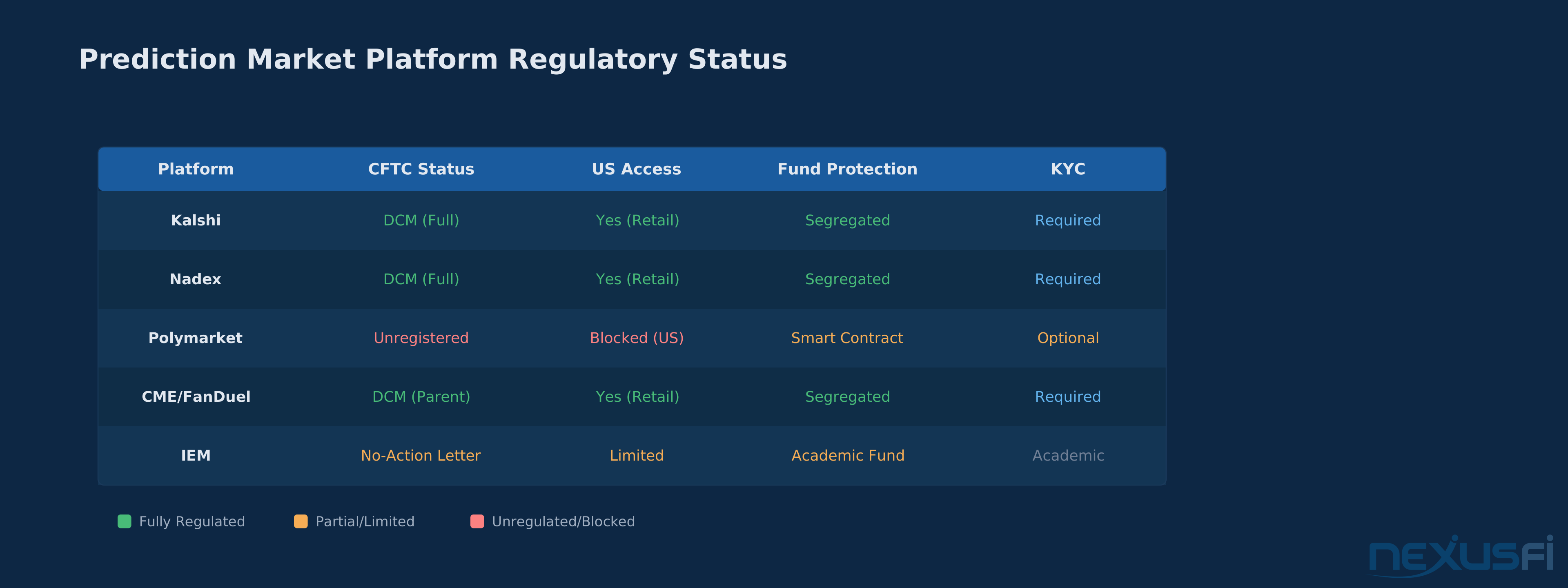
Designated Contract Market (DCM): The highest regulatory tier. DCMs can offer contracts to any US customer, including retail investors. Kalshi operates as a DCM. Requirements include: minimum capitalization, surveillance programs, anti-manipulation rules, KYC/AML compliance, and ongoing CFTC reporting.
Swap Execution Facility (SEF): Designed for institutional swaps trading. Less relevant for retail prediction market access.
No designation: Operating without CFTC authorization for US customers is illegal under the CEA. Polymarket has historically operated without US DCM status and restricts US residents.
Regulatory History: From Exemptions to DCM Status #
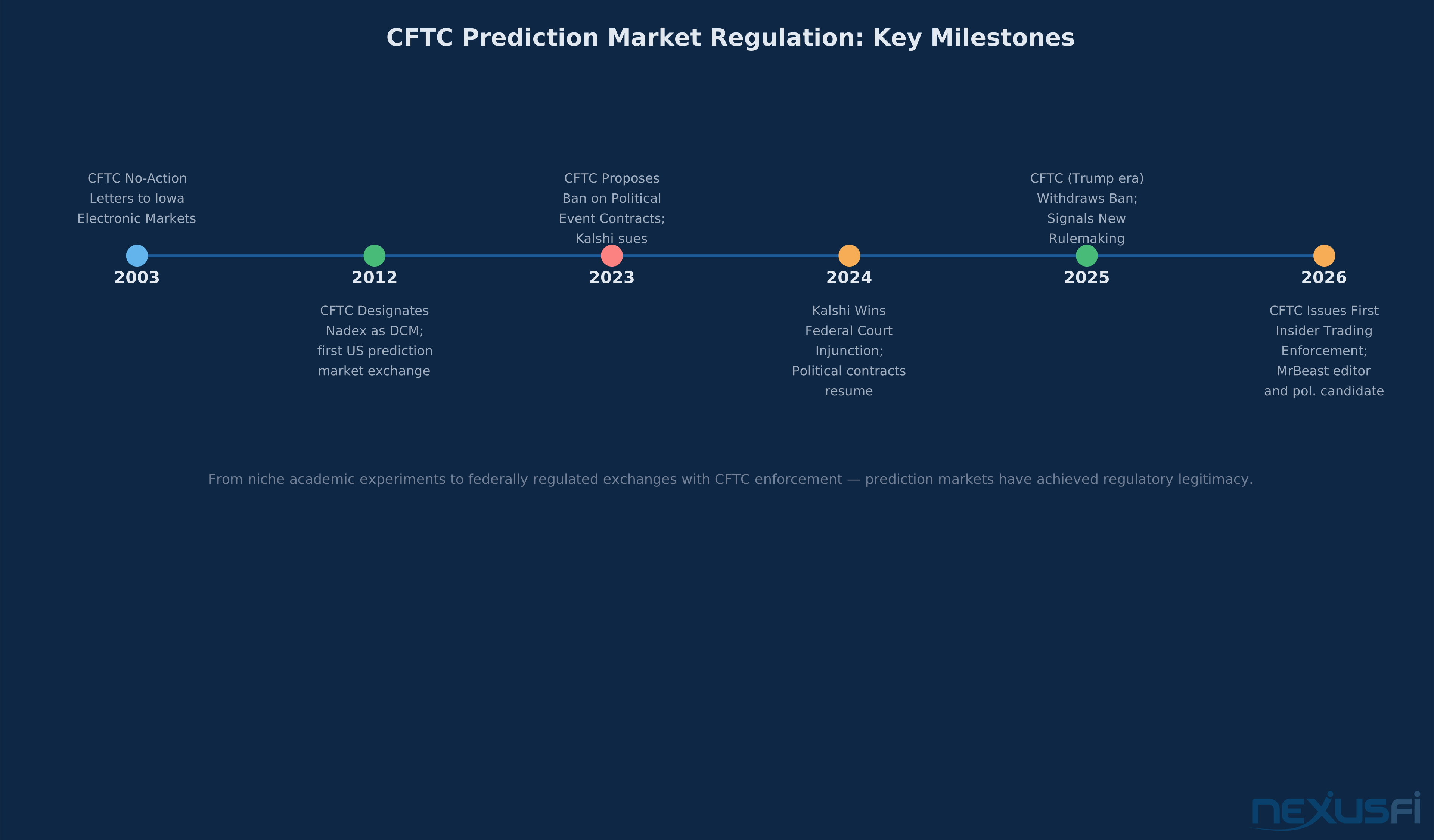
Early Days: CFTC No-Action Letters (2003--2012) #
Prediction markets began as academic experiments. The Iowa Electronic Markets (IEM), run by the University of Iowa, was the first US prediction market, receiving a CFTC no-action letter in 1993 allowing it to operate without full registration.
No-action letters aren't approvals — they're statements that the CFTC won't take enforcement action against a specific entity for a specific limited activity. IEM was allowed to operate because it had small position limits and academic, non-profit purposes.
Nadex and the First Real DCM (2010--2012) #
Nadex (North American Derivatives Exchange) became the first entity to receive full CFTC designation as a DCM specifically to offer retail event contracts. This established the regulatory template: platforms offering binary event contracts to US retail customers need DCM status.
Kalshi's DCM Designation (2020) #
In November 2020, the CFTC approved Kalshi's application for DCM status — a significant milestone. Kalshi became the first exchange designated specifically to offer event contracts on economic and political outcomes to US retail customers.
Kalshi's approval was notable because it signaled that the CFTC viewed economic and public affairs event contracts as legitimate financial instruments, not gambling. Not everyone in the trading community agrees with this distinction. As @SMCJB argued in a NexusFi discussion, "I do think this is just enabling degenerate gambling and violating gambling laws. The amount of money these companies are making, mostly from people who can't afford to lose the money is crazy. But then so is the lottery (aka the stupid tax) but that's legal and doing well."
The Political Contracts Battle (2023--2024) #
In 2023, the CFTC under the Biden administration proposed rules to ban political event contracts — specifically contracts on elections, legislation, and government policy. The agency argued these created conflicts of interest and resembled gambling.
Kalshi sued the CFTC. In 2024, a federal court issued an injunction against the proposed ban, ruling the CFTC had overstepped its authority. Political event contracts resumed on Kalshi.
The Trump-Era Regulatory Reset (2025--2026) #
When CFTC Chairman Brian Selig took over in 2025, the regulatory posture shifted decisively. In February 2026, the CFTC formally withdrew the Biden-era ban and signaled it would pursue new rulemaking establishing "clear standards" for prediction markets — with an expected market-friendly approach.
This withdrawal, reported by @Fi in NexusFi's CFTC Withdraws Prediction Market Ban thread, cleared the regulatory cloud that had hung over the sector.
What DCM Status Means for Traders #
Trading on a CFTC-regulated DCM like Kalshi provides specific protections and imposes specific obligations.
Trader Protections Under CFTC Regulation #
Customer fund segregation: DCMs must segregate customer funds from their own operating capital. If Kalshi were to fail financially, customer assets in segregated accounts would be protected from the company's creditors. This is the same protection that futures traders have at CME-listed futures exchanges.
Anti-manipulation rules: The CFTC prohibits market manipulation on DCMs. This includes coordinated buying to influence prices for non-trading purposes. Enforcement actions are possible and real.
Dispute resolution: Traders with disputes against a DCM have access to CFTC complaint mechanisms. This is a formal legal avenue that's unavailable for unregulated platforms.
Position limit oversight: The CFTC reviews and approves position limits on DCMs. This prevents any single actor from taking positions large enough to manipulate market prices.
KYC/AML Requirements #
To trade on Kalshi, you must complete Know Your Customer (KYC) verification:
- Government-issued ID
- Social Security Number or equivalent
- Address verification
- Age verification (18+)
These requirements exist because DCMs have Anti-Money Laundering (AML) obligations under both CFTC rules and the Bank Secrecy Act. Unverified accounts are restricted to limited activity.
For US retail traders, KYC is a minor inconvenience. For traders attempting to use prediction markets for money laundering or tax evasion, it's a meaningful barrier.
The 2026 Insider Trading Enforcement Environment #
In 2026, the CFTC issued its first enforcement actions specifically targeting insider trading in prediction markets. Two cases were documented:
Case 1 (MrBeast editor): An employee of content creator MrBeast had advance knowledge of an event contract outcome involving the creator. They traded on Kalshi before the information was public, earning profits from the non-public information. Kalshi's compliance program flagged the unusual trading pattern and reported it to the CFTC.
Case 2 (Political candidate's aide): A staff member of a political candidate had access to internal campaign information about election strategy. They traded on election outcome contracts on Kalshi before the information became public.
The CFTC prosecuted both cases under the CEA's anti-fraud and manipulation provisions. These enforcement actions established that:
- Insider trading in prediction markets is illegal under federal law
- Kalshi actively monitors for and reports suspicious trading to the CFTC
- The CFTC treats prediction market insider trading the same as futures market insider trading
For legitimate retail traders, these actions are a positive development. Active enforcement against information asymmetry improves price efficiency and makes prediction market prices more reliable as probability estimates.
Polymarket and Unregistered Platforms #
Polymarket operates on the Polygon blockchain and historically has not been registered with the CFTC as a DCM. This creates a different regulatory picture for US traders.
Polymarket's US restrictions: Polymarket uses geofencing to restrict US IP addresses. US residents are not supposed to access Polymarket, and using a VPN to access it from the US likely violates Polymarket's terms of service and potentially US law.
CFTC enforcement history: The CFTC investigated Polymarket in 2022 and reached a settlement that included restrictions on US customer access. The settlement did not result in Polymarket becoming a DCM.
Practical implication for US traders: Stick to Kalshi and Nadex for legal US prediction market trading. Polymarket is legally accessible from many other jurisdictions where it operates without issue.
Jurisdictional Considerations for Non-US Traders #
Prediction market regulation varies dramatically by country. US CFTC rules apply to US persons and US-accessible platforms. Traders outside the US face different regulatory environments:
European Union: Event contracts that constitute financial instruments may fall under MiFID II regulation. The regulatory picture is fragmented across EU member states.
United Kingdom: The FCA regulates binary options (which overlap with event contracts) with strict restrictions. Some prediction market activity may require FCA authorization.
Australia: ASIC regulates derivatives broadly; prediction market event contracts face unclear regulatory status.
Unregulated jurisdictions: Many countries have no specific prediction market regulation, creating both opportunity and risk for traders who lack the legal protections of regulated markets.
The Regulatory Outlook for 2026 and Beyond #
The current regulatory direction under CFTC Chairman Selig is market-friendly but structured. Key developments to watch:
New rulemaking process: The CFTC's promised new rules for prediction markets will likely address: categories of permissible event contracts, position limits, reporting requirements, and the treatment of blockchain-based prediction markets. This rulemaking could take 12-24 months.
Competition from traditional exchanges: CME Group launched event contracts through a FanDuel partnership in late 2025. If traditional futures exchanges enter prediction markets at scale, CFTC regulation will become more sophisticated and potentially more complex.
International regulatory coordination: As prediction markets globalize, pressure will grow for international regulatory coordination — especially between the CFTC and EU/UK regulators.
Practical Guidance for Traders #
For US retail traders: Trade on Kalshi. It's the most liquid, CFTC-regulated DCM with full retail access. Nadex is an alternative for certain categories.
Complete KYC promptly: Accounts with incomplete KYC face trading restrictions. The verification process takes minutes and is a prerequisite for meaningful participation.
Understand position limits: CFTC-approved position limits apply to certain contract categories. Check Kalshi's position limit disclosures before building large positions in political or economic contracts.
Know the insider trading rules: If you have material non-public information about an event contract's outcome — through your employment, a personal relationship with a key decision-maker, or any other means — trading on that information in prediction markets is illegal. The enforcement infrastructure is now real.
For non-US traders: Check whether Polymarket or other platforms are accessible in your jurisdiction. Verify the regulatory status of any platform before depositing funds.
Citations #
- @Fi: CFTC Withdraws Prediction Market Ban, Signals New Rulemaking Under Chairman Selig — CFTC regulatory shift under Chairman Selig
- @Fi: CFTC Withdraws Biden-Era Prediction Market Ban, Signals New Regulatory Framework — Detailed regulatory history and implications
- @Fi: Kalshi Catches MrBeast Editor and Political Candidate for Insider Trading — CFTC Issues First Enforcement Actions — First CFTC enforcement in prediction markets
- @Fi: CME to list Sports Event Contracts Dec'25 — Traditional exchange entry into prediction markets
- @Fi: Plus500 Futures Launches US Prediction Markets Through Kalshi Partnership — Institutional partnerships under CFTC framework
- @Fi: Kalshi, Polymarket, Prediction Markets etc — Community analysis of regulatory environment
- How Kalshi Works: Contracts, Odds & Settlement Explained — pm.wiki
This article is part of the NexusFi Academy Prediction Markets series. Full series at /a/prediction-markets/.
Knowledge Map
Prerequisites
Understand these firstGo Deeper
Build on this knowledgeReferences This Article
Articles that build on this topicCitations
- — CFTC Withdraws Prediction Market Ban, Signals New Rulemaking Under Chairman Selig (2026)“CFTC regulatory shift under Chairman Selig”
- — CFTC Withdraws Biden-Era Prediction Market Ban, Signals New Regulatory Framework (2026)“Detailed regulatory history and implications”
- — Kalshi Catches MrBeast Editor and Political Candidate for Insider Trading (2026)“First CFTC enforcement in prediction markets”
- — CME to list Sports Event Contracts (2025)“Traditional exchange entry into prediction markets”
- — Plus500 Futures Launches US Prediction Markets Through Kalshi Partnership (2026)“Institutional partnerships under CFTC framework”
- — Kalshi, Polymarket, Prediction Markets etc (2025)“Community analysis of regulatory landscape”
- — Kalshi, Polymarket, Prediction Markets etc (2025) 👍 4“I do think this is just enabling degenerate gambling and violating gambling laws. The amount of money these companies are making, mostly from people who can't afford to lose the money is crazy.”
- pm.wiki — How Kalshi Works: Contracts, Odds & Settlement Explained (2026)