



Futures Exchange Regulation and Oversight: Who Watches the Markets and Why It Matters to Your Account
Every futures trade you place passes through a regulatory framework that took decades of market failures, billion-dollar scandals, and Congressional overhauls to build. Most traders don't think about regulation until something goes wrong — their broker collapses, their funds vanish, or they get a letter from the CFTC. By then it's too late to care about the details.
Here's what the regulatory structure actually looks like, how it protects you (and where it doesn't), and what every serious futures trader should understand about the system sitting between your order and the market.
Overview #
This article examines the full regulatory stack governing U.S. futures markets — from the CFTC's federal oversight and exchange self-regulation through the NFA, to customer fund segregation rules born from the MF Global and PFGBest failures. It covers position limits, large trader reporting, market surveillance, and enforcement, with practical guidance on what this framework means for your trading account and broker due diligence.
Key Concepts #
Before diving in, here's the terminology you'll see throughout:
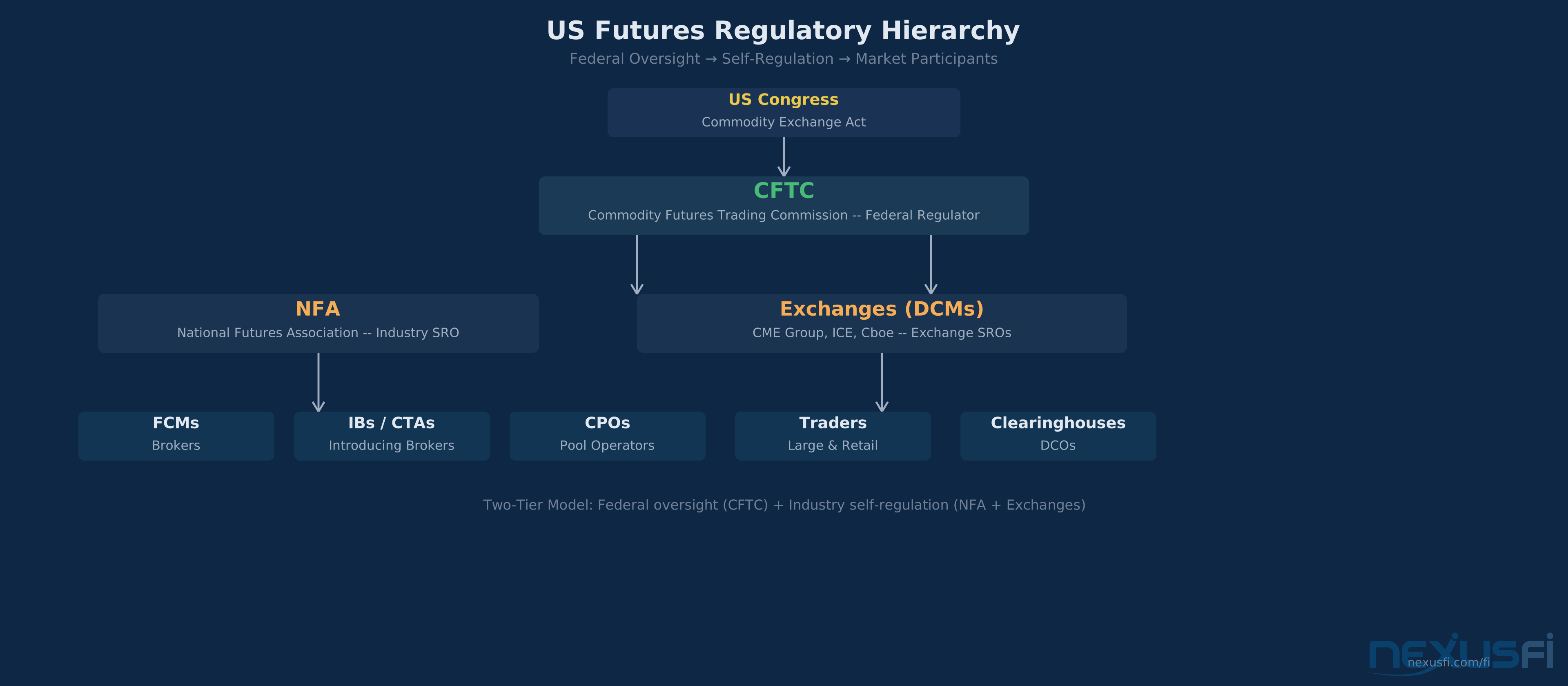
CFTC (Commodity Futures Trading Commission) — The federal agency that oversees all futures and options markets in the United States. Think of the CFTC as the SEC's counterpart for derivatives. Created in 1974, it has exclusive jurisdiction over futures trading.
NFA (National Futures Association) — The industry's self-regulatory organization. Every futures professional in the US — brokers, advisors, pool operators, exchanges — must register with the NFA. They handle day-to-day compliance, audits, and dispute resolution.
DCM (Designated Contract Market) — The formal designation for a futures exchange authorized by the CFTC to list and trade contracts. CME Group, ICE, Cboe, MGEX — they're all DCMs. To operate, an exchange must satisfy 23 core principles covering everything from market surveillance to financial integrity.
FCM (Futures Commission Merchant) — Your broker, in regulatory terms. FCMs hold customer funds, execute trades, and carry positions. They're the regulated entity between you and the exchange.
SRO (Self-Regulatory Organization) — An entity authorized to regulate its own members. Both the NFA and the exchanges themselves are SROs. This dual-layer model — federal oversight plus industry self-regulation — is the backbone of futures market governance.
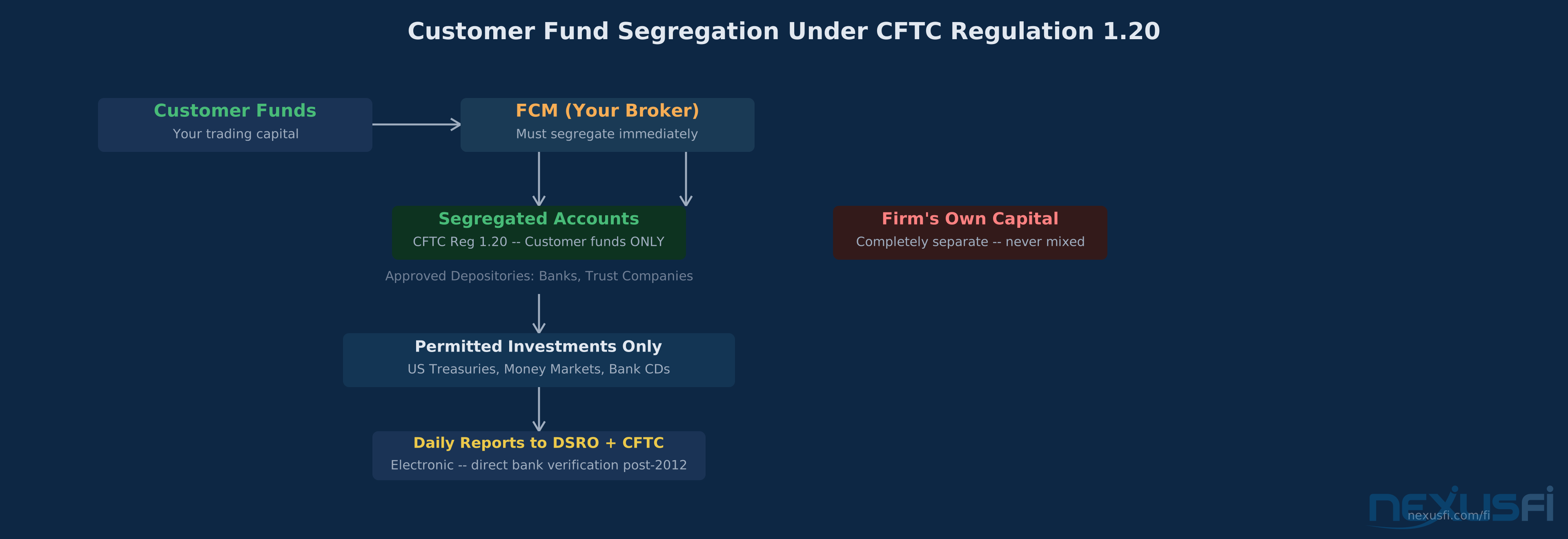
Segregated Funds — Customer money that FCMs must keep completely separate from their own operating capital. CFTC Regulation 1.20 requires this segregation for all customer funds deposited to trade on designated contract markets.
DSRO (Designated Self-Regulatory Organization) — The specific SRO primarily responsible for auditing and conducting financial surveillance over a given FCM. As @Big Mike explained in his breakdown of CFTC capital requirements, "A DSRO is the organization that is primarily responsible for conducting audits of and ongoing financial surveillance over the firm. A DSRO can be a designated contract market (DCM) or the National Futures Association."
The CFTC: Federal Oversight of Futures Markets #
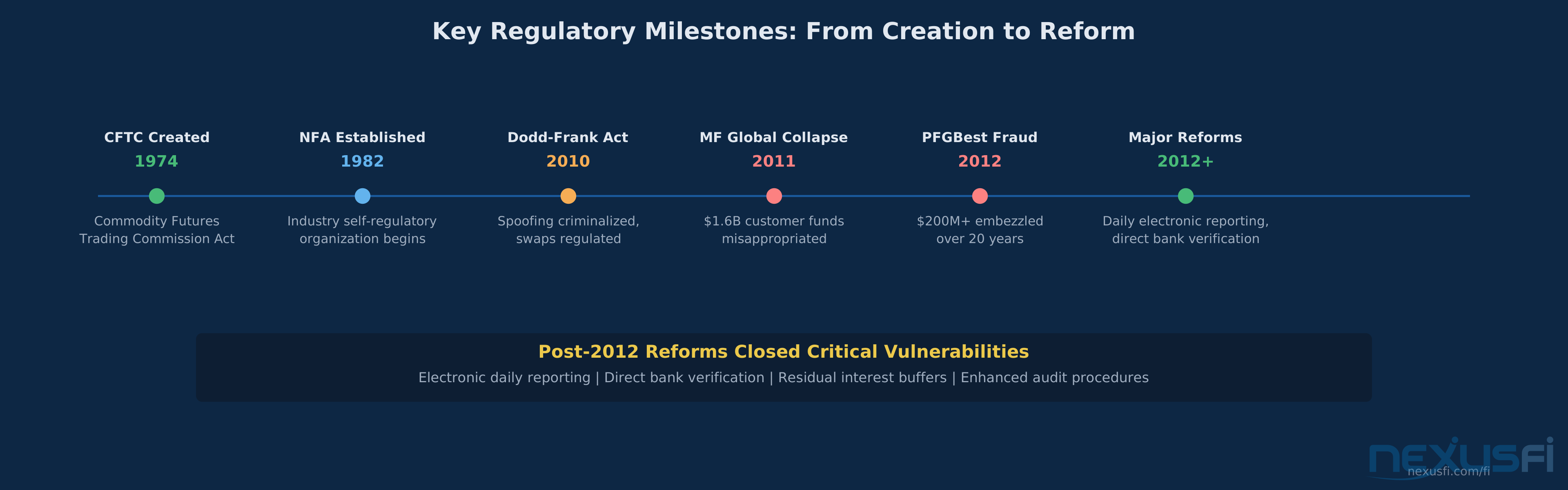
The Commodity Futures Trading Commission was created by the Commodity Futures Trading Commission Act of 1974, carving futures regulation out from under the Department of Agriculture where it had lived since 1922. Congress decided that a market handling billions in daily notional value needed its own dedicated federal regulator.
The CFTC's mandate is straightforward: promote market integrity, protect market participants from fraud and manipulation, and promote open, competitive markets. In practice, this breaks down into several key functions.
Rulemaking and Policy #
The CFTC writes the rules that govern everything from how exchanges operate to what brokers can do with your money. These are codified in Title 17 of the Code of Federal Regulations. The big ones traders should know:
- Part 1 — General regulations covering customer protection, segregation of funds, minimum financial requirements for FCMs
- Part 15-21 — Large trader reporting requirements and position limits
- Part 38 — The 23 core principles that every designated contract market must satisfy
- Part 150 — Speculative position limits for physical commodity derivatives
Enforcement #
The CFTC's Division of Enforcement investigates and prosecutes market manipulation, fraud, spoofing, and violations of the Commodity Exchange Act. They can impose civil monetary penalties, seek injunctions, and refer cases to the Department of Justice for criminal prosecution.
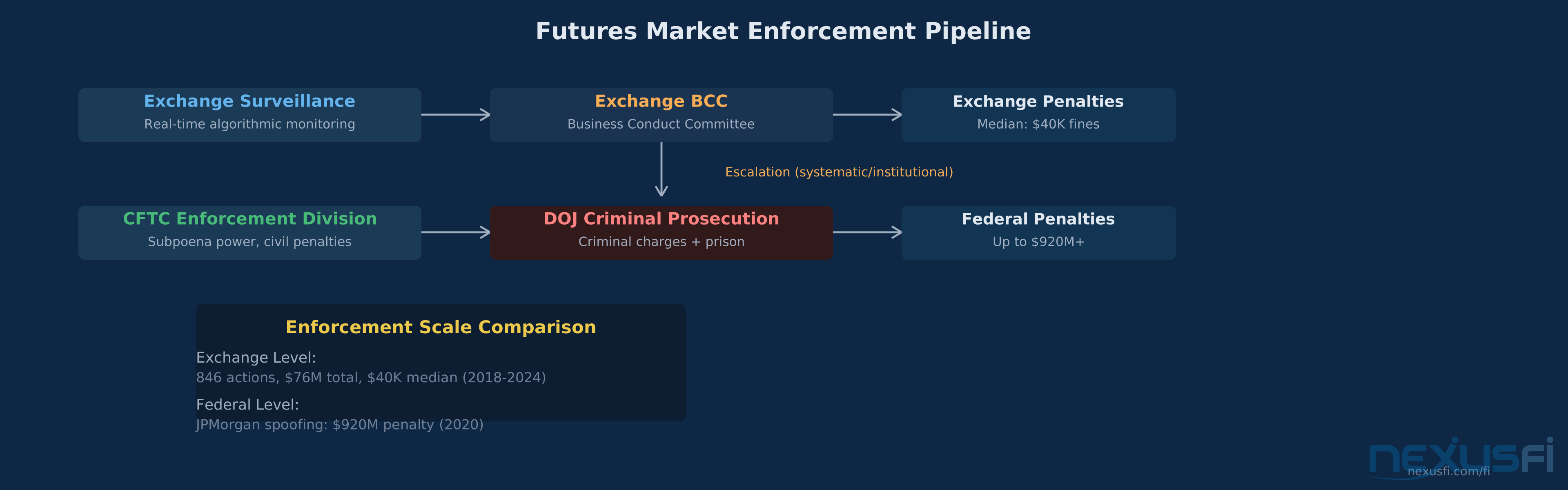
The numbers are real. In the JPMorgan spoofing case, the CFTC imposed a $920 million penalty — the largest in its history. As Fi noted in a 2026 discussion of CME enforcement actions, "JPMorgan ran a systematic spoofing operation across precious metals and Treasuries for eight straight years, 2008 to 2016. Hundreds of thousands of spoof orders... It went to the CFTC and DOJ, who hit JPMorgan with $920 million."
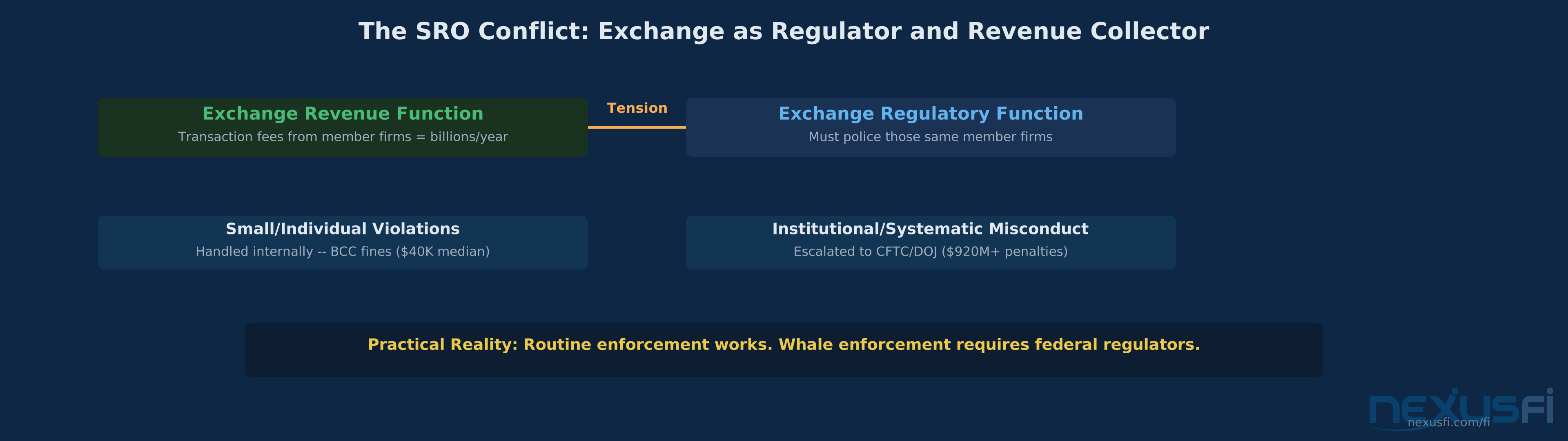
That case illustrates something important about the regulatory structure. The CME's internal enforcement arm — the Business Conduct Committee (BCC) — handles smaller violations with median fines around $40,000. When misconduct is institutional and systematic, it jumps to the federal level where the penalties have real teeth.
Market Surveillance #
The CFTC maintains a sophisticated surveillance program that monitors trading activity across all US futures markets. The centerpiece is the Large Trader Reporting System, which requires clearing members and FCMs to report daily position data for any account that exceeds specific reporting thresholds. The CFTC uses this data to detect manipulation, monitor concentration risk, and produce the weekly Commitments of Traders (COT) reports that many traders follow religiously.
Designated Contract Markets: The Exchange as Regulator #
Here's where futures regulation gets interesting — and where most traders don't realize there's a second layer of oversight built right into the exchange.
Every futures exchange operating in the US must be designated as a DCM by the CFTC. To earn and maintain that designation, the exchange must comply with 23 Core Principles laid out in Section 5(d) of the Commodity Exchange Act and CFTC Regulation Part 38. These aren't suggestions. They're mandatory requirements that the CFTC reviews continuously.
The core principles cover:
- Compliance with rules — The exchange must establish and enforce rules prohibiting fraud, manipulation, and disruptive trading
- Contract specifications — Contracts must not be susceptible to manipulation
- Prevention of market disruption — Real-time monitoring of trading activity
- Position limits and accountability — Exchanges must set position limits or accountability levels for each contract
- Financial integrity — Rules to ensure the financial soundness of clearing and settlement
- Customer protection — Rules to protect customer funds and ensure fair treatment
- Market surveillance — Active programs to detect manipulation and rule violations
- Recordkeeping — Complete audit trails of all trading activity
The SRO Model in Practice #
Exchanges are self-regulatory organizations. That means CME Group doesn't just provide a venue for trading — it also polices its own markets. The Market Regulation Department at CME Group runs surveillance algorithms that monitor order entry, trade execution, position concentration, and price movements in real time across every contract.
When the surveillance system flags something, it goes to the exchange's Business Conduct Committee (BCC) for review. Corning from a Cornerstone Research study tracking every CME disciplinary action from 2018 through 2024, the numbers show 846 total actions and $76 million in penalties over that period, with a median fine of $40,000.
CME's enforcement arm handles everything from wash trading to position limit violations to the kind of information leakage that got a NYMEX broker fined and suspended in 2025 for tipping off other traders about large customer orders in crude oil. As Fi wrote about that case, "This is textbook information leakage — one of the oldest integrity concerns in futures markets. When a broker receives a large order and tips off other traders about the size, direction, or timing, it harms the customer who placed the order."
The Conflict Question #
The SRO model has a built-in tension that experienced traders should understand. Exchanges earn revenue from transaction fees generated by their member firms. The BCC members who adjudicate enforcement cases are appointed by the exchange's Chairman and include representatives from those same member firms.
This creates an inherent conflict. The exchange has a financial interest in keeping its largest members happy while also having a regulatory obligation to police their behavior. As Fi observed, "CME Group pulls in billions in transaction fees from its biggest member firms. The BCC members are appointed by the Chairman and include people from those same member firms. That's the SRO model working exactly as designed — industry self-policing — with all the conflicts that come baked in."
The practical result: routine violations and smaller firms get handled internally by the exchange. Institutional, systematic misconduct tends to get escalated to the CFTC and DOJ, where enforcement is independent of commercial relationships.
The NFA: Industry Self-Regulation #
The National Futures Association is the industry-wide SRO for the US futures market. Created in 1982, it operates under CFTC oversight but is funded by the industry itself through membership dues and assessment fees.
Who Must Register #
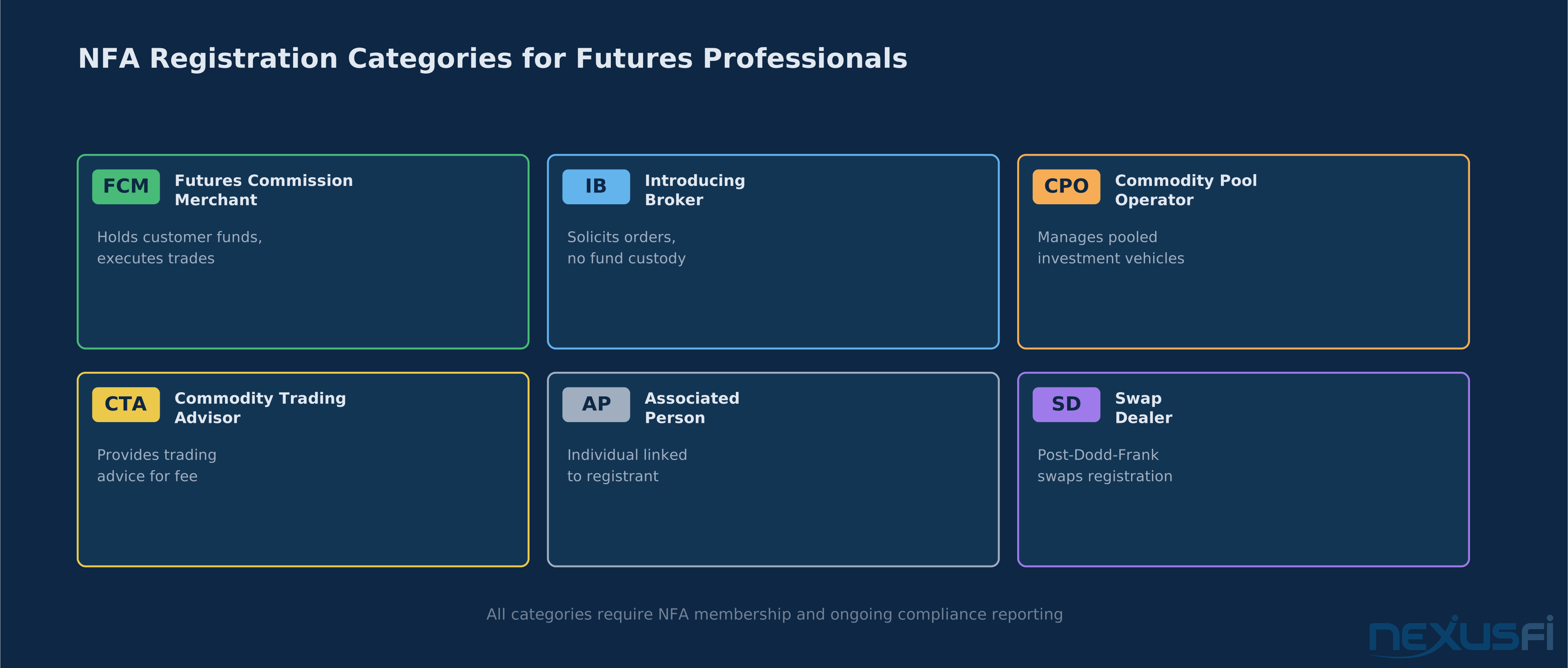
If you're a futures professional in the US, you're registering with the NFA. That includes:
- FCMs (Futures Commission Merchants) — your broker
- IBs (Introducing Brokers) — firms that solicit orders but don't hold customer funds
- CPOs (Commodity Pool Operators) — managers of pooled investment vehicles
- CTAs (Commodity Trading Advisors) — firms that provide trading advice for compensation
- APs (Associated Persons) — individuals associated with any of the above
- SDs (Swap Dealers) and MSPs (Major Swap Participants) — post-Dodd-Frank additions
The BASIC System #
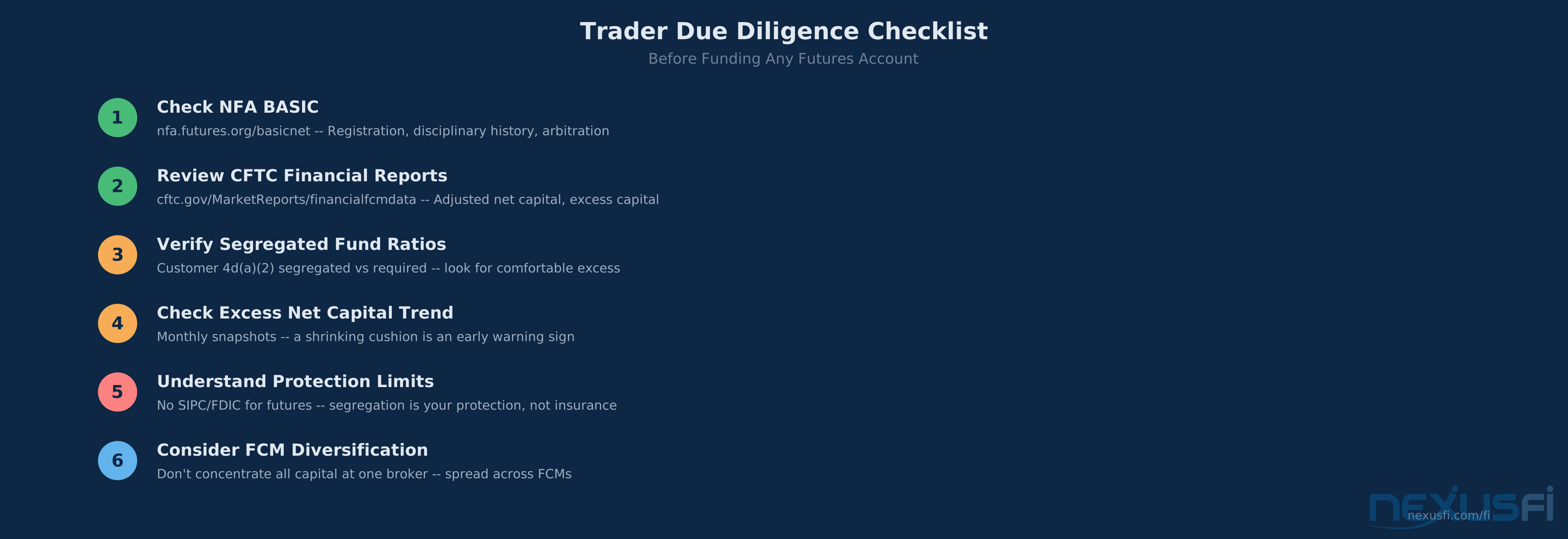
One of the NFA's most useful tools for traders is BASIC (Background Affiliation Status Information Center) at nfa.futures.org/basicnet. Type in any firm or individual's name and you get their registration status, regulatory actions, arbitration history, and financial filings. Before you fund any futures account, check BASIC. It takes two minutes and it's the single best piece of due diligence you can do.
Financial Surveillance #
The NFA conducts financial audits of its member firms, monitors capital adequacy, and enforces compliance with CFTC financial rules. For FCMs, this means verifying that adjusted net capital exceeds the minimum requirement, that customer segregated funds are properly maintained, and that financial reports are filed accurately and on time.
The CFTC publishes this data monthly at cftc.gov/MarketReports/financialfcmdata. If you want to evaluate your broker's financial health, start there.
Customer Protection: Segregated Funds and What Can Go Wrong #
This is the section that matters most to your money. The regulatory framework's customer protection regime centers on one principle: your money stays separate from your broker's money. Always.
The Segregation Requirement #
CFTC Regulation 1.20 through 1.30 establishes the rules for segregating customer funds. FCMs must:
- Hold customer funds in accounts clearly identified as "customer segregated" at approved depositories
- Never use customer funds for the firm's own purposes
- Compute the segregation requirement daily — the total of all customer net liquidating equities
- Report the segregation calculation to their DSRO daily
- Maintain segregated funds that equal or exceed the total customer requirement at all times
- Invest customer funds only in approved instruments (US Treasury securities, money market funds, certain bank products)
When the System Failed: MF Global and PFGBest #
The theory sounds bulletproof. The practice proved otherwise — twice in quick succession.
In October 2011, MF Global collapsed after making massive leveraged bets on European sovereign debt. What made it catastrophic for customers: the firm had transferred an estimated $1.6 billion in customer segregated funds to cover its own margin calls. As @Delta_Panther reported at the time, MF Global's "internal records indicate that the company moved segregated customer funds to its own brokerage accounts."
Less than a year later, in July 2012, PFGBest's founder Russell Wasendorf Sr. was arrested for embezzling more than $200 million in customer funds over nearly 20 years. He had forged bank statements to hide the theft from auditors.
The NexusFi community tracked both scandals extensively.
@djkiwi also made a sharp observation about the UK dimension of MF Global: "The reason MF Global went down the toilet was because unlike the US, the UK had no limits in place. They sent all the client funds to London where they were able to rehypothecate them without limit."
Post-Crisis Reforms #
Both failures triggered significant regulatory changes. As @ThatManFromTexas reported in 2012, "U.S. futures regulators approved new regulations on Friday to shore up protection of brokerage customer funds following last year's collapse of MF Global."
Key reforms included:
- Enhanced reporting requirements — FCMs now file daily segregation reports electronically, and the CFTC can access bank account balances directly
- Residual interest requirements — FCMs must hold additional capital in segregated accounts as a buffer (initially full pre-margin cover, phased to a percentage requirement)
- Strengthened audit procedures — Annual audits must include surprise examinations and direct confirmation with depositories
- The CFTC's system for direct electronic confirmation — regulators can verify account balances independently, closing the loophole Wasendorf exploited with forged statements
Practical Implications for Traders #
Despite the reforms, futures customer funds don't carry SIPC or FDIC insurance.
@djkiwi offered the counterpoint — noting that he personally liked Interactive Brokers because of "their option that allows me to sweep funds to a SIPC account, which currently is providing $2.75M in per-account protection." This is a broker-specific feature, not an industry standard.
Smart risk management for customer protection includes:
- Check your FCM's financial health monthly at the CFTC's public reporting page
- Verify NFA registration and disciplinary history via BASIC
- Don't concentrate all capital at one FCM — @djkiwi's approach of diversifying across FCMs has merit
- Understand the difference between 4d(a)(2) segregated funds (domestic trading) and Part 30 secured amounts (foreign exchange trading) — they have different protection levels
- Monitor excess net capital — the gap between your FCM's adjusted net capital and the minimum requirement. A shrinking cushion is an early warning sign
Position Limits and Large Trader Reporting #
Position limits exist for a simple reason: to prevent any single entity from accumulating a position large enough to manipulate the market or create systemic risk. This part of regulation directly affects traders who scale up.
Speculative Position Limits #
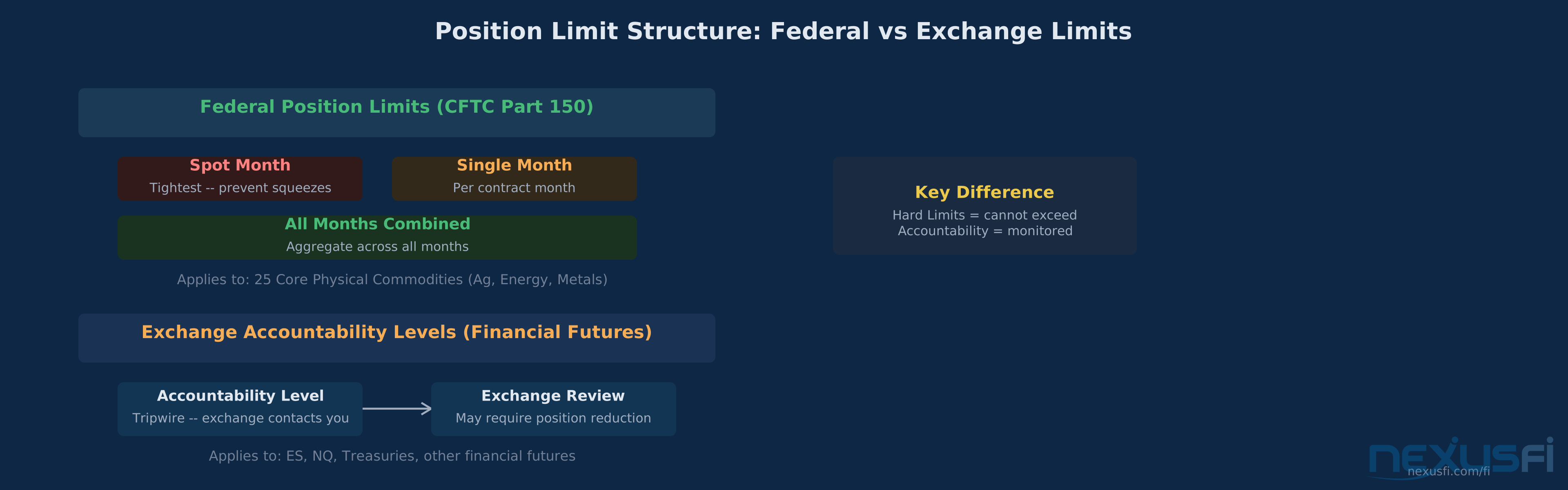
CFTC Part 150 establishes federal position limits for 25 core physical commodity contracts (agricultural products, energy, metals) and their economically equivalent futures, options, and swaps. These limits apply to:
- Spot month — The tightest limits, set to prevent corners and squeezes as delivery approaches
- Single month — Limits on positions in any one contract month
- All months combined — Aggregate limit across all contract months
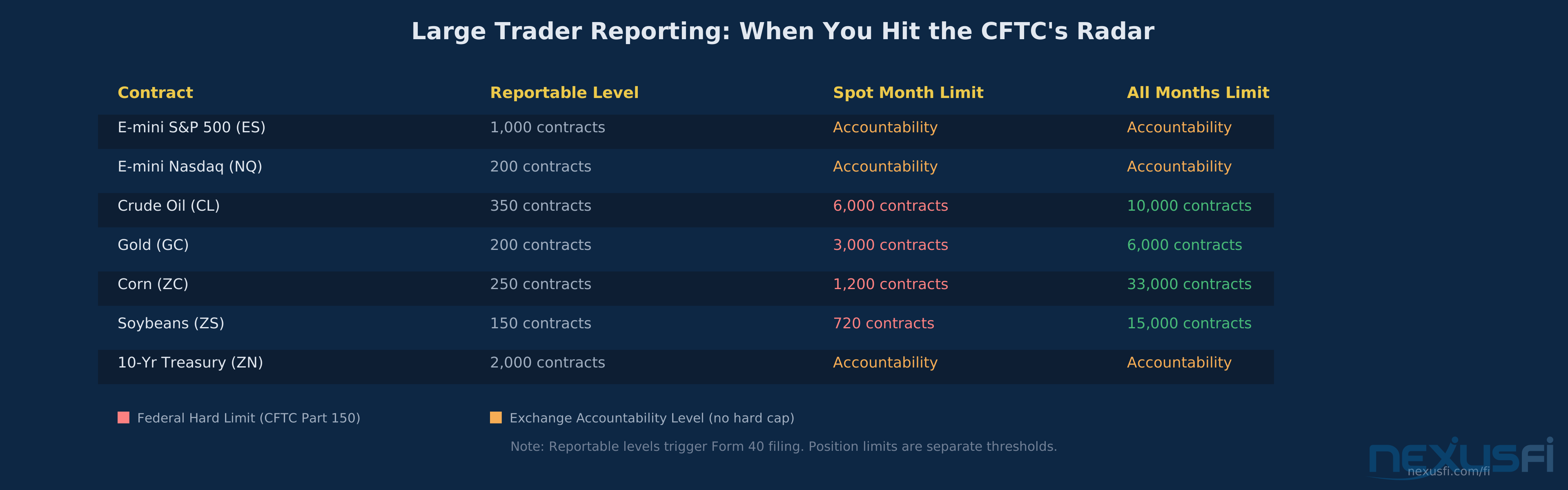
For financial futures like the E-mini S&P 500 (ES), E-mini Nasdaq (NQ), and Treasury futures, the exchanges set their own limits or accountability levels rather than the CFTC imposing federal limits.
Accountability Levels vs. Hard Limits #
There's a critical distinction here. Hard limits are exactly that — you can't exceed them without an exemption. Physical commodity contracts carry hard limits under CFTC Part 150.
Accountability levels are more like tripwires. When your position exceeds the accountability level, the exchange contacts you for information about the position. They can then require you to reduce the position, but there's no automatic prohibition. Financial futures contracts generally use accountability levels rather than hard limits, giving large institutional participants more flexibility while keeping the exchange informed.
Exemptions #
Not everyone trades under speculative limits. Bona fide hedgers — commercial entities using futures to offset business risk in the physical market — can apply for hedge exemptions that allow positions above the speculative limit. Spread traders may also receive higher limits since offsetting positions carry less directional risk. The exemption process runs through the exchange and, for federal limits, through the CFTC.
Large Trader Reporting #
When your position in any single contract exceeds the CFTC's reportable level, you become a "large trader." At that point, you're required to file CFTC Form 40, which provides the Commission with information about your trading activities, identity, and the purpose of your positions.
@FuturesTrader71 reinforced this point: "Generally, you are required to do so if you are holding or controlling a reportable position. This isn't an option. A trader must do so. The goal of this is for this federal regulator to understand what you are doing and the risks."
Reportable position levels vary by contract and are published by the CFTC. For context, the ES reportable level is 1,000 contracts. Most retail traders won't hit it, but prop firm traders, fund managers, and anyone scaling a successful strategy should know where the thresholds sit.
Market Surveillance and Enforcement #
Market surveillance operates on two tiers — the exchange level and the federal level — and understanding how they interact matters.
Exchange-Level Surveillance #
Every DCM runs real-time surveillance systems that monitor:
- Order book activity — Detecting spoofing (placing orders intended to be cancelled), layering, and quote stuffing
- Trade activity — Identifying wash trading, prearranged trading, and accommodation trades
- Position concentration — Flagging when any account or group of related accounts accumulates positions that could affect market integrity
- Price movements — Correlating unusual price moves with trading activity to detect potential manipulation
- Cross-market activity — Monitoring related contracts for manipulative cross-market schemes
When surveillance flags a potential violation, the exchange's market regulation department investigates. Violations can result in fines, trading suspensions, or referral to the CFTC.
CME Group publishes its disciplinary actions publicly — you can track every fine and suspension through their regulatory notices. In February 2026, CME fined a retail trader for disruptive trading practices in Silver and Gold futures, demonstrating that "exchange surveillance and enforcement mechanisms apply at every scale of market participation — retail traders aren't below the radar."
Federal-Level Enforcement #
The CFTC's Division of Enforcement handles cases that exceed exchange-level capacity or involve systematic misconduct. They have subpoena power, can coordinate with the DOJ for criminal prosecutions, and can impose civil penalties that dwarf anything an exchange can levy.
Key enforcement priorities include:
- Spoofing and manipulation — Post-Dodd-Frank, spoofing became a standalone offense. The CFTC has pursued cases aggressively, from individual traders to the JPMorgan $920 million settlement
- Fraud — Ponzi schemes, embezzlement of customer funds, misrepresentation of track records
- Disruptive trading — Practices that undermine the integrity of the order book
- Position limit violations — Exceeding limits without proper exemptions
- Reporting failures — Failure to file required reports or filing false information
Whistleblower Program #
The CFTC maintains a whistleblower program that pays awards of 10-30% of monetary sanctions exceeding $1 million. This program has proven effective at uncovering fraud that internal compliance and surveillance systems miss.
Global Regulatory Environment #
While this article focuses on the US framework, futures trade globally and regulatory approaches vary much.
United Kingdom — The Financial Conduct Authority (FCA) regulates futures markets. Post-MF Global, UK regulations on rehypothecation of client assets were tightened considerably.
European Union — Markets in Financial Instruments Directive II (MiFID II) and the European Markets Infrastructure Regulation (EMIR) govern derivatives trading. The European Securities and Markets Authority (ESMA) coordinates enforcement across member states.
Japan — The Japan Securities Clearing Corporation (JSCC) and the Financial Services Agency (FSA) oversee futures markets, with some of the most prescriptive position limit regimes globally.
Singapore — The Monetary Authority of Singapore (MAS) regulates the Singapore Exchange (SGX), a major hub for Asian derivatives.
Australia — The Australian Securities and Investments Commission (ASIC) governs futures markets with a framework that shares DNA with the UK model.
The key takeaway for traders operating across jurisdictions: customer protection levels and fund segregation rules differ meaningfully between countries. US segregation requirements are among the strongest globally, especially after the post-2012 reforms. Trading on foreign exchanges through a US FCM generally keeps you under US customer protection rules (Part 30 secured amount), but the protections are somewhat different from domestic segregation.
What This Means for Your Trading #
Regulation isn't abstract. It affects your daily trading in concrete ways:
Account safety — Your choice of FCM determines which regulatory protections apply to your funds. Check the CFTC financial reports, verify NFA registration, and understand that futures accounts don't carry deposit insurance.
Position sizing — If you're scaling up, know the position limits and accountability levels for every contract you trade. Hitting a reportable level triggers Form 40 obligations. Exceeding a speculative limit without an exemption is a regulatory violation.
Order behavior — Spoofing, layering, and other disruptive practices are actively surveilled and prosecuted. This isn't theoretical — retail traders have been fined. If your algorithm rapidly enters and cancels orders in patterns that could be construed as spoofing, you have a compliance problem.
Broker due diligence — The NFA's BASIC system and the CFTC's financial reports give you more transparency into your broker's health than exists in almost any other financial market. Use them.
Recovery options — If you have a dispute with your broker, the NFA provides an arbitration process. If your broker fails, the CFTC-supervised liquidation process distributes assets, but recovery isn't guaranteed and takes time. Diversifying across FCMs provides a practical buffer.
The regulatory framework isn't perfect — MF Global and PFGBest proved that. But the reforms implemented after those failures closed real vulnerabilities. The system now makes it much harder for an FCM to misuse customer funds without detection. The daily electronic reporting, direct account verification, and enhanced audit requirements all add layers of protection that didn't exist before 2012.
For the working trader, the regulatory structure is infrastructure. You don't think about it daily, but when you need it — when a broker runs into trouble, when you scale past reporting thresholds, when someone manipulates the market you're trading — the strength of that infrastructure determines whether you're protected or exposed.
Knowledge Map
Prerequisites
Understand these firstGo Deeper
Build on this knowledgeReferences This Article
Articles that build on this topicCitations
- — CFTC Capital Requirements for FCM's (2020) 👍 11“Couldn't find the last place this was posted, so making this a sticky. Check your FCM's CFTC capital requirements report here: https://www.cftc.gov/MarketReports/financialfcmdata/index.”
- — CME Fines and Suspends NYMEX Broker for Leaking Customer Order Info in Crude Oil (2026) 👍 1“jlabtrades, Look at the numbers and judge for yourself. Cornerstone Research tracked every CME disciplinary action from 2018 through 2024 -- 846 total actions, $76 million in penalties, median fine of $40,000. That median number is telling.”
- — CME Fines and Suspends NYMEX Broker for Leaking Customer Order Info in Crude Oil (2026) 👍 1“CME Group has fined NYMEX broker Kevin Milan $40,000 and suspended him for 30 business days for disclosing non-public information about customer orders in Crude Oil futures.”
- — MF Global situation (2011) 👍 2“Probe finds MF Global used funds of customers Dow Jones Newswires/Wall Street Journal 5:08 p.m. CST, November 17, 2011 Regulators have unearthed more details about MF Global Holdings Inc.”
- — AMP Futures / AMP Global Review (2014) 👍 17“Depositing funds with AMP, like any other privately owned broker is a game of Russian roulette. You place your funds and hope you don't wake up one morning look at the news and find you have fallen victim to another MF Global or PFG Best.”
- — Futures Broker Due Diligence Notes post PFG (2012) 👍 3“Additional financial disclosure requirements is pointless in my opinion. All this shows is the CFTCs poor understanding of the risks faced by futures traders and the steps required to address these risks.”
- — U.S. approves new rules to protect futures customers (2012) 👍 1“UPDATE 1-U.S. approves new rules to protect futures customers | Reuters UPDATE 1-U.S. approves new rules to protect futures customers MF Global Holdings Ltd MFGLQ.PK $0.03 +0.00+3.”
- — Need Help: Urgent Broker Problem (Phillip Capital: NT Brokerage, Edge Clear) (2021) 👍 8“Where do you get this from? That is not how futures brokers work. It is a highly regulated industry. There have only been a few notable exceptions in the last few decades where customers segregated funds were at-risk.”
- — Class Action Lawsuit: AMP Global Clearing LLC (2020) 👍 21“Hmm, not sure if he edited it or what but that's not what it says. Anyway, I get his point. But it's dangerous for people to think that AMP is only a broker, since they are also acting as the FCM.”
- — CFTC / Large Trader (2020) 👍 10“Apparently your position size has exceeded one or more of these thresholds. I can't offer any personal insight beyond that which is written on the CFTC website, but since you now hold a large futures position you don't have a choice in the matter.”
- — CFTC / Large Trader (2020) 👍 7“Hi Myrrdin, I see that nobody responded, so I will do my best to help out with the understanding that I'm not a regulatory or compliance attorney and this is not legal advice. This is my view based on what I know about this process.”
- — CFTC / Large Trader (2021) 👍 1“My positions definitely exceed the level required for reporting. I'm a spread trader so that's actually a lot easier than you might think. Have you considered the total position summed across all accounts as thats what the CFTC look at.”
- — CME Group Fines Retail Futures Trader for Disruptive Trading Practices (2026)“CME Group Fines Retail Futures Trader $30,000 for Disruptive Trading in Gold and Silver What Happened CME Group posted a notice of disciplinary action on March 2, 2026 against Mark Ninyo, a retail trader located in the United States, for engaging in...”
- — PFGBest Accounts Frozen (PFG scandal big thread) (2012) 👍 3“Hi. As mentioned in an earlier post, you have far greater exposure to theft if the broker is owned by one or a few people. This is because there will likely be few or no compliance staff with the broker being in full control of the finances.”