



Futures Trading in a Self-Directed IRA: Tax-Free Compounding for Active Traders
Overview #
Most futures traders leave the biggest tax advantage in the game completely untouched. A Roth IRA lets you trade ES, NQ, CL — any futures contract — and keep every dollar of profit, tax-free, forever. No 60/40 split, no capital gains, no annual tax drag compounding against you over decades. The structure exists. It's legal. And most traders never set it up.
This isn't a get-rich-quick angle. It's a structural edge that compounds over time the same way any other edge does — quietly, steadily, and only for traders who actually understand how it works.
What Makes This Different From a Regular Brokerage IRA #
Most brokers offer IRA accounts. Most of those accounts restrict you to stocks, ETFs, and maybe options. If you want to trade futures in an IRA — actually trade futures, with real margin mechanics — you need a self-directed IRA (SDIRA).
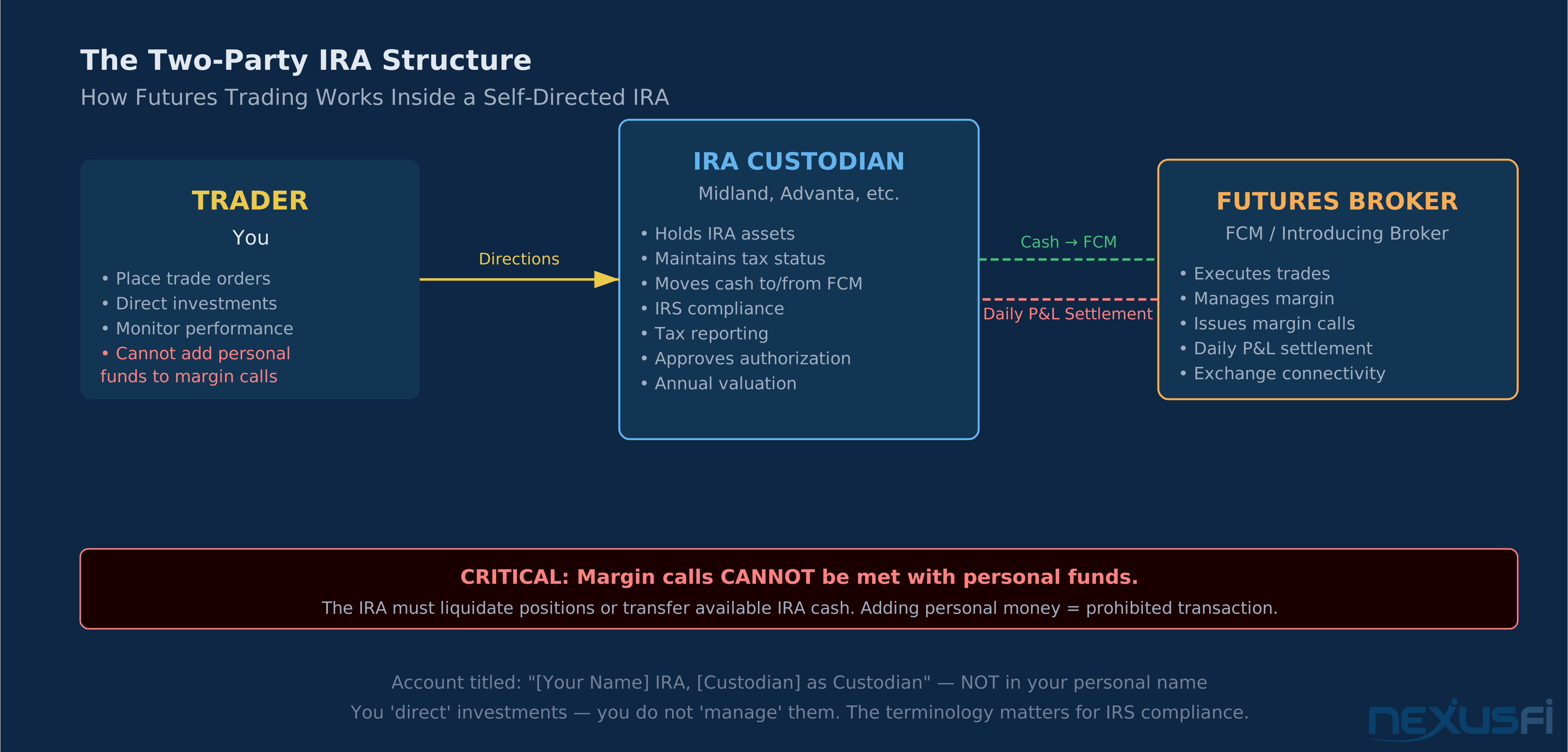
A self-directed IRA uses a two-party structure that most traders have never seen:
- The custodian — an IRA custodian (not a traditional brokerage) that holds your IRA assets, maintains the account's tax-qualified status, and handles compliance. Think of them as the official keeper of the account.
- The futures broker (FCM) — your actual trading firm, where you enter orders, manage margin, and execute. The FCM holds the trading capital, posts it as margin at the exchange, and reports activity back to the custodian.
You sit between them. You direct the trades (the IRS is careful about the word "direct" vs. "manage" — that distinction matters legally). The custodian ensures everything stays within IRA rules. The FCM handles the market-facing mechanics.
This setup doesn't exist at Schwab, Fidelity, or most retail brokerages. They're set up to hold securities, not to manage the daily cash flows that futures margin creates. You need a custodian that explicitly supports derivatives and futures margin movements — and there aren't that many of them.
That post is from a thread where an Elite Circle member outlined the complete Roth futures compounding thesis — worth reading in full. The mechanics are more accessible than people assume. The friction is in finding the right custodian, not in trading itself.
When Interactive Brokers abruptly ended futures trading in all IRA accounts in March 2015, traders found out via permission-denied errors on their automated systems — with no advance warning. Custodian policy risk is real. Verify your custodian's futures policy in writing before transferring a significant IRA balance.
Four Account Types -- Which One to Use #
Not all retirement accounts work the same for futures trading. Here's the comparison that matters.
Traditional IRA #
You contribute pre-tax dollars (if you meet deductibility rules). The account grows tax-deferred — you pay ordinary income tax when you withdraw. Required Minimum Distributions (RMDs) kick in at age 73.
For futures traders, the traditional IRA makes sense if you're in a high tax bracket now and expect lower taxes in retirement. Every profitable year inside the account doesn't trigger a tax event — you're just deferring.
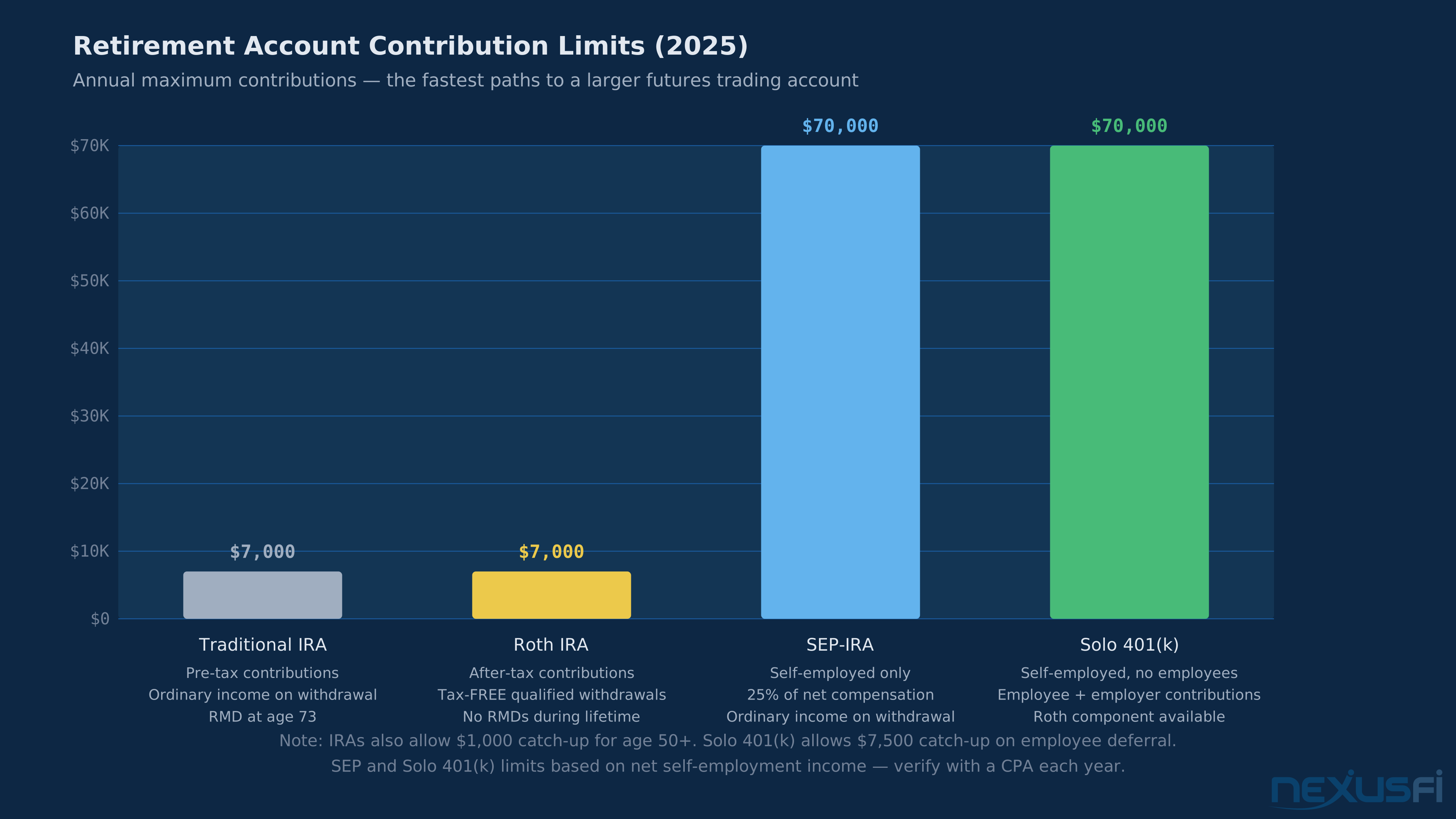
2025 contribution limits: $7,000 per year ($8,000 if age 50 or older).
Roth IRA #
You contribute after-tax dollars. Growth is completely tax-free, and qualified withdrawals cost you nothing. No RMDs during your lifetime.
This is the power move for futures traders. In a taxable account, your Section 1256 gains get the 60/40 treatment — 60% long-term, 40% short-term capital gains rates. In a Roth, there is no tax event at all. You trade, compound, and eventually withdraw with zero tax on any of the gains — ever.
The catch: income limits apply to direct contributions. In 2025, the ability to contribute phases out at $150,000 MAGI for single filers and $236,000 for married filing jointly. Above those limits, you need a backdoor Roth conversion to get money in.
2025 contribution limits: $7,000 ($8,000 if 50+), subject to income limits.
The Roth's lack of RMDs is significant for traders who build large accounts. With a traditional IRA, you're forced to start withdrawing at 73 regardless of whether you need the money. The Roth lets the compound growth run as long as you live — and it can leave the account to heirs tax-free.
SEP-IRA #
Designed for self-employed traders and small business owners. Contribution limits are dramatically higher — up to 25% of net self-employment income, capped at $70,000 in 2025. Tax treatment is identical to a traditional IRA (deductible contributions, ordinary income on withdrawal).
The SEP is the fastest way to build a large futures trading account inside a tax-advantaged wrapper, if you have the self-employment income to justify the contributions. A profitable trader making $200K in net income can contribute $50K to a SEP in a single year.
No Roth version of a SEP exists.
Solo 401(k) — The Professional's Choice #
The Solo 401(k) is for self-employed individuals with no full-time employees (other than a spouse). It combines employee deferrals and employer contributions under one plan:
- Employee deferral: Up to $23,500 in 2025 ($31,000 if 50+)
- Employer contribution: Up to 25% of self-employment compensation
- Total: Up to $70,000 in 2025 ($77,500 if 50+)
Solo 401(k)s offer both traditional and Roth components. They also allow participant loans (you can borrow from yourself), which IRAs do not.
The downside: more administrative burden. You need a third-party administrator and proper plan documents, and the plan must file Form 5500 once it exceeds $250,000 in assets.
If you're self-employed and serious about building a futures trading account inside a retirement wrapper, the combination play is: maximize employee Roth deferral in the Solo 401(k) for tax-free growth, add employer contribution as traditional for the current deduction. You get both tax benefits simultaneously.
Side-by-side comparison:
| Feature | Traditional IRA | Roth IRA | SEP-IRA | Solo 401(k) |
|---|---|---|---|---|
| 2025 contribution | $7,000 / $8,000 | $7,000 / $8,000 | 25% comp or $70K | $23,500 + employer, max $70K |
| Deductible? | Yes (with income limits) | No | Yes | Employee: either; Employer: yes |
| Tax on withdrawals | Ordinary income | Tax-free (qualified) | Ordinary income | Depends on component |
| RMDs | Age 73 | None | Age 73 | Age 73 (non-Roth) |
| PDT rules apply? | No | No | No | No |
| Short futures allowed? | Yes | Yes | Yes | Yes |
| Short stock allowed? | No | No | No | No |
| Loan provision | No | No | No | Yes |
| Admin complexity | Low | Low | Low-Medium | Medium-High |
One important point for active traders: Pattern Day Trader (PDT) rules do not apply to IRA accounts. You can trade freely regardless of account size. And while you can't short stock in an IRA, short futures positions are permitted — you can be long or short any futures contract.
The Margin Rules -- This Is Where It Gets Real #
Here's the thing that trips up traders who think they can just open an IRA and trade the way they normally do: margin inside an IRA is at the core different.
In a personal account, your broker will extend you credit. You deposit $50K, you can often trade $200K+ in notional exposure because the broker will loan you the rest. If a position goes against you, you can wire in cash to meet the margin call.
In an IRA, none of that works.
What's allowed: Exchange-minimum initial margin. You must post the full initial margin requirement for each position using cash in the IRA. No borrowing, no personal funds, no getting creative.
What's not allowed: Adding personal money to meet a margin call. If you get a call and your IRA doesn't have sufficient cash, the broker liquidates your positions. You cannot wire $10K from your personal account to rescue a trade. That would constitute a prohibited contribution.
Variation margin mechanics: Futures positions are marked to market daily. Every day, your gains or losses flow through the account as cash. The custodian must help this movement between the IRA cash ledger and the FCM margin account. This isn't instantaneous — there can be timing friction, and you need to maintain enough cash buffer to handle adverse daily marks without triggering a call.
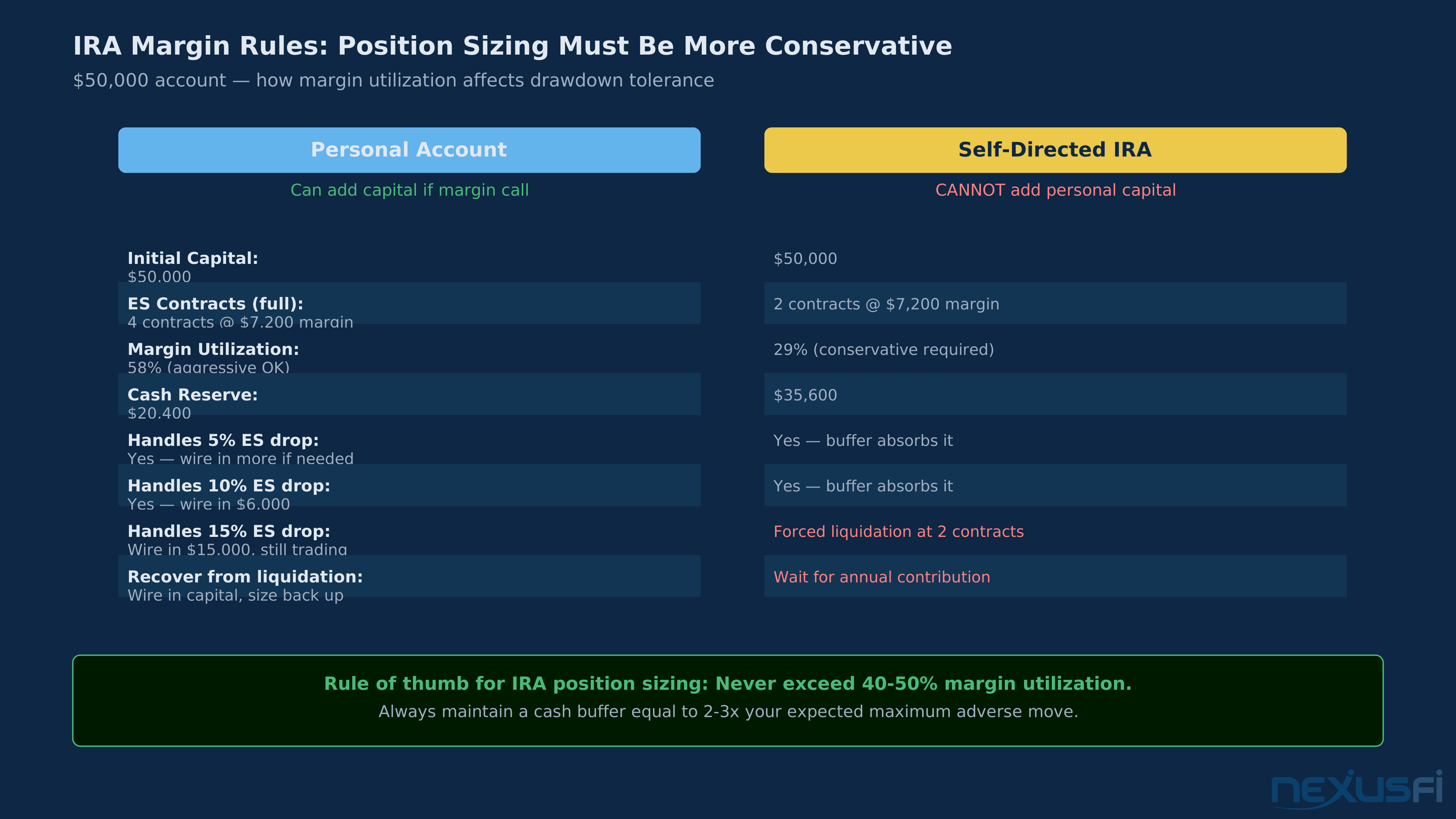
The no-rescue rule has an important implication for position sizing. In your personal account, you can overcorrect after a bad week by depositing more capital. In an IRA, your capital is whatever's in the account. If a run of losses burns through your margin buffer, positions get liquidated. You're done trading until remaining capital recovers or you make another qualifying contribution — which takes time and is capped annually.
The practical minimum to trade futures effectively in an IRA is around $25,000-$50,000. Below that, standard exchange margin requirements leave you with almost no buffer for normal volatility. Micro contracts (MES, MNQ, MCL) change the calculus somewhat — you can access ES-equivalent exposure with $1,265 initial margin, making smaller accounts more viable.
As @josh noted in the Elite Circle thread, one MES gives you SPY-equivalent exposure at a fraction of the cash requirement:
Many custodians impose additional margin on top of exchange minimums — often 2x or even 5x the CME requirement. Verify this before assuming you can trade the standard size.
IRS Rules: What You Can't Do and Why It Matters #
The tax advantages of an IRA are conditional. Violate the rules, and the IRS disqualifies the entire account — not just the transaction. The full balance becomes taxable immediately, plus a 10% early withdrawal penalty if you're under 59½. That's an existential event for your trading capital.
The primary rules that futures traders need to understand:
Prohibited Transactions (IRC §4975) #
The IRS has a specific list of transactions that are forbidden inside retirement accounts. The relevant ones for traders:
Self-dealing: You cannot use IRA funds to trade your own business interests. If you run a grain operation and trade corn futures in your IRA to hedge that business, that's self-dealing. Standard speculative futures trading in liquid markets (ES, NQ, CL, GC) is not self-dealing.
Disqualified persons: You cannot transact with yourself, your spouse, your lineal ascendants or descendants, or certain entities you control. The IRA cannot loan money to any of these parties, purchase their assets, or in any way benefit them directly.
Personal guarantees: You cannot personally guarantee the IRA's obligations. You cannot pledge IRA assets as collateral for a personal loan. The IRA must stand alone.
Commingling: IRA assets must remain completely separate from personal funds. The FCM account must be titled in the name of the IRA, not your personal name.
Penalty structure: 15% excise tax on the amount of the prohibited transaction. If the transaction isn't corrected, it escalates. And if the prohibited transaction constitutes a complete disqualification of the account, the entire balance becomes ordinary income, plus the 10% early withdrawal penalty if under 59½.
UBTI — Generally Not a Problem for Standard Futures Trading #
Unrelated Business Taxable Income (UBTI) is what happens when a tax-exempt entity (including an IRA) generates income from an active business or from debt-financed activity. UBTI is taxed at trust tax rates, which reach 37% quickly.
For futures traders: standard futures trading does not generate UBTI. The reason is that futures margin is not debt. When you post $5,000 as initial margin on an ES contract, you haven't borrowed anything. You've posted a performance bond. This is categorically different from buying stock on margin, where you're borrowing from the broker and the resulting profit on the borrowed portion can trigger UBTI.
Section 1256 contracts (which includes most exchange-traded futures) are treated as capital asset transactions, not active business income, inside an IRA. Standard speculative futures trading is safe.
The UBTI concern enters when traders start using complex entity structures inside their IRAs. If your IRA invests in an LLC that actively trades, and that LLC is structured in a way that creates business income rather than investment income, you may have UBTI exposure. The further you get from a simple custodian-FCM structure, the more you need a CPA to evaluate.
The first $1,000 of UBTI annually is exempt. Above that, the IRA must file Form 990-T and pay the tax. If you're sticking to standard futures in a straightforward two-party structure, you won't see this form.
Standard futures trading (ES, NQ, CL, ZB, GC through an FCM) inside an IRA does not generate UBTI. Complex entity structures, leveraged partnerships, or arrangements that look like active business operations can trigger it. Keep the structure simple and you stay out of trouble.
Contribution Limits, Rollovers, and Distribution Rules #
Getting Money In #
The annual contribution limits are small relative to what you can build through trading:
- IRA (Traditional or Roth): $7,000 per year ($8,000 if 50+)
- SEP-IRA: 25% of net self-employment income, max $70,000 in 2025
- Solo 401(k): Up to $70,000 combined employee/employer in 2025
But contributions aren't the only way to fund an IRA. Rollovers and transfers move existing retirement money:
- Direct rollover: Move funds from a 401(k) or other qualified plan directly to an IRA. No taxes, no penalties. This is how most traders initially fund a meaningful SDIRA — rolling over a former employer's 401(k).
- IRA transfer: Move between custodians. Direct transfers are not taxable events and don't count against the annual contribution limit.
- 60-day rollover: You receive a distribution and have 60 days to deposit it into an IRA. One per 12-month period. Miss the 60-day window and it becomes taxable income.
Rolling over a former employer's 401(k) to an SDIRA is the most common path to building a meaningful trading account. The key discipline: keep it to a portion of your retirement assets. Concentrating your entire retirement in a futures trading account removes the margin for error that retirement capital requires.
Getting Money Out #
Traditional IRA and SEP-IRA:
- Withdrawals after 59½: Ordinary income tax, no penalty
- Withdrawals before 59½: Ordinary income tax plus 10% penalty (with specific exceptions for first home purchase, certain medical expenses, permanent disability, and others)
- Required Minimum Distributions: Must start at age 73
Roth IRA:
- Contributions (not earnings) can be withdrawn any time, tax and penalty-free
- Earnings require the account to be at least 5 years old AND you to be at least 59½ for a qualified (tax-free) distribution
- No RMDs during the owner's lifetime — the account can grow indefinitely
The Roth's lack of RMDs is significant for traders who build large accounts. With a traditional IRA, you're forced to start withdrawing at 73 regardless of whether you need the money. The Roth lets the compound growth run as long as you live.
The Capital Replacement Problem #
In a personal trading account, if you have a bad streak and lose 30% of your capital, you can wire in fresh money next month and get back to size quickly. In an IRA, your options are limited:
- Add up to $7,000 via annual contribution
- Wait for the next tax year to add more
- The trading account recovers on its own, or it doesn't
This constraint — the inability to rescue the account with personal capital — is the single most important risk management difference between IRA trading and personal account trading. It demands lower position sizing, larger cash buffers, and more conservative drawdown limits.
Why a Roth IRA Is Worth the Setup Cost #
There's a reason experienced traders who run futures in SDIRAs almost always land on the Roth structure. Let's run the math:
A trader with a $100,000 Roth IRA earns 30% annually for 20 years. In the Roth:
- $100,000 x 1.30^20 = $19,004,963
- Tax on withdrawal: $0
The same trader with $100,000 in a taxable account, paying 25% effective tax rate annually on Section 1256 gains (blended 60/40 treatment):
- Net annual return after tax: ~22.5%
- $100,000 x 1.225^20 = $5,800,000 (approximate)
The tax drag alone accounts for roughly $13 million of the difference over 20 years.
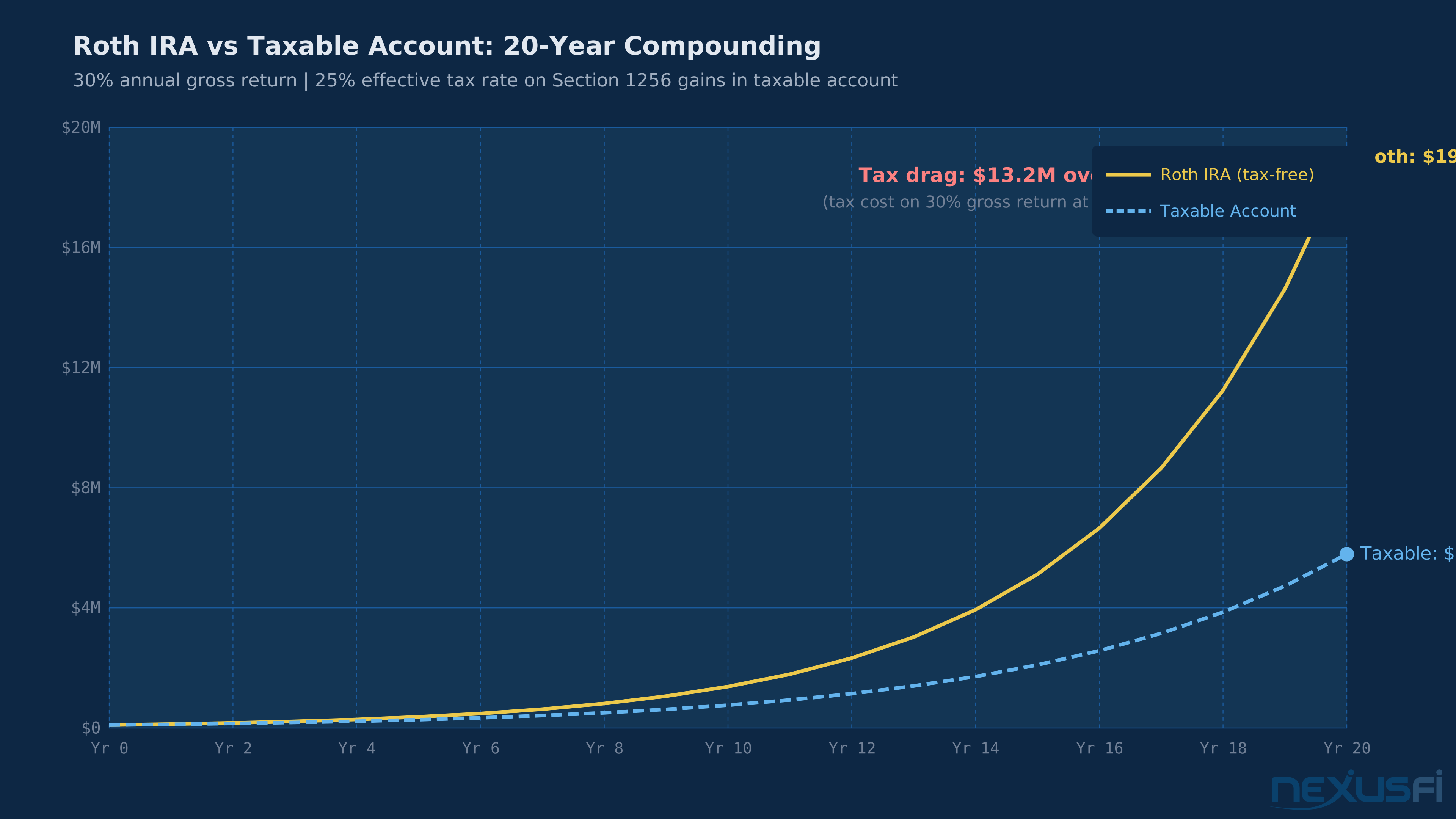
These numbers are extreme illustrations, but the structural advantage is real at any return level and any time horizon.
That post is from 2011. The Roth futures thesis has been in the NexusFi community for over a decade. The traders who started early and stayed disciplined have compound growth on their side.
Setting Up a Self-Directed IRA for Futures -- The Actual Process #
The setup is more involved than opening a standard brokerage account but not as complicated as people fear. Here's the sequence:
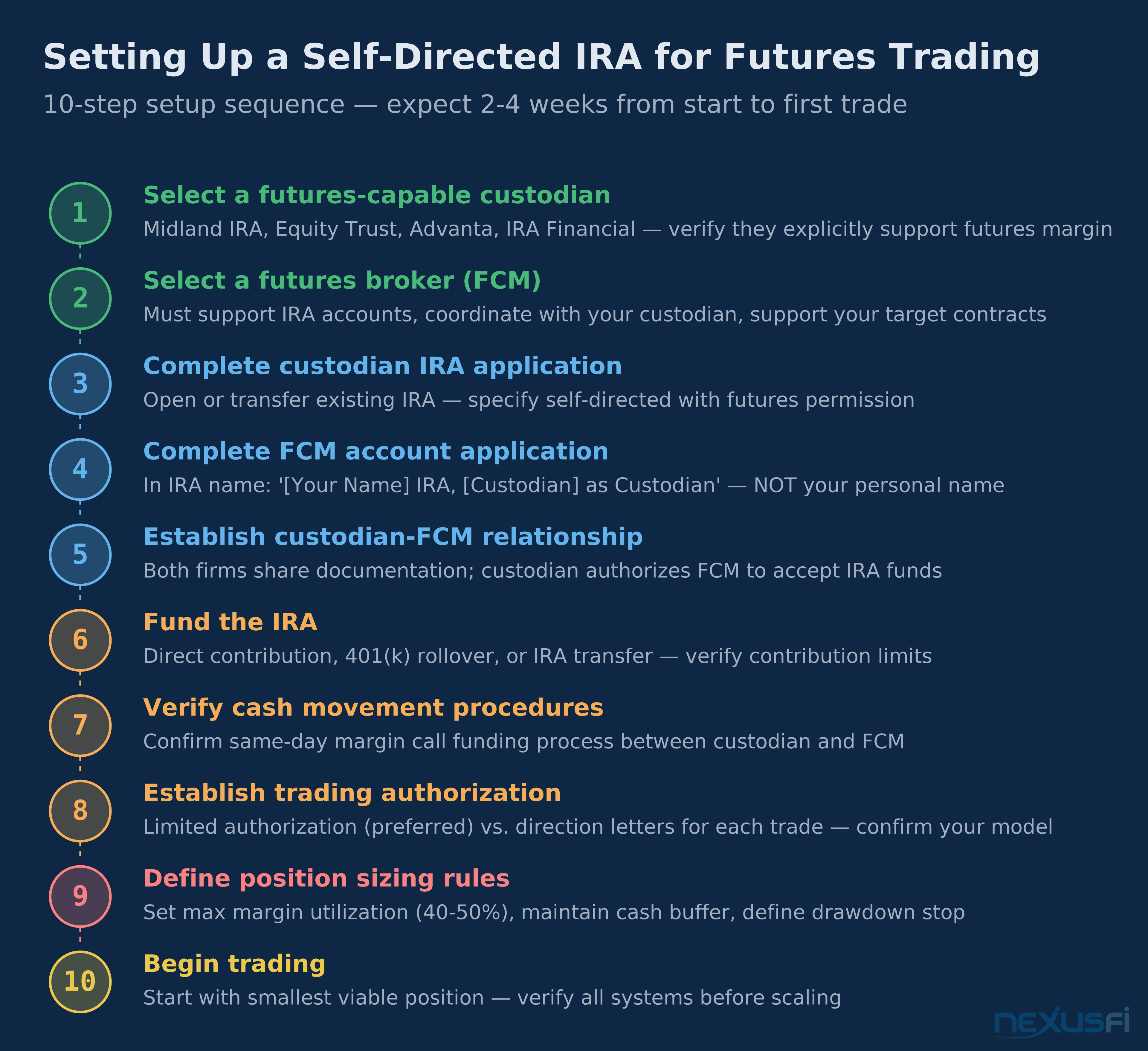
Step 1: Select a Futures-Capable Custodian #
You need a custodian that explicitly permits futures trading and can handle the daily margin cash flows. Most retail custodians (Fidelity, Schwab, Vanguard) do not. Custodians that have historically supported futures in IRAs include Midland IRA, Equity Trust, Advanta IRA, and IRA Financial Group.
What to verify before signing:
- Explicitly permits futures and options on futures
- Supports daily variation margin cash movements with your target FCM
- Has an established relationship with (or accepts) your preferred futures broker
- Fee structure: annual maintenance, per-transaction, or asset-based
- Turnaround time on direction letters or trading authorizations
- Written policy on futures (not just "we allow alternative investments")
Fees: Custodian fees run from $300 to $600+ annually for active trading accounts, plus possible per-transaction charges. Compared to the tax savings on profitable trading, these fees are trivial.
Step 2: Select a Futures-Capable Broker #
Not all futures brokers support IRA accounts. They require additional documentation, have restrictions on certain strategies, and need to coordinate with the custodian on cash movement.
Verify the broker:
- Has an established process for IRA accounts and has done this before
- Works with your chosen custodian
- Supports the contracts you trade
- Has clear procedures for margin call handling in IRA accounts
Step 3: Fund and Open Both Accounts #
The account at the FCM must be titled in the name of the IRA, not your personal name. Typical titling: "[Your Name] IRA, [Custodian] as Custodian."
Fund the custodian account first (via contribution, transfer, or rollover). The custodian then allocates capital to the FCM account per your direction.
Step 4: Establish Trading Authorization #
There are two models for how you place trades:
Direction letters: For each trade, you submit a written direction to the custodian authorizing the transaction. Slow, impractical for active futures trading.
Limited trading authorization: The custodian pre-authorizes you to place trades directly with the FCM within defined parameters. This is how most active futures traders operate.
When evaluating custodians, ask specifically about limited trading authorization and what parameters they place on it. Some custodians restrict this to certain contract types or position sizes. Get the specifics in writing before you transfer any capital.
Step 5: Verify Cash Movement Mechanics #
Daily variation margin means daily cash flowing between the custodian and the FCM. Confirm:
- How quickly the custodian can move cash to meet a margin call
- What buffer they require in the IRA cash account
- Whether they handle this automatically or require your intervention
Step 6: Size Conservatively and Trade #
Once everything is funded and authorized, the mechanics are identical to your personal account. You place orders through the FCM platform, positions are marked to market daily, and gains/losses settle as cash.
The difference is in the sizing. With no ability to add personal capital, you need to trade smaller relative to account size than you would in a personal account. A position sizing model that works fine at 50% margin utilization in a personal account may be too aggressive in an IRA.
Operational Friction: What You Don't Hear About Until It Happens #
Real traders who have run futures through SDIRAs report several operational realities worth knowing:
Cash timing: The delay between a profitable trade settling and the cash being available for margin on the next trade can be 24-48 hours through some custodians. This affects intraday capital efficiency.
Year-end tax reporting: The FCM issues a 1099 to the IRA, not to you. The custodian handles all tax reporting. You won't receive a 1099-B for your IRA trading activity. The gains stay in the account, sheltered.
Valuation requirements: Custodians must report the fair market value of IRA assets annually. Futures are exchange-traded, so this is automatic. Compared to alternative assets like real estate in an SDIRA, futures are the easy case.
Custodian policy changes: Harvester's experience in 2015 — IB ending futures in IRAs with no notice — is the real risk. Custodian policy changes can strand you in the middle of active positions. Always have a plan for how you'd migrate to another custodian if needed.
The abruptness of the 2015 IB policy change was the operational lesson. IB wasn't required to give advance notice, and they didn't. Always have a backup plan for custodian migration, especially if running automated systems from the IRA account.
Risk Management Specifically for IRA Trading #
The IRA's structural constraints — no rescued margin calls, annual contribution caps, early withdrawal penalties — require a different risk management approach than personal accounts:
Position sizing: Use no more than 40-50% of available margin capacity at any time. Leave explicit cash buffer for adverse marks.
Maximum loss limits: Define a hard stop — a balance level below which you stop trading and let the account recover. In a personal account, you can fund through a drawdown. In an IRA, forced liquidation at the wrong moment locks in losses permanently.
Contract selection: Micro contracts (MES, MNQ, MCL) let you trade with proper risk fractions on smaller accounts. A $30,000 IRA doesn't need to trade full ES — one MES gives you meaningful exposure without requiring $15,000+ in margin.
Drawdown planning: In a taxable account, a 30% drawdown is painful but recoverable quickly with additional capital. In an IRA, a 30% drawdown requires the account to recover on its own or wait for annual contributions to rebuild the base. Factor this into your position sizing.
Custodian buffer requirement: Many custodians require a minimum cash balance in the IRA custodial account (separate from what's posted as margin at the FCM). Understand this requirement so you're not caught short.
Trade an IRA like you trade with capital you can never replace — because you effectively can't. The compounding advantage is real, but only if the account survives long enough to compound. Conservative sizing isn't timid trading; it's structurally appropriate trading.
This article is for educational purposes only and does not constitute tax, legal, or investment advice. IRS rules, contribution limits, and custodian policies change. Consult a qualified CPA or tax attorney before establishing a self-directed IRA for futures trading.
Knowledge Map
Go Deeper
Build on this knowledgeReferences This Article
Articles that build on this topicCitations
- — Futures in a Roth and a path to retirement (2021) 👍 15“Self-direct the Roth via a custodian like Millennium, Advanta, Midland, etc. Select a futures broker and open an account there.”
- — Futures in a Roth and a path to retirement (2021) 👍 6“Futures margin is fundamentally different. You don't borrow anything, as you do with an equity margin account.”
- — Interactive Brokers not allowing futures trading in IRAs (2015) 👍 7“Management has decided to stop allowing futures positions on IRA accounts held with IB as of midnight eastern, March 6th.”
- — Interactive Brokers not allowing futures trading in IRAs (2015) 👍 5“There are two options to continue to trade futures in my IRA. One is to move to a broker similar to IB such as TOS.”
- — How did you get a capital? (2015) 👍 4“I converted an old 401K account from a previous employer to a self-directed IRA account and use it to trade futures.”
- — The Tax Thread (2011) 👍 5“Proceeds from a Roth account are not taxable. Only contributions made to the Roth account are taxable at the time of the contribution.”
- — Futures in a Roth and a path to retirement (2021) 👍 8“A partnership allows profit interests to be unevenly distributed relative to capital contributions.”
- — What I wish I would have known when I got started. (2019) 👍 215“Two and a half years ago I was completely new to trading. Through a family friend I became acquainted with the futures market. Seeing how much the markets move and the opportunity that it represented I felt that it would be worth a shot to try trading. I was single, graduated from college, no debt a”
- — Lawsuit: AMP Futures Trading aka AMP Global Clearing (2019) 👍 157“This is a public notice that AMP GLOBAL CLEARING aka AMP FUTURES TRADING has filed a lawsuit against nexusfi.com (formerly BMT) regarding posts on nexusfi.com (formerly BMT). This is not the first time AMP TRADING has used attorneys in an attempt to manipulate what is shared on the site. Attache”
- — Big Mike's day trading method and advice (2019) 👍 151“While on vacation, I've been giving some thought to what happened two months ago that caused me to stop posting on my own forum. The conclusion I've reached was it was an overreaction to a minority. That minority was constantly vocal in the background of the site, basically "anti" anything I was p”