



Futures Market Regulation: CFTC, NFA, and the Rules Every Trader Must Understand
Overview #
U.S. futures trading sits inside one of the most comprehensively supervised markets on the planet. That's not an accident. Futures are leveraged, centrally cleared, and systemically important — so the regulatory model is layered by design, with multiple entities watching different parts of the system simultaneously.
Most retail traders treat regulation the same way they treat the fine print on a brokerage agreement: skim it once, sign, and move on. That's a mistake. The rules that govern U.S. futures markets directly shape your margin requirements, your account safety if a broker fails, your exposure to compliance scrutiny as your size grows, and your options when something goes wrong. Understanding the framework isn't a compliance exercise — it's risk management.
This article maps the entire U.S. futures regulatory environment: who the players are, what each one actually does, how their authority flows, and how that authority touches your account at every stage of the trading lifecycle. It also covers the specific rules you'll encounter as a retail futures trader — from position limits to anti-manipulation standards — and what changed after the 2008 crisis reshaped the entire derivatives regulatory environment.

The U.S. Regulatory Architecture #
Five distinct entities govern U.S. futures markets, each with a different mandate, different authority, and different ways of touching your trading.
CFTC: Federal Rulemaker and Top-Level Enforcer #
The Commodity Futures Trading Commission (CFTC) is the federal regulator for U.S. futures, options on futures, and swaps. Created under the Commodity Exchange Act, it writes the core rules for derivatives markets, oversees registered market participants, and can investigate and prosecute violations — fraud, manipulation, spoofing, recordkeeping failures, and customer-fund misuse.
The CFTC doesn't run day-to-day market surveillance. It delegates that to the exchanges and NFA, then steps in for civil enforcement, major rulemaking, and systemic oversight. When the CFTC acts, it's usually because something has escalated past the SRO level — a major manipulation case, a broker failure, or a systemic regulatory gap.
For retail traders, direct CFTC interaction is rare. But every rule the CFTC writes shapes your broker, your exchange, and the market structure you trade in. The CFTC sets the terms. Everyone else enforces them.
NFA: Self-Regulatory Organization for Firms and Individuals #
The National Futures Association (NFA) is the industry's self-regulatory organization. It's not a government agency — it operates under CFTC oversight with delegated authority to regulate compliance for futures-related businesses and individuals.
What the NFA actually does: registers and disciplines FCMs, IBs, CTAs, CPOs, and associated persons; runs BASIC (the public registration and disciplinary lookup database); enforces conduct, disclosure, advertising, and anti-money-laundering standards; and handles arbitration and dispute resolution between customers and members.
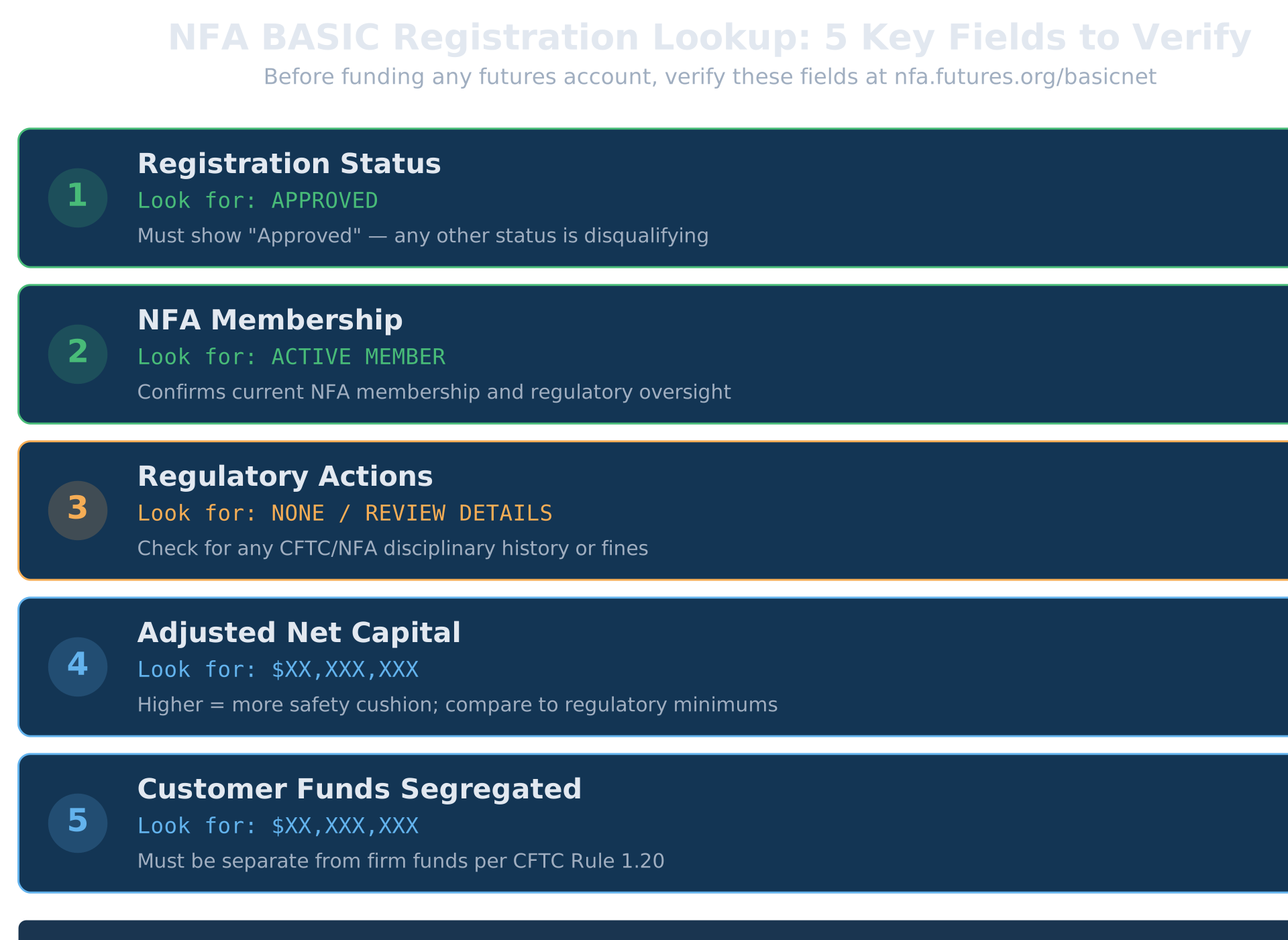
Before you fund any brokerage account, futures advisor, or introducing broker, check them on NFA BASIC. Registration status, disciplinary history, financial-responsibility level — all of it is public. Unregistered entities cannot legally hold your margin. This five-minute check is one of the most concrete risk-reduction moves a retail trader can make.
Tip: Always check NFA BASIC before funding
Before depositing capital with any futures broker, run a five-minute check at NFA BASIC. You can verify registration status, view the complete disciplinary history, and check current financial-responsibility levels — all free, all public. If a firm is not registered with the NFA, it cannot legally hold your margin. This single check eliminates the most avoidable category of broker risk.
Exchanges and DCMs: Venue-Level SROs with Real Enforcement Power #
Most U.S. futures trading happens on Designated Contract Markets (DCMs) — exchanges like CME, CBOT, NYMEX, and COMEX, all under CME Group. Exchanges are not just venues. They're self-regulatory bodies with direct surveillance, discipline authority, and real enforcement power over market participants.
CME Group's dual role creates an important dynamic: it's a for-profit business that generates revenue from trading volume and a regulatory body responsible for maintaining fair markets. These functions are managed separately within the organization, but both are real. The exchange can suspend, fine, or ban participants — not because of a government lawsuit, but because of a violation of the exchange rulebook.
Exchange rules are the regulatory layer traders feel most often: contract specifications, tick sizes, trading hours, daily price limits, trading halts, circuit breakers, and anti-disruptive trading standards. Your trading behavior is monitored at the venue level in real time.
FCMs and IBs: The Customer-Facing Gatekeepers #
The Futures Commission Merchant (FCM) is the core customer-facing intermediary. It carries your account, accepts your margin, routes your orders to the exchange, clears through clearing members, and holds your segregated funds. An Introducing Broker (IB) solicits and services customers but doesn't hold customer funds or clear trades — it works through an FCM for all of that.
For retail traders, the practical counterparty relationship is almost always with the FCM. Your margin, account permissions, statements, and liquidation risk are all governed by your FCM. The IB is the face of the relationship; the FCM is the engine running it.
Clearinghouses and DCOs: The Systemic Risk Backstop #
A Derivatives Clearing Organization (DCO) clears trades and becomes the buyer to every seller and seller to every buyer — the central counterparty. CME Clearing operates the clearinghouse for CME Group products.
The clearinghouse collects performance bonds (margin) from clearing members, manages default waterfalls, conducts daily mark-to-market, and uses variation margin to keep losses continuously settled. If a clearing member defaults, the clearinghouse absorbs the exposure through structured default procedures rather than letting it cascade.
For retail traders: futures are structurally safer than bilateral OTC products because the clearinghouse eliminates bilateral counterparty risk. Your unrealized gains and losses settle daily, which means your leverage is continuously marked and margined — not a one-way bet resolved at expiration.
How the Layers Interact #
The flow of regulatory authority: the CFTC sets the statutory framework and approves exchange rulebooks. Exchanges operate under CFTC oversight, performing venue-level surveillance and discipline. The NFA registers and audits market participants, enforcing conduct standards at the firm and individual level. FCMs interface with customers and must comply with CFTC, NFA, and exchange rules simultaneously. Clearinghouses manage systemic risk under CFTC-approved models.
A trade you place can be scrutinized by your broker (FCM compliance), the exchange (order flow surveillance), the NFA (intermediary conduct issues), and the CFTC (federal enforcement level). These aren't redundant — each layer catches different things.

Why Futures Regulation Exists #
The architecture above exists because futures markets have repeatedly demonstrated that without structured oversight, they become vehicles for fraud, manipulation, and systemic collapse.
Market Integrity: Preventing Fraud and Manipulation #
Futures markets are used for hedging, price discovery, and speculation. That combination — liquid, leveraged, with prices that affect real-world commodity costs — makes them magnets for abusive conduct. Spoofing, wash trades, market corners, false signals, manipulative position accumulation — all of these contaminate price discovery and destroy the market's core value.
The NexusFi community has tracked multiple high-profile cases. @SMCJB documented the 2015 spoofing case in ES futures and a separate CFTC probe of high-frequency firm Allston Trading for alleged manipulation — noting the increasingly sophisticated surveillance tools CME deploys to detect disruptive order patterns.
Customer Protection: The Segregation Imperative #
The cardinal customer-protection rule in futures is segregation of customer funds. Your margin sits in a designated account, separate from the FCM's proprietary operating cash. This is legally required, not optional.
But segregation doesn't mean your funds are insured — and this distinction matters enormously.
The CFTC mandates segregation as a structural protection, but SIPC coverage — which protects brokerage accounts for equities — does not apply to futures accounts.
"You need to understand that there is NO INSURANCE for funds deposited with an FCM. The CFTC mandates segregation as a structural protection, but SIPC coverage — which protects brokerage accounts for equities — does not apply to futures accounts. FCM quality matters as much as your commission schedule."
-- Big Mike, NexusFi, Is Amp at Risk of Going Under? (2020)
FCM quality matters as much as your commission schedule. A well-capitalized, disciplined FCM is a at the core different risk profile than a discount shop with thin capital.
Systemic Risk Control: Clearing, Margin, and Capital Standards #
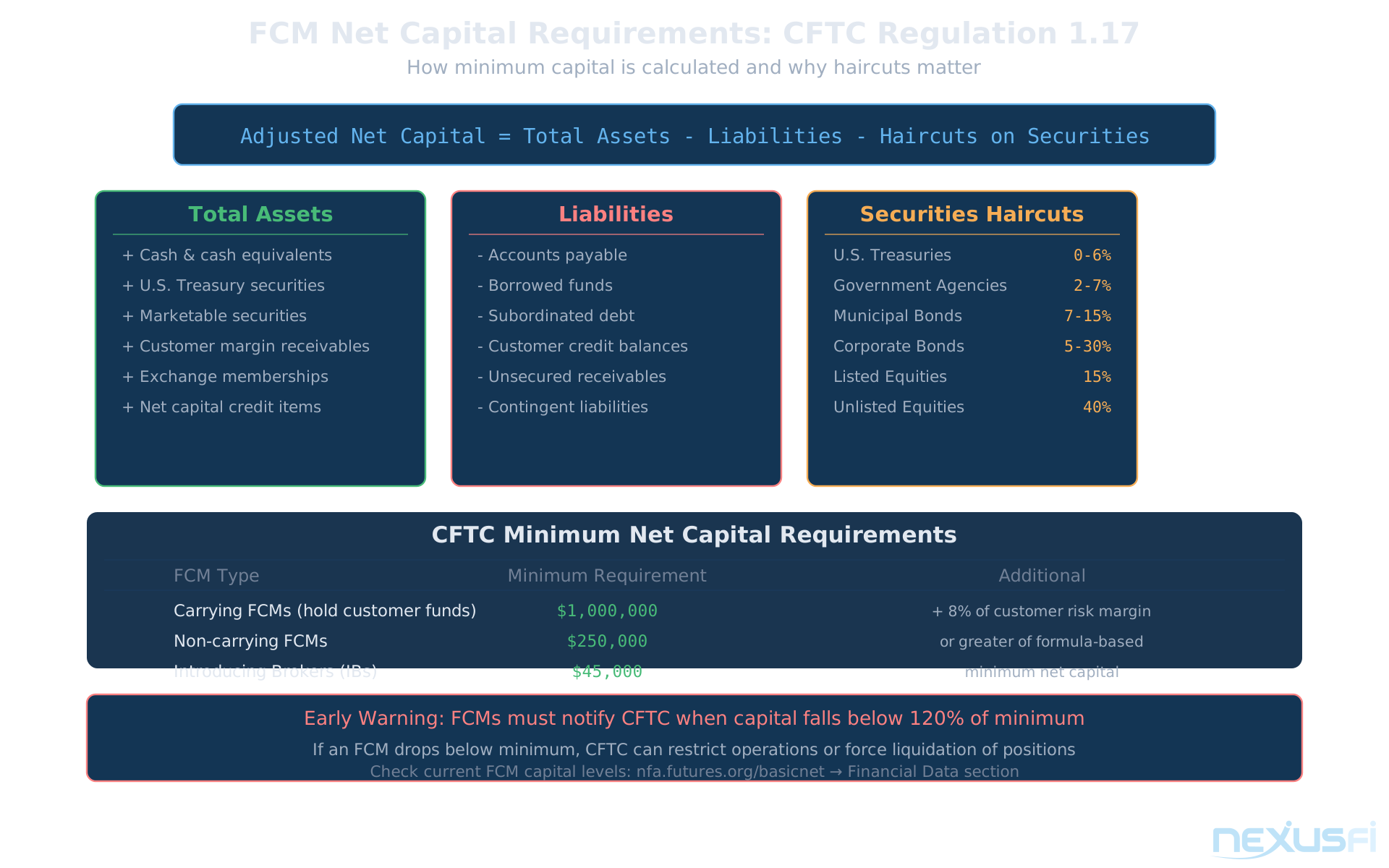
CFTC Regulation 1.17 sets net capital requirements for FCMs, covering the specific calculation methods and haircuts that determine whether an FCM meets regulatory capital minimums. @Big Mike documented the specifics at NexusFi, including how capital haircuts under CFTC Reg 1.17 stack for different asset categories.
MF Global in 2011 was the defining retail-awareness event: the firm improperly transferred customer segregated funds to cover proprietary trades, and customers waited months or years to recover their money. The @djkiwi post-PFG due diligence thread captures the community's response — exhaustive scrutiny of capital statements, segregation practices, and sweep programs became routine after both MF Global and Peregrine Financial (PFG) failures.

How Regulation Touches the Trading Lifecycle #
Regulatory requirements aren't theoretical — they show up at every stage of your relationship with the futures market.
Account Opening and KYC #
When you open a futures account, your broker performs onboarding checks mandated by NFA rules: identity verification, suitability questions about trading experience and risk tolerance, required risk disclosures, and review of organizational documents if you're trading through an entity. For managed or discretionary accounts, additional scrutiny applies.
This isn't bureaucratic box-checking. The disclosures you sign document your acknowledgment of specific risks the regulator requires you to know about before you're exposed to leverage.
Order Routing and Exchange Surveillance #
Once your order hits the exchange, you're inside the exchange's surveillance perimeter. CME Group's surveillance systems monitor in real time: quote-to-trade ratios, cancellation patterns, order bursts, layering behavior, and unusual concentration. Both automated pattern detection and human analyst review are part of this process.
@artemiso captured an important operational reality in the NexusFi HFT thread: CME sets messaging limits at the clearing firm level that cascade down to individual traders. The surveillance capability isn't limited to large players — it extends to order behavior patterns across all participants.
Active DOM traders and algo users should understand this clearly: fast cancel/re-enter behavior that seems like normal liquidity management can still draw scrutiny if the pattern fits the profile of disruptive intent.
Clearing, Margin, and Daily Settlement #
After execution, the clearinghouse novates the trade and becomes the central counterparty for both sides. Margin is recalculated daily, variation margin moves cash between winners and losers, and the clearinghouse continuously stress-tests positions.
Margin requirements can change quickly during volatility. CME Clearing typically provides 48-hour advance notice for significant margin increases (greater than 20% changes), but in fast-moving markets, requirements can adjust on shorter timelines. Position sizing must account for margin-jump risk, not just current requirements.
Settlement and Delivery #
Most retail futures traders close or roll positions well before expiration. For cash-settled contracts like ES and NQ, the position settles to a cash value referenced to the index at expiration. For physically delivered contracts like crude oil (CL), gold (GC), and agricultural futures, holding through expiration creates actual delivery obligations.
Brokers often impose their own earlier cutoffs for physically delivered contracts. Ignoring delivery mechanics in a physically delivered contract isn't a paperwork problem — it's a trade gone wrong with real-world consequences.
Customer Fund Segregation as Ongoing Protection #
Segregation isn't a one-time account setup requirement — it's an ongoing obligation. FCMs must compute daily segregation calculations to ensure compliance. The EdgeClear thread on NexusFi captures the principle: "This customer segregation protection is a core principle of the futures industry. We take customer funds and the risk in trading very seriously."

Key Rules Retail Traders Actually Encounter #
Position Limits and Accountability Levels #
Position limits cap the number of contracts a trader may hold in specified markets, especially in the spot month approaching expiration. Accountability levels are lower thresholds that don't prohibit holding but trigger exchange inquiry — the exchange can ask for your trading rationale and risk information when you approach or exceed them.
Position limits vary by contract, by delivery month (spot-month limits are tighter than all-months limits), and differ for physical delivery vs. cash-settled contracts. Speculative position limits exist to prevent any single participant from dominating a market near delivery and creating artificial price pressure.
Don't rely on static numbers from any article — limits change via exchange rulemaking and CFTC approval. For current contract-specific limits, verify directly from CME's published position limit schedule.
Most retail traders never approach spot-month limits even at meaningful size. The accountability level is typically hit first. If you scale aggressively in any single contract, know where your aggregate position lands relative to both thresholds.
Large Trader Reporting and Form 40 #
The CFTC uses large trader reporting to monitor concentration and detect manipulation. When your aggregate position exceeds a reportable threshold, your FCM may be required to report your positions to the CFTC.
The CFTC can then request a Form 40 — a disclosure document identifying who controls the position, why it's held, and the organizational structure behind it. As the @Schnook thread on large trader reporting explains: "A reportable trader must file a Form 40 on call by the Commission or its designee. Every person who holds or controls a reportable position must file."
"Reportable" doesn't mean illegal. It means the CFTC is watching aggregate concentration. Keep records showing the purpose of large positions — speculative intent, hedging relationships, or fund-level aggregation — because a Form 40 request asks exactly those questions.
Anti-Manipulation Rules and CME Rule 575 #
CME Rule 575 is the foundational anti-disruptive trading standard for CME Group markets. It prohibits entering orders that create a false impression of market depth or activity, including behavior that fits the profile of spoofing.
The prohibited conduct includes:
Spoofing — placing orders with the intent to cancel before execution to influence other participants' behavior. Layering — multiple coordinated spoof orders on one or both sides of the book simultaneously. Wash trading — buying and selling the same contract with no genuine change in market position. Banging the close — executing at or near settlement to influence the reference price.
@iantg captured the surveillance reality in the NexusFi scalping thread: a pattern of orders that might look like normal activity to a retail trader can still be submitted to CME for investigation if it creates a documented impact on price behavior.
The issue isn't that you cancel orders — active DOM traders cancel and re-enter constantly. The issue is whether your order placement pattern is designed to move price rather than express genuine directional demand. If your strategy depends on creating false signals to push other participants out of their positions, you're in violation territory.
Trading Halts, Limit Moves, and Circuit Breakers #
Exchanges can impose price limits, trading pauses, and outright halts in response to extreme volatility.
For S&P 500 futures (ES), CME has circuit breaker levels tied to the underlying index: a 7% move triggers a 15-minute halt (Level 1), a 13% move triggers another halt (Level 2), and a 20% move triggers a halt for the remainder of the trading session. Agricultural and energy futures have product-specific limit-move structures that can leave contracts locked limit-up or limit-down for extended periods.
The consequence traders underestimate: stop orders may not fill during limit moves. If you're long crude oil and the market locks limit-down, there may be no market on the other side of your stop. Position sizing for physically delivered, volatility-sensitive contracts needs to account for gap-and-lock risk.
Disclosure Requirements #
NFA rules require brokers and advisors to provide standardized risk disclosures before you trade. For managed accounts, CTAs and CPOs must provide regulated disclosure documents covering fees, drawdown history, conflicts of interest, and the specific trading program's approach.
If you're evaluating a CTA or managed futures product, demand a Disclosure Document. Verify NFA registration and disciplinary history in BASIC. Track records can be cherry-picked — look for VAMI going back at least three years across full market cycles, and verify that the track record is audited or at minimum NFA-reviewed.


Self-Regulation in Practice #
CME Group's Dual Role #
CME Group simultaneously runs a for-profit exchange business and performs SRO functions under CFTC oversight. These roles coexist without inherent conflict — the exchange has strong incentives to maintain market integrity because manipulation and abuse destroy the trust that makes futures markets function.
CME's Market Regulation department operates surveillance independently of the commercial exchange business. Investigations can begin based purely on algorithmic flags, without any human complaint. When surveillance identifies a potential violation, the process runs from alert to analyst review to formal enforcement determination — fines, suspensions, or market access restrictions.
Exchange discipline can happen fast. The exchange doesn't need a federal court order to restrict your market access.
NFA as Complementary SRO #
While CME handles venue conduct, NFA handles intermediary conduct. NFA audits FCMs and IBs, reviews financial statements, enforces customer protection practices, and runs the arbitration program. A trader can face exchange discipline and NFA action simultaneously — they're parallel tracks, not alternatives.
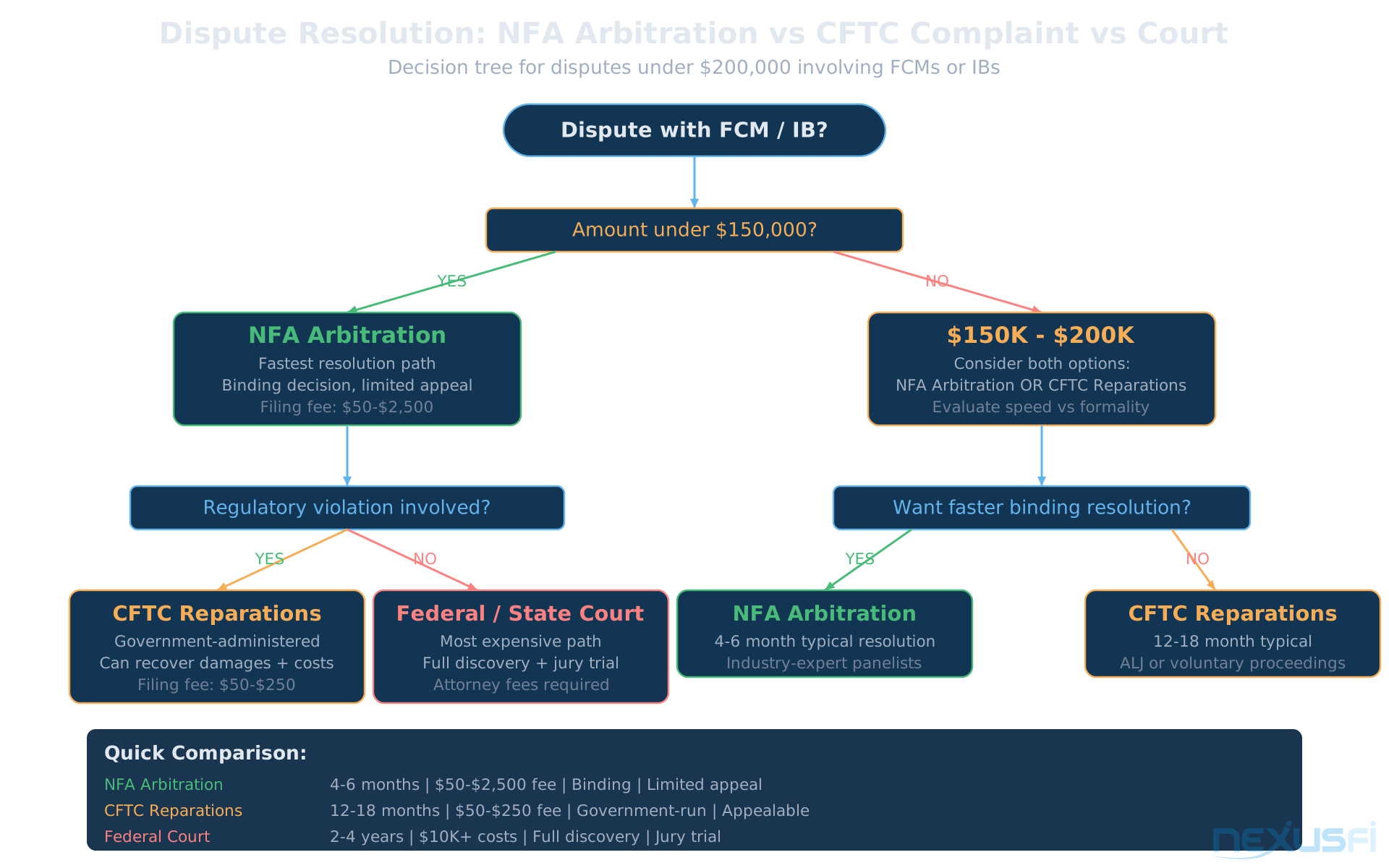
For retail traders, NFA discipline matters most when your broker's conduct is the issue: unauthorized trading, misappropriation of funds, fraudulent statements, failure to supervise. The NFA arbitration program provides dispute resolution with a $200,000 claim limit for most retail disputes.

Dodd-Frank's Lasting Impact on Futures Markets #
The 2008 financial crisis, and the derivatives exposure it revealed, drove the most significant U.S. derivatives regulation reform since the CFTC was created.
The Core Reform: Push to Clear #
The Dodd-Frank Wall Street Reform and Consumer Protection Act (2010) pushed standardized OTC swaps toward exchange-like infrastructure — central clearing through DCOs, trade reporting to Swap Data Repositories, execution on regulated Swap Execution Facilities. Listed futures already had central clearing, daily mark-to-market, and transparent reporting. OTC swaps had none of that.
What Changed for Retail Futures Traders #
The direct impact on retail futures trading was more incremental than fundamental, because exchange-traded futures already had most of the infrastructure Dodd-Frank required.
What strengthened: the position limits framework got more formal and enforceable. FCM capital standards got clearer requirements under CFTC Regulation 1.17 and 1.18. Anti-manipulation enforcement became more aggressive with higher civil penalties. Overall surveillance and reporting data became richer.
What stayed the same: daily margin calls and variation margin methodology. Basic account KYC requirements. CME and ICE rulebooks governing market-specific conduct. The fundamental experience of opening an account, placing orders, and managing positions.
The meaningful long-term effect: the overall surveillance and enforcement system is better resourced, more data-driven, and faster to act than pre-2008. Large, persistent positions are more visible. FCM capital can be verified on NFA BASIC.

Practical Due Diligence Checklist #
Verify Registration Before Funding #
Before wiring funds to any broker, advisor, or introducing firm, search NFA BASIC for the firm name and associated individuals. Confirm current registration status. Review any disciplinary disclosures — fines, suspensions, arbitration outcomes. Check the financial-responsibility level and net capital figures where available.
This five-minute search has a documented track record of catching problems before they cost traders money.
Monitor What Can Affect Your Positions #
Subscribe to CME and ICE notice systems (email or RSS) and review them before market open. Margin changes can arrive with 48 hours notice — or less in volatile conditions. Contract specification changes, delivery procedure updates, and expiration schedule adjustments affect active positions directly.
Set up a routine: check exchange notices weekly (or daily if you carry positions through volatile periods), verify that your contract margin requirements match current exchange published levels, and flag changes to limit-move parameters for the contracts you trade.
Documentation to Maintain #
If a dispute occurs, documentation is your defense. Keep: account statements (download monthly), trade confirmations and execution reports, order history, margin call notices, and any written representations from broker staff.
For larger positions, maintain records of strategic rationale — whether a position is speculative, part of a hedging program, or part of an entity structure. If you receive a Form 40 request or accountability inquiry, documented intent matters.
Filing a Complaint #
Escalation path: start with the broker's compliance department (a formal written complaint creates a documented record). If unsatisfactory, escalate to NFA's complaint center for disputes involving NFA members. For suspected fraud, manipulation, or serious violations, the CFTC maintains a public complaint and whistleblower program.
NFA arbitration handles disputes up to $200,000 for most retail claims. The process is faster and cheaper than court, but you give up the right to a jury trial. Preserve all documentation before filing.

What Every Serious Futures Trader Needs Memorized #
Know the hierarchy: CFTC sets federal rules, NFA regulates intermediaries, exchanges govern market conduct, clearinghouses manage default risk, FCMs interface with your account.
Understand why it exists: market integrity, customer protection through segregation, systemic risk containment through clearing and margin.
Map rules onto your workflow: onboarding and KYC, order routing and surveillance, daily clearing and margin, position limits as you scale, and ongoing FCM quality as ongoing account safety.
Treat order-entry discipline as compliance, not just style. Large, persistent positions are visible to exchange surveillance and potentially reportable to the CFTC. Segregation and FCM quality are risk factors as real as your strategy's drawdown profile.
The regulatory system isn't designed to prevent every loss. But it's the infrastructure that keeps U.S. futures markets among the most liquid and trustworthy in the world. Trade inside it intelligently, and it works for you.
Knowledge Map
Go Deeper
Build on this knowledgeReferences This Article
Articles that build on this topicCitations
- — Spoo-nalysis ES e-mini futures S&P 500 (2015) 👍 8“Documented the 2015 spoofing case in ES futures and increasingly sophisticated CME surveillance tools for detecting disruptive order patterns.”
- — HFT High Frequency Trading (2015) 👍 6“CFTC probe of high-frequency firm Allston Trading for alleged manipulation.”
- — Is Amp at risk of going under? (2020) 👍 12“You need to understand that there is NO INSURANCE for funds deposited with an FCM.”
- — CFTC Capital Requirements for FCMs (2020) 👍 8“CFTC Regulation 1.17 sets net capital requirements for FCMs, covering specific calculation methods and haircuts.”
- — Futures Broker Due Diligence Notes post PFG (2012) 👍 18“Exhaustive scrutiny of capital statements, segregation practices, and sweep programs became routine after MF Global and Peregrine Financial failures.”
- — HFT High Frequency Trading (2015) 👍 5“CME sets messaging limits at the clearing firm level that cascade down to individual traders.”
- — Edge Clear futures broker www.edgeclear.com (FT71) (2020) 👍 4“This customer segregation protection is a core principle of the futures industry. We take customer funds and the risk in trading very seriously.”
- — NinjaTrader Clearing Risks (2024) 👍 3“Discussion of clearing risks and segregation principles for retail futures traders.”
- — CFTC / Large Trader (2020) 👍 7“A reportable trader must file a Form 40 on call by the Commission or its designee. Every person who holds or controls a reportable position must file.”
- — Scalping activity recognition (2018) 👍 5“A pattern of orders that might look like normal activity can still be submitted to CME for investigation if it creates a documented impact on price behavior.”
- — futures vs swaps (2018) 👍 9“One of things Dodd-Frank wanted to achieve was greater transparency of what deals were out there between companies. It brought in such stringent reporting requirements.”
- — Commodity Exchange Act & Regulations
- — CME Group Market Regulation Advisory Notice RA2107-5: Rule 575 - Disruptive Practices Prohibited
- — NFA BASIC - Background Affiliation Status Information Center