



FINRA: The Rule-Maker Behind Every U.S. Broker-Dealer
If you trade stocks or options through a U.S. brokerage account, FINRA touches nearly every aspect of your relationship with that broker — from how the firm handles your margin account, to what happens if you dispute a trade, to whether you can day trade freely or face restrictions. Yet most traders know almost nothing about FINRA beyond the pattern day trader rule.
The Financial Industry Regulatory Authority is not a government agency. It cannot arrest anyone or levy criminal charges. What it can do is make and enforce rules governing approximately 3,400 broker-dealer firms and 612,000 registered representatives — with real consequences: fines running into the millions, permanent industry bars, and restitution orders that can include your account losses.
Understanding FINRA means understanding what protections you have, where they end, and what recourse is available when a broker behaves badly. It also means knowing what FINRA does not do — futures traders operate under a completely separate regulatory framework, and conflating FINRA rules with futures regulation leads to wrong conclusions about account restrictions, trading rights, and regulatory protections.
Overview #
This article covers what FINRA is and how it regulates broker-dealers, the 23-year-old pattern day trader rule and its 2026 replacement with risk-based margin, how margin requirements stack across federal, FINRA, exchange, and broker layers, and practical tools like BrokerCheck for due diligence. It also maps the jurisdictional boundaries between FINRA, SEC, CFTC, and NFA to help traders understand which rules apply to their accounts.

What FINRA Is -- and What It Is Not #
FINRA is a self-regulatory organization (SRO) — a private, non-governmental body that exercises regulatory authority over its member firms by contract and by authority delegated from the Securities and Exchange Commission. The SEC retains ultimate oversight of FINRA, approving major rule changes and reviewing operations. Day-to-day regulation of broker-dealer conduct happens within FINRA's framework.
FINRA's membership is mandatory for firms that want to act as broker-dealers in the United States. If a firm wants to execute securities transactions on behalf of customers, it must register with the SEC and become a FINRA member. This creates the regulatory relationship that gives FINRA its authority.
What FINRA regulates is firm and representative conduct — the how of doing business, not the what of the markets themselves. FINRA does not care whether Apple's stock should be worth $150 or $200. It cares whether the broker who recommended Apple disclosed all material information, whether the recommendation was suitable for your risk profile, whether the firm's supervision was adequate, and whether you were treated fairly.
What it can do is make and enforce rules governing approximately 3,400 broker-dealer firms and 612,000 registered representatives — with real consequences: fines running into the millions, permanent industry bars, and restitution orders that can include your account losses.
The distinction between market regulation (SEC, CFTC, exchanges) and conduct regulation (FINRA, NFA) is fundamental. FINRA has jurisdiction over broker-dealer sales practices but not over, for example, whether high-frequency trading algorithms need additional rules — that falls to the SEC and exchange rules.
How FINRA Regulates Broker-Dealers #
FINRA's regulatory toolkit has five main components.
Rulemaking creates the standards broker-dealers must meet. Key rules traders encounter most frequently: Rule 4210 (margin requirements), Rule 2111 (suitability), Rule 5310 (best execution), and Rule 2520 (day trading). Major rule changes require SEC approval, checking FINRA's self-regulatory authority.
Examination and Surveillance monitors whether firms follow the rules. FINRA conducts regular firm examinations and runs surveillance systems that scan trading data for patterns suggesting violations.
Enforcement handles rule violations. Investigations begin from examination findings, customer complaints, regulatory referrals, or surveillance alerts. Document requests, witness interviews, and trading data analysis follow. Most cases settle — firms pay fines, agree to enhanced supervision, and often provide customer restitution. Contested cases go to hearing panels. Sanctions range from fines to permanent industry bars.
Dispute Resolution provides arbitration between customers and member firms — the largest securities arbitration forum in the United States. Most brokerage customer agreements require FINRA arbitration as the exclusive dispute resolution method.
BrokerCheck makes disciplinary history publicly searchable at brokercheck.finra.org, free for anyone.
The Pattern Day Trader Rule: 23 Years and the 2026 Change #
No FINRA rule touches more retail traders than the pattern day trader (PDT) rule. Understanding exactly what it requires, how it works mechanically, and what the 2026 change actually means requires cutting through significant mythology.

The Original Rule: Born From the Dot-Com Crash #
The pattern day trader rule emerged from NASD Rule 2520 in 2001, following problems during the dot-com boom. Online trading democratized intraday equity trading for small accounts with margin. When markets crashed, many small accounts were wiped out with outstanding margin balances — losses brokers had to absorb. Regulators concluded a minimum capital threshold would ensure traders had enough equity to absorb intraday losses.
The rule defined a "pattern day trader" as any customer executing four or more day trades within a rolling five business day period (if those trades exceeded 6% of total trading activity). As bobwest explained to a fellow NexusFi trader, "if you do over 3 in a 5-day period, you run into the pattern day trader rule — they have defined you as having a day-trader pattern on the 4th day-trade." [6] Pattern day traders were required to maintain $25,000 minimum equity in their margin account. Falling below triggered restrictions until the account was restored.
The $25,000 number was not derived from sophisticated risk analysis — it was a round number chosen to ensure meaningful skin in the game without completely excluding the emerging class of retail active traders. The rule represented 2001's view of "adequate" capitalization for active trading.
For the next two decades, the rule remained basically unchanged — even as zero-commission trading, mobile apps, fractional shares, and real-time risk analytics transformed retail trading. The $25,000 floor stayed frozen in 2001. As NexusFi community member bobwest noted while looking up Interactive Brokers' definition: "FINRA and the NYSE define a Pattern Day Trader (PDT) as one who effects four or more [day trades within five days]" — a rule that has frustrated generations of undercapitalized traders. [1] As another community member put it, "Based on FINRA and NYSE day trading rules, any account that places 4 day-trades in a 5 trading day period is permanently deemed to be a Pattern Day Trading Account" — and the consequences were immediate and inflexible. [10]
The 2025 FINRA Board Vote #
In September 2025, FINRA's Board of Governors voted to replace the static $25,000 minimum with a risk-based intraday margin framework. The vote followed a retrospective review FINRA launched in 2024, asking whether 2001 rules were still appropriate.
The Board's reasoning: technology has at the core changed what is possible. In 2001, calculating real-time intraday portfolio exposure was computationally expensive and operationally difficult for many brokers. In 2025, the same calculation happens in milliseconds. The $25,000 static threshold was a crude proxy for risk because precise calculation was impractical. With real-time risk calculation now routine — already applied for options and futures accounts — the static threshold was no longer the right tool.
As Fi reported when the board vote occurred: "FINRA's Board of Governors voted to replace the 23-year-old $25,000 minimum equity requirement for pattern day traders with an intraday margin rule based on actual risk exposure. The change applies existing maintenance margin rules to intraday positions rather than enforcing a fixed dollar threshold." [2] SEC approval was still required.
SEC Approval: April 14, 2026 #
On April 14, 2026, the SEC granted accelerated approval under Release No. 34-105226. The accelerated approval — unusual, signaling the SEC viewed the change as non-controversial — triggered a 45-day implementation window for broker-dealers, beginning when FINRA publishes its official Regulatory Notice announcing the approval. As of this writing, that Regulatory Notice has not yet been published; SEC approval is necessary but not sufficient.
The three-step sequence matters for traders: (1) SEC approval — complete; (2) FINRA publishes Regulatory Notice — pending; (3) brokers implement within 45 days of step 2 — not yet started. As the NexusFi community discussion clarified: "SEC approval is necessary but not sufficient. FINRA's notice is what legally starts the clock for broker compliance. Until that's published, any broker that dropped PDT enforcement early would technically be ahead of the regulatory requirement." [3]
What the Change Actually Means #
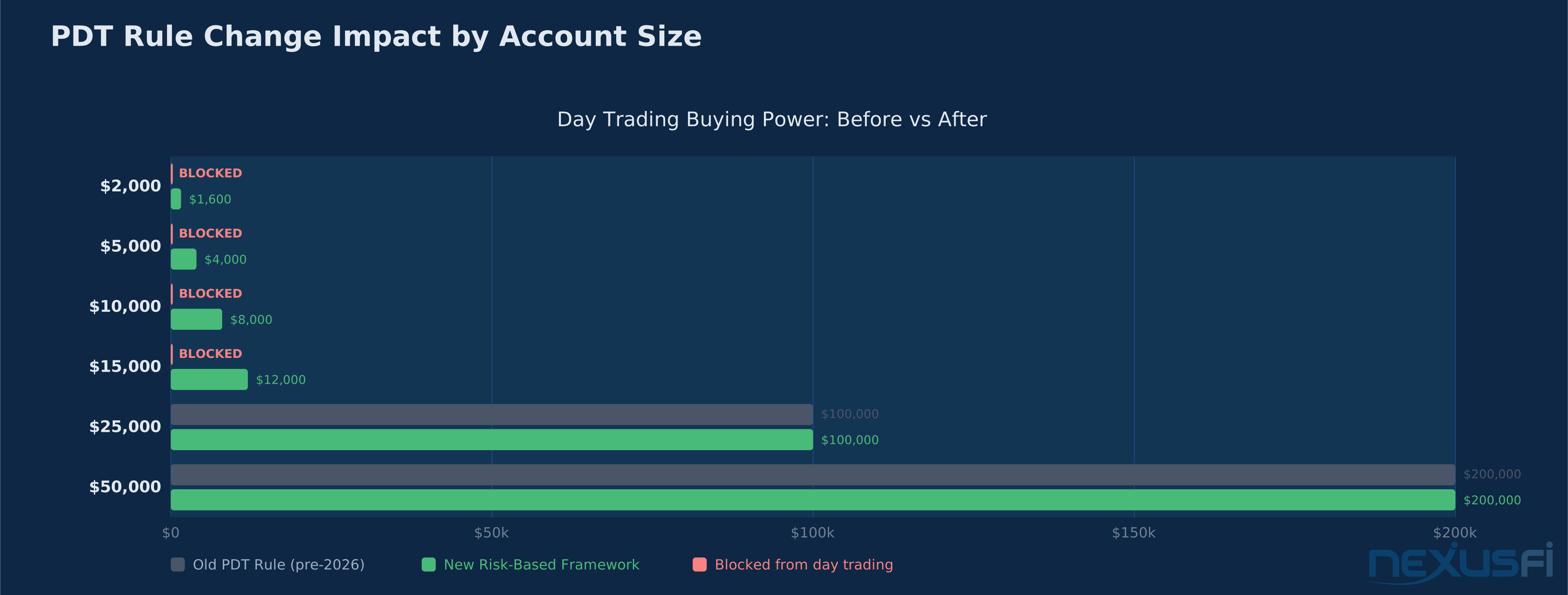
The new framework replaces the flat $25,000 minimum with maintenance margin requirements applied to intraday positions. Instead of asking "does this account have $25,000 in equity?" the rule asks "does this account have enough equity to cover the maintenance margin on its actual intraday positions?"
For accounts already above $25,000, practical impact is minimal. The significant change is for accounts below $25,000 — they are no longer categorically blocked from day trading by equity level alone.
However, the removal of the $25,000 floor does not mean unlimited day trading for small accounts:
Risk-based buying power. Day trading buying power scales with the margin requirement of each position. A small account can take positions its maintenance margin can support. It cannot take leveraged positions requiring margins beyond its equity.
Broker house margin rules. As the NexusFi discussion observed: "FINRA Rule 4210 defines the minimum; individual firms layer their own risk tolerances on top." [3] A broker might require $5,000 internal equity minimum even when the regulatory floor drops below that.
Differentiation by broker type. App-based brokers (Robinhood, Webull) will likely implement at the regulatory minimum quickly — removing PDT barriers drives their user acquisition. Traditional risk-focused brokers may maintain higher internal requirements. Webull announced on April 15, 2026 they would "be among the first retail brokerages to bring the updated intraday trading framework to clients."

The Honest Assessment #
Democratizing day trading access sounds appealing. The uncomfortable reality is that the $25,000 minimum was arbitrary, but it served as a crude filter: studies consistently show 70-80% of retail day traders lose money. Capital requirements change; human psychology does not. Smart traders will not change their approach based on regulatory minimums — they will continue sizing positions based on actual risk tolerance and maintaining adequate capital buffers. The rule change matters most for brokers and beginning traders who have not yet learned why adequate capital matters, not for established traders managing risk properly.
How Margin Requirements Stack #
Margin trading involves four distinct layers of requirements, each of which can be stricter than the layer below. Understanding this stack prevents confusing regulatory minimums with what your broker actually enforces.

Layer 1: Federal Reserve / Regulation T. Sets the baseline initial margin — 50% for most equity securities. Buying $10,000 of stock requires at least $5,000 of your own equity.
Layer 2: FINRA Rules. Rule 4210 sets maintenance margin requirements — 25% for long positions in most securities. Higher minimums apply for concentrated positions, volatile securities, and short positions.
Layer 3: Exchange Requirements. Options clearing models (OCC) and futures performance bonds (CME, CBOE) specify requirements for derivatives that can much exceed FINRA minimums for complex strategies.
Layer 4: Broker House Margin. The layer most traders encounter — always at least as strict as regulatory minimums and frequently stricter. A broker might require 30% maintenance margin instead of FINRA's 25% minimum, or 75% initial margin for volatile securities. Cobra Trading maintained a $30,000 minimum for certain accounts even before the PDT changes. As @SMCJB observed from direct experience, "IB have some of the highest margin requirements and some of the most aggressive liquidation policies" — an important reminder that house margin can substantially exceed regulatory minimums. [7]
The practical rule: the margin enforced on your account is always the highest applicable layer. Knowing FINRA's minimum is necessary but not sufficient — your broker's house rules often determine what you can actually trade.
FINRA BrokerCheck: Your Due Diligence Tool #
BrokerCheck at brokercheck.finra.org is free and requires no login. Every trader should use it before opening an account.

For the firm, check: Registration status (active FINRA member?). Disclosure events — regulatory actions, civil judgments, bankruptcies. The number and nature of customer complaints. Pattern recognition is key: a single complaint may be normal business; the same type of complaint recurring across years at different firms is a warning sign.
For the registered rep, check: Current state registration. Employment history (frequent firm changes warrant scrutiny). Disclosure events — each complaint should be evaluated for context and pattern. Has the same type of conduct been alleged repeatedly?
NexusFi community member danielk's advice on broker due diligence remains sound: "I'd also advise looking up the companies at NFA — National Futures Association and BrokerCheck to reveal any prior disciplinary actions. Note that it can be tricky finding the 'right' broker, as you have to nail the search term, and check any/all parent/daughter companies in my experience." [4]
One important caveat: BrokerCheck allows expungement of certain disclosure events. A history that appears unusually clean for a long-tenured rep may reflect successful expungements rather than a genuinely pristine record.
For futures traders: NFA's BASIC system at nfa.futures.org serves the equivalent function. Search your FCM and any introducing broker before opening a futures account.
FINRA Enforcement: When Rules Have Consequences #
Enforcement is how FINRA gives its rules teeth. The process is investigative rather than prosecutorial — FINRA does not arrest people or bring criminal charges. What it can do is impose industry bars that end careers and fines that can bankrupt firms.

An investigation typically begins with one of four triggers: a routine firm examination finding; a customer complaint; a referral from another regulator; or anomalies detected by FINRA's market surveillance systems. Investigations involve document requests, witness interviews, and trading data analysis. Most enforcement matters settle — fines, enhanced supervision, and sometimes customer restitution — without an admission of wrongdoing. Contested cases go to hearing panels with potential sanctions including permanent industry bars.
What enforcement patterns tell traders: Supervision failures are chronically the most common category — broker-dealers that fail to adequately supervise registered reps. This is not because supervision is especially hard; it is because adequate supervision requires ongoing investment in compliance staff and systems. Firms that cut compliance corners to improve profitability create supervision failures that become enforcement actions.
Suitability violations typically involve recommending complex products to customers whose profiles do not match — options strategies to retirees, concentrated positions to customers needing diversification. The stakes are real: when Interactive Brokers settled charges in 2020 for failing to flag suspicious activity and AML compliance failures, the combined SEC and CFTC fines exceeded $38 million — a case that @Big Mike flagged for the NexusFi community. [8] Options supervision violations overlap substantially: firms allowing complex options strategies without proper approval processes or monitoring are frequent targets.
For traders, the enforcement record is signal. A firm with multiple options supervision enforcement actions is telling you something about its compliance culture that is relevant to whether you want to trade options with them.
FINRA Arbitration: When Brokers Do Wrong #
When a broker-dealer harms you, FINRA arbitration is almost certainly your primary avenue for legal recourse. Most brokerage customer agreements include mandatory arbitration clauses — you agreed to this when signing your account agreement.

Common claim types: Unsuitable recommendations (the largest single category); misrepresentation and omissions; unauthorized trading; excessive trading (churning); failure to supervise; and margin account mismanagement.
The process: File a claim with FINRA Dispute Resolution Services and pay the filing fee ($50 to $1,800+ depending on claim size). Respondents file answers. Arbitrators are selected from FINRA's roster through a ranking and striking process — three-person panels for claims over $100,000, single arbitrators for smaller claims. The discovery phase is more limited than civil litigation. Many cases settle before the hearing stage. Hearings produce binding decisions. Awards can be challenged in court only on narrow grounds (fraud in the proceeding, arbitrator bias, or arbitrator misconduct) — not on the merits.
FINRA also offers voluntary mediation as an alternative — faster, cheaper, non-binding, and successful in resolving a significant percentage of cases where both parties have incentive to settle. For claims under $250,000 where the relationship has not completely broken down, exploring mediation before formal arbitration is generally sound strategy.
Practical preparation: Document everything before a dispute arises. Keep all trade confirmations, account statements, and written communications with your broker. When receiving recommendations for complex strategies — especially options, concentrated positions, or anything involving leverage — get the recommendation and risk disclosures in writing. In arbitration, your ability to prove what the broker told you depends on what you can document. Verbal representations become factually contested, and contested claims are harder to win.
FINRA vs. SEC vs. CFTC: The Regulatory Map #

The regulatory environment involves multiple agencies with overlapping but distinct jurisdictions. The practical question for traders: which regulator governs what you are actually doing?
The SEC is the federal regulator for securities markets, created by the Securities Exchange Act of 1934. It has broad authority over exchanges, broker-dealers, investment advisers, and mutual funds. The SEC oversees FINRA, approves its rules, and directly enforces federal securities law against manipulation, fraud, and insider trading.
The CFTC (Commodity Futures Trading Commission) is the federal regulator for futures and swaps markets. It has jurisdiction over equity index futures (E-mini S&P 500, Nasdaq-100), agricultural futures, energy futures, and related derivatives.
FINRA regulates broker-dealer conduct in the securities space. It does not regulate futures markets or CFTC-regulated instruments. A broker-dealer that also operates as a Futures Commission Merchant (FCM) is subject to both FINRA jurisdiction (for securities operations) and CFTC/NFA jurisdiction (for futures operations) — regulated separately, with boundaries drawn at the product type.
The NFA (National Futures Association) is the SRO for the U.S. derivatives industry — the FINRA equivalent for futures, swaps, and related instruments. FCMs, introducing brokers, commodity pool operators, and trading advisors must be NFA members.
In practice:
If you trade stocks and options through Schwab, Fidelity, or Robinhood:
- FINRA rules govern your broker's conduct
- PDT rules applied to your margin account (changing under the new framework)
- FINRA arbitration is your primary dispute forum
- FINRA BrokerCheck covers your firm and rep
If you trade E-mini S&P 500 or other futures through NinjaTrader Brokerage, Tradovate, or AMP:
- CFTC regulations and NFA rules govern your broker's conduct
- No PDT rules apply — trade long or short, intraday, without equity minimums
- NFA arbitration and reparations programs are your dispute options
- NFA BASIC covers your FCM and introducing broker
The SPY vs. ES comparison frequently discussed in the NexusFi community illustrates this: the community notes "commission and tax implications" as key differences [5] — with the regulatory framework being a third major dimension affecting account access and restrictions. The absence of PDT restrictions in futures is a genuine structural advantage for active traders who need to trade both sides of the market freely.
Options Regulation Under FINRA #
FINRA's role in options centers on three areas: account approvals, suitability, and supervision.
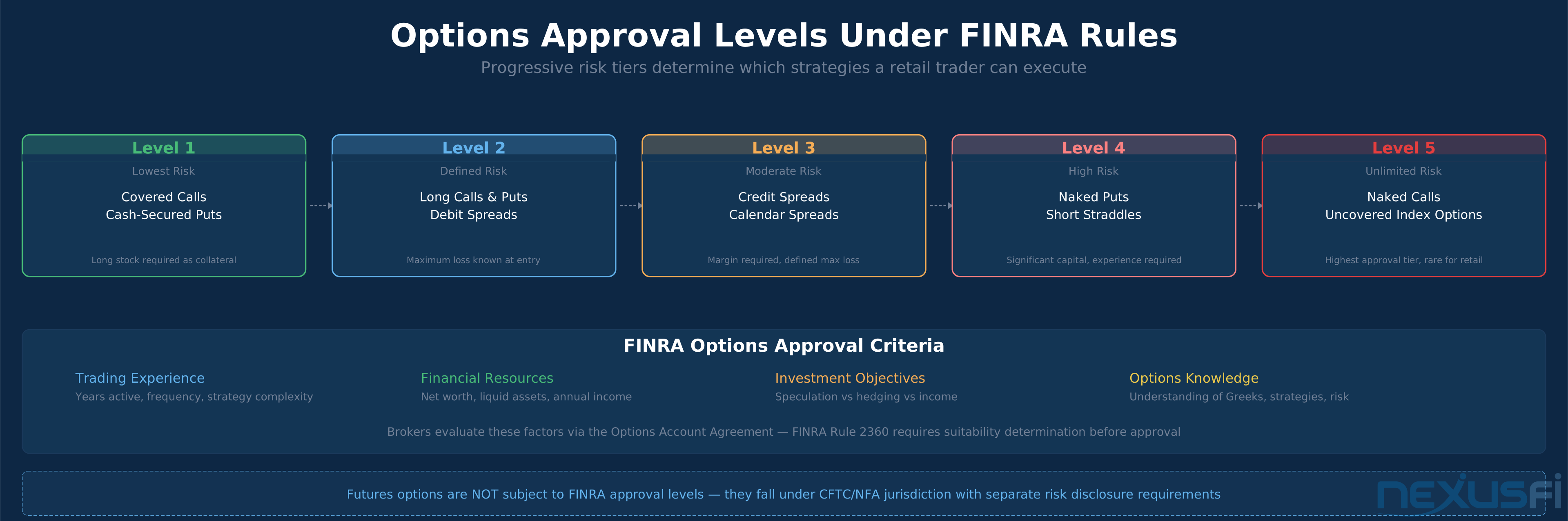
Account approval levels determine which strategies you can execute. Most brokers use a tiered system:
- Level 1: Covered calls and covered puts (own the underlying)
- Level 2: Buying calls and puts, cash-secured puts
- Level 3: Multi-leg spreads with limited risk
- Level 4: Naked writing — selling uncovered options, highest risk
FINRA rules require that the approval process be substantive, not a rubber stamp. Approving a retiree seeking income for Level 4 naked option writing requires demonstrated suitability that FINRA scrutinizes closely in enforcement.
Suitability under Rule 2111 requires matching recommended strategy risk to the customer's financial situation, objectives, time horizon, and risk tolerance. Strategies with unlimited loss potential should not be recommended to customers who need capital preservation. Self-directed accounts where customers make all decisions without recommendations carry reduced suitability obligations (though approval requirements remain).
Supervision requires broker-dealers to maintain adequate monitoring of options activity — reviewing accounts, identifying unusual patterns, ensuring specialists have appropriate qualifications. Options supervision failures are a persistent FINRA enforcement category.
For self-directed options traders, the practical implication is straightforward: your broker's approval level determines what you can execute. If you believe you qualify for a higher level, formally request upgrade approval with documentation of your experience and financial situation.
Short Selling and Wash Sales: What's FINRA, What's Not #
Short selling regulation in equities involves SEC Regulation SHO primarily — requiring brokers to have a "locate" (reasonable grounds to believe they can borrow the security) before executing a short sale, and requiring close-out of fails-to-deliver in threshold securities. FINRA enforces member firm Regulation SHO compliance.
For traders, short selling constraints are broker-level: the availability and cost of borrowing determine whether you can short and at what cost. Hard-to-borrow securities carry significant borrow fees (sometimes exceeding 100% annualized), and may require pre-locating shares before shorting. Short squeezes occur when forced short-covering at rising prices creates cascading buy pressure; the regulatory framework does not prevent them.
In futures markets, going short is mechanically identical to going long — no borrowing, no borrow fee, symmetric margin treatment. This is one of the structural advantages driving traders from equities to futures for active two-sided trading.
Wash sales are frequently associated with brokerage regulatory discussions but are an IRS tax provision (Internal Revenue Code Section 1091), not a FINRA regulation. FINRA does not enforce wash sale rules; the IRS does. Broker-dealers report wash sales on 1099-B forms, which creates the association — but the substantive rule is tax law.
The wash sale rule disallows a realized tax loss if you purchase a "substantially identical" security within 30 days before or after the sale. The disallowed loss is added to the replacement position's cost basis, deferred rather than eliminated. For active traders, chains of wash sales in frequently traded securities create complex tax-lot accounting. Options positions can trigger wash sales in the underlying under certain conditions. The practical recommendation: use tax software capable of tracking wash sales across all accounts, and consult a tax professional for complex situations.
Practical Trader Action Items #
Before opening any equities or options account: Run BrokerCheck on the firm and any individual rep. Look for patterns of complaints, not just isolated events. Read your customer agreement's arbitration clause — you are agreeing to binding arbitration.
When receiving complex strategy recommendations: Request the recommendation and its rationale in writing. Ask specifically about downside risks. Verify your options approval level matches the strategy.
When reviewing your margin agreement: Find the broker's specific liquidation policy — notice timing, triggering conditions, and liquidation priority. These vary much and can mean the difference between a manageable margin call and an account-destroying forced liquidation.
[9]
After the PDT rule changes take effect: Contact your broker's margin desk to understand new requirements if your account is below $25,000. Ask for the specific day trading buying power calculation that now applies. Understand what house margin requirements still constrain you under the revised framework.
If your broker has harmed you: Document everything before contacting the broker about the problem. Consult with a securities attorney before filing an arbitration claim — many operate on contingency for investor claims and can assess your case's merits.
For futures traders: FINRA rules do not govern your futures account. Use NFA BASIC for FCM due diligence. Your primary regulatory protections come from CFTC rules and NFA membership requirements. The absence of PDT restrictions in futures is genuine — use it thoughtfully, not recklessly.
Citations #
[1] bobwest, NexusFi Spoo-nalysis thread (September 30, 2015) — FINRA PDT definition at Interactive Brokers Spoo-nalysis ES e-mini futures S&P 500 (@tigertrader)
[2] Fi, NexusFi Brokers forum — "FINRA Approves End of $25,000 Pattern Day Trading Minimum" (September 30, 2025) FINRA Approves End of $25,000 Pattern Day Trading Minimum (@Fi)
[3] Fi, NexusFi Traders Hideout — SEC PDT rule change discussion (April 17-18, 2026) SEC Eliminates $25,000 Pattern Day Trader Rule After 25 Years — Risk-Based Margin Replaces Fla (@Fi)
[4] danielk, NexusFi Brokers forum — "Commission shopping w/brokerages" (January 9, 2014) Commission shopping w/brokerages (@Big Mike)
[5] bobwest, NexusFi Stocks & ETFs — "SPY vs ES - commission and tax implications" (October 6, 2019) SPY vs ES - commission and tax implications (@patrader65)
[6] FINRA Board of Governors Meeting Report, September 24, 2025 Source
[7] SEC Release No. 34-105226, April 14, 2026 Source
Knowledge Map
Go Deeper
Build on this knowledgeReferences This Article
Articles that build on this topicCitations
- — Spoo-nalysis ES e-mini futures S&P 500 (2015) 👍 4“FINRA and the NYSE define a Pattern Day Trader (PDT) as one who effects four or more day trades within five days”
- — FINRA Approves End of $25,000 Pattern Day Trading Minimum (2025) 👍 5“FINRA's Board of Governors voted to replace the 23-year-old $25,000 minimum equity requirement for pattern day traders with an intraday margin rule based on actual risk exposure”
- — SEC Eliminates $25,000 Pattern Day Trader Rule (2026)“SEC approval is necessary but not sufficient. FINRA's notice is what legally starts the clock for broker compliance.”
- — Commission shopping w/brokerages (2014) 👍 7“I'd also advise looking up the companies at NFA and BrokerCheck to reveal any prior disciplinary actions”
- — SPY vs ES - commission and tax implications (2019) 👍 1“Commission and tax implications of SPY vs ES”
- — Newbie seeks new Porsche via day trading (2014) 👍 3“If you do over 3 in a 5-day period, you run into the pattern day trader rule”
- — Futures Margin Leniency (2023) 👍 3“IB have some of the highest margin requirements and some of the most aggressive liquidation policies”
- — Interactive Brokers settle charges for AML compliance failures (2020) 👍 8“Interactive Brokers settle charges for failing to flag suspicious activity and AML compliance failures”
- — Question about leverage (2020) 👍 4“They do not care which positions or what your history is, they sell you out, period”
- — Questions from McMathews (2011)“Based on FINRA and NYSE day trading rules, any account that places 4 day-trades in a 5 trading day period is permanently deemed to be a Pattern Day Trading Account”