



Drawdown Recovery Mathematics: Why a 50% Loss Requires a 100% Gain and What That Means for Your Survival
Overview #
You lost 20% of your account last month. That stings, but it's recoverable — just make 20% back, right?
Wrong. You need 25%.
Lose 30%, and you need 42.9% to break even. Lose 50%, and you need to double your remaining capital just to get back to where you started. This isn't opinion or pessimism — it's arithmetic. And it's the single most important piece of mathematics that separates traders who survive from traders who blow up.
The asymmetry exists because every loss reduces the capital base from which you're compounding. After a 50% loss, you're working with half the money. That missing half now represents 100% of what you have left. The deeper the hole, the steeper the climb out — and the relationship isn't linear. It's exponential.
[As @grausch explains in a discussion about blown accounts] [1]: "There is a table showing that if you lose 10%, you need to make 11% to get back to break-even. If you lose 50%, you need to make 100% to get back to break-even. Thus, the larger the loss, the tougher it becomes to recoup that."
This article walks through the exact math, shows why it creates exponentially harder recovery paths, and lays out the professional frameworks that prevent accounts from ever reaching the danger zone in the first place.
The Asymmetry Table: What Loss Recovery Actually Costs #
The formula is straightforward:
Required Recovery Gain = Loss / (1 - Loss)
Here's what that produces across a range of drawdowns:
| Account Loss | Capital Remaining | Required Gain to Recover | Difficulty Rating |
|---|---|---|---|
| 5% | 95% | 5.3% | Routine |
| 10% | 90% | 11.1% | Manageable |
| 15% | 85% | 17.6% | Uncomfortable |
| 20% | 80% | 25.0% | Difficult |
| 25% | 75% | 33.3% | Very Difficult |
| 30% | 70% | 42.9% | Severe |
| 40% | 60% | 66.7% | Critical |
| 50% | 50% | 100.0% | Near-Fatal |
| 60% | 40% | 150.0% | Catastrophic |
| 75% | 25% | 300.0% | Terminal |
| 90% | 10% | 900.0% | Irrecoverable |
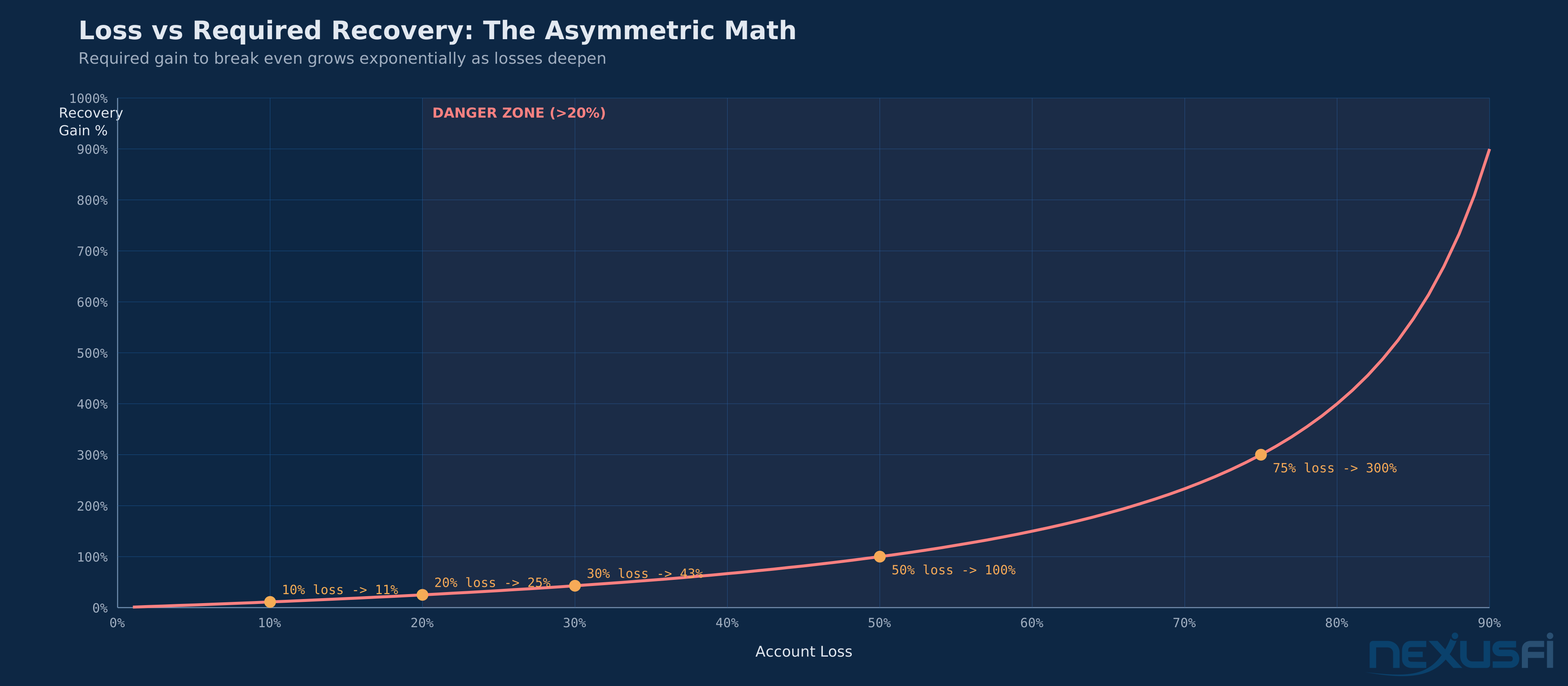
Study that table carefully. There's a critical inflection point around 20-25% where the recovery math starts becoming unreasonable. At 20% loss, you need 25% — that's still within reach for a competent strategy. At 30%, you need nearly 43% — that's asking for an solid quarter just to get back to zero. By 50%, you need to double what's left, which most strategies cannot accomplish in any reasonable timeframe.
This is why professional risk managers obsess over preventing drawdowns past 20%. It's not conservatism — it's mathematical realism.
Why the Math Works This Way #
The asymmetry stems from a fundamental property of percentage returns: they compound on a changing base.
Consider a $100,000 account. A 50% loss takes it to $50,000. Now you need to make $50,000 to recover. But $50,000 is 100% of your current $50,000 account — not 50%. The denominator changed.
Written algebraically: if your starting equity is E and you lose fraction x, your equity becomes E(1-x). To recover, you need gain y such that:
E(1-x)(1+y) = E
Solving: y = 1/(1-x) - 1 = x/(1-x)
That denominator (1-x) is the key. As x approaches 1 (total loss), the required recovery gain approaches infinity. This is why losses past 50% enter the realm of mathematical impossibility for most traders.
There's a useful rule of thumb: for small losses (under 10%), the required recovery is approximately equal to the loss plus about 10% of itself. A 5% loss needs roughly 5.3%. A 10% loss needs roughly 11%. But this approximation breaks down rapidly past 20%, where the exponential nature takes over.
The Recovery Timeline Problem #
The percentage required to recover is only half the story. The other half is time.
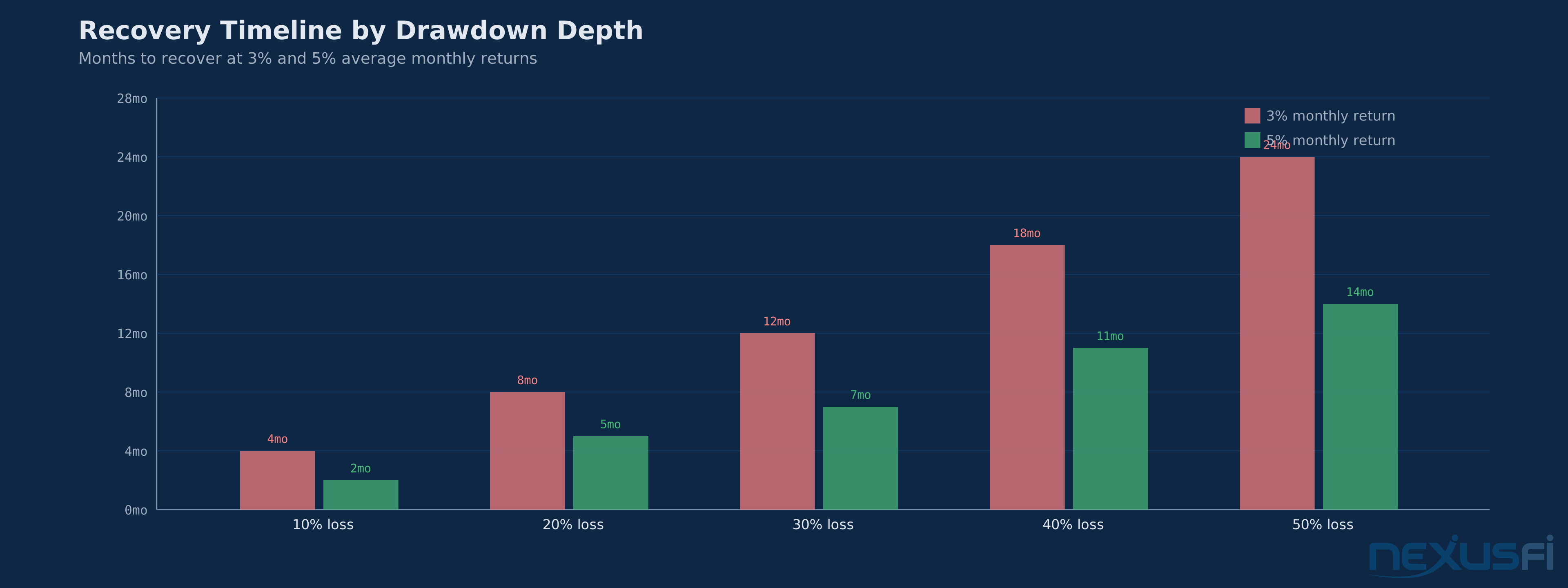
If your strategy generates an average monthly return of 3% (which is excellent for most futures traders), here's how long recovery takes from various drawdown levels:
| Drawdown | Required Recovery | Months at 3%/month | Months at 5%/month |
|---|---|---|---|
| 10% | 11.1% | ~4 months | ~2 months |
| 20% | 25.0% | ~8 months | ~5 months |
| 30% | 42.9% | ~12 months | ~7 months |
| 40% | 66.7% | ~18 months | ~11 months |
| 50% | 100.0% | ~24 months | ~14 months |
These estimates assume consistent positive returns with no further drawdowns during recovery — an optimistic assumption. In reality, you'll have losing months during the recovery period, which extends the timeline further. A 30% drawdown that theoretically takes 12 months to recover at 3%/month might take 18-24 months in practice.
This timeline problem creates a vicious secondary effect: during recovery, you're trading with reduced capital, which means reduced position sizes, which means reduced dollar returns even on winning trades. You're climbing a hill that gets steeper the longer you're on it.
[As @Small Dog points out in a rigorous discussion about risk of ruin] [2]: "Eventually the probability of blowing the account are 100% (enough monkeys with typewriters). So, removing money from risk is one way to keep it. Diversification is another. Weighing portfolio through money management is yet another."
The implication is stark: if you accept that deep drawdowns are statistically inevitable over long enough periods, the only defense is preventing them from getting deep in the first place.
Professional Drawdown Threshold Systems #
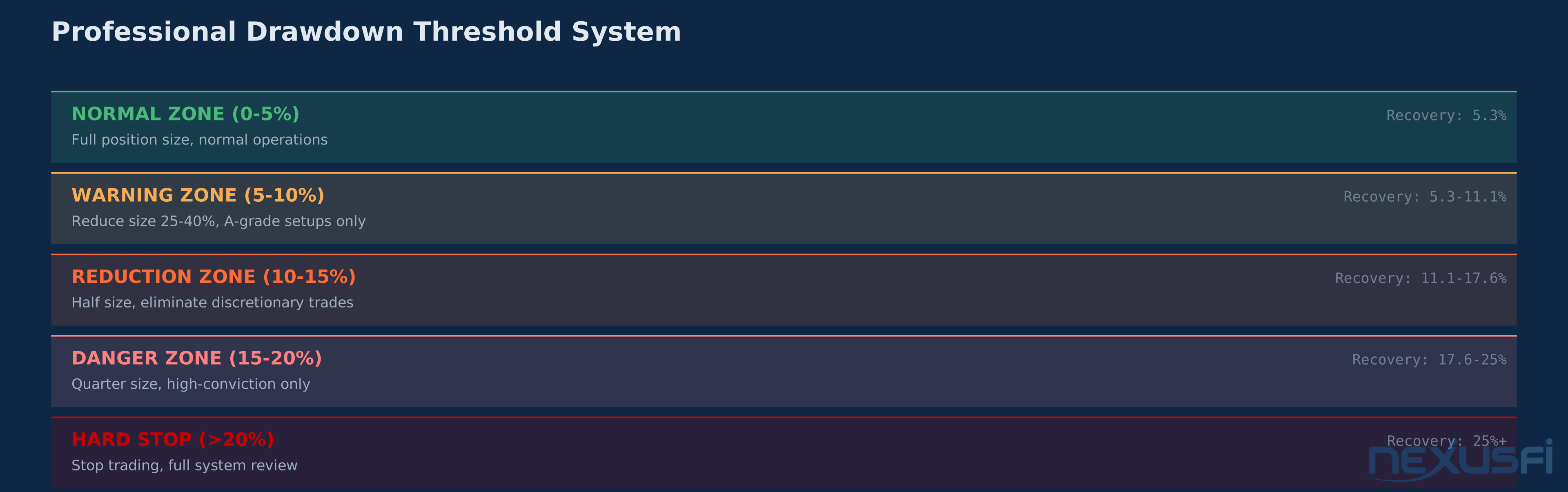
Professional trading firms, prop desks, and institutional fund managers universally implement layered drawdown threshold systems. They don't do this because they're conservative — they do it because the math demands it.
The Three-Tier Framework #
Tier 1: Warning Level (5-8% drawdown from equity peak)
At this level, the recovery math is still manageable (5.3% to 8.7% required gain). Actions:
- Review recent trades for pattern deterioration
- Tighten trade selection criteria — take only A-grade setups
- Reduce position size by 25-40%
- Increase journaling discipline
Tier 2: Reduction Level (8-15% drawdown from equity peak)
The recovery requirement has jumped to 8.7% to 17.6%. Actions:
- Cut position size by 50% or more
- Eliminate all discretionary trades
- Trade only the highest-conviction mechanical setups
- Set a mandatory daily loss limit at 50% of normal
- Review entire approach with a trading partner or mentor
Tier 3: Hard Stop (15-20% drawdown from equity peak)
Beyond 15%, recovery requires 17.6% or more. Beyond 20%, it requires 25%+. Actions:
- Stop trading entirely for a minimum defined period (1-2 weeks)
- Conduct full system review — is the edge still present?
- Switch to simulation trading before returning to live
- When resuming, start at minimum size and earn back full size through demonstrated performance
The key insight is that professional traders don't wait until they're in a deep hole to take action. They intervene early, when the math is still forgiving.
[In his NQ trading journal] [3],
His specific sizing ladder — cutting from full NQ contracts to progressively fewer micro contracts as drawdown deepens — is a textbook implementation of proportional risk reduction.
Peak-to-Trough Measurement #
Professional drawdown limits are measured from the equity high-water mark, not from a fixed starting point. This is critical. If your account grows from $50,000 to $75,000, your drawdown threshold is measured from $75,000, not from $50,000. This prevents the dangerous psychology of thinking "I'm still up from where I started" while sitting in a significant drawdown from peak equity.
Scaling Position Size During Drawdown #
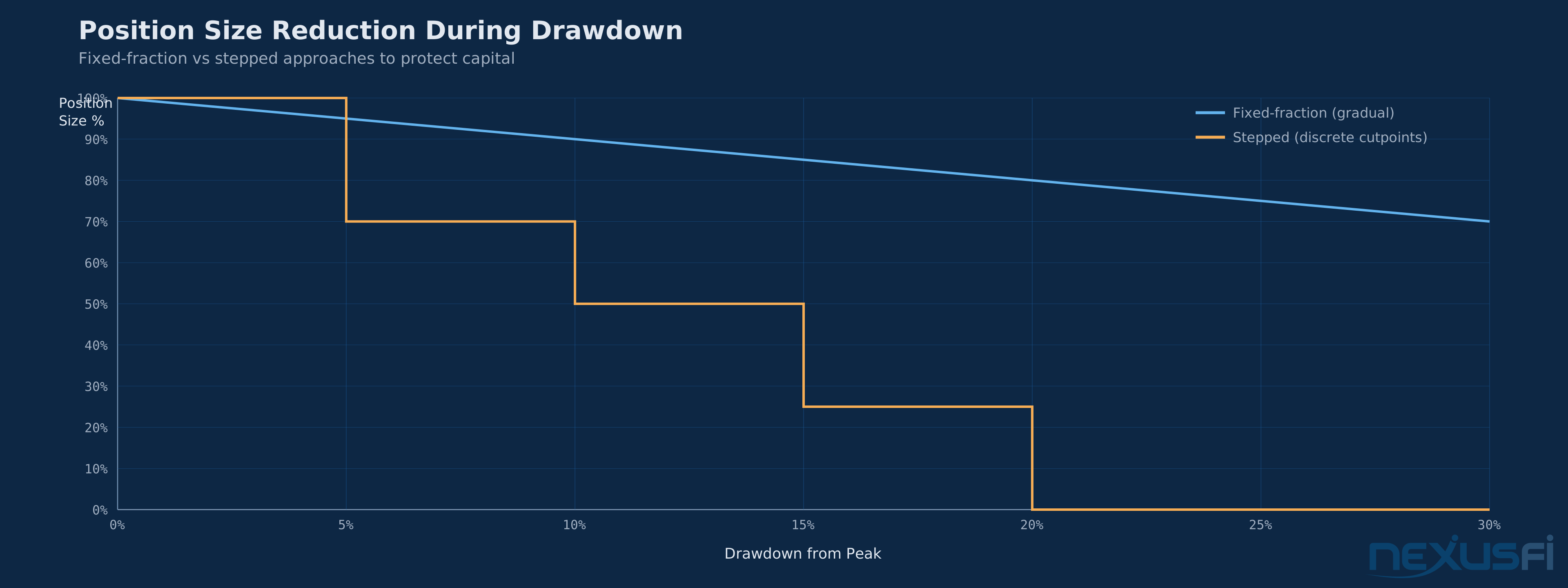
One of the most effective defenses against the asymmetric recovery problem is systematic position-size reduction during drawdowns. The logic is simple: if each loss makes recovery harder, reduce the size of each potential loss as your account declines.
Fixed-Fraction Sizing #
The most common approach: risk a fixed percentage of current equity per trade (typically 0.5% to 2%). This automatically reduces dollar risk as equity declines.
Example with 1% risk per trade:
- Starting equity $100,000: risk $1,000 per trade
- After 20% drawdown ($80,000): risk $800 per trade
- After 40% drawdown ($60,000): risk $600 per trade
The beauty of this approach is that it's self-correcting. As equity falls, risk falls proportionally, which slows the drawdown's acceleration. The cost is that winning trades during recovery also produce smaller dollar gains, extending the recovery timeline.
[As @bwolf notes] [4], citing Dr. Van Tharp: "One of the most highly regarded experts on position sizing strategies, Dr Van Tharp, says that if your positions are over 3% of your account, you are a gunslinger." For a $2,500 account, that means a maximum $75 loss per position. The math is unforgiving at small account sizes — which is exactly why small accounts blow up disproportionately.
Stepped Risk Reduction #
More aggressive than fixed-fraction, stepped reduction involves discrete cutpoints:
| Drawdown Zone | Risk Level | Action |
|---|---|---|
| 0% to 5% | 100% (normal) | Trade normally |
| 5% to 10% | 70% of normal | Reduce to 70% of standard size |
| 10% to 15% | 50% of normal | Half size on all positions |
| 15% to 20% | 25% of normal | Quarter size, high-conviction only |
| Beyond 20% | 0% | Stop trading, full review |
This approach provides stronger protection than pure fixed-fraction because it forces larger reductions at critical thresholds. The trekke position-sizing ladder described earlier is a real-world implementation of this stepped approach applied to funded evaluation accounts.
The Anti-Martingale Principle #
Drawdown-aware sizing is at the core anti-Martingale: you decrease risk when losing and increase risk when winning. This is the opposite of the Martingale strategy (doubling down after losses), which is mathematically guaranteed to produce ruin given enough time.
The anti-Martingale principle aligns position sizing with the recovery math: since each loss makes recovery harder, you make each subsequent loss smaller to limit the damage. Conversely, since each win from a peak makes the next win compound on a larger base, you increase size to exploit the favorable asymmetry.
The Behavioral Trap: Revenge Trading After Losses #
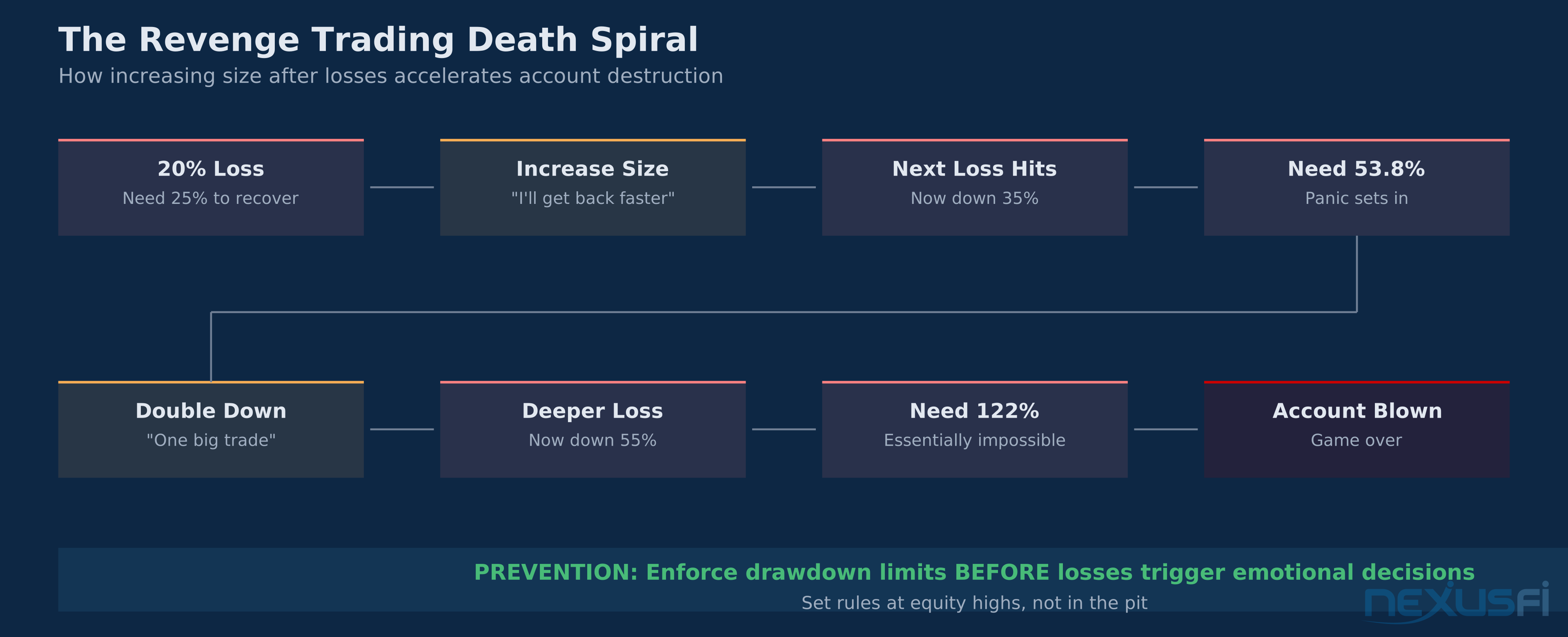
The recovery math creates a psychological pressure cooker. When a trader sees they need 43% to recover from a 30% loss, the temptation to "make it back fast" by increasing size or taking lower-quality setups is overwhelming. This is revenge trading, and it's where the asymmetric math actually kills accounts.
The cycle works like this:
- Trader suffers a significant loss (say 20%)
- Trader calculates they need 25% to recover
- Trader thinks: "If I increase my size, I can get back faster"
- Trader doubles position size
- Next loss (which was always coming) is now twice as large in dollar terms
- Drawdown deepens from 20% to 30% or worse
- Required recovery jumps from 25% to 43%+
- Trader panics, increases size further
- Account destruction follows
[In a powerful account of blowing up] [5], @matthew28 describes the pattern many traders experience: fixating on money made rather than concentrating on risk management, and losing the ability to accept that some days market conditions simply won't be favorable. The thread, with its 201 replies, shows this is a universal experience in the trading community.
The professional countermeasure is rigid enforcement of drawdown rules — ideally automated or at least bound by written commitments made when judgment was not compromised by loss. The time to set drawdown rules is when you're at equity highs, not when you're in the pit.
[As one experienced trader advises in an Apex challenge journal] [6]: "Analyze the results. If you still are at risk of failure, cut the size again all the way down to 1 lot if you have to. Calculate the worst possible scenario and take it seriously."
Building a Drawdown Defense System #
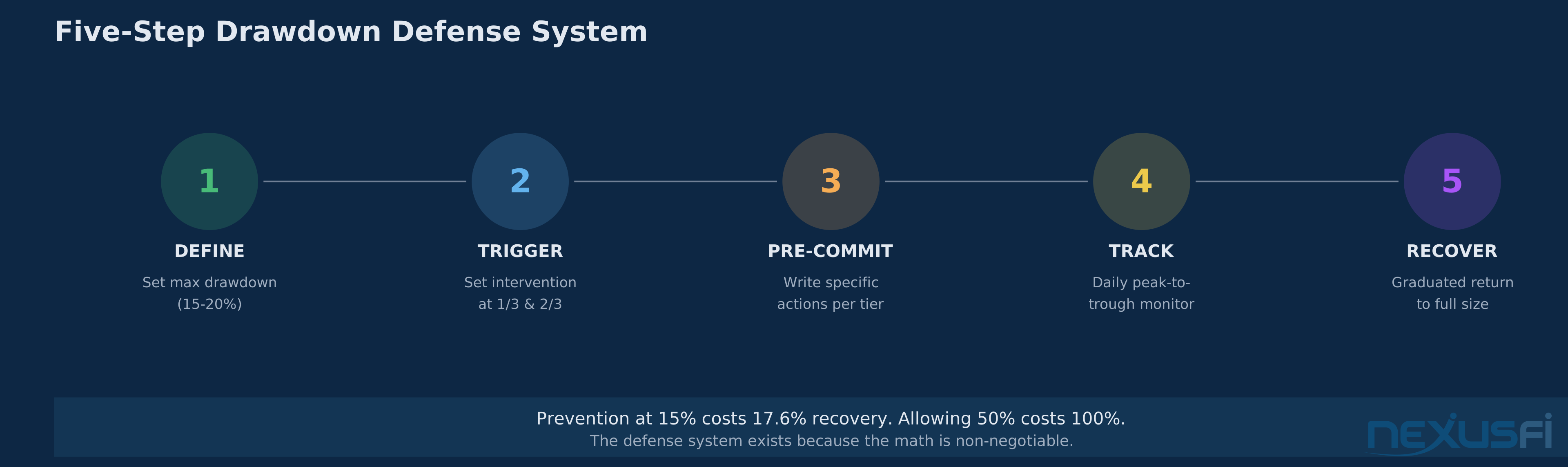
Given the asymmetric math, the single most valuable thing you can build as a trader is a drawdown defense system — a pre-committed set of rules that activates before losses become unrecoverable.
Step 1: Define Your Maximum Tolerable Drawdown #
Based on the recovery table, most traders should set their absolute maximum drawdown between 15% and 20%. Beyond 20%, you need 25%+ returns just to get back to zero, which is typically 6-12 months of excellent trading. That's a realistic upper bound for pain tolerance and recovery capacity.
For funded evaluation accounts with fixed drawdown limits (common in prop firms), your effective maximum is set by the firm — and it's usually smaller than 20%. In those environments, the drawdown defense system needs even tighter thresholds.
Step 2: Set Intervention Triggers #
Place intervention triggers at roughly one-third and two-thirds of your maximum:
- Maximum 20%: triggers at 7% and 14%
- Maximum 15%: triggers at 5% and 10%
- Maximum 10%: triggers at 3% and 7%
Step 3: Pre-Commit to Specific Actions #
Write down exactly what you will do at each trigger level. This removes decision-making from the equation when your judgment is most compromised.
At Trigger 1 (one-third of max):
- Reduce size to 60% of normal
- Eliminate discretionary trades for the week
- Journal every trade with entry rationale
- Review daily for pattern analysis
At Trigger 2 (two-thirds of max):
- Reduce size to 30% of normal
- Trade only one instrument
- Set a hard daily loss limit at $X
- Review with accountability partner
- Must demonstrate 5 consecutive winning days at reduced size before returning to Trigger 1 levels
At Maximum Drawdown:
- Stop all live trading
- Minimum 1-week pause
- Full system audit
- Return to simulation for minimum 2 weeks
- Restart at Trigger 2 size levels
Step 4: Track Peak-to-Trough Daily #
Update your equity high-water mark at the end of every trading day. Calculate your current drawdown from that peak. Many traders use a simple spreadsheet:
| Date | Closing Equity | Peak Equity | Drawdown % | Status |
|---|---|---|---|---|
| Apr 1 | $52,300 | $52,300 | 0.0% | Normal |
| Apr 2 | $50,100 | $52,300 | 4.2% | Normal |
| Apr 3 | $48,700 | $52,300 | 6.9% | Trigger 1 |
The discipline of daily tracking makes the drawdown visible and real before it becomes unmanageable.
Step 5: Build Recovery Milestones #
When you're in a drawdown, set milestones for returning to normal operations. Don't jump from Trigger 2 back to full size because you had one good day. Require sustained performance at each level before graduating to the next.
[In the Risk of Ruin thread] [7], @PandaWarrior illustrates this concern with a practical example: after five consecutive losing months consuming roughly 75% of capital, the probability of a turnaround in month six is low. The math at that point requires a 300% gain to recover — basically starting over. The defense system exists to ensure you never reach that point.
The Compound Cost of Deep Drawdowns #
Beyond the direct mathematical penalty, deep drawdowns impose compound costs that make recovery even harder than the table suggests:
Margin Constraints. In futures, drawdowns reduce your available margin. Fewer contracts means less dollar opportunity per winning trade. A 40% account drawdown might reduce your tradeable size by 60% or more once margin requirements are factored in, because margin isn't proportional — it's step-function based on contract count.
Psychological Capital Erosion. Confidence damage from deep drawdowns persists long after the equity recovers. Traders who've experienced a 40%+ drawdown often become gun-shy, taking profits too early and avoiding trades that feel risky but have strong expected value. This behavioral change can permanently reduce system performance.
Opportunity Cost. Every month spent recovering from a drawdown is a month not spent growing equity from a new high. If you spend 12 months recovering from a 30% drawdown, you've spent a year getting back to zero while the market offered compounding opportunities you couldn't capture at full size.
Strategy Confidence Decay. After a deep drawdown, traders often abandon their system right before it would have recovered. They switch strategies at the worst possible time — locking in the drawdown and starting fresh with an unproven approach. The recovery math makes the system feel broken even when it's performing within statistical norms.
The Bottom Line #
The mathematics of drawdown recovery is the most important concept in trading risk management, and it comes down to a single uncomfortable truth: losses and gains are not symmetrical, and the asymmetry gets worse as losses deepen.
A 10% loss is a minor setback that requires an 11% gain — annoying but manageable. A 30% loss requires a 43% gain — that's a quarter or more of excellent trading just to return to zero. A 50% loss requires doubling your remaining capital, which most traders will never accomplish from a depleted account.
The professional response to this math is not optimism about recovery, but obsession with prevention. Hard drawdown limits, systematic position-size reduction, tiered intervention triggers, and rigid behavioral rules all exist to keep accounts out of the mathematical danger zone where recovery becomes impractical.
Prevention is exponentially easier than cure. A trader who limits their maximum drawdown to 15% never faces a recovery requirement exceeding 17.6%. That's achievable in a few months of disciplined trading. A trader who lets drawdown reach 40% needs a 66.7% gain — which might take years, if it ever happens.
Set your limits now, while your judgment is clear and your account is intact. Write them down. Tell someone about them. And when the trigger levels are hit — because eventually they will be — execute the pre-committed actions without negotiation.
The math doesn't negotiate. Neither should you.
Knowledge Map
Prerequisites
Understand these firstGo Deeper
Build on this knowledgeReferences This Article
Articles that build on this topicCitations
- — Account blown up (2015) 👍 4“There is a table showing that if you lose 10%, you need to make 11% to get back to break-even. If you lose 50%, you need to make 100% to get back to break-even.”
- — Risk of Ruin (2022) 👍 6“Eventually the probability of blowing the account are 100%. Therefore, removing money from risk is one way to keep it.”
- — My NQ Trading Journal (2024) 👍 4“As my drawdown decreases I lower my overall risk of ruin by moving quickly to micros.”
- — Discipline problems (2023) 👍 11“Dr Van Tharp says that if your positions are over 3% of your account, you are a gunslinger.”
- — I finally blew up an account (2021) 👍 26“Fixating on money made instead of concentrating on risk management.”
- — APEX 300K+: The Journey (2023) 👍 7“Cut the size again all the way down to 1 lot if you have to. Calculate the worst possible scenario.”
- — Risk of Ruin (2011) 👍 4“About 75% of the original capital is left... if you are in a five month losing streak.”