



How Much Capital Do You Need to Trade Futures: Account Sizing, Minimum Requirements, and the Math Behind Sustainable Trading
Overview #
Here's the question every new futures trader asks, and almost nobody answers correctly: how much money do you actually need?
The broker says $500 for day trading margin. The forums say $25,000. Reddit says start with $10k. None of them are telling you the same thing, because they're answering different questions.
The broker is telling you the minimum to open a position — the mechanical floor. That's not the same as the minimum to trade sustainably. The forum veteran is telling you what they learned after blowing up a few small accounts. Reddit is averaging a bunch of opinions from people with wildly different strategies and risk tolerances.
The actual answer is: minimum capital is a function of your strategy, not a fixed number. It depends on what you trade, how wide your stops need to be, how many consecutive losses you can absorb before margin stress forces a bad decision, and whether you're holding overnight or flatting before close.
This article gives you the framework to calculate your own number — not someone else's rule of thumb that may not fit your situation at all.
The question isn't "can I technically open a position?" The question is "do I have enough capital to let my edge play out across 20, 50, 100 trades without getting forced out by a margin call or behavioral breakdown?"
Key Concepts #
Margin is the performance bond — the collateral your broker/clearinghouse requires to hold a futures position. There are two types that matter:
- Initial margin: the amount required to open a position or hold it overnight
- Maintenance margin: the lower threshold where a margin call triggers if equity falls below it
- Intraday margin: a broker-specific reduced amount valid only during the trading session, removed if you hold through settlement
Capital (your account equity) is what actually absorbs losses. Margin is the trip wire. Capital is the buffer between your current equity and that wire.
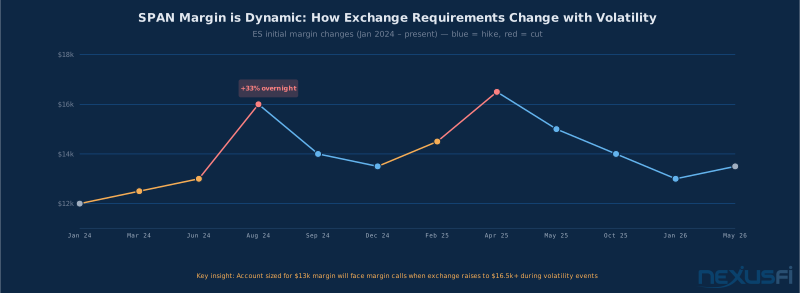
SPAN margin (Standard Portfolio ANalysis of Risk) is CME — for full detail see SPAN Margin for Futures Options's methodology for computing margin requirements. It's dynamic — it can increase on high-volatility days, around major data releases, during geopolitical events, or simply because the exchange decides the risk profile has changed. Your broker's "house margin" is set on top of SPAN and is typically higher.
Point value is the dollar change in your account for every one-point move in the underlying instrument. For ES, one point = $50. For NQ, one point = $20. For CL (crude oil), one dollar move = $1,000. Getting this wrong is how traders consistently missize.
Risk per trade (R) is the maximum dollar amount you'll lose if your stop gets hit. Expressed as a percentage of equity or a fixed dollar amount. Industry standard for sustainable trading is 0.5% to 1% of equity per trade.
Drawdown is the peak-to-trough decline in account equity. A 20% drawdown on a $50,000 account means you're at $40,000. Recovering back to $50,000 requires a 25% gain on the reduced balance — not 20%.
Undercapitalization is when your account is too small for the instrument's volatility given your risk parameters. The outcome is predictable: margin stress, behavioral degradation, forced exits at bad prices.
Margin vs. Capital: The Critical Distinction #
Trading at minimum margin is a trap. Here's why.
Suppose you have $15,000 and you trade one ES contract. Current overnight initial margin for ES runs around $14,000-$16,000 depending on your broker and market conditions. You're technically "funded." But a 20-point adverse move on ES — routine intraday noise — costs you $1,000. That's 6.7% of your account gone before you've even finished your morning coffee.
The real damage isn't the dollar loss. It's what happens to your decision-making. When the position is down and you've got almost nothing between your current equity and a margin call, you stop trading your plan. You start trading your stress. You widen stops to avoid realizing the loss. You hold a loser longer than you should. You add to a losing position. These aren't character flaws — they're predictable responses to undercapitalization, documented repeatedly in trading psychology research.
The margin requirement is the floor. The practical question is: how much buffer above the floor do you need to trade your plan without interference from account stress?
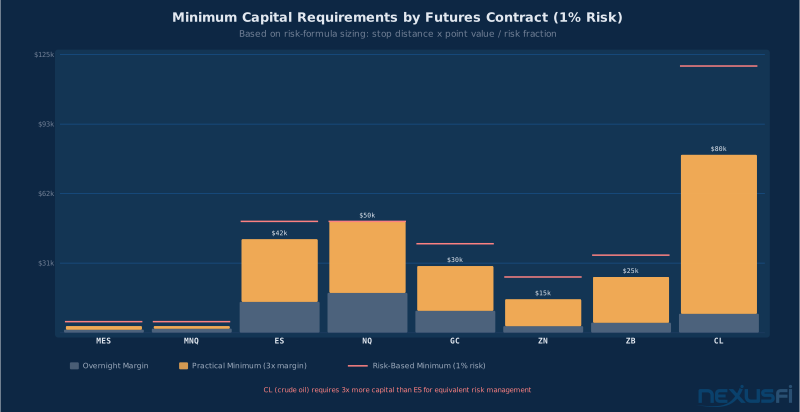
Professional futures traders commonly target 3x to 5x overnight margin as the minimum starting point for a single contract. That's $42,000 to $70,000 to trade one ES contract properly. Most people reading this will be shocked. That's the point. The broker's $500 intraday margin offer is marketing. The reality is substantially different.
Never conflate intraday margin with capital requirements. Intraday margin is a credit facility your broker extends for the session. If you're still holding at settlement, you need the full overnight margin — and your broker will either margin-call you or liquidate the position automatically. Matthew28 documented this exactly on NexusFi: "On the ES, lots of brokers offer low daytrading margins of $500 to lure people in to opening small accounts, but the full margin is currently around $6,000+ per contract." [1]
The Position Sizing Formula #
Related: Volatility-Based Position Sizing expands on this formula with ATR-based stop calculation.
This is the math that actually determines your minimum capital.
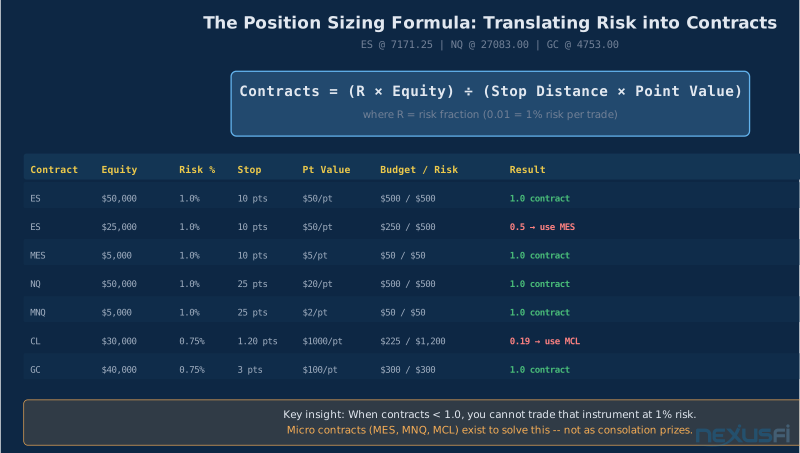
Contracts = (R × Equity) / (Stop Distance × Point Value)Where:
- R = risk fraction (e.g., 0.01 for 1%)
- Equity = your account size
- Stop Distance = distance from entry to stop in points
- Point Value = dollars per point for the contract
Run this backward: if you know your stop distance and the point value, you can solve for the minimum equity that lets you trade one contract at a given risk fraction.
Minimum Equity = (1 × Stop Distance × Point Value) / R
Let's work through real examples.
ES Example #
ES point value: $50. Say your strategy uses a 10-point stop — reasonable for a swing setup.
Minimum equity for 1 ES at 1% risk:
- Risk per contract = 10 × $50 = $500
- Minimum equity = $500 / 0.01 = $50,000
That's the minimum to trade one ES contract at 1% risk with a 10-point stop. Most day trading setups use 4-8 point stops, which reduces the number to $20,000-$40,000 — still far above what low-margin brokers advertise.
At a 4-point stop: Minimum equity = (4 × $50) / 0.01 = $20,000
As Fat Tails laid out clearly in NexusFi's Position Sizer thread: "Define acceptable $$$ risk per trade. A typical amount would be $300 for an account of $30,000 (corresponding to 1% of equity)... 12 ticks of ES are 3 points or $150 per contract. Not difficult to calculate that you can trade 2 contracts." [2]
MES Example #
MES (Micro E-mini S&P 500) point value: $5. Same 10-point stop.
Minimum equity for 1 MES at 1% risk:
- Risk per contract = 10 × $5 = $50
- Minimum equity = $50 / 0.01 = $5,000
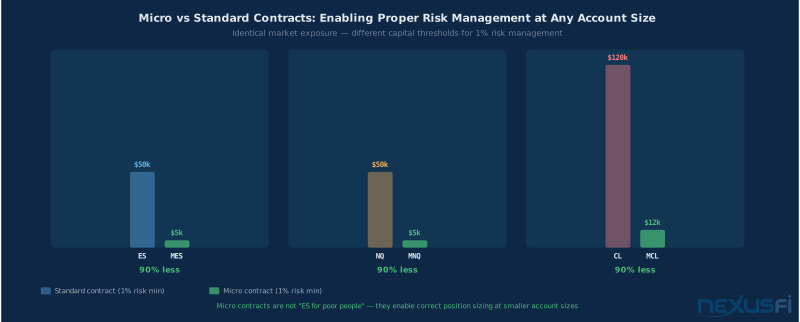
That's the real use case for micro contracts. They're not "ES for poor people." They're precision risk management tools that let you trade with proper position sizing on a smaller account. You can trade 1 MES with a $5,000-$10,000 account and maintain consistent 1% risk per trade — which you absolutely cannot do with one ES on the same account.
NQ Example #
NQ point value: $20. NQ has higher intraday ranges than ES — typical day sees 100-200 points of movement. A 25-point stop is modest.
Minimum equity for 1 NQ at 1% risk:
- Risk per contract = 25 × $20 = $500
- Minimum equity = $500 / 0.01 = $50,000
As bobwest put it bluntly on NexusFi: "Especially if you are trading NQ, which is a very sudden, quickly-moving account killer. About 10 times that $500/contract might not be enough." [3]
MNQ Example #
MNQ (Micro E-mini Nasdaq-100) point value: $2. Same 25-point stop.
Minimum equity for 1 MNQ at 1% risk:
- Risk per contract = 25 × $2 = $50
- Minimum equity = $50 / 0.01 = $5,000
CL Example #
CL (Crude Oil) point value: $1,000 per $1 move (quoted in cents, so one tick = $10). A 1.20-point stop is reasonable for intraday CL.
Minimum equity for 1 CL at 1% risk:
- Risk per contract = 1.20 × $1,000 = $1,200
- Minimum equity = $1,200 / 0.01 = $120,000
Not a typo. CL is an institutional instrument. The intraday margin looks accessible — brokers offer $500-$2,000 for day sessions. The capital requirement for proper sizing tells a completely different story. Most retail traders have no business trading full CL contracts. The micro crude (MCL) at 1/10th the size is the appropriate instrument if you want crude oil exposure with proper risk management.
GC Example #
GC (Gold) point value: $100 per $1 move ($10/tick). A 3-point stop is typical.
Minimum equity for 1 GC at 0.75% risk:
- Risk per contract = 3 × $100 = $300
- Minimum equity = $300 / 0.0075 = $40,000
Gold looks calmer than crude, but macro events (FOMC, CPI, geopolitical shocks) create violent overnight gaps. The gap risk on GC is underestimated by most retail traders.
The formula reveals something important: the instrument's volatility (reflected in how wide your stop needs to be) is the primary driver of minimum capital requirements. A wider stop doesn't just increase your per-trade risk — it multiplies the minimum equity you need to maintain consistent risk percentages.
Contract Specifications Reference #
For live margin figures, see Futures Margin Requirements.
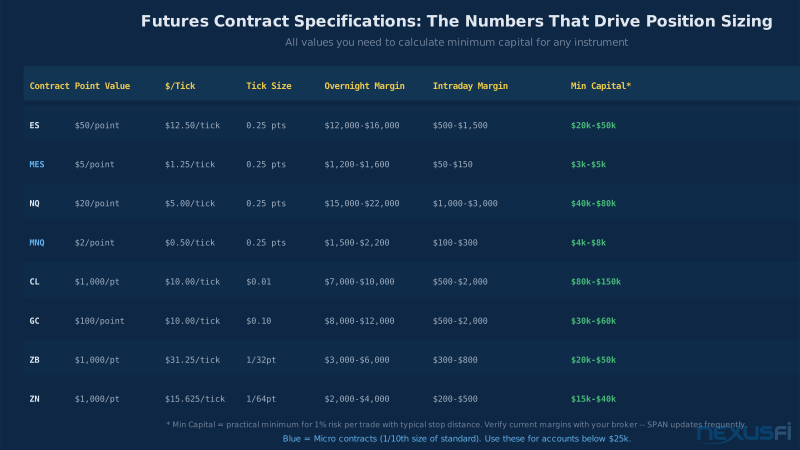
| Contract | Point Value | Tick Size | $/Tick | Typical Overnight Margin | Min Equity (1% risk, typical stop) |
|---|---|---|---|---|---|
| ES | $50/point | 0.25 pts | $12.50 | $12,000-$16,000 | $20,000-$50,000 |
| MES | $5/point | 0.25 pts | $1.25 | $1,200-$1,600 | $2,000-$5,000 |
| NQ | $20/point | 0.25 pts | $5.00 | $15,000-$22,000 | $40,000-$80,000 |
| MNQ | $2/point | 0.25 pts | $0.50 | $1,500-$2,200 | $4,000-$8,000 |
| CL | $1,000/point | $0.01 | $10.00 | $7,000-$10,000 | $80,000-$150,000+ |
| GC | $100/point | $0.10 | $10.00 | $8,000-$12,000 | $30,000-$60,000 |
| ZB | $1,000/point | 1/32 pt | $31.25 | $3,000-$6,000 | $20,000-$50,000 |
| ZN | $1,000/point | 1/64 pt | $15.625 | $2,000-$4,000 | $15,000-$40,000 |
Margin figures are approximate broker ranges as of 2026. SPAN margin changes frequently — verify with your specific FCM before trading.
Intraday vs. Overnight Margins: The Settlement Trap #
Here's where a lot of undercapitalized traders get destroyed.
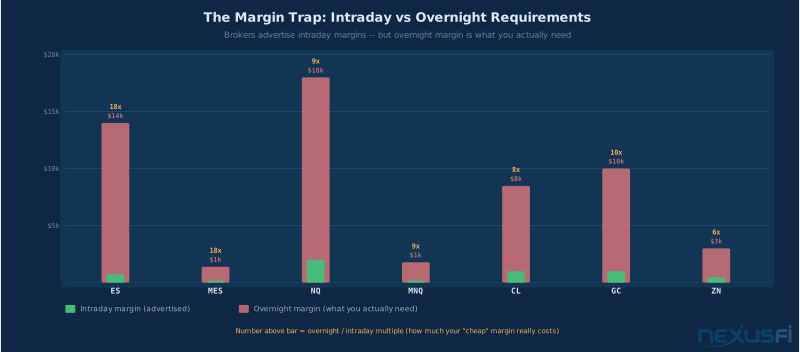
Brokers offer dramatically reduced intraday margins — sometimes $500 for ES when overnight margin is $14,000+. This is designed to attract active day traders who close before settlement. The trap: if you're still holding when settlement arrives, your broker requires the full overnight margin.
If your account can't cover it, the position gets liquidated. Automatically. Without asking you. At whatever price is available at that moment.
This is the "End of Trading Day Liquidation" problem that comes up regularly on NexusFi. As josh explained in a discussion of micro futures margin risk: "In practice, most brokers will never let this happen and you will be automatically liquidated. Note this is only an issue really if you are really close to your max margin." [4]
The solution is simple in theory and hard in practice: if you're a day trader, flatten before settlement. If you're a swing trader, size to the overnight margin requirement. Never enter a position with intraday margin that your account can't support if converted to overnight.
Overnight margin carries additional risks:
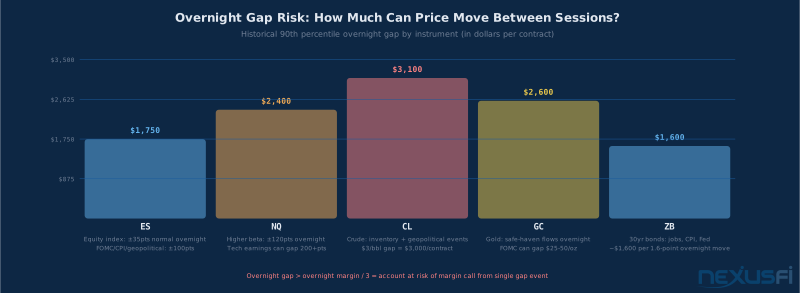
- Overnight gaps: futures can and do move 50-200+ points between sessions on news
- SPAN margin increases: volatility expansion can trigger margin requirement hikes overnight
- Weekend gap risk: holding through Friday close exposes you to three days of news
For CL and GC specifically, overnight holds around inventory reports (crude) or FOMC meetings (gold) can be violent. The intraday margin for CL around $500-$2,000 looks attractive. The overnight exposure on a surprise inventory draw or geopolitical event can be catastrophic on an undercapitalized account.
Intraday margin is for day traders who actually flatten. If you're using intraday margin and holding overnight — intentionally or because you forgot to exit — you're playing Russian roulette with your account. The broker will not warn you. They will liquidate you.
The Four Thresholds of Capital Adequacy #
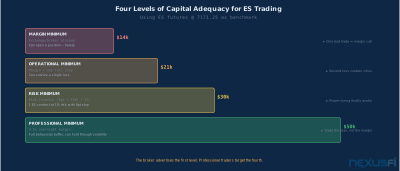
Not all "minimum capital" means the same thing. There are four distinct levels:
1. Margin Minimum #
The mechanical floor — enough to meet your broker's requirement to open a position. This is not a viable trading capital level. It's the legal minimum, not the practical one. At this level, a single losing trade can trigger a margin call.
2. Operational Minimum #
Enough to cover: overnight margin + one full stop-out + slippage + commissions. You can survive one bad trade without a margin call. Two bad trades is still a problem. This is the bottom of "technically functional" — you can trade, but you're one bad streak away from crisis.
Formula: Margin + (Stop Distance × Point Value × 1.5 for slippage buffer)
3. Risk Minimum #
The level where your position sizing formula actually works — where you can trade 1% risk per trade and absorb a realistic drawdown streak without breaching margin requirements. This is the true floor for sustainable trading.
Formula: (Stop Distance × Point Value) / R
4. Psychological Minimum #
High enough that individual trade outcomes don't drive decisions. Research on trader behavior consistently shows discretionary decisions deteriorate under account stress.
Size your account so that Threshold 3 (Risk Minimum) and Threshold 4 (Psychological Minimum) coincide. That's the level where you stay rational.
Drawdown Math: Why Recovery Is Harder Than You Think #
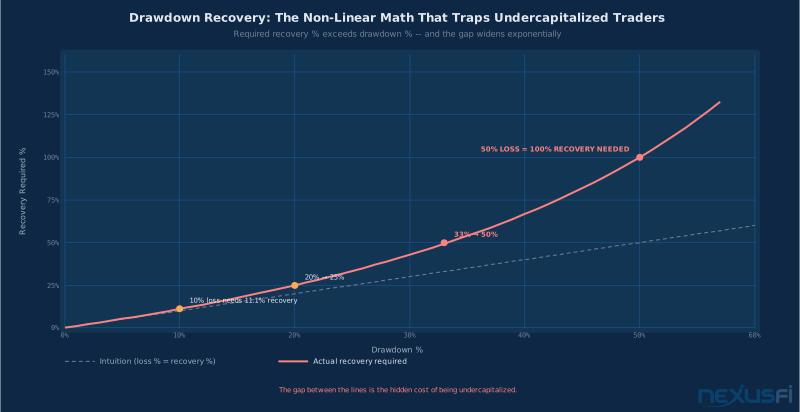
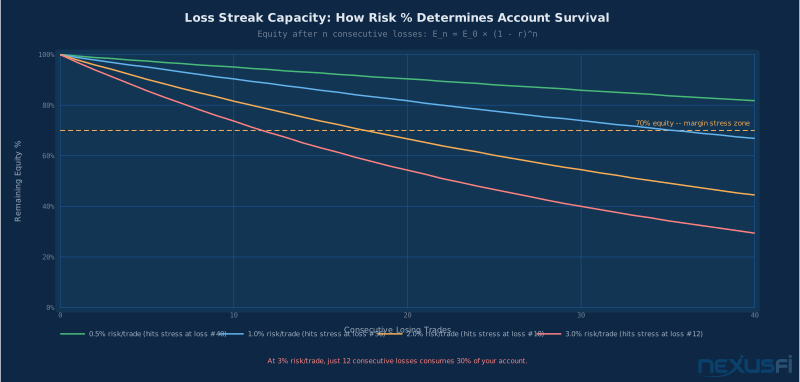
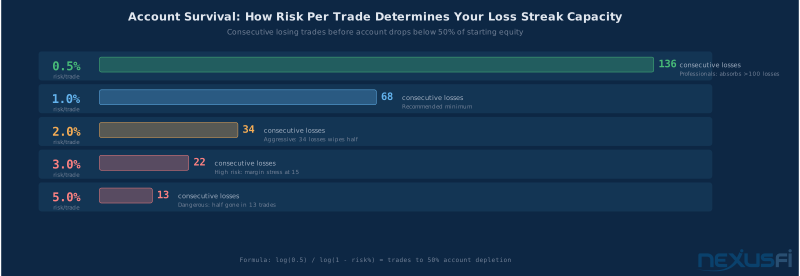
See also: Drawdown Recovery Mathematics for detailed mathematical analysis. This is the math that makes small accounts non-viable even when your strategy has edge. The recovery required from a drawdown is non-linear and increases geometrically with loss size: Loss Recovery Required 5% 5.3% 10% 11.1% 15% 17.6% 20% 25.0% 25% 33.3% 30% 42.9% 40% 66.7% 50% 100.0% 60% 150.0% The formula: Recovery Required = d / (1 - d), where d is the decimal loss. A 30% drawdown on a $50,000 account leaves you at $35,000. You need to make $15,000 — a 42.9% return on your reduced base — to get back to even. Meanwhile, the market doesn't care that you're in a hole. Every trade you take while in drawdown is harder psychologically, and if the account gets anywhere near margin minimums, you lose the ability to size correctly. Loss Streak Capacity # At 1% risk per trade with fractional sizing, equity compounds down through losing streaks: E_n = E_0 × (1 - 0.01)^n Consecutive Losses Drawdown 5 4.9% 10 9.6% 15 14.0% 20 18.2% 30 26.0% 50 39.5% At 2% risk per trade, those numbers roughly double. 20 consecutive losses at 2% risk = 33.2% drawdown. Still mathematically survivable, but psychologically devastating — and margin requirements don't scale down with your shrinking equity.
The formula Silver Dragon uses is actually excellent:
Minimum Account Value = (Max loss per trade × Minimum consecutive losses) + Margin requirement
If your max loss is $200 and you want 50-loss capacity, with $7,000 overnight margin:
- Minimum = (200 × 50) + 7,000 = $17,000
That's the floor — not the broker's advertised minimum.
A trading edge doesn't help you if you can't stay in the game long enough for it to manifest. The entire point of capital adequacy is survivability — not just mathematical survival, but the psychological capacity to keep executing your plan after a losing streak.
Undercapitalization Failure Modes #
See also: Consecutive Loss Protocols for systematic shutdown rules.
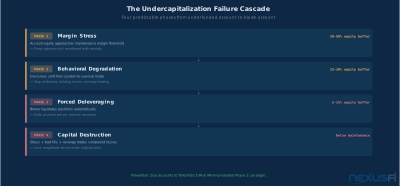
Undercapitalization doesn't just mean your account goes to zero. It follows a predictable cascade:
Phase 1: Margin Stress #
Your equity approaches the danger zone relative to margin requirements. Positions that were comfortable become uncomfortable. Every adverse tick increases anxiety.
Phase 2: Behavioral Degradation #
You start making decisions that violate your trading plan. You hold losers longer than you should — you can't afford to realize the loss. You move stops. You skip valid setups because you can't afford another loss right now. You trade revenge. None of this is weakness; it's a predictable response to an inadequate capital structure.
Phase 3: Forced Deleveraging #
Your broker liquidates positions automatically when equity breaches maintenance margin. This happens at exactly the worst moment — when markets are moving against you, when liquidity is thinner, when fills are at bad prices. You exit at the worst possible time and miss any subsequent recovery.
Phase 4: Capital Destruction #
Poor decisions under stress + forced liquidation at bad prices + slippage = losses far larger than your original plan accounted for. A strategy that works with adequate capital fails catastrophically with inadequate capital.
@Scalpingtrader's advice on NexusFi: "Open an account with 8-9k. This should be about enough for pretty much any daytrading strategy that uses 1 or 2 contracts on ES or CL... The rest of the money should be far far away from the account — so far that you couldn't deposit it within one week's time even if you wanted. That gives you time to think about adding." [7]
That staged approach protects the reserve while you prove out your strategy on smaller size. The key insight: don't risk more than you can actually afford to trade with properly.
Instrument-Specific Capital Reality #
ES and MES #
ES is the benchmark index futures contract — $50/point, deeply liquid, 23+ hours/day. It's also substantially more expensive to trade correctly than most retail traders expect.
The common mistake: opening an account with $10,000-$15,000, trading one ES contract because intraday margin permits it, then getting caught on the wrong side of a 30-50 point move and either margin-calling out or making desperate decisions.
MES is the correct starting point for accounts under $25,000. Ten MES = one ES in risk exposure, but MES provides position sizing granularity that's impossible with full contracts. From NexusFi: "I believe the liquidity in MES is excellent. Just keep size at or below 2 to start out and slippage is not likely to be a factor except if a news event takes hold." [8]
Practical minimums: 1 MES at 1% risk: $3,000-$5,000. 1 ES at 1% risk: $25,000-$50,000.
NQ and MNQ #
NQ is more volatile than ES — higher intraday ranges, faster moves, more punishing whipsaws. A 100-point NQ move costs $2,000 per contract, and those swings happen routinely on tech-heavy news days.
The critical mistake: using intraday margins to trade full NQ on small accounts. bobwest's NexusFi warning stands: NQ is a "very sudden, quickly-moving account killer." The $500 intraday margin looks like an opportunity. It's not.
MNQ at $2/point is the proper vehicle for accounts under $30,000. A 100-point NQ move is $200 on MNQ — manageable on a $5,000 account if properly sized.
Practical minimums: 1 MNQ at 1% risk: $3,000-$6,000. 1 NQ at 1% risk: $40,000-$80,000.
CL (Crude Oil) #
CL is an institutional instrument masquerading as retail-accessible. The tick value ($10/tick, $1,000/point) means ordinary intraday moves of $1-$2 translate to $1,000-$2,000 per contract in P&L. EIA inventory reports (Wednesday 10:30 AM ET) regularly move CL $1-3 in seconds. OPEC announcements can gap overnight $3-5. Geopolitical events can gap 10%+.
The intraday margin of $500-$2,000 looks accessible. The capital requirement for proper sizing tells a different story. Most retail traders have no business trading full CL contracts — the micro WTI crude (MCL) at 1/10th the size is the appropriate vehicle.
Practical minimums: 1 CL, consistent 0.5% risk: $80,000-$150,000+. Not the right instrument for accounts under $50,000 without MCL.
GC (Gold) #
GC at $100/point ($10/tick) requires meaningful capital for proper sizing. Gold gaps hard on FOMC decisions, CPI surprises, and geopolitical shocks — $30-100+ moves overnight aren't rare. The $8,000-$12,000 overnight margin is the floor, not the practical capital minimum. Apply the 3x rule: $25,000-$35,000 at minimum, and $40,000+ for a properly sized account.
Practical minimums: 1 GC, consistent 1% risk: $30,000-$60,000
ZB and ZN (Treasury Bonds) #
Treasury futures have a unique tick structure. ZB (30-year bond): one full point = $1,000, one tick = 1/32nd = $31.25. ZN (10-year note): 1/64th = $15.625/tick.
Treasuries are rate-sensitive — FOMC decisions, CPI releases, and auction results move them. A 1-2 point ZB move on a big data release is $1,000-$2,000 per contract. Overnight margins are lower than equity futures, but the rate-event gap risk is still real.
Practical minimums: 1 ZN, consistent 1% risk: $15,000-$40,000. 1 ZB: $25,000-$60,000
Practical Capital Adequacy Framework #
Here's how to calculate your specific number.
Step 1: Choose your instrument and stop distance. Based on your strategy structure, what stop distance do you actually need? Not the minimum possible — the one that keeps you in the trade with reasonable room to develop.
Step 2: Calculate minimum risk-based capital. Minimum Equity = (Stop Distance × Point Value) / R
Use R = 0.01 (1% risk). If you find the number is larger than your account, you either need more capital, a smaller stop, or a micro contract.
Step 3: Add margin buffer. Your risk-based minimum assumes you hit your stop exactly and recover. Real trading adds slippage, commissions, and occasionally getting stopped on a spike. Add 20-30% buffer above the risk-based minimum.
Buffered Minimum = Risk Minimum × 1.25
Step 4: Verify loss streak capacity. Using your buffered minimum, calculate how many consecutive maximum-loss trades you can absorb before breaching overnight margin:
Loss Streak Capacity = (Buffered Minimum - Overnight Margin) / (Stop Distance × Point Value)
If this number is less than 20, you're vulnerable. If it's less than 10, you're significantly undercapitalized.
Step 5: Add overnight margin buffer. Final Minimum = max(Buffered Minimum, 3 × Overnight Margin)
Taking the larger of these two — risk-based buffer and the 3x margin rule — gives you a conservative minimum that accounts for both risk-based sizing and margin mechanics.
Example: ES Day Trader #
- Strategy: ES intraday, 6-point stop
- Point value: $50
- R: 1%
Risk minimum: (6 × $50) / 0.01 = $30,000 Buffered minimum: $30,000 × 1.25 = $37,500 Overnight margin (if holding): ~$14,000 × 3 = $42,000 Final minimum: $42,000 (3x margin rule is binding)
Loss streak capacity check: ($42,000 - $14,000) / (6 × $50) = 93 trades. Solid.
Example: MES Swing Trader #
- Strategy: MES swing, 15-point stop, holding overnight
- Point value: $5
- R: 1%
Risk minimum: (15 × $5) / 0.01 = $7,500 Buffered minimum: $7,500 × 1.25 = $9,375 Overnight margin: ~$1,400 × 3 = $4,200 Final minimum: $9,375 (risk-based is binding)
Loss streak capacity: ($9,375 - $1,400) / (15 × $5) = 106 trades. Solid.
Example: NQ Day Trader #
- Strategy: NQ intraday, 30-point stop, flat at close
- Point value: $20
- R: 0.75%
Risk minimum: (30 × $20) / 0.0075 = $80,000 Buffered minimum: $80,000 × 1.25 = $100,000 Overnight margin: $0 (flat at close, but use 3x as safety for intraday margin) Final minimum: $100,000 (or switch to MNQ)
That's the honest reality of trading NQ properly. The market doesn't care what your account size is.
Most retail traders are attempting to trade instruments that require $30,000-$100,000+ in capital with accounts of $5,000-$15,000. The math doesn't work. The micro contracts exist precisely to solve this problem — use them.
True Cost Integration #
Your minimum capital calculation needs to include the full cost of trading, not just the position risk.
Commissions: Round-trip commissions of $1.50-$4.00 per contract per side are typical. 5-10 trades/day at those rates adds $15-$80/day in costs — material on small accounts.
Slippage: On ES, stop fills typically — see Slippage in Futures Trading for full analysis — slip 0.5-1 tick ($6.25-$12.50). NQ during volatile periods can slip 2-4 ticks ($10-$20). CL inventory report stops can slip $20-$50.
Fixed overhead: Data feeds ($50-$200/month) and platform fees ($30-$200/month) are real costs regardless of trading performance.
A $5,000 account paying $100/month in fixed costs loses 2% to overhead before making a single trade. On a $50,000 account, the same overhead is 0.2% — a rounding error. Size matters for overhead, not just risk.
Micro Contracts: The Right Tool for Smaller Accounts #
CME launched micro futures (MES, MNQ, MYM, M2K — see Micro E-mini contracts overview) in 2019 at 1/10th the size of standard contracts. The key insight most traders miss: micro contracts don't just mean smaller risk — they enable correct risk management that was mathematically impossible with standard contracts at smaller account sizes.
On a $10,000 account trading ES with 1% risk, you can trade 0.33 contracts. That's not a real number — you can't trade fractional contracts. On the same $10,000 account trading MES with 1% risk, you can trade 3-4 MES contracts with precise position sizing and the ability to scale in and out.
The aggregate exposure is identical. The risk management is the difference between correct and impossible.
From the NexusFi micro futures discussion: "I think these MES/MNQ products are an amazing addition. I trade around a size of 3x MES/MNQ contracts to match the risk profile I want without the full-contract exposure." [9]
The Staged Capital Approach #
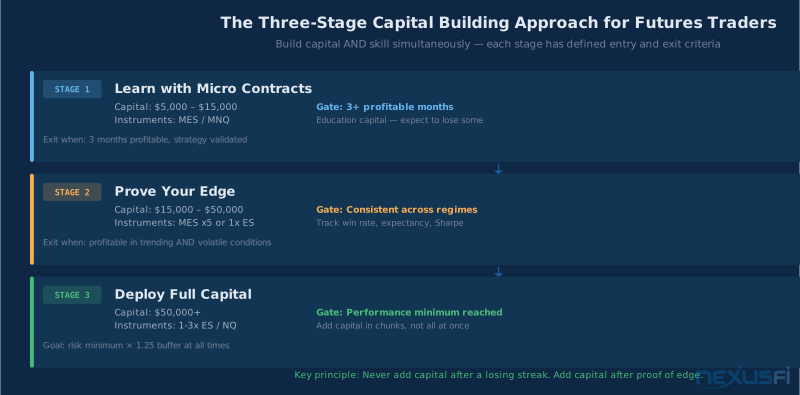
If your current capital is below the practical minimum for your target instrument, a staged approach is the rational path:
Stage 1: Learn with micro contracts. Start on MES or MNQ with 1-5% of what you eventually want to trade. The commission structure is slightly less favorable, but you're buying experience at a fraction of the cost. A 3-month apprenticeship on MES with a $5,000 account costs roughly the same in commission overhead as one bad ES trade on an undercapitalized account.
Stage 2: Prove your edge consistently. Don't scale until you've demonstrated profitability across multiple months with different market conditions. A winning week doesn't prove edge. Three winning months across trending, ranging, and volatile conditions starts to suggest you have something repeatable.
Stage 3: Scale capital, not just size. When you add capital, add the full risk-based minimum for the next size up — don't just add enough to open an additional contract. The buffer is the whole point.
@Scalpingtrader's staged approach from NexusFi is pragmatic: "Open an account with 8-9k. This should be about enough for pretty much any daytrading strategy that uses 1 or 2 contracts on ES or CL. The rest of the money should be far far away from the account — so far that you couldn't deposit it within one week's time even if you wanted." [7]
Three rounds of learning before deploying all capital. Each round builds experience. The physical separation removes the temptation to impulsively add capital after a bad day.
The goal is the minimum viable account for consistent, properly-sized trading. That number is strategy-specific. There's no universal answer — but there is a universal framework for calculating it.
What Adequate Capital Actually Buys You #
Four things: decision quality (system-based exits, not stress), room for valid setups to develop, survival through the learning curve, and meaningful statistics. Undercapitalization eliminates all four.
The Bottom Line #
Minimum capital isn't a fixed number. It's a function of five variables:
- Your strategy's stop distance — the primary driver of risk minimum
- Your instrument's point value — determines how stop distance translates to dollars
- Your risk fraction (R) — what percentage of equity you risk per trade
- Overnight margin requirements — the buffer needed if holding positions overnight
- Your loss streak capacity — how many consecutive losses you can absorb before margin stress
The formula:
Risk Minimum = (Stop Distance × Point Value) / R
Final Minimum = max(Risk Minimum × 1.25, Overnight Margin × 3)
Check your loss streak capacity. If you can't absorb 20 consecutive full stops without margin stress, you're undercapitalized for your current setup.
If the math says you need $50,000 to trade one ES contract properly and you have $15,000, the answer isn't to trade ES anyway on reduced risk. The answer is to trade MES until you've built the account or added the capital.
The micro contracts exist precisely for this. Use them. They're not a consolation prize — they're the mathematically correct tool for accounts that haven't yet reached the threshold for standard contracts.
The market doesn't negotiate. A 50-point ES move against you costs $2,500 per contract whether your account is $15,000 or $150,000. Capital adequacy determines whether that move is a setback or a crisis.
Related: Futures Margin Mechanics | Drawdown Recovery Math | Volatility Position Sizing | Consecutive Loss Protocols | Daily Loss Limits
Knowledge Map
Prerequisites
Understand these firstGo Deeper
Build on this knowledgeReferences This Article
Articles that build on this topicCitations
- — End of trading day Liquidation Notices from Major Brokers (2019) 👍 4“On the ES, lots of brokers offer low daytrading margins of $500 to lure people in to opening small accounts, but the full margin is currently around $6,000+ per contract.”
- — PositionSizer for ninjatrader (2011) 👍 18“Define acceptable $$$ risk per trade. A typical amount would be $300 for an account of $30,000 (corresponding to 1% of equity).”
- — Best deal on futures margin (2021) 👍 9“Especially if you are trading NQ, which is a very sudden, quickly-moving account killer. About 10 times that $500/contract might not be enough.”
- — Risk of trading micro futures (2020) 👍 7“In practice, most brokers will never let this happen and you will be automatically liquidated. Note this is only an issue really if you are really close to your max margin.”
- — Optimum account size (2014) 👍 5“Account sizing discussion on proper capital for futures trading”
- — Minimum starting funds to learn to trade (2013) 👍 3“Trading capital requirements and account management for futures”
- — Futures Trading Account Size? (2015) 👍 12“Open an account with 8-9k. This should be about enough for pretty much any daytrading strategy that uses 1 or 2 contracts on ES or CL.”
- — Trading the new CME E-Micro's (E micro) MES, MNQ, MYM, M2K and other micros (2019) 👍 6“Position sizing and account capital for futures day trading”
- — Options on Micro-Futures Experience (2021) 👍 8“I think these MES/MNQ products are an amazing addition. I trade around a size of 3x MES/MNQ contracts to match the risk profile I want without the full-contract exposure.”
- — Futures Trading Account Size? (2015) 👍 10“The rest of the money should be far far away from the account -- so far that you couldn't deposit it within one week's time even if you wanted.”
- — CME Group: E-mini S&P 500 Performance Bonds (Margin Requirements)