



Slippage in Futures Trading: Measuring, Managing, and Minimizing Execution Costs
Overview #
Every time you send a market order, three invisible taxes hit your account simultaneously. The bid-ask spread costs you the moment the order leaves your hands. Execution delay costs you the 0.3 to 0.8 seconds it takes to travel from your platform through your broker to the exchange. Market impact costs you again as your order consumes available liquidity and nudges price away from you. Together, these three components constitute slippage — and most traders either don't measure it or dramatically underestimate it.
Here's the math that should get your attention: analysis of the NexusFi community's most detailed execution discussions shows slippage consuming 20-40% of a scalper's expected profit on a typical trade. For a trader targeting 2 ticks on ES, one round-trip of 1.5 ticks in slippage means the trade needs to hit perfectly just to break even before commissions. That's not edge erosion — that's edge elimination.
The traders who consistently outperform on execution quality rarely have better analysis. They have systematically lower friction on the same analysis. Implementation shortfall — the gap between what a strategy should return and what it actually returns — is where most trading edges disappear.
Swing traders have more cushion. A 20-tick NQ swing with 2 ticks round-trip slippage gives up 10% of P&L to execution inefficiency — at 100 trades per month, that compounds into tens of thousands annually.
This article covers the mechanics of how slippage works, realistic cost benchmarks across the four major futures instruments (ES, NQ, CL, GC), time-of-day effects that create 3x variation across a single session, and the specific tactical choices — order types, timing, sizing — that cut slippage costs by 40-60% without sacrificing fill quality.
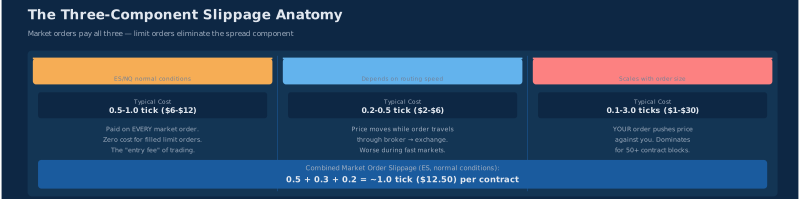
Every market order pays all three slippage components simultaneously. Limit orders eliminate the spread component but introduce non-fill risk. The optimal approach is usually an aggressive limit — fills like a market order but can be cancelled.
Key Concepts #
Before the tactics, the terminology. These terms appear throughout the article and are used precisely:
Slippage is the difference between the price you expected to receive and the price you actually received. A positive number means you got a worse fill than expected; negative slippage (which happens with limit orders that fill at better-than-requested prices) is a benefit, not a problem.
Bid-ask spread is the gap between the best available buy price (ask) and the best available sell price (bid). If ES is trading at 4512.25 bid / 4512.50 ask, the spread is one tick ($12.50). Market orders always pay the spread. Limit orders don't — but they may not fill.
Execution delay is the latency between when your order is sent and when it reaches the exchange matching engine. During this window — typically 0.1 to 0.8 seconds for retail traders through standard brokerage routing — price can move. In fast markets, 0.5 seconds can be a tick or more.
Market impact is the price displacement caused by your own order. When you buy 10 contracts with a market order in a thin book, you may fill at multiple price levels as your order consumes available liquidity. The first 4 contracts fill at 4512.50, the next 4 at 4512.75, the last 2 at 4513.00. Your average fill price is higher than the best ask at the time of order submission.
Implementation shortfall is the gold standard slippage measurement methodology. It compares your actual execution price to the mid-price at the moment you made the trading decision. This captures all three components in a single number and works consistently across strategies, instruments, and timeframes.
Aggressive limit order is a limit order placed at or slightly better than the current best ask (for buys) or best bid (for sells). It fills immediately like a market order in most cases but can be cancelled if the market moves away before execution. It's the best default for most retail futures traders.
Transaction cost analysis (TCA) is the systematic post-trade process of measuring, decomposing, and reporting slippage costs. Institutional desks run automated TCA on every trade. Serious retail traders should run at least a weekly manual version.
The Three-Component Framework #
Slippage isn't one thing — it's three distinct costs that hit simultaneously when you use a market order. Understanding them separately is what lets you address each one tactically.
Component 1: Bid-Ask Spread
The spread is the most visible slippage component and the most commonly discussed. When you send a market order to buy, you fill at the ask price. The current bid is immediately below that. The spread — the gap between ask and bid — is the immediate cost of your transaction. You've already "lost" one tick before price moves a single point.
For ES and NQ, the spread is typically one tick during peak trading hours. That's $12.50 on ES or $5.00 on NQ. For CL and GC, the spread can be one to three ticks depending on time of day and market conditions. During news events, spreads can widen dramatically as liquidity providers pull their quotes — GC spreads of five to ten ticks are not unusual during Fed announcements.
The good news: the spread component is the most controllable. A well-placed aggressive limit order at the inside of the market can capture the spread rather than paying it. As @Fat Tails noted in a widely-cited thread on index futures execution costs:
Component 2: Execution Delay
Your trading platform, your broker's routing system, and the exchange matching engine are not in the same room. The full mechanics of how futures orders get filled at each step explain exactly where latency accumulates. Every link in that chain introduces latency. A typical retail trader using a standard brokerage connection faces round-trip latency of 10 to 50 milliseconds. A co-located institutional desk might be under 1 millisecond. The difference sounds small until you realize that in fast ES markets, price can move 1 to 2 ticks in 50 milliseconds.
Execution delay slippage is most damaging when markets are moving quickly — exactly when you're most likely to be sending orders. News releases, opening range breakouts, and sudden large block trades all create fast price action where delay costs are highest.
Mitigation strategies for execution delay: use a broker with direct market access (DMA) to CME Globex rather than intermediated routing; ensure your platform sends FIX protocol orders with minimal overhead; and for scalping-style strategies, consider whether co-located infrastructure justifies the cost.
Component 3: Market Impact
Market impact is the least understood slippage component and the most dangerous for traders scaling up position size. When you send a market order, you consume the available liquidity at the best price first, then the next price level, and so on. For small retail orders (1-5 contracts), the book depth in ES or NQ is usually sufficient that impact is minimal. For larger orders, it's not.
That's a 0.5 tick impact on a 30-contract order in ES.
Market impact scales non-linearly. Doubling position size doesn't double impact — it amplifies it. The standard impact model shows impact scaling roughly as the square root of order size relative to average depth. The practical rule: if your order exceeds 10-15% of the displayed depth at the best price, you're likely to face material impact costs.
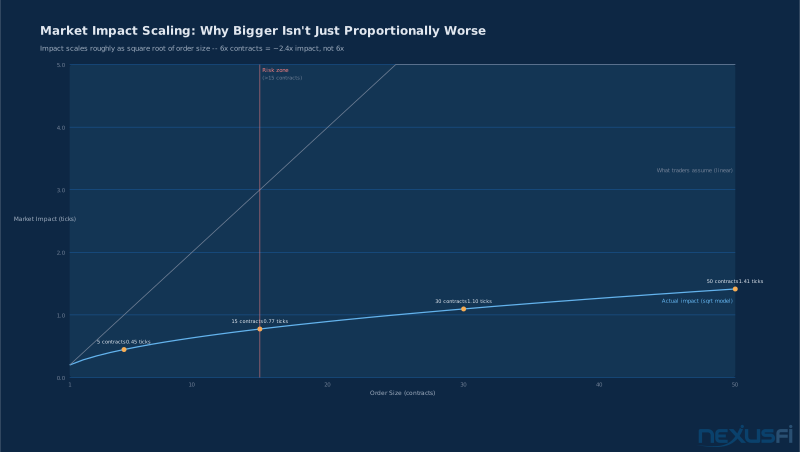
Impact scales as square root of order size — 6x contracts gives ~2.4x impact, not 6x. Above 15 contracts in retail timeframes, you enter the zone where impact compounds unpredictably against you.
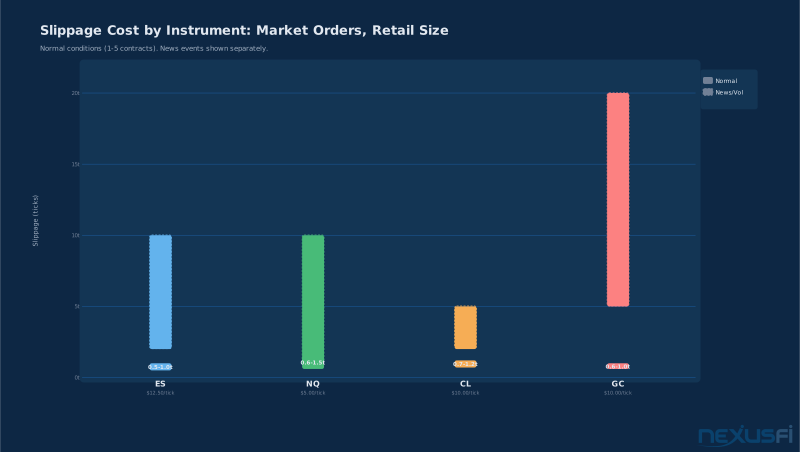
ES has the lowest dollar slippage despite a higher tick value — its liquidity depth absorbs retail orders cleanly. GC news slippage (up to 20 ticks = $200/contract) can exceed an entire swing trade's profit target.
Realistic Slippage Costs by Instrument #
Here are the actual numbers. These are median values for retail-size orders (1-5 contracts) using market orders in normal market conditions. Not averages — medians. The distribution is fat-tailed; news events and thin periods can push costs 5-10x higher.
ES (E-mini S&P 500)
Tick size: 0.25 index points ($12.50 per tick). Median market order slippage: 0.5 to 0.8 ticks ($6.25 to $10.00). Best-in-class liquidity. During peak hours (9:30-10:00 CT, 14:30-15:15 CT), the book depth is typically 500-2,000+ contracts at the inside, meaning retail-size orders rarely create meaningful impact. Aggressive limits typically fill at 0.2 to 0.4 ticks of slippage — 40-60% better than market orders.
ES is the benchmark. More than 1 tick round-trip in ES under normal conditions signals a problem with your execution setup.
NQ (E-mini Nasdaq-100)
Tick size: 0.25 index points ($5.00 per tick). Median market order slippage: 0.6 to 1.5 ticks ($3.00 to $7.50). Higher beta than ES means faster price movement, which amplifies execution delay costs. Spreads widen more aggressively during news — a 2-tick spread on NQ during major tech earnings is not unusual. In tick terms, NQ slippage runs consistently higher than ES despite the lower dollar value per tick.
CL (Crude Oil)
Tick size: $0.01 per barrel ($10.00 per tick). Median market order slippage: 0.7 to 1.2 ticks ($7.00 to $12.00). Strong time-of-day dependence — tight during London/NY overlap, wider after 3 PM CT settlement. The EIA crude inventory report (Wednesdays 9:30 CT) regularly produces 3-5 ticks of market order slippage. Avoid market orders around that release window.
GC (Gold)
Tick size: $0.10 per troy ounce ($10.00 per tick). Median market order slippage: 0.6 to 1.0 ticks ($6.00 to $10.00). GC has the most dangerous tail risk of the four instruments during macro events. During Fed decisions and CPI releases, spreads can explode to 3-5 ticks as liquidity providers widen quotes. Market orders during these windows can face 10-20 tick slippage. GC traders should have kill-switch logic that cancels all pending orders at least 30 seconds before scheduled macro releases.
GC and CL during scheduled macro releases (Fed decisions, CPI, EIA crude inventory) are slippage traps. Spreads can widen to 5-20 ticks in seconds as liquidity providers pull quotes. Cancel all pending orders at least 30 seconds before any scheduled release, and place no new orders for 60 seconds after. One market order into a GC feed release can cost more than a full week of normal slippage.
Time-of-Day Effects: When You Trade Matters as Much as How #
Here's the insight most retail traders miss: slippage is not constant across the trading day. It varies by a factor of 2-3x between the best and worst periods. A systematic trader who learns to avoid thin periods and concentrate execution in peak liquidity windows can cut average slippage costs much without changing anything else about their strategy.
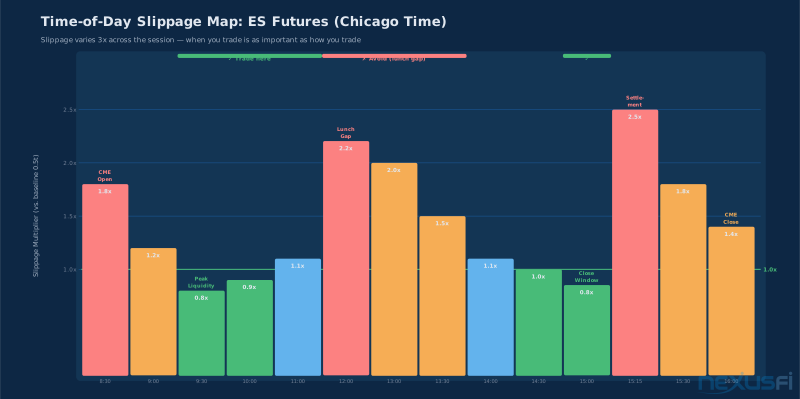
The lunch gap (12:00-13:30 CT) has 2-3x higher slippage than the open. A scalper who accidentally drifts into the lunch period pays double their normal execution cost — same trades, same strategy, but systematically worse fills.
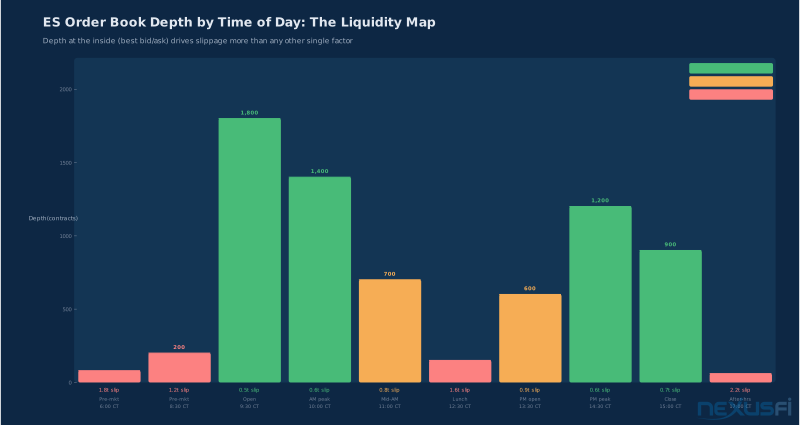
The open has 10-20x the depth of the lunch gap — this depth difference directly drives the 3x slippage variation across session periods. The liquidity map tells you when your fills will be clean and when they won't.
The Open (8:30-9:30 CT pre-market, 9:30-10:00 CT peak)
The open is complex. The 30 minutes immediately following the CME electronic open (8:30 CT for equities) has elevated volatility as overnight positions are adjusted. Spreads can be 1.5 to 2 ticks. But by 9:30-10:00 CT, ES and NQ are at peak liquidity — 30-40% of the day's volume transacts in this window, spreads tighten to 1 tick, and book depth is at its maximum. This is the best execution window for most strategies.
The Lunch Gap (12:00-13:30 CT)
Volume drops to 10-15% of daily levels. Market makers reduce their depth. Spreads on ES widen to 1-2 ticks. Market orders in this period face 0.8 to 1.5 ticks of slippage versus 0.3 to 0.6 ticks during the open. For scalpers, this is a period where their edge can disappear entirely into execution costs. The lunch gap is a known slippage trap.
@grausch's systematic analysis of slippage sensitivity confirms this: "Shorter-term systems are always more sensitive to slippage. The idea is to get an accurate assessment of how sensitive the system is to slippage and whether it can be profitable with realistic slippage." Source — NexusFi Post #647502 The "realistic slippage" varies dramatically by session period.
The Close (14:30-15:15 CT)
The second-best execution window. Volume picks up as institutions manage end-of-day positioning, spreads tighten back to 1 tick, and depth returns. This is a reliable backup if you missed the morning window.
Scalpers vs. Swing Traders: At the core Different Problems #
The same 1 tick of slippage creates completely different risk profiles depending on your trade target. This is the most important conceptual split in slippage management.
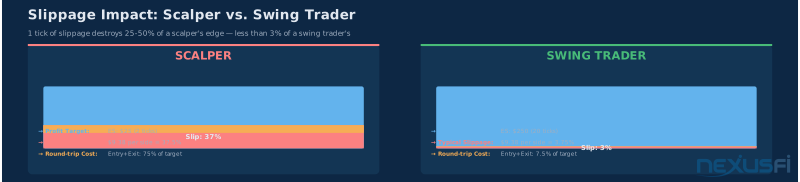
1 tick of slippage erases 25-50% of a scalper's profit target but only 2-5% of a swing trader's. Same dollar amount, completely different risk profiles — which is why scalpers must obsess over execution quality while swing traders focus primarily on setup quality.
The Scalper's Problem: Slippage Dominates
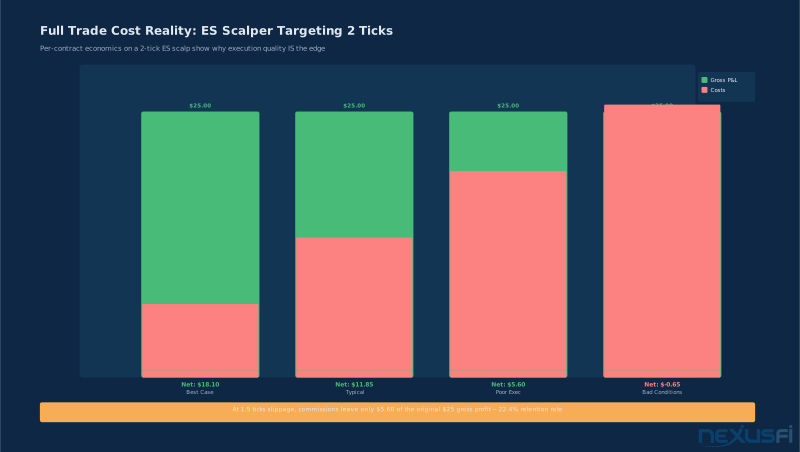
A scalper targeting 2 ticks on ES is targeting $25 per contract. A round-trip slippage of 1.5 ticks (entry + exit combined) costs $18.75 per contract — 75% of the gross profit before commissions. At this ratio, the scalper needs to be right much more often than 50% just to overcome execution friction.
At 1.5 ticks of round-trip slippage, a 2-tick ES scalp yields only $5.60 net — 22.4% of gross. This is why execution quality IS the edge for scalpers, not an afterthought.
Scalpers (see Scalping Strategies for Futures) have no choice but to engineer execution quality as a core part of their edge. Key requirements: passive limit orders as the primary entry mechanism (not market orders), queue position awareness (post limits early to secure front-of-queue position), low-latency routing, strict avoidance of the lunch gap and settlement windows, and automatic position exit when spread widens beyond threshold.
The Swing Trader's Problem: Impact and Sizing
A swing trader targeting 20 ticks on ES ($250 per contract) faces the same 1.5-tick round-trip slippage as the scalper — but that's only 7.5% of target, not 75%. Slippage matters but doesn't dominate. The swing trader's primary execution concern shifts from spread/latency to market impact on larger position sizes.
A swing trader scaling to 10 contracts who uses market orders to enter and exit will face significant impact costs if they're trading in thin periods or using illiquid instruments. Their focus should be on TWAP-style entry/exit (breaking large orders into smaller clips over time), limit-order-primary execution, and depth monitoring before any large order.
Order Type Strategy: Limit vs. Market vs. Aggressive Limit #
This is where theory meets execution. The right order type depends on three factors: how much immediacy you actually need, what the current spread is, and what the current depth looks like.
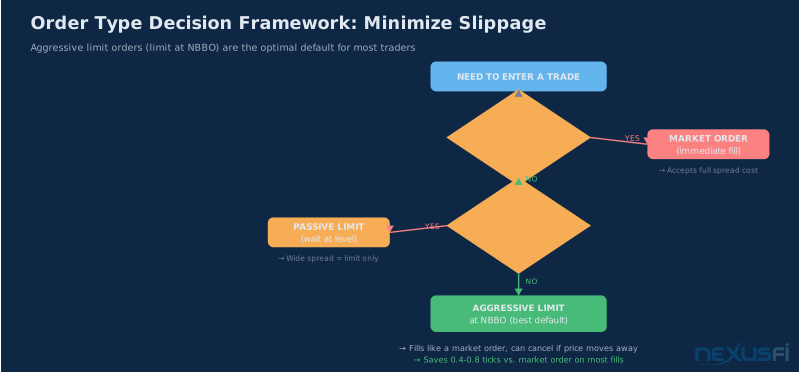
The aggressive limit (limit at NBBO with short timeout) is the optimal default for most retail futures traders. It fills like a market order in normal conditions but can be cancelled if price moves away — eliminating the worst-case market order fills.
Market Orders
Use when: you must exit immediately (stop-loss triggered, risk-off event), trading ultra-liquid instruments during peak volume and spread is known to be 1 tick, or execution at any price is genuinely preferable to missing the trade.
Source — NexusFi Post #467342 That's the correct framing — market orders are an insurance premium for execution certainty.
Passive Limit Orders
Use when: you have a specific price target and are willing to wait, entering against a pullback where you expect price to return to your level, or spread is wider than 2 ticks and you want to capture some of it.
The risk with passive limits: non-fill. If price never touches your level, you miss the trade. If price blazes through your level at high speed, your order may be filled but you're immediately underwater on a fast-moving market. Passive limits work best in mean-reverting, orderly markets — not in breakouts or news-driven moves.
@Fat Tails' extensive analysis of limit order fills confirms: "You are guaranteed to get the specified price if your order is filled. There is no guarantee to be filled." Source — NexusFi Post #232990 The non-fill probability is the hidden cost that many traders don't include in their slippage accounting.
Aggressive Limit Orders (The Best Default)
Set aggressive limits with a 1-2 second timeout. If the order doesn't fill in that window, cancel it and reassess — don't let it drift in the book as a passive limit. NinjaTrader, Sierra Chart, and MultiCharts all support native conditional order timeouts. This one habit eliminates 80% of worst-case market order outcomes for active ES and NQ traders.
An aggressive limit order is a limit at the current best ask (for buys) or best bid (for sells). In normal market conditions, it fills immediately — like a market order. But unlike a market order, it has a ceiling: if the price moves against you before the order is processed, it won't fill at a worse price. It cancels instead.
@josh's recommendation in the limit vs. market order thread captures it well: "Use an aggressive limit — it is a limit order, but because it will execute at market, it basically fills like a market order." Source — NexusFi Post #467492 This is the right default for most ES and NQ entries and exits in normal conditions.
The practical setup: place the aggressive limit with a short timeout (1-2 seconds). If it doesn't fill in that window, either the market moved against you (in which case the order was correctly cancelled) or liquidity dried up (and you should reassess whether to enter). Don't let aggressive limits sit in the order book as passive orders — that changes the risk profile entirely.
Measuring Your Actual Slippage #
Theory is worth nothing without measurement. Most trading platforms give you the fill price and the requested price — that's a starting point, but it's not a complete slippage measurement. Here's the correct methodology.
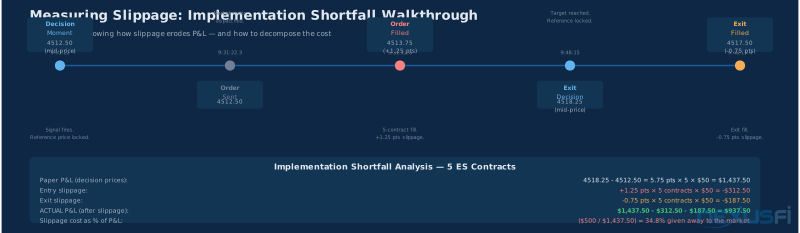
This real ES trade shows implementation shortfall in action: paper P&L of $1,437.50 becomes actual P&L of $937.50 after $500 in total slippage — 34.8% of gross P&L surrendered to execution costs without recognizing it.
Implementation Shortfall: The Standard
The reference price is the mid-price (average of bid and ask) at the exact moment you made the trading decision — when you clicked or when your algo generated the signal. Not when the order was sent, not when it was filled: when the decision happened.
Implementation shortfall = (fill price) - (decision-time mid-price), for buys. Positive means you paid more than the decision-time price — that's the slippage. For sells, it's reversed: (decision-time mid-price) - (fill price).
Example: You decide to buy 5 ES at 9:31:22 when the mid is 4512.50. The order fills at 9:31:22.8 at an average price of 4513.75. Your implementation shortfall is 4513.75 - 4512.50 = 1.25 index points = 5 ticks per contract. On 5 contracts, that's $312.50 in slippage on the entry alone.
Building a Slippage Log
Even a basic spreadsheet tracking decision time, decision-time mid, fill time, and fill price is enough to measure slippage systematically. After 50-100 trades, you'll have a stable median and clear visibility of your worst-case outliers. @artemiso's systematic trading AMA on NexusFi makes the point precisely: "The formal way to look at market impact is participation rate and depth modeling — but even a simple per-instrument slippage log reveals stable patterns quickly." Source — NexusFi Post #605455
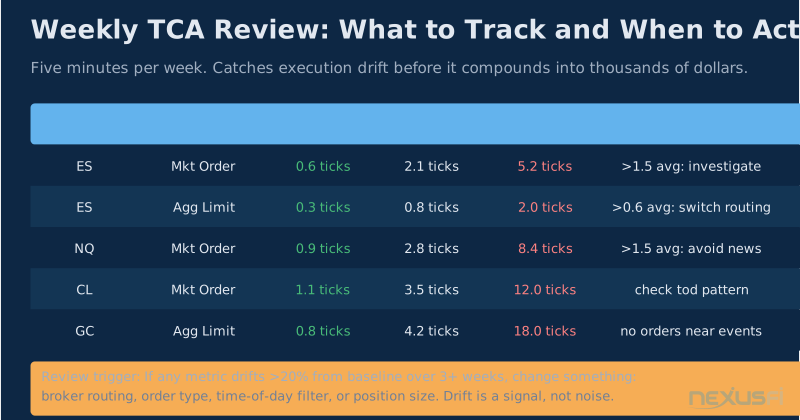
Five minutes per week in a TCA log catches execution drift before it compounds. When median slippage drifts >20% from baseline over 3+ weeks, something changed — broker routing, time-of-day patterns, or order type mix.
Report distributions, not averages. Your median slippage might be 0.6 ticks, but your p90 might be 2.5 ticks. Those outliers — news events, thin periods, large orders that push through multiple price levels — can materially affect your actual P&L versus your backtested P&L if you only model the average.
The Backtesting Problem
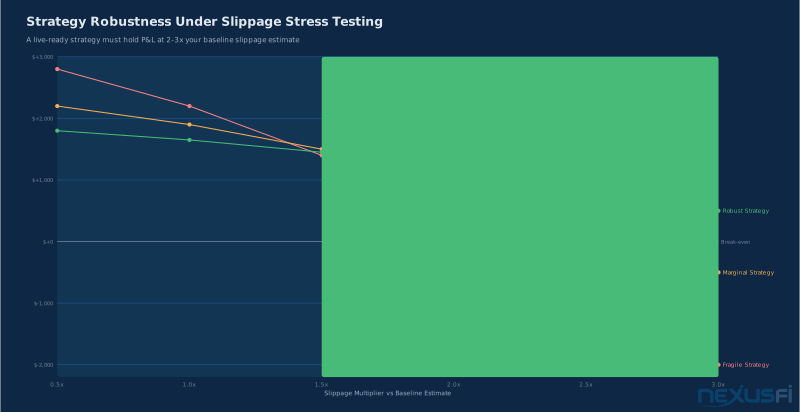
A live-ready strategy holds at 2-3x the baseline slippage estimate. Strategies that collapse below breakeven at 2x need redesign before going live, no matter how good the 1x backtest looks.
Slippage is one of the primary reasons systematic strategies that look great in backtests underperform in live trading. @Hulk's practical approach: "In my backtests, I double the bid-ask spread and use that for slippage. So for ZC, I would use 2 ticks per side when backtesting. That brings it closer to actual fills especially if you are executing larger orders." Source — NexusFi Post #858909
Doubling the spread as a slippage estimate is a reasonable conservative approach for backtesting. For automated strategies, @grausch's sensitivity testing methodology is more rigorous: "Increase [slippage assumption] to 2, then 3 to get an indication of how sensitive the system is. Knowing how sensitive a system is to slippage gives an indication of robustness." Source — NexusFi Post #625886 A strategy that breaks at 1.5x slippage isn't strong. A strategy that holds up at 3x slippage has real edge.
Institutional vs. Retail: Understanding the Structural Gap #
The data shows a structural 3-4x cost disadvantage for retail traders versus institutional desks. Understanding why — and what retail traders can borrow from institutional practice — is worth spending time on.
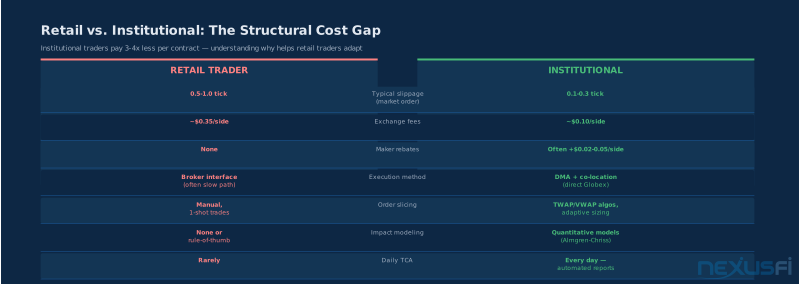 .10/side in exchange fees versus retail's ~
.35/side -- and earn maker rebates on top. The per-contract structural cost gap is 3-4x, built on DMA, co-location, and algorithmic execution that retail traders can partially replicate with disciplined practices.
.10/side in exchange fees versus retail's ~
.35/side -- and earn maker rebates on top. The per-contract structural cost gap is 3-4x, built on DMA, co-location, and algorithmic execution that retail traders can partially replicate with disciplined practices.Institutional traders pay ~$0.10/side in exchange fees versus retail's ~$0.35/side — and earn maker rebates on top. The per-contract structural cost gap is 3-4x, built on DMA, co-location, and algorithmic execution that retail traders can partially replicate with disciplined practices.
What Institutional Traders Do That Retail Traders Can Replicate
Real-time depth monitoring. Before every order, check Level 2. If depth at the inside is thin (fewer than 20-30 contracts on ES), reduce size or use a more passive approach.
Time-of-day discipline. Institutional desks schedule large orders for peak liquidity windows and avoid thin periods. For retail traders this means not scalping during the lunch gap.
Weekly TCA review. If running any systematic strategy, slippage measurement must be baked into performance reporting. The gap between backtest and live performance is almost always execution cost.
The Autotrading Slippage Problem #
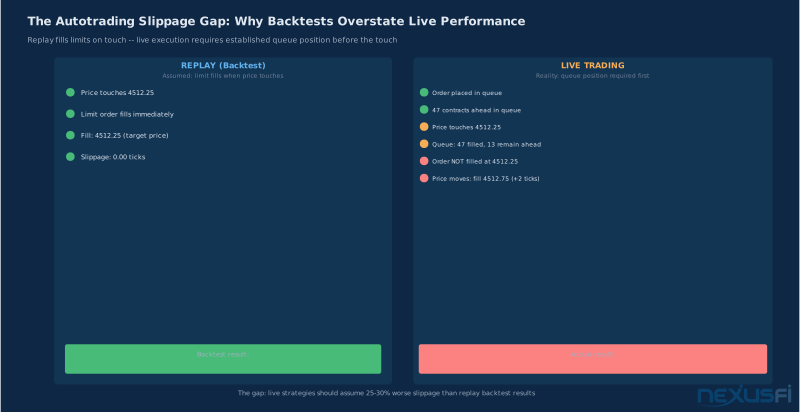
Replay fills limits on touch; live trading requires established queue position before the touch. The result: systematic 25-30% worse slippage in live trading versus replay for limit-order-dominant automated strategies.
Automated strategies face a specific version of the slippage problem: the backtest environment almost never matches live execution. Market replay in NinjaTrader and other platforms fills limit orders when price touches the level — live execution requires the order to be in the queue before the touch, which requires a position in the order book that the backtest can't perfectly replicate.
As @Big Mike documented, when trading in market replay versus live simulation, fill quality differs because replay doesn't accurately model queue position. The practical consequence: assume your live slippage will be 20-30% worse than your replay estimate. Source — NexusFi Post #173946
For ES-based automated strategies, @JonnyBoy's long-term experience provides a useful data point: "When trading with limit orders I have rarely seen slippage in the ES in 10+ years." Source — NexusFi Post #739655 This is consistent with what we know about ES liquidity: if you're patient enough to use limit orders in a strategy with sufficient price tolerance, ES will fill you cleanly. The slippage problem for automated ES strategies is almost entirely a market order problem.
Practical Application: Building Your Slippage Management System #
All of this theory converges on a practical framework. Here's how to implement it.
Immediate Actions (This Week)
Start a slippage log. Every trade: instrument, order type, decision-time mid-price (estimated if you don't have exact timestamps), fill price, slippage in ticks. After 30 trades, you'll have your baseline.
Switch from default market orders to aggressive limits for non-emergency entries. In ES and NQ during peak hours, this will consistently save you 0.3 to 0.6 ticks per fill. At 10 entries/week, that's 3-6 ticks per week saved — $37.50 to $75 per contract per week in improved execution.
Block lunch-gap trading. Set a rule: no new positions between 12:00 and 13:30 CT. This is the highest-friction, lowest-edge period of the day for most retail traders.
Key Takeaways #
- Slippage has three components: bid-ask spread (most controllable), execution delay (addressable with broker choice and order timing), and market impact (scales with position size). Market orders pay all three simultaneously.
- Typical market order slippage: 0.5-1.0 tick ($6-$12) on ES and NQ in normal conditions. News events can push this to 10-20+ ticks on GC and CL -- often avoidable entirely by not trading through scheduled releases.
- Time-of-day matters as much as order type: 12:00-13:30 CT has 2-3x higher slippage than the 9:30-10:00 CT peak window. Trading the lunch gap as a scalper can eliminate your edge entirely.
- Aggressive limit orders (limit at NBBO with short timeout) reduce slippage by 40-60% versus market orders in most conditions. Use market orders only for emergency exits or guaranteed fills during peak liquidity.
- Measure your slippage using implementation shortfall (fill price vs. decision-time mid). Maintain a slippage log. Report distributions, not averages -- the p90 outliers reveal where your edge erodes.
- Backtesting with average slippage assumptions creates overly optimistic performance. Test with 2-3x baseline to verify strategy robustness. A strategy that breaks at 1.5x slippage isn't ready for live trading.
- The retail-institutional cost gap is 3-4x per contract -- addressable by borrowing institutional habits: DMA routing, time-of-day discipline, order slicing, and weekly TCA review.
Knowledge Map
Go Deeper
Build on this knowledgeReferences This Article
Articles that build on this topicCitations
- — Comparing Index Futures (2010) 👍 68“The bid-ask spread is the tax you pay for immediacy -- if you don't need immediacy, there's no reason to pay it.”
- — Experience with Slippage/Delay on ES S&P 500 as you increase contracts? (2016) 👍 5“If you want to buy 30 contracts at market, you would inevitably have slippage -- filled for 10 contracts at 1933.75 and the remaining 20 at 1934.00.”
- — Supply/Demand - Revisited: A journal into the unknown (2017) 👍 3“Shorter-term systems are always more sensitive to slippage. The idea is to get an accurate assessment of how sensitive the system is to slippage and whether it can be profitable with realistic slippage.”
- — Market order type better for futures vs Limit order? (2015) 👍 2“Pro Market: always filled. Contra Market: slippage possible, especially in CL and during news -- worse fills that affect R:R. In ES, essentially a 1-tick cost for immediacy.”
- — Filling Limit Orders on the ES (2012) 👍 4“You are guaranteed to get the specified price if your order is filled. There is no guarantee to be filled.”
- — MIT (Market if touched) - Reduce Slippage (2013) 👍 15“MIT orders become market orders when the touch price is hit -- good for entries at support/resistance levels where you need to confirm the touch but then want immediate execution.”
- — Market order type better for futures vs Limit order? (2015) 👍 3“Use an aggressive limit -- it is a limit order, but because it will execute at market, it essentially fills like a market order.”
- — Ask me anything: systematic trading (AMA) (2016) 👍 2“The formal way to look at market impact is participation rate and depth modeling -- but even a simple per-instrument slippage log reveals stable patterns quickly.”
- — How to account for slippage when backtesting? (2022) 👍 3“In my backtests, I double the bid-ask spread and use that for slippage. So for ZC, I would use 2 ticks per side when backtesting.”
- — ES - Penalising backtesting results (2017) 👍 3“Increase slippage assumption to 2, then 3 to get an indication of how sensitive the system is. Knowing how sensitive a system is to slippage gives an indication of robustness.”
- — Autotrading Slippage compared to Replay (2012) 👍 3“Autotrading slippage compared to replay -- at least now you have an estimation of the slippages including market impact cost to factor into your backtests.”
- — Automated DayTrading: Market Replay vs. Live SIM. Why are results different? (2011) 👍 10“When trading in market replay versus live simulation, fill quality differs because the replay doesn't accurately model queue position.”
- — Is this a Holy Grail Strategy? Am I ignoring something? (2019) 👍 2“When trading with limit orders I have rarely seen slippage in the ES in 10+ years.”