



Stress Testing Your Futures Trading Account: A Complete Framework for Survival Analysis
Overview #
Most futures traders spend a lot of time thinking about where the market is going. They spend almost no time thinking about whether their account can physically survive the path to being right.
That asymmetry kills accounts. The margin call death spiral doesn't care how good your analysis is. It only cares whether your equity stays above a threshold at every mark-to-market cycle. Miss that threshold by a dollar at the wrong moment, and you're liquidated into the worst possible tape while your thesis eventually plays out without you in it.
Stress testing is the discipline of asking a different question: Can my account survive this specific adverse scenario without forced liquidation? Not "what's the probability of this loss?" — that's a different exercise entirely. Stress testing answers the survivability question by working through the actual mechanics: margin requirements, daily mark-to-market, broker liquidation policies, and execution degradation when the order book goes thin.
This is the framework every futures trader needs before they're in the middle of a market crisis trying to figure it out in real time.
Key Concepts #
Mark-to-Market (MTM) — the daily settlement process by which futures gains and losses are settled in cash. See Futures Settlement Prices and Mark-to-Market. Unlike equities where unrealized losses stay unrealized, futures losses are extracted every settlement cycle. You can be directionally correct and still get liquidated because the path to being right passed through a margin breach.
Variation Margin — the daily cash flow mechanism of MTM. Losses are debited from your account — not an accounting entry, but cash removed before you can close the position.
Initial Margin — collateral required to open a futures position. See Futures Margin and Leverage. Brokers almost always require more than the CME exchange minimum. The exchange minimum is SPAN-calculated — see SPAN Margin for details.
Maintenance Margin — the minimum equity level required to keep the position open. Drop below this and you face an immediate margin call or liquidation. This threshold is what stress testing is designed to measure against.
Liquidation Price — the specific futures price at which your account equity breaches the maintenance threshold. This is calculable before the trade. Most traders never calculate it.
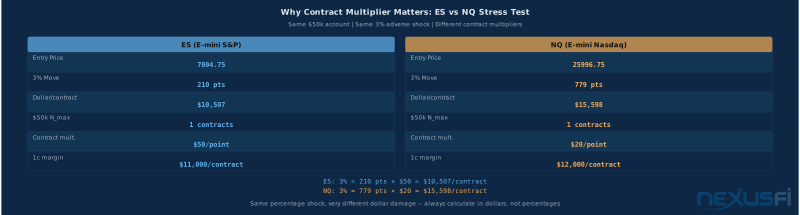
Contract Multiplier — the dollar-per-point value. For ES, one point equals $50. A 10-point move equals $500 per contract. This gear ratio is what makes futures lethal in drawdowns.
Slippage Multiplier — during stress, bid-ask spreads widen, order book depth collapses, and stops execute at far worse prices. See Slippage in Futures Trading. A 5x normal slippage assumption for crisis conditions is conservative, not extreme.
Why Futures Stress Testing Is Different #
Equities have leverage but the mechanics differ enough that equity-based risk thinking gets traders killed in futures.
Futures differ in three critical ways from equity margin:
Daily MTM cash flow. Every settlement, losses are extracted. A 3-day trend move against 2 ES contracts at $100/point drains $12,000+ before you can react.
Leverage amplifies liquidation speed. ES at 5,000 means controlling $250,000 exposure per contract with ~$13,000 margin. That's ~19:1 leverage. A 2% adverse move wipes out a third of initial margin in one session.
You can be right and still lose. Forced liquidation at the low is the canonical futures nightmare. The stress test tells you before Day 1 where the spiral starts.
Here's the mechanics: Day 1 long 2 ES at 5,000, market drops 80 points → $8,000 MTM loss, equity $30k → $22k. Day 2 market gaps 60 points lower → $6,000 MTM loss, equity $16k. Broker maintenance for 2 contracts: $18,000. Liquidation triggered. Day 3: market bounces 200 points. You're not in it.
The Core Difference Between Futures and Equity Risk In equities, unrealized losses stay unrealized until you close the position. In futures, losses are extracted in cash every settlement cycle. You can be directionally correct and still get liquidated because the path to being right passed through a margin breach.
The Liquidation Price Formula #
This is the core calculation every futures trader should run before entering any position.
For a long position, the liquidation-breach price is:
P_liq = P_0 + (M_th - E_0) / (N × C)Where P_0 = entry price, E_0 = starting account equity, M_th = maintenance threshold, N = contracts, C = multiplier ($50/point for ES).
Worked example: $25,000 account, 2 ES contracts, entry at 5,000
Broker requires $11,000 maintenance per contract. Total M_th = $22,000.
P_liq = 5,000 + (22,000 - 25,000) / (2 × 50) = 5,000 - 30 = 4,970A 30-point adverse move triggers a maintenance breach. ES moves 30 points in 15 minutes on a normal day. This demonstrates that 2 contracts on $25,000 has almost no cushion.
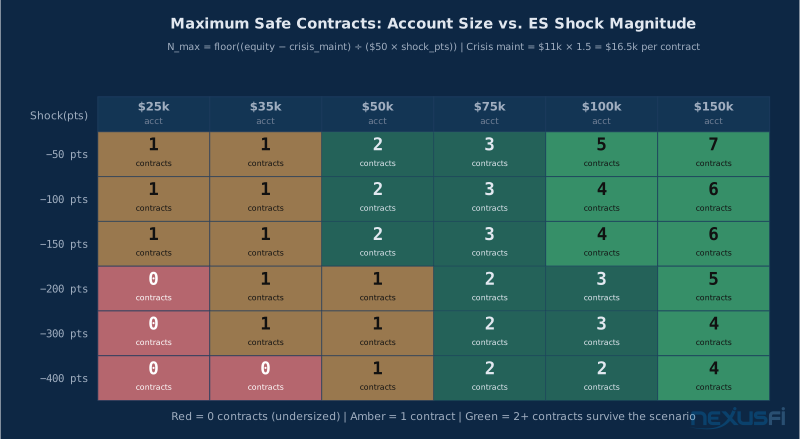
Rearrange to solve for maximum surviving contracts given a shock:
N_max = floor((E_0 - M_th) / (C × Delta_P_shock))For $25,000 account surviving a 100-point ES shock: N_max = floor((25,000 - 22,000) / (50 × 100)) = floor(0.6) = 0. Zero contracts. The account cannot hold even 1 ES contract through 100 points. This is a fact you'd rather know before the trade. See Position Sizing for Futures Trading for the full framework.
Broker Margin vs. Exchange Minimum Your stress test must use broker-house margin, not CME exchange minimums. Brokers require 10-30% more and can raise requirements overnight without notice during volatile markets.
The Five-Scenario Stress Test Framework #
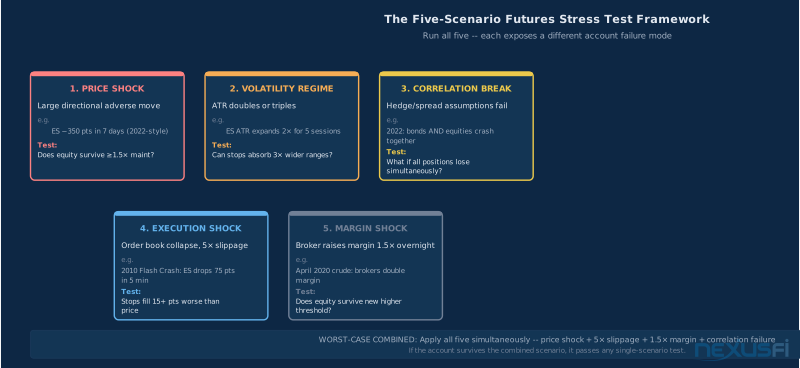
A complete stress test covers five distinct failure modes. Price alone is insufficient — scenarios that kill accounts involve price, volatility, correlation, execution, and margin behaving simultaneously under stress.
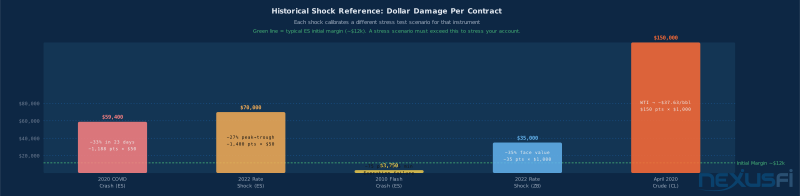
Scenario 1: Price Shock. A large directional move against your position over 1-5 sessions. Calibrate to historical reference points: ES COVID crash (~1,188 points), 2022 rate shock (300+ point legs). Test three magnitudes: moderate (1 ATR day), severe (3-4 ATR days), historical-worst (worst 5-day stretch in 10 years).
Scenario 2: Volatility Regime Shift. ATR explosion changes the entire execution environment. Test ATR expanding 2-3x. Check if your stop distance makes sense at current size, and recalculate liquidation price after 3 days of elevated-ATR adverse sessions.
Real accounts, real liquidations.
Scenario 3: Correlation Breakdown. The 2022 equity-bond crisis is the textbook case: traders using long bonds as an equity hedge got killed on both legs simultaneously. Test your portfolio for simultaneous adverse moves across all positions — what's your total dollar exposure at maximum correlation?
Scenario 4: Liquidity and Execution Shock. The 2010 Flash Crash: ES dropped 75 points in 5 minutes, stop orders executed 20-30 points worse than the stop level.
Stress testing tells you in advance exactly how close you'll be. Use 5x normal slippage as floor for crisis execution assumptions.
Scenario 5: Margin Shock. During crises, brokers routinely increase margin 30-50% overnight. Market moves against you while the maintenance threshold simultaneously jumps — you're forced to reduce position even if equity hasn't breached the old threshold. The April 2020 crude oil crisis shows this at the extreme: WTI traded to -$37.63/barrel. Apply a 1.5x multiplier to current broker margin requirements for stress test calculations.
Full Walkthrough: $50,000 Account, 2-Contract ES #
Running the full stress test with real-world parameters. "2022-style shock" scenario — sustained sell-off combined with broker margin increase.
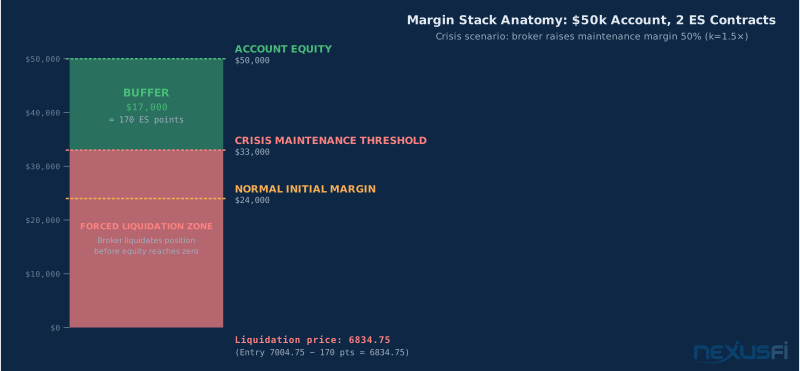
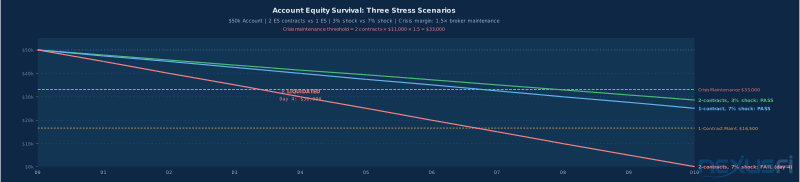
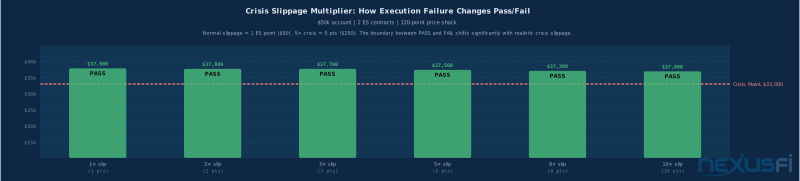
Inputs: E_0 = $50,000, N = 2, C = $50/pt, P_0 = 5,000, M_maint = $11,000/contract, k_m = 1.5 (broker crisis hike). Effective M_th = 2 × ($11,000 × 1.5) = $33,000.
Scenario: 7% adverse move (350 points) + 5-point crisis slippage.
Loss = 2 × $50 × 355 = $35,500
E_shock = $50,000 - $35,500 = $14,500
M_th = $33,000
$14,500 < $33,000 → FAIL
Liquidation price:
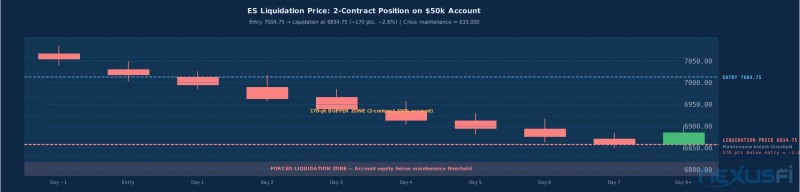
P_liq = 5,000 - (50,000 - 33,000) / (2 × 50) = 5,000 - 170 = 4,830Forced out at ES 4,830 — a 3.4% drop from entry. That's one average-vol day in a volatile market. Check maximum contracts:
With N=1: M_th = $16,500, Buffer = $33,500, Max loss = $17,750
$33,500 > $17,750 → PASS
One contract passes. The correct position size for $50k under a 7% shock with broker margin hike is 1 contract. Not 2. Not 3. One.
The 2020 Negative Crude Oil Case Study #
April 20, 2020: WTI crude front-month (CLK20) traded to approximately -$37.63/barrel. Negative oil. Not zero — negative. Storage near Cushing was full; physical buyers couldn't take delivery; futures traders holding the front contract had to pay someone to take it.
The stress test failure was twofold: "asset can go to negative prices" wasn't in most scenario libraries, and as
AMP Futures faced a class action from traders whose positions were liquidated improperly.
The lesson: your scenario library needs instrument-specific mechanics, not just price-magnitude scenarios. Crude's physical delivery creates risks index futures don't have. Build scenarios that stress the specific failure modes of your instruments.
Interpreting Results and Taking Action #
A stress test that produces numbers but doesn't change behavior is just an anxiety exercise. The output must translate into trading decisions.
Minimum pass criteria: post-shock equity remains above maintenance margin threshold (with margin shock multiplier) and remains sufficient to continue trading. Surviving a margin call by $500 isn't actually surviving — you'll be forced to cut to micros while paying the worst possible prices.
Set your maximum position size as the largest N that passes your most severe scenario, then apply a 0.75 safety factor: N_cap = floor(N_max × 0.75). For the $50k account: N_max = 1, N_cap = 0 — the account is too small for ES in a crisis scenario. Options: trade MES (micro ES, $5/point), add capital, or lower the shock magnitude to match your actual risk tolerance.
Stops don't save you in crisis conditions. If your stop is at ES 4,900 but your liquidation price is ES 4,970, you hit maintenance breach before the stop triggers — especially with crisis slippage widening fills far beyond the stop price. Size so the math works, then let the stop be your behavioral floor.
@dsdnaples in the Account blown up thread: "I blew up my day trading futures account 3 times. The last time was in 2009 when I put on a few large ES shorts. Moved my stops — total idiot move and I knew better. I lost 125K on a 150K account." Moving stops during a stress scenario is the behavioral failure the math-based position cap is designed to override.
@tigertrader on account sizing after multiple black swan events: "I have been present and trading in the pits during more than one black swan event. The longer I am in this game, the more risk-averse I become — the number of black swans I have seen are already way too much for me to be comfortable with." See Tail Risk and Black Swan Events.
@tigertrader, Traders Hideout
Stress Testing vs. Monte Carlo vs. VaR #
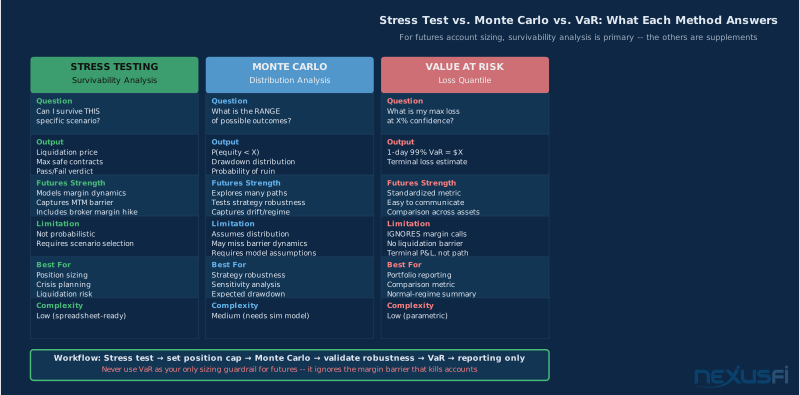
These three tools answer different questions. Using the wrong one for futures survivability is how traders get confident about risks they don't actually understand.
Stress Testing answers: "Can my account survive this specific scenario without forced liquidation?" Output: liquidation price, breach point, max surviving position, pass/fail. Directly models the barrier problem — equity must stay above threshold at every point, not just at the end. Requires you to define scenarios; not probabilistic.
Monte Carlo answers: "What's the distribution across thousands of simulated paths?" See Monte Carlo Simulation for Trading Systems. Weakness: standard implementations don't model margin calls correctly. If the simulation doesn't include the maintenance-breach trigger, it underestimates liquidation risk.
VaR answers: "What's the maximum expected loss at a given confidence level over a given horizon?" Weakness for futures: VaR treats loss as a terminal number at horizon end. Futures liquidation is a barrier problem — you're forced out when equity hits the threshold during the horizon, not at the end. A 1-day 99% VaR might show $10k maximum loss, but if maintenance breach triggers at $6k of adverse MTM, you're liquidated before reaching the VaR number. @Fat Tails in the losses can exceed deposits thread: "Margin is simply an amount expected to be large enough to cover losses for the instrument. Set by the exchange for overnight, by the broker for intraday."
Recommended workflow: Stress test first (hard position cap), Monte Carlo second (strategy robustness), VaR as supplementary reporting only.
Building Your Scenario Library #
A stress test is only as good as its scenarios. Build a permanent library of reference events for each instrument and run the test before sizing any new position.
Minimum scenario library per futures instrument:
- Price shocks (3 magnitudes): moderate (1.5× ATR, 1 day), severe (3× ATR, 3 days), historical-worst (largest 5-day decline in 10 years)
- Regime: ATR doubles for 5 days; correlations collapse to +1; roll stress near expiry
- Mechanical: broker margin hike 1.5×; 5× slippage on exits; gap open 30-50 points through stop
For ES specifically: Flash Crash (75 points in 5 minutes), COVID crash (1,200-point drawdown over 23 days), 2022 rate shock (200-300 point moves with multiple bounces). Run all three before deciding on position size for any new ES trade. For the mathematical relationship between position size and probability of ruin, see Risk of Ruin.
When Stress Tests Are Wrong #
Stress testing reduces risk — it doesn't eliminate it. Five ways stress tests fail:
Wrong scenario selection. Negative crude oil wasn't in most scenario libraries. Tests only protect against scenarios you've modeled.
Wrong margin assumptions. Brokers can double margin in hours. The 1.5x multiplier is a baseline — genuine crises have seen 2-3x hikes.
Correlation failures. The 2022 equity-bond breakdown destroyed "hedged" traders. Missing scenario: "both legs sell simultaneously."
Execution assumption failures. The Flash Crash showed fills 20-30 points below stop prices. Model the gap-open: price opens 40-50 points through your stop with no fills between.
Psychological failure. You ran the test, set the cap at 1 contract, then traded 2 because the setup looked good. Make the position cap a hard rule. @SMCJB in the margin requirements thread: "IB have some of the highest margin requirements and some of the most aggressive liquidation policies. You need one that uses SPAN minimums."
Knowledge Map
Prerequisites
Understand these firstGo Deeper
Build on this knowledgeReferences This Article
Articles that build on this topicCitations
- — Question about intraday margins (2021) 👍 6“In futures, if you close a trade with a 1 dollar profit, your account is immediately credited 1 dollar. If your trade goes against you and loses 1 dollar, your account immediately loses 1 dollar.”
- — losses can exceed deposits (2015) 👍 6“Margin is simply an amount that is expected to be large enough to cover any losses for the particular instrument you are trading. Set by the exchange for overnight trading, by the broker for intraday.”
- — Futures Margin Leniency (2023) 👍 3“IB have some of the highest margin requirements and some of the most aggressive liquidation policies. In addition to shopping around for different brokers margin policies -- you need one that uses SPAN minimums.”
- — Margin: initial vs maintenance vs day trading (2017) 👍 7“Futures are a highly leveraged trading product. Margins are good faith deposits that a trader must maintain in order to trade a particular product. There are three different types: initial margin, maintenance margin, and intraday margin.”
- — Risk of trading micro futures (2020) 👍 3“Most brokers will never let this happen and you will be automatically liquidated. Note this is only an issue really if you are really close to your max margin.”
- — Account blown up (2015) 👍 17“I blew up my day trading futures account 3 times. The last time was in 2009 when I put on a few large ES shorts. Moved my stops -- total idiot move. I lost 125K on a 150K account.”
- — Selling Options on Futures? (2016) 👍 5“On the drop on 8/24/15, using 3X caused all trades to go on margin call except the one using 2 longs.”
- — 90/10 Statistic the Obvious- For New Traders (2019) 👍 4“The mark-to-market process is even and balances out. This is different from trading other instruments, but it's how things are implemented for futures contracts. These are actual cash transactions.”
- — Killer Instinct and the Home Run Mentality (2011) 👍 8“If you want to fine tune your risk profile, adjust your position for the varying levels of volatility in the market. Since volatility is commonly increasing as a trade is working out, adding to positions is significantly adding to risk.”