



Strategy Evaluation Metrics for Automated Futures Trading: Sharpe, Sortino, Drawdown, and the Numbers That Actually Matter
Overview #
No single number tells you whether a trading system works. Sharpe Ratio, win rate, profit factor — each captures one dimension of performance while hiding others. Traders who evaluate automated strategies through a single metric routinely deploy systems that look excellent on paper and blow up in practice.
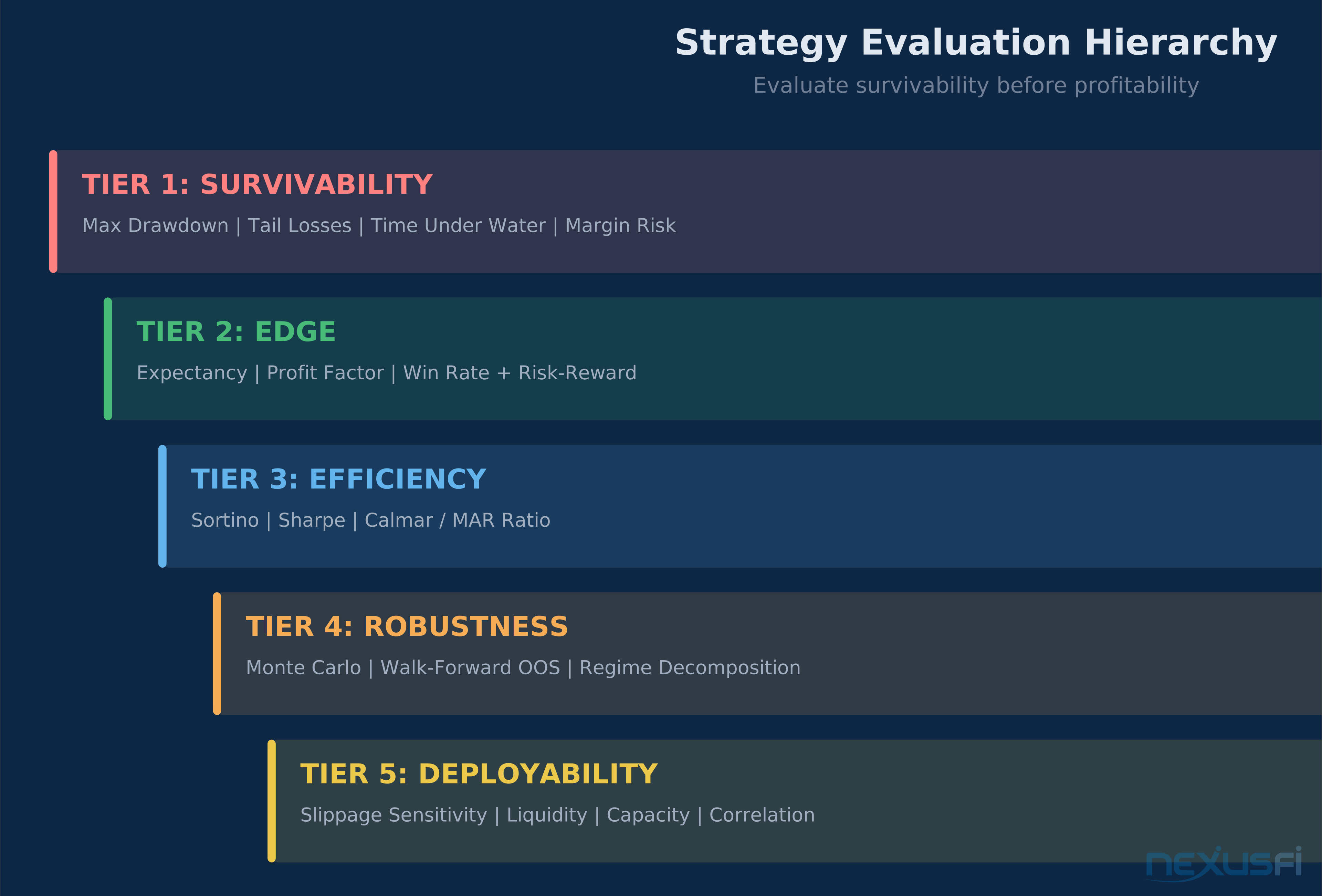
This article builds a multi-layered evaluation framework for automated futures trading systems. The hierarchy starts where it should — survivability — and works upward through edge, efficiency, robustness, and real-world deployability. Every metric earns its place by answering a specific question about whether your system can survive, profit, and adapt.
The Single-Metric Trap #
The most common mistake in strategy evaluation is anchoring on one number. A system with a Sharpe Ratio of 2.0 sounds excellent — until you discover it achieved that number during a six-month low-volatility window and has never traded through a VIX spike. A 75% win rate impresses — until the average loss is four times the average win, producing negative expectancy.
@Fat Tails demonstrated this directly on NexusFi when comparing [two systems with identical expectancy but different win rates and R-multiples][1]. The systems performed identically on paper but produced dramatically different drawdown profiles. "Comparing Win Rate and R-Multiple for Equal Expectancy," as @Fat Tails put it, reveals that the path matters as much as the destination.
Every metric tells you something. No metric tells you everything. Professional evaluation requires a structured hierarchy that prevents you from optimizing one dimension at the expense of others.
Tier 1: Survivability -- The Foundation #
Before asking whether a strategy is profitable, ask whether it can survive. In leveraged futures markets, a system that produces excellent returns but occasionally draws down 60% will eventually hit a margin call or trigger forced liquidation during precisely the wrong market conditions.
Maximum Drawdown (MDD) #
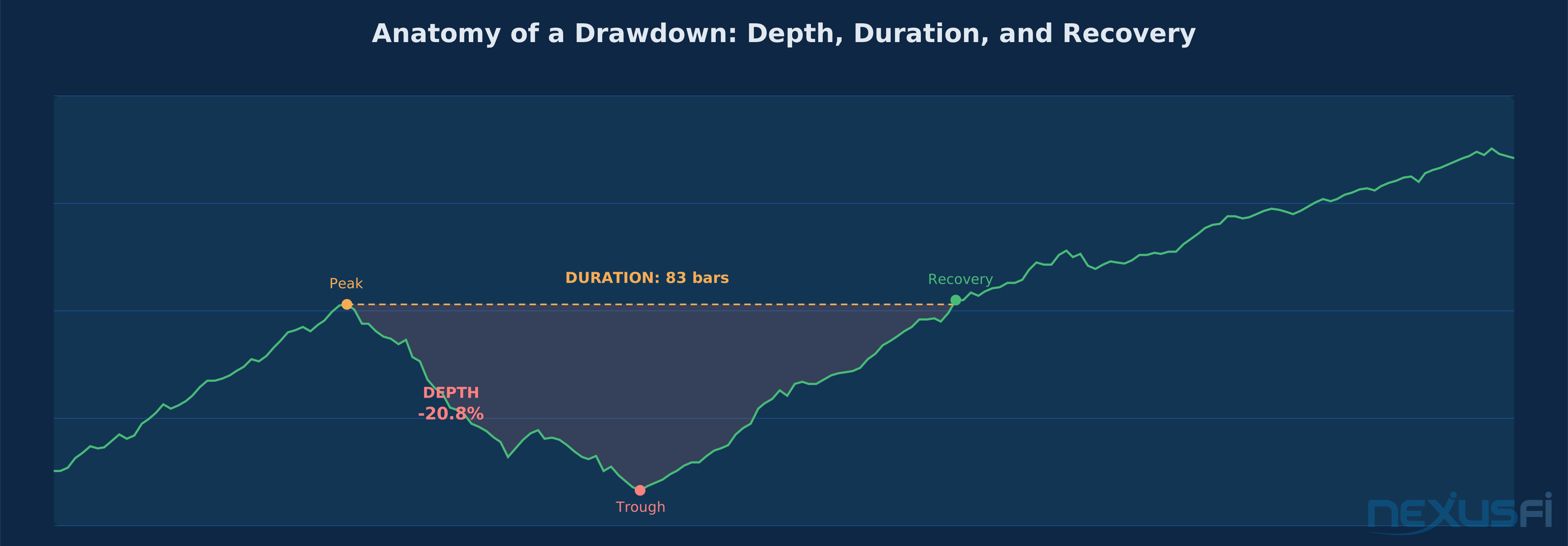
Maximum drawdown measures the largest peak-to-trough decline in your equity curve. It answers the most visceral question in trading: "How much of my money disappeared before it came back?"
Three dimensions of drawdown matter:
Depth — the percentage decline from peak to trough. A 25% drawdown requires a 33% gain to recover. A 50% drawdown requires 100%. The math is asymmetric and unforgiving.
Duration — how long the drawdown lasts. A 15% drawdown that recovers in two weeks feels different from one that persists for six months. Duration tests psychological endurance and capital allocation patience.
Recovery time — how long from trough back to the prior peak. @SMCJB documented this phenomenon in the [iSystems Journal][2], noting that live drawdowns were "4 times larger than the largest drawdown seen in the backtest." This is not unusual — backtests systematically underestimate maximum drawdown because they cannot model extreme events, liquidity gaps, and execution degradation under stress.
Tail Losses and Worst-Case Events #
Maximum drawdown captures the single worst episode. But a complete survivability assessment examines the full distribution of losses:
- Worst single day: What is the largest one-day loss the system has produced?
- Worst week: How bad can a sequence of losing days get?
- Value at Risk (VaR) and Conditional VaR (CVaR): What is the expected loss in the worst 5% of scenarios? CVaR (Expected Shortfall) is especially relevant for futures because it captures the severity of tail events, not just their threshold.
Time Under Water #
Time under water measures how many days, weeks, or months the equity curve spends below its prior peak. A system can have a modest maximum drawdown but spend 80% of its time underwater — psychologically brutal even if mathematically acceptable.
The Ulcer Index combines depth and duration into a single measure, penalizing both deep and prolonged drawdowns. @DowDaddy tracked this metric alongside Sharpe and Sortino in the [1% Risk Journal][3], demonstrating how the combination provides a more complete picture than any single metric.
Margin Utilization #
For futures specifically, survivability includes margin behavior. A system that uses 85% of available margin during normal conditions will face forced position reduction or liquidation during volatility spikes when exchanges raise margin requirements. Conservative systems rarely exceed 40-50% margin utilization even at peak exposure.
Tier 2: Edge -- Does the System Actually Work? #
Once survivability is established, the next question is whether the system has a genuine statistical edge. This is where most traders start their evaluation — but starting here without first passing Tier 1 is a recipe for deploying profitable-but-fragile systems.
Expectancy #
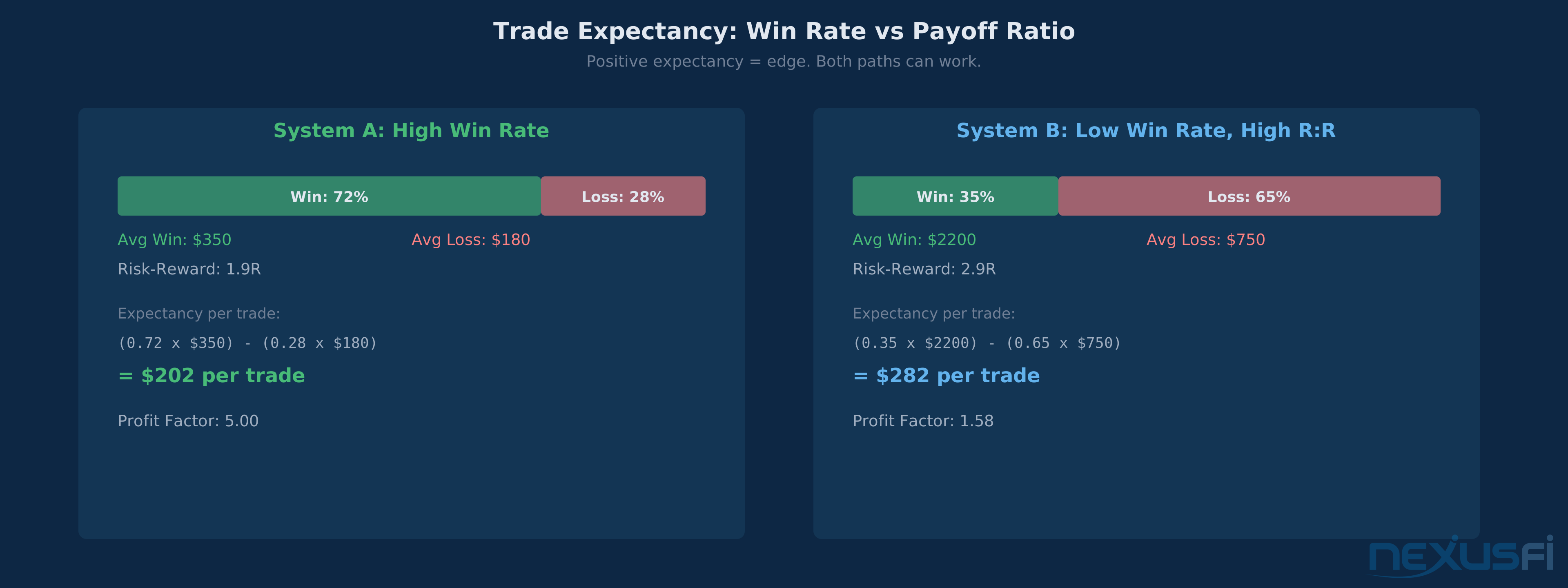
Expectancy is the average profit per trade, accounting for both wins and losses:
Expectancy = (Win Rate x Average Win) - (Loss Rate x Average Loss)
This single calculation captures whether the system has positive edge at the trade level. A system with $127 average expectancy per trade has demonstrated that, on average, each trade adds value. But context matters enormously.
@Fat Tails explored this relationship extensively in the [risk of ruin thread][4], showing how position sizing interacts with expectancy to determine whether a positive-edge system actually survives long enough to realize its statistical advantage. A system with positive expectancy can still blow up if position sizing is too aggressive relative to the variance of outcomes.
Critical requirement: Expectancy must be calculated after ALL costs — commissions, exchange fees, estimated slippage, and spread costs. A system with $50 expectancy before costs and $48 in round-trip costs has $2 real expectancy — one tick of additional slippage eliminates the edge entirely.
Profit Factor #
Profit Factor = Gross Profits / Gross Losses
A profit factor of 1.0 means the system breaks even. Above 1.0, it profits. The question is how much margin exists above breakeven:
- 1.0-1.2: Marginal edge. Transaction costs and slippage can eliminate it.
- 1.2-1.5: Tradeable edge, but sensitive to execution quality.
- 1.5-2.0: Solid edge with meaningful buffer above breakeven.
- Above 2.0: Strong edge, but verify it is not curve-fit to a specific regime.
Profit factor is most useful when combined with sufficient sample size. A profit factor of 3.0 from 15 trades is statistically meaningless. A profit factor of 1.4 from 2,000 trades is far more informative.
Win Rate and Risk-Reward: The Joint Distribution #
Win rate alone tells you almost nothing. A 90% win rate with 1:10 risk-reward loses money. A 30% win rate with 5:1 risk-reward is highly profitable. What matters is the joint distribution.
@Fat Tails demonstrated in [Why 7% is the Difference between Failure and Success][5] that the relationship between win rate and average win/loss ratio has non-obvious implications for drawdown behavior: "average win to average loss is the better option because it produces smaller drawdowns." This counterintuitive result — that lower win rate systems with better payoff ratios can produce smoother equity curves — challenges the common preference for high win rates.
@Hulk outlined a practical ranking approach in [What metrics to focus on when backtesting][6], prioritizing "Net P/L minus commissions and anticipated slippage" and "Expectancy (mean P/L per trade), the higher the better" as the primary evaluation metrics.
For futures specifically, examine how win rate and payoff ratio change across:
- Different market sessions (overnight vs. regular hours)
- Different volatility regimes
- Different holding periods within the same strategy
If the edge concentrates in one session or regime, the aggregate numbers overstate the system's reliability.
Tier 3: Risk-Adjusted Efficiency #
Tier 2 established that edge exists. Tier 3 asks how efficiently that edge converts to returns relative to the risk taken. Two systems with identical absolute returns may have wildly different risk profiles.
Sharpe Ratio #
The Sharpe Ratio — average excess return divided by standard deviation of returns — is the most widely cited risk-adjusted performance measure. It answers: "How much return am I earning per unit of total volatility?"
Benchmark values for futures:
- Below 0.5: Weak risk-adjusted returns
- 0.5-1.0: Acceptable for many systematic strategies
- 1.0-1.5: Strong risk-adjusted performance
- Above 1.5: Excellent, but verify it is not regime-specific or curve-fit
Limitations for futures traders:
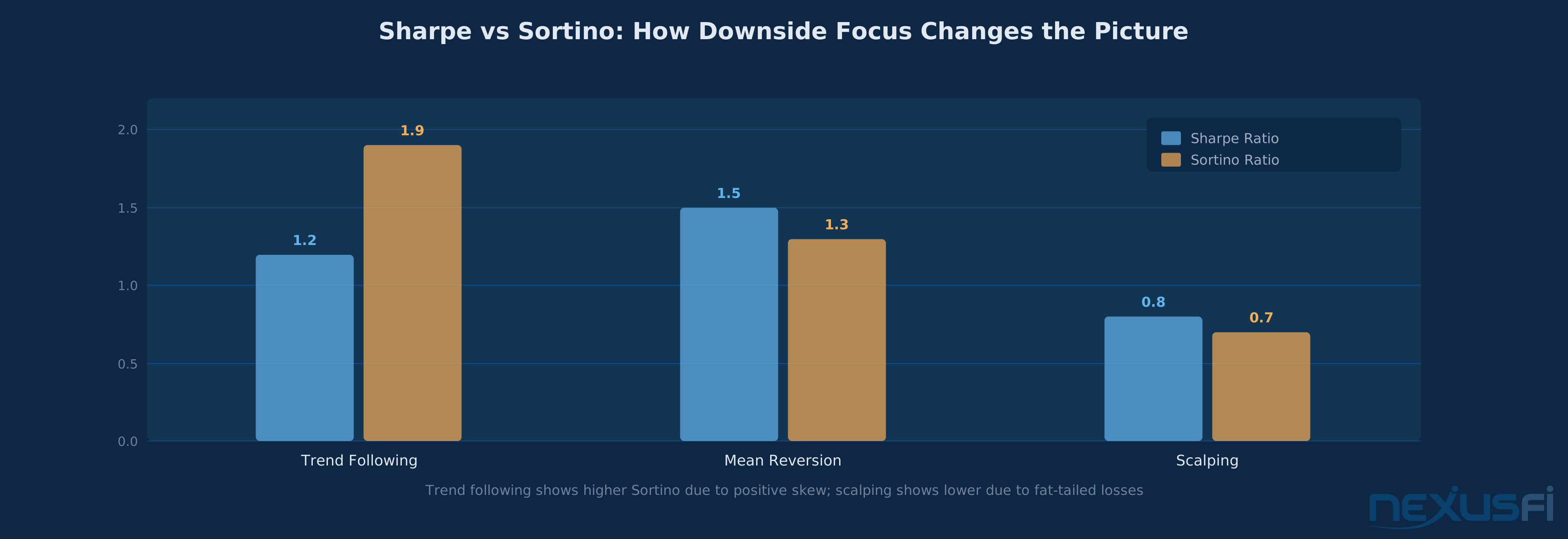
- Sharpe treats upside and downside volatility equally. A trend-following system that produces large winning months (high upside volatility) gets penalized for exactly the behavior you want.
- Futures returns are typically non-normal, fat-tailed, and often autocorrelated. Sharpe assumes none of these properties.
- Short sample periods, low-volatility regimes, and curve-fit parameters can all inflate Sharpe artificially.
Sortino Ratio #
The Sortino Ratio replaces total standard deviation with downside deviation — only measuring volatility below a target return (typically zero). This is more appropriate for futures strategies because:
- It does not penalize positive volatility (profitable months with large gains)
- It better captures the risk that actually concerns traders — losing money
- It is more informative for asymmetric return distributions, which are common in trend-following and options-selling strategies
A strategy with Sharpe of 1.2 and Sortino of 2.0 has favorable skew — most of its volatility comes from upside. A strategy where Sharpe exceeds Sortino has dangerous negative skew — the losses are larger and more volatile than the gains.
Calmar and MAR Ratios #
Both divide compound annual growth rate (CAGR) by maximum drawdown. They answer: "How much return am I earning per unit of worst-case pain?"
- Calmar Ratio typically uses a 3-year lookback
- MAR Ratio often covers the full track record
These ratios are especially actionable for futures because:
- They directly connect return to the capital you need to survive the worst period
- A Calmar of 2.0 means the strategy's annual return is twice its maximum drawdown — a reasonable starting point for position sizing discussions
- They are unstable in short samples (a single bad month can halve the ratio), so they require meaningful track records
Tier 4: Robustness -- Will It Keep Working? #
A strategy that passes Tiers 1-3 on historical data has demonstrated past performance. Tier 4 asks the harder question: is this edge strong enough to persist in live trading?
Monte Carlo Simulation #
A backtest is one path through history. Monte Carlo simulation generates thousands of possible paths by resampling trades or returns, revealing the distribution of outcomes your strategy could have produced.
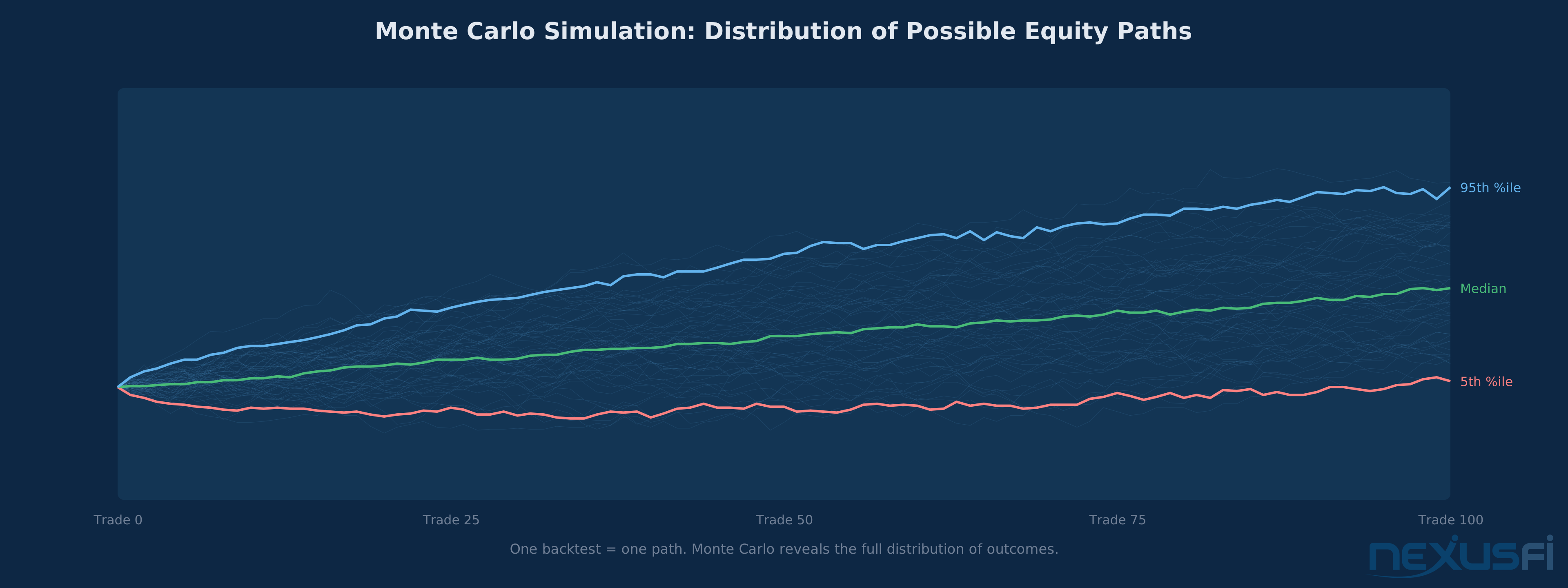
What Monte Carlo reveals:
- The range of possible equity curves from the same trade distribution
- Confidence intervals for final equity, maximum drawdown, and Sharpe Ratio
- The probability of hitting specific drawdown thresholds or ruin levels
- Whether your backtest result sits in the median or the lucky tail of the distribution
Critical methodology warning: Simple independent resampling (shuffling trades randomly) destroys the serial correlation structure of real trading returns. If your system has winning and losing streaks — which most do — random shuffling produces overly optimistic drawdown estimates. Use block bootstrap methods that preserve the autocorrelation structure of your return series.
@Fat Tails covered the mathematics behind this in [advanced mathematics and gaming theory for traders][7], noting that "SQRT(N) has been added to emphasize the sample size" as a proxy for drawdown behavior across different sample sizes. The interaction between sample size, expectancy, and the probability of ruin is more subtle than most traders realize.
@Ozquant reinforced this in [No more BS - what works and what doesn't][8]: "As long as you are aware of probability matrix you can make any positive expectancy system work but without knowing the matrix, optimal position sizing to give best chance of avoiding risk of ruin is not possible."
Walk-Forward and Out-of-Sample Validation #
Walk-forward analysis divides your data into sequential train-test windows: improve on one period, test on the next, roll forward, and repeat. This is the single most important robustness test because it simulates how the system would have actually been traded — with parameters fit on past data and deployed on unseen future data.
Key metrics to compare in-sample vs. out-of-sample:
- Sharpe and Sortino degradation (some decay is normal; >50% suggests overfitting)
- Profit factor deterioration
- Drawdown increase
- Win rate stability
- Parameter value drift across windows
@kevinkdog illustrated the reality of out-of-sample performance in [Kevin's TST Combine Journal][9], showing "system performance after 140 days. Barely positive, and close to the lowest point." Even a positive system can spend extended periods underwater in live trading, testing the trader's conviction that the edge is real.
A strategy with unstable parameter sensitivity across walk-forward windows — where optimal values shift dramatically from one period to the next — is likely overfit to noise rather than capturing genuine market structure.
Regime-Specific Performance Decomposition #
This is the most underrated and most diagnostic robustness test. Instead of evaluating aggregate performance, break results by market regime:
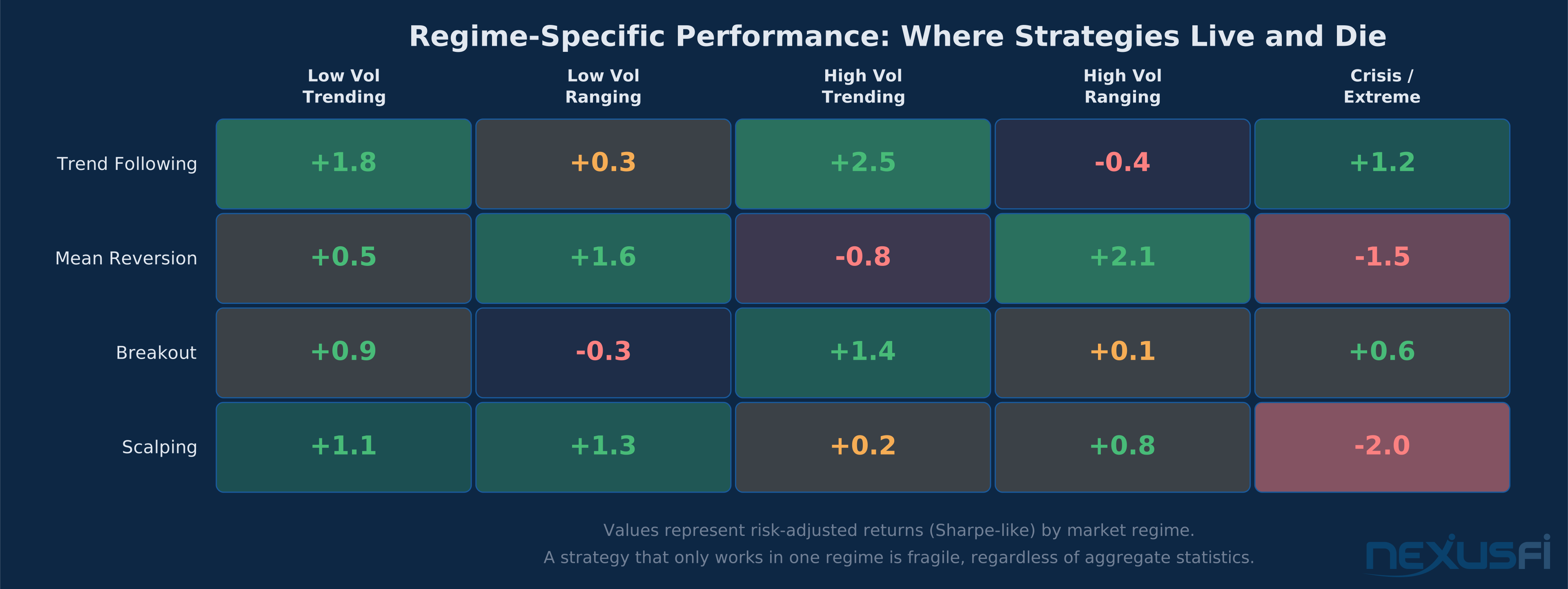
Common regime categories for futures:
- Volatility: High VIX/ATR vs. Low VIX/ATR periods
- Trend: Trending markets (strong directional moves) vs. ranging markets (mean-reversion dominant)
- Session: Regular hours vs. overnight/globex sessions
- Calendar: FOMC weeks, CPI releases, contract roll periods vs. normal weeks
- Correlation: Risk-on (correlations collapse) vs. risk-off (correlations spike)
For each regime bucket, compute the complete metric stack: Sharpe, Sortino, MDD, expectancy, profit factor, and slippage sensitivity.
The key insight: A strategy that only performs in one regime is fragile, regardless of its aggregate statistics. A trend-following system that shows Sharpe 2.5 in trending markets and Sharpe -0.8 in ranging markets needs a reliable regime classifier to be tradeable — and regime classifiers are themselves imperfect and subject to overfitting.
Tier 5: Deployability -- Can You Actually Trade It? #
The final tier addresses whether a theoretically sound, historically strong system can be deployed in practice.
Slippage Sensitivity #
Test your system's performance at progressively worse execution: +1 tick, +2 ticks, +3 ticks of additional slippage per trade. If performance collapses at +1 tick, the edge is too thin to survive real-world execution.
For futures, slippage is not constant — it varies by:
- Time of day (thin overnight books vs. liquid regular hours)
- Volatility regime (spreads widen during VIX spikes)
- Contract (ES fills differently than lumber or lean hogs)
- Size (10 contracts fill differently than 1)
@sam028 discussed practical optimization for strategy evaluation in [Automated Strategy for MNQ][10], demonstrating how to systematically rank parameter combinations using performance metrics after realistic cost assumptions.
Liquidity and Capacity #
How many contracts can the system trade before its own orders move the market? A system that produces 2.0 Sharpe on 1 contract of MNQ may produce 0.5 Sharpe at 50 contracts due to market impact. Capacity analysis is critical for anyone planning to scale beyond small size.
Correlation to Existing Exposures #
A new system's standalone metrics mean less if it is highly correlated with strategies you already trade. The marginal value of a strategy depends on what it adds to the portfolio — not just its individual performance. Low-correlation strategies with modest standalone metrics often contribute more to a portfolio than high-Sharpe strategies that duplicate existing exposures.
The Complete Scorecard #
Professional strategy evaluation uses a multi-dimensional scorecard rather than any single metric or ranking:
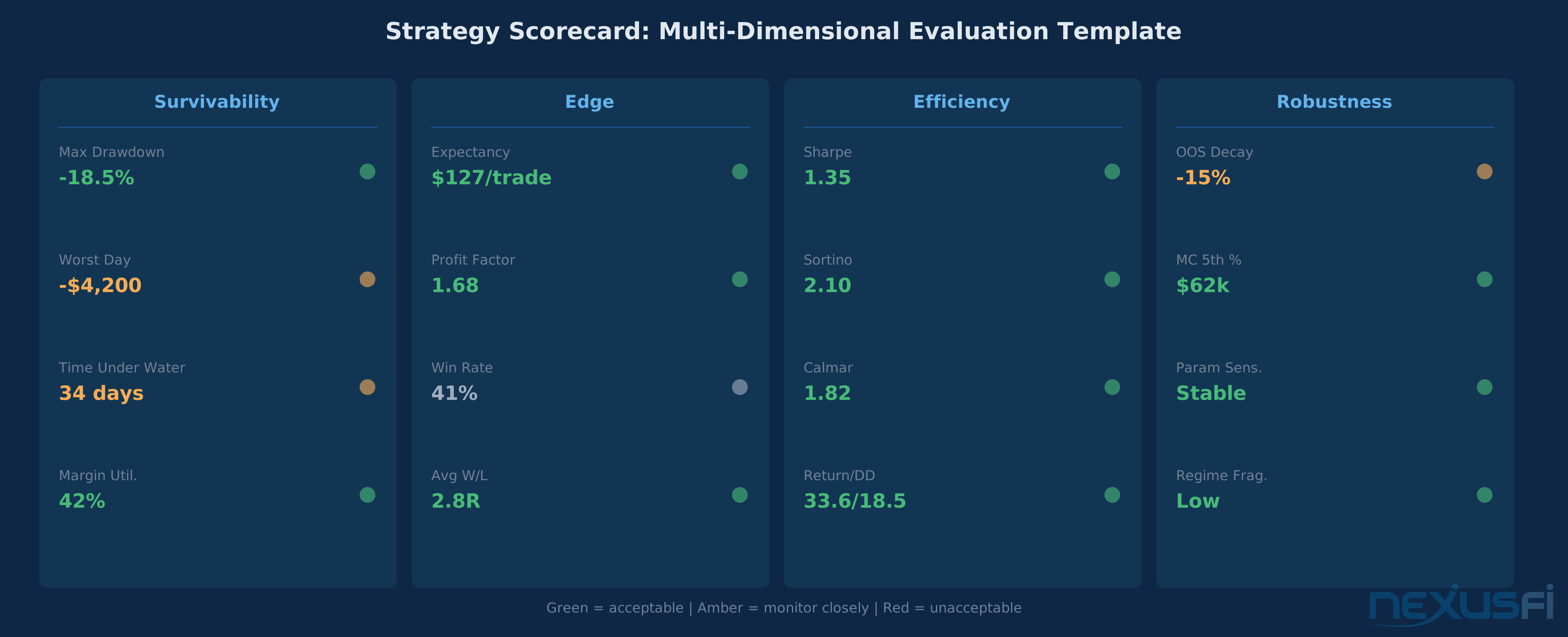
The scorecard structure forces complete evaluation:
- Can it survive? (Drawdown, tail risk, margin)
- Does it have edge? (Expectancy, profit factor, win/loss distribution)
- Is the edge efficient? (Risk-adjusted returns via Sortino, Calmar)
- Will it persist? (Monte Carlo, walk-forward, regime stability)
- Can I deploy it? (Slippage, liquidity, correlation, operational complexity)
A system that scores well across all five dimensions is genuinely tradeable. A system that scores excellently on one dimension but fails another — a common Sharpe-optimized system with poor tail-risk metrics, for example — is a statistical illusion waiting to become a real loss.
Equity Curve Analysis: What the Shape Tells You #
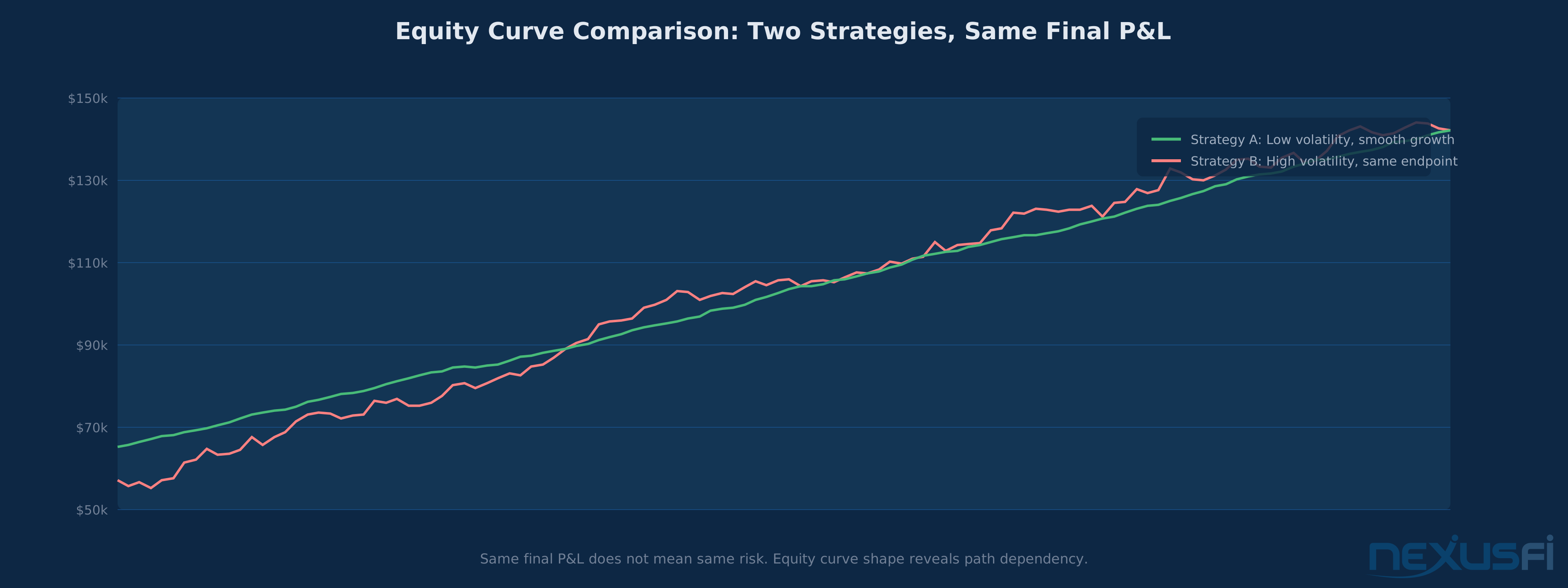
Beyond summary statistics, the equity curve itself reveals critical information:
Smoothness vs. burstiness: A smooth upward drift indicates consistent edge. A bursty curve — long flat periods punctuated by occasional large gains — suggests the system depends on specific market conditions and may produce extended drawdowns during the wrong regime.
Concentration risk: If 80% of profits come from 5% of trades, the system's edge is fragile. Remove those few trades and the remaining performance may be negative.
Structural breaks: A visible change in equity curve behavior — steeper slope, increased volatility, prolonged flatness — often signals a shift in market microstructure that the system has not adapted to.
Stair-step patterns: Clean stair-step equity curves (consistent gains interrupted by sharp but brief drawdowns) often indicate mean-reversion or scalping systems. The risk is that the stairs occasionally become cliffs when the market trends strongly.
Common Failure Modes #
Even with a complete evaluation framework, certain failure modes recur:
Overfitting: Too many parameters optimized on too little data. The telltale sign is excellent in-sample performance with significant out-of-sample degradation. If a system requires 15 parameters to capture 200 trades of edge, it is almost certainly fitting noise.
Cost underestimation: Backtests that use fixed 1-tick slippage when real slippage varies from 0 to 5+ ticks depending on conditions. Always stress-test with progressively worse execution assumptions.
Non-stationarity: Market microstructure changes over time. A system optimized on 2018-2022 data may not work in 2024 because spreads, volatility patterns, and participant composition have shifted.
Survivorship bias in data: Using only currently listed contracts, ignoring delisted or expired products that would have produced losses.
Position sizing inconsistencies: Evaluating a system with one position sizing model in backtesting and deploying with another. The metrics only apply to the sizing model that produced them.
@OneEye raised an important meta-point about evaluation metrics in a discussion of the [Omega ratio][11]: "system evaluation are Sharpe ratio, Sortino ratio, Kelly criterium and Omega ratio. One could calculate Sharpe ratio by hand. For Sortino, Kelly and Omega manual calculations are not practical." The practical takeaway: use tools that compute the full metric stack automatically, but understand what each metric measures and where it fails.
What "Good" Looks Like #
There are no universal thresholds, but experienced systematic futures traders generally consider:
| Metric | Marginal | Solid | Strong |
|---|---|---|---|
| Sharpe Ratio | 0.5-0.8 | 0.8-1.5 | Above 1.5 |
| Sortino Ratio | 0.8-1.2 | 1.2-2.0 | Above 2.0 |
| Profit Factor | 1.1-1.3 | 1.3-1.8 | Above 1.8 |
| Max Drawdown | 30-40% | 15-30% | Below 15% |
| Calmar Ratio | 0.5-1.0 | 1.0-2.0 | Above 2.0 |
| OOS Sharpe Decay | 40-60% | 20-40% | Below 20% |
These numbers are context-dependent. A high-frequency system trading 50 times per day can tolerate lower per-trade metrics because sample size provides statistical confidence. A swing system with 100 trades per year needs much stronger per-trade metrics to achieve the same confidence.
Building Your Own Evaluation Process #
Start with the hierarchy. Resist the temptation to skip to Sharpe Ratio or total P&L:
- Compute survivability metrics first. If maximum drawdown exceeds your risk tolerance or margin constraints, nothing else matters.
- Verify positive expectancy after all costs. If expectancy is negative or breakeven, no amount of position sizing or optimization will save the system.
- Calculate risk-adjusted returns. Prefer Sortino over Sharpe for futures due to non-normal return distributions.
- Run Monte Carlo with block bootstrap. Simple reshuffling understates drawdown risk.
- Decompose by regime. If the system only works in one market condition, you need to know that before deploying capital.
- Stress-test execution. Add slippage, widen spreads, degrade fill assumptions. If the system survives +2 ticks of slippage, it has meaningful execution buffer.
The goal is not to find a perfect system — those do not exist. The goal is to understand exactly where your system's strengths and vulnerabilities lie, so you can size positions appropriately, set realistic expectations, and know in advance what market conditions would cause you to shut it down.
Knowledge Map
Prerequisites
Understand these firstReferences This Article
Articles that build on this topicCitations
- — Discussion“Comparing Win Rate and R-Multiple for Equal Expectancy”
- — Discussion“Live drawdowns 4x larger than backtest”
- — Discussion“Ulcer Index alongside Sharpe and Sortino”
- — Discussion“Risk of ruin and position sizing interaction”
- — Discussion“Average win to average loss produces smaller drawdowns”
- — Discussion“Net P/L minus commissions and expectancy”
- — Discussion“SQRT(N) as proxy for drawdown behavior”
- — Discussion“Probability matrix and risk of ruin”
- — Discussion“System performance after 140 days”
- — Discussion“Systematic parameter ranking”
- — Discussion“Omega ratio and metric comparisons”
- — Which risk equivalents favor better drawdowns? (2012) 👍 9
- — iSystems Journal (2018) 👍 3
- — 1% Risk Journal (2024) 👍 3
- — Risk of Ruin (2012) 👍 24
- — Why 7% is the Difference between Failure and Success in Trading (2012) 👍 11
- — What metrics to focus on when backtesting (2022) 👍 2
- — How advanced mathematics and gaming theory can help you as a trader (2011) 👍 3
- — No more BS- what works and what doesnt. (2019) 👍 7
- — Kevin's TST Combine Journal (2013) 👍 11
- — Automated Strategy for MNQ (2023) 👍 3
- — Omega Ratio by Keating and Shadwick (2019) 👍 2