



Strategy Portfolio Management: Running Multiple Automated Futures Systems as One Risk-Managed Entity
Overview #
Strategy Portfolio Management: Running Multiple Automated Futures Systems as One Risk-Managed Entity
You've built a profitable automated strategy. It makes money. It draws down. It recovers. You've done the backtesting, the walk-forward, the live deployment. Now what?
You build a second one. Then a third. And suddenly you're not a trader running an algorithm
Strategy portfolio management is the discipline of treating multiple automated trading systems as a single, risk-managed entity. Instead of monitoring each system in isolation, you allocate capital across them, manage their combined risk, and make portfolio-level decisions about when to scale up, scale down, add new systems, or retire failing ones.
As @kevinkdog [puts it on NexusFi] [1]: "Portfolio Trading is the closest thing out there to the 'Holy Grail.' For people starting out with small accounts, it is really hard to do, so most stick with one strategy and one market. Maybe that is partly why so many small traders lose. They put themselves at the mercy of one market, and one strategy."
That's the core insight. A single strategy exposes you to a single failure mode. A portfolio of systems distributes that risk
This article covers how professional systematic traders actually run multi-strategy portfolios in futures markets: the allocation frameworks, the correlation traps, the risk controls, and the operational discipline that separates a collection of algorithms from a real portfolio.
Key Concepts #
Before diving in, here are the terms you need to know:
Strategy portfolio
Risk/return stream
Diversification axes
Marginal risk contribution
Volatility targeting
Risk parity
Kill switch
Diversification: The Axes That Matter #
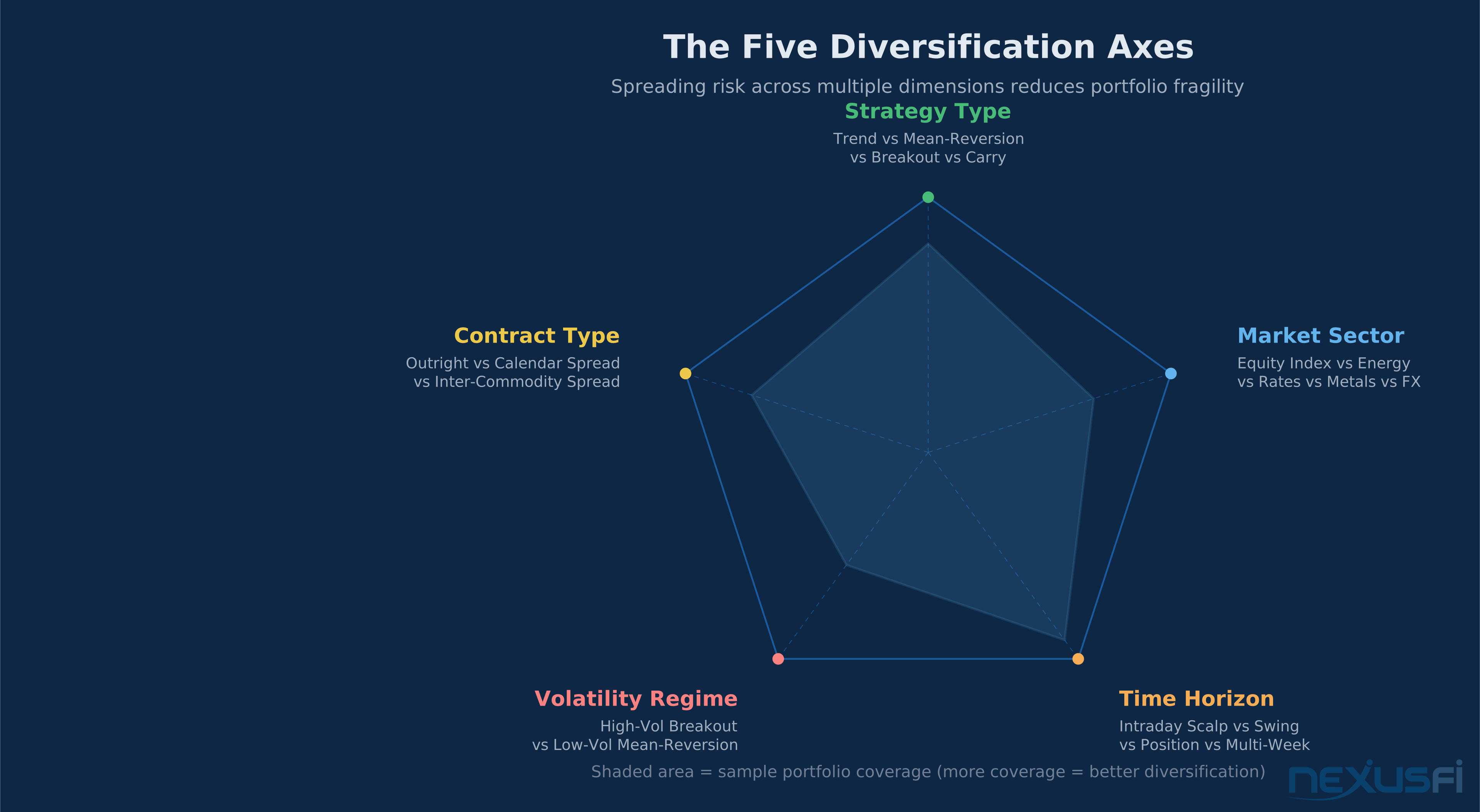
Diversification in a futures strategy portfolio isn't just "trade different markets." There are at least five axes, and most traders only think about one or two.
Strategy type. Trend-following and mean-reversion systems tend to have natural negative correlation. When a market trends hard, trend systems print money while mean-reversion gets chopped up. In range-bound conditions, the opposite happens. Running both creates a portfolio that performs across regimes rather than betting on one.
Market sector. ES and NQ move together
Time horizon. An intraday ES scalper and a multi-day CL swing system can trade the same account simultaneously with almost zero correlation, because they're operating on at the core different time scales. The scalper is responding to microstructure; the swing system is responding to macro flows.
Volatility regime. Some strategies thrive in high-vol environments (breakout systems, gamma-scalping approaches). Others need calm markets (mean-reversion in tight ranges). Mixing these creates natural regime diversification.
Contract type. Mixing outright futures with spreads (calendar spreads, inter-commodity spreads) adds another dimension. Spread strategies often have completely different risk profiles from directional systems.
The goal isn't to maximize the number of axes
@Big Mike [raised this exact question] [4] on NexusFi: "If you have a basket of say five strategies, the idea is you trade a few different markets and each strategy has its own unique signals that are unlikely to signal the same entry type on the same type of stock, then I think the results can be far better than trying to selectively choose the perfect strategy for the perfect market."
That intuition is correct
Correlation Management #
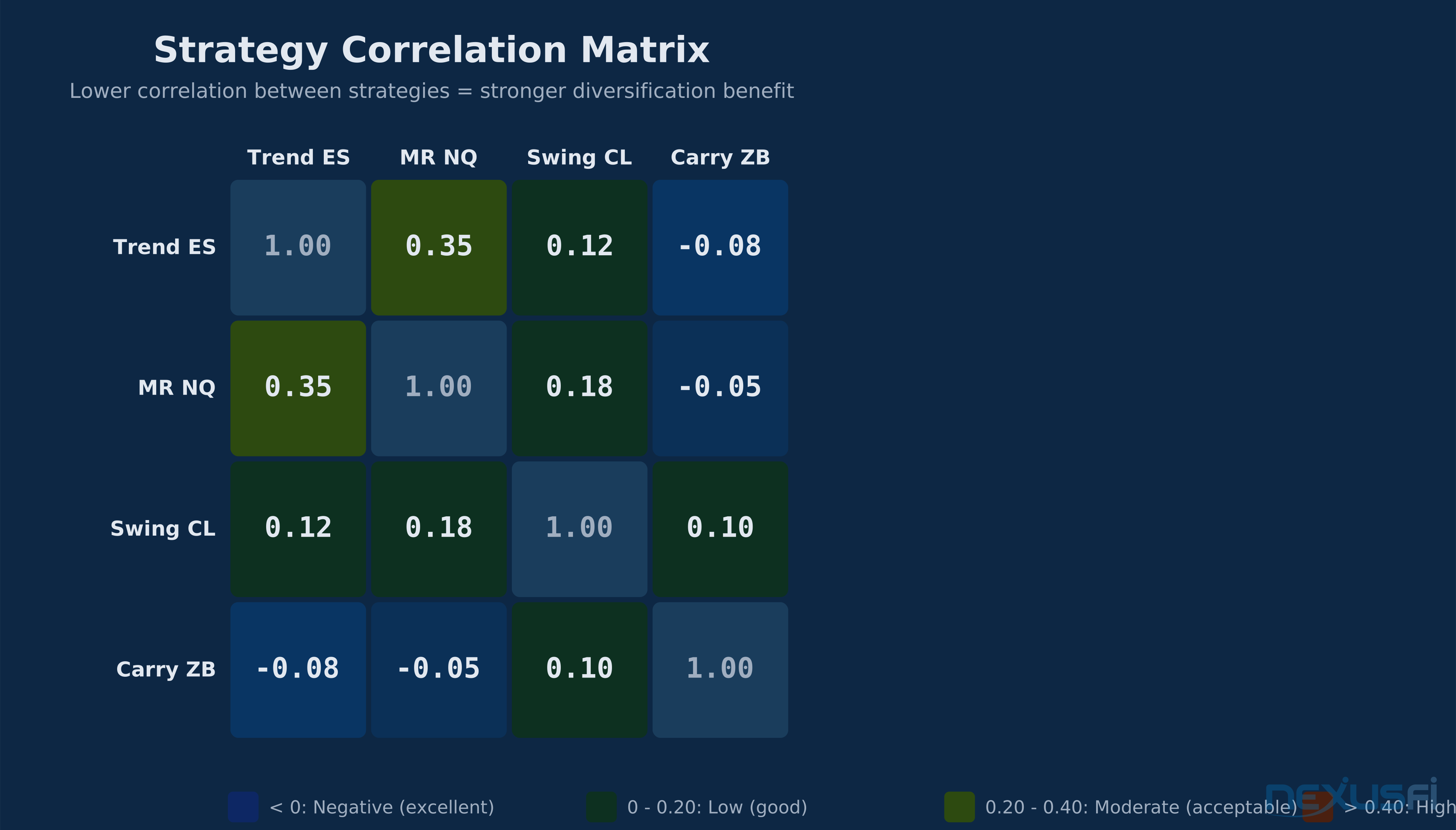
Here's where most portfolio builders get burned: they measure correlation once, during backtesting, and assume it holds.
It doesn't. Correlation between futures strategies is time-varying, regime-dependent, and spikes exactly when you need diversification most
What to measure. Don't just measure return correlation between strategy equity curves. Measure:
- Return correlation
- Factor exposure correlation
- Tail dependence
Practical approach. Use rolling windows of 40-60 trading days for correlation estimation. Shorter windows are noisy; longer windows miss regime changes. Apply exponentially weighted moving average (EWMA) with a half-life of 20-30 days to give more weight to recent observations.
The shrinkage trick. Sample correlations from short windows are unreliable. Shrinkage estimators (like Ledoit-Wolf) blend the sample correlation matrix toward a structured target (e.g., equal correlation across all pairs). This reduces estimation error and produces more stable allocation weights.
When correlation breaks. During the March 2020 crash, strategies across nearly every market and style showed correlated losses for 2-3 weeks. The portfolio-level response isn't to pretend this won't happen
Capital Allocation Frameworks #
Allocation is the single highest-leverage decision in portfolio management. Get it wrong and everything else is cosmetic.
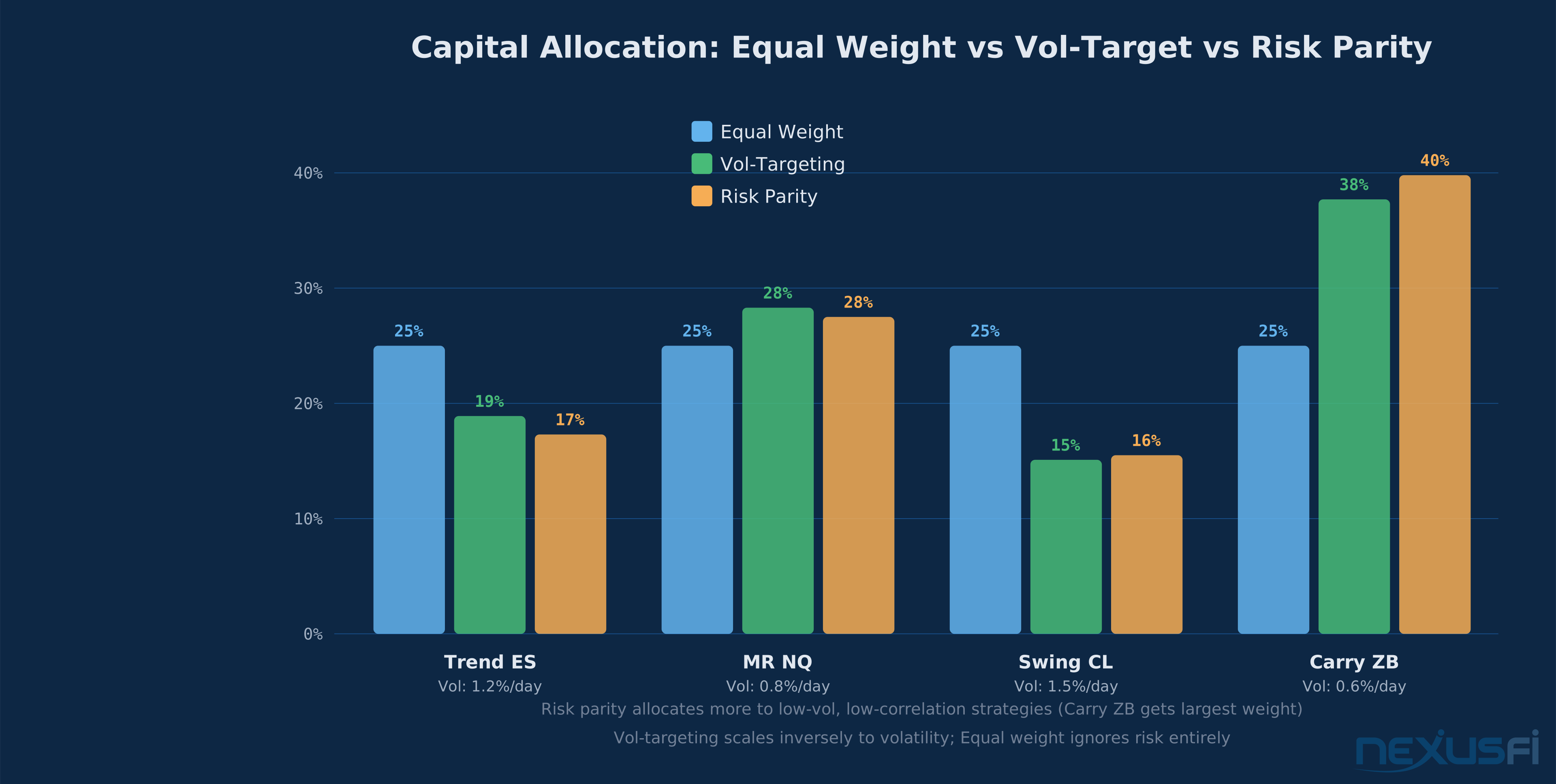
Equal weight. Give each strategy the same capital allocation. Simple, transparent, no estimation error. As @treydog999 [recommends] [3]: "Honestly doing simple equal weighting is a good place to start, as it is the benchmark to which all other asset allocation strategies are compared against." He's right. Any sophisticated allocation scheme should be benchmarked against equal weight. If it doesn't beat it out of sample, the sophistication isn't worth the complexity.
Volatility targeting. Scale each strategy's position size so it contributes a target daily volatility. If Strategy A has 2% daily vol and Strategy B has 0.5% daily vol, and you want 1% target vol per system, you'd run Strategy A at 50% of full size and Strategy B at 200%. This prevents high-volatility strategies from dominating portfolio risk.
Implementation: use 20-day realized volatility (standard deviation of daily returns) as the vol estimate. Rebalance weekly or when vol changes by more than 25% from the target.
Risk parity. Allocate so each strategy contributes equally to total portfolio risk, accounting for correlations. The calculation requires the covariance matrix:
Weight_i = (1 / (sigma_i sum(rho_ij sigma_j))) / normalization_factor
In practice, this means lower-volatility strategies get more capital, and strategies with high correlation to the rest get less. The result is a portfolio where no single strategy dominates risk.
Kelly-based allocation. The Kelly criterion maximizes long-term geometric growth rate. For a strategy with win rate p, average win W, and average loss L, the optimal fraction is:
f = (p W - (1-p) L) / (W L)
As @Fat Tails [demonstrates extensively on NexusFi] [8], full Kelly is dangerously aggressive. At full Kelly with a 50% win rate and 4:1 reward-to-risk, the risk of ruin is 43%. At half Kelly, it drops to 12.3%. At quarter Kelly, it's under 1%. Most systematic traders use quarter to half Kelly as an upper bound.
Practical constraints. No allocation framework operates in a vacuum. Real constraints include:
- Margin requirements: Futures margin is non-negotiable. Your allocation must leave enough margin headroom for all systems to hold positions simultaneously, plus a buffer for adverse moves.
- Liquidity caps: Don't allocate 40% of your portfolio to a strategy that trades illiquid back-month natural gas. Position sizes must respect daily volume.
- Maximum strategy concentration: Cap any single strategy at 20-30% of total portfolio risk. Even your best system can break.
Portfolio-Level Risk Controls #
Individual strategy risk controls aren't enough. A portfolio needs its own layer.
Total portfolio drawdown limit. Set a hard maximum drawdown for the entire portfolio
Net exposure caps. When multiple strategies signal the same direction across correlated markets, net exposure can spike. If three strategies are all long equity index futures simultaneously, your effective position is triple what any individual strategy shows. Monitor and cap net directional exposure across correlated groups:
- Equity index group: ES, NQ, RTY, YM
- Energy group: CL, NG, HO, RB
- Rates group: ZB, ZN, ZF
Margin utilization ceiling. Never deploy more than 50-60% of available margin. The remaining 40-50% is your buffer against adverse moves, margin requirement increases (which exchanges impose during volatility spikes), and correlation-driven simultaneous drawdowns.
Correlation-adjusted stress test. Run a monthly scenario: what happens if all strategies experience their 95th percentile loss simultaneously, with crisis-level correlations of 0.60? If that scenario exceeds your drawdown limit, you're over-allocated.
Drawdown Management Across Systems #
Portfolio drawdown doesn't equal the sum of individual strategy drawdowns
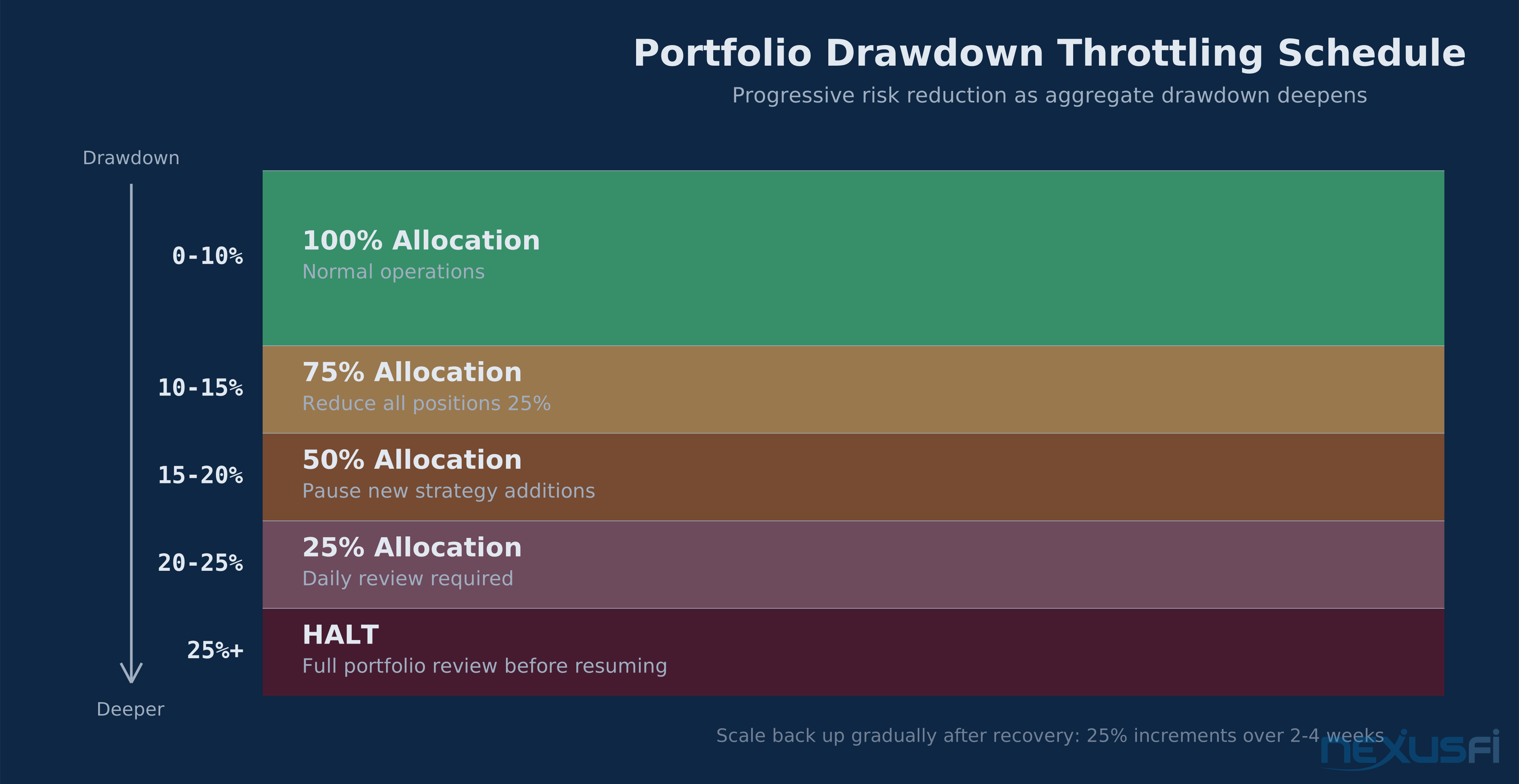
Throttling vs. hard stops. A hard stop shuts everything down at a threshold. Throttling reduces position sizes progressively as drawdown deepens. Most professionals prefer throttling because hard stops create binary outcomes (trading or not trading), while throttling allows recovery while managing risk.
A common implementation:
| Portfolio Drawdown | Action |
|---|
|
| 0-10% | Full allocation, normal operations |
|---|---|
| 15-20% | Reduce all positions by 50%, pause new strategy additions |
| 20-25% | Reduce to 25% allocation, daily review |
| 25%+ | Halt all trading, full portfolio review before resuming |
Margin-aware de-risking. When you scale down, freed margin becomes a buffer. Don't reallocate it. During drawdowns, capital preservation beats capital efficiency. The temptation to deploy freed margin into "the one strategy that's still working" is a trap
Recovery cadence. After a throttle event, scale back up gradually
Strategy Lifecycle: When to Add and Remove Systems #
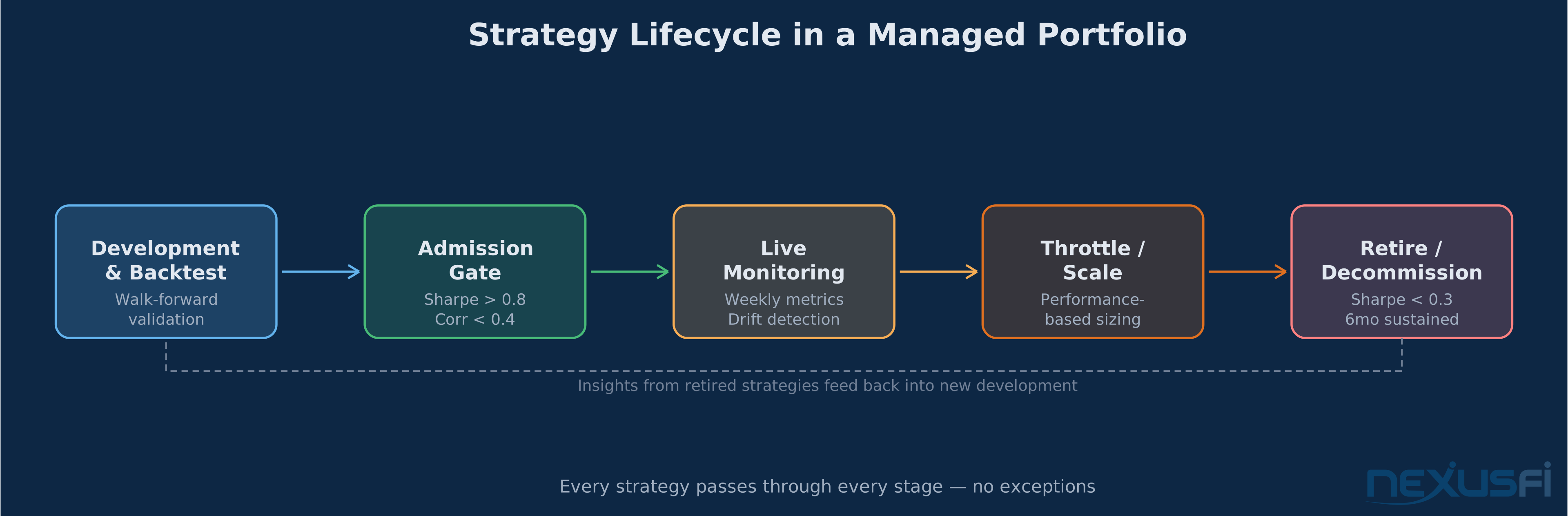
@kevinkdog [describes the lifecycle reality] [1]: "With multiple strats, it also makes it easier to kill a bad strategy, and it makes it harder to cheat on a strategy." The portfolio framework gives you the discipline and the metrics to make rational add/remove decisions.
Admission criteria for new systems. Before adding a strategy to the portfolio:
- Minimum 2 years of out-of-sample backtest performance (walk-forward validated)
- Sharpe ratio above 0.80 after realistic execution costs
- Maximum drawdown less than 2x the average annual return
- Correlation below 0.40 with every existing portfolio strategy
- Positive marginal Sharpe
Monitoring triggers. Check these weekly:
- Is the strategy's trailing 60-day Sharpe below 50% of its historical average?
- Has correlation with other portfolio strategies drifted above 0.50?
- Has slippage increased by more than 30% versus the backtest assumption?
- Has the strategy's win rate shifted by more than 2 standard deviations from its historical mean?
@M4STR0 [shares a practical weekly review process] [6]: rank systems by recent profit factor, filter out those below their in-sample profit factor threshold, then recompose the portfolio prioritizing diversity across futures, strategy types, and timeframes. Simple, executable, and catches degradation early.
Decommission rules. Remove a strategy when:
- Trailing 6-month Sharpe drops below 0.30
- Drawdown exceeds 1.5x the maximum historical drawdown
- Three consecutive months of losses with no sign of regime change
- The strategy's market shows structural changes (liquidity collapse, tick size change, new regulations)
Don't decommission based on a single bad month. Every strategy has bad months. The signal is persistent degradation, not noise.
Execution and Margin Realities #
Futures portfolios face execution challenges that single-strategy traders never encounter.
Cross-margin benefits. When you're long ES and short NQ, the CME's cross-margining recognizes these as partially offsetting positions and reduces the combined margin requirement. This frees capital. A well-diversified portfolio gets meaningful margin relief through netting
Order routing priority. When multiple systems generate orders simultaneously, which goes first? Establish a priority:
- Risk-reduction orders (stops, exits)
- Expiring orders (about to miss a fill window)
- New entries from higher-allocation strategies
- New entries from lower-allocation strategies
Liquidation avoidance. @Breukelen's [experience on NexusFi] [7] illustrates the real danger: "CME rejected the order with message 'Order type not permitted while the market is reserved.' Which basically means things are too volatile, we're not accepting market orders." During extreme volatility, exchanges restrict order types. Your portfolio's exit logic must handle this
Performance Attribution #
Running multiple systems without attribution is flying blind. You need to know who's contributing what.
Strategy-level P&L decomposition. Break down daily portfolio P&L by strategy. Simple but essential. This tells you which systems are earning their allocation and which are dragging.
Risk-adjusted contribution. Raw P&L favors high-volatility strategies. Measure each strategy's contribution to portfolio Sharpe ratio instead. A low-return, low-vol strategy that provides genuine diversification might contribute more to risk-adjusted performance than a high-return, high-vol strategy that's correlated with everything else.
Slippage and execution cost tracking. Compare realized fills versus theoretical fills from the backtester. If a strategy's slippage is consistently 2 ticks worse than modeled, its actual risk-adjusted return is lower than reported. This is especially important in less liquid contracts like agricultural futures or back-month energy.
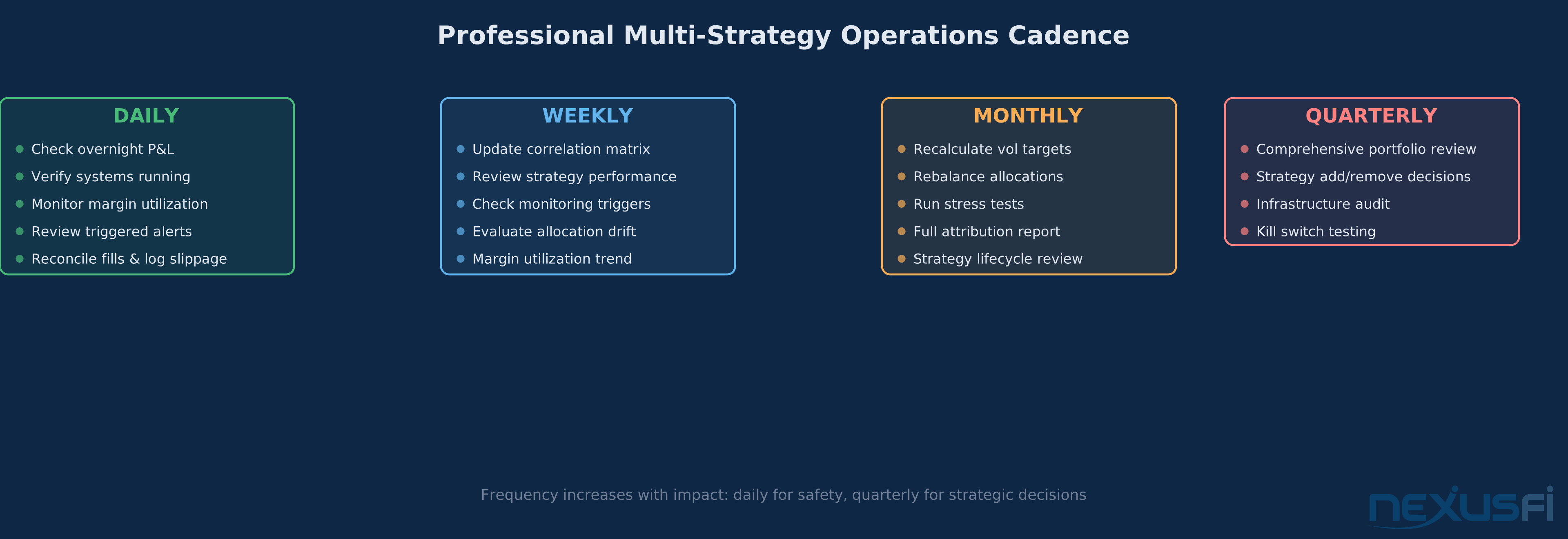
Attribution cadence. Weekly for operational monitoring, monthly for allocation decisions, quarterly for complete portfolio review. Don't over-react to weekly attribution
The Professional Operations Model #
@treydog999 [captures the mindset shift] [3]: "This becomes more like running your own tiny fund than it is like just being a normal 'trader'. Portfolio management becomes about resource allocations and optimizing risk reward ratio."
Here's the operational framework that professional systematic traders actually follow:
Daily workflow.
- Pre-market: Check overnight P&L, margin utilization, net exposure by sector. Verify all systems are running. Review any triggered alerts.
- Intraday: Monitor aggregate portfolio metrics. No individual trade intervention unless a kill switch triggers.
- Post-market: Reconcile fills, update P&L, log slippage, run attribution. Flag any strategy whose daily loss exceeds 2 standard deviations.
Weekly review.
- Update correlation matrix (rolling 60-day)
- Review strategy performance vs. expectations
- Check margin utilization trend
- Evaluate any monitoring triggers that fired
- Adjust allocations if warranted (but not reactively
Monthly rebalancing.
- Recalculate volatility targets
- Rebalance allocations using the chosen framework (risk parity, vol-target, etc.)
- Review strategy lifecycle metrics
- Run stress tests with updated correlation estimates
- Generate attribution report
Kill switch architecture. Every portfolio needs layered kill switches:
- Strategy level: Daily loss limit per system (typically 2-3x average daily vol)
- Portfolio level: Aggregate daily loss limit (typically 1.5-2x average daily portfolio vol)
- Infrastructure level: Dead-man switch that closes all positions if the monitoring system stops responding
The portfolio-level kill switch is the critical one. Individual strategies can have bad days without the portfolio being in danger. But when the aggregate hits its limit, something systemic is happening and the correct response is to flatten.
Putting It All Together #
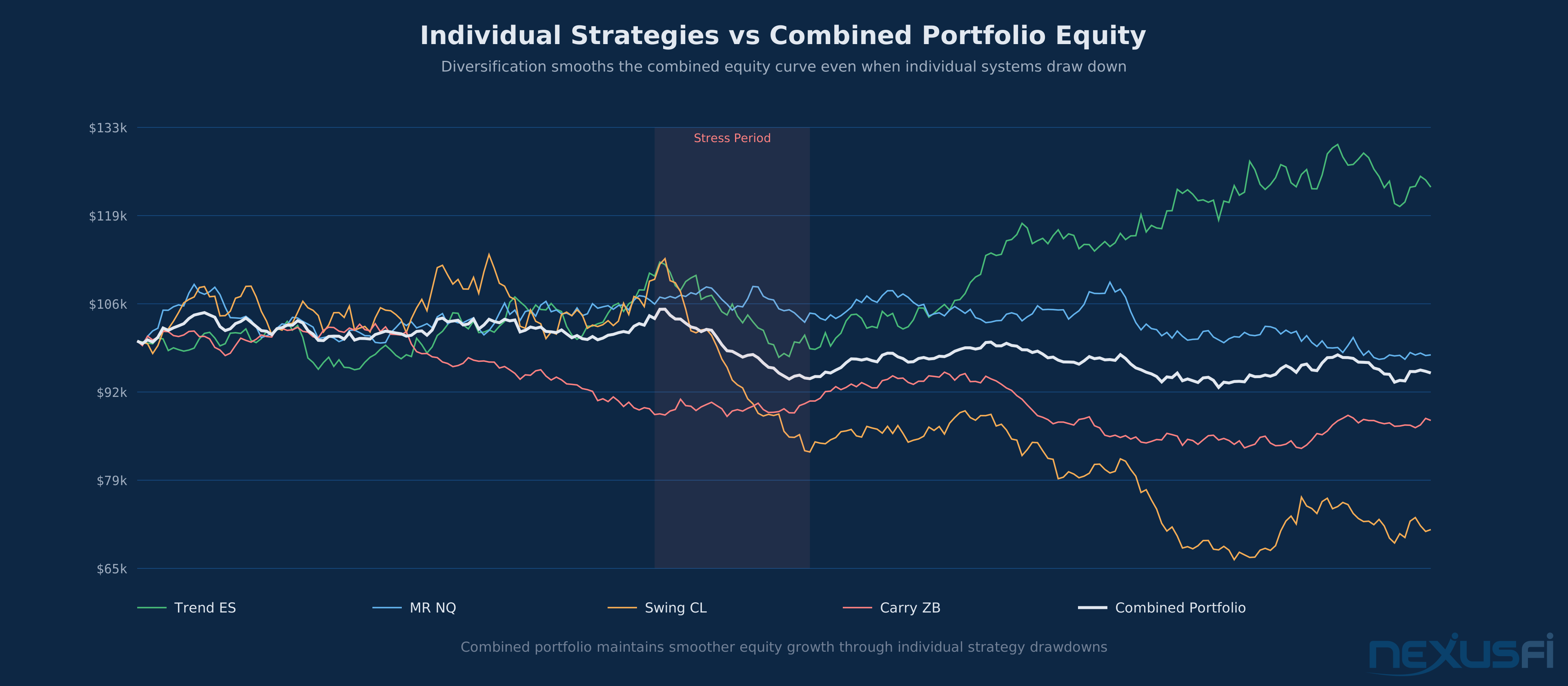
Here's a concrete example. You're running four automated futures systems:
| System | Market | Type | Daily Vol | Correlation to Portfolio |
|---|
|
| Trend ES | ES | Trend-following | 1.2% | 0.35 |
|---|---|---|---|---|
| Swing CL | CL | Momentum | 1.5% | 0.15 |
| Carry ZB | ZB | Carry/rates | 0.6% | -0.10 |
Using volatility targeting at 1% daily vol per system:
- Trend ES runs at 83% of full size (1.0/1.2)
- MR NQ runs at 125% of full size (1.0/0.8)
- Swing CL runs at 67% of full size (1.0/1.5)
- Carry ZB runs at 167% of full size (1.0/0.6)
The Carry ZB system gets the largest position because it has the lowest volatility and negative correlation to the rest. That's risk parity logic at work
Portfolio drawdown limit: 20%. Throttle schedule kicks in at 10%. Monthly rebalance. Weekly correlation update. Daily kill switch at 3% portfolio loss.
This isn't complicated. It's disciplined. And that discipline
As @kevinkdog [advises] [5]: "Start out with the maximum capital (assume all strategies are independent), then as you get comfortable trading all of them, you can make adjustments based on the amount of free capital you see, the risk you want to take. Having uncorrelated strategies makes a big difference in this regard."
Start conservative. Measure everything. Let the data tell you when to add leverage, not your enthusiasm about the backtest.
Knowledge Map
Prerequisites
Understand these firstGo Deeper
Build on this knowledgeReferences This Article
Articles that build on this topicCitations
- — KJ Trading Systems Kevin Davey - Ask Me Anything (AMA) (2013) 👍 13“Portfolio Trading is the closest thing out there to the Holy Grail.”
- — Key Advantage of an Autotrade System - Ability to Portfolio (2015) 👍 3“Simple and Robust strategies traded across a variety of markets is much more rewarding than some people believe.”
- — Key Advantage of an Autotrade System - Ability to Portfolio (2015) 👍 7“This becomes more like running your own tiny fund than it is like just being a normal trader.”
- — Multiple non-correlating strategies or portfolio (2010) 👍 1“If you have a basket of say five strategies the idea is you trade a few different markets.”
- — Strategy portfolio Drawdwon in relation of single systems DD (2018) 👍 5“Start out with the maximum capital, then make adjustments based on free capital and risk.”
- — How do you manage and pick strategies for your portfolio? (2023) 👍 1“Rank systems by recent profit factor, filter, then recompose the portfolio.”
- — My algo hit the kill switch, CME said no! Lady Luck Saved Me! (2022) 👍 6“CME rejected the order during FOMC volatility - kill switch failure.”
- — Risk of Ruin (2012) 👍 30“At full Kelly, risk of ruin is 43%. At half Kelly, 12.3%. At quarter Kelly, under 1%.”