



Walk-Forward Analysis: The Stress Test That Separates Robust Strategies from Curve-Fit Miracles
Overview #
Walk-forward analysis (WFA) is the single most reliable method for determining whether an optimized trading strategy will hold up in live markets. It's the structured, repeatable process of optimizing parameters on historical data, then immediately testing those parameters on unseen data — rolling forward through time to build a track record that no single backtest can provide.
If you've built a strategy that looks great in backtesting but you're not sure whether those results are real or just an artifact of optimization, WFA gives you the answer. Not a guarantee — nothing does — but the closest thing to a controlled experiment that trading offers.
This article is a deep dive into WFA mechanics, implementation, and interpretation. For broader context on backtesting methodology, see Backtesting Trading Strategies.
How Walk-Forward Analysis Works #
The core mechanic is simple: divide your historical data into segments, improve on one chunk, test on the next chunk, then roll everything forward and repeat.
Here's the concrete process:
1. Split your data into In-Sample (IS) and Out-of-Sample (OOS) windows.
The IS window is where optimization happens — your platform tests thousands of parameter combinations and selects the best performers. The OOS window is the proving ground — you apply those "best" parameters to data the optimizer never touched.
2. Roll forward.
After testing the first OOS window, slide both windows forward by the OOS length. The new IS window now includes data that was previously OOS. Run optimization again. Test on the new OOS window. Repeat until you've consumed all available data.
3. Stitch the OOS results together.
The concatenated OOS results form your walk-forward equity curve. This is the closest approximation to what your strategy would have actually produced if you'd been re-optimizing and trading it in real time.
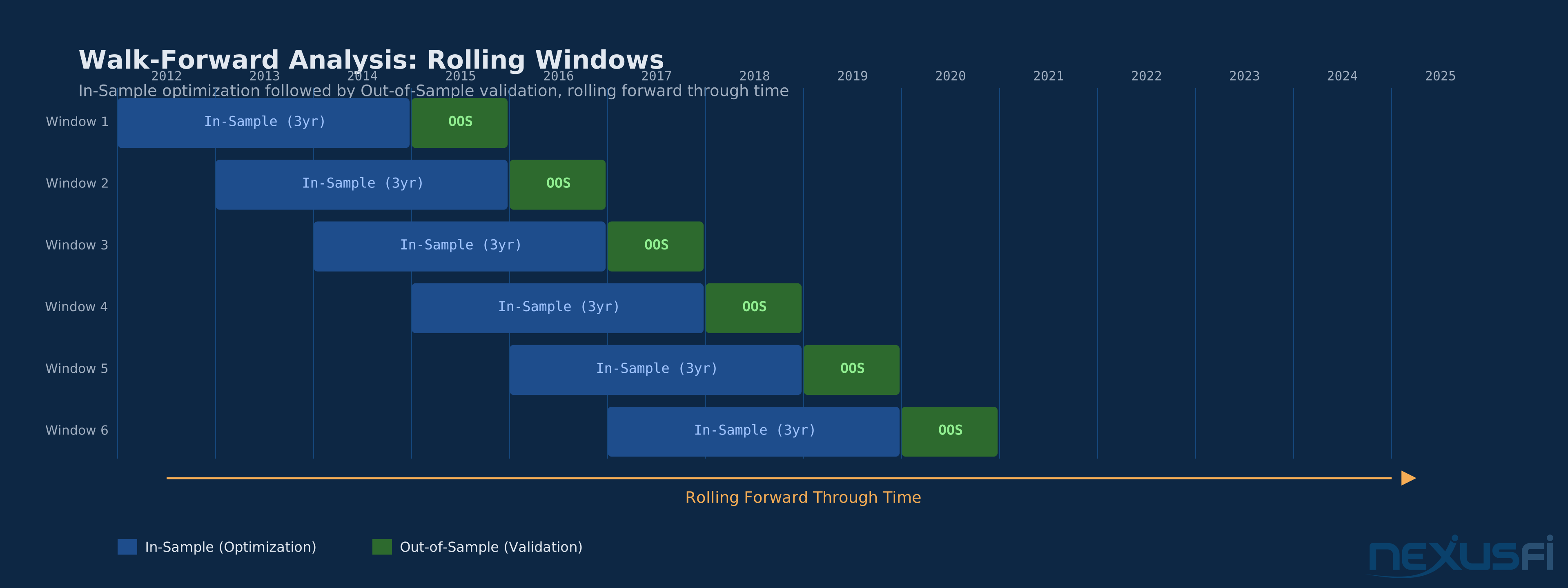
A typical setup for an ES day trading strategy might look like this:
- Total data: 2010-2025 (15 years)
- IS window: 3 years
- OOS window: 1 year (3:1 ratio)
- Number of walk-forward periods: 12
Each of those 12 OOS periods represents performance on data the optimizer never saw. Stitch them together and you have 12 years of pseudo-out-of-sample results.
Anchored vs. Rolling Windows #
There are two approaches to how the IS window moves:
Rolling (Unanchored): The IS window maintains a fixed length and slides forward. If your IS window is 3 years and OOS is 1 year, the first IS is 2010-2012, the second is 2011-2013, the third is 2012-2014, and so on. Old data drops off the back as new data enters the front.
Anchored: The IS start point never moves. The first IS is 2010-2012, the second is 2010-2013, the third is 2010-2014. The IS window grows over time, incorporating all available historical data.
As @kevinkdog explains in his systematic trading AMA, "I personally use [rolling]. I don't like [anchored] because old data keeps impacting the optimization well into the future." [1]
Rolling windows adapt faster to regime changes — important in futures markets where volatility regimes shift. Anchored windows produce more stable parameters because they improve on larger datasets. For most futures strategies, rolling windows with a 3:1 or 4:1 IS:OOS ratio are the standard starting point.
Walk-Forward Efficiency #
Walk-forward efficiency (WFE) is the ratio of OOS performance to IS performance, expressed as a percentage:
WFE = (OOS Net Profit / IS Net Profit) x 100
A WFE of 50% means your strategy captured half the profit in unseen data that it showed during optimization. That's considered acceptable. A WFE above 60% is strong. Below 30% is a red flag — your optimizer is finding parameters that don't generalize.
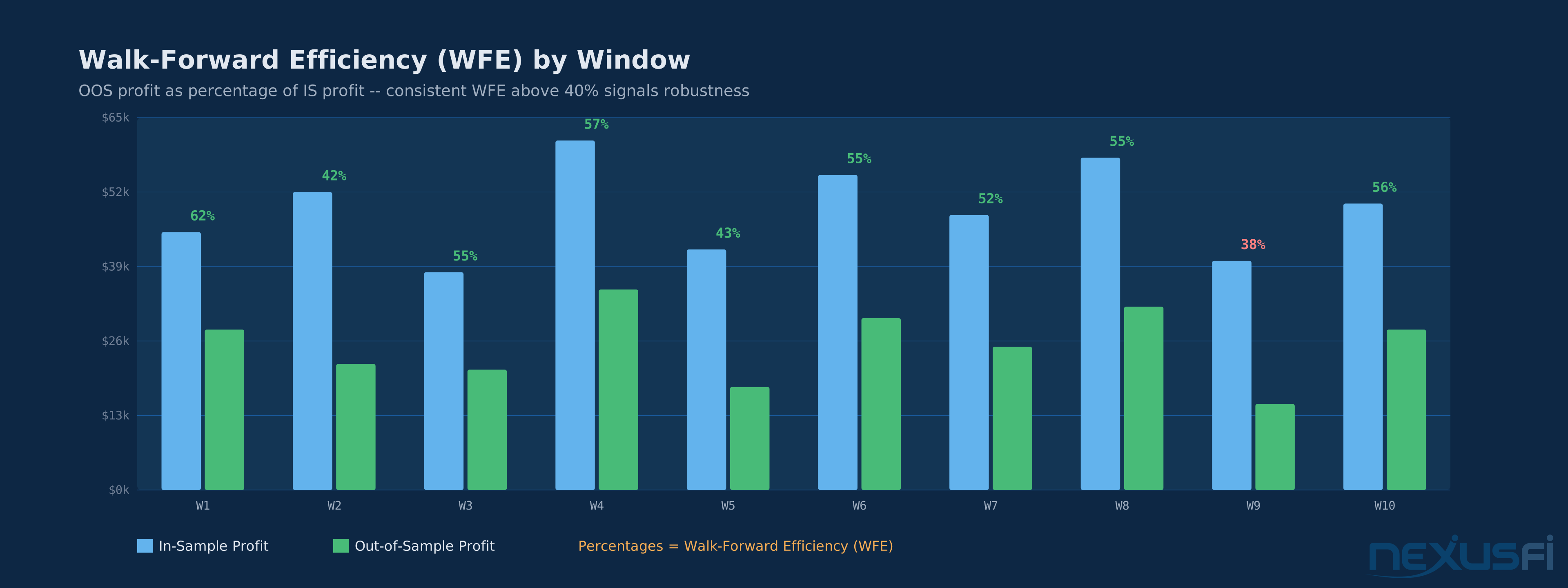
WFE should be calculated for each individual walk-forward window AND as an aggregate across all windows. Consistent WFE across windows matters more than a high average — if WFE swings from 80% to 10% between windows, the strategy is regime-dependent and you need to understand which market conditions cause degradation.
Don't chase high WFE by adjusting window sizes. That's meta-optimization — optimizing the optimization itself — and it destroys the integrity of the entire process.
Parameter Stability: The Real Signal #
Raw WFE numbers are useful, but parameter stability across walk-forward windows tells you more about whether your strategy has a genuine edge.
Plot the optimized parameter values for each window. If your moving average period jumps from 12 to 45 to 8 to 63 across consecutive windows, the optimizer is chasing noise. There's no stable relationship between the parameter and the market — it's just finding whatever worked best in each specific IS period.
If the parameter holds relatively steady — say, bouncing between 18 and 26 across 12 windows — that's evidence of a stable structural relationship. The market rewards that parameter range consistently, not just in one lucky period.
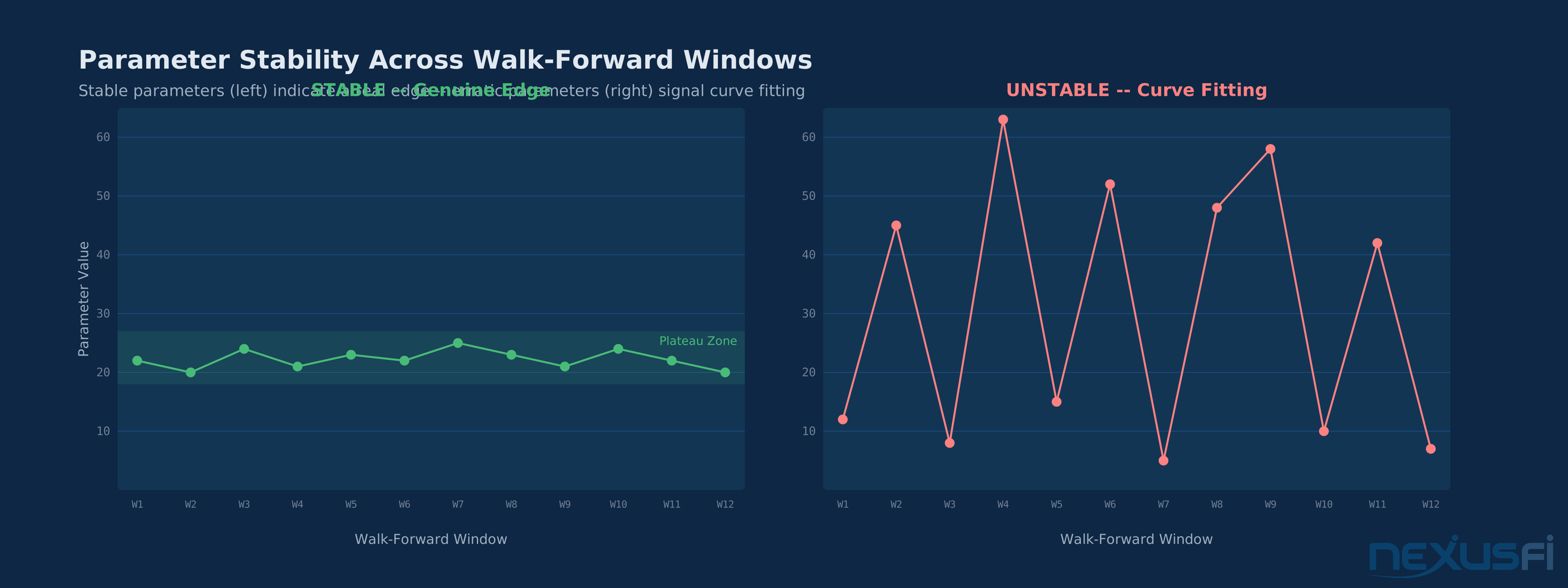
This is the "plateau test." In a strong strategy, the optimization environment shows a broad plateau of profitable parameters, not a narrow spike. Slight changes to the parameter value should produce similar results. If moving from period 20 to period 22 causes a 50% profit drop, you're standing on a spike, not a plateau.
Futures-Specific Considerations #
WFA on futures requires attention to details that equity traders don't face:
Contract Rollovers. Your IS/OOS windows must respect roll dates. A window that spans a rollover needs continuous contract data — and the roll method matters. Back-adjusted data preserves point spreads but distorts percentage returns. Ratio-adjusted data preserves percentage returns but complicates absolute price-level strategies.
Session Data. Futures trade nearly 24 hours, but RTH (Regular Trading Hours) and ETH (Electronic Trading Hours) have at the core different characteristics. A strategy optimized on 24-hour data might find parameters that work during the overnight session but fail during RTH, or vice versa. Decide upfront whether your strategy targets RTH, ETH, or both — and use consistent session data across all walk-forward windows.
Margin Changes. CME and other exchanges periodically adjust margin requirements, especially during high-volatility periods. A strategy optimized during a low-margin period may be overleveraged when margins increase.
Tick Size. When defining parameter ranges for optimization, respect the instrument's tick size. Optimizing a stop loss on ES in $1 increments (4 ticks) makes sense. Optimizing in $0.10 increments does not — you're creating artificial granularity that the market can't actually execute.
How Many Walk-Forward Periods? #
More is better, but there are practical limits.
@kevinkdog notes that "one period of out of sample might not be significant — that's why true walkforward testing has 10-20+ out of sample periods." [3]
The minimum viable number is 6-8 periods. Below that, the law of small numbers dominates — you can't distinguish skill from luck with 4 data points. Ideal is 12-20 periods, which gives enough statistical weight to draw conclusions.
This creates a tension: more periods requires either longer total data history or shorter IS/OOS windows. For most futures strategies using daily data, 10-15 years of history with a 3:1 IS:OOS ratio and annual OOS windows produces 10-12 walk-forward periods. That's a reasonable balance.
The Meta-Optimization Trap #
The single most common mistake in WFA is optimizing the walk-forward parameters themselves.
You run WFA with a 3-year IS / 1-year OOS split. Results look mediocre. So you try 4-year IS / 1-year OOS. Better. Then 4-year IS / 2-year OOS. Even better. You pick the best combination and declare victory.
Stop. You just optimized.
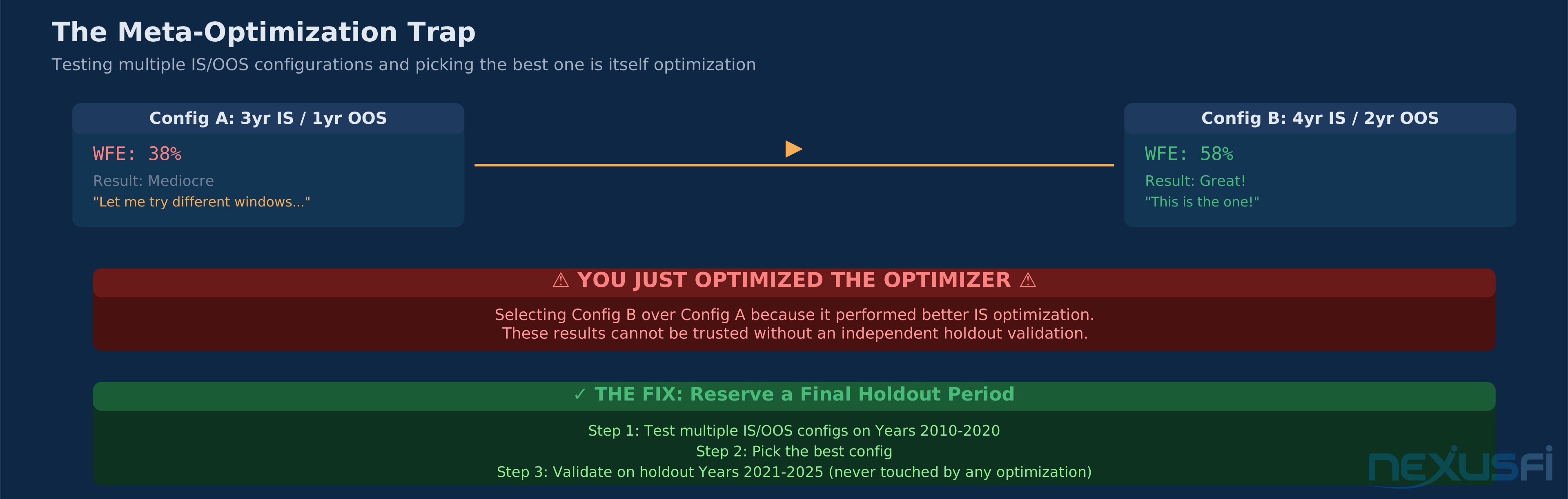
The solution: reserve a final holdout period. Run multiple IS/OOS configurations on the first portion of your data, select the best configuration, then validate it on the holdout data that neither the strategy optimizer nor the WFA configuration selection ever touched.
@kbellare reinforces this from practical experience: "I've used WFO for several months across over 100 strategies and it's been a frustrating experience. Even strategies with few parameters that perform well break down in WFO." The key insight: "Objective function really matters — choosing 'Highest/Lowest' metrics set you up for failure — by definition, they pick the outliers in-sample period which invariably fail in out-of-sample periods." [5]
When Walk-Forward Analysis Fails #
WFA is not a magic filter. It reduces overfitting but doesn't eliminate it.
Regime breaks. If market structure changes at the core — new regulations, new participant types, structural volatility shifts — no amount of historical WFA predicts performance. The 2020 COVID crash, the 2022 rate hiking cycle, and the post-2023 AI-driven microstructure changes all represent regimes where parameters optimized on prior data could legitimately fail despite passing WFA.
Too many parameters. Every optimized parameter consumes degrees of freedom. A strategy with 8 tunable parameters needs exponentially more IS data to avoid overfitting than one with 2 parameters. If your strategy has more than 3-4 optimizable parameters and you're running WFA on daily data with standard window sizes, you're almost certainly overfitting despite the WFA framework.
Survivorship bias in strategy selection. If you develop 50 strategies and run WFA on all of them, some will pass by chance. The more strategies you test, the more false positives you'll get. WFA validates a single strategy — it doesn't solve the multiple testing problem across your entire strategy portfolio.
Practical Checklist #
Before going live with a strategy that passed WFA:
- Minimum 8 walk-forward periods with consistent positive OOS results
- WFE above 40% on aggregate, with no individual window below 15%
- Stable parameters across windows -- plot them and verify no wild jumps
- Fewer than 4 optimized parameters (fewer is always better)
- Robustness check -- test on correlated instruments and slightly different timeframes
- Final holdout period not touched by any optimization or WFA configuration selection
- Transaction costs included -- slippage, commission, and roll costs in all calculations
WFA doesn't prove your strategy works. It proves your strategy survived a structured stress test. That's the difference between confidence and certainty — and for systematic futures trading, confidence backed by evidence is the best you'll get.
Knowledge Map
Prerequisites
Understand these firstReferences This Article
Articles that build on this topicCitations
- — KJ Trading Systems Kevin Davey - AMA (2015) 👍 6“That is a good question. I'm not sure there is a correct answer, but there are some alternatives... 1. What you describe is what many people call a standard "out of sample" test.”
- — Benchmarks for a good automated ES trading system (2014) 👍 3“My first guess would be that you have almost certainly overfit (Curve fit) to the historical data. You can quickly verify this a couple of ways: a) Whatever time frame you are using, slightly change it.”
- — KJ Trading Systems Kevin Davey - AMA (2015) 👍 6“That is a good question. I'm not sure there is a correct answer, but there are some alternatives... 1. What you describe is what many people call a standard "out of sample" test.”
- — Taking a Trading System Live (2013) 👍 3“One common mistake during walkforward analysis is to surreptitiously optimize the IN and OUT periods. Say, for example, that you run the walkforward analysis with 4 year In period, and 1 year Out period.”
- — Walk Forward Testing & Optimization (2013) 👍 6“I've used WFO for several months across over 100 strategies (across portfolio of futures, stocks, ETFs) and it's been a frustrating experience. Even strategies with few parameters that perform well (Profit Factor>1.6, APR>20%, MAR>0.”
- — How quickly do algos go bad? (2021) 👍 5“I think the fact that you have tested on the latest data and then tested backwards on old data is a huge flag of possible curve fitting. Time series testing is hard. It requires a good amount of honesty.”
- — Strategy Optimization and trusting the results (2011) 👍 5“There's more than one issue at work here. The reason you forward test is to gain confidence for both edge and execution. Many people do not trust the results of a backtest for execution reasons.”