



Multi-Strategy Automated Futures Trading: Building and Managing a Portfolio of Algorithms
Overview #
Running a single automated strategy is hard enough. Running several simultaneously — each competing for capital, each generating its own risk, each interacting with the others in ways that only become visible during drawdowns — is a at the core different discipline.
Most retail algo traders treat multi-strategy portfolio management as additive: build Strategy A, build Strategy B, turn them both on, collect the diversification benefit. Professional trading firms know it's not that simple. Strategies interact. Correlations spike during stress. Capital requirements compound in non-obvious ways. Position limits need to aggregate across the entire book. Kill switches need hierarchy.
This article covers how to build a multi-strategy automated futures operation correctly — from architecture and capital allocation to correlation management, kill-switch design, and platform-specific execution mechanics. Whether you're running 2 strategies or 20, these principles apply. For the single-strategy foundation, see Automated Risk Controls, Walk-Forward Analysis, and Strategy Portfolio Management.
Key Concepts #
Before getting into the how, you need to speak the language. Multi-strategy portfolio trading has its own vocabulary, and precision matters here.
Strategy Engine — The individual algorithm processes that generate signals and desired position exposures. Each strategy "wants" to be long or short some quantity of a given contract. The critical distinction: strategies express intent, they don't execute directly.
Risk Engine — The centralized portfolio-level system that aggregates all strategy exposures, enforces limits, monitors correlation, and decides what orders actually get sent to the exchange. This is the most important component in any multi-strategy operation and the one most retail traders skip.
OMS/EMS — Order Management System / Execution Management System. Routes approved orders to the exchange, handles fills, manages working orders, and reports position updates back to the risk engine.
Net Exposure — The aggregated position across all strategies on a single instrument. Strategy A long 3 ES + Strategy B short 1 ES = net +2 ES. This is the number that matters for margin, risk limits, and exchange position accountability.
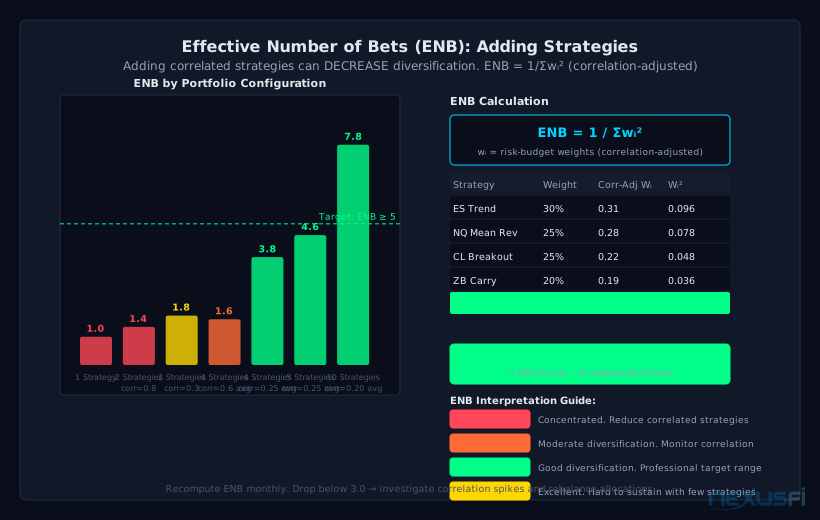
Effective Number of Bets (ENB) — A measure of true portfolio diversification after accounting for correlation. Calculated as 1 / Σwᵢ² where wᵢ are risk-budget weights adjusted for correlation. An ENB of 1 means one bet. An ENB of 5 means you effectively have 5 independent bets. Higher is better.
Incremental VaR (IVaR) — How much a specific strategy contributes to the total portfolio's Value at Risk. The strategy that contributes 40% of your portfolio VaR despite representing 20% of capital is probably overallocated.
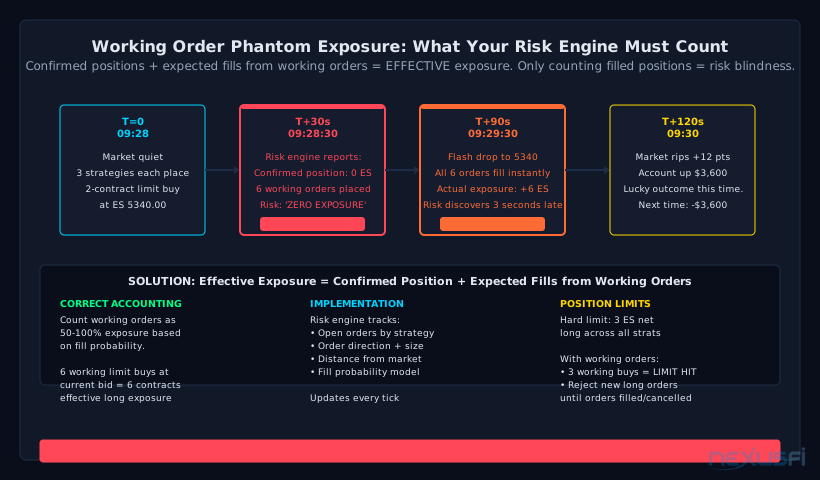
Effective Exposure — Current positions plus expected fills from working orders. This is what your risk engine must track, not just confirmed positions. Working orders that haven't filled yet still represent capital at risk.
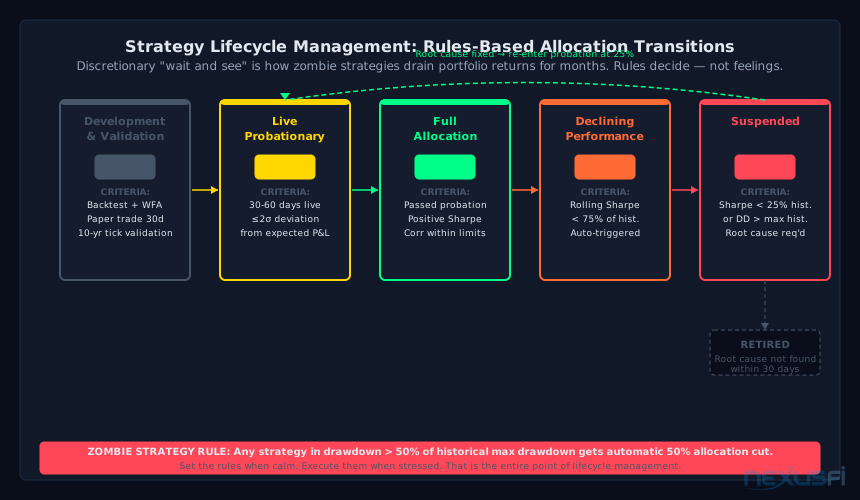
Kill Switch — An automated mechanism to immediately halt trading and/or liquidate positions. Effective kill-switch design has three levels: strategy-level (one algo stops), underlying-level (all algos freeze on one instrument), and portfolio-level (complete book shutdown).
Strategy Drawdown Correlation — Not the same as instrument price correlation. Two strategies trading different instruments can have highly correlated drawdowns if they share underlying logic or respond to the same market regime.
Why Architecture Determines Everything #
The single biggest mistake retail multi-strategy traders make is running strategies that self-manage risk. Each strategy has its own stop, its own position sizing, its own logic — and none of them know the others exist. This works until it doesn't.
Here's what breaks it: coordinated drawdowns. Two strategies both short ES during a fast rip. Three strategies all exit risk simultaneously during a flash crash. Your "diversified" portfolio suddenly looks like one concentrated bet. And because no single system is watching the whole picture, nobody pulls the emergency brake.
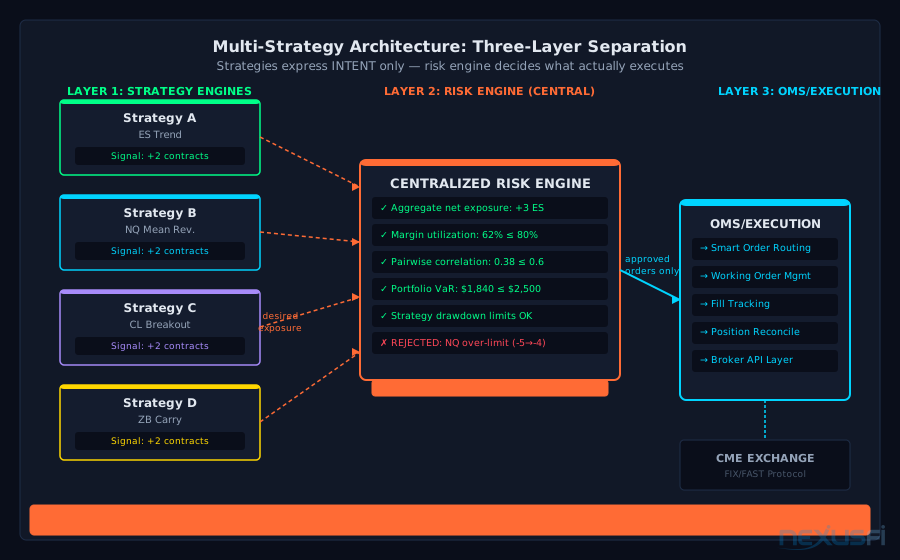
Professional firms solve this with the three-layer separation:
Layer 1 — Strategy Engines: Each strategy runs as an independent process. Its only job is to compute desired exposure (e.g., "I want to be long 2 ES"). It has no knowledge of other strategies, no order management logic, and no risk controls. Strategies generate signals. That's it.
Layer 2 — Centralized Risk Engine: All desired exposures feed into a single real-time system. The risk engine aggregates positions across strategies, checks against all limits (per-instrument, per-factor, portfolio-wide), monitors correlation, and either approves or modifies orders before they leave the building. This layer is the source of truth for risk.
Layer 3 — OMS/Execution: Receives only risk-approved orders. Routes to the exchange, handles fills, tracks working orders, reconciles with the broker. Reports confirmed positions back to the risk engine continuously.
The separation sounds enterprise-y, but even running 2-3 strategies on NinjaTrader 8 or TradeStation, this architecture applies. The "risk engine" might be a simple master strategy that aggregates positions. The "OMS" might be the platform itself. The principle — strategies express intent, a central layer approves execution — is what keeps you from having a compounding-risk disaster.
That framing is exactly right. Once you have multiple strategies, you're running a fund. Fund management is different from strategy management.
Capital Requirements: The Two-Extremes Framework #
Before you go live with multiple strategies, you need to know how much capital the combination requires. This is less obvious than it looks.
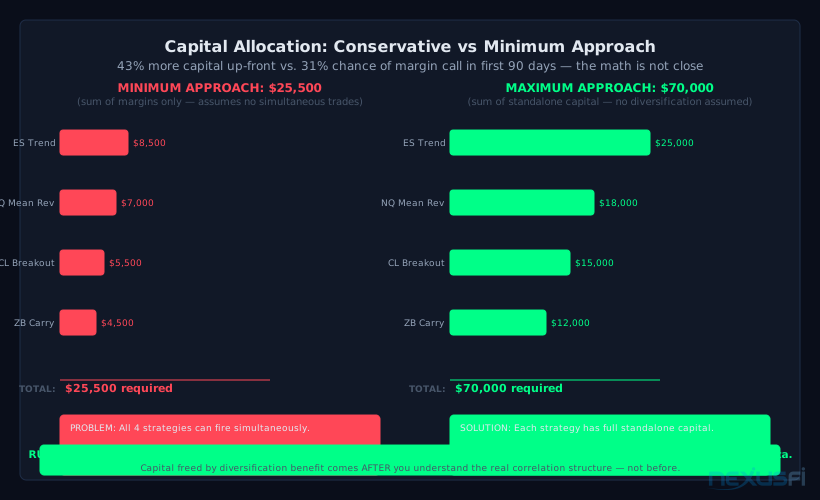
The minimum is dangerous — you're counting on trades not all triggering simultaneously. They will, at the exact worst moment. The maximum is conservative but leaves diversification benefits on the table.
The right answer sits between them, and finding it requires running the combined backtest:
- Take the daily P&L series for each individual strategy
- Sum them to create the portfolio P&L series
- Calculate the combined maximum drawdown
- Add intraday margin requirements (worst-case simultaneous entries)
- Apply a 20-30% safety buffer
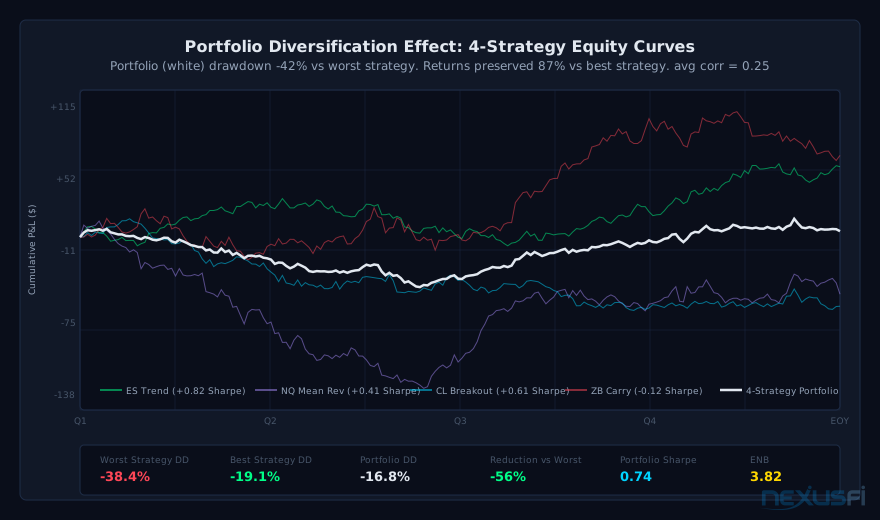
The combined drawdown will typically be lower than the sum of individual drawdowns — that's the diversification benefit. But it'll be higher than the best single strategy's drawdown. How much higher depends entirely on correlation.
His advice for new multi-strategy traders: "start out with the maximum capital (assume all strategies are independent), then as you get comfortable trading all of them, you can make adjustments based on the amount of free capital you see, the risk you want to take, etc."
Conservative. Correct. You can always reduce capital allocation as you gain confidence in the correlation structure. You can't un-blow an account.
Risk Budgeting and Capital Allocation #
Running multiple strategies without a systematic capital allocation framework is how you end up with too much capital in a deteriorating strategy and not enough in a performing one.
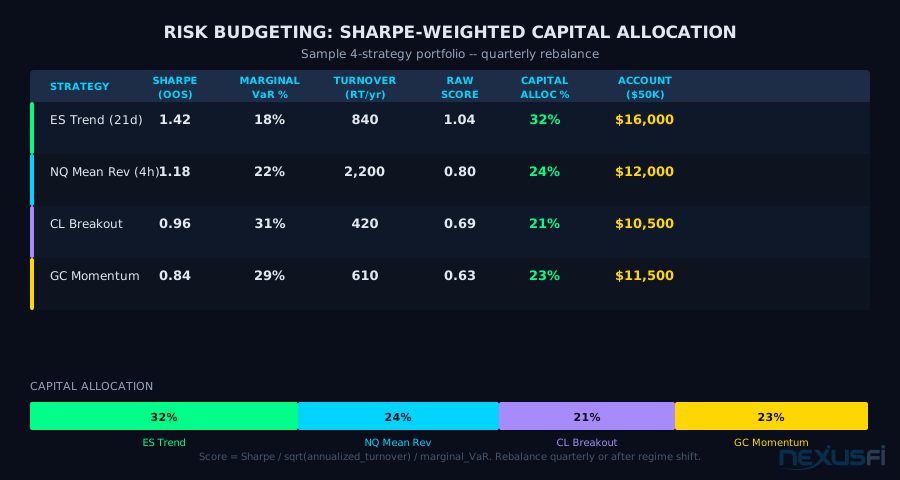
Risk budgeting starts with the portfolio's total risk tolerance. Define it as a maximum daily VaR (e.g., 2% of capital) or maximum expected drawdown (e.g., 15% of capital). Then allocate that risk budget across strategies based on expected return per unit of risk contributed.
The allocation process:
- Calculate each strategy's standalone Sharpe ratio from walk-forward out-of-sample results
- Calculate each strategy's marginal risk contribution to the portfolio (incremental VaR)
- Allocate capital proportionally to Sharpe / (marginal VaR contribution)
- Apply a turnover penalty: strategies with high turnover get weighted by Sharpe / √(annualized turnover)
- Rebalance quarterly or after significant regime shifts
The turnover penalty is critical and frequently ignored. A strategy generating 1.2 Sharpe but trading 4,000 round-trips per year will eat you alive in commissions and slippage at scale. Weight turnover into the allocation to avoid capital concentrating in high-churn systems.
Dynamic scaling:
Allocation isn't set-and-forget. As market regimes shift, a strategy's Sharpe degrades or improves. Build a simple performance scoring system:
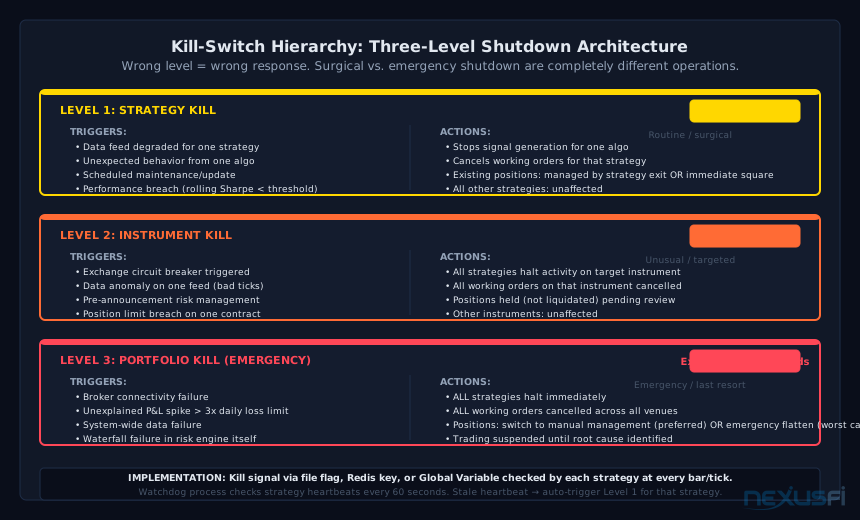
- Each strategy gets a rolling 30-day performance score (recent Sharpe vs. historical)
- If a strategy's score drops below 50% of historical Sharpe, reduce its capital allocation by 30%
- If it drops below 25%, suspend it pending review
- If it recovers above 75% of historical Sharpe, restore allocation gradually
This is the same concept that
Automated, rules-based. Not discretionary. When you're watching five strategies simultaneously at 9:30 AM, you don't have bandwidth for discretionary allocation decisions. The system decides.
Pre-Trade Risk Controls and Position Limits #
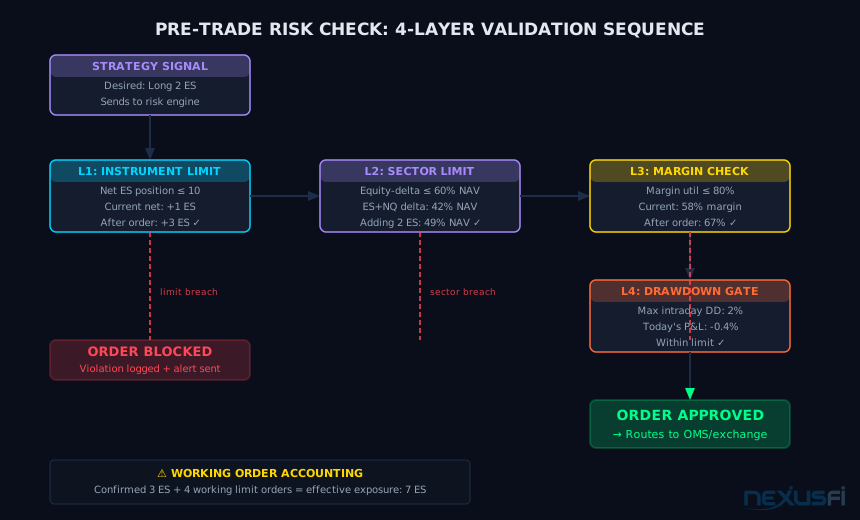
Every order from every strategy must pass through a pre-trade risk check before hitting the exchange. This is non-negotiable at any scale.
The layered limit structure:
Level 1 — Instrument limits: Maximum net position per contract. For a retail algo trader running 2-3 strategies, this might be 6-10 ES equivalents total. For a prop shop, much larger. The point is having a hard number that can't be exceeded, regardless of how many strategies are firing simultaneously.
Level 2 — Sector/factor limits: Maximum net exposure to correlated risk factors. If you're running an ES trend strategy and an NQ trend strategy simultaneously, you have concentrated equity-index long/short exposure. Cap the total equity-index delta at a defined percentage of capital regardless of which individual instruments are involved.
Level 3 — Margin constraints: Real-time margin utilization monitoring. Never exceed 75-80% of available margin. At 80%, automatic reduction in position sizing begins. This isn't negotiable.
Level 4 — Portfolio drawdown controls: Maximum intraday drawdown (typically 2-3% of account), maximum rolling 5-day drawdown (typically 5-8%), maximum monthly drawdown (typically 10-12%). Any breach triggers suspension of new entries and alerts.
Working order accounting:
This is where most retail implementations fail. Your risk engine must track effective exposure — not just confirmed positions, but also expected fills from working limit orders. If you have 3 ES long and 4 working limit orders to buy 1 ES each, your effective exposure is 7 ES, not 3.
Naive implementations count only confirmed positions. This means during fast-moving markets when fills come rapidly, your real exposure can spike well above your intended limits before the risk check catches up. Count working orders as exposure at the conservative fill probability.
Kill-Switch Architecture #
A kill switch that takes 5 seconds to engage during a runaway algo event can mean the difference between a bad day and an account-blowing event. Design it carefully.
Three-level hierarchy:
Strategy-level kill: Stops one algorithm from generating new signals. Existing positions are managed by that strategy's exit logic (or immediately squared if appropriate). Useful for: degraded data feed to one strategy, unexpected behavior from one algo, scheduled maintenance.
Underlying-level kill: Freezes all activity on one instrument across all strategies. Cancels all working orders on that instrument. Useful for: exchange circuit breaker, data anomaly on one feed, pre-announcement risk management.
Portfolio-level kill: Emergency shutdown of all strategies. Cancels all working orders. Squares all positions or switches to manual management. Useful for: broker connectivity issues, unexplained P&L spike, system-wide data failure.
Implementation:
At minimum, implement an external kill-switch file. Every strategy checks a file path or database flag at each bar or tick. If the kill signal is set, the strategy immediately exits positions and stops trading. This works in NinjaTrader 8 via file reads or global variables, in TradeStation via global variables, in custom Python implementations via Redis flags.
More robustly, use a watchdog process — a lightweight monitor that independently checks strategy health, position state, and P&L. If the watchdog detects anomalies, it sends the kill signal without waiting for strategy-level logic.
Real-world kill-switch failures are more instructive than any theory. @Breukelen documented a near-miss in his NexusFi journal that illustrates exactly what happens when kill-switch implementation relies on assumptions:
The lesson is exact: "confirmation received" is not the same as "order executed." A production kill switch must verify position = 0, not just that the kill signal was sent. Market orders can be rejected during circuit breakers, news events, and market reservation periods.
"Trading with yourself" — two strategies entering opposite positions on the same instrument — is exactly what proper position netting prevents. But it also illustrates what happens without coordinated risk management: runaway order flow that accomplishes nothing except generating commissions.
Strategy Coordination: Preventing Crosstalk #
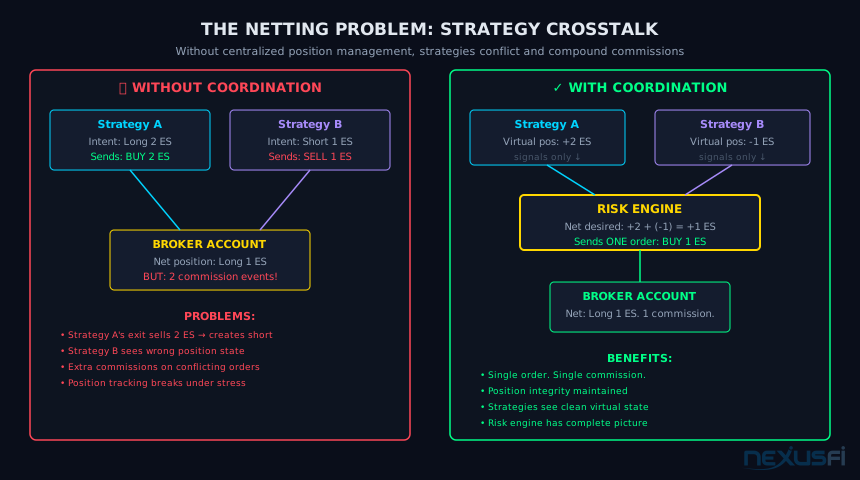
When multiple strategies target the same instrument, you can end up in situations where Strategy A is building a long while Strategy B is selling out a long from yesterday. Net exposure is flat, you're paying commissions in both directions, and neither strategy's intent is being executed efficiently.
The netting problem:
Futures accounts are generally netted at the account level by the exchange and broker. Two strategies each managing positions independently will see their intended positions merged into a single account position. This creates issues:
- Strategy A intends to be long 2 ES, short 0
- Strategy B intends to be short 1 ES, long 0
- Account position: net long 1 ES
- But when Strategy A's exit signal fires, it tries to sell 2 ES — which squares its position and goes short 1 on behalf of the account
- Strategy B now thinks it has its intended short position, but the account is short 1 for the wrong reason
This confusion cascades quickly with 3+ strategies on the same instrument.
The solution — centralized position management:
The risk engine assigns each strategy a "virtual account." Strategies compute signals against their virtual position. The risk engine translates virtual positions into a net account position and generates the actual orders needed to move the real account to the desired state.
In NinjaTrader, this can be partially achieved via Global Variables that strategies use to communicate intended positions to a master strategy that manages actual execution. In TradeStation, similar approaches exist but require more manual implementation.
At the simplest level, if you're running multiple strategies on the same instrument: have one "master" strategy that aggregates all signals and manages execution, rather than independent strategies each managing their own orders. Complexity is higher, but position integrity is maintained.
Performance Attribution: Knowing What's Actually Working #
After a month of running four strategies simultaneously, do you know which one is carrying the portfolio and which one is dragging it? Can you tell which strategies are performing as expected versus which ones are in drawdown that warrants review?
Without performance attribution, a multi-strategy portfolio is a black box. You'll know the combined P&L but not which components are contributing to it.
Basic attribution framework:
Tag every trade with its originating strategy ID. At the end of each day, calculate:
- Each strategy's gross P&L (before commissions and fees)
- Each strategy's net P&L (after commissions)
- Each strategy's current drawdown from its individual equity peak
- Each strategy's rolling Sharpe (30-day, 90-day)
- Cross-strategy correlation for the period (did correlation increase relative to historical?)
What to do with the data:
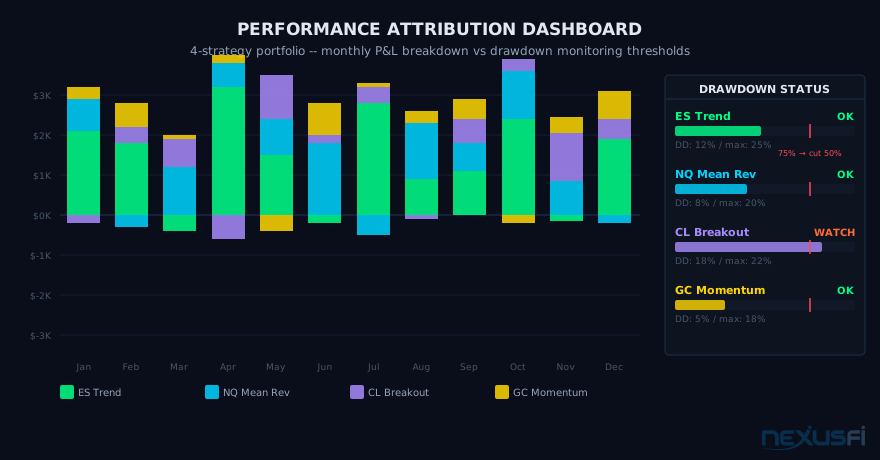
- Any strategy in drawdown exceeding 75% of its historical maximum drawdown: automatic capital reduction by 50%
- Any strategy with 30-day Sharpe below zero for two consecutive months: suspend and review
- Any strategy pair with 30-day correlation above 0.7 (much above historical): reduce combined allocation until correlation normalizes
Without this monitoring, you'll inevitably keep over-allocating to a degrading strategy and under-allocating to a performing one — because the combined P&L masks the underlying drift.
@mtzimmer1 described his approach as "100% systematic - zero discretion." That discipline has to extend to attribution monitoring too. Manual reviews of combined P&L are not sufficient. The monitoring system makes the allocation decisions based on rules.
Platform-Specific Execution Mechanics #
The architecture above is vendor-agnostic. Here's how it maps to the platforms retail algo traders actually use.
NinjaTrader 8:
NinjaScript allows running multiple independent strategies on different charts simultaneously. Each strategy manages positions within its own order context. The challenge is cross-strategy position coordination.
For simple multi-strategy setups (no netting needed):
- Use Independent order management mode
- Set each strategy's position sizing to not exceed the desired per-strategy limit
- Configure maximum daily loss limits at the account level as a backstop
For coordinated multi-strategy setups (netting required):
- Implement a master strategy using Global Variables to aggregate signals
- Individual "signal generator" strategies update shared Global Variables with their signals
- Master strategy reads all signals, computes net desired position, executes so
NinjaTrader 8's Account-level controls (Maximum Daily Loss, Maximum Contracts, etc.) provide a basic portfolio-level kill switch at the platform level. Configure these as a last-resort backstop to platform-level automation.
TradeStation:
TradeStation allows running multiple strategies on different charts and same instruments (futures specifically). As @kevinkdog noted, this works well in TradeStation 10.0+ and less reliably in earlier versions.
TradeStation Global Variables enable cross-strategy communication similar to NinjaTrader's approach. The "hub chart" pattern — one chart that reads signals from other charts via Global Variables and manages all execution — is the recommended approach for strategies on the same instrument.
For different instruments, independent strategies generally work cleanly since there's no netting confusion.
Custom Python/C++ implementations:
Professional implementations use message queues (Redis, ZeroMQ, RabbitMQ) to pass signals from strategy processes to a centralized risk engine. The risk engine applies limits, computes net positions, and publishes approved orders to an execution engine that interfaces with the broker API.
This architecture is fully decoupled — strategies have no access to the order router, the risk engine doesn't know strategy-specific logic, and the execution engine doesn't know position intent. Bugs in one layer don't cascade to others.
For retail traders using Interactive Brokers, Tradovate, or similar broker APIs, a lightweight version of this is achievable in Python: each strategy publishes signals to a shared dict or Redis hash, a risk-management wrapper reads all signals, aggregates them, checks limits, and submits orders.
Common Failure Modes #
Professional multi-strategy trading has well-documented failure patterns. Most of them are avoidable with the right architecture.
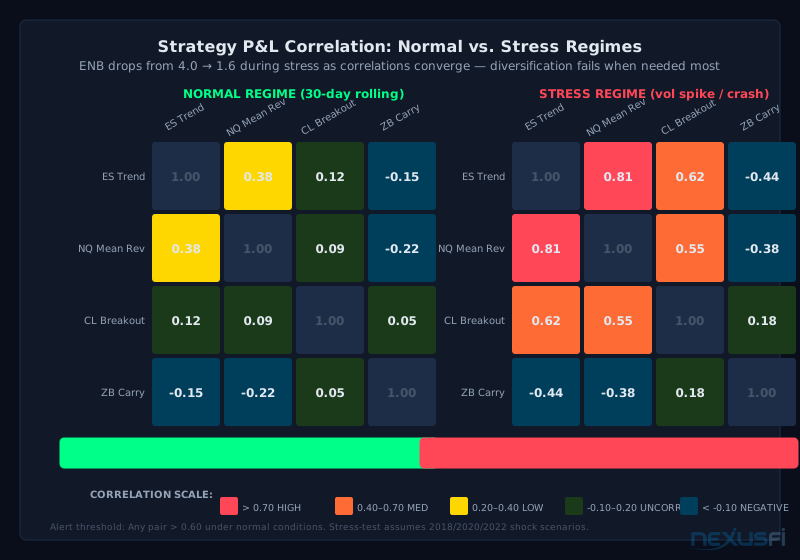
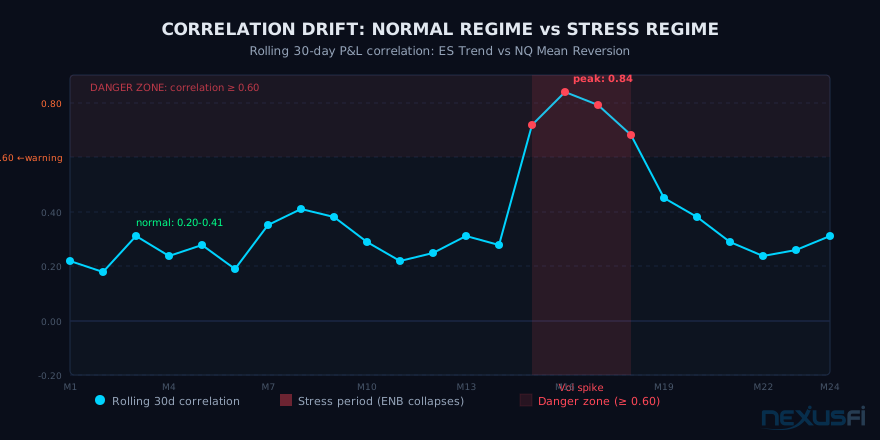
Failure 1 — Correlation drift: Two strategies looked uncorrelated in backtesting across 2018-2022. In 2024, a macro regime shift makes them highly correlated. The portfolio that looked like it had 5 independent bets now has 2. Mitigation: monitor rolling correlation continuously. Recompute ENB monthly. Reduce combined allocation when correlation exceeds thresholds.
Failure 2 — Capital starvation: A drawdown in Strategy A temporarily ties up capital needed for Strategy B's optimal position size. Strategy B underperforms as a result. Mitigation: allocate capital per strategy with reserves, not just minimum margin. The "maximum capital" approach from kevinkdog above is the correct starting point.
Failure 3 — Working order phantom exposure: Three strategies each have working limit buy orders for 2 ES. None of them are filled yet, so the risk engine reports zero net position. Then the market drops rapidly and all three fill simultaneously — 6 ES long at once. Mitigation: count working orders as exposure at conservative fill probability.
Failure 4 — Regime breakdown: All strategies are calibrated on bull market data. A bear market regime causes synchronized drawdowns. The correlation that was 0.2 in backtesting spikes to 0.8 in production. Mitigation: test correlation under different market regimes. Explicitly include 2008, 2020 crash period, and 2022 rate-shock period in correlation analysis.
Failure 5 — P&L attribution blindness: Combined portfolio P&L looks fine — small gains, small losses. Underlying the surface, two strategies are up 15% and two are down 15%, masking the deterioration. Capital stays allocated to deteriorating strategies too long. Mitigation: independent performance attribution with automatic reallocation triggers.
Failure 6 — Strategy zombie walk: A strategy that "should have been turned off months ago" keeps running because its individual P&L is masked by the portfolio. It's generating small, consistent losses that the other strategies are covering. Mitigation: mandatory review of any strategy in drawdown exceeding 50% of its historical max drawdown. Rules-based allocation reduction. No "waiting to see if it comes back."
Maintenance and Strategy Lifecycle #
Every automated strategy has a lifecycle. The edge degrades. Market microstructure changes. Competing capital discovers the same inefficiency and arbitrages it away. Multi-strategy portfolio management must include systematic lifecycle monitoring.
The lifecycle stages:
- Development and validation: Strategy is built, backtested, walk-forward validated, and paper-traded. Not in the portfolio yet.
- Live probationary period (30-60 days): Strategy goes live at 25% of intended allocation. Performance is compared to live forward expectations daily. Any 2-standard-deviation negative deviation from expected performance triggers extended review.
- Full allocation: Strategy has passed probationary performance criteria. Capital allocated at full weight.
- Declining performance: Rolling Sharpe drops below 75% of historical. Allocation cut to 50% pending investigation.
- Suspension: Sharpe below 25% of historical or in drawdown exceeding maximum historical drawdown. Strategy suspended. Root cause analysis required before re-activation.
- Retirement: Root cause cannot be identified or corrected within 30 days. Strategy is retired and removed from the portfolio.
The transitions between these stages must be rules-based. Discretionary decisions about whether a strategy is "in a temporary drawdown" or "has permanently degraded" are how you keep losers too long. The rules are set when you're calm. They execute when you're stressed. That's the whole point.
Building the Monitoring Infrastructure #
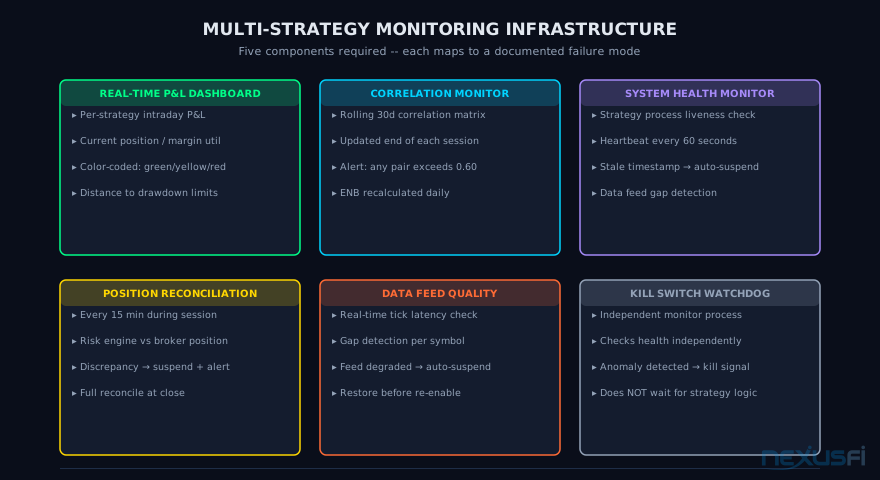
The monitoring system that keeps a multi-strategy portfolio alive includes several components:
Real-time P&L dashboard: Each strategy's intraday P&L, current position, and margin utilization. Visible at a glance. Color-coded: green/yellow/red based on distance to drawdown limits.
Correlation monitor: Rolling 30-day correlation matrix updated at end of each trading day. Alert trigger when any pair exceeds 0.6 (historical threshold + 0.2 warning level).
System health monitor: Every strategy process checked for liveness every 60 seconds. Heartbeat mechanism: each strategy writes a timestamp to a shared file/database. If the timestamp is stale by more than 2x the strategy's bar period, alert fires.
Data feed quality monitor: Real-time tick data latency and gap detection. If a strategy's data feed has a gap or excessive latency, automatic suspension of that strategy until data quality is restored.
Position reconciliation: Every 15 minutes during trading hours, compare the risk engine's position tracking against the broker's reported position. Any discrepancy above the threshold immediately triggers alert and automatic trading suspension until reconciled.
These aren't nice-to-haves. Each one corresponds to a failure mode that has caused real losses for real traders running unmonitored multi-strategy portfolios.
Practical Starting Point for Retail Traders #
All of this architecture is right. Most of it is also overkill for someone running 2-3 strategies on a $50,000 account in NinjaTrader.
Here's the scaled-down practical starting point:
Step 1: Run combined backtests before going live. Don't analyze strategies independently — analyze them as a portfolio. Compute combined drawdown, combined Sharpe, and pairwise P&L correlation.
Step 2: Allocate capital using the conservative "maximum capital" framework (treat strategies as independent, sum their individual capital requirements). Reduce toward minimum only after 90 days of live portfolio data.
Step 3: Set account-level stops at the broker/platform level as a backstop. NinjaTrader Account-level controls, TradeStation Global Stop Loss — configure these as absolute last-resort protections.
Step 4: Maintain a simple daily attribution log. Strategy A P&L, Strategy B P&L, Strategy C P&L. Review weekly. If any strategy has been negative for 3 consecutive weeks, reduce allocation by 50%.
Step 5: For strategies on the same instrument, use a master-strategy netting pattern or accept the position-tracking complexity and reconcile manually at end of each day.
Step 6: Measure correlation of daily P&L between strategy pairs every 30 days. If pairwise correlation spikes above 0.6, investigate before adding more capital to the correlated pair.
That's it. Six steps, no enterprise infrastructure required, and you've covered the critical failure modes that end multi-strategy portfolios prematurely.
The professional infrastructure scales these same principles with more automation, more precision, and more resilience. But the principles themselves — centralized risk awareness, conservative capital allocation, correlation monitoring, and lifecycle management — apply at every scale.
Running multiple automated strategies is fund management, not strategy management. The distinction isn't semantic — it changes everything about how you size capital, monitor risk, and decide when to intervene. the central risk engine is the dividing line between a managed portfolio from a collection of strategies that happen to share an account.
Key Takeaways #
Multi-strategy automated futures trading is where systematic trading gets interesting — and where the mistakes get expensive.
The central insight is that running multiple strategies simultaneously changes the risk calculation at the core. You're not managing five independent risk streams. You're managing a portfolio where the streams interact, correlate, and compound. The single most important thing you can do is create a centralized view of the combined risk exposure, updated in real time, with automatic limits and kill switches.
Strategy quality still matters. Diversification by strategy type, time horizon, and regime dependency still matters. But none of it matters if you don't know what your combined portfolio's real exposure is at any given moment.
The traders who run multi-strategy books successfully treat it like running a small fund, not like running several trading systems. The mental shift from "how is Strategy A performing?" to "what is my portfolio doing?" is the most important change you can make.
Knowledge Map
Prerequisites
Understand these firstCitations
- — Strategy portfolio Drawdown in relation of single systems DD (2018) 👍 5“Capital requirements framework: minimum vs. maximum capital approaches”
- — Looking for EasyLanguage Programmer (TS) (2022) 👍 5“Trading multiple strategies on same instrument in TradeStation”
- — Key Advantage of an Autotrade System - Ability to Portfolio (2015) 👍 7“Multi-strategy portfolio management as running a fund”
- — The logic of your strategies (2020) 👍 4“Portfolio of uncorrelated strategies as ultimate goal”
- — Diversification while Trading Futures? (2013) 👍 2“Measuring drawdown correlation between instruments”
- — Trade long & short simultaneously in NT8 (2024) 👍 2“Long and short simultaneously in one account with multiple strategies”
- — My algo hit the kill switch, CME said no! (2022) 👍 6“Kill switch failure during FOMC - Rithmic built-in exitPositions rejected by CME”
- — KJ Trading Systems Kevin Davey - Ask Me Anything (AMA) (2013) 👍 13“Portfolio trading as closest thing to Holy Grail - diversifying across markets and strategies”
- — Key Advantage of an Autotrade System - Ability to Portfolio (2015) 👍 3“Portfolio level approach - diversification asset allocation model selection”
- — KJ Trading Systems Kevin Davey - Ask Me Anything (AMA) (2016) 👍 3“Capital reweighting as time progresses - more to winners, less to losers”
- — Sustained success with an algo (2022) 👍 2“Performance monitoring and drawdown thresholds for algo sustainability”