



Algo Trading Live Deployment: Taking Your Strategy from Backtest to Real Capital
Overview #
Algo Trading Live Deployment: Taking Your Strategy from Backtest to Real Capital
You've backtested. You've walk-forward validated. You've stress-tested with Monte Carlo simulation. The equity curve looks beautiful.
Now comes the part that actually matters: putting real money behind it.
Live deployment isn't the finish line of strategy development — it's a completely separate discipline with its own failure modes, infrastructure requirements, and risk surface. A profitable backtest is the beginning of validation, not the end. Treat the transition to live trading as a gated production rollout, not a binary switch.
Key Concepts #
Gated Deployment Pipeline: A staged process where each phase must pass specific criteria before advancing to the next — backtest, walk-forward, Monte Carlo, paper trading, shadow mode, small-size live, then scale-up.
Kill Switch: An automated mechanism that cancels all working orders, blocks new signal generation, and optionally flattens positions when predefined risk thresholds are breached.
Strategy Drift: Behavioral divergence between a strategy's expected and actual performance — measured not just by PnL, but by trade frequency, fill quality, holding time, and slippage distribution.
Execution Reconciliation: The process of comparing your strategy's internal fill records against broker-reported fills to detect accounting errors, missed fills, or state machine bugs.
Capacity: The maximum position size a strategy can sustain without degrading execution quality — determined by average daily volume, spread dynamics, and queue position effects.

The Gated Deployment Pipeline #
Think of this as a production rollout with checkpoints. Skip a gate, and you're gambling on infrastructure you haven't tested.
Stage 1: Backtest (Estimate Edge) #
Your backtest establishes whether the strategy has theoretical edge. But realistic backtests require more than historical price data. Include exchange fees (maker/taker), realistic slippage models, contract roll costs, and session calendars. As @kevinkdog documented in his "Taking a Trading System Live" journal, the gap between backtest assumptions and live reality is where most strategies die.
Taking a Trading System Live (@kevinkdog)
Stage 2: Walk-Forward Validation (Prove Stability) #
Walk-forward testing splits your data into rolling in-sample/out-of-sample windows and requires that metrics stay within tolerance bands across all folds. You're not just checking profitability — you're checking that trade frequency, average slippage, and drawdown profiles remain consistent across regimes.
The gate here is stability, not optimality. If performance collapses in certain folds, the strategy is curve-fit regardless of aggregate results. @Silver Dragon's walk-forward experiment on NexusFi is a rare real-time example of this process executed with discipline.
Walk Forward Experiment (@Silver Dragon)
For a deep dive on walk-forward methodology, see Walk-Forward Analysis.
Stage 3: Monte Carlo Stress Testing (Probe Tail Risk) #
Monte Carlo simulation randomizes trade sequences to estimate the probability distribution of outcomes — especially worst-case drawdowns. But good Monte Carlo goes beyond reshuffling returns. Perturb execution variables too: slippage distributions, partial fill rates, latency jitter, and data gap scenarios.
The gate: your 95th-percentile worst-case drawdown must remain inside your risk budget with conservative sizing. If it doesn't, reduce position size or tighten the strategy before going further.
See Monte Carlo Simulation for Trading Strategies for the full methodology.
Stage 4: Paper Trading (Prove Operational Correctness) #
Here's where most traders go wrong: they paper trade to prove the strategy is profitable. Wrong objective. Paper trading proves your execution stack works correctly — order lifecycle, data integrity, session handling, contract roll logic, risk controls. Profitability during paper trading is a nice bonus, not the point.
Run for at least 1-2 weeks covering different market conditions. If the strategy is low-frequency or sensitive to specific sessions, extend to 4-8 weeks. As @Big Mike explained in discussing automated daytrading, "market replay fills are too optimistic — live sim is the minimum viable test for order handling."
Automated DayTrading: Market Replay vs. Live SIM. Why are results different? (@Turtrend)
What to verify during paper trading:
- Every order's lifecycle (submit, acknowledge, partial fill, fill, cancel) logs correctly
- Session templates and time filters align with strategy design
- Contract roll mapping handles expiration correctly
- Risk controls trigger when breached (test them intentionally)
- Strategy state resets properly after disconnect/reconnect
Stage 5: Shadow Mode (Optional but Valuable) #
Generate signals, compute orders, but don't send them to the broker. Compare what you would have done against market outcomes. This catches edge cases your paper trading might miss — especially around fast markets and connectivity issues.
Stage 6: Small-Size Live (Phase 1) #
Trade 10-30% of your intended position size with tight daily loss limits. This is your first real execution data. Compare fill quality, slippage, and latency against paper trading expectations. @vmodus documented this transition in "Attack of the Robots" — running the strategy on micro e-minis before scaling to full contracts.
Attack of the Robots - An Algo Journal (@vmodus)
Stage 7: Scale-Up (Phase 2) #
Only after Phase 1 proves stable. Increment in measured steps (e.g., 5-10% of target size per step), documenting slippage versus size at each level. Stop scaling if execution quality degrades.
Infrastructure That Matters #
Execution Platform #
Your platform must expose deterministic order states: submitted, working, partially filled, filled, cancelled, rejected. Log every state transition with timestamps. If the platform can't tell you exactly what happened to every order, you can't debug production failures.
Critical validation: what happens on disconnect and reconnect? Does the platform duplicate orders? Does it assume prior working orders still exist? Test this deliberately — pull the network cable during a paper trade session and observe.
Market Data Connectivity #
Data integrity is a first-class risk. A single stale quote feeding into your signal logic can generate a wrong-direction trade. Implement:
- Staleness detection: if last tick age exceeds your threshold (e.g., 500ms for intraday strategies), halt trading
- Gap detection: monitor for missing ticks or sequence breaks
- Redundancy: dual data feeds where possible, with automatic failover
Order Routing #
Execution quality depends heavily on routing. Verify how your broker handles maker/taker fees, immediate-or-cancel orders, partial fills, and cancel/replace sequences. Build a fill-quality monitor that tracks average slippage per trade against your model.
@kevinkdog found that adding roughly 2x the normal bid-ask spread as a slippage assumption brought backtest results into alignment with live results. That's a practical calibration technique worth adopting.
Demo and live account in parallel (@confusedxx)
Execution Environment #
Co-location matters only for sub-second, tick-scalping, or spread-arbitrage strategies. For bar-based or swing systems, a reliable VPS or even a stable home connection is sufficient — focus on reliability and monitoring over raw microsecond latency.
What every setup needs: NTP clock synchronization, a centralized audit trail (signal timestamp to order submission to fill), and measured end-to-end latency so you know what you're working with.
Risk Controls: Non-Negotiable #
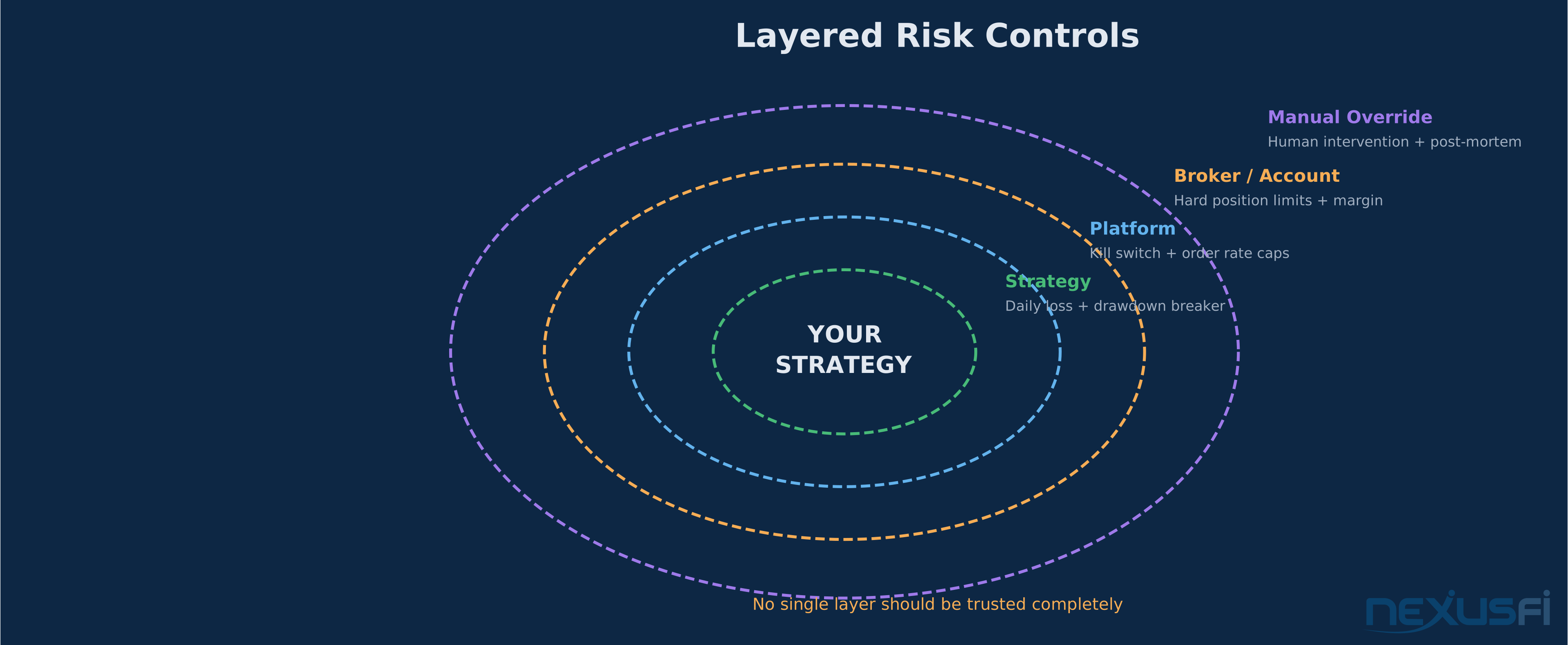
Risk controls must be layered — strategy level, platform level, broker level, and manual override. No single layer should be trusted completely.
Position Limits #
Hard limits per instrument and in aggregate. Include pending orders in your exposure calculation, not just filled positions. An order working in the market is already risk.
Daily Loss Limits #
When breached, the system stops trading for the day. Not "reduces size." Stops. A daily loss limit that merely reduces position size is a suggestion, not a control.
Drawdown Circuit Breaker #
Track equity peak-to-trough using realized PnL plus mark-to-market. When drawdown exceeds your threshold, the system flattens all positions and stops generating signals. This is your last line of defense against catastrophic loss.
Kill Switch #
Cancels all working orders, blocks new signals, and logs the event. Must activate within seconds of a trigger. Common triggers:
- Data feed disconnect or staleness
- Risk limit breach
- Repeated order rejections
- Abnormal fill rate (too many partials, unexpected fills)
- Connection loss to broker
Test your kill switch. Deliberately trigger it in paper trading. If you've never seen it fire, you have no idea if it works.
Order Rate Caps #
Prevent runaway loops. Set maximum orders and cancels per second. A strategy bug that generates 100 orders in a second can destroy an account before you notice.
Where Backtests Lie #
Slippage #
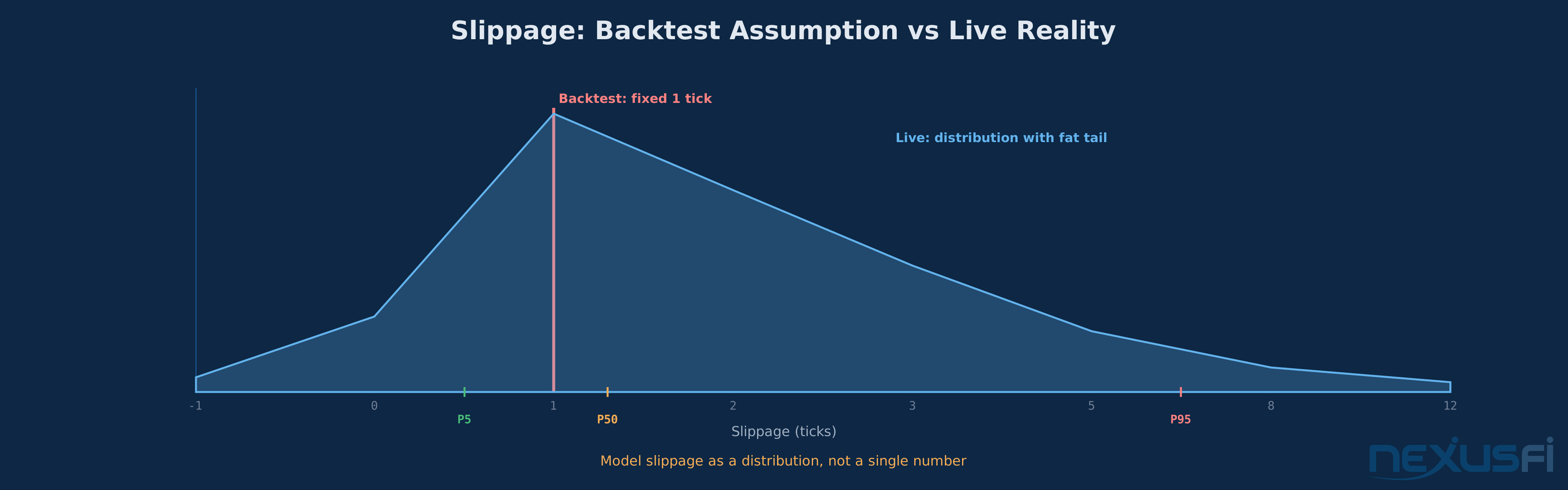
Backtests typically model slippage as a fixed cost — one tick, two ticks, 0.1%. Reality is regime-dependent, order-type specific, and distributional. During fast markets, stop orders can slip 5-10 ticks. During quiet periods, limit orders fill at better prices than modeled. Use slippage distributions (5th percentile, median, 95th percentile) in your Monte Carlo, not a single number.
@kevinkdog breaks this down precisely: "The difference between the real money fill price and the strategy fill price is what I am calling slippage." Track this metric religiously.
Backtest Strategy weak points (@walter739)
Latency and Jitter #
Your backtest assumes zero delay between signal and execution. Reality has variable network latency plus processing time. One delayed cancel can turn a good limit order into a bad fill. Measure decision-to-order-sent and order-sent-to-acknowledgment latency in production. Log it. Alert on anomalies.
Partial Fills #
Backtests assume full fills at requested size. In live markets, limit orders may fill partially, leaving you with unintended exposure. Your execution logic must track remaining quantity and define behavior: reprice, cancel, or wait. A strategy that breaks on partial fills has a production bug, not a market problem.
Different results after "Recalculate strategy". (@Dzam)
Data Feed Gaps #
Missing ticks cause wrong indicator values, which cause wrong signals, which cause wrong trades. Implement a state machine: "trading enabled" only after indicators are fully warmed with valid data. On data gaps, choose explicitly: flatten and halt, or hold positions but stop initiating.
Contract Roll Errors #
Rollover mechanics vary by exchange and contract. A strategy running on an expired contract or calculating signals across a roll gap produces garbage. Encode roll logic with an explicit calendar and unit-test it around actual roll dates.
Monitoring: Observe and Adjust #
An unmonitored algorithm is a liability. "Set and forget" doesn't exist in production trading.
Real-Time Dashboard #
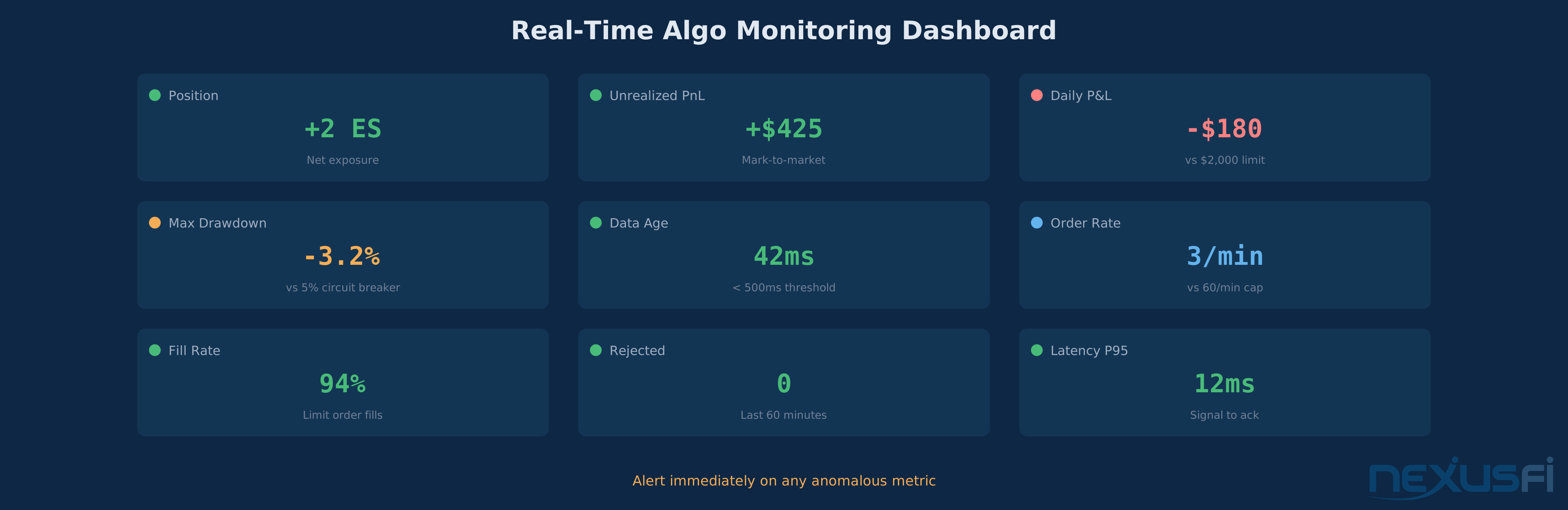
Track at minimum: current positions, unrealized PnL, daily loss versus limit, last data timestamp, order rate per minute, fill rate, rejected order count, and latency histogram. If any of these goes anomalous, you need to know immediately.
Strategy Drift Detection #
Drift isn't just performance decay. It's behavioral divergence: different trade frequency, changed slippage distribution, different average holding time, degraded fill ratios. Set alerts when any metric deviates more than two standard deviations from your baseline. Consider automatic "safe mode" (reduced size) when drift triggers fire.
Execution Reconciliation #
End-of-day audit: compare your internal fill records against your broker statement. Mismatches — even small ones — can indicate logic errors, missed fills, or state machine bugs. Fix discrepancies before the next trading session.
Maintenance Routine #
Monthly: scan logs for unhandled rejects or orphaned orders. Quarterly: compare live metrics to backtest expectations and flag drift. Re-optimization only through a gated process: schedule or trigger, walk-forward validate, paper trade new parameters, then deploy.
As @kevinkdog documented throughout his journal, consistent monitoring of live versus expected metrics is what separates sustainable algo trading from "it worked in the backtest."
Scaling and Capacity #
A strategy that works at 1 contract may not scale linearly to 10 or 50 contracts. Scaling is both a risk question and an execution question.
Market Impact #
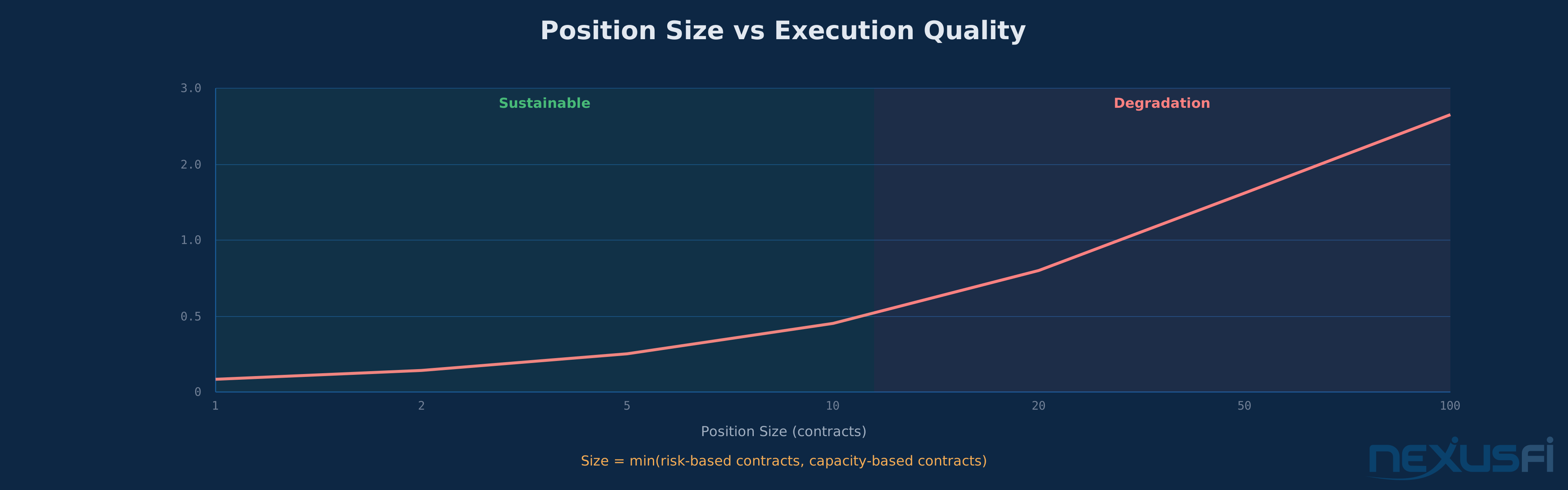
Larger orders consume depth, increase slippage, and may move the market against you. Even in liquid futures like ES, the relationship between size and slippage is nonlinear at the margin.
As @josh's thread on trading large size in ES revealed, "pro traders do not move enough money, generally, to worry about adverse price impact" — but that assumes liquid products and professional execution infrastructure. Most retail algo traders don't have either.
Why dont people trade 150 ES contracts? (@Avi24)
Capacity Analysis #
Estimate your strategy's maximum sustainable volume: what fraction of average daily volume (ADTV) do you consume? Target no more than 5-10% of ADTV for aggressive strategies and 2% or less for passive limit-order strategies. Build a capacity heat-map: plot ADTV by hour against your strategy's order flow.
Position Sizing Formula #
For live deployment, position size equals the minimum of your risk-based calculation (max drawdown budget) and your capacity-based calculation (max tolerable slippage). The smaller number wins.
@tigertrader emphasizes that scaling "is more a question of psychology and emotion than methodology" — but for automated strategies, it's pure execution math. Let the data decide.
Platform-Specific Deployment Notes #
NinjaTrader #
Strong retail accessibility with broad broker support. Key deployment concerns:
- Verify historical versus real-time data alignment, especially for session templates
- Test disconnect/reconnect behavior — ensure no duplicate order submission
- Understand intrabar order timing versus bar close behavior
- Log everything: NinjaTrader's strategy debug mode is your friend during paper-to-live transition
Sierra Chart #
Excellent performance and granular data control. Watch for:
- Study-system coupling that can introduce hidden latency
- Multiple data feed configuration errors (timestamps must be monotonic)
- Order routing settings that may not be obvious in the default configuration
- Test OCO/bracket behavior under fast market conditions
MultiCharts #
Powerful automation with EasyLanguage compatibility. Verify:
- Broker API reconnection handling — "ghost orders" can persist after connection drops
- Session and roll logic requires explicit coding (platform doesn't handle automatically)
- State persistence across platform crashes — run a reconciliation script on restart
- Signal-to-order timing matches your backtest assumptions
Regardless of platform: implement a platform-agnostic logger that captures signal timestamp, order ID, order type, broker-reported state, fill price/size, and error codes. This makes debugging consistent across any execution environment.
The Pre-Live Checklist #
Before your first live trade:
- Strategy validated — walk-forward and Monte Carlo gates passed
- Data feed verified — staleness detection active, no gaps in recent history
- Broker route tested — order types behave as expected in paper/sim
- Risk limits configured — daily loss, max drawdown, position limits
- Kill switch tested — deliberately triggered and verified working
- Contract roll plan defined — explicit calendar, tested around recent rolls
- Logging enabled — signal, order, fill, and error timestamps captured
- Reconciliation process ready — end-of-day broker statement comparison
- Scaling plan documented — exact size increments and criteria for each step
- Restart behavior verified — platform correctly reconciles state after restart
Don't go live because the strategy "looks right." Go live because the entire deployment stack has been validated.
Knowledge Map
Go Deeper
Build on this knowledgeReferences This Article
Articles that build on this topicCitations
- — Taking a Trading System Live (2013) 👍 47“OK, if you'd read my other journal here at Big Mike's, you'll know (as of today) that I have attempted 2 TopStepTrader Combines in the past few months.”
- — Walk Forward Experiment (2011) 👍 20“I have decided to put my automated system to the test. There has been a lot of talk about automated systems lately on NexusFi (formerly BMT).”
- — Automated DayTrading: Market Replay vs. Live SIM (2011) 👍 10“OK since you are specifically focused on just automated trading, I will try to answer only within that context. I am also answering specifically with regards to my experiences with NinjaTrader.”
- — Attack of the Robots (2020) 👍 2“Fistful of Dollars Yeah, somehow I'm stuck on Sergio Leone references this week. Anyhow, I ran another day of sim for my strategy on ES. It was another successful day, though it gave back a bit in the mid-afternoon.”
- — Demo and live account in parallel (2014) 👍 1“Hi Shane - If you are using SIM to "prove" the profitability of your strategy, I think you are likely to reach bad conclusions. For example, SIM always assumes that limit orders are filled immediately upon touching.”
- — Backtest Strategy weak points (2020) 👍 7“Speedytradingservers is great, but it will not save you from slippage. When your order goes to the market, for a buy you pay the higher ask price. BUT, your strategy might think you have been filled at the bid price.”
- — Different results after Recalculate strategy (2016) 👍 1“I don't know if it will help, I am not an expert with NT 7 but I have observed a big difference in the fills between market replay and SIM trading and live trading. In market replay the fill are too good.”
- — Taking a Trading System Live (2013) 👍 4“At this point, I have everything in place to begin the trading the system. If you think I've missed anything up to this point, please bring it up here. Assuming things are in place, I'd like to share what I do once I go "live" with a strategy.”
- — Why dont people trade 150 ES contracts? (2021) 👍 7“Whether they scale into a position is mostly a function of the time frame of the trade. If the trade is to be longer term, then it's no big deal to add lower or higher.”
- — Spoo-nalysis ES e-mini futures S&P 500 (2015) 👍 17“scaling your size in a liquid instrument, is more a question of psychology and emotion, than methodology. it's not unlike the difference between sim trading and live trading.”