



Section 1256 Tax Treatment for Futures Traders: The 60/40 Rule, Mark-to-Market, and What It Means for Your Bottom Line
Overview #
Overview #
Here's one of the most overlooked advantages futures traders have over equity day traders: the tax code is built in your favor. Section 1256 of the Internal Revenue Code gives regulated futures contracts a blended tax rate that's lower than what stock traders pay on short-term gains — regardless of how long you hold the position. You could scalp ES for 30 seconds or swing crude oil for three weeks. The tax treatment doesn't change.
As @SMCJB explains on NexusFi: "All futures are taxed as section 1256 contracts and hence are treated as 60% long term capital gains and 40% short term capital gains." The advantage compounds year after year.
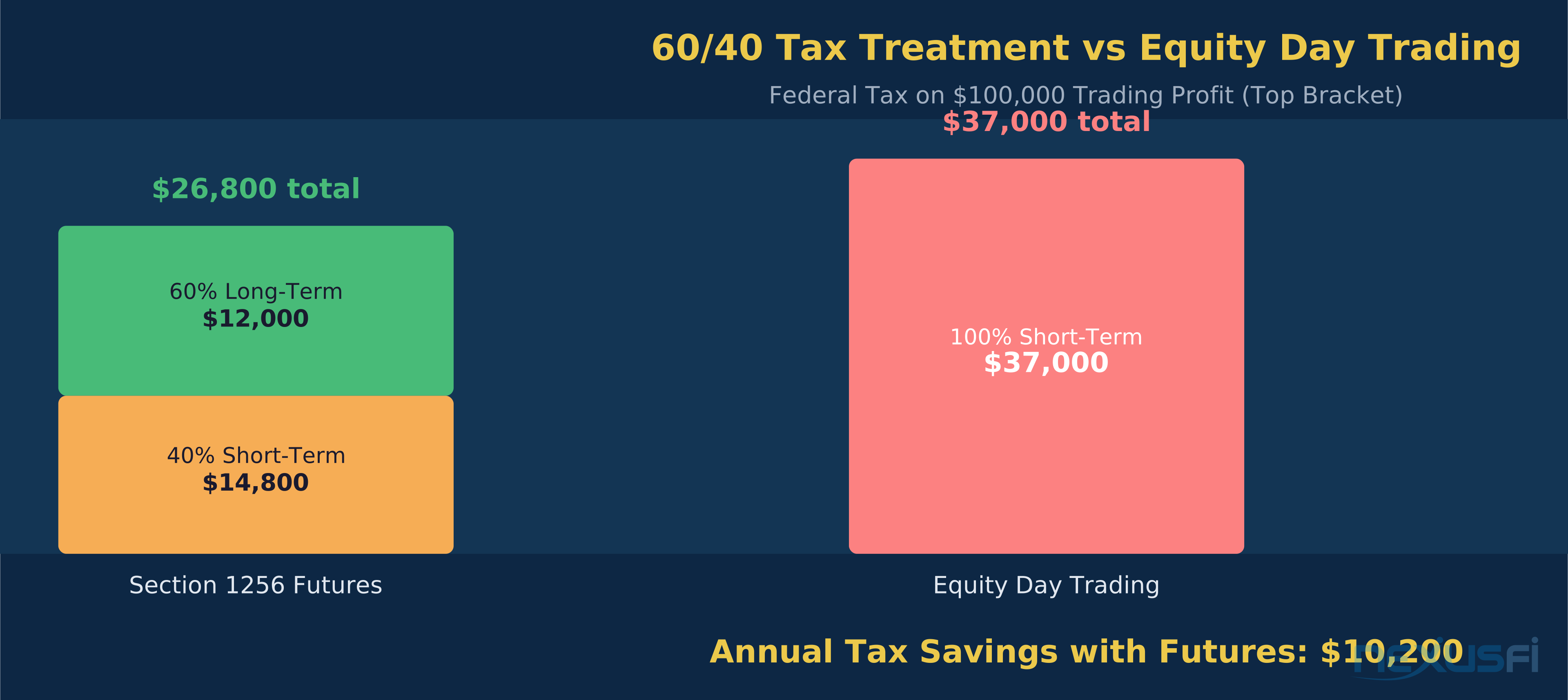
The core mechanic: 60% of your net futures gains are taxed at the long-term capital gains rate (currently 20% at the top bracket), and 40% at your ordinary income rate. On $100,000 in trading profits, that's $26,800 in federal tax vs $37,000 if you'd day-traded equities. That's $10,200 back in your pocket every year, just from choosing the right instrument class.
This isn't a loophole or an aggressive tax position. It's the default treatment — automatic, mandatory, and has been in the code since 1981.
The advantage compounds year after year.
This article covers U.S. federal tax treatment only. State tax treatment varies. This is educational content, not tax advice — work with a CPA who understands derivatives.
What Qualifies as a Section 1256 Contract #
Section 1256 treatment is instrument-based, not trader-based. It doesn't matter whether you're a full-time professional or trade two contracts a month in your IRA. If the instrument qualifies, the tax treatment is mandatory — you can't opt out and you don't need to elect in.
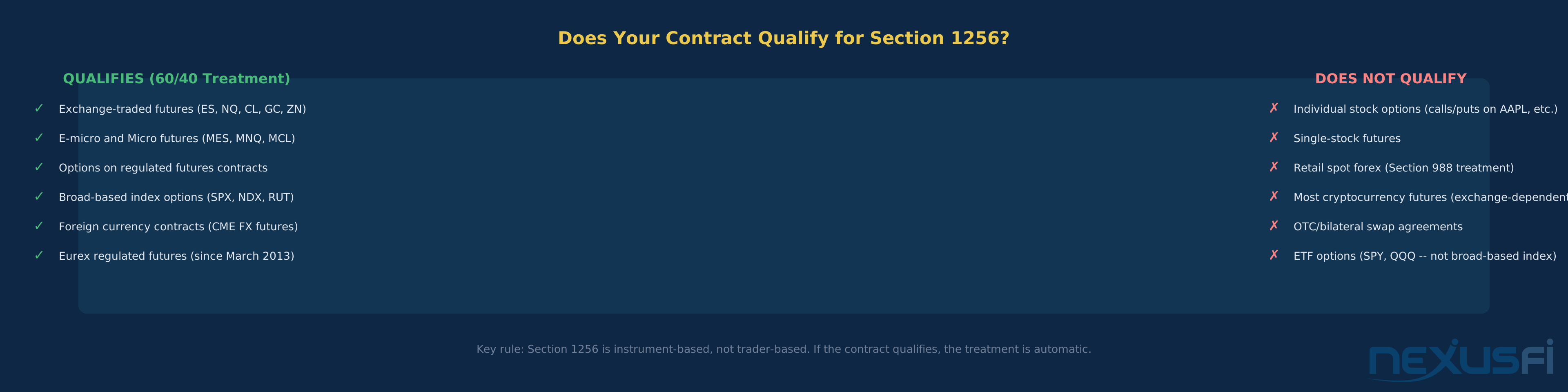
Under IRC Section 1256(b), a "Section 1256 contract" includes:
Regulated futures contracts — this covers the vast majority of what retail traders trade. Any futures contract traded on or subject to the rules of a qualified board of trade (CBOT, CME, NYMEX, COMEX, ICE US). ES, NQ, CL, GC, ZN, ZB, RTY, YM, MES, MNQ, MCL — all qualify. E-micro and Micro contracts get the same treatment as their full-size counterparts.
Foreign currency contracts — but only those that meet specific requirements under IRC 1256(g). CME FX futures (6E, 6J, 6B) qualify. Retail spot forex does NOT — that falls under Section 988 ordinary income treatment. Different game entirely.
Non-equity options — specifically broad-based index options like SPX, NDX, and RUT options. These trade on CBOE and get the 60/40 treatment. SPY options, however, do NOT qualify — they're equity options on an ETF, not broad-based index options.
Options on regulated futures — options on ES, CL, GC, or any other qualifying futures contract also receive Section 1256 treatment.
As @marcopolo1 notes in the Tax Thread, since March 2013, U.S. persons trading at Eurex Deutschland may also receive 60/40 treatment, the same as when trading at U.S. futures exchanges.
What doesn't qualify: individual stock options, single-stock futures, most cryptocurrency futures (exchange-dependent — consult your CPA), OTC/bilateral swap agreements, and ETF options. The distinction matters. Getting this wrong means filing incorrectly and potentially owing penalties.
The 60/40 Split: How the Math Works #
The 60/40 rule under IRC Section 1256(a)(3) is straightforward: compute your net gain or loss from all Section 1256 contracts for the tax year, then characterize 60% as long-term capital gain/loss and 40% as short-term. The characterization happens at the annual aggregate level, not trade by trade.
As @Luger breaks it down on NexusFi: "Tax rate on broad based index futures = (60% 15%) + (40% 25%) = 19%." Compare that to 25% on equivalent equity gains — and the higher your bracket, the bigger the advantage.
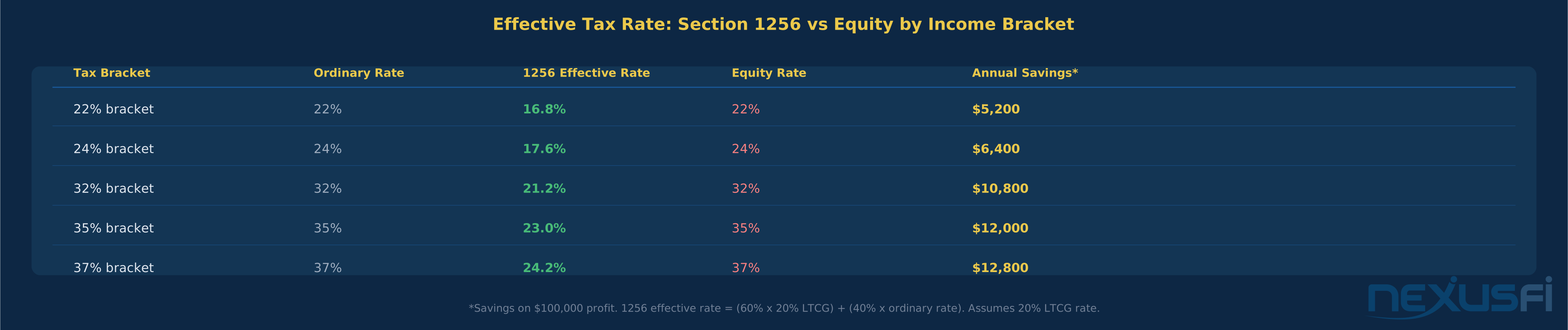
Walk through the math at the top bracket:
$100,000 net futures gain:
- 60% = $60,000 taxed at 20% long-term rate = $12,000
- 40% = $40,000 taxed at 37% ordinary rate = $14,800
- Total federal tax: $26,800 (effective rate: 26.8%)
$100,000 equity day trading gain:
- 100% = $100,000 taxed at 37% short-term rate = $37,000
- Total federal tax: $37,000 (effective rate: 37%)
The spread: $10,200. Over a 10-year career, that's $102,000 in tax savings — and that's before compounding the reinvested savings.
The 60/40 applies to losses too. If you have a net Section 1256 loss of $50,000, 60% is characterized as long-term and 40% as short-term. This character matters because long-term capital losses offset long-term capital gains first, and short-term losses offset short-term gains first. As @sstheo explains, "60% are taxed at the long-term capital gains tax rate of 15%, while only 40% of your short-term capital gains are taxed at your ordinary income rate."
Mark-to-Market: Your December 31 Tax Bill #
Here's where Section 1256 gets interesting — and where traders get blindsided if they're not paying attention. Under IRC Section 1256(a)(1), all open Section 1256 positions are treated as if they were sold at fair market value on the last business day of the tax year. The IRS calls this "mark-to-market."

What this means in practice: if you're long 2 ES contracts on December 31 with $15,000 in unrealized profit, that $15,000 is taxable in the current year. You haven't closed the position. You haven't taken a single dollar out of the market. But the IRS treats it as a realized gain.
The flip side is also true. If you're sitting on $20,000 in unrealized losses on December 31, those losses are recognized in the current tax year. You get to deduct them now rather than waiting until you close the trade.
The cash flow problem: MTM can create a tax liability without corresponding cash. You owe taxes on gains you haven't realized. If you're carrying a large winning position through year-end, you need cash available to cover the tax bill. This catches traders every year — especially those who had a great Q4 run and didn't set aside estimated tax payments.
The basis adjustment: When the new year starts, your cost basis in those open positions resets to the December 31 mark price. So if your ES position was marked at +$15,000 on Dec 31 (and taxed), then you close it in February at +$20,000 from original entry, you only owe tax on the additional $5,000 in the new year. No double taxation — but you need to track this carefully.
What if the position reverses? Here's the scenario that keeps new futures traders up at night. You hold ES through year-end with $50,000 in unrealized gains. You pay tax on that $50,000. In January, the market drops and you close at only $20,000 above your original entry. You have a $30,000 loss to deduct in the new year, but you've already paid tax on $50,000 in the prior year. The math works out over time, but the cash flow timing mismatch is real. Plan for it.
Form 6781: Where It All Comes Together #
Form 6781 (Gains and Losses from Section 1256 Contracts and Straddles) is the central document for reporting your futures tax activity. Part I handles Section 1256 contracts. Part II handles straddles — most retail traders can ignore Part II unless they're running hedged positions across related instruments.
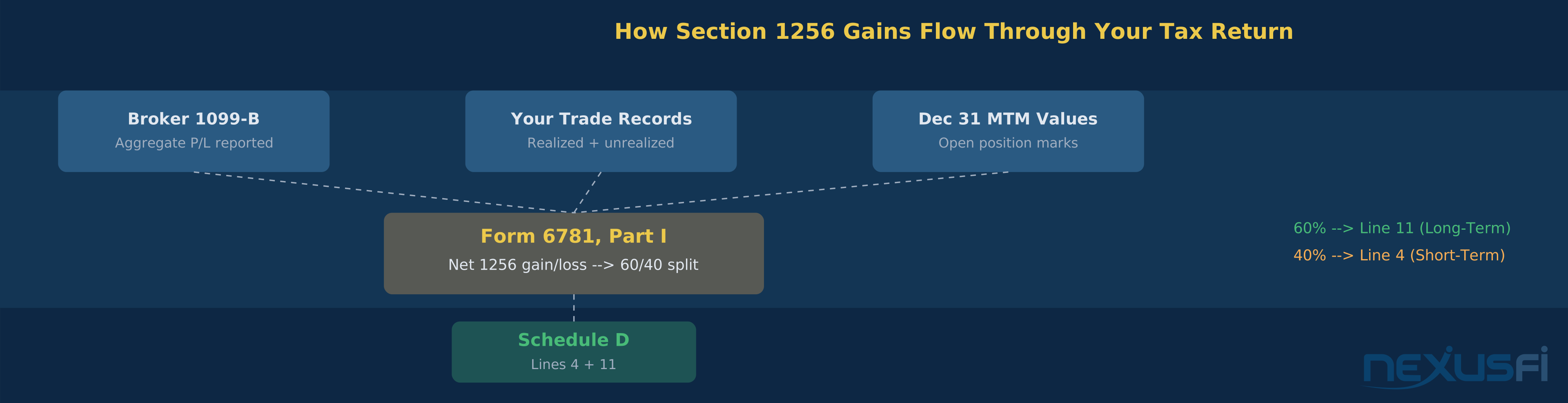
The Form 6781 process:
- Aggregate your net gain or loss. Combine all realized Section 1256 gains and losses for the year, plus any unrealized gains/losses from the December 31 mark-to-market. Your broker's 1099-B should provide the aggregate, but verify it against your own records.
- Enter the net amount on Part I, Line 1. This is your total Section 1256 gain or loss for the year.
- Apply the 60/40 split. The form automatically splits your net result: 60% goes to Line 8 (long-term) and 40% goes to Line 9 (short-term).
- Transfer to Schedule D. The long-term portion flows to Schedule D, Line 11. The short-term portion flows to Schedule D, Line 4.
1099-B reconciliation: Your broker issues a 1099-B with aggregate proceeds and basis for Section 1256 contracts. Don't assume these numbers are your final tax figures. The 1099-B is a reporting document, not the tax calculation. The computation on Form 6781 is what governs your actual tax liability. Common mismatches occur around year-end MTM adjustments, rollovers, and basis resets from prior-year marks.
Multiple brokers: If you trade futures at more than one broker, aggregate the 1099-B data from all brokers onto a single Form 6781. Each broker reports separately — you combine them.
The Wash Sale Exemption: A Structural Advantage #
This is one of the most significant practical advantages of trading futures over equities, and most traders outside the futures world don't know it exists.
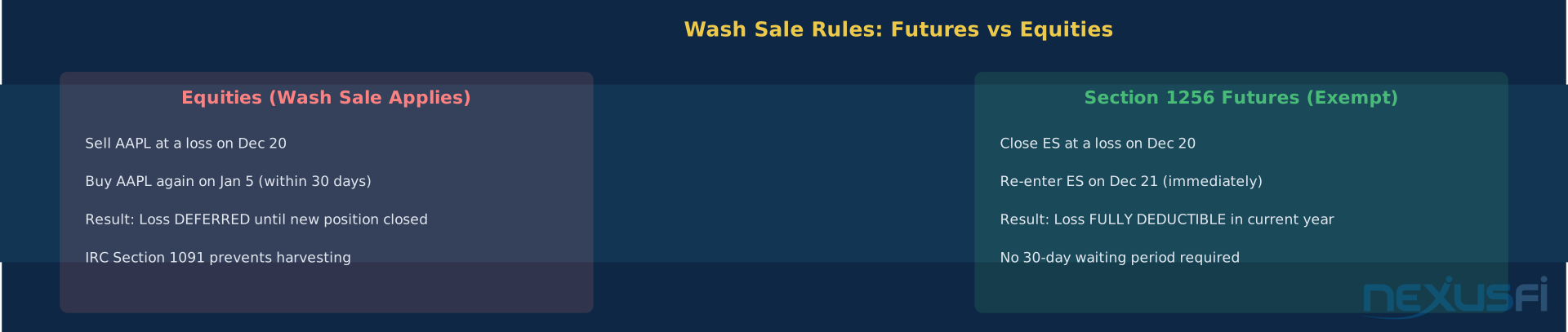
Under IRC Section 1091, equity traders face the wash sale rule: if you sell a stock at a loss and buy a "substantially identical" security within 30 days (before or after the sale), the loss is deferred. You can't harvest the loss for tax purposes until you close the replacement position. This creates real headaches for active equity traders who are constantly entering and exiting positions in the same names.
Section 1256 contracts are exempt from wash sale rules. Close ES at a loss on Tuesday, re-enter ES on Wednesday — the loss is fully deductible. No waiting period. No loss deferral. No complicated tracking of adjusted basis on replacement positions.
Why does this matter practically? Two scenarios:
Year-end tax management: Equity traders who want to harvest losses in December face a 31-day lockout from re-entering the position. Futures traders can close a losing position on December 30 to realize the loss, and re-enter the exact same contract on December 31. The loss counts in the current year, and you're right back in your trade.
Active trading strategy: If you're trading ES 20 times a day, every losing trade creates a deductible loss immediately. You don't need to track 30-day windows or worry about substantially identical contract definitions. This dramatically simplifies tax accounting for active futures traders.
One caveat: the wash sale exemption applies to Section 1256 contracts specifically. If you're trading a mix of futures and related equity positions (say, ES futures and SPY shares), the interaction between those positions could trigger straddle rules under IRC Section 1092, which is a different and more complex area of tax law. Keep your futures and equity activity clean and separated where possible.
The 3-Year Loss Carryback: Getting Money Back #
Section 1256 losses have a unique feature that equity losses don't: the option to carry losses back three years against prior Section 1256 gains. Under IRC Section 1212(c), if you have a net Section 1256 loss in the current year, you can amend returns for the prior three years and claim a refund.
As @Big Mike notes: you can "claim, and then carryover future losses into next year, and so forth." But what many traders miss is the carryback option — you don't have to carry losses forward and hope for gains next year. You can reach back and get cash now.
The mechanics: file Form 1045 (Application for Tentative Refund) or an amended return (Form 1040-X) for the prior year(s). You carry back the net Section 1256 loss to the earliest eligible year first, then forward through subsequent years until the loss is absorbed.
This is a powerful liquidity tool. Had a brutal year in 2025 but profitable years in 2022-2024? Carry the 2025 losses back and get a refund check from the IRS. The capital is back in your account in weeks rather than waiting for future profits to offset the loss.
Important constraint: the carryback only applies against prior Section 1256 gains, not all capital gains. You can't carry back a futures loss to offset stock gains from a prior year. The gains and losses must both be from Section 1256 contracts.
Estimated Tax Payments and Cash Planning #
Mark-to-market taxation means your tax liability doesn't wait until April. If you're profitable trading futures, you likely owe quarterly estimated tax payments. Miss them and you'll face underpayment penalties under Form 2210 — currently running around 8%.
As @booneyall points out, "Losses in Q3 or Q4 may offset gains in Q1/Q2. Since section 1256 contracts aren't subject to self employment tax, the pressure to send them in is greatly reduced." But reduced pressure doesn't mean no obligation.
The quarterly schedule:
- Q1 (Jan-Mar): Payment due April 15
- Q2 (Apr-May): Payment due June 15
- Q3 (Jun-Aug): Payment due September 15
- Q4 (Sep-Dec): Payment due January 15 of the following year
Safe harbor rules: You can avoid underpayment penalties by paying either 100% of your prior year's tax liability or 90% of the current year's liability through estimated payments. For high earners (AGI over $150,000), the safe harbor is 110% of prior year's tax. Many traders use the prior-year safe harbor because futures P/L is naturally unpredictable — you know what you owed last year, but you don't know what you'll owe this year until December 31.
Cash management tip: Set aside 25-30% of realized profits each quarter into a dedicated tax savings account. Don't trade with your tax money. The December 31 MTM adjustment can create a surprise liability if you had a strong Q4 — having a cash buffer prevents the situation where you need to liquidate winning positions to pay the tax bill.
Common Pitfalls and Mistakes #
Filing futures taxes wrong doesn't just cost money — it draws IRS attention. Here are the mistakes traders make most often, ranked by how frequently they cause real problems.
Assuming all "futures" qualify. Not everything marketed as a futures product gets Section 1256 treatment. Single-stock futures, many crypto futures, and retail spot forex do NOT qualify.
If your CPA doesn't understand 1256, you need a different CPA or you need to educate them.
Ignoring the December 31 mark-to-market. Every year, traders get blindsided by a tax bill on gains they haven't cashed out. You held ES through year-end with $50,000 in unrealized gains. That's taxable. In the current year. Whether you like it or not.
Blindly trusting the 1099-B. Your broker reports aggregate numbers, but those numbers may not match your Form 6781 calculation — especially around year-end positions, rollovers, and prior-year MTM basis adjustments. Always reconcile.
Missing estimated tax payments. Profitable trading + no quarterly payments = underpayment penalty. It's 8% right now. Don't donate money to the IRS because you forgot to set up estimated payments.
Commingling accounts. Trading stocks and futures in the same account creates messy 1099-B reporting and potential straddle rule complications. Keep futures in a dedicated account for clean tax treatment.
Not using the loss carryback. Many traders carry forward Section 1256 losses when they could carry them back three years against prior 1256 gains and get an immediate refund. If you had profitable futures years in the prior three years, look at carryback first.
State tax oversight. The 60/40 split applies at the federal level. Not all states follow the federal characterization. Some states tax all trading gains as ordinary income regardless of the 1256 split. Check your state's treatment before building a tax plan that assumes the federal advantage applies everywhere.
Confusing SPY options with SPX options. SPX (index options) qualify for 1256 treatment. SPY (ETF options) do not. One letter difference, completely different tax treatment. This trips up options traders who switch between the two.
Year-End Tax Planning Checklist #
Every futures trader should run through this checklist in December. It takes 30 minutes and can save thousands.
By December 15:
- Calculate year-to-date net Section 1256 gains/losses
- Make Q4 estimated tax payment if needed (due Jan 15)
- Review open positions for year-end MTM implications
- Decide whether to close positions before Dec 31 or hold through the mark
By December 31:
- All open Section 1256 positions marked to market automatically
- Consider harvesting losses -- no wash sale restriction on re-entry
- Document all open positions and their mark values for your records
- Note: your broker does the MTM calculation for tax purposes, but verify against your own records
By January 31:
- Receive 1099-B from all brokers
- Compare broker aggregate to your own P/L records
- Identify any discrepancies for reconciliation
By April 15:
- Complete Form 6781, Part I
- Transfer 60/40 split to Schedule D (Lines 4 and 11)
- If net loss: evaluate 3-year carryback option vs forward carry
- File return or extension
The 60/40 advantage is one of the few structural edges that every futures trader gets for free. It doesn't require a special election, a business entity, or trader tax status. You just need to trade the right instruments and file the right form. The tax code gives futures traders a measurable, repeatable advantage — make sure you're capturing all of it.
Knowledge Map
References This Article
Articles that build on this topicCitations
- — Selling Options on Futures? (2021) 👍 6“All futures are taxed as section 1256 contracts and hence are treated as 60% long term capital gains and 40% short term capital gains.”
- — The Tax Thread (2015) 👍 1“Taxed 60% at your long term capital gains rates and 40% at your short term capital gains rate no matter what the holding period.”
- — Why futures instead of equities/ETFs/spot forex? (2012) 👍 2“Tax rate on broad based index futures = (60% * 15%) + (40% * 25%) = 19%”
- — Making a Living with the Micros (2021) 👍 6“60% are taxed at the long-term capital gains tax rate of 15%, while only 40% of your short-term capital gains are taxed at your ordinary income rate.”
- — Senate Bill to revoke Futures 60/40 tax treatment (2021) 👍 5“Losses in Q3 or Q4 may offset gains in Q1/Q2. Since section 1256 contracts aren't subject to self employment tax, the pressure to send them in is greatly reduced.”
- — The Tax Thread (2013) 👍 2“U.S. persons that trade at Eurex Deutschland may receive 60/40 tax treatment in the same way when trading at other U.S. futures exchanges.”
- — The Tax Thread (2012) 👍 3“Claim, and then carryover future losses into next year, and so forth. For gains, futures are taxed as 60/40, meaning 60% long term gains, and 40% short term gains.”
- — Personal or LLC? (2018) 👍 5“Most CPAs, even very bright and very good CPAs, are unaware of futures tax treatment, like the Section 1256 contracts 60/40 capital gains split.”
- — The Tax Thread (2012) 👍 2“For Section 1256 (Futures Contracts and Straddles) contracts, you enter the Gains/Loss on Form 6781. It is one line item, not itemized.”