



Prop Firm Trading Taxes: How Funded Account Payouts Are Classified and Taxed
Overview #
Most prop firm traders discover the same unpleasant truth at tax time: the 60/40 capital gains rule that makes futures trading so tax-efficient does not apply to funded account payouts. At all. Not even a little. Your $80,000 profit split from Topstep, Apex, or FTMO is ordinary income — and if you receive it on a 1099-NEC, it also triggers self-employment tax on top of federal income rates.
The reason is structural, not arbitrary. Section 1256's favorable 60/40 treatment attaches to the taxpayer who owns the trading account. In virtually every retail prop firm arrangement, that's the firm — not you. You're a contractor being paid for performance, not an investor earning returns on your own capital. The IRS follows the money and the ownership, and in funded trading, both belong to the firm.
Before reading further: locate the exact tax form your prop firm issues (W-2, 1099-NEC, or K-1). That single form determines most of what follows. If you don't know, email their support now — you need this before filing.
Related articles: Funded Trading Evaluations: How Prop Firm Challenges Work, Prop Firm Fees and Costs, Payout Structures and Profit Splits, Section 1256 Tax Treatment for Futures Traders, Prop Firm Regulatory Status
Account Ownership Determines Everything #
The IRS classification of your prop firm income hinges on one foundational question: who is the taxpayer on the trading account? Specifically, in whose name is the account held at the FCM (futures commission merchant) or brokerage, and who receives the broker's tax documents (Form 1099-B, Form 6781)?
In most retail prop firm programs — the evaluation-based "funded trading" firms that dominate the retail space — the answer is the firm. The prop firm holds the account. The broker issues tax documents to the firm. The trades are the firm's trades, the capital is the firm's capital, and the profits are the firm's profits. What you receive is a share of those profits under a profit-split agreement, characterized as compensation for your services as a trader.
As @bobwest explained in the Topstep AMA thread, one of the most thorough community discussions on this topic: "You as a trader would be an independent contractor, and the funded account is not your account, it's the firm's. You just get to trade it. Since it's not your account, the funds in it aren't yours, and the profit isn't yours either. So 'you' didn't make 10k in actual profit, the firm did. Under the profit split agreement, they will pay you, on request, 80% of the account's profit, which is reported to you as income on the 1099."
That description — contractor, not owner — is the starting point for everything that follows in your tax return.
The legal distinction matters more than the economic substance. Even though your trading decisions drove the profit, if you don't own the account, you don't own the gain. The IRS taxes ownership, not contribution.
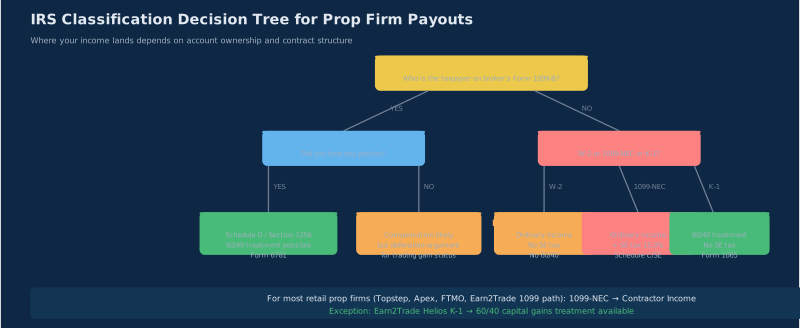
This classification framework creates three possible outcomes depending on how the firm structures its relationship with traders:
1099-NEC (independent contractor): The most common structure among retail prop firms. You are a contractor; your payouts are self-employment income subject to federal income tax at ordinary rates plus self-employment (SE) tax of approximately 15.3% on the first ~$176,100 (2025 threshold for Social Security) and 2.9% thereafter. No capital gains rates. No Section 1256 60/40 split.
W-2 (employee): Less common in retail evaluation-based programs, but used by some traditional desk prop firms. You are an employee; payouts are wages subject to income tax withholding and payroll taxes. Employer pays half of payroll taxes. No capital gains treatment, but no self-employment tax obligation on your end either — the employer handles it.
K-1 (partnership interest): Available through specific firm structures (notably Earn2Trade's Helios Trading Partners LLC). You hold a partnership interest; profits flow through as your share of partnership income, which can retain the Section 1256 character of the underlying futures trades — including the 60/40 blended rate. This is the closest structure to personal account tax treatment.
1099-NEC Income and Self-Employment Tax #
If you receive a 1099-NEC from your prop firm, you're in the most common — and most expensive — tax category for funded traders. Here's the full impact:
Self-employment tax exists because independent contractors pay both the employee's and employer's portions of Social Security and Medicare taxes. Employees split FICA 50/50 with their employer (each paying 7.65%). Self-employed individuals pay the entire 15.3% themselves, though they can deduct the employer's half (7.65%) from adjusted gross income.
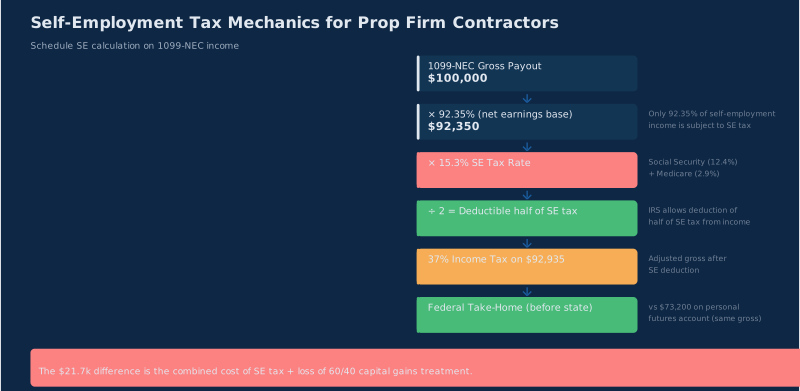
The SE tax calculation on $100,000 of prop firm income:
- Net earnings base: $100,000 × 92.35% = $92,350 (IRS uses 92.35% because you first deduct the "employer equivalent" portion)
- SE tax: $92,350 × 15.3% = $14,130
- Deductible half of SE tax: $7,065 (reduces your AGI)
- Federal income tax at 37%: approximately $34,386 (on $92,935 after SE deduction)
- Federal take-home: approximately $51,484
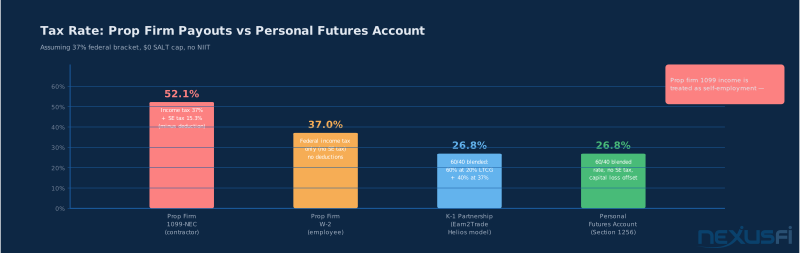
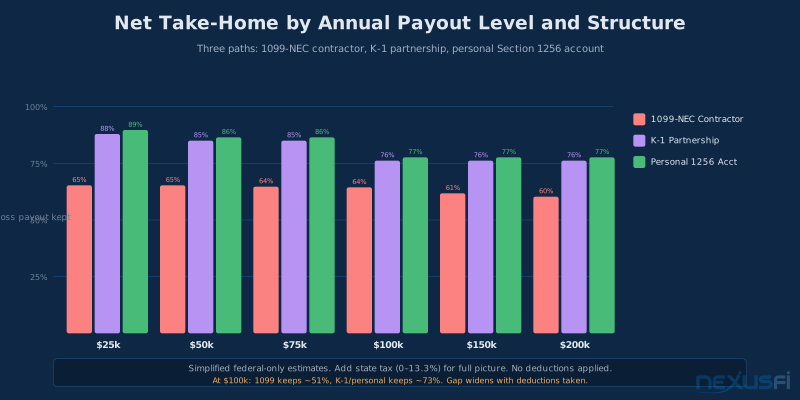
Compare that to the same $100,000 earned on a personal futures account under Section 1256 treatment: federal income tax of approximately $26,800 (60/40 blended rate at 37% bracket) and zero SE tax, leaving $73,200. The difference — $21,716 — is the combined cost of SE tax and the loss of capital gains treatment. On $100,000 gross.
This reality drives a calculation that many prop traders make eventually. @ValhallaTrader ran the German equivalent — the principle applies universally regardless of jurisdiction: "20,000 trading profit per month, -20% for the provider, I still receive $16,000. I have to pay 42% income tax on this, leaving $9,280 for me in the case of trading with one of the providers. In the case of trading on my own with $20,000 trading profit per month, I only have to pay the 27.5% at the end of the year, leaving $14,500 per month for me. So trading with these providers costs me $5,220 per month with this example profit of 20k."
The prop firm model still makes sense for traders who lack the capital to trade their own account at meaningful size — but anyone calculating the economics of funded trading must factor in the tax structure difference, not just the profit split percentage.
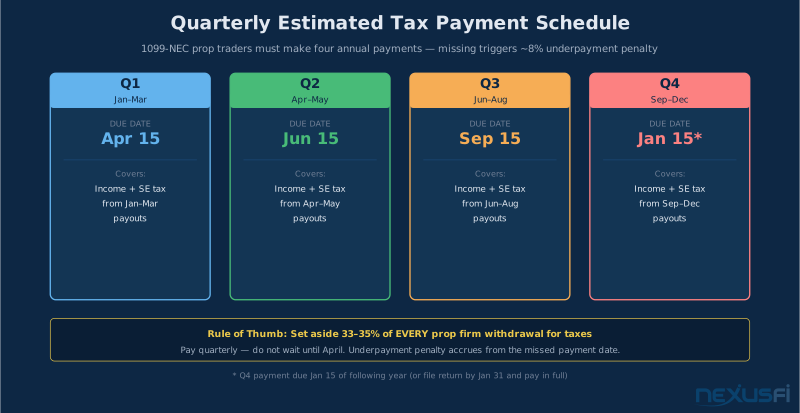
Quarterly estimated tax payments are mandatory for 1099 income above $1,000 in expected SE and income tax liability. The IRS expects four installments due in April, June, September, and January. Missing these triggers underpayment penalties of roughly 8% per year (2025 rate) on the shortfall. Many first-year prop traders get hit with this because they're used to employer withholding handling taxes automatically.
Why Section 1256 Doesn't Apply to Most Prop Payouts #
Section 1256 of the Internal Revenue Code covers "regulated futures contracts" — exchange-traded futures on Section 31 exchanges (CME, CBOT, NYMEX, etc.), broad-based index options, and similar instruments. These contracts receive two benefits: year-end mark-to-market (open positions valued as if sold on December 31) and the 60/40 blended rate (60% treated as long-term capital gain, 40% as short-term, regardless of actual holding period).
The 60/40 split is significant. For a trader in the 37% federal bracket, Section 1256 gains are effectively taxed at 26.8% blended (60% at 20% LTCG rate + 40% at 37% short-term rate), versus 37% for ordinary income. That's a 10.2 percentage point difference on the same dollar of gain.
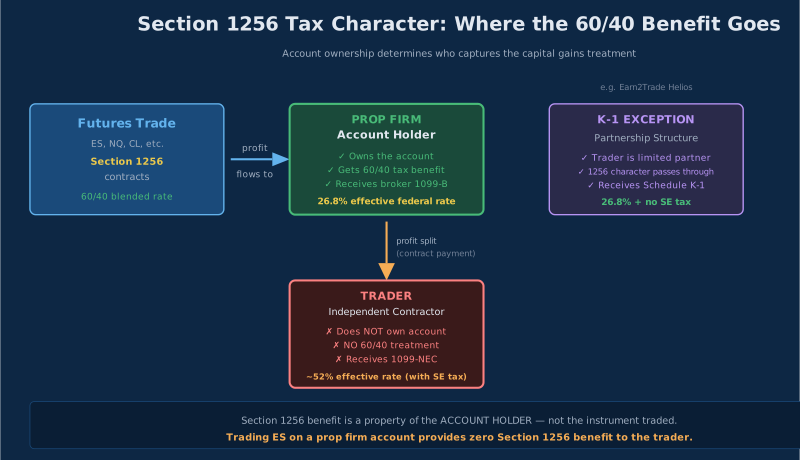
The problem for prop traders: Section 1256 treatment flows through the taxpayer who owns the positions. If the prop firm's account holds the futures contracts and the firm is the taxpayer, the firm gets the 60/40 treatment. The firm then pays the trader a percentage of profits under their agreement — and that payment is compensation for services, not a pass-through of the firm's trading gains.
This is the core structural issue: Section 1256 is not a property of the instrument being traded. It's a property of the taxpayer's relationship to that instrument. Changing which futures you trade doesn't change your tax treatment — changing who owns the account does.
As @vantojo summarized after researching this directly with Topstep: "This would be ordinary 1099 income... subject to the full tax rate, not eligible for the 60/40 tax rules for Futures traders... the 60/40 tax rates go to the entity supplying the capital and controlling the trading account."
The "entity supplying the capital" framing is precise. The 60/40 benefit is the firm's to claim on the underlying trading activity. What the trader receives is a contractual payment from the firm — classified as contractor income when issued on a 1099.
Similarly, the mark-to-market year-end feature of Section 1256 doesn't apply to contractor income. If you don't close all your prop firm positions by December 31, that creates no tax event for you — the firm's account settles separately. You are taxed when you actually receive a payout, not on unrealized position value.
The K-1 Exception: When 60/40 Is Available #
There is one funded trading path that delivers Section 1256 treatment to the trader: the K-1 partnership structure.
Earn2Trade's Helios Trading Partners LLC is the best-known example in the retail space. Under this structure, funded traders become limited members/partners of the trading entity. The entity trades futures in a partnership account; year-end gains and losses retain their character (including Section 1256 classification for futures) and flow through to partners via Schedule K-1. The trader receives a K-1 form, not a 1099, and reports their share of partnership income on their personal return.
As @dwt51 noted when this structure was disclosed in the Earn2Trade AMA: "The trader joins Helios as a limited member/partner of their trading firm. This means that at tax time, the trader receives a K1 statement where the trading PNL passes through with the normal benefits. For instance, on Futures, it's the 60/40 capital gains as normal. This sort of income is not normally subject to SE tax. To my knowledge every other of the popular futures trading prop firms treats the trader as a self employed contractor and their trading profits are considered ordinary income instead of capital gains. Capital gains treatment is clearly superior to ordinary income, which incurs self employment SS taxes and higher income tax rates."
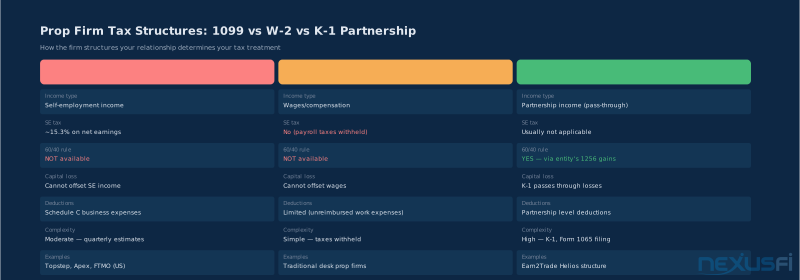
The K-1 structure carries its own complexity and compliance costs:
- Requires filing Schedule E (Supplemental Income and Loss) rather than Schedule C
- The partnership files Form 1065; the trader receives their K-1 from that filing
- State filing obligations may arise even if the partnership is in a no-tax state
- K-1s often arrive later than 1099s, potentially delaying your own filing
- Partnership losses flow through to the partner -- useful if the firm has losing periods, but creates complexity
The tax benefit of the K-1 structure is real and significant — typically 10+ percentage points of effective rate difference. But it requires the firm to maintain the partnership structure correctly, which increases their compliance costs. Not all firms offer it. Before selecting a prop firm partly for tax reasons, verify with your CPA that the K-1 arrangement is structured and maintained correctly, not just labeled as such.
Deductions Available to Prop Firm Contractors #
If your prop firm income is classified as self-employment (Schedule C), you can deduct legitimate business expenses against that income. This is one of the few advantages of 1099 status over being an employee — employees lost most unreimbursed business expense deductions after the 2017 Tax Cuts and Jobs Act. Self-employed traders can still deduct them.
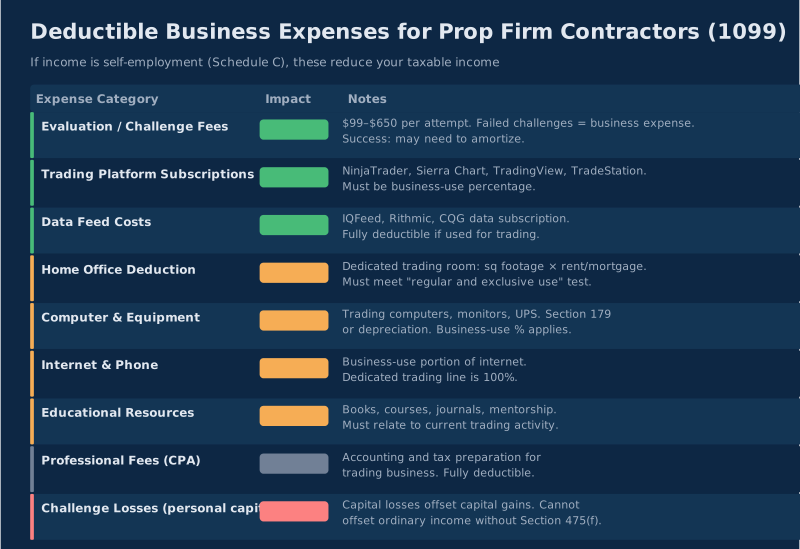
Evaluation and challenge fees: The most significant deduction for active prop traders. Fees paid to take funded trading evaluations — whether you pass or fail — are deductible as ordinary and necessary business expenses. As Fi noted in the "Trading is a Business" thread: "With prop firms and funding companies it's actually even easier to write off all of those losses because they do not show up as capital losses. Failed challenges are business expenses for contractors — direct deductions against SE income." A $500 challenge fee that you fail reduces your taxable SE income by $500, saving roughly $260 in combined SE and income taxes at the 37% bracket.
Platform and data subscriptions: NinjaTrader, Sierra Chart, TradingView, TradeStation subscriptions, plus data feeds (IQFeed, Rithmic, CQG) are deductible to the extent they are used for business trading. If you use a platform for both prop trading and personal trading, you can deduct the business-use percentage.
Home office deduction: If you have a dedicated trading room that is used regularly and exclusively for trading, you can deduct either the simplified method ($5 per square foot, up to 300 square feet) or the actual expense method (proportional rent/mortgage, utilities, internet). "Regularly and exclusively" is a genuine standard — a room that doubles as a guest room or general workspace doesn't qualify.
Computer and equipment: Trading computers, monitors, UPS systems, and networking equipment can be deducted either fully in year one under Section 179 or depreciated over time. The business-use percentage applies; a computer used 80% for trading is 80% deductible.
The deduction most frequently missed: educational expenses. Books, trading courses, subscription services like NexusFi Elite, and mentorship fees paid to improve your trading skills are deductible if they relate to your existing trading business. They cannot establish a new trade or business — but once you're actively trading as a contractor, ongoing education qualifies.
Quarterly estimated taxes paid: The actual taxes paid on prop firm income — including the self-employment tax — are not deductible as business expenses, but they reduce your cash balance. Budget 30-35% of every withdrawal for taxes before spending it. Failure to set aside taxes is the #1 financial management error among new funded traders.
Mark-to-Market Election (Section 475(f)) #
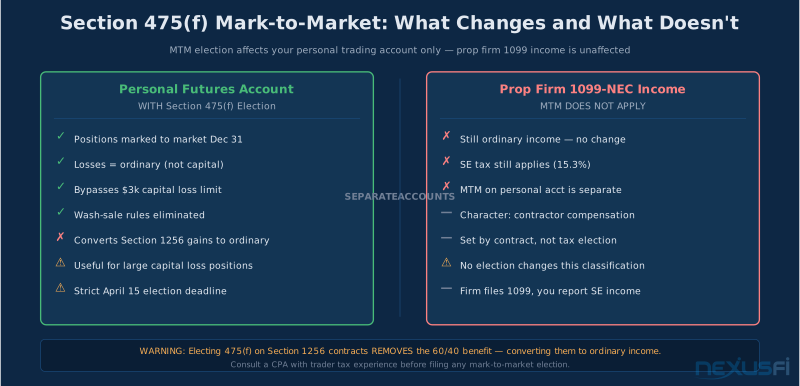
The Section 475(f) mark-to-market election is often discussed in trader tax circles as a way to convert capital gains into ordinary income, eliminate wash-sale rules, and potentially improve the tax treatment of losses. For personal account traders, it can be valuable in specific circumstances. For prop firm contractors, it's largely irrelevant.
Section 475(f) applies to "traders in securities or commodities" who have elected MTM accounting. Under this election, you mark positions to market at year-end, treating them as sold, and recognize ordinary income or loss rather than capital gain or loss. It eliminates the wash-sale rules and the $3,000 capital loss deduction limit — losses are fully ordinary and can offset all income.
Why it doesn't help most prop traders: your income from the prop firm is already ordinary (1099-NEC contractor income). Electing MTM on your personal trading activity changes the character of your personal account's gains and losses — it does nothing to the characterization of your contractor income from the prop firm. The prop firm income remains what it is regardless of any personal account election.
The one scenario where MTM might matter: if you also have a personal futures trading account with significant capital loss positions that you want to deduct as ordinary losses rather than capital losses. MTM on your personal trading can free those losses. But this is a separate analysis from your prop firm tax treatment, and the election has strict deadlines (generally by April 15 for the tax year starting January 1, or the due date for the return in the preceding year).
Note: Section 1256 contracts already have built-in MTM at year-end as part of the 1256 regime. Electing 475(f) on top of 1256 positions would convert them from the favorable 60/40 capital gains treatment to ordinary income — a worse outcome. Discuss with a CPA before filing any MTM election.
State Taxes: Residency, Sourcing, and Apportionment #
State tax treatment of prop firm income follows the federal characterization in most cases — ordinary income is taxed as ordinary income — but adds additional layers around where you live, where you traded, and how states source the income.
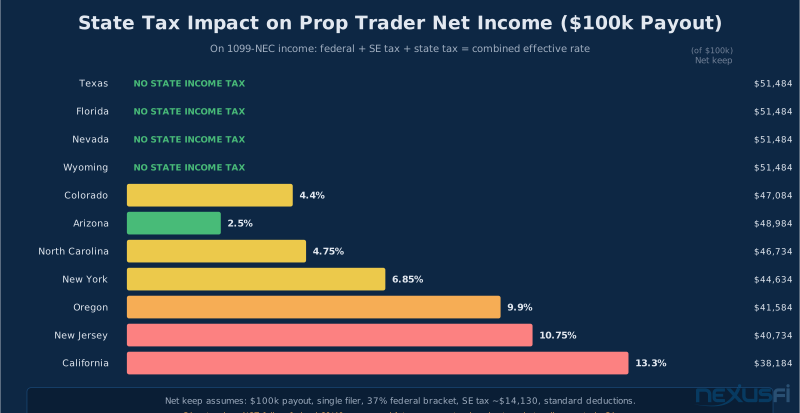
Residency state: Your domicile state taxes all your worldwide income, including prop firm payouts. If you live in California, New York, or other high-income-tax states, your effective combined rate can reach 50%+ on 1099-NEC income including SE tax. Moving to a no-income-tax state (Texas, Florida, Nevada, Wyoming) can materially improve your economics — but the move must be genuine (primary residence, voter registration, driver's license, and documented days in each state). States aggressively audit high-income "domicile migrations," especially from California and New York.
Nonresident sourcing: If you trade for a prop firm based in another state, or if you travel and trade from multiple states, you may have nonresident filing obligations. States that treat prop income as business income subject to sourcing (rather than personal service income sourced to your state of residence) can require you to allocate income to the state where "services" were performed. The definition of where you performed trading services varies by state and is frequently litigated for high-income traders.
State conformity to federal: Most states conform to federal treatment of self-employment income. However, some states have specific rules around capital gains, capital loss carryovers, or business income that can create differences from federal treatment. California, for example, does not follow federal capital gains tax rates — all capital gains are taxed at ordinary income rates at the state level. This makes the K-1 structure's federal 60/40 benefit irrelevant for California state taxes, even when the federal treatment is favorable.
For prop traders earning significant income ($100k+), state domicile planning can save more money annually than any trading strategy optimization. The difference between a 13.3% California rate and 0% Texas rate on $150k of prop income is nearly $20k per year — before considering the federal income tax difference.
Estimated state taxes: Most states require quarterly estimated payments mirroring the federal schedule. States often assess their own underpayment penalties independent of federal penalties. Budget separately for each state where you have filing obligations.
Real Numbers: What You Actually Keep #
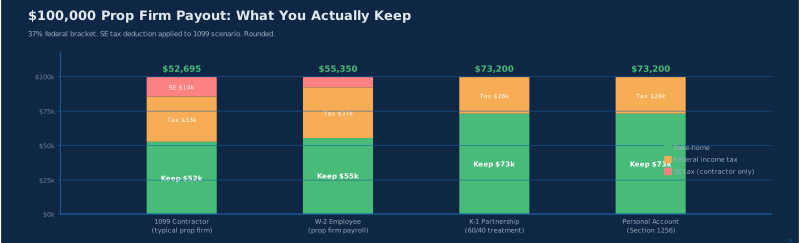
Let's run the complete numbers on a $100,000 prop firm payout under each structure, using 2025 tax parameters and a single filer in the 37% federal bracket with no other deductions.
1099-NEC contractor path (most common):
- Gross payout: $100,000
- SE tax (14.13% effective): −$14,130
- SE deduction from AGI: −$7,065
- Federal income tax at 37% on $92,935: −$34,386
- Federal take-home: $51,484
- Adding 5% state tax (low-tax state): −$5,000 → $46,484
- Adding 9.3% state tax (mid-tax state, e.g., Oregon): −$9,300 → $42,184
K-1 partnership path (Earn2Trade Helios model):
- Gross K-1 income: $100,000
- SE tax: $0 (partnership income, not SE)
- Federal income tax at 60/40 blended 26.8%: −$26,800
- Federal take-home: $73,200
- Adding 5% state tax: −$5,000 → $68,200
- Note: California does NOT conform to 60/40 → state taxes at ordinary rate regardless of K-1 character
Personal futures account (Section 1256):
- Gross trading profit: $100,000
- SE tax: $0 (investment income)
- Federal income tax at 60/40 blended 26.8%: −$26,800
- Federal take-home: $73,200
- Plus capital loss carryforward capability (trading losses offset future gains)
The deduction opportunity for 1099 contractors: a trader who runs $3,000/year in challenge fees, $1,200 in platform subscriptions, $600 in data feed costs, $1,800 in home office allocation, and $1,000 in equipment depreciation can deduct $7,600 from their SE income. At the combined 37% income + 15.3% SE rate, that's worth approximately $3,800 in tax savings. Not nothing, but it doesn't close the fundamental gap.
@dannyinhouston identified another cost asymmetry: "For every $100 you pay to Topstep, and if you don't make any profit, you give away $100 in tax 'credit' that can be banked until you actually make money from a live account. Add to that the 20% (or whatever) cut you pay to Topstep and it's just a no brainer. There is zero difference in market feel between micros and minis, why not suffer your losses at 1/10x and gain the tax benefit?"
That calculation — that losses on personal micro futures can be banked as capital losses against future gains, while prop firm evaluation fees are deductible business expenses but not capital losses — represents a genuine difference in the tax mechanics of each path.
Documentation and Record-Keeping Requirements #
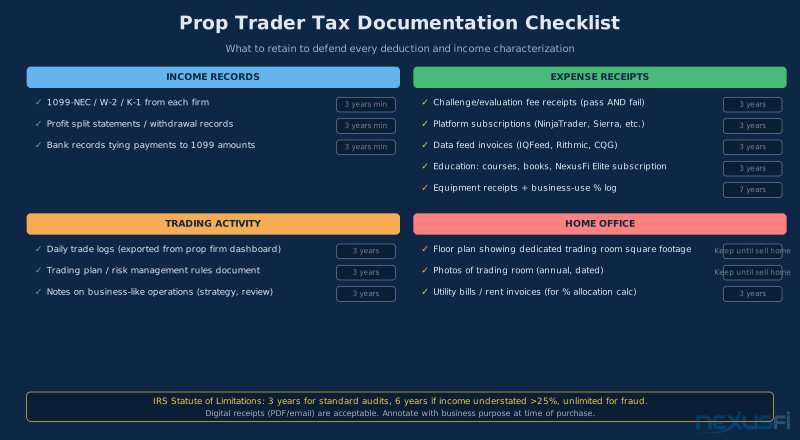
Proper documentation separates defensible tax positions from audit bait. For prop firm contractors, the documentation requirements fall into three categories:
Business activity documentation: To support Schedule C deductions, you must demonstrate that trading is your trade or business, not a hobby. The IRS uses a profit motive test — three profitable years in five creates a presumption of profit motive, but even loss years can be supported if you have evidence of business-like operations:
- Trading logs showing dates, instruments, and results (prop firm dashboards usually provide this; export and retain)
- Educational activity records (course certificates, book purchases, seminar attendance)
- Business planning documents (risk management rules, trading plan, target markets)
- Separation of trading activity from personal finances (dedicated trading bank account, separate credit card for business expenses)
Income verification: Retain all 1099s, W-2s, or K-1s from every prop firm you traded with during the year. If you traded multiple firms — common among multi-funded-account traders — you may have five or six 1099s. Also retain any profit split statements or withdrawal records that tie out to the 1099 amounts. Discrepancies between what you received and what was reported create compliance issues.
Expense records: Every deducted expense requires substantiation: receipts showing amount, date, vendor, and business purpose. Digital receipts are acceptable. Organize by category (platform fees, data fees, education, etc.) and maintain for at least three years after filing (seven years if you claim large losses or have unusual circumstances). Credit card statements support amounts but not business purpose — annotate them contemporaneously.
Home office documentation requires a floor plan or diagram showing the dedicated trading space, its square footage relative to total home square footage, and evidence that it's used regularly and exclusively for trading. Photos taken once a year are helpful if ever challenged.
Common Mistakes Prop Traders Make on Taxes #
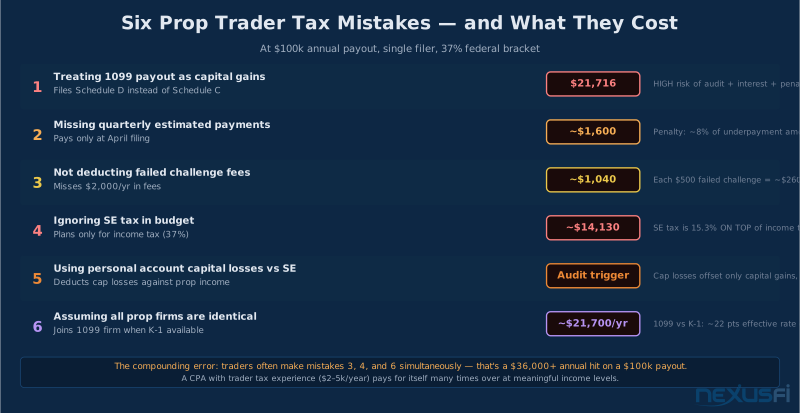
Treating prop payouts as capital gains. The most common and expensive mistake. Some traders see "futures" and assume 60/40 treatment applies automatically. It doesn't — the character follows account ownership, not instrument type. Filing 1099-NEC income as Schedule D capital gains creates a tax understatement that compounds with penalties and interest.
Missing quarterly estimated tax payments. First-year funded traders are especially vulnerable. They trade through the year, withdraw $40,000, spend $35,000 of it, and then discover in April that they owe $20,000 in federal taxes plus an underpayment penalty. The correct approach: set aside 30-35% of every withdrawal into a dedicated tax savings account and make four quarterly payments.
Deducting personal trading losses against prop firm income. If you trade your own personal account and have capital losses there, those losses offset capital gains (not ordinary income) up to $3,000 per year. They do not offset your 1099-NEC prop firm income. The two streams are separate categories. Without a Section 475(f) election, trading losses are capital losses, period.
Not deducting challenge fees from failed evaluations. Every failed challenge is a fully deductible business expense for 1099 contractors. A trader who spends $1,500 on failed challenges in a year where they earned $30,000 in payouts should be deducting $1,500 from their SE income — that's a $750+ tax saving they often miss by not tracking evaluation costs.
Ignoring self-employment tax. Some traders calculate only the federal income tax on their prop income without accounting for the 15.3% SE tax layer. The effective rate on 1099 prop income at the 37% bracket is closer to 52% all-in (before deductions), not 37%. Not planning for this creates severe cash flow problems.
Treating all prop firms identically. The Earn2Trade K-1 structure is materially different from a standard 1099 arrangement. Ask specifically: "What form will I receive for my payouts — 1099-NEC, W-2, or K-1?" before assuming. The answer can be worth tens of thousands of dollars annually at meaningful trading income levels.
Tax treatment should be factored into prop firm selection, not treated as an afterthought. At $100k+ annual payout levels, the difference between a 1099-NEC firm and a K-1 firm can equal the annual platform subscription costs of your entire trading setup — every year.
Failing to separate personal and prop trading. Run them through different accounts, different brokerage accounts if applicable, and track them as separate P&L streams in your records. The IRS may aggregate them for certain purposes, but your documentation should distinguish them clearly. Commingling creates compliance confusion and obscures the performance data you need to make good trading decisions anyway.
Knowledge Map
Go Deeper
Build on this knowledgeReferences This Article
Articles that build on this topicCitations
- — Topstep's Nick Dolby (Social Media and Community Coordinator) - Ask me Anything (AMA) (2020) 👍 2“You as a trader would be an independent contractor, and the funded account is not your account, it's the firm's. You just get to trade it. Since it's not your account, the funds in it aren't yours, and the profit isn't yours either. So 'you' didn't make 10k in actual profit, the firm did. Under the profit split agreement, they will pay you, on request, 80% of the account's profit, which is reported to you as income on the 1099.”
- — Taxes with TopStep (2021) 👍 2“Topstep income is self-employed income and is not eligible for the 60/40 split. The 60/40 rate goes to the entity supplying the capital and controlling the trading account.”
- — Topstep's Nick Dolby (Social Media and Community Coordinator) - Ask me Anything (AMA) (2016) 👍 2“Topstep traders are independent contractors. Earnings from the funded trading account are ordinary income, not capital gains. The 60/40 futures tax treatment applies to Topstep as the account holder, not to traders receiving profit splits.”
- — Earn2Trade - Orianna Foucault (Director of Support) - Ask Me Anything (AMA) (2021) 👍 2“The trader joins Helios as a limited member/partner of their trading firm. This means that at tax time, the trader receives a K1 statement where the trading PNL passes through with the normal benefits. For instance, on Futures, it's the 60/40 capital gains as normal. This sort of income is not normally subject to SE tax. To my knowledge every other of the popular futures trading prop firms treats the trader as a self employed contractor and their trading profits are considered ordinary income instead of capital gains.”
- — Any long term success stories from funded traders in these get-funded programs? (2021) 👍 4“For every $100 you pay to Topstep, and if you don't make any profit, you give away $100 in tax 'credit' that can be banked until you actually make money from a live account. Add to that the 20% (or whatever) cut you pay to Topstep and it's just a no brainer. There is zero difference in market feel between micros and minis, why not suffer your losses at 1/10x and gain the tax benefit?”
- — Any long term success stories from funded traders in these get-funded programs? (2021) 👍 4“20,000 trading profit per month, -20% for the provider, I still receive $16,000. I have to pay 42% income tax on this, leaving $9,280 for me. In the case of trading on my own with $20,000 trading profit per month, I only have to pay the 27.5% at the end of the year, leaving $14,500 per month. So trading with these providers costs me $5,220 per month with this example profit of 20k.”
- — US taxes for prop trading, for example Top Step Trader (2020) 👍 1“This would be ordinary 1099 income... subject to the full tax rate, not eligible for the 60/40 tax rules for Futures traders... the 60/40 tax rates go to the entity supplying the capital and controlling the trading account.”
- — Trading is a Business (2025)“With prop firms and funding companies it's actually even easier to write off all of those losses because they do not show up as capital losses. Failed challenges are business expenses for contractors -- direct deductions against SE income.”
- — IRS Publication 550: Investment Income and Expenses
- — IRS Schedule SE: Self-Employment Tax
- — IRS Publication 535: Business Expenses