



Fill the Gap: Why Price Returns to Unfinished Business and How Traders Exploit It
Overview #
What Filling the Gap Actually Means #
The market gaps up 15 points overnight. Every instinct says fade it — most of the time, that instinct is right. But the times it's wrong, months of steady gains can evaporate in a single session. That tension is gap trading in a nutshell.
A gap is a price jump between sessions where no trading occurs — the market skips a range of prices entirely. When the prior session's close is 5950.00 and the next session opens at 5962.00, that 12-point void is the gap. Filling the gap means price trades back into that empty range, revisiting levels that were skipped at the open.
Five distinct market microstructure forces pull price back toward the gap zone, and understanding them transforms gap trading from pattern recognition into structural analysis.
Gap up: the open prints higher than the prior close. Gap down: the open prints lower. Fill: price later retraces into the void. Simple concept, but the execution is where accounts live or die. As NexusFi member @thegapguy — who has traded opening gaps in the E-mini S&P exclusively since 2005 — put it in his primer on gap trading: the concept is straightforward, but the nuances of which gaps fill and which don't separate the profitable traders from the rest.
Three levels of fill matter. A partial fill means price enters some portion of the gap but doesn't reach the prior close. A full fill means price trades all the way back to the prior close. And a gap-and-go means the gap never fills — price continues in the gap direction and builds new value. Each outcome demands a different response from the trader.
Why Gaps Get Filled: Five Converging Forces #
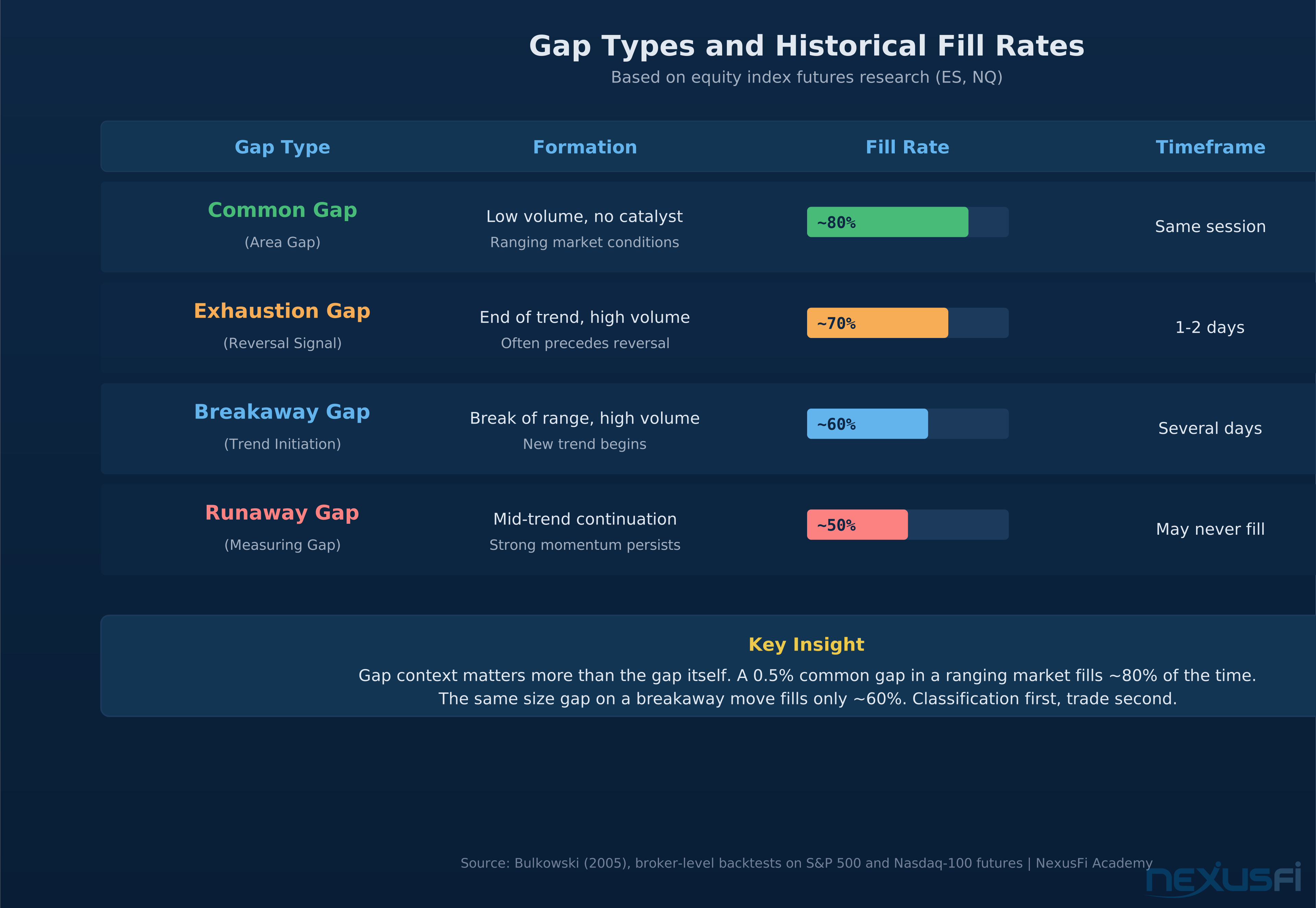
Gap fills aren't random. Five distinct market microstructure forces pull price back toward the gap zone, and understanding them transforms gap trading from pattern recognition into structural analysis.
Liquidity normalization. Overnight moves happen with thin order books. When regular trading hours bring deeper liquidity and two-sided participation, exaggerated overnight moves naturally compress. The gap was created with a fraction of the liquidity available during the regular session — once that liquidity arrives, it often corrects the overshoot.
Mean reversion to fair value. The prior close functions as a consensus valuation anchor. Most institutional models reference it for position sizing, risk calculations, and rebalancing triggers. Once the initial shock digests, markets reassess and often revert toward that anchor. This isn't mystical — it's math. Portfolio rebalancing algorithms literally target the prior close as a reference price.
Order imbalance reversal. The opening auction can overshoot when one-sided flow dominates. If overnight buyers push ES up 15 points but passive sell liquidity replenishes at the open, the imbalance that created the gap reverses. The opening print was an auction artifact, not sustainable equilibrium.
Resting orders as magnets. Stop-losses and limit orders cluster in the gap zone because traders placed them before the gap occurred. Those orders don't disappear overnight. Once price approaches the gap boundary, they activate — stops get triggered, limits get filled — and the resulting flow pulls price further into the gap.
Hedging and institutional rebalancing. Funds and market makers carrying overnight risk rebalance when deeper RTH liquidity returns. Options dealers adjusting delta hedges, index funds rebalancing, and market makers flattening overnight inventory all generate flow that can oppose the gap direction.
When multiple mechanisms align, fill probability increases substantially. When none apply — genuine fundamental repricing from a regime change — gaps persist. That distinction is everything.
Gap Types and Their Fill Characteristics #
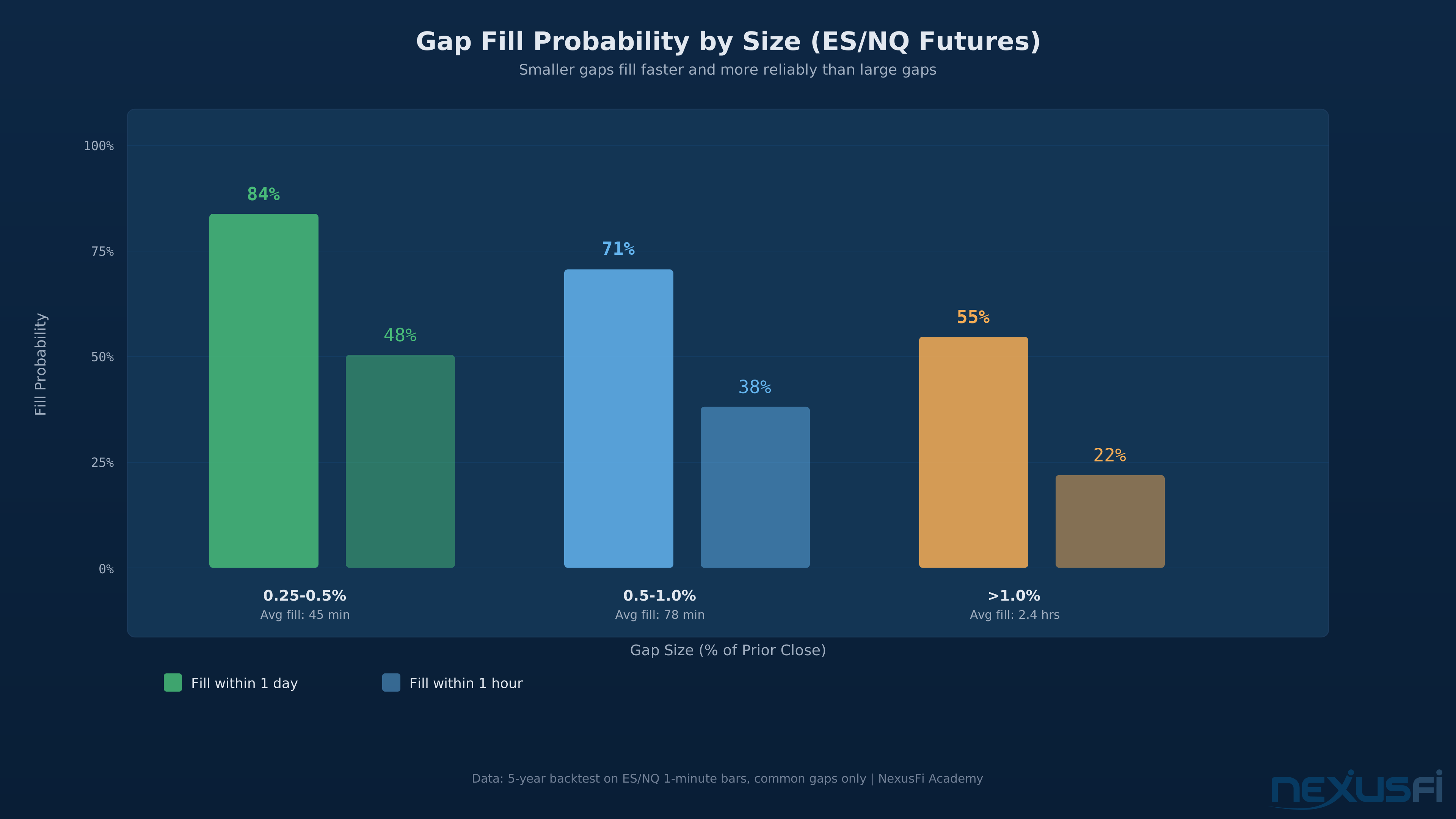
Not all gaps are created equal. Classification determines which gaps to fade and which to respect. Thomas Bulkowski's Encyclopedia of Chart Patterns remains the foundational reference here, cataloging gap behavior across decades of market data.
Common gaps (also called area gaps) form in low-volume, ranging markets without a trigger. No news, no earnings, no macro shock — just the normal drift of overnight positioning. These fill approximately 80% of the time within the same session. They're the bread-and-butter of gap traders because the gap itself has no fundamental justification.
Exhaustion gaps appear at the end of extended trends, often with high volume. The move looks like continuation but it's actually the last gasp of buying or selling pressure. These fill roughly 70% of the time within 1-2 days and often signal a reversal. The tricky part: exhaustion gaps look identical to continuation gaps in real time. Volume behavior and follow-through in the first hour separate them.
Breakaway gaps break through established support, resistance, or ranges on high volume. They mark the beginning of a new trend. Fill rate drops to about 60% and the timeline extends to several days or longer. Fading breakaway gaps is one of the fastest ways to blow up an account because the market is repricing, not overshooting.
Runaway gaps (measuring gaps) appear mid-trend and confirm continuation. Strong momentum creates them, and that same momentum makes filling them unlikely — roughly 50% fill, and some never do. These gaps actually function as technical support and resistance levels themselves.
Fill Probability by Gap Size in ES and NQ #
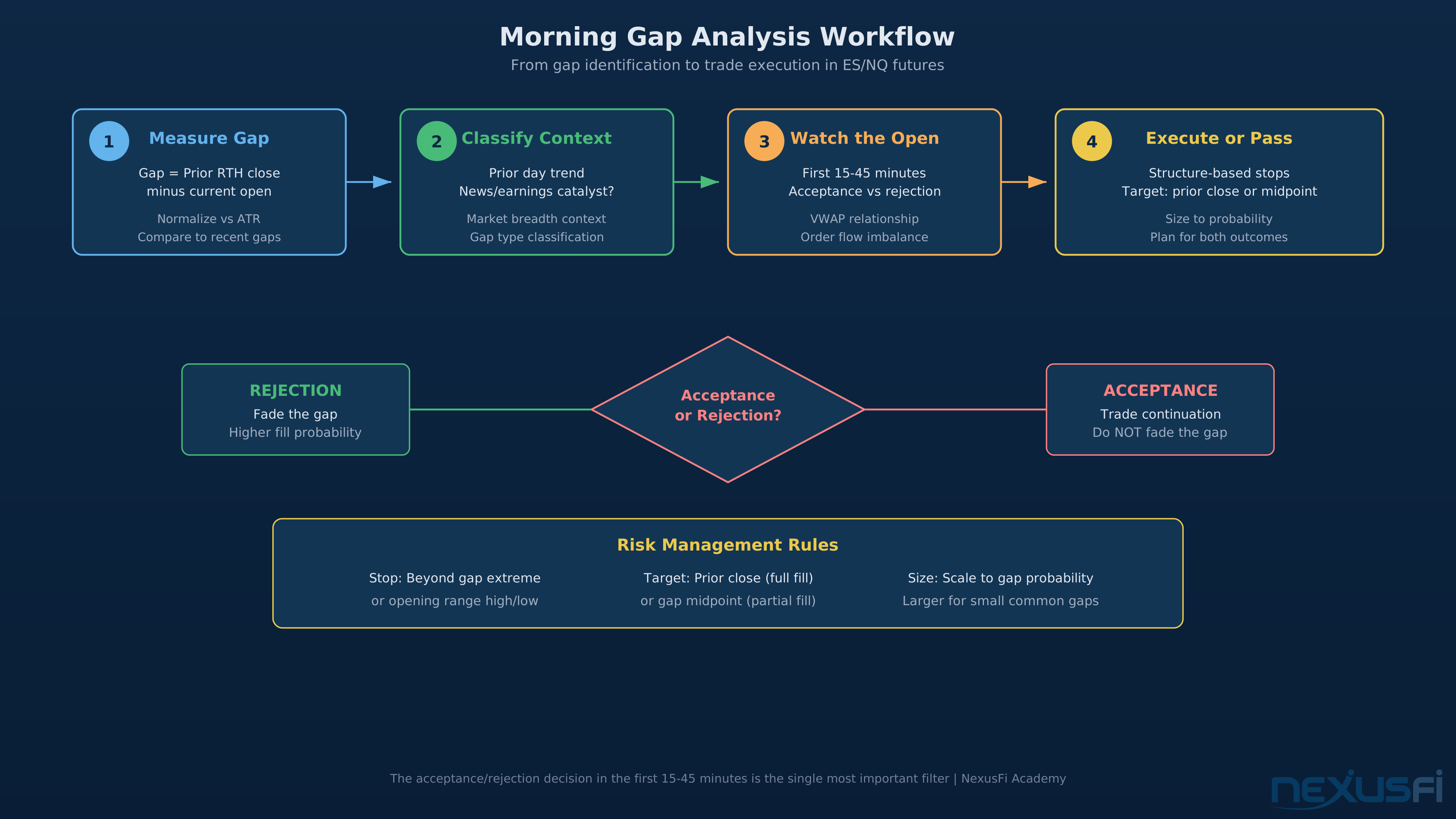
Gap size relative to recent volatility is the single strongest predictor of fill probability. Research across 5-year backtests on ES and NQ 1-minute data reveals a clear inverse relationship. NexusFi member @greenroomhoo documented this extensively in the Master Homework and Statistics Thread, building EasyLanguage strategies to test gap closing behavior on ES — and found that raw gap-fade approaches needed careful filtering to become profitable.
Small gaps (0.25-0.5% of prior close): 84% fill within the same trading day, 48% fill within the first hour. Average time to fill: 45 minutes. These are the high-probability candidates. In ES terms, a 0.3% gap is roughly 15 points — manageable, frequently noise rather than signal.
Medium gaps (0.5-1.0%): 71% fill within the same day, 38% within the first hour. Average time: 78 minutes. Still favorable odds, but the increased size demands tighter risk management. A 0.7% gap in ES is about 35 points — often requires news or a meaningful overnight trigger.
Large gaps (>1.0%): 55% fill within the day, only 22% within the first hour. Average time: 2.4 hours. These numbers drop further when you separate breakaway and common gaps — breakaway gaps this size fill roughly 30% less often. A 1%+ gap in ES is 50+ points and usually reflects genuine repricing rather than a liquidity artifact.
A large-scale analysis of 12,390 trading sessions across ES, NQ, YM, and RTY (2014-2026) confirms this pattern: in-range opens show 71-73% probability of touching the previous close, while gap opens — especially gap downs — carry much lower reversion rates. The distribution is remarkably stable across instruments: roughly 60% of sessions open in range, 25% gap up, and 15% gap down.
The bigger and more dramatic the gap, the less likely it fills. The boring, small overnight drift gaps are where the consistent edge lives.
Overnight and Opening Gaps in ES and NQ Futures #
ES and NQ have unique gap characteristics because they trade nearly 24 hours. The "gap" isn't really a gap in the traditional sense — it's the price discontinuity between the last regular-session (RTH) bar and the first RTH bar of the next day. Trading happened overnight; it just happened with different liquidity. NexusFi member @aquarian1 described this distinction clearly: the overnight gap is the difference between yesterday's RTH close and today's RTH open, and he tracked specific gap sizes and fill outcomes to build both gap-fill and pro-gap continuation strategies.
For ES (E-mini S&P 500), gaps exceeding 0.5% fill approximately 65% of the time within the first hour of RTH. The S&P's broad-market composition gives it slightly more mean-reverting character than single-name stocks. CME Fair Value provides a pre-market reference point — comparing it to the actual opening price helps gauge whether the gap represents real repricing or overnight noise.
For NQ (E-mini Nasdaq-100), higher beta to technology creates sharper swings and larger gaps. Fill probability runs about 55% within the first 30 minutes, climbing to roughly 75% by session end. Tech earnings, sector rotation, and AI/semiconductor news can create 1%+ gaps that behave very differently from typical drift gaps. NQ gap traders need wider stops and must account for the instrument's tendency toward momentum continuation.
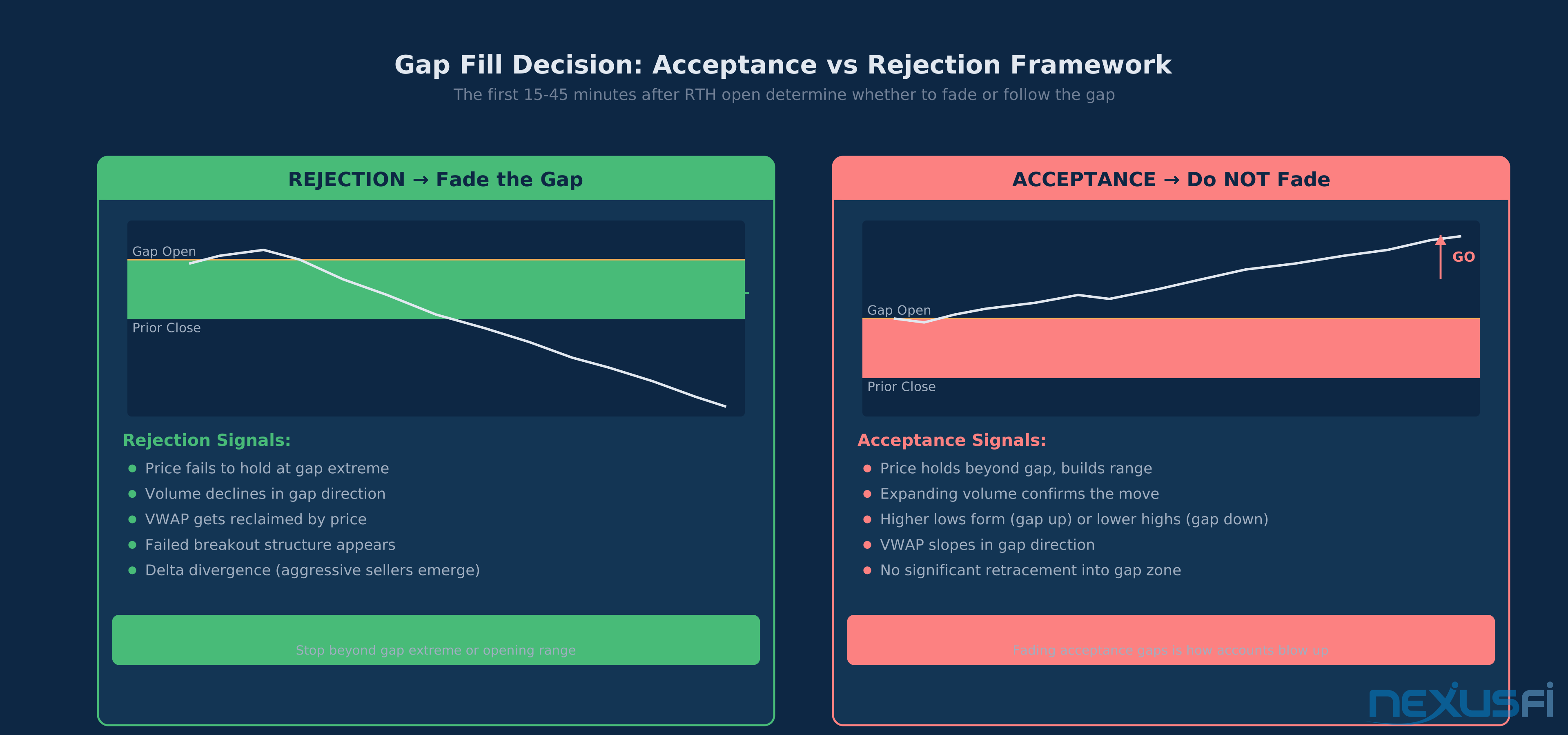
A critical distinction: the first 15-45 minutes of RTH contain the highest information density for gap behavior. Most gap fills that are going to happen begin showing signals early — either the market rejects the gap extreme immediately, or it accepts the new level and builds a range. Waiting beyond this window for a fill that hasn't started usually means the fill isn't coming.
Gap Fill Trading Strategies #
For a complete deep-dive into gap trading as a complete strategy — including opening print reads, entry/exit frameworks, and session-type filters — see Gap Trading in Futures: Reading the Opening Print and Trading What Happens Next. The strategies below focus specifically on the gap fill mechanics covered in this article.
Strategy 1: Mean-reversion fade. The classic. Wait for the first 5-30 minutes to see if price rejects the gap extreme. Enter on the pullback toward the prior close. Stop goes beyond the gap extreme or the opening range high/low — whichever provides cleaner structure. Target the prior close for full fills, gap midpoint for partial. This works best with small-to-medium common gaps in ranging or neutral market regimes. NexusFi member @MXASJ built and shared a strategy testing exactly this approach on ES — a straightforward fade-the-gap system with +/- 2 point filters — and published the results for community evaluation.
Strategy 2: Acceptance/rejection framework. This is the more sophisticated approach and produces better risk-adjusted returns. Monitor the opening auction for two specific behaviors:
- Rejection: Price fails to hold at the gap extreme. Volume declines in the gap direction. VWAP gets reclaimed. Failed breakout structure appears. Higher fill probability -- trade the fade.
- Acceptance: Price holds beyond the gap, builds a new intraday range, and expanding volume confirms the move. Lower fill probability -- do NOT fade. Trade the continuation instead or stand aside.
The acceptance/rejection read in the first 15-45 minutes is the single most valuable filter for gap trading. It separates the 80% fill-rate common gaps from the 50% fill-rate breakaway gaps in real time, before the classification becomes obvious in hindsight.
Strategy 3: Confirmation-based entry. Layer gap analysis with order flow signals: aggressor imbalance shifts, delta divergence, failure swings at key levels, VWAP reclaim or loss. Add filters for gap size relative to ATR, volatility regime (VIX), and prior trend context. Position size scales with conditional probability — larger for small common gaps with rejection, smaller for medium gaps in trending regimes.
Strategy 4: Gap-and-go continuation. When the gap aligns with a strong trend and acceptance signals, don't fight it. Trade the continuation using trailing stops. Only exit if a fill begins and structure breaks. This requires discipline because every trader's instinct screams "it has to come back." Sometimes it doesn't.
Morning Gap Analysis: The Professional Workflow #
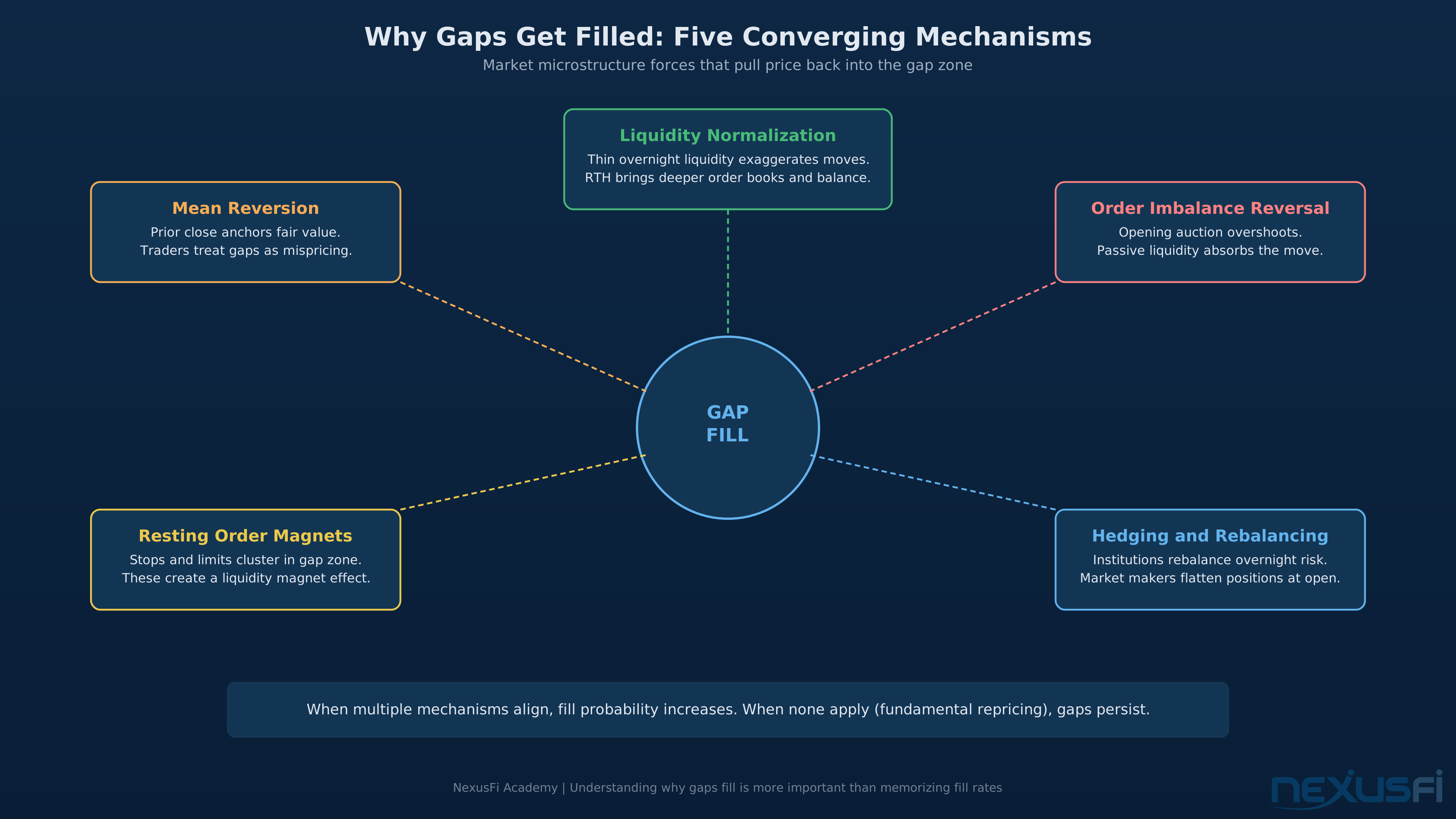
Here's the pre-market routine used by professional gap traders in ES and NQ:
Step 1: Measure the gap. Calculate the gap in ticks and as a percentage of ATR. Compare to the recent frequency of similar-sized gaps for the instrument. A 10-point ES gap after a week of 30-point daily ranges is very different from the same 10-point gap after a week of 80-point ranges.
Step 2: Classify the context. What was the prior day's trend? Are there earnings, economic releases, or geopolitical catalysts? Where does the prior close sit relative to the developing value area? What does market breadth look like? Is the gap a common drift, or does it have a story behind it?
Step 3: Watch the open. The first 15-45 minutes are the data collection period. Track acceptance versus rejection. Watch VWAP — if price is far from VWAP and failing to build acceptance, fades have favorable structure. If price rides VWAP and builds higher lows (for a gap up), the fill trade is lower probability. Monitor order flow: aggressive trade dominance, volume concentration at the gap extreme versus the return path, and bid-ask spread behavior.
Step 4: Execute or pass. If rejection is confirmed, enter the fade with a structure-based stop beyond the gap extreme. Target the prior close or gap midpoint. If acceptance is confirmed, either trade the continuation or do nothing. Passing on a gap is always a valid decision — there will be another one tomorrow.
Risk Management: Where Gap Traders Get Hurt #
The most dangerous assumption in gap trading: "all gaps fill." They don't. Large gaps on fundamental news — earnings surprises, geopolitical shocks, major economic data — can represent permanent repricing. Fading a genuine breakaway gap with size is how experienced traders blow through months of profits in a single session. NexusFi member @shodson documented this tension in his trading journal — taking a discretionary gap fade against an overnight uptrend and carefully listing the risks: trading against the trend, potential for a trend day, and the need for a disciplined invalidation plan when the counter-trend thesis fails.
Other common mistakes:
- No invalidation plan. The gap boundary can become a continuation point rather than a reversal level. Without structure-based stops, losses compound as the market trends away.
- Ignoring the regime. Strong trend days violate mean-reversion assumptions entirely. If every other signal says "trend continuation," the gap fill thesis is fighting the market.
- Entering too early. Jumping in at the open without waiting for acceptance/rejection signals means you're guessing, not trading. The first 15 minutes of data are worth more than any pre-market thesis.
- Holding for full fill without evidence. Partial fills are far more common than full fills. Taking profits at structural levels rather than holding for the perfect outcome is how gap traders stay profitable over time.
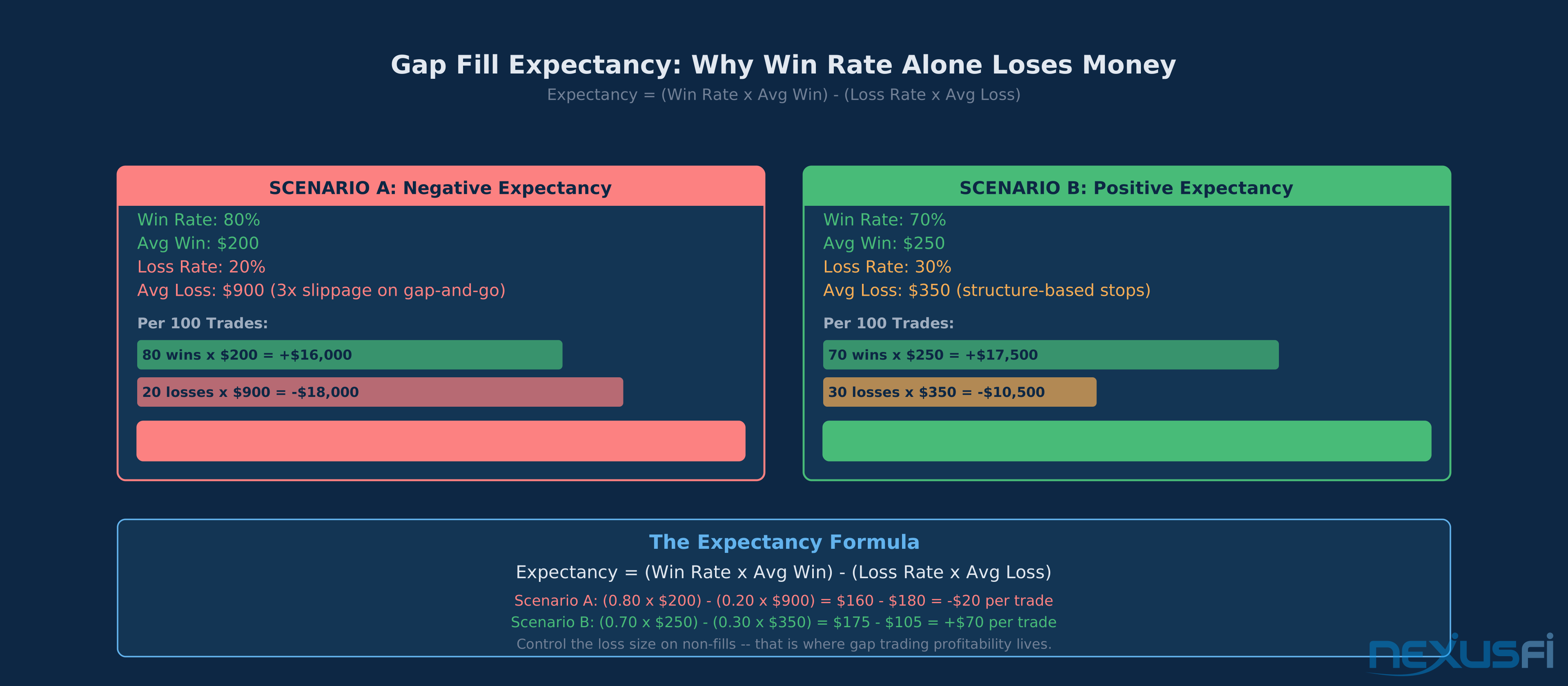
Even at an 80% fill rate for common gaps, the 20% of non-fills can produce outsized losses if position sizing doesn't account for them. Expectancy -- not win rate -- determines profitability. A strategy that fills 80% of the time but gives back 3x on the misses still loses money.
Building a Systematic Gap Fill Edge #
For traders who want to formalize gap fills into a rules-based system, the research framework matters as much as the strategy. Academic work by Trequattrini (2022) at Nova School of Business and Economics developed a bidirectional gap filling strategy on ES using 1-minute data spanning 2000-2021, with an new out-of-sample validation methodology that increased performance stability — demonstrating that rigorous quantitative frameworks can extract durable edge from gap behavior.
Define precisely. Gap measurement: prior close to RTH open. Fill criteria: touch of prior close (full fill) versus entering the gap range (partial). Time window: within 60 minutes, by end of day, or within N sessions. Inconsistent definitions produce inconsistent results.
Segment by conditions. Bucket gap sizes relative to ATR. Separate by volatility regime (VIX above or below 20). Filter by prior trend context: gap with trend versus gap against trend. Isolate scheduled news days from normal sessions. Each segment has different fill characteristics.
Test with realistic execution. Include slippage estimates for the opening minutes when spreads are wider. Model the bid-ask spread variability that occurs during the first 15 minutes of RTH. Account for the fact that stop-fills during fast moves often slip beyond the intended level.
Measure expectancy, not just hit rate. A 70% fill rate means nothing if the 30% of non-fills produce outsized losses. Calculate average profit on fills versus average loss on non-fills. The system is profitable only when (win rate x average win) > (loss rate x average loss). Most gap traders who fail are measuring the wrong metric.
The Bottom Line #
Gap fills are one of the most visible and intuitive signals in trading. The mechanics are sound — liquidity normalization, mean reversion, order imbalance reversal, resting order magnetism, and institutional rebalancing all push price back toward the gap. The statistical tendency is real: most common, small-to-medium gaps do fill.
But the edge lives in the details. Which gaps, under what conditions, with what confirmation, and with what risk controls. "Gaps always fill" is how beginners think about it. "This specific gap, in this regime, with this acceptance/rejection signal, has a 75% fill probability and a 2:1 reward-to-risk" is how professionals think about it. The gap itself is just the setup. Everything after the open — the acceptance, the flow, the structure — determines whether you have a trade or a trap.
Knowledge Map
Go Deeper
Build on this knowledgeReferences This Article
Articles that build on this topicCitations
- — Emini gap fill strategy data, books? (2020) 👍 10“Hi Tuglife, Opening gaps in the Emini S&P are pretty much all that I've traded since 2005. In 2008, I wrote a short book/primer called Understanding Gaps and updated it in 2015.”
- — Gap Fade the ES (2010) 👍 3“Hi all, I was playing around this morning to try and test the "fade the gap" theory, which is supposed to be one of the easiest plays on the ES. A Strategy to test trading gaps +/- 2 points is attached. It prints results to the output window.”
- — shodson's Trading Journal (2011) 👍 6“Friday, January 21st, 2011 - I took a discretionary trade based on gap data. Here was my thinking: Risks ------------ - Trading against the trend, the market had been trending up all night, this is a counter-trend trade.”
- — Combining discretionary trading, risk management and ML as an art (2017) 👍 2“As most traders know there is an overnight gap fill idea. The o/n gap is the difference between yesterday's close and today's open (RTH). So for Dec 08 the gap was 7.00 (Close=2639.75 Dec 7 to Open=2646.75 Dec 8) temp1.”
- — Master Homework and Statistics Thread (2013) 👍 6“I started looking at ES gaps closing. I tackled this in easylanguage with a strategy first as a gap closing - buy/sell at open, hold to prior day close, etc. I played with it for a while and could not really get it profitable.”
- — Encyclopedia of Chart Patterns - Gap Analysis
- — Trading at the Opening Bell: Gap Filling Strategy on the E-mini S&P 500 (2022)
- — Session Open Analysis: Gap Up, Gap Down & In-Range Stats (12,390 Sessions) (2026)