



Ethereum Layer 2 Networks: Arbitrum, Optimism, Base, and zkSync -- The Trader's Complete Guide
Overview #
Ethereum mainnet's gas fees have cost traders real money. During the 2021 DeFi boom, a single swap on Uniswap cost $50-200 in gas. Arbitrage that was profitable in theory became a loss in practice. Liquidations were delayed because bots couldn't afford to execute them. The 2020-2022 congestion cycle made one thing clear: trading frequently on Ethereum L1 is economically unviable for most strategies.
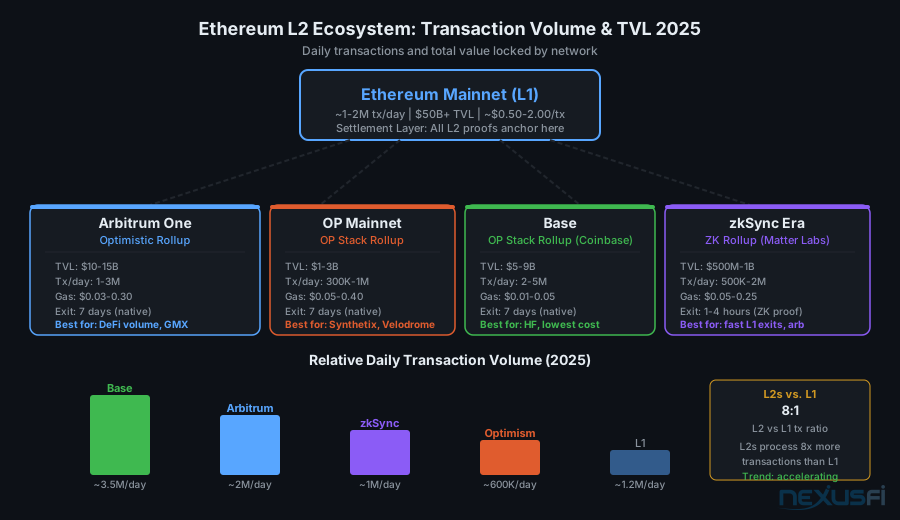
Layer 2 networks solve this — same assets, same contracts, same non-custodial guarantees — at 10-100x lower cost and throughput. By 2025, L2s processed more daily transactions than Ethereum mainnet. Arbitrum beat mainnet volume on dozens of days. Base grew from zero to 1M+ daily transactions in 18 months.
If you're trading beyond spot buys, you need to understand L2s. The same cryptocurrency trading fundamentals apply — the liquidity is there. The risks differ from L1 in ways that directly affect position sizing and execution.
Key Concepts #
Layer 1 (L1): Ethereum mainnet — all transactions ultimately settle here. High security, scarce blockspace, expensive during congestion.
Layer 2 (L2): Separate execution environment that settles proofs back to L1. Same assets, lower cost, higher throughput.
Rollup: The dominant L2 architecture. Transactions are "rolled up" into batches and the batch proof is posted to L1. Two types: Optimistic rollups and ZK rollups.
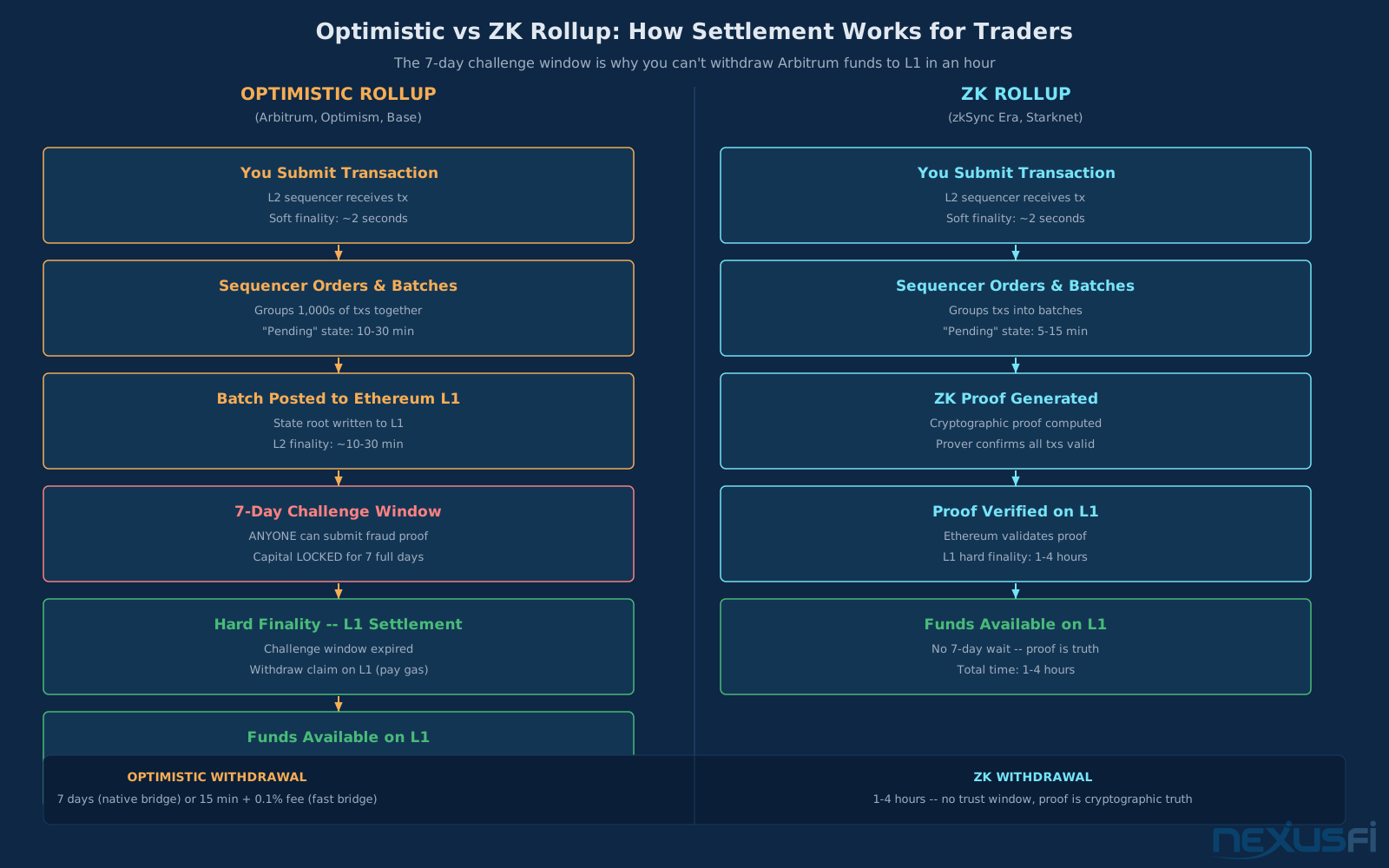
Optimistic rollup: Assumes transactions are valid by default. Anyone can challenge a fraudulent transaction within the challenge period (typically 7 days). Challenge period creates withdrawal delays back to L1.
ZK rollup (Zero-Knowledge rollup): Generates cryptographic proofs that transactions are valid before posting to L1. No challenge period — withdrawals finalize as soon as the proof is verified on L1, typically 30 minutes to a few hours.
Sequencer: The entity that orders and batches transactions on an L2 before they're posted to L1. Most major L2s run centralized sequencers today. The sequencer can go down, delay transactions, or in theory reorder transactions — all relevant risks for traders.
Bridging: The process of moving assets between L1 and L2 (or between different L2s). Deposits (L1 → L2) are fast, typically 10-20 minutes. Withdrawals (L2 → L1) vary dramatically by rollup type.
Finality: On L2: soft (sequencer accepted), L2 (in block), hard (proof on L1). Soft is sufficient for most DEX ops; hard finality matters for cross-chain capital.
MEV (Maximal Extractable Value): Value extracted by reordering/inserting transactions. Exists on L2 — sequencer controls ordering instead of distributed miners.
TVL (Total Value Locked): Assets deposited in an L2 ecosystem's contracts. Primary proxy for liquidity depth.
How Ethereum Layer 2 Networks Work #
The Scalability Bottleneck #
Ethereum processes roughly 15-30 transactions per second on mainnet. Bitcoin processes 7. Visa processes 24,000. The gap isn't small — it's structural. Every validator in Ethereum's network processes every transaction, which is what gives you decentralized security. But it's also why throughput has a hard ceiling.
When demand exceeds that ceiling, gas prices spike. As Big Mike noted when L1 fees peaked: "gas fees on Ethereum are completely out of control" — that 2021 moment drove the urgency behind L2 adoption. The fee market is an auction: you bid what you're willing to pay, and validators prioritize the highest bids. During the 2021 NFT craze, base fees exceeded 500 gwei — making a simple ETH transfer cost $50 and a DEX swap cost $200+. Arbitrage bots that needed 5-second execution windows couldn't function.
L2 networks offload this. Instead of every Ethereum validator processing every DEX swap, an L2 processes the swap in its own environment. Periodically — every few minutes to every hour depending on the L2 — the L2 bundles thousands of transactions into a single compressed batch and posts that batch (or its proof) to Ethereum L1. One L1 transaction instead of thousands. The L1 cost is amortized across all the bundled L2 transactions. Result: L2 users pay a fraction of L1 gas.
Optimistic Rollups: The Fraud-Proof Architecture #
Optimistic rollups (Arbitrum, Optimism, Base) operate on a "trust but verify" model. When the sequencer posts a batch to L1, it asserts that all transactions in the batch are valid. This assertion is accepted optimistically — it's assumed to be correct.
But here's the critical detail: anyone can challenge a fraudulent batch during the challenge window. The challenge period is typically 7 days. During those 7 days, a fraud proof can be submitted to L1, which would roll back the invalid batch. If nobody challenges in 7 days, the batch achieves L1 finality.
What this means for traders:
Deposits from L1 to L2 are fast. Your ETH hits the L2 sequencer, it's credited to your L2 account within 10-20 minutes, and you can trade immediately. The 7-day window is irrelevant for deposits.
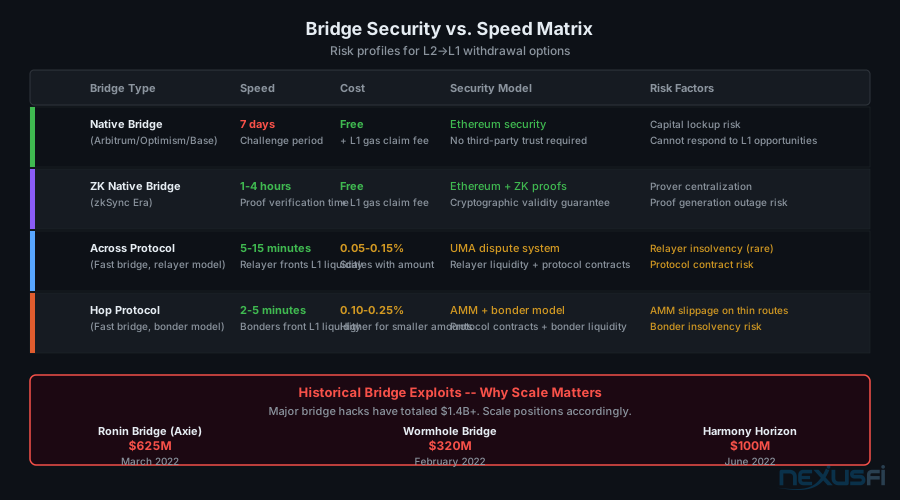
Withdrawals from L2 back to L1 take 7 days through the native bridge. Your assets sit in escrow during the challenge period. This is not theoretical — if you need funds back on L1 quickly, the native bridge doesn't work. You either plan ahead or use a third-party fast bridge (like Across, Hop, or Stargate) that fronts you the L1 liquidity for a fee, typically 0.05-0.3%.
The 7-day window creates real capital lockup risk. If you're running a strategy that needs to rapidly redeploy capital between L1 and L2 — say, arbitraging against a Binance CEX position — the native bridge destroys your ability to close the position quickly.
ZK Rollups: Cryptographic Proof of Validity #
ZK rollups (zkSync Era, Starknet, Polygon zkEVM, Linea) don't rely on the challenge period. Instead, the sequencer generates a cryptographic proof — specifically a zero-knowledge proof — that mathematically demonstrates all transactions in the batch are valid. This proof is posted to L1 along with the batch.
Ethereum's smart contracts verify the proof. If it passes, the batch achieves finality immediately. No 7-day wait. Withdrawals typically finalize in 30 minutes to a few hours — the time needed to generate and verify the proof, not a trust-based waiting period.
The tradeoff: generating ZK proofs is computationally expensive. This creates higher overhead costs and slower batch posting in some implementations. ZK proof systems are also more complex to develop — supporting the full range of EVM opcodes in a ZK-provable circuit is genuinely hard engineering. Some early ZK rollups had compatibility constraints (not all Solidity contracts would deploy correctly). By 2025, most major ZK rollups achieved full EVM equivalence, but tooling maturity still lags Optimistic rollups in some areas.
For traders, ZK's main advantage is fast withdrawals. If you need to move capital from zkSync Era to L1 in an hour, you can. That flexibility has real value for strategies that operate across multiple venues.
Platform Comparison: Arbitrum, Optimism, Base, and zkSync #
Arbitrum #
Architecture: Optimistic rollup (Arbitrum One) and AnyTrust chain (Arbitrum Nova, designed for gaming/social). Arbitrum has its own custom virtual machine (Arbitrum Virtual Machine) that's EVM-compatible but technically distinct.
Sequencer: Centralized, run by Offchain Labs (the company behind Arbitrum). Decentralization roadmap exists but hasn't materialized.
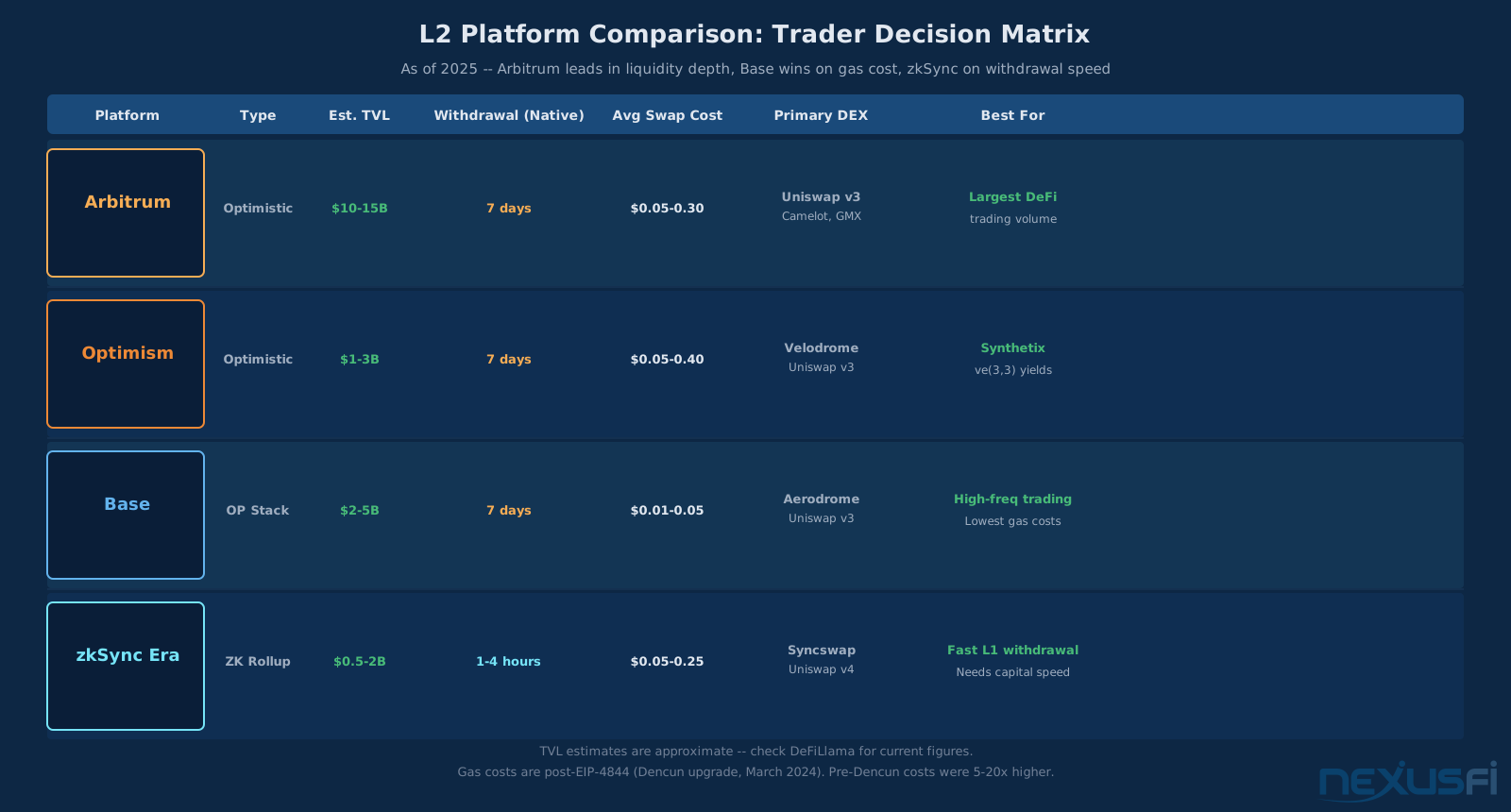
Withdrawal time (native bridge): 7 days through the native bridge. Third-party fast bridges work in minutes.
Liquidity reality: Arbitrum is the deepest DeFi L2 by TVL, consistently holding $10-15B in total value locked. Major DEX venues: Uniswap v3 (dominant), Camelot (Arbitrum-native, strong incentives), Curve, Balancer, and GMX (perpetuals). GMX in particular has done significant volume on Arbitrum — $20B+ cumulative. The ecosystem is mature enough that most major tokens have deep pools.
Gas costs: Consistently among the lowest of any Optimistic rollup. A Uniswap swap typically costs $0.05-0.30 depending on L1 data costs.
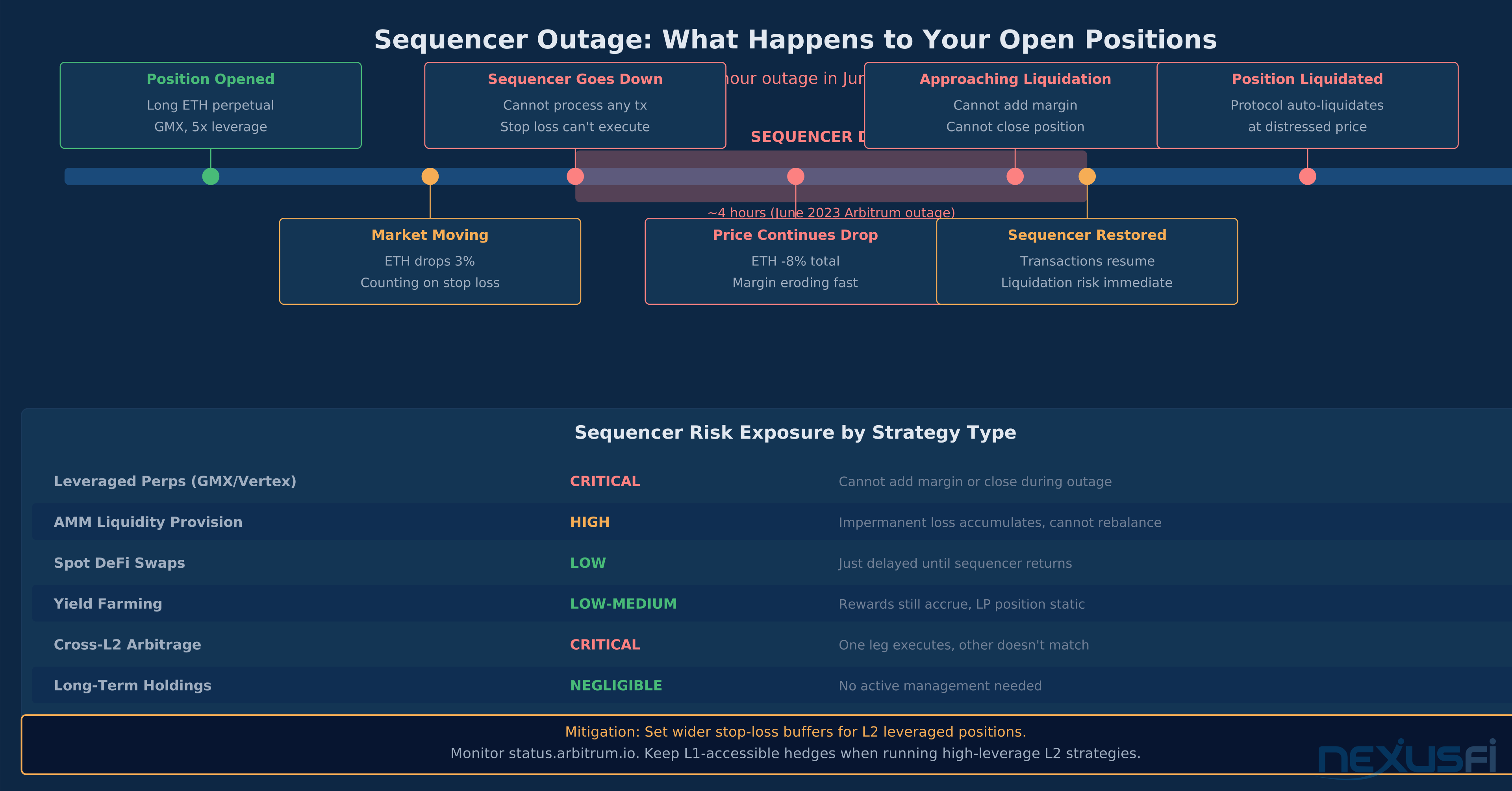
Known incidents: Arbitrum has had sequencer downtime episodes, including a multi-hour outage in June 2023 that stopped transaction processing entirely. Automated strategies were frozen.
Trader verdict: Highest liquidity, most established ecosystem, best DEX routing. The default choice for most serious DeFi trading volume. The 7-day withdrawal creates capital lockup risk, but third-party bridges largely solve this.
Optimism (OP Mainnet) #
Architecture: Optimistic rollup. Parent of the "Superchain" concept — Optimism's technology stack (OP Stack) is shared with Base, Mode, and other chains, creating an interoperability layer.
Sequencer: Centralized, run by OP Labs (Optimism Foundation). Same withdrawal mechanics as Arbitrum.
Withdrawal time (native bridge): 7 days. Same fast bridge options apply.
Liquidity reality: Smaller TVL than Arbitrum ($1-3B range), but strong for specific assets — Velodrome is the dominant Optimism-native DEX with concentrated liquidity incentives. Synthetix historically ran its synthetic assets primarily on Optimism. Liquidity is more concentrated in specific protocols vs Arbitrum's broader distribution.
Gas costs: Comparable to Arbitrum, typically $0.05-0.40 per swap.
Superchain integration: Optimism's OP Stack creates a network of L2s that can share security and liquidity. This is strategically significant — in theory, the Superchain collapses some of the cross-L2 fragmentation problem. In practice, cross-chain messaging and liquidity aggregation is still early.
Trader verdict: Lower overall liquidity than Arbitrum, but strong for specific protocols. Better choice if your strategy centers on Synthetix, Velodrome, or Optimism-native incentive programs.
Base #
Architecture: OP Stack Optimistic rollup, built and operated by Coinbase. Launched August 2023.
Sequencer: Centralized, operated by Coinbase. No Base token was issued (at launch) — Coinbase runs this as infrastructure.
Withdrawal time (native bridge): 7 days. Coinbase also operates a faster withdrawal path for Coinbase users.
Liquidity reality: Base grew faster than any prior L2. 1 million+ daily transactions by early 2024. The growth driver was memecoins and social applications (friend.tech early on, then a wave of cultural activity). Aerodrome Finance became the dominant Base DEX. Uniswap v3 has significant volume.
For serious traders: Base has high transaction volume but some of that is low-value memecoin activity. Deep liquidity for major pairs (ETH/USDC, ETH/cbETH) but thinner for mid-cap tokens vs Arbitrum. Coinbase users can move assets to Base trivially, which creates retail-driven flow patterns.
Gas costs: Very low, often $0.01-0.05 per swap. Some of the cheapest execution on any L2.
Unique considerations: Coinbase's involvement is a double-edged sword. It provides institutional credibility and a massive user funnel. It also means the sequencer is a regulated entity in California — there are scenarios (government pressure, regulatory action) where Coinbase could be compelled to censor transactions. This is theoretical but not zero.
Trader verdict: Lowest gas costs, high volume, growing liquidity. Best choice for high-frequency strategies where cost matters most. Watch liquidity depth on specific token pairs — broad volume doesn't mean deep pools everywhere.
zkSync Era #
Architecture: ZK rollup (zkEVM). Native account abstraction. Different underlying design choices from Optimistic rollups — transactions are processed by a Boojum prover system.
Sequencer: Centralized, run by Matter Labs. Decentralization is planned.
Withdrawal time (native bridge): 1-3 hours typically, not 7 days. The proof verification finality is dramatically faster than Optimistic challenge periods.
Liquidity reality: Smaller TVL than Arbitrum or Base. Syncswap and Mute (now iZUMi on zkSync) are primary native DEXes. Uniswap launched on zkSync Era. Ecosystem is less mature — fewer protocols, thinner liquidity for most pairs beyond ETH and major stables.
Gas costs: Competitive, typically $0.05-0.25 per operation. Native account abstraction means some operations can be fee-sponsored (gasless transactions in some apps).
EVM compatibility nuances: zkSync Era achieved EVM equivalence but has subtle differences (different address derivation, different behavior for certain opcodes). Most protocols port over without issues, but edge cases exist.
Trader verdict: Best for strategies requiring fast L2→L1 capital movement. Liquidity depth is the main constraint — zkSync Era is not yet the right venue for large institutional DEX flows. Watch for liquidity migration as the ecosystem matures.
Bridging Mechanics: The Trader's Reality #
Bridging is where theory meets execution risk. Most traders underestimate the complexity until they're stuck mid-trade with assets in transit.
L1 to L2 Deposits #
Deposits are straightforward. You send assets from your L1 Ethereum wallet to the official bridge contract. The sequencer sees the L1 transaction, credits your L2 account. Typical timing: 10-20 minutes for Arbitrum/Optimism/Base, 10-30 minutes for zkSync.
The risk here is user error — sending to the wrong address or wrong chain. L2 addresses look identical to L1 Ethereum addresses (both are 20-byte hex). If you send ETH directly to an Arbitrum address from an exchange that doesn't support Arbitrum, your funds land on L1 but the recipient address may not exist on L1 or may be controlled by someone else on L2. This has cost traders real money.
Use the official bridge UI. Double-check the network in your wallet before sending. Triple-check for large amounts.
L2 to L1 Withdrawals (Native Bridge) #
This is where rollup type matters enormously.
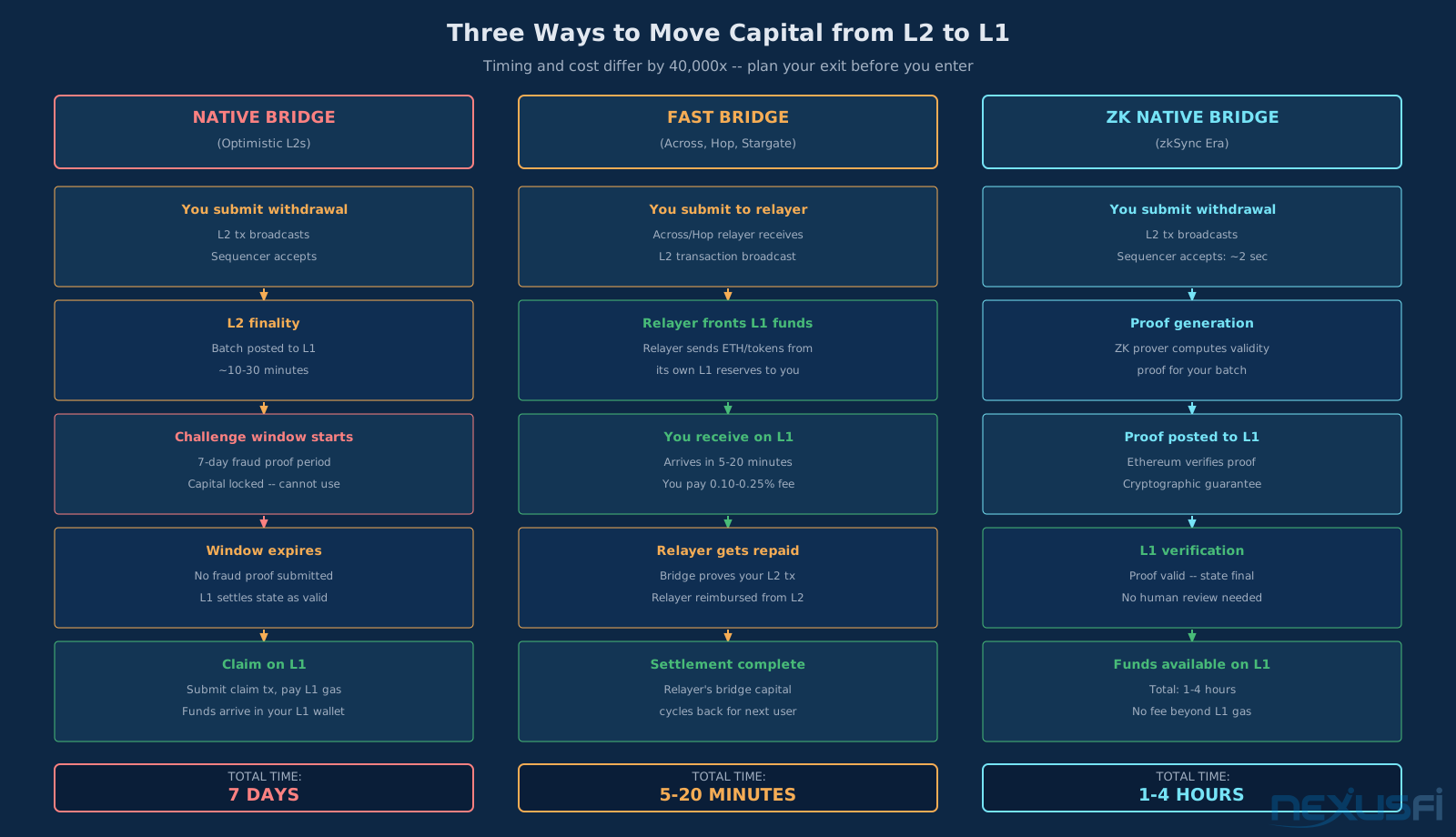
Optimistic rollups (Arbitrum, Optimism, Base): 7-day challenge period. Your assets are escrowed. You can't access them on L1 for 7 days. The timer starts when you submit the withdrawal on L2. After 7 days, you execute a second transaction on L1 to claim the funds (and pay L1 gas for that claim).
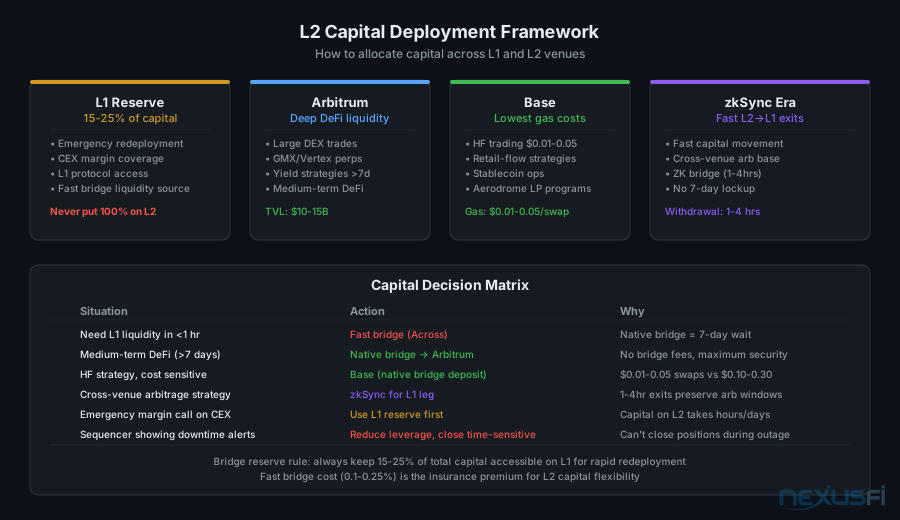
The 7-day lockup creates real constraints. Capital deployed on Arbitrum that needs to respond to an opportunity on L1 — or that needs to meet a margin call at a CEX — is stuck. This is not a papercut. Traders have been liquidated on other venues because capital was locked in a 7-day withdrawal. Smart position sizing accounts for venue-specific lockup periods — never commit 100% of tradable capital where it can be stranded for a week.
ZK rollups (zkSync Era): Proof verification finality. Withdrawals complete in 1-4 hours once the ZK proof is generated and verified on L1. No challenge period. This is a meaningful operational advantage.
Third-Party Fast Bridges #
The 7-day lockup problem on Optimistic rollups has spawned an entire ecosystem of fast bridges:
- Across Protocol: Typically the fastest and cheapest. Relayers front you L1 liquidity in exchange for your L2 assets. Finality in 5-15 minutes. Fees: 0.05-0.15%.
- Hop Protocol: Similar mechanic, bonders provide L1 liquidity. 2-5 minutes typical. Fees: 0.10-0.25%.
- Stargate: LayerZero-based. Supports cross-chain (not just L1/L2). Higher fees for smaller amounts.
- Synapse: Broader cross-chain support, competitive fees.
Fast bridges introduce their own risk: the bridge contract itself. All bridges have been audited, but Harmony's Horizon bridge ($100M exploit), Wormhole ($320M exploit), and Ronin Bridge ($625M exploit) demonstrate that bridge contracts are high-value attack targets. Most major L2-to-L1 fast bridges have held up, but the risk model is different from the native bridge.
The native bridge risk: smart contract risk is entirely in Ethereum's security perimeter (and the L2's own contracts). Fast bridge risk: adds the bridge protocol's contracts. More vectors, but faster capital movement.
Rule of thumb for sizing: For amounts where the 7-day wait is acceptable and you want maximum security, use the native bridge. For amounts where speed matters or you need L1 liquidity quickly, use a reputable fast bridge (Across is generally regarded as the tightest). For very large amounts, consider splitting between multiple bridges.
Cross-L2 Bridging #
Moving between L2s (Arbitrum → Optimism, Base → zkSync) requires either going through L1 (slow and expensive for Optimistic L2s) or using cross-chain protocols (Stargate, Across, Synapse).
Cross-L2 bridging is meaningfully slower and more complex than L1→L2. This creates real friction for strategies that need to arbitrage across multiple L2 ecosystems. By the time you've moved capital, the opportunity may have closed.
Gas Costs and Fee Mechanics #
L2 Fee Structure #
L2 gas fees have two components:
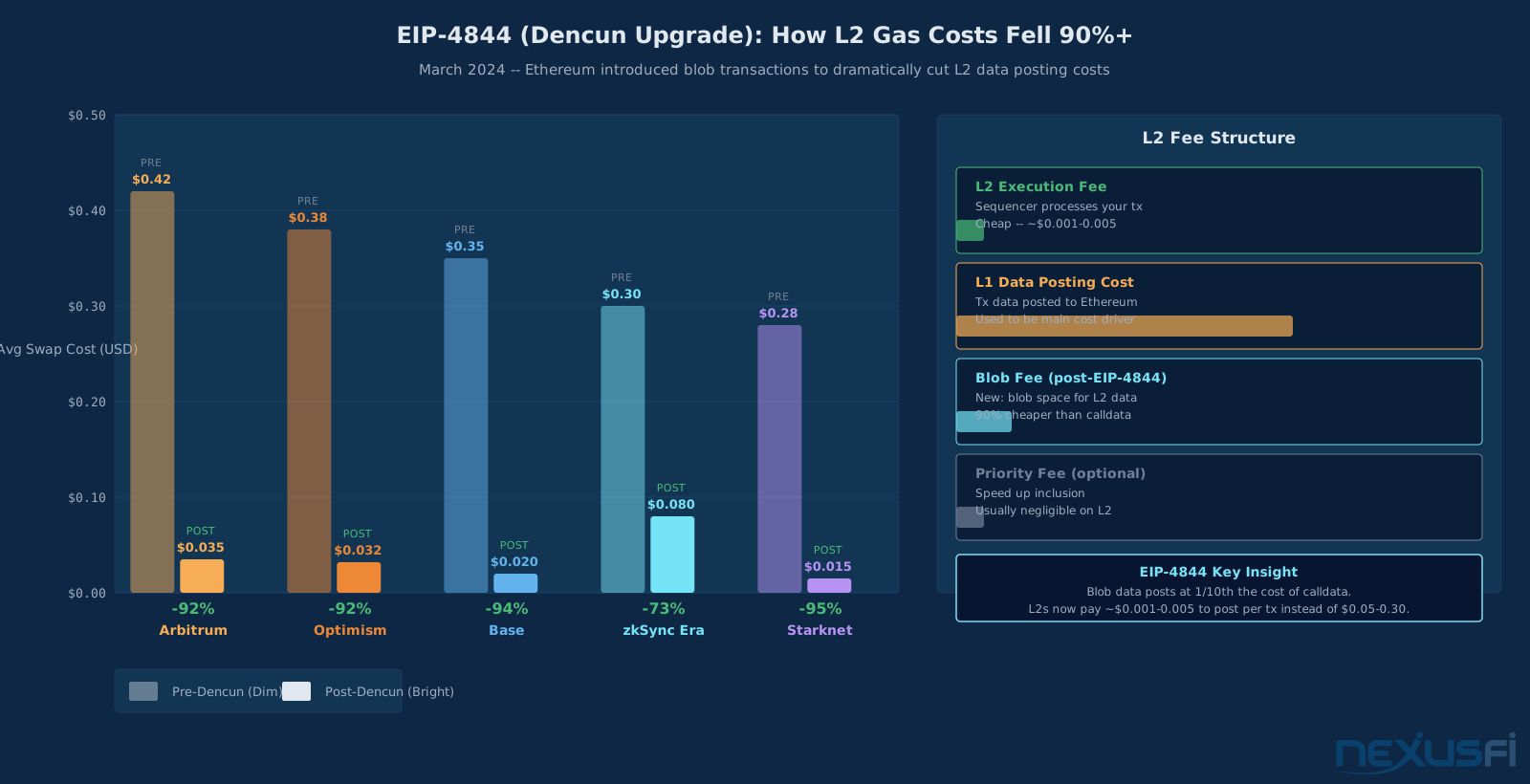
L2 execution cost: The fee for the sequencer to include and execute your transaction on the L2 chain. This is cheap — often 0.001-0.01 USD equivalent. The sequencer operates efficiently and amortizes costs across many users.
L1 data posting cost: The L2 must post compressed transaction data to Ethereum L1, which costs L1 gas. This cost is shared across all transactions in the batch, but each transaction contributes a proportional share. This component is more volatile — it moves with L1 gas prices.
Post-EIP-4844 (March 2024, the "Dencun" upgrade), L1 data costs for L2s dropped 90%+ because Ethereum introduced "blob" transactions specifically for L2 data posting. Blob space is cheaper than regular calldata. The Dencun upgrade cut L2 fees dramatically. Arbitrum average fees went from $0.30-0.50 pre-Dencun to $0.01-0.05 post-Dencun.
Dencun Changed the Math (March 2024) EIP-4844 cut L2 gas 90%+. Arbitrum swaps: $0.42 → $0.03. Base swaps: $0.01-0.02. Any P&L model or yield calculator from before March 2024 has wrong fee assumptions. Rebuild with post-Dencun numbers.
Fee Volatility #
L2 fees aren't constant. They spike during:
- L1 gas spikes: If Ethereum mainnet is congested, the L1 data posting component rises for all L2s.
- L2-local congestion: If an L2 is hit with unusual transaction volume (major airdrop, memecoin frenzy), the sequencer fee component rises.
- Network events: Protocol launches, NFT mints, and market crash liquidation cascades all create fee spikes.
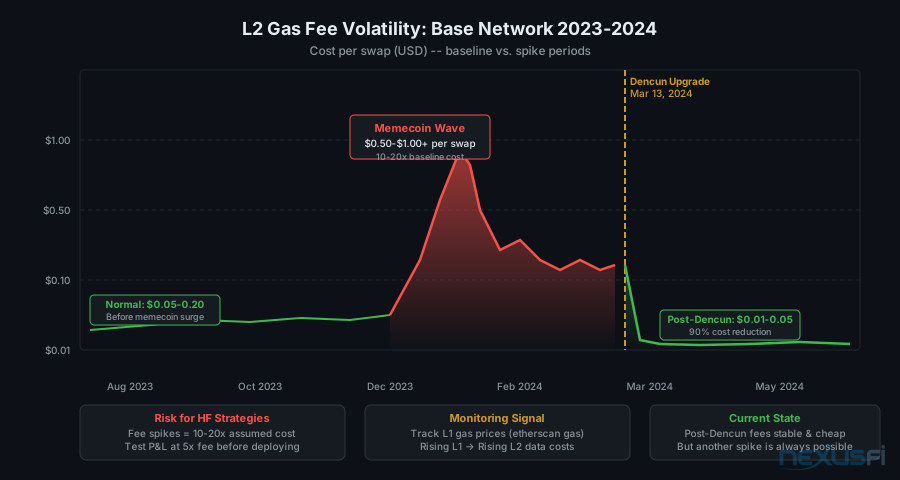
During the Base memecoin wave of 2023-2024, fees on Base spiked 10-20x their baseline for hours at a time. Strategies that assumed $0.05 swap costs were suddenly paying $0.50-1.00. For strategies where fee predictability matters (tight arbitrage, high-frequency DEX trading), this volatility is a real risk.
Practical guidance: Build fee estimates into your strategy P&L model. Assume the 75th percentile fee, not the average. For strategies with thin margins, test at 3-5x your assumed fee to see if you're still profitable.
Impact on Arbitrage and High-Frequency Strategies #
Arbitrage requires fast execution, competitive fee estimation, and tight spread capture. L2 enables arbitrage that's impossible on L1 ($200 gas fees kill any trade under $2000). But L2 arbitrage has its own constraints:
- Sequencer ordering means the "mempool" on L2 is controlled. Some L2s have no public mempool at all — transactions go directly to the sequencer. This limits traditional front-running but also limits some types of arbitrage bots that rely on mempool monitoring.
- Cross-DEX arbitrage on the same L2 is viable and competitive. Cross-L2 arbitrage is harder because of bridge delays and cross-chain execution complexity.
- Gas estimation on L2 isn't stable — the L1 data component can change between estimate and inclusion. @MarketT on NexusFi found this building a short-horizon crypto strategy: "venues that advertise 0% fees often compensate with unstable or artificially widened spread conditions." Same principle applies to L2 DEX routing.
DEX Trading on L2: Market Microstructure #
Where Liquidity Lives #
L2 DEX liquidity is concentrated in specific protocols. The distribution as of 2025:
Arbitrum: Uniswap v3 dominates by volume (~50-60%). Camelot (Arbitrum-native, strong in newer projects), Curve (stablecoin and liquid staking), Balancer, and GMX/Vertex (perpetuals with their own spot/futures liquidity). Ramses (Velodrome fork) for incentivized liquidity.
Optimism/Base: Velodrome (Optimism) and Aerodrome (Base fork) use a ve(3,3) model with native token emissions driving LP incentives. These DEXes have captured deep liquidity for specific pairs, especially stablecoins and liquid staking tokens. Uniswap v3 also operates on both. Curve on Optimism.
zkSync Era: Syncswap is the native DEX with the deepest liquidity. Uniswap v4 launched here. Thinner overall vs Arbitrum/Base.
Liquidity Fragmentation #
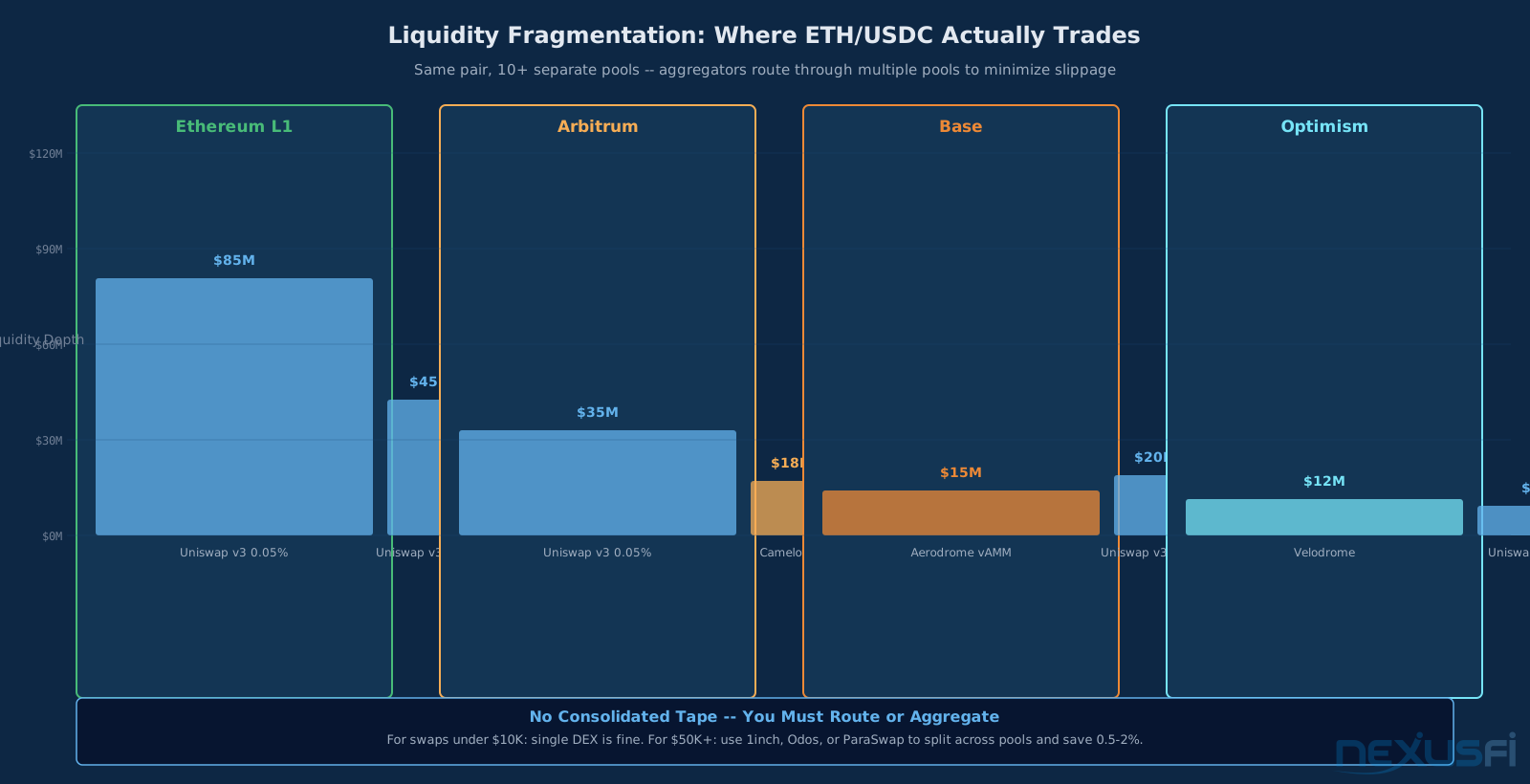
This is the dominant market structure problem for L2 trading. The same asset — say, USDC/ETH — might have liquidity spread across:
- Uniswap v3 on Arbitrum (multiple fee tiers: 0.05%, 0.30%, 1%)
- Camelot v3 on Arbitrum
- GMX's liquidity pool
- Uniswap v3 on Base
- Aerodrome on Base
- Velodrome on Optimism
- Uniswap v3 on zkSync
- Uniswap v3 on Ethereum mainnet
Each of these is a separate pool. Prices can diverge. Arbitrage bots keep them close, but during volatility, there are brief windows where the same pair prices diverge across venues by meaningful amounts.
For a trader: there's no consolidated tape. You don't get the aggregate L2 order book the way you see ES depth on the CME. The liquidity dynamics are at the core different — fragmented across dozens of independent pools rather than concentrated on a single exchange. You're trading against a specific pool's depth. For liquid pairs (ETH/USDC), the major pools have $10M+ in liquidity and spreads are tight. For mid-cap tokens, the deepest pool might have $500K in liquidity and a swap of $50K causes meaningful slippage.
Use aggregators: DEX aggregators (1inch, ParaSwap, Odos, KyberSwap) split orders across multiple pools to minimize slippage. For anything above $50K, an aggregator route can save 0.5-2% vs hitting a single pool directly. This isn't a nice-to-have for large traders — it's essential.
Slippage Mechanics #
AMM slippage on L2 works identically to L1 AMMs (same Uniswap v3 contracts, same curve math). What differs:
- Pool depth: L2 pools are shallower than mainnet for most pairs. Expect higher slippage on equivalent trade sizes vs L1.
- Volatility impact: During price moves, LP rebalancing lags slightly. You can hit a pool that temporarily has a worse price than the aggregate market because LPs haven't arbitraged it back yet.
- Fee tiers: Uniswap v3's 0.01%, 0.05%, 0.30%, 1.00% tiers create different liquidity concentrations. Most volume routes through 0.05% for stablecoin pairs and 0.30% for volatile pairs, but the aggregator usually handles this.
Set Slippage Correctly #
L2 DEX trades can fail if slippage tolerance is too tight. During high volatility, a 0.1% slippage tolerance will cause frequent failed transactions — and you still pay gas for failed txs on some L2s (though usually small). During normal conditions, 0.5% is reasonable for liquid pairs. For mid-cap tokens, 1-2%.
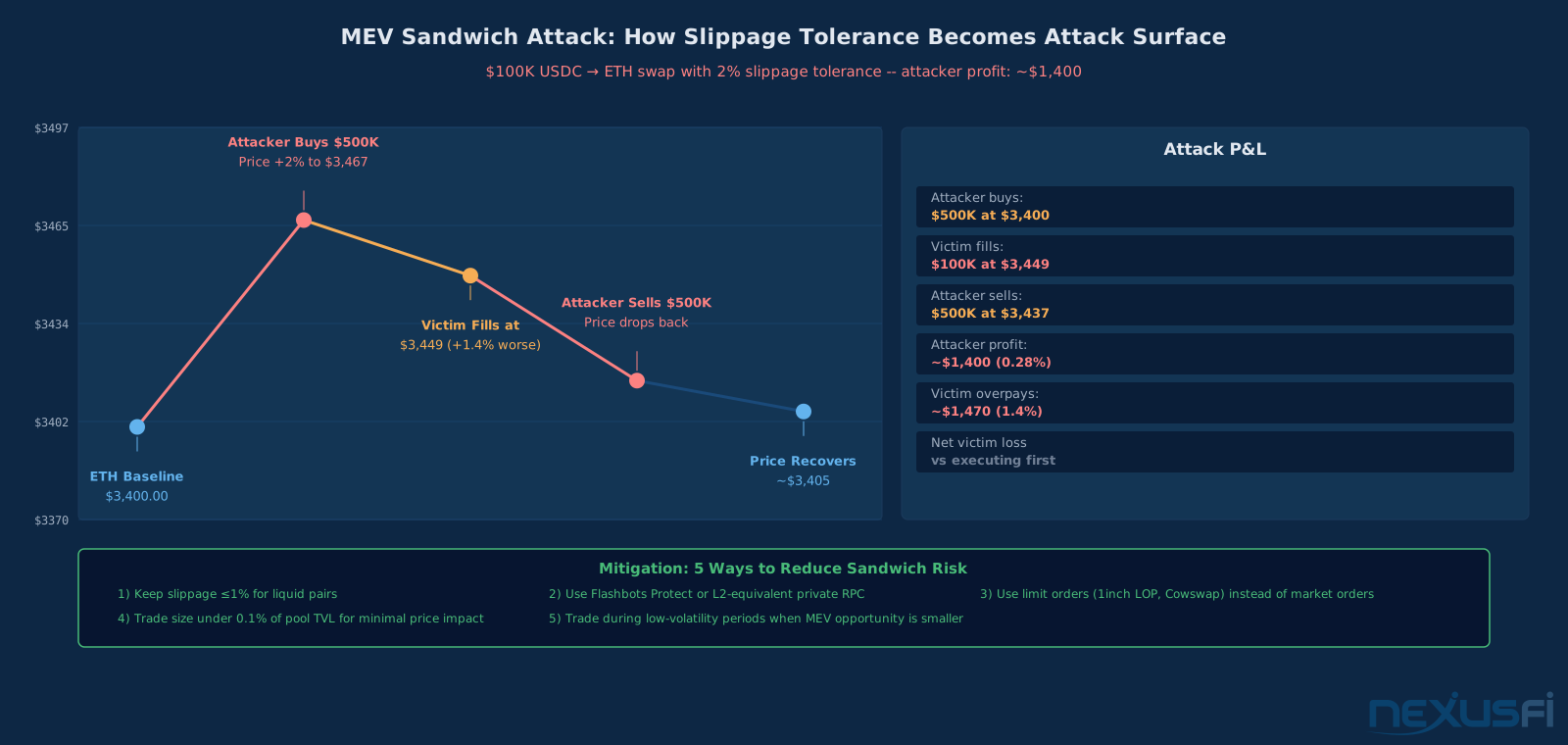
Slippage tolerance is also an MEV attack surface. Setting 5%+ slippage is an invitation for sandwich attacks.
Slippage Settings That Won't Get You Sandwiched Liquid pairs (ETH/USDC): 0.5%. During volatility: 1%. Mid-cap thin pools: 1-2%. Never 5%+ — that invites sandwich bots.
Sequencer Risks #
What Sequencers Control #
The sequencer is the transaction ordering authority on an L2. All major L2s run centralized sequencers. When you submit a transaction to Arbitrum, it goes to the Arbitrum sequencer — not to a distributed mempool. The sequencer:
- Decides the order transactions are included
- Posts batches to L1
- Controls soft finality (your immediate confirmation)
Downtime Risk #
Sequencers go down. Arbitrum's sequencer experienced a multi-hour outage in June 2023 — during which zero transactions were processed. For traders with open positions on GMX or other protocols that use L2 for execution, this meant:
- No ability to add margin
- No ability to close positions
- No ability to adjust orders
- But positions could still move against you — price oracles on GMX reference off-chain data
This is a real tail risk for automated strategies. A sequencer outage during a market crash means you can't close positions. Plan for this: maintain L1-accessible positions or hedges that can be managed during an L2 outage.
Sequencer Downtime Is Not Theoretical Arbitrum's sequencer went down for 4+ hours in June 2023. Zero transactions processed. Leveraged positions on GMX couldn't be closed. If you run automated strategies on L2, maintain L1-accessible hedges you can manage during an outage.
Force Inclusion #
Most L2s have a force inclusion mechanism — a way to submit a transaction directly to the L1 smart contract, bypassing the sequencer. This provides censorship resistance: if the sequencer refuses to include your transaction (intentional or due to outage), you can force it through L1.
Force inclusion works but is slow — the transaction goes into the L1 queue and gets included when the L2 contract processes it. Timing is measured in hours, not minutes. Not useful for time-sensitive execution, but it's important for capital recovery in worst-case scenarios.
MEV on L2 #
MEV exists on L2 because the sequencer controls ordering — effectively shaping market microstructure at the transaction level. The dynamics differ from L1:
Sandwich attacks: If an L2 has a public mempool (some do, many don't), bots can sandwich your large swap. Front-run with a buy, let your trade push price up, sell into the price impact. This is the most common MEV type for DEX traders.
Arbitrage: When price diverges between pools (due to a large trade or sudden volatility), arbitrage bots close the gap. This is beneficial MEV — it keeps prices efficient. You're implicitly paying for this efficiency through slightly worse execution in volatile periods.
Backrunning: After your trade moves the price, bots jump in to restore the pool to market price. You don't lose money to this — it's an arbitrage that happens after your trade completes.
How to reduce MEV exposure:
- Set reasonable slippage tolerance (0.5-1% for liquid pairs, not 5%). Sandwich attacks are only profitable if slippage tolerance permits a round trip.
- Use private RPCs where available. Flashbots Protect (and its equivalents on various L2s) route transactions privately, preventing front-running bots from seeing your order before it's included.
- Trade during low-volatility periods when arbitrage spreads are tighter and sandwich profitability is lower.
- Use limit orders (via protocols like 1inch Limit Order Protocol or Cowswap) rather than market orders. Limit orders don't execute at a price the bot controls — they execute only if the price hits your level.
- Size appropriately. A $5K USDC/ETH swap on Uniswap on Arbitrum (which has billions in liquidity) will not move the price meaningfully. MEV attacks target large relative trades. If your trade represents less than 0.1% of pool depth, sandwich risk is minimal.

Practical Trading Playbook #
Capital Deployment Strategy #
Think of L2 as a separate trading venue with its own settlement layer. Capital deployed on Arbitrum is not instantly available for margin on Binance or for an L1 protocol. Plan capital allocation so:
- Keep a "bridge reserve" on L1 for emergency redeployment. Don't put 100% of tradeable capital on L2.
- For strategies with 7-day-plus horizons (medium-term DeFi positions, yield farming, longer-dated arb), the native bridge lockup is acceptable.
- For intraday or cross-venue strategies, budget for fast bridge costs (0.1-0.25% of bridged amount).
Monitoring What Matters #
Sequencer status: Check the status page for each L2 you trade on. Arbitrum, Optimism, and Base all have status.* pages. Integrate these into your monitoring if you run automated strategies.
L1 gas prices: Rising L1 gas → rising L2 data posting costs → rising L2 fees. Etherscan Gas Tracker or Gas.watch give real-time L1 gas data.
Bridge activity: Unusual bridge inflows/outflows from an L2 can signal smart money movement. Large withdrawals sometimes precede risk-off periods.
DEX pool depth: For protocols you trade frequently, track TVL changes. A 30%+ TVL drop in your primary pool means your slippage assumptions are wrong. Recheck routing.
Contract upgrade risk: L2 bridge contracts are often upgradeable. A malicious upgrade could theoretically trap funds. Major L2s have timelocks on upgrades (typically 7+ days), giving users time to exit. Monitor governance proposals on chains where you have significant capital. Arbitrum and Optimism have active governance forums.
The Yield Farming Trap #
L2 DEXes advertise impressive APRs for liquidity provision. 20%, 50%, 100% APR on certain pairs. These numbers are real but highly misleading.
What the APR includes: Trading fees (sustainable) + token emissions (not sustainable). Most high-APR opportunities are 70-90% emissions-driven. When emissions end or the token price drops, the APR collapses.
What the APR doesn't include: Impermanent loss (IL). In a volatile pair, IL can exceed fee income. The data shows that most LPs underperform simply holding the underlying assets in volatile pairs.
Smart contract risk: You're exposing liquidity to the DEX's smart contracts, not just market risk. A contract exploit means losing LP capital. Audits reduce but don't eliminate this risk.
Oracle risk: Some protocols depend on price oracles for liquidations or synthetic prices. If the oracle reports a bad price (flash loan attack, circuit breaker failure), liquidations can cascade incorrectly.
Treat L2 yield farming as a carry strategy with embedded options: you earn the carry (fees + emissions) but you're long smart contract risk, long liquidity risk, and short volatility (via IL). Size it so — not as a pure yield play, but as a risk-adjusted position. The same risk management discipline that protects futures capital applies here.
The Yield Farming Math Nobody Shows You That 80% APR: 10% trading fees (real), 70% token emissions (that token may drop 90%). Add 20-40% impermanent loss for volatile pairs. Treat L2 yield farming as a short-vol carry trade with smart contract risk — not a savings account.
When to Use Which L2 #
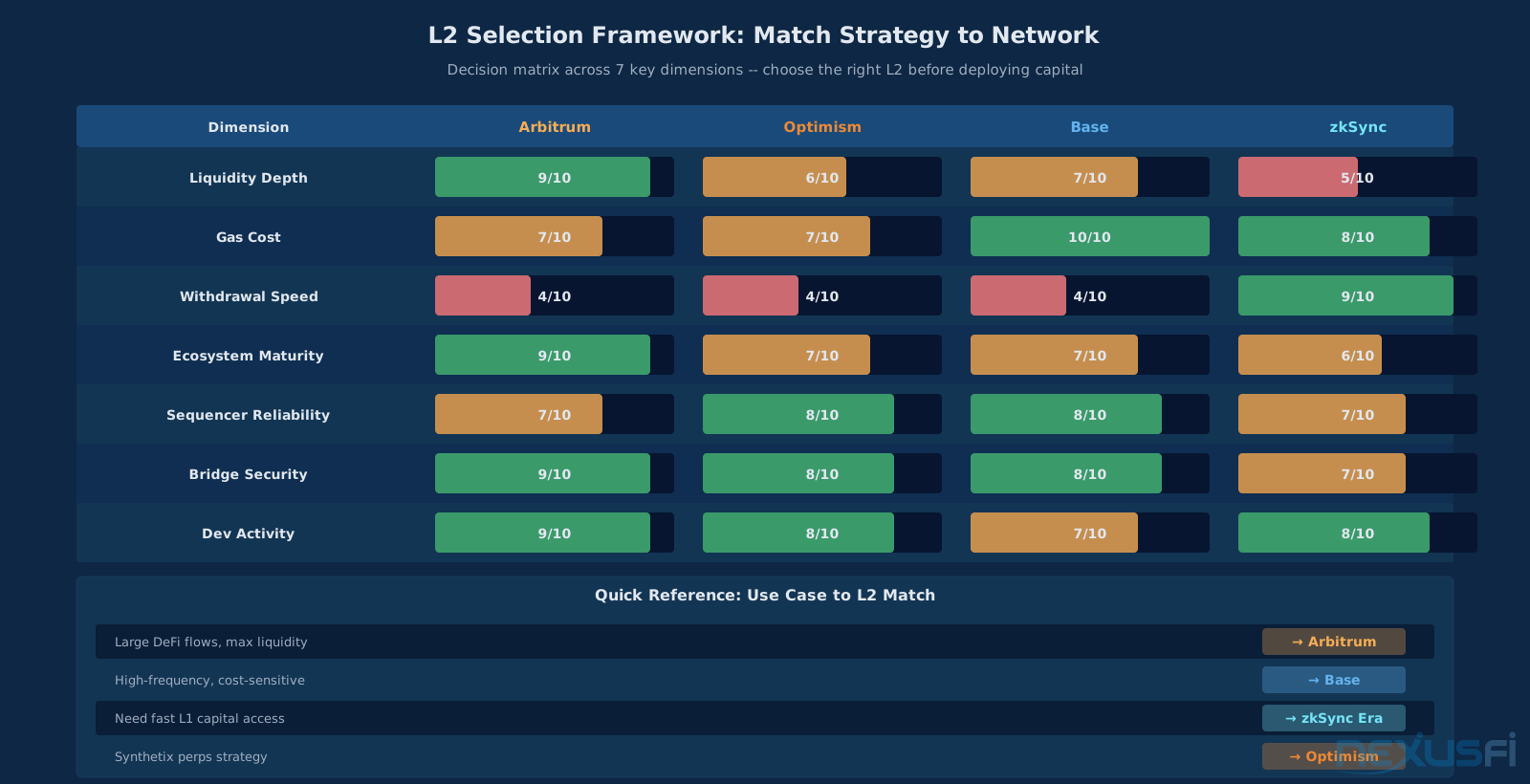
| Use Case | Best L2 |
|---|---|
| Maximum liquidity for large DEX trades | Arbitrum |
| Lowest gas costs, high frequency | Base |
| Fast L2→L1 capital movement needed | zkSync Era |
| Synthetix/synthetic assets strategy | Optimism |
| Memecoin trading and social tokens | Base |
| Cross-L2 yield optimization | Arbitrum (start here) |
This isn't a permanent ranking — ecosystem dynamics shift. Monitor TVL trends on DeFiLlama. Where TVL is growing, liquidity is improving. Where it's stagnant or shrinking, be cautious about pool depth assumptions.
Knowledge Map
Go Deeper
Build on this knowledgeReferences This Article
Articles that build on this topicCitations
- — Cryptocurrency Trading Platforms (2021)“You are trading live, on-chain (i.e., all trades are auditable transaction on the Ethereum blockchain). Ethereum transaction fees are high right now, but if you trade using limit orders, there's no transaction fee.”
- — Cryptocurrency Trading Platforms (2021) 👍 3“Yes, there is contract risk with every DeFi platform. 1. There could be a hack/exploit of the contract, and someone could steal your funds. 2. There could be an unanticipated problem with the contracts, and your funds could be locked up or made inaccessible.”
- — Cryptocurrency Trading Platforms (2021) 👍 2“I think the 'average liquidity' column is supposed to give a sense of the quality of liquidity / fills.”
- — Tezos (XTZ) -- the self-governing, smart contracts, DeFi capable coin (2021) 👍 4“LOL, this is highlighting that gas fees on Ethereum are completely out of control whereas on Tezos they are unbelievably inexpensive!”
- — Is there any realistic non-standard path to near-zero taker cost for a live crypto order-book strategy? (2026) 👍 1“venues that advertise 0% fees often compensate with unstable or artificially widened spread conditions, which can be even worse than paying a normal explicit commission.”
- — Webinar: Ethereum Futures from CME Group (2021) 👍 3“Market makers are necessary to close the bid ask spread. Retailers alone, no matter how much demand they may have, can't provide the liquidity needed for a new derivatives contract to succeed.”
- L2Beat — L2Beat -- Layer 2 TVL and Risk Metrics (2025)
- Ethereum Foundation — EIP-4844: Shard Blob Transactions (Dencun Upgrade) (2024)
- Across Protocol — Across Protocol -- Fast Ethereum L2 Bridge (2024)
- Rekt News — Rekt -- The DeFi Exploit Leaderboard (2024)
- Ethereum Foundation — Ethereum.org -- Layer 2 Scaling (2025)