



NEAR Protocol (NEAR): The Sharded Layer-1 Every Crypto Trader Needs to Understand
Overview #
NEAR Protocol is a sharded Layer-1 blockchain built around one architectural bet: that splitting transaction execution across parallel shards produces better scalability than making a single chain faster. The chain delivers low fees (approximately $0.001 per transaction), fast finality (1-2 seconds), and an EVM-compatible execution layer called Aurora that allows Ethereum developers to deploy code without rewriting it. For traders, the technology architecture matters less than what it enables: real network activity, a DeFi ecosystem generating measurable volume, and a capital bridge to Ethereum whose flows are publicly trackable.
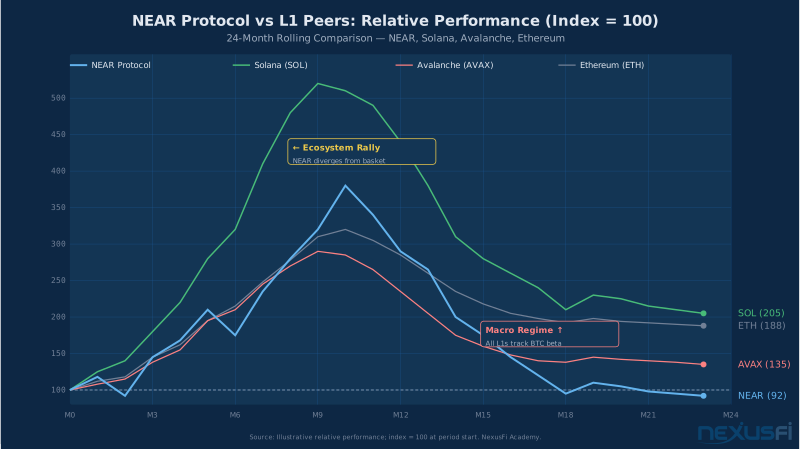
NEAR trades as a high-beta Layer-1 altcoin. During altcoin seasons when Bitcoin dominance falls below 40%, NEAR has the potential to much outperform the L1 basket. During macro-driven drawdowns, it correlates tightly with Bitcoin and sells off harder. Identifying which regime you're in determines whether you trade NEAR for ecosystem alpha or treat it as leveraged crypto beta. That single distinction is the foundation of every NEAR trade that makes sense.
This guide covers the three components that drive NEAR's price — Aurora EVM, Rainbow Bridge capital flows, and native DeFi ecosystem activity — along with a practical on-chain monitoring framework, regime detection methodology, and position sizing adjustments for NEAR's thinner order book depth relative to ETH and SOL. The goal is to give you tradeable signals from the on-chain data that chart analysis alone cannot provide.
What NEAR Protocol Actually Is #
NEAR Protocol is a Layer-1 blockchain built around one core premise: scale by splitting the chain into parallel shards rather than making a single chain faster. The result is low fees, consistent throughput under load, and an execution environment designed to attract developers who find Ethereum too expensive and Solana too opaque.
For traders, none of that matters unless it generates actual network activity. And that's where NEAR's story gets interesting. The chain has a working EVM compatibility layer called Aurora, a live cross-chain bridge to Ethereum called Rainbow Bridge, and a DeFi ecosystem that generates real volume. Those three components — the bridge, the EVM layer, and the native DeFi protocols — are the levers that drive NEAR's price. Not the technology narrative.
NEAR trades as a high-beta Layer 1 altcoin. During risk-on altcoin seasons, it can much outperform Bitcoin and even other major L1s. During macro-driven drawdowns, it tracks the L1 basket closely. Knowing which regime you're in determines whether you trade NEAR for idiosyncratic alpha or treat it as leveraged beta. That distinction is the whole game.
The Architecture: Why Nightshade Matters to Traders #
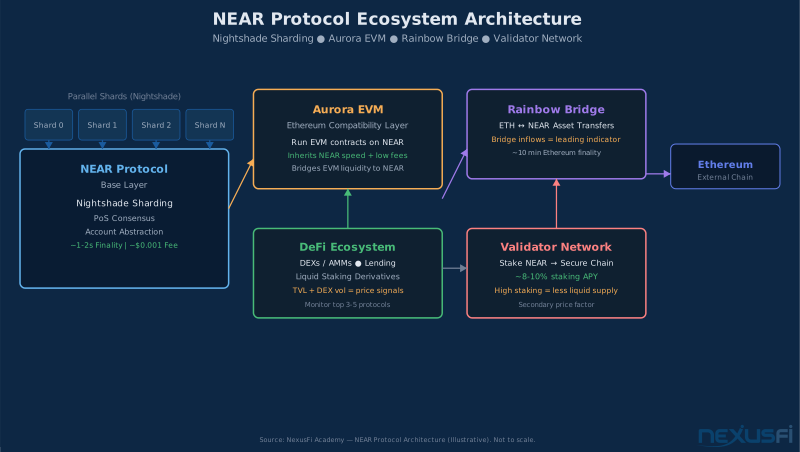
NEAR's scaling approach is called Nightshade sharding. Instead of processing all transactions on a single chain, the network splits state and execution across multiple shards running in parallel. Each shard handles a subset of accounts and contracts. The protocol coordinates cross-shard communication through a receipt system that routes results between shards.
What this means in practice: NEAR doesn't have a single-chain throughput ceiling. As demand grows, more shards can activate to absorb it. The theoretical benefit is fee stability and consistent confirmation times even during volume spikes — the exact situation where monolithic chains like pre-L2 Ethereum struggled badly.
The practical implications for DeFi traders are direct. When fee stability holds under congestion, swap execution remains predictable. Predictable execution attracts liquidity providers. Stable liquidity supports tighter DEX spreads. Tighter spreads make NEAR-native DeFi competitive with alternatives. That's the chain from architecture to capital attraction that NEAR is betting on.
Finality on NEAR runs approximately 1-2 seconds for transaction confirmation. Fees average around $0.001 per transaction. Both figures are competitive with Solana, which has faster raw throughput but has historically experienced congestion-related reliability issues at load peaks. The comparison that matters isn't which chain looks best on a benchmark spreadsheet — it's which chain keeps working when actual volume hits.
The PoS consensus model means validators stake NEAR to secure the chain and earn rewards. This is covered in the tokenomics section, but the architecture point is that PoS + sharding together determine NEAR's cost structure. Low validator overhead translates to low fees. Low fees enable high-frequency DeFi interactions that generate volume — and volume is what you're ultimately trying to trade against.
Aurora EVM: The Ethereum Developer Magnet #
Aurora is an EVM-compatible execution environment that runs on top of NEAR. A developer who built a Uniswap fork or an Aave clone for Ethereum can deploy the same code on Aurora with minimal changes. The application inherits NEAR's speed and fee structure while retaining EVM tooling compatibility.
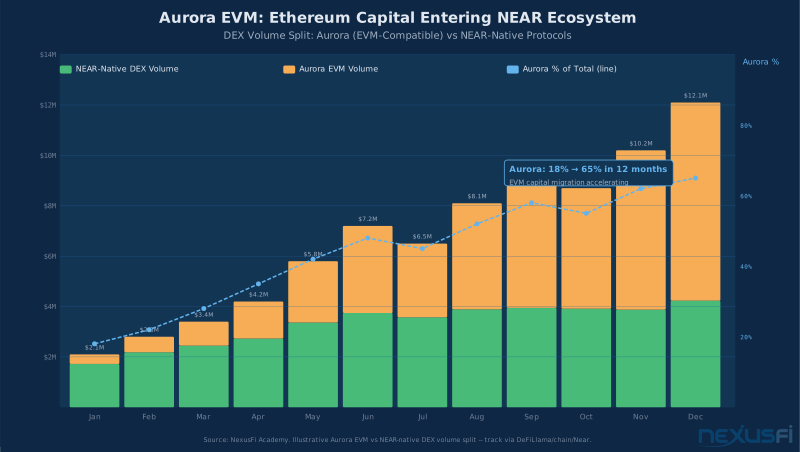
Why this matters for traders: Aurora is NEAR's primary mechanism for capturing liquidity that originated in the Ethereum ecosystem. When DeFi users on Ethereum face $30 swap fees during periods of congestion, Aurora becomes attractive as an alternative. Bridge some USDC via Rainbow Bridge, swap on an Aurora DEX, bridge back if needed. The entire operation is dramatically cheaper than staying on Ethereum L1.
Aurora activity shows up in on-chain metrics as DEX volume and stablecoin inflows. These metrics are trackable. When Aurora's DEX volume rises as a percentage of total NEAR ecosystem activity, it signals that capital from the EVM world is actively entering — a leading indicator of demand for NEAR the token, since fees on Aurora are ultimately paid in NEAR.
The friction point is that Aurora adds a layer of abstraction. Users who experience a problem on an Aurora DEX are dealing with NEAR infrastructure through an EVM interface — support is more complex, and edge cases around bridging and settlement can catch users off-guard. This doesn't kill the use case, but it means Aurora's user experience is slightly more complicated than native NEAR, which is something DeFi protocols building on it have to manage.
Rainbow Bridge: The Capital Flow Signal You Can Actually Track #
Rainbow Bridge connects NEAR and Ethereum. Assets can move between chains in both directions. The bridge operates with Ethereum-level security because it relies on Ethereum's own consensus for finality on the ETH side — transactions waiting for finality can take up to 10-16 minutes in each direction. That's the security tradeoff: slower bridging, but cryptographic security rather than a committee of validators.
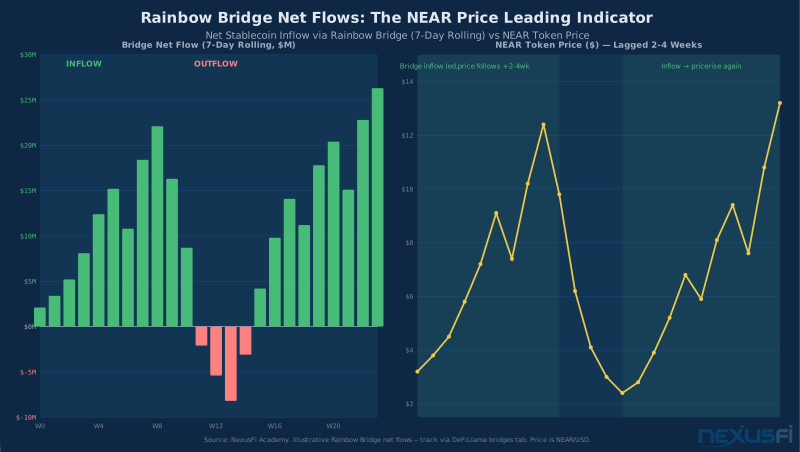
For traders, Rainbow Bridge is a data source, not just an infrastructure component. When net stablecoin inflows via the bridge are rising, capital is migrating into the NEAR ecosystem looking for yield or liquidity opportunities. These flows typically precede increases in DEX volume on NEAR-native protocols and Aurora. DEX volume upticks tend to correlate with price appreciation. The sequence is traceable: bridge inflows → increased on-chain activity → demand for NEAR to pay fees and provide liquidity → price support or appreciation.
The inverse is also true. When bridge flows reverse — net outflows dominate — capital is leaving the ecosystem. This often precedes or accompanies price weakness, especially if the outflows are concentrated in stablecoins (indicating yield-seeking capital exiting rather than just profit-taking in NEAR itself).
Bridge data is public on-chain and tracked by analytics platforms. DeFiLlama maintains a bridge flow tracker that shows net capital movement across major cross-chain bridges including Rainbow. Making this a part of your NEAR monitoring routine is straightforward — and it gives you an edge that pure chart analysis doesn't.
DeFi Ecosystem: What Actually Drives Price #
The DeFi protocols on NEAR — both native and Aurora-based — are the proximate drivers of NEAR price. Token price isn't driven by the technology architecture; it's driven by whether people are actually using the chain and for what purpose.
The NEAR DeFi environment covers DEXs and AMMs for spot trading and stablecoin liquidity, lending and borrowing protocols that generate interest rate markets, and liquid staking derivatives that allow staked NEAR to remain usable as collateral. The relative size and activity of each category changes over time as incentive programs launch and expire, as new protocols compete for liquidity, and as yields shift relative to alternatives on other chains.
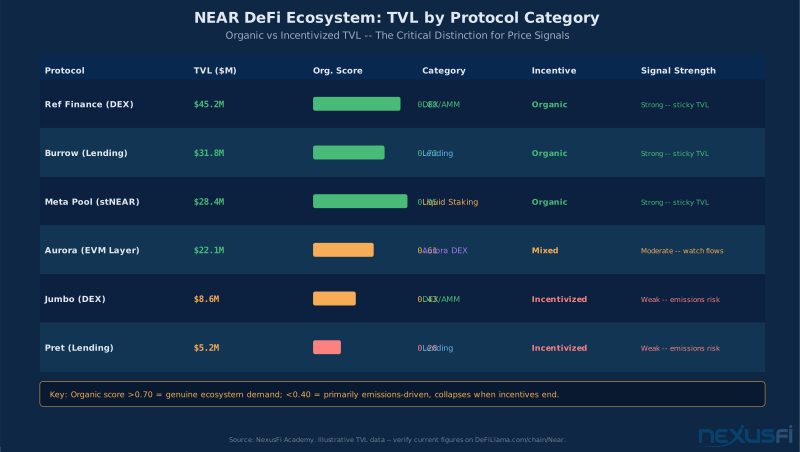
The practical monitoring approach: identify the top 3-5 protocols by TVL on NEAR + Aurora (DeFiLlama shows this broken down by chain). Track their 30-day TVL trend and 24-hour DEX volume. Rising TVL with rising volume signals genuine ecosystem growth — both demand for the protocol's services and the capital to provide those services are increasing simultaneously. Flat or falling TVL with high volume often signals yield farms being harvested rather than new capital formation.
One nuance that matters: ecosystem-driven price moves are sustainable when TVL growth is driven by non-incentivized capital. When growth is primarily driven by emissions-funded yield farming, the TVL collapses when the emissions stop, and so does the demand that was supporting it. For medium-term positioning, distinguishing between real DeFi adoption and yield-farming-driven TVL is the difference between participating in a genuine ecosystem trend and getting caught in a farm-and-dump cycle.
How NEAR Trades: Beta, Regimes, and Liquidity #
NEAR is a high-beta Layer 1. That statement has specific, actionable meaning.
High beta means that when the broader crypto market — measured by Bitcoin and the major L1 basket — moves 10%, NEAR tends to move more. In bull markets this creates outsized gains. In drawdowns it creates outsized losses. A trader who bought NEAR in November 2021 expecting it to track Bitcoin's drawdown was in for a painful education. NEAR dropped further, faster, than BTC, and recovered more slowly through the bear market.
@Fluid Fox captured the patience required for alt season timing in March 2021, charting altcoin dominance in real time:
@"Alt season is taking longer than I thought it would to arrive. But just look at these charts — very bullish."
This beta relationship dominates during macro-driven regimes. When the Federal Reserve is raising rates aggressively and risk assets are selling off broadly, NEAR correlates tightly with BTC and the L1 basket. Ecosystem-specific catalysts — new protocol launches, bridge volume upticks, Aurora developer adoption — stop mattering. The price action is dominated by global risk appetite, not NEAR's fundamentals.
Members in the NexusFi trading community have written extensively about altcoin dynamics. @Fluid Fox documented the Bitcoin dominance chart dynamic in early 2021:
@""This is the Bitcoin dominance chart. When the alt-coins rally, it tanks, of course.""
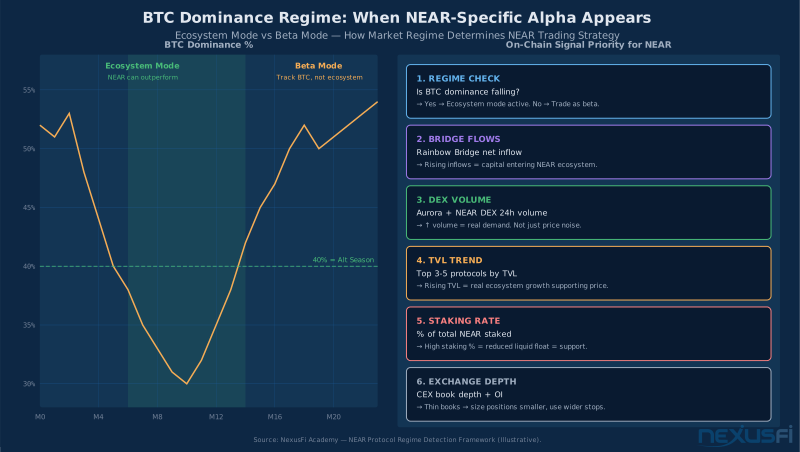
That's the regime signal. BTC dominance falling means capital is rotating from BTC to altcoins. During those windows, NEAR-specific catalysts can drive genuine outperformance. BTC dominance rising means the opposite — capital is consolidating in BTC, and altcoins including NEAR trade on beta, not fundamentals.
Key Regime Rule: Below 40% BTC dominance, NEAR-specific catalysts can drive genuine outperformance. Above 40%, NEAR trades as leveraged beta — check Bitcoin dominance first, every time, before acting on any NEAR ecosystem signal.
@Fluid Fox captured this rotation dynamic directly in May 2021:
@""Altcoin dominance is 60% (relative to BTC, which is 40% of the market).""
The liquidity profile compounds this. NEAR is thinner than ETH and SOL. Order book depth on major exchanges is lower. This means that position sizing errors get punished more severely. A size that works fine in ETH becomes dangerous in NEAR because bid/ask spreads widen faster under selling pressure and slippage on large orders can be significant. The flip side is that thin order books can amplify upside moves when buyer conviction is strong — the same illiquidity that hurts you on the way down accelerates price on the way up.
NEAR vs ETH, SOL, and Avalanche: The Honest Comparison #
Traders who come from futures and equities often ask: why NEAR over Solana, or why not just trade ETH? These are reasonable questions that deserve specific answers rather than vague ecosystem claims.
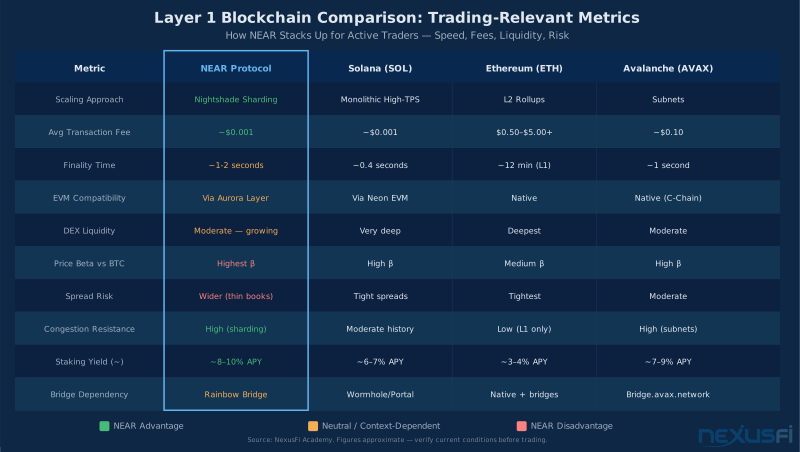
Against Solana (SOL): SOL has deeper order book liquidity, faster raw transaction throughput (~0.4 second confirmation vs NEAR's ~1-2 seconds), and a more established DeFi ecosystem by TVL. SOL also has a track record of network outages under extreme load that NEAR has not experienced to the same degree — sharding's parallel execution is supposed to prevent the monolithic chain congestion that caused Solana's historical reliability issues. In practice this makes NEAR a more speculative bet on its architecture being proven at scale, while SOL is trading with an established user base and known reliability trade-offs already priced in.
Against Ethereum (ETH): ETH is the deepest, most liquid of the major L1s. It trades with medium beta because it's established enough that macro institutional flows matter more than altcoin rotation dynamics. NEAR offers higher potential returns during alt seasons at the cost of larger drawdowns. ETH offers more predictable behavior and tighter execution. The trade is purely expected return vs. volatility risk: NEAR is higher on both dimensions.
Against Avalanche (AVAX): Both chains compete in the "fast finality, low fees, EVM compatible" space. Avalanche uses subnet architecture rather than sharding — subnets are basically separate chains with shared security. NEAR's sharding preserves unified state across the base layer, which matters for DeFi composability (your liquidity on one NEAR protocol can interact with another without a cross-chain bridge hop). Avalanche has a longer track record and deeper ecosystem by most metrics. NEAR is the more speculative bet on sharding beating subnet architecture as the dominant scaling paradigm.
Tokenomics: Supply, Staking, and What Actually Moves Price #
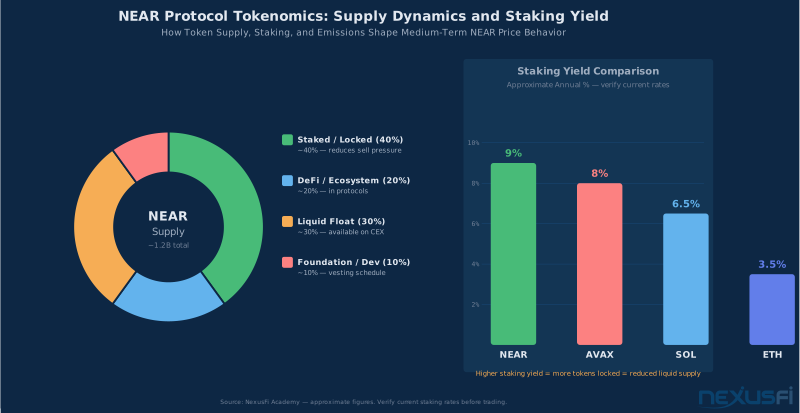
NEAR's total supply is approximately 1.2 billion tokens with ongoing inflation to fund validator rewards. The inflation rate is designed to decrease over time as network fee revenue grows relative to block rewards. In the current period, staking yield runs approximately 8-10% APY, which is competitive with most PoS alternatives.
Staking matters for traders in a specific, limited way. When a large percentage of NEAR's total supply is staked — historically in the 40-50% range — the liquid float available for trading on exchanges is reduced. All else equal, a smaller liquid float means that the same buying pressure produces more price movement upward. This creates a natural support mechanism during periods of low demand: yield-seeking stakers are reluctant to unstake unless price appreciation makes selling more attractive than continued yield, which tends to put a floor under the token during moderate drawdowns.
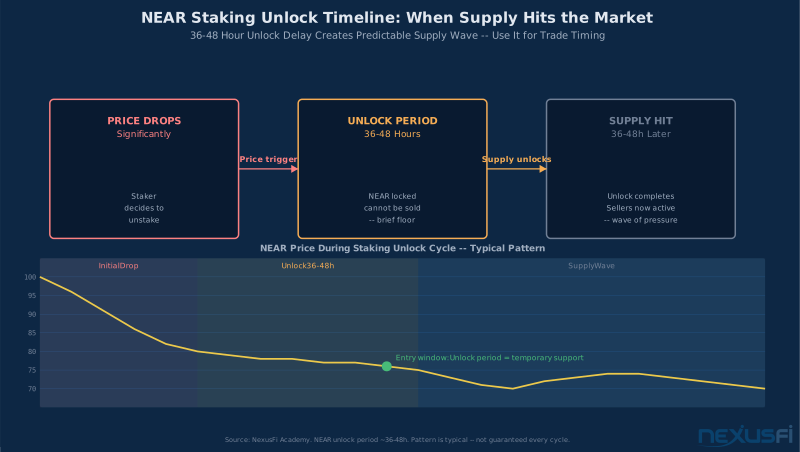
The risk runs in the other direction during strong downtrends. If price falls enough that stakers decide to unstake and sell, the unlocking period on NEAR takes approximately 36-48 hours. This creates a predictable window when supply expands — stakers who decide to sell can do so, but the unlock delay means the selling pressure arrives with a lag rather than instantly. Price often stabilizes briefly as selling is deferred, then sees a wave of pressure when unlocks complete. Understanding this mechanic helps with timing entries during sharp drawdowns.
Emission schedules and ecosystem grants create secondary supply dynamics. NEAR Foundation and ecosystem programs distribute tokens to developers, liquidity providers, and protocol participants. These distributions create predictable selling pressure from recipients who need to cover operating costs or take profits. The timing and magnitude of significant grant distributions can be tracked by monitoring NEAR Foundation announcements and on-chain wallet activity from known ecosystem wallets.
The honest framing for tokenomics: in the short term (days to weeks), ecosystem activity and macro regime dominate price. In the medium term (weeks to months), tokenomics set the backdrop. Heavy emissions relative to organic demand create ceiling pressure. Strong staking participation and real fee-based demand create floor support. Tokenomics don't predict the next 10% move; they help contextualize whether the current price level is structurally supported or running on stimulus.
On-Chain Monitoring Framework #
The monitoring framework has a strict priority order. BTC dominance first — it determines whether ecosystem signals matter at all. Then bridge flows, then DEX volume. Skip the regime check and you are analyzing NEAR signals in a context where they are noise, not signal.
Trading NEAR without monitoring on-chain data is trading blind. The price chart tells you what already happened. On-chain metrics tell you what's building underneath.
The priority framework, in order of signal quality:
1. Regime identification first. Before any on-chain analysis, determine whether you're in ecosystem mode or beta mode. BTC dominance below 40% historically correlates with periods when altcoin-specific catalysts can drive outperformance. Above 40%, save the NEAR-specific analysis for position sizing context; the primary signal is the L1 basket.
2. Rainbow Bridge net flows. Monitor net USD-denominated inflow or outflow via Rainbow Bridge over 7-day and 30-day windows. Sustained net inflows of stablecoins signal capital migration into the NEAR ecosystem. This is your primary forward-looking signal in ecosystem mode.
3. DEX volume trends. Track 24-hour and 7-day DEX volume across the top protocols on NEAR and Aurora. Volume rising with TVL rising is a bullish confirmation. Volume rising with falling TVL is a warning — activity but not capital growth, which often precedes a TVL collapse when yield incentives expire.
4. TVL composition. Total TVL is less informative than TVL composition. How much is stablecoins? How much is ETH bridged via Aurora? High stablecoin TVL means capital is looking for yield; it's utilitarian demand and can be sticky. ETH bridged means traders are actively using the ecosystem for transactions, which correlates more directly with fee demand and NEAR token demand.
5. Staking rate. Percentage of supply staked tells you the liquid float dynamics. Higher staking = more locked supply = smaller liquid market = more volatile price per unit of demand. Track this as context for position sizing.
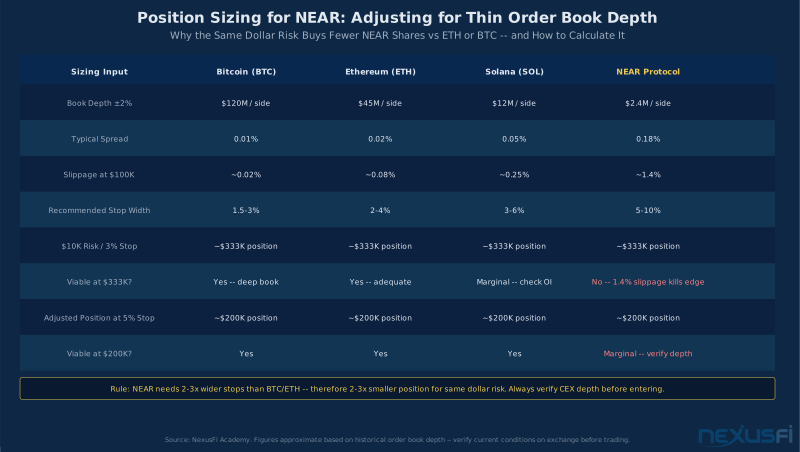
6. CEX order book depth. Check order book depth on your primary exchange before entering NEAR positions. Depth at ±2% from mid gives you a practical sense of how large a position you can build or exit without meaningful slippage. NEAR's depth is meaningfully lower than ETH and SOL, which changes the viable position sizing math.
Position sizing in NEAR needs to be calibrated to this thinner liquidity. @tigertrader outlined the core principle in a thread on risk that applies directly here:
@""If you are willing to risk 2% of your $100,000 trading account on a trade where your stop is set at 4 points ($200 per contract), then you are limiting yourself to 1 contract.""
That principle scales directly: risk a fixed dollar amount per NEAR position, and let the stop distance determine your size. With NEAR's wider spreads and thinner books, you need wider stops than you would for ETH or SOL to avoid being stopped out by noise. Wider stops mean smaller position sizes for the same dollar risk — which is exactly what the liquidity profile demands.
@Fat Tails captured the framework for sizing when the asset has unconventional characteristics:
@""The answer comes with position sizing, which is one of the most advanced concepts in trading.""
There's no shortcut to this: NEAR's thinner liquidity requires explicit position sizing methodology, not intuition calibrated on more liquid assets.
Trading Strategies and Playbooks #
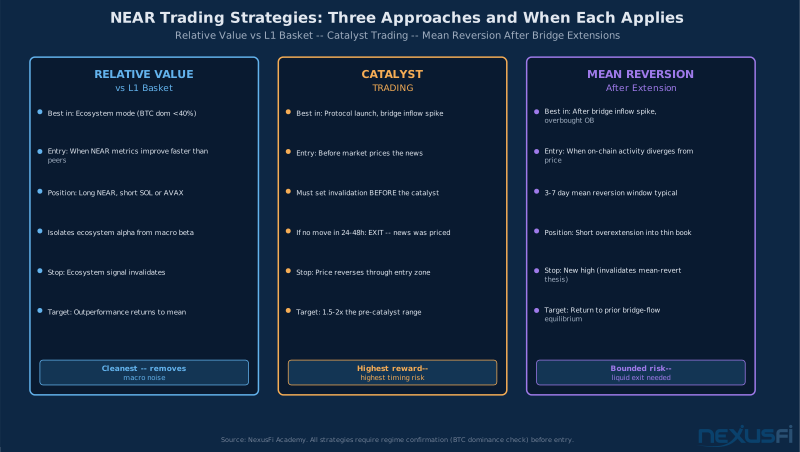
Three approaches have logical coherence for NEAR given its market characteristics:
Relative value vs L1 basket. Build a simple rolling correlation model comparing NEAR's 30-day performance against a basket of SOL, AVAX, and ETH. When NEAR's on-chain metrics (bridge inflows, DEX volume, TVL) are improving faster than peers, and BTC dominance is below 40%, NEAR should outperform. Going long NEAR against short SOL or AVAX (or the basket) isolates the ecosystem alpha from macro beta. This is the cleanest trade for traders who want NEAR exposure without pure directional crypto risk.
Trigger trading. NEAR's ecosystem produces measurable catalysts: major protocol launches, significant bridge inflow events, Aurora milestone announcements, governance upgrades. These events create entry opportunities if you can position before the broader market prices the news. The key discipline: set your invalidation level before the trigger. Ecosystem catalysts can fail to translate into sustained price appreciation — the news was priced by arbitrageurs before it was public, or the protocol launched but didn't attract organic users. A trigger that doesn't move price within 24-48 hours is telling you something. Exit the position.
Mean reversion after bridge-driven extensions. Significant bridge inflow events often cause short-term price overshoots as liquidity providers and momentum traders chase the move. These extensions into thin order book regions frequently mean-revert over a 3-7 day window as the capital that bridged in either deploys into DeFi protocols (reducing direct buy pressure) or takes early profits. Identifying these overextension points using on-chain activity vs. price divergence gives clean, bounded setups with clear invalidation.
@jamiej83 captured the fundamental truth about position sizing that applies to all three strategies:
@""DEFINE your risk without knowing your objectives. However, knowing HOW MUCH to risk is different. Position sizing has 2 key elements — 1) number of ticks risked 2) $ amount risked.""
In NEAR, "number of ticks risked" translates to understanding the asset's ATR and spread dynamics at your intended entry. $1 of NEAR price movement means something different at $3 NEAR vs. $8 NEAR. Build your risk calculation on dollar-weighted price distance, not tick counts from a futures mindset.
Risk Factors Specific to NEAR #
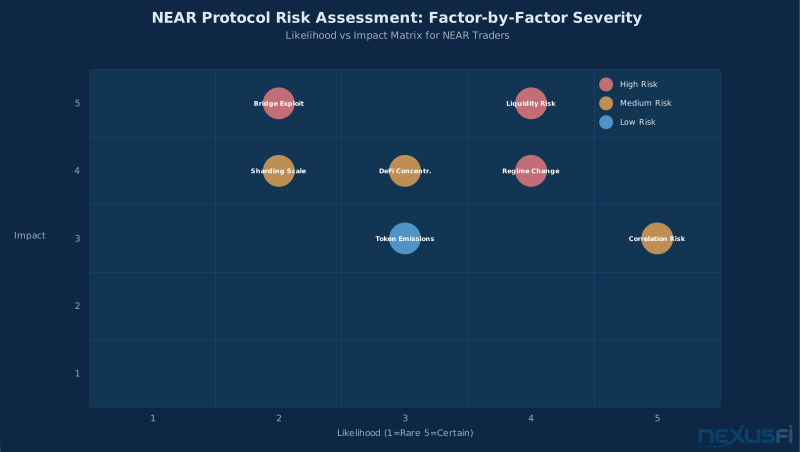
Liquidity risk is the primary one. In a fast-moving crypto market, getting out of a NEAR position at scale is harder than getting out of ETH or BTC. Emergency exits often happen at prices meaningfully worse than the quoted price when order book depth thins during panic selling. This is not a theoretical risk — it happens in every significant altcoin drawdown. Size so.
@alacrity laid out the contract risk framework for DeFi platforms in the NexusFi Cryptocurrency forum:
@"Yes, there is contract risk with every DeFi platform. There could be a hack/exploit of the contract, and someone could steal your funds. There could be an unanticipated problem with the contracts, and your funds could be locked up or made inaccessible."
Bridge risk is structural. The Rainbow Bridge's security relies on Ethereum finality. A successful exploit of the bridge's smart contracts could allow an attacker to drain bridged assets. This has happened to other bridges in the crypto ecosystem with significant TVL losses. While NEAR Foundation maintains security bounty programs and regular audits, bridge risk is real and should inform how much of your NEAR ecosystem exposure is in assets that went through the bridge versus native NEAR holdings.
Correlation risk operates both ways. During altcoin rallies, NEAR's high beta is your friend. During macro stress, it becomes amplified exposure to the crypto selloff. If your broader portfolio already has significant crypto beta — through BTC, ETH, or other L1s — adding NEAR increases concentration rather than diversification. The correlation between NEAR and the broader crypto market is high enough that NEAR is portfolio diversification only if you're diversifying from a non-crypto base.
Sharding at scale is still being validated. Nightshade is architecturally sound on paper, but the production environment for blockchain systems often reveals failure modes that testing doesn't. As NEAR's user base and transaction volumes grow, the sharding system will face load conditions it hasn't been tested under at ecosystem scale. This is a risk on the infrastructure side that exists regardless of market conditions.
Finally, @Fluid Fox's observation from March 2021 remains relevant for all high-beta altcoins:
@""BTC is pretty much all over the news at this point. I wouldn't be surprised to see a huge correction soon, and I'll be taking a lot of heat then.""
When BTC corrects sharply, NEAR corrects harder. Plan for that scenario explicitly in your risk management before entering any meaningful NEAR position.
What Makes NEAR Worth Trading At All #
The honest case for NEAR as a trading vehicle rests on three things. First, the architecture is coherent: sharding is a credible long-term scaling approach, Aurora is a real bridge to Ethereum developer liquidity, and Rainbow Bridge provides trackable capital flows that higher-quality assets (BTC, ETH) don't offer to the same degree. Second, the ecosystem is live and generating measurable activity — TVL, DEX volume, and bridge data are real numbers, not projections. Third, the market is liquid enough for retail and institutional-retail traders to participate meaningfully, even if position sizes need to be calibrated to lower depth than the major L1s.
The risk is the standard high-beta altcoin risk: larger drawdowns than BTC in bear markets, execution quality that degrades faster under stress, and dependence on ecosystem growth continuing rather than plateauing. NEAR is not a defensive position. It's a bet that the sharded Layer 1 thesis scales, Aurora captures meaningful EVM developer flow, and the DeFi ecosystem on NEAR grows into something that generates organic, non-incentivized demand for the token.
That bet has a coherent thesis. Whether the thesis plays out depends on execution over the next 2-3 years. For traders, the opportunity isn't to bet on the long-term thesis directly — it's to trade the ecosystem signals that arise as the thesis either validates or fails, using the on-chain monitoring framework and regime detection described above to stay on the right side of the larger move.
Key Resources for NEAR Research #
- NEAR Foundation -- near.org for protocol documentation and ecosystem updates
- DeFiLlama -- defillama.com/chain/Near for NEAR ecosystem TVL and bridge flow tracking
- NexusFi Academy -- Related Articles: On-Chain Analysis for Traders · DeFi (Decentralized Finance) · Stablecoins: USDT, USDC, DAI · Bitcoin (BTC) · Ethereum (ETH) · Cryptocurrency Trading Fundamentals
- NexusFi Cryptocurrency Forum -- active discussion threads on altcoin trading dynamics
Knowledge Map
Prerequisites
Understand these firstCitations
- — Becoming A Better Trader (2021) 👍 4“This is the Bitcoin dominance chart. When the alt-coins rally, it tanks, of course.”
- — Becoming A Better Trader (2021) 👍 3“Altcoin dominance is 60% (relative to BTC, which is 40% of the market).”
- — Becoming A Better Trader (2021) 👍 7“BTC is pretty much all over the news at this point. I wouldn't be surprised to see a huge correction soon.”
- — Killer Instinct and the Home Run Mentality (2011) 👍 8“If you are willing to risk 2% of your $100,000 trading account on a trade where your stop is set at 4 points ($200 per contract), then you are limiting yourself to 1 contract.”
- — Money management help pls (2013) 👍 10“The answer comes with position sizing, which is one of the most advanced concepts in trading.”
- — Concerning risk per trade sizing (2012) 👍 18“DEFINE your risk without knowing your objectives. Position sizing has 2 key elements - 1) number of ticks risked 2) $ amount risked.”
- NEAR Foundation — NEAR Protocol Official Documentation (2024)
- DeFiLlama — NEAR Ecosystem TVL and Bridge Flow Data (2024)
- — Becoming A Better Trader (2021) 👍 7“Alt season is taking longer than I thought it would to arrive. But just look at these charts.. Very bullish IMO.”
- — Cryptocurrency Trading Platforms (2021) 👍 3“Yes, there is contract risk with every DeFi platform. There could be a hack/exploit of the contract, and someone could steal your funds.”