



Alternative Data Sources for Futures Trading: What Actually Works, What Doesn't, and How to Tell the Difference
Overview #
Every futures trader starts with the same data: price, volume, time. The difference between mediocre and solid often comes down to what else you're watching. Alternative data — information sources beyond traditional market feeds — has gone from institutional luxury to a genuinely accessible toolkit for serious traders willing to do the work.
Here's the reality check upfront: most alternative data doesn't generate consistent alpha for retail traders after costs. But specific categories, applied with discipline and proper validation, can meaningfully improve your edge. This article breaks down what's actually worth your time and money, and what's expensive noise.
Key Concepts #
Alternative Data
Satellite Imagery
Sentiment Analysis
Options Flow
Weather Data
Shipping and Freight Data
Web Scraping
Alpha Decay
Signal-to-Noise Ratio
Walk-Forward Validation
What Counts as Alternative Data #
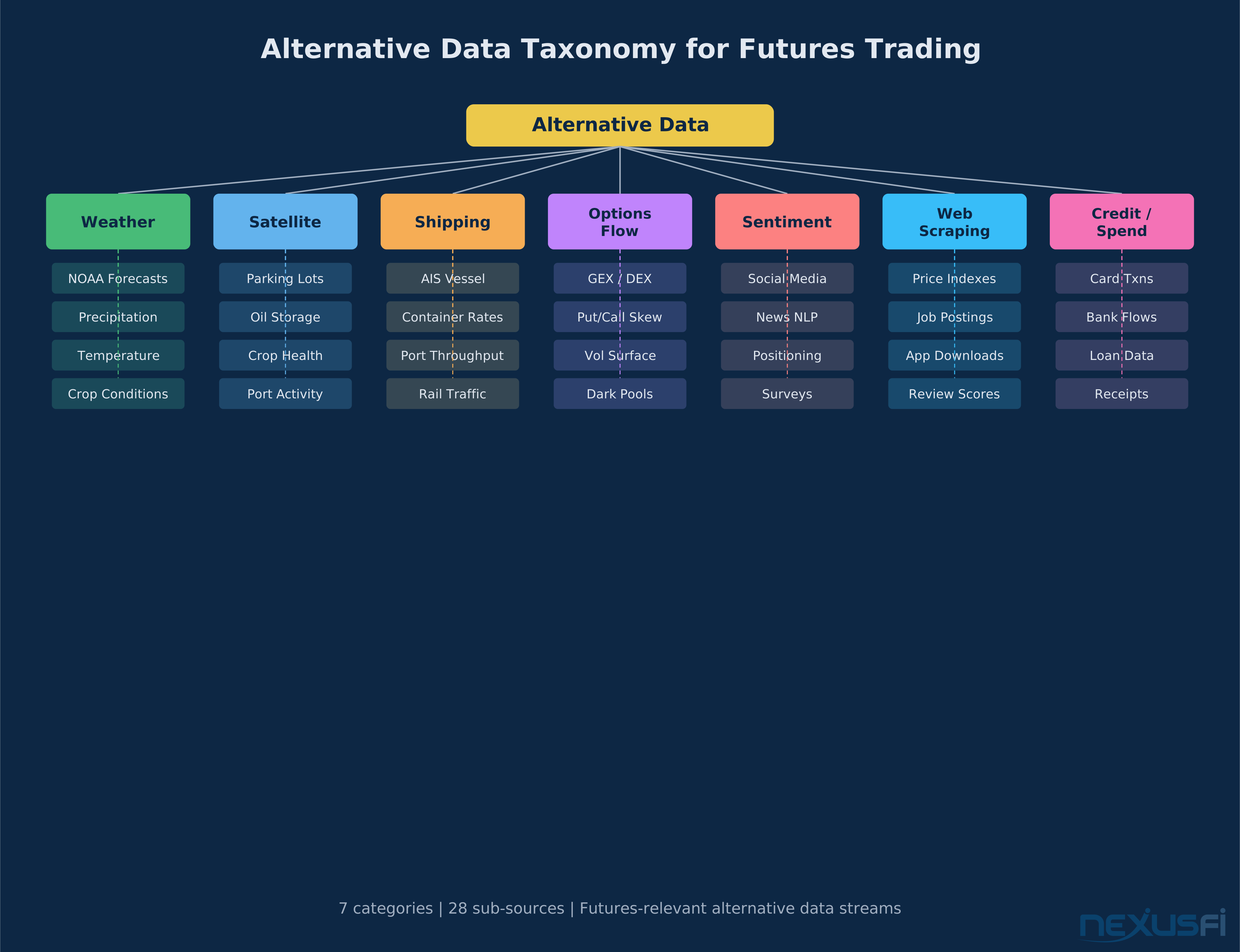
Alternative data is any information source that goes beyond standard OHLCV price feeds, exchange-provided market data, and official government releases. The categories break down roughly like this:
Physical-world signals: satellite imagery, weather data, shipping vessel tracking, port congestion metrics. These measure real economic activity — crops growing, oil moving, ships loading — before that activity shows up in official reports.
Market microstructure signals: options flow, dark pool prints, dealer positioning estimates, gamma exposure calculations. These measure what sophisticated participants are doing with their risk, which often precedes futures price moves.
Digital exhaust signals: social sentiment, web traffic, app downloads, credit card transaction aggregates, job postings. These measure human behavior at scale, sometimes before it registers in traditional economic indicators.
Hybrid signals: COT reports (which blur the line between "traditional" and "alternative"), cross-asset correlation monitors, volatility regime classifiers. These combine multiple data types into derived metrics.
The key distinction isn't exotic versus boring. It's whether the data gives you information before the market prices it in. If your sentiment feed tells you what the market already reflected two hours ago, you're paying for a rear-view mirror.
Weather Data: The Strongest Case for Retail Traders #
If you trade agricultural or energy futures, weather data is the single most defensible alternative data source available. The causal mechanism is clear, the data is often free, and the relationship between weather and commodity supply is well-understood.
What actually works:
For grain futures (corn, wheat, soybeans), NOAA provides free precipitation and temperature data. During critical growing periods — planting in April-May, pollination in July for corn, harvest in September-October — deviations from normal weather patterns directly impact yield estimates. A two-week heat wave during corn pollination can reduce yields by 15-30%, and that translates directly into futures prices.
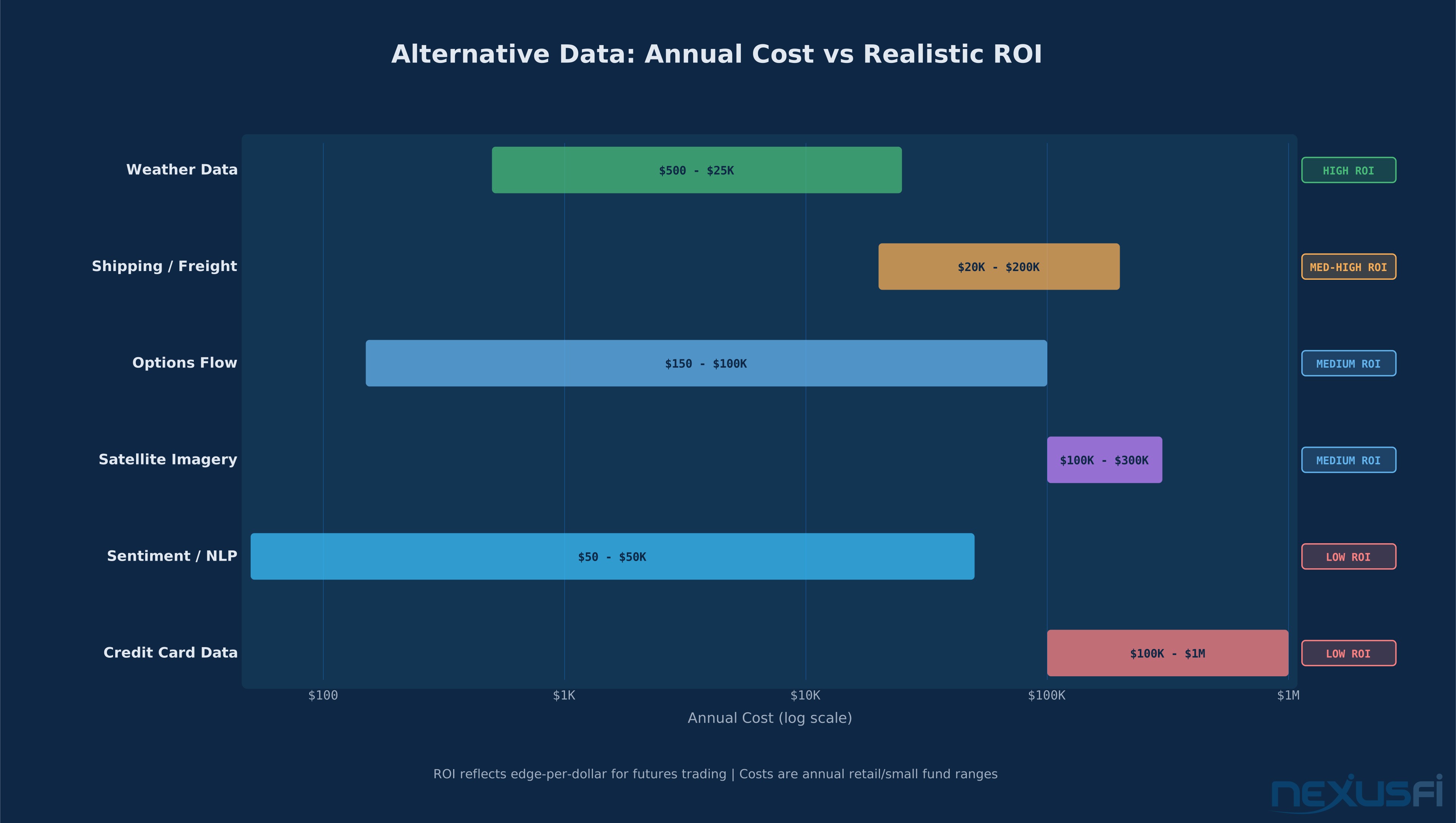
For natural gas, heating degree days (HDD) and cooling degree days (CDD) drive demand forecasts. The relationship is nearly mechanical: colder winters mean more heating demand, which draws down storage faster. Commercial products from DTN and Tomorrow.io provide high-frequency weather forecasts specifically calibrated for energy trading, typically running $500-$25,000 per year depending on resolution and forecast horizon.
Implementation reality:
The edge isn't in accessing the weather data — everyone has NOAA. The edge is in your model that converts weather readings into supply/demand impact estimates. You need a calibrated crop model (or at minimum, a regression framework) that maps temperature anomalies, precipitation deficits, and growing degree days to probable yield outcomes.
As @Fat Tails [1] notes on NexusFi regarding data interpretation: "You want to know what the different groups of traders are doing with their positions." That same principle applies to weather data — you want to know what the weather is telling you about supply before the USDA publishes its monthly WASDE report, not after.
The validation framework matters more than the data source. Walk-forward testing across multiple growing seasons, including drought years (2012) and ideal conditions (2014), will tell you whether your weather-to-yield model actually works or just fits historical noise.
Options Flow: Reading Institutional Positioning #
Options flow analysis — tracking unusual options activity, dealer gamma exposure, and implied volatility term structure changes — is the most actionable alternative data for liquid futures like ES, NQ, and CL.
The core insight: options market makers hedge their positions in the underlying futures. When large directional bets appear in the options market, they create predictable hedging flows in futures. Understanding these flows can help you anticipate short-term directional pressure and volatility clustering.
@tigertrader [2] demonstrated this on NexusFi: "The last two monthly expirations have seen turning points the Monday following OPEX, and considering we are at/near zero gamma (notional) the stage is set." That observation — zero gamma creating conditions for a directional move — is exactly the kind of signal that options flow analysis provides.
What retail traders can access:
Services like Unusual Whales ($150/month) and FlowAlgo aggregate unusual options activity and present it as alerts. These tools show large block trades, sweeps, and unusual open interest changes. The challenge is distinguishing informed flow from hedging, rolling, and liquidity-providing activity — most of what looks "unusual" is just normal institutional portfolio management.
@wldman [3] describes the practical application: "I admit to be a premium whore....selling near dated 30 delta puts has been a thing for me for years. I started using some of the flow data to confirm what I was already seeing in the options chain." That captures the right approach — options flow as confirmation and context, not as a primary signal.
Where options flow genuinely helps:
- Volatility regime detection: When dealer gamma exposure shifts from positive to negative, realized volatility tends to increase. This is well-documented and relatively persistent as a signal.
- Strike magnetism around expiration: Large open interest at specific strikes creates hedging flows that pull price toward those levels. The research on "pinning" is strong.
- Tail risk warning: Unusual put buying ahead of events can signal institutional concern before it appears in the futures price. @tigertrader [4] explains: "If you want to know how options volume translates into actionable signals, you can look at a chart of May2850 Puts. Notice the spike in volume." That spike preceded a significant move.
What doesn't work:
Following "smart money" alerts blindly. Most unusual options activity has a 50/50 success rate once you account for timing, direction, and magnitude. The edge, when it exists, comes from understanding why the flow matters mechanically (gamma hedging, volatility positioning), not from assuming every large trade is informed.
Satellite Imagery and Remote Sensing #
Satellite data was the darling of alternative data from 2015-2018, when early adopters could track Chinese steel production, Brazilian soybean acreage, and Cushing oil storage levels before anyone else. That window has largely closed — institutional adoption spread, and the signals got arbitraged.
What satellites measure:
- Crop health: NDVI (Normalized Difference Vegetation Index) measures plant stress via spectral imagery. Providers like Planet Labs capture daily global imagery at 3-5 meter resolution.
- Oil storage: Tank shadow analysis at major storage facilities like Cushing, Oklahoma. Orbital Insight pioneered this approach.
- Retail activity: Parking lot car counting at major retailers. This was popular for equity macro signals but less directly useful for commodity futures.
- Mining and construction: Activity levels at mines, ports, and industrial facilities.
Cost reality:
This is institutional-grade data. Orbital Insight, Planet Labs, and Maxar charge $100,000-$300,000 per year for commercial access, and that's before you hire the data science team to build object detection models, handle cloud cover, and maintain the preprocessing pipeline.
Retail relevance:
Close to zero for direct satellite imagery. However, several analytics firms publish derivative products — weekly crop condition indices, port activity summaries — at lower price points ($5,000-$25,000/year). These are still primarily consumed by institutional commodity desks.
The practical takeaway for retail traders: if you trade agricultural futures, the USDA's weekly Crop Progress report already incorporates satellite-derived crop condition data. You're probably better off understanding that report deeply than trying to build a competing satellite analysis pipeline.
Shipping and Freight Data: The Supply Chain Window #
Vessel tracking via AIS (Automatic Identification System) provides real-time visibility into global commodity flows. Every commercial vessel broadcasts its position, heading, speed, and cargo information, creating a massive dataset that can inform commodity futures trading.
What shipping data reveals:
- Crude oil flows: Tanker tracking services like Vortexa and Kpler monitor VLCC (Very Large Crude Carrier) movements globally. When tankers cluster at a port or reroute around a geopolitical hotspot, it signals supply disruption before it appears in EIA inventory data.
- LNG shipments: LNG tanker routes and berthing times at terminals inform natural gas pricing, especially for European and Asian benchmark contracts.
- Grain and metals: Bulk carrier movements at key export ports (Santos for soybeans, Richards Bay for coal, Port Hedland for iron ore) provide leading indicators for commodity supply.
- Port congestion: Vessel queue lengths at major ports signal logistical bottlenecks that can affect basis and delivery dynamics.
As @wldman [5] observes about data sources: "There are a few sources where you can get a 'dark' volume." The same principle applies to shipping — these data sources illuminate flows that are otherwise invisible to most market participants.
Cost and access:
MarineTraffic offers free basic vessel tracking, which is useful for manual research but insufficient for systematic trading. Commercial products from Vortexa, Kpler, and Spire run $30,000-$200,000 per year for institutional-grade feeds.
Where shipping data generates alpha:
The consensus among institutional commodity traders is that shipping data works best for basis and spread trades rather than outright directional futures. If you can identify a supply bottleneck at a specific port before it shows up in industry reports, you can trade the calendar spread or geographic basis ahead of the crowd.
Implementation challenge:
Converting vessel positions into actionable inventory estimates requires significant data engineering. You need to classify vessels by cargo type, estimate loading/unloading status from draft readings, and aggregate across multiple ports. The bridge model from "ship positions" to "expected inventory change" is where most implementations either succeed or fail.
The Alpha Decay Problem #
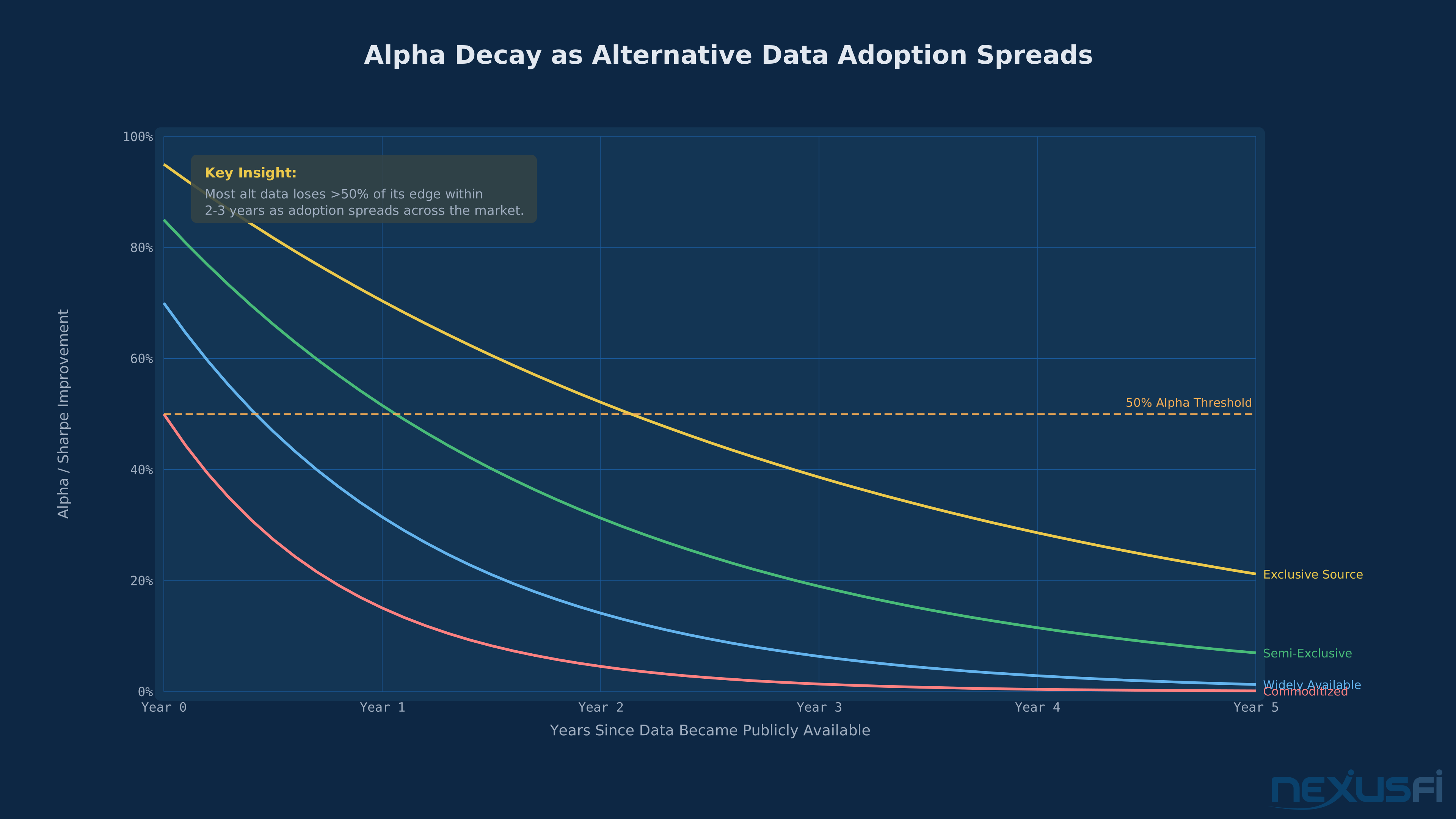
Every alternative data source follows the same lifecycle: discovery, early adopter alpha, institutional adoption, signal decay, commoditization. The typical alpha half-life is 2-3 years from when a dataset becomes commercially available.
Satellite data on Chinese steel production generated significant alpha in 2015-2016. By 2018, every major commodity fund had access to similar products, and the signal-to-noise ratio dropped below profitability for most users.
@Salao [7] captures this dynamic when discussing COT data: "Most of the time the COT report is fairly boring, it just confirms the same thing from week to week." The same fate eventually awaits most alternative data — what starts as edge becomes background noise as adoption increases.
Implications for your trading:
- Don't build your strategy around a single alternative data source. When the signal decays, your strategy dies.
- Focus on your interpretation model, not the data access. Everyone can get NOAA weather data. Few people have a calibrated crop yield model that converts it into actionable trades.
- Maintain realistic expectations about shelf life. If you're paying $50,000/year for an alternative dataset, you need to extract that value within 2-3 years before the edge erodes.
The Validation Framework That Actually Matters #
Before committing money to any alternative data source, run this validation framework. Skip it, and you'll almost certainly end up paying for expensive noise.
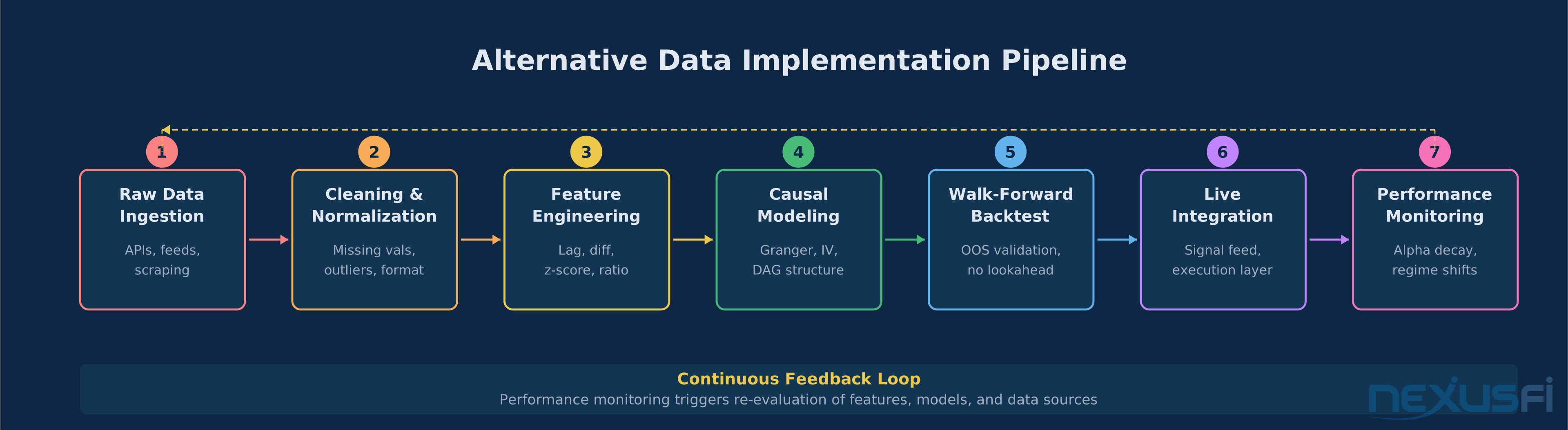
Step 1: Define the causal mechanism. What physical or economic bottleneck does this data measure? If you can't draw a clear causal chain from the data point to futures price impact, the relationship is probably spurious.
Step 2: Strict time alignment. Use publication/collection time, not the timestamp embedded in the data. The alpha is often "when you receive it," not the content itself. If your backtest uses data that wasn't available at trade time, your results are fiction.
As @Fi [8] explains about data analysis on NexusFi: "Many systematic traders find value in positioning data as a positioning context tool rather than a timing signal." That distinction — context versus timing — determines whether alternative data helps or hurts your trading.
Step 3: Walk-forward testing. Rolling windows with zero in-sample optimization. If your model only works on the data it was trained on, it's overfit and will lose money live.
Step 4: Include all costs. Data subscriptions, execution slippage, spreads, roll costs, and infrastructure overhead. A signal that generates 0.2 Sharpe improvement but costs $100,000/year needs a significant account to justify.
Step 5: Regime stability. Test across volatility environments, seasonal patterns, and macro stress periods. Weather-to-yield relationships change by crop variety and policy regime. Shipping patterns shift with trade routes. Models that work in calm markets often fail during crises.
Step 6: Incremental value. Compare performance with and without the alternative data. If your model performs equally well using only price and standard fundamentals, the alternative data is redundant — you're paying for information the market already incorporated.
Step 7: Ablation testing. Remove feature groups and re-test. Does each data source contribute independently, or are some just correlated proxies of others?
Practical Recommendations by Account Size #
Retail accounts ($10K-$100K):
Start with free or low-cost sources. NOAA weather data for agricultural futures costs nothing and has clear causal mechanisms. Basic MarineTraffic vessel tracking is free for manual research. GDELT provides free news/event data for building sentiment indicators.
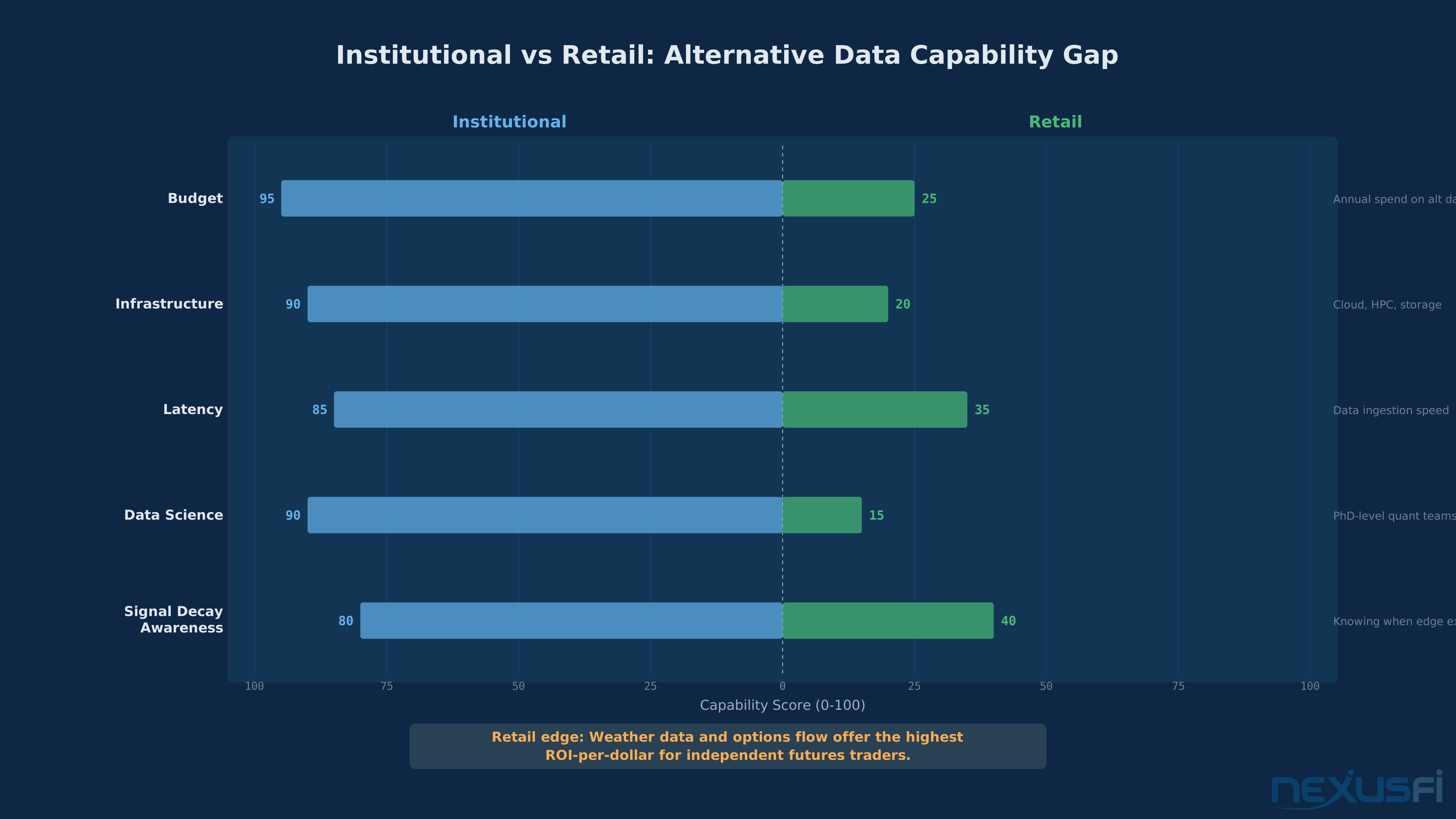
Focus on understanding one data source deeply rather than subscribing to multiple feeds. The edge isn't in data access — it's in interpretation and model quality. Most alternative data is "educational theater" for retail traders, as one institutional analyst put it — psychologically satisfying but rarely profitable after costs.
Total recommended spend: $0-$2,000/year on alternative data, with the balance invested in backtesting infrastructure and education.
Intermediate systematic traders ($100K-$1M):
Weather data ($500-$5,000/year) for agricultural futures offers the best cost-to-value ratio. Options flow alerts ($150-$300/month) for volatility awareness and regime detection, used as confirmation rather than primary signals.
Invest in backtesting infrastructure before buying more data. A proper walk-forward testing framework with transaction cost modeling will tell you more about your strategy's viability than another data subscription.
Total recommended spend: $5,000-$25,000/year on alternative data, heavily weighted toward weather and options flow.
Institutional and systematic funds ($10M+):
Multi-source integration: satellite, shipping, weather, options positioning, and specialized fundamental datasets. Dedicated data engineering for quality monitoring, latency tracking, and compliance.
Realistic expectation: 0.1-0.3 Sharpe improvement over baseline, manifesting as reduced drawdowns and better risk targeting rather than dramatic directional alpha.
Total budget: $200,000-$1,000,000+ annually, including data science headcount.
The Bottom Line #
Alternative data provides genuine but diminishing alpha when three conditions are met: the data arrives before the market prices it in, you have a strong model to interpret it, and you validate rigorously across market regimes.
For most retail futures traders, the highest-ROI investment isn't exotic data subscriptions — it's deeper understanding of the standard data you already have. Price, volume, market structure, and publicly available government reports contain enormous informational content that the average trader barely scratches.
The real edge isn't data access. It's disciplined interpretation and risk management. That was true before alternative data existed, and it'll still be true when today's novel datasets become tomorrow's commodities.
Knowledge Map
Go Deeper
Build on this knowledgeReferences This Article
Articles that build on this topicCitations
- — Commitment of traders (2010) 👍 5“Commitment of Trader is extremely useful, as it shows the market positions of different groups of traders. You want to know what the other's are doing. Extreme readings of the COT figure can be used as a sentiment indicator for countertrades.”
- — Spoo-nalysis ES e-mini futures S&P 500 (2020) 👍 23“The last two monthly expirations have seen turning points the Monday following OPEX, and considering we are at/near zero gamma (notional) the stage could be set for a turn. 2020-04-19-FLEXIBLE_GRID opex https://nexusfi.com/attachment.”
- — Spoo-nalysis ES e-mini futures S&P 500 (2020) 👍 13“Exactly right tigertrader I admit to be a premium whore....selling near dated 30 delta puts has been a thing for me for years.”
- — Spoo-nalysis ES e-mini futures S&P 500 (2020) 👍 19“If you want to know see options volume translates into actionable signals, you can look at a chart of May2850 Puts. Notice the spike in volume at 12:05.”
- — Tao te Trade: way of the WLD (2020) 👍 5“davethetrade Yeah, there are a few sources where you can get a "dark" volume. I think the CBOE has one. If looking at that is important or something you want to check out try the lemon guy Matt at www.squeezemetrics.”
- — Spoo-nalysis ES e-mini futures S&P 500 (2014) 👍 7“Two years ago I developed a Twitter scanner to look at a hundred feeds or so and parse out keywords associating them with index prices or individual sectors, in real time.”
- — COT Report? (2022) 👍 3“I've really only studied the Gold disaggregated full report, so I'm unsure if what I've learned of the COT report is transferable to other commodity reports. I suspect all the reports are similar, but I don't know for sure. So caveat emptor. :becky:.”
- — how do make use of COT to its best ability? (2025) 👍 1“Tomo22, You're absolutely right that COT reports lag - they're published Fridays with Tuesday's data, creating a 3-day delay. Despite this, many systematic traders find value in them as a positioning context tool rather than a timing signal.”
Social Sentiment: The Noise Problem #
Social sentiment analysis — scraping Twitter, Reddit, and news feeds for trading signals — is probably the most overhyped category of alternative data for futures traders.
@Big Mike [6] described his own experience on NexusFi: "Two years ago I developed a Twitter scanner to look at a hundred feeds or so and parse out keywords associating them with index prices or individual stocks." The effort required to build, maintain, and validate sentiment analysis is significant, and the payoff is uncertain.
Why sentiment mostly fails for futures:
Where sentiment has marginal value:
Provider environment:
GDELT provides free, open news/event data. Commercial providers like RavenPack and Accern charge $2,000-$50,000 per month for institutional-grade NLP analytics. Retail services like Santiment and LunarCrush cost $50-$200 per month but target crypto rather than traditional futures.