



Cryptocurrency Futures Data: CME Bitcoin, Ether, and the Market Intelligence Unique to Digital Assets
Most futures traders pull up the CME Bitcoin spec sheet, see a $340,000 notional contract with 42% initial margin, and move on. The traders who dismiss crypto futures data entirely are leaving one of the most useful sentiment and positioning datasets in markets completely unread.
Overview #
The regulated crypto futures market — primarily CME Group with ICE participation — generates data that professional futures traders should understand for three reasons. First, the data signals are genuinely different from spot crypto data. Settlement mechanics, margin dynamics, and the CF Reference Rate construction produce behaviors that don't exist anywhere else. Second, CME Bitcoin futures have become deep enough — roughly $12 billion notional traded daily in 2025 — that institutional positioning shows up clearly in CFTC data. And third, the basis between regulated futures and spot prices is one of the cleanest sentiment reads available in any market. You don't need to trade BTC to use this data.
There are two at the core different crypto futures markets, and confusing them is the #1 error traders make when reading crypto data. Regulated futures trade on CFTC-registered exchanges (CME, ICE) with standardized contracts, audited reporting, and full CFTC oversight. Unregulated perpetual swaps trade on offshore platforms (Binance, Bybit, OKX) and are roughly 10-20x larger by volume but generate no standardized, audited data. The regulated market is smaller but produces CFTC-reportable positioning data, exchange-validated prices, and clear daily settlement records. Those are what this article covers.
This article covers the data layer: what's published, how it's constructed, how to read it, and where it misleads you. It assumes familiarity with futures mechanics, open interest, and basis. If you're new to futures structure, start with Open Interest Data for Futures Trading and Exchange Data Fees and Market Data Costs before continuing.
The Regulated Crypto Futures Environment #
CME Group dominates regulated crypto futures in the U.S. Five products cover the full spectrum from nano-scale retail to institutional-grade contracts.
Bitcoin (BTC): 5 BTC per contract. At $68,000 BTC, that's $340,000 notional — institutional money only. Initial margin runs approximately 40-42% of notional (the exchange adjusts periodically based on realized volatility). You need roughly $140,000 to hold one contract. Settlement is cash: final settlement uses the CME CF Bitcoin Reference Rate (BRR) for a specific one-hour window on the expiration Friday.
Micro Bitcoin (MBT): 0.1 BTC per contract, approximately $6,800 notional at $68,000 BTC. This is where retail crypto futures trading actually happens. Fifty MBT contracts equal one standard BTC in notional terms. The Micro contract opened up regulated futures access to retail traders who couldn't swing the standard margin, and adoption has been explosive — CME reported 255% year-over-year ADV growth for MBT in 2025.
Ether (ETH): 50 ETH per contract. At $2,800 ETH, that's $140,000 notional. Initial margin: 50% of notional. Yes, 50% — CME set this higher than Bitcoin because Ethereum historically exhibits greater realized volatility, especially around major network upgrades (the Merge, EIP changes, staking yield shifts). Effective leverage: approximately 2:1.
Micro Ether (MET): 0.1 ETH per contract, roughly $280 notional. The nano-scale entry point. The fee structure makes MET expensive relative to exposure — the fee per unit of ETH exposure is 33-36x higher than the full-size ETH contract, making it costly for anything beyond occasional use.
ICE Bitcoin (BTM): 1 BTC per contract, traded on ICE Futures U.S. Unlike CME's financially-settled contract, ICE Bitcoin is physically delivered via Bakkt with $100 million of insurance. Liquidity is thinner than CME but the physical delivery mechanism matters for one specific use case: cash-and-carry trades, where you can actually deliver coins rather than cash-settling.
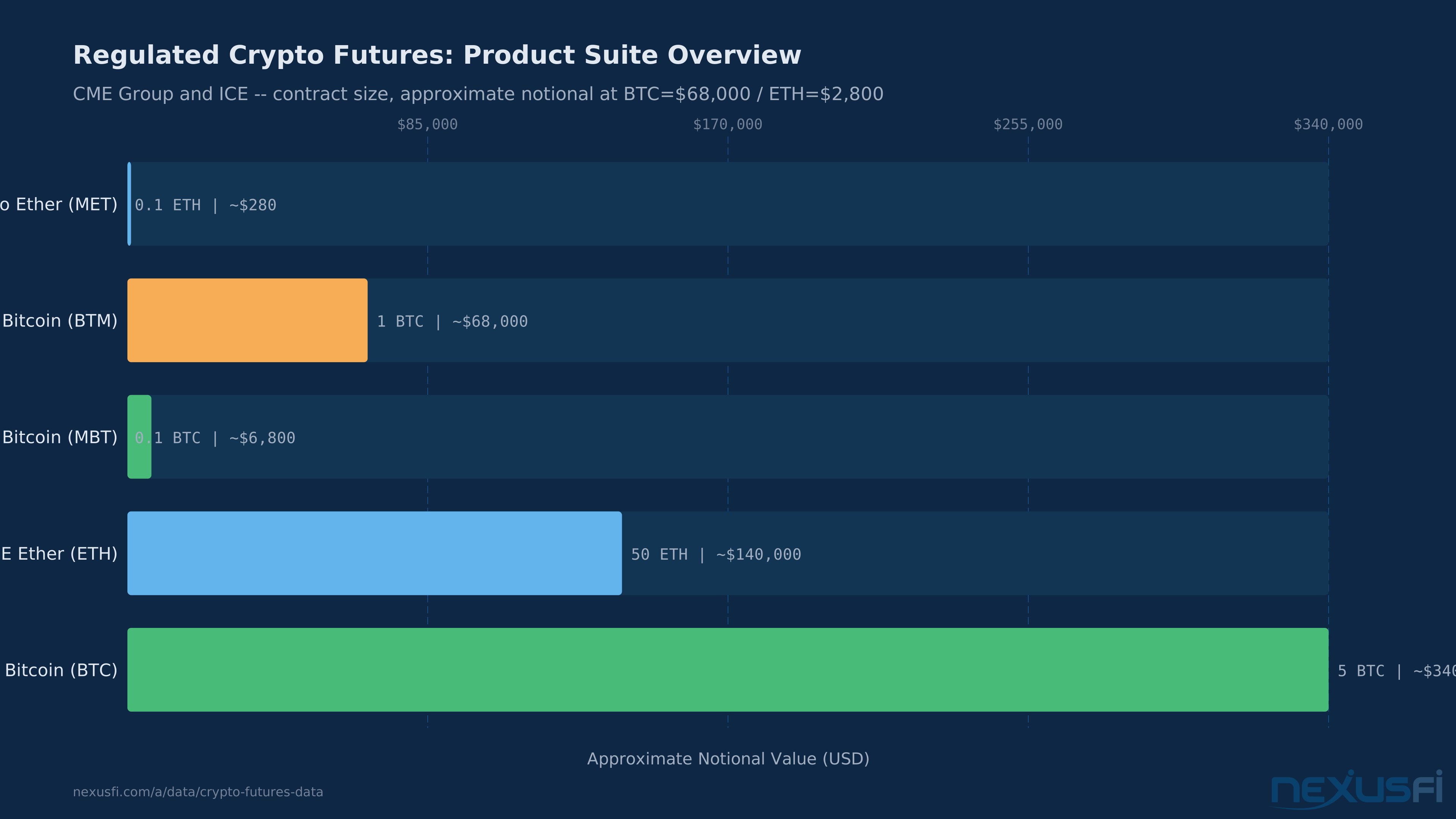
Five regulated products cover $280 to $340,000 in notional exposure. Which one you trade determines what data you generate and who you're trading against. Standard BTC is an institutional book. Micro BTC is where retail and institutional flows interleave.
CF Reference Rates: The Index Behind the Settlement #
CME and ICE don't settle crypto futures against a single exchange's price. They settle against a calculated reference rate designed to be manipulation-resistant and representative of the broader market. Understanding how these rates are constructed matters because the settlement window creates specific dynamics at expiration — and specific risks if you're holding into it accidentally.
The CF Bitcoin Reference Rate (BRR) #
The BRR is calculated once daily at 4:00 PM London time. The methodology: the one-hour observation window (3:00 PM to 4:00 PM London) is divided into twelve 5-minute partitions. Volume-weighted median prices are calculated for each partition. The BRR is the equally-weighted mean of those twelve partition medians.
The equal-weighting of partitions — rather than weighting by volume — prevents large volumes in a single 5-minute window from dominating the rate. This makes it much harder to manipulate than a simple time-weighted average price.
Constituent exchanges for BRR calculation: Bitstamp, Coinbase, Gemini, itBit, and Kraken (subject to ongoing review). Exchanges are added or removed based on compliance with CF Benchmarks' code of conduct and minimum liquidity requirements. CME publishes the current constituent list on their website.
If you're running a basis trade that settles at expiration, you're exposed to whatever happens to the BRR in that one-hour window on the expiration Friday. Liquidity concentrates in that window as market makers hedge settlement exposure. The final settlement price can deviate meaningfully from where you expected it if large positions are being unwound. Know your settlement mechanics before you let contracts expire.
The CF Ether-Dollar Reference Rate (ETHUSD_RR) #
Constructed with the same methodology as BRR but using Ether price data from the same constituent exchanges. The 4:00 PM London settlement window is identical. Ethereum's multiple major network upgrades — the Merge (September 2022), EIP changes, and staking yield shifts — contributed to the elevated 50% CME margin requirement for ETH. The network's maturation may eventually reduce this, but the current high margin reflects a history of upgrade-driven volatility spikes.
CME publishes CF Reference Rate data on a 24-hour lag for free on their website. Real-time BRR requires a CF Benchmarks subscription or prime broker access. The delayed data is sufficient for post-trade analysis and basis calculation.
Data Anatomy: What Gets Published and When #
Settlement Prices #
CME publishes daily settlement prices for all active contract months. For crypto futures, settlement is determined by a committee process referencing recent trading activity — the same process used for other CME products, not the CF Reference Rate (which is only used for final settlement at expiration).
Final settlement at expiration uses the BRR or ETHUSD_RR calculated on the expiration Friday. This is the only time the CF Reference Rate directly determines your P&L.
Volume and Open Interest #
CME publishes daily volume and OI by contract month. The critical adjustment: always convert to BTC-equivalent when comparing across contract types. Fifty MBT contracts equal one BTC contract in notional.
Looking at raw contract counts without the conversion produces a completely distorted picture of market activity.
Block trades: CME crypto products have minimum block trade thresholds. Large transactions negotiated off-screen count toward daily volume but aren't visible in real-time. A jump in end-of-day volume without corresponding screen activity usually indicates a block trade was reported.
Open Interest and the ETF relationship: Since the approval of U.S. spot Bitcoin ETFs in January 2024, CME OI is partially driven by ETF mechanics. Authorized participants (APs) use CME futures to hedge their Bitcoin inventory during ETF creation and redemption. High ETF inflow days produce mechanical OI increases that aren't speculative signals.
CFTC Commitment of Traders Report #
Bitcoin futures generate COT data in the Financial section of the CFTC report. The Leveraged Funds category is the signal — when these hedge funds and CTAs are net long at extreme levels, corrections historically follow. Flat or modestly long Leveraged Fund positioning has tended to appear at cycle lows. The correlation is real but imperfect — the Bitcoin COT report has fewer cycles than most other CFTC-covered markets.
Contract Months #
CME Bitcoin and Ether list quarterly contracts (March/H, June/M, September/U, December/Z) plus serial monthly contracts for the front few months. Liquidity concentrates heavily in the front-month contract. The bid-ask spread widens much in back-month contracts, which have thin institutional participation.
Don't roll crypto futures contracts based on calendar alone — watch the volume and OI shift between front and back months. Crypto rolls tend to be less orderly than equity index rolls because the participant base is more concentrated. Give yourself at least two weeks before expiration to execute a clean roll.
The Margin Math: Why Leverage Is Different Here #
Bitcoin futures have the highest margin requirements of any CME product — higher than the DAX, higher than Palladium, higher than anything else in the suite. This is not arbitrary. It reflects realized volatility history.
The leverage reality: At 42% initial margin on CME BTC, effective leverage is approximately 2.4:1. Compare this to ES at approximately 15:1, crude oil at 8.5:1, gold at about 5:1. Bitcoin is more leveraged than holding spot BTC — but dramatically less leveraged than any other futures product CME offers.
@SMCJB put exact numbers on it: with Bitcoin at $17,000, one CME BTC contract has $31,450 in margin on $85,000 notional — 2.7:1 leverage. In the same period, ES was running over 15:1. The "high-risk leverage" narrative around crypto futures gets it backwards when you're trading regulated products. CME crypto futures are among the lowest-leverage instruments in the futures universe.
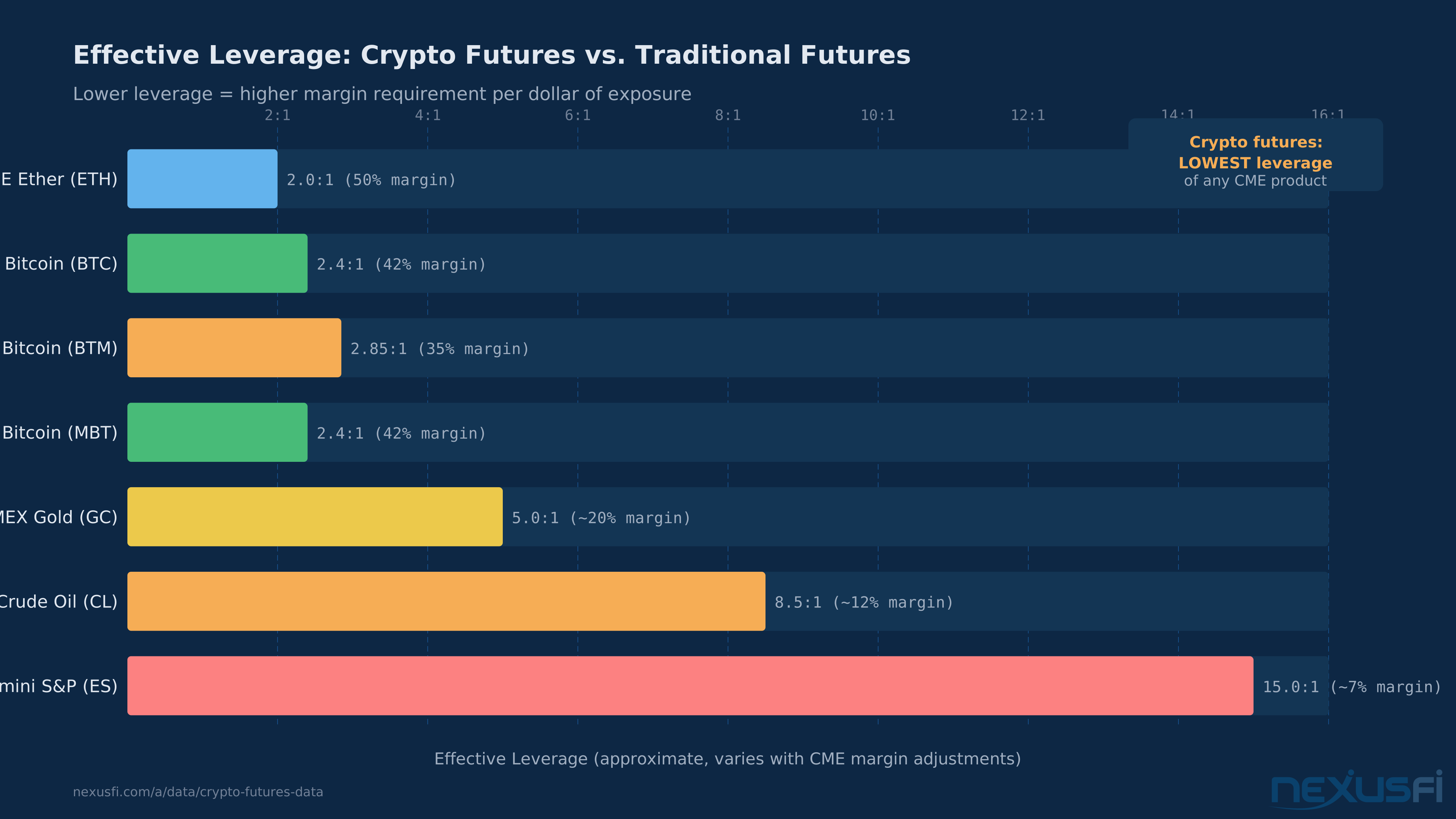
Why ETH margin is higher than BTC: CME set Ether's initial margin at 50% of notional at launch, above Bitcoin's 37-42%. @SMCJB noted the economic implication: at launch with ETH at $1,350, the 50 ETH contract had $67,500 notional and $33,750 in required margin — making it "staggering" compared to every other CME product outside crypto. ETH's higher margin reflects its greater realized volatility relative to BTC, especially around network events.
The 24/7 gap risk: CME crypto futures don't trade 24/7, but spot crypto markets do. If Bitcoin moves 20% over a weekend, you face a margin call Monday morning at 6:00 PM ET when the CME session reopens (Sunday). This gap between Friday 4:00 PM ET and Sunday 5:00 PM ET is the largest recurring gap risk in regulated futures markets.
Don't size crypto futures positions the same way you'd size equity index positions. The low leverage doesn't mean low risk — it means the underlying asset's extreme volatility is the risk. A 10% daily Bitcoin move (common in trending markets) generates the same notional P&L as a far more unusual move in ES. Size so.
Funding Rates and the Perpetual Swap Universe #
This is where regulated and unregulated market data diverges most sharply — and where understanding the relationship between them produces genuinely useful signals.
What Perpetual Swaps Are #
Most crypto trading globally doesn't happen in expiring futures. It happens in perpetual swaps — derivatives that never expire, trading on offshore exchanges (Binance, Bybit, OKX, and others). Perpetual swaps dominate global leveraged crypto trading by volume, running 10-20x the CME market.
Because they don't expire, perpetual swaps use a funding rate mechanism to anchor the swap price near spot. Every 8 hours, a payment transfers between long and short holders:
- Swap trading above spot: positive funding — longs pay shorts to hold their position
- Swap trading below spot: negative funding — shorts pay longs
The rate is calculated to push the swap price toward spot. When speculative demand is high and longs dominate, funding goes positive and longs pay a carrying cost. When fear dominates and shorts pile in, funding goes negative.
Reading Funding Rate Data #
Funding rate data is published by major crypto exchanges and aggregated by providers (Coinglass.com is the most accessible free source). The levels:
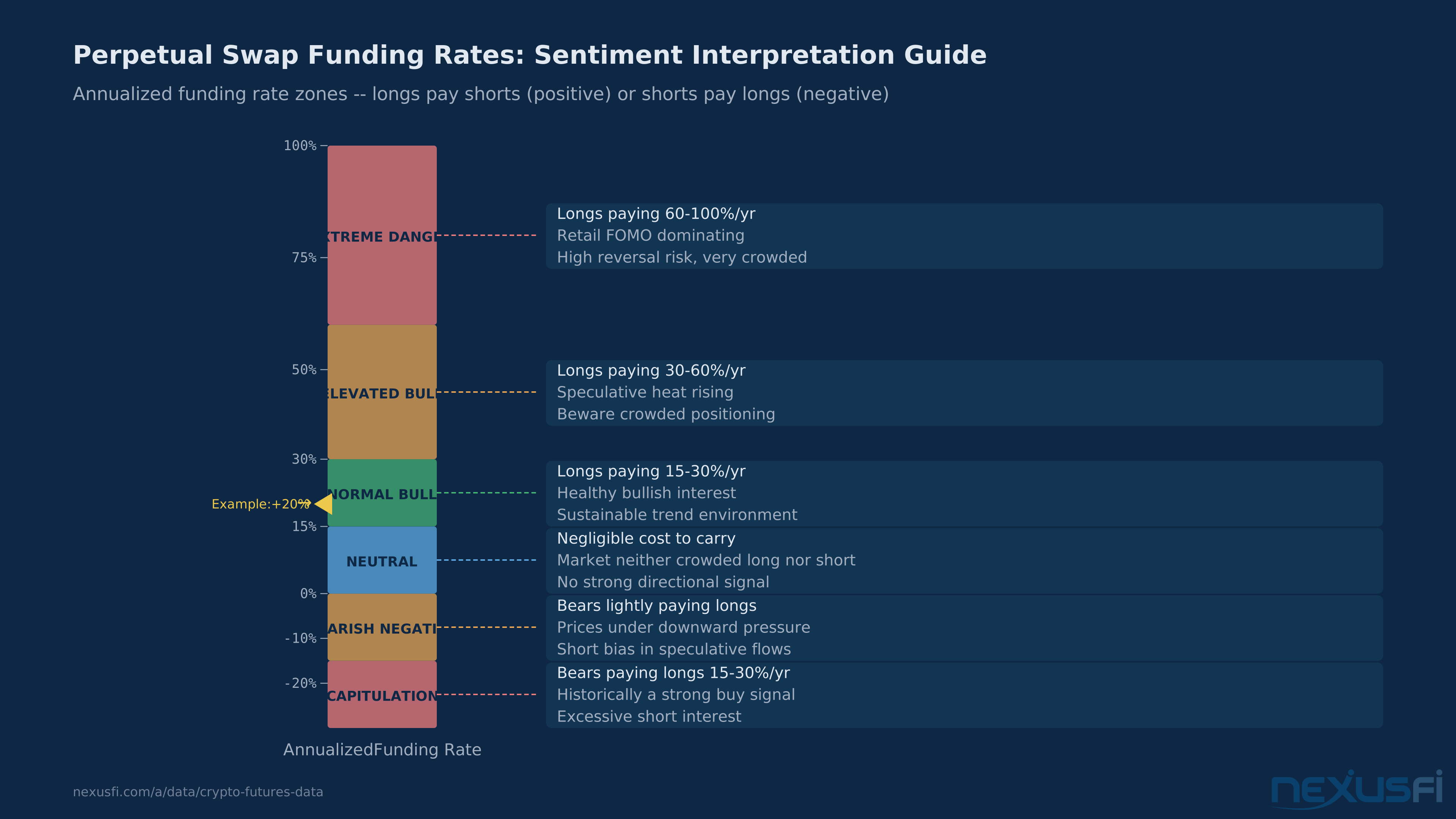
Annualized rate of 15-30%: Normal-to-elevated speculative interest. Longs are paying, but the premium isn't extreme. Typical in uptrending markets with reasonable participation.
Annualized 50-100%: Frothy. The cost of holding longs compresses risk-adjusted returns much. Retail is paying a high premium to maintain leveraged exposure. These extremes have historically preceded short-term corrections as long holders capitulate on funding costs.
Annualized -15% or below: Bears are in control and paying longs to hold exposure. Unusual and historically appears at local bottoms. Sustained negative funding is one of the more reliable reversal signals in crypto — the market is so one-sided short that longs collect yield just from holding.
For CME futures traders, funding rate data matters because: when CME futures open each Sunday evening, the price gap from Friday's close reflects what happened in the 24/7 unregulated market. High positive funding rates heading into a weekend signal crowded speculative positioning and elevated gap-down risk.
Where to Get Funding Rate Data #
- Coinglass.com: Free aggregation of funding rates across major exchanges, historical data, and charts
- CryptoQuant: Institutional-grade funding data, subscription required for deep history
- Individual exchange APIs: Binance, Bybit, OKX publish real-time funding rates via public API
Note: These are unregulated market data sources. Verify your compliance situation before using them for investment decisions if you're operating under a registered entity.
The funding rate mechanism is why perpetual swaps don't need to expire. The funding payment is a continuous transfer from the crowded side to the uncrowded side, which mechanically prevents the swap from drifting away from spot indefinitely. When you see extreme funding rates, you're seeing the market literally paying the other side to take the opposite position.
Basis, Premium, and the Cash-and-Carry Trade #
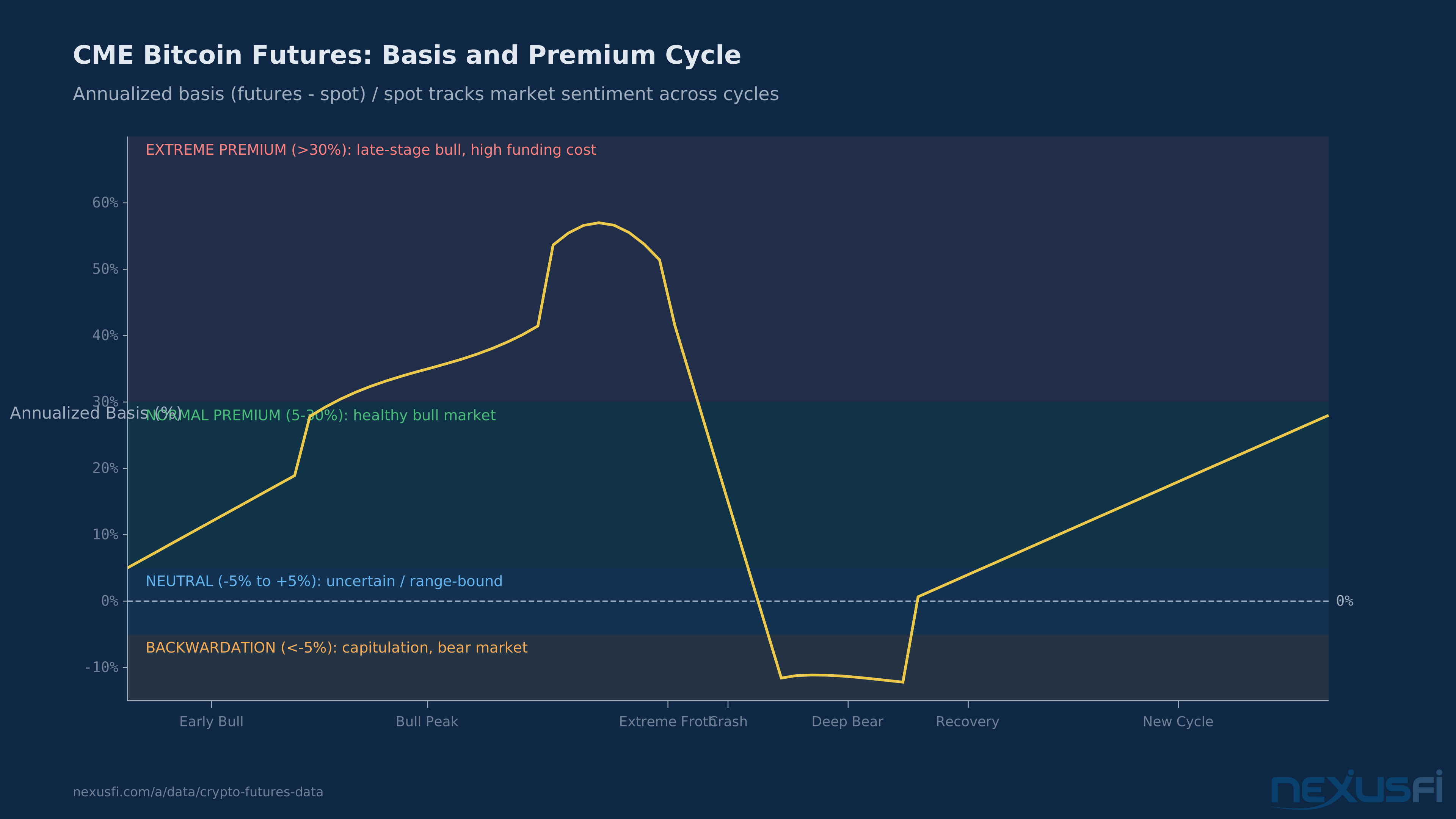
The basis — the difference between CME futures prices and spot Bitcoin prices — is one of the most actionable data signals in crypto futures. It tracks the aggregate bullishness or bearishness of institutional futures participants in real time.
How Basis Works in Crypto Futures #
In traditional futures markets, basis reflects cost of carry (interest rates, storage costs). In crypto futures, it reflects the risk premium and forward demand for exposure. The calculation: (futures price - spot price) / spot price × (365 / days to expiration) = annualized basis.
Bull markets: CME Bitcoin futures trade at a premium to spot. Annualized premiums of 15-30% were standard in 2021's bull market, meaning the futures market was pricing in a 15-30% annualized return from holding exposure. Arbitrageurs try to capture this via cash-and-carry trades.
Bear markets: The premium compresses and can invert (futures trade at a discount to spot — backwardation). Negative basis signals capitulation — institutions aren't willing to pay a premium to hold futures exposure, and shorts are crowding in.
What basis tells you: The annualized basis tracks market confidence more reliably than price alone because it measures what participants are willing to pay for future exposure rather than just what the current price is.
The Cash-and-Carry Trade: Why It's Harder Than It Looks #
The arbitrage sounds obvious: buy BTC spot, short CME BTC futures, collect the annualized basis spread risk-free.
That 135% means: if you hold $100,000 in BTC, you need another $35,000+ in margin collateral to short the CME futures leg. If BTC rallies, your futures loss triggers margin calls requiring additional cash. The trade can work at sufficiently wide basis levels, but the capital efficiency is poor compared to similar trades in traditional markets.
The basis trade in crypto futures doesn't resemble basis trading in traditional markets. There's no cross-margin between spot crypto holdings and CME futures positions. Your capital requirements are additive, not offsetting. Calculate required capital as 135% of exposure before entering this trade.
Open Interest: Reading Commitment in Crypto Futures #
The Scale of CME Crypto OI #
CME Bitcoin open interest reached approximately 300,000 contracts in 2025, up 82% year-over-year according to CME data. The critical adjustment: always convert to BTC-equivalent before drawing conclusions.
Standard BTC contracts (5 BTC each) and Micro BTC contracts (0.1 BTC each) are reported in separate contract counts. If 50,000 are standard BTC and 250,000 are Micro BTC, the BTC-equivalent open interest is: (50,000 × 5) + (250,000 × 0.1) = 275,000 BTC. The notional value depends on the current BTC price. Looking at raw contract counts treats a Micro contract as equivalent to a standard contract — a 50:1 error.
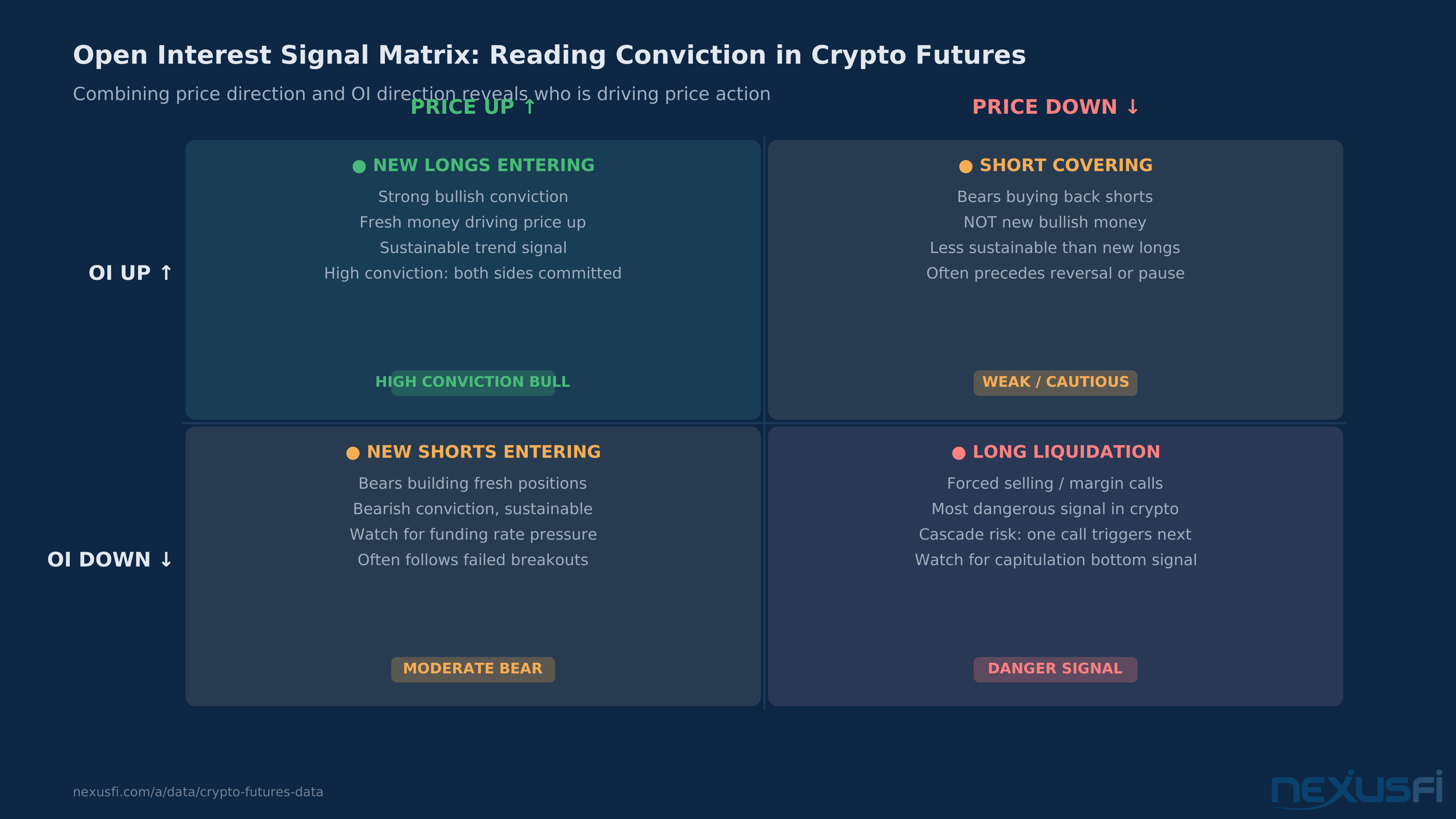
OI Trend Interpretation #
Price up + OI up: New longs entering. Genuine bullish conviction. Fresh money driving price higher — the most sustainable of the four signals.
Price up + OI down: Shorts being covered, not new longs entering. Less conviction. The move is coming from bears exiting, not bulls entering. Often a precursor to a pause or reversal once the short squeeze exhausts.
Price down + OI up: New shorts entering. Bears building fresh positions with conviction. Can be sustainable if accompanied by negative funding rates confirming the directional bias.
Price down + OI down: Long liquidation. The most dangerous signal in crypto — forced selling as margin calls trigger across leveraged positions. Crypto has no daily circuit breakers on position liquidation, so these cascades can compress into minutes. The 24/7 operation means a cascade at 3 AM London time faces no regulatory pause.
The ETF Factor #
Since January 2024, spot Bitcoin ETF authorized participants use CME futures to hedge inventory during ETF creation and redemption. When large ETF inflows occur, APs often short CME futures to hedge the BTC they've accumulated. High ETF inflow days produce mechanical OI increases that have nothing to do with speculative sentiment — these are hedge-driven, mean-reverting positions.
Check ETF flow data (published daily by each ETF sponsor, aggregated at Coinglass and BitMEX Research) alongside CME OI. ETF flow-driven OI changes are mechanical. Speculative OI changes are directional. Without separating these, your OI interpretation is mixing two completely different signals.
Volatility: Crypto's Unique Data Challenge #
The 24/7 Annualization Problem #
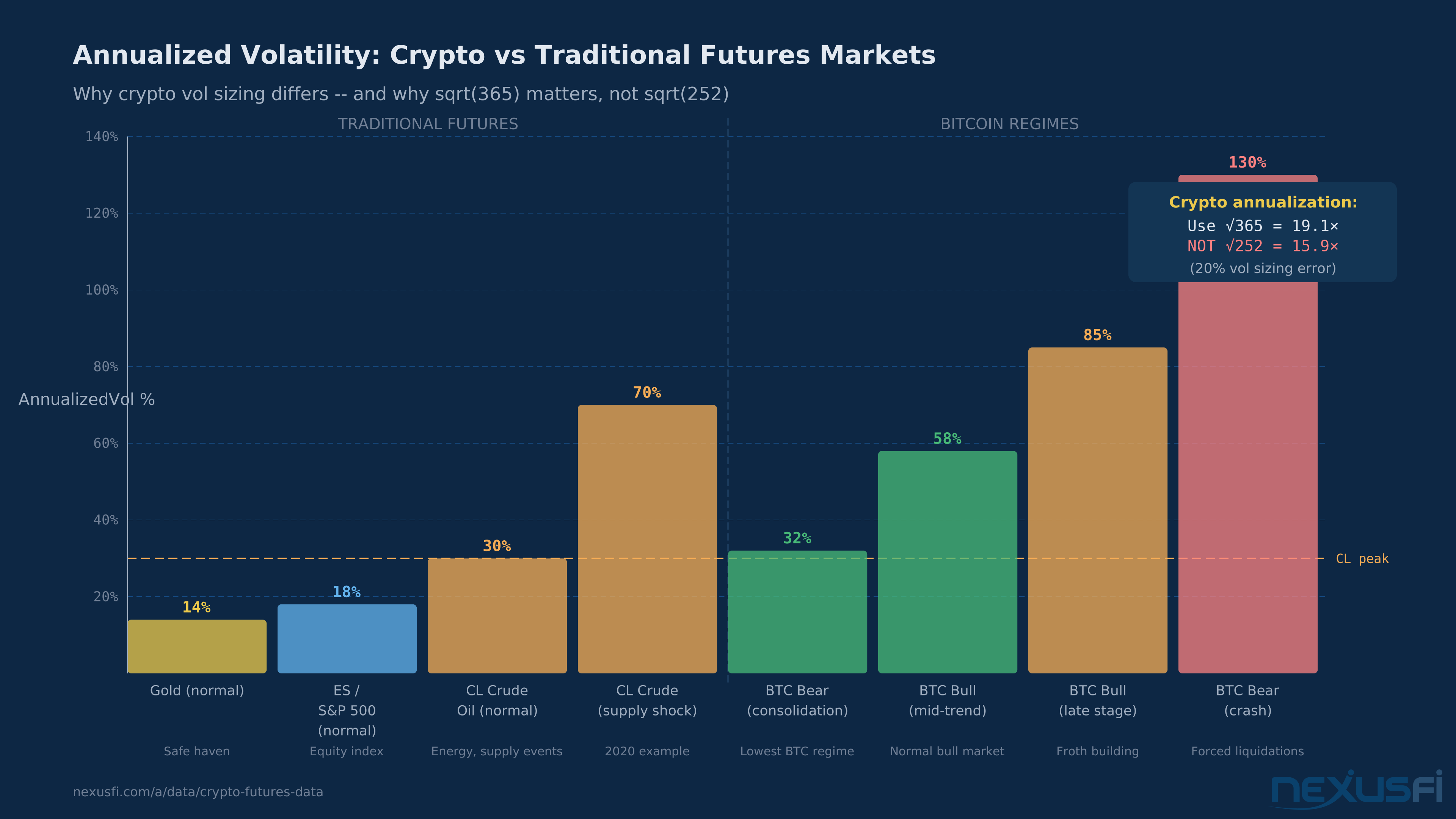
Every volatility calculation from traditional futures assumes roughly 252 trading days per year, giving an annualization factor of sqrt(252) ≈ 15.87. Crypto trades 24 hours a day, 365 days a year. The correct annualization factor is sqrt(365) ≈ 19.1.
@SMCJB caught a CME presenter making this exact error in a 2021 webinar: "Given Ether trades 7 days a week not just 5 days a week shouldn't annualized volatility be 19.1 (square root of 365) times the daily volatility not 16x?" The consequence: if you're using a vol model designed for traditional markets to size crypto positions, you're systematically underestimating annualized volatility by a factor of 19.1/15.87 ≈ 1.2. A 20% vol sizing error in a market where realized vol already runs 50-80% annualized is a meaningful mistake.
Volatility Regimes #
Bitcoin's realized volatility cycles through distinct regimes:
Bull market mid-trend: 40-60% annualized. The market moves up with occasional sharp pullbacks. Vol is elevated but not extreme.
Late-stage bull: 60-100% annualized. Speculative excess building, leverage concentrating, daily ranges widening.
Bear market crash: 80-150% annualized. Forced liquidations across the leveraged perpetual swap ecosystem create cascade dynamics. Vol spikes are sharper and faster than in traditional markets because there are no circuit breakers for individual position sizes.
Bear market consolidation: 25-40% annualized. The quietest crypto gets. Comparable to crude oil during a supply shock — elevated by traditional standards, unremarkable by crypto standards.
Implied Volatility: The Deribit Situation #
Bitcoin and Ether options trade primarily on Deribit, an exchange outside U.S. jurisdiction and inaccessible to U.S. residents. CME offers Bitcoin and Ether options on their regulated platform, but Deribit liquidity is substantially larger — the "real" crypto implied volatility surface lives offshore. U.S. traders can observe Deribit vol data through aggregators (it's public information), but cannot trade there. Key signals to track: DVOL (Deribit Bitcoin Volatility Index, the VIX equivalent for BTC, tracking 30-day implied vol) and CME Bitcoin options skew (the put/call premium spread — elevated upside skew signals FOMO, elevated downside skew signals institutional hedging).
On-Chain Data as Supplementary Signal #
On-chain data is derived directly from public blockchain records and has no parallel in traditional futures markets. It lets you observe where actual Bitcoin is held and where it's moving — something impossible with equity index or commodity futures.
Exchange Flow Data #
Bitcoin held on exchanges is visible on-chain because exchange wallet addresses are tracked by blockchain analytics firms (Glassnode, CryptoQuant, Chainalysis). The directional signal:
BTC flowing into exchanges: Potential selling pressure ahead. Large holders moving coins to exchange wallets may be positioning to sell. The flow precedes the sale by hours to days.
BTC flowing out of exchanges: Accumulation and cold storage. Moving coins off exchanges indicates long-term holding intent, removing supply from the liquid float.
The signal is directional, not precise. Exchange flows are correlated with price direction but with enough noise that they're confirmation tools, not triggers.
Miner Data #
Bitcoin miners receive newly issued BTC as block rewards. Miners are natural sellers — they have operational costs (electricity, hardware) in fiat. When miners sell to cover costs, it creates structural selling pressure proportional to the mining reward rate and current BTC price.
Key miner data: Hash rate (total computational power on the network — rising hash rate indicates miner profitability and confidence), miner revenue (total BTC value earned daily), and miner net position change (whether miners are accumulating or distributing coins).
Note: Since Ethereum's transition to proof-of-stake (the Merge, September 2022), there are no ETH miners. Ethereum supply dynamics are now governed by staking yields and the EIP-1559 burn mechanism — the miner data framework doesn't apply.
Limitations of On-Chain Data #
Data lags: Blockchain confirmations take time, and analytics providers add additional processing delay. You're never looking at real-time on-chain data.
Interpretation noise: Not all exchange flows are spot sales. Custody movements, OTC deals, and internal exchange transfers can all appear as exchange inflows. Analytics firms make educated guesses about address ownership that are sometimes wrong.
Gaming by sophisticated actors: Institutional participants know on-chain signals are monitored. Large holders break transactions into smaller chunks and use OTC channels specifically to avoid generating obvious on-chain signals.
On-chain data is most useful over longer timeframes (weeks to months) as a supplementary signal, not as a short-term trading trigger. The value is in direction and trend, not timing.
On-chain data gives you a window into Bitcoin ownership dynamics that has no parallel in traditional futures. But it's slow, noisy, and subject to gaming by sophisticated participants. Use it for confirmation of a thesis you've already formed from price, OI, and funding rate data — not as the primary signal.
Practical Considerations #
Data Subscriptions and Access #
CME Market Data: Real-time data requires an exchange fee plus vendor distribution fee. CME publishes end-of-day settlement data free. CF Reference Rates: Delayed (24-hour lag) rates are free on CME's website, real-time requires CF Benchmarks subscription. CFTC COT: Free at CFTC.gov, published weekly. Funding rates: Coinglass.com provides free aggregation across major exchanges. On-chain analytics: Glassnode and CryptoQuant offer free delayed tiers, professional tiers run $50-$150/month.
The Practical Monitoring Stack #
For a futures trader tracking crypto data without actively trading it: CME daily settlement (free, EOD) for price, volume, OI in BTC-equivalent, CFTC COT (free, weekly) for Leveraged Fund positioning, basis calculation as (CME front-month - spot) / spot × (365 / DTE), funding rate data from Coinglass for perp market sentiment, ETF flow data for OI context, and Glassnode exchange net flow for medium-term accumulation signal. Most of this is free — the value is in knowing how to read it, not in the subscription cost.
The Monday Morning Gap #
CME Bitcoin and Ether futures are closed from Friday 4:00 PM ET through Sunday 5:00 PM ET. Spot markets run continuously, and BTC can move 10-20% over a weekend. The Sunday evening gap is genuine information: spot price action compressed into a single opening print. Gaps from real news (regulation, exchange failures, macro shocks) tend to persist. Gaps from pure thin-market spot volatility tend to fill. If you're running CME crypto positions, Friday close is not your risk management point — it's where gap risk starts accruing. Size for the Sunday opening gap, not just daily vol.
Knowledge Map
Go Deeper
Build on this knowledgeReferences This Article
Articles that build on this topicCitations
- — New Micro Contract: Micro Ether coming 5-Dec-21 (2021) 👍 10“In the regulated crypto futures space we have: ICE Bitcoin (1 coin, ~$64k notional), CME Bitcoin (5 coins, ~$320k notional), CME Micro Bitcoin (0.1 coins, ~$6.4k notional), CME Ether (50 Ether, ~$225k notional), CME Micro Ether (0.1 Ether, ~$0.45k notional).”
- — Exiting BTC with a Cash and Carry Premium Arbitrage (2021) 👍 3“CME and ICE both have a 35% of notional margin requirement and neither provide offset for coins held. Hence to perform cash and carry with regulated futures you actually need 135% of the Bitcoin value.”
- — Bitcoin Futures by the CME (2020) 👍 1“With Bitcoin at $17,000 margin on the 5 coin CME future is $31,450. This represents leverage of just 2.7:1 versus approximately 8.5:1 in CL and 15:1 in ES.”
- — Webinar: Ethereum Futures from CME Group (2021) 👍 3“CME released the margin requirements for these contracts this week and it is a staggering 50% of Notional which makes Bitcoin margins (37% of Notional) look low!”
- — Webinar: Ethereum Futures from CME Group (2021) 👍 4“Given Ether trades 7 days a week not just 5 days a week, shouldn't annualized volatility be 19.1 (square root of 365) times the daily volatility not 16x.”
- — The New Micro Contract - MICRO BITCOIN coming May 2021 (2021) 👍 3“The 2.38:1 leverage that you can get on CME Bitcoin futures while low for non-US residents is the only leverage US residents can get trading crypto.”
- — Interactive Brokers Launches Coinbase Derivatives Nano Bitcoin and Ether Futures (2026) 👍 1“CME Bitcoin futures actually doubled their ADV in 2025 to a record 278,000 contracts (~$12 billion notional daily). Open interest climbed 82% YoY to nearly 300,000 contracts.”
- — CME annouces 7x24 crypto futures trading to start in 2026 (2026) 👍 6“[B][SIZE="4"]CME Group to Offer Around-the-Clock Trading for Cryptocurrency Futures and Options[/SIZE][/B] [url]https://www.cmegroup.com/media-room/press-releases/2025/10/02/cme_group_to_offeraround-the-clocktradingforcryptocurrencyfuture.html[/url] Obviously playing catch upto the crypto exch”
- — CME Group Launches 24/7 Futures Trading - December 5, 2025 (2026) 👍 3“[MENTION=74120]xplorer[/MENTION] Answer from ChatGPT to the question: [B]CME 24/7 Trading: What starts December 5, 2025?[/B] Effective Friday, December 5, 2025 (trade date Monday, December 8, 2025), CME Group is launching a new market segment on its electronic platform in which "swap-based ev”
- — Webinar: Ethereum Futures from CME Group (2023) 👍 2“Thanks for sharing the webinar. Futures can already be obscure for the general public, and cryptocurrency can be well...cryptic, so cryptocurrency futures would probably sound like something from the Matrix itself. The slide at 13:05 on the increase of institutional interest in the bitcoin futures”
- — The New Micro Contract - MICRO BITCOIN coming May 2021 (2023) 👍 2“Very disappointing but expected, US traders who wish to comply with trading crypto micro futures on US exchanges, this is the only cryptocurrency futures product (along with ether) I will trade Spot where I can define my tradesize and risk effortlessly and still remain with a US cryptocurrency ex”