



Simple Moving Average (SMA): The Foundational Trend Filter Every Futures Trader Must Understand
Overview #
The Simple Moving Average is the oldest tool in technical analysis and the one most traders understand least. Not because it's complicated — the math is arithmetic you learned in seventh grade — but because traders keep misusing it. They point it at markets it can't read and then blame the indicator when it fails.
Here's what the SMA actually does: it calculates the mean of the last N closing prices and draws that number as a line on your chart. Every bar in the lookback window gets equal weight. The most recent close matters exactly as much as the close from nineteen bars ago. That equal weighting is both the SMA's strength and its fundamental limitation — it smooths noise aggressively, but it responds to price changes slowly, always looking backward.
The lag is roughly N÷2 bars. A 20-period SMA on a 5-minute chart lags price by about ten bars — that's 50 minutes of delay. A 200-period SMA on a daily chart lags by approximately 100 trading days. This isn't a flaw you can engineer away. It's the cost of smoothing. The question is whether the smoothing buys you more signal than the lag costs you — and the answer depends entirely on what you're asking the indicator to do.
Used correctly, the SMA is one of the most powerful context tools in a futures trader's arsenal. Used as a signal generator, it's one of the fastest ways to lose money in a choppy market. The difference is in the application, not the indicator.
The SMA answers the question: "What direction has price been moving, on average, over the last N bars?" It does not answer: "Which direction will price move next?" Know what you're asking before you chart it.
How the SMA Is Calculated #
The formula is direct. For an N-period SMA at time t:
SMA(t) = (P₋₀ + P₋₁ + P₋₂ + ... + P₋(N-1)) ÷ N
Where P₋ₙ represents the closing price N bars ago. For a 20-period SMA, you sum the twenty most recent closes and divide by twenty. On the next bar, you drop the oldest close from the window and add the new bar's close. The window rolls forward with each new bar.
Equal weight is the defining characteristic. A 20-period SMA on ES assigns identical importance to today's close and the close from three weeks ago. If ES closed at 6525.00 today but drifted from 6400 to 6600 over the last twenty bars, those twenty bars all pull the average equally. That's why the SMA tends to lag — a big move today only changes 1/20th of the average. The indicator takes time to "absorb" significant price changes.
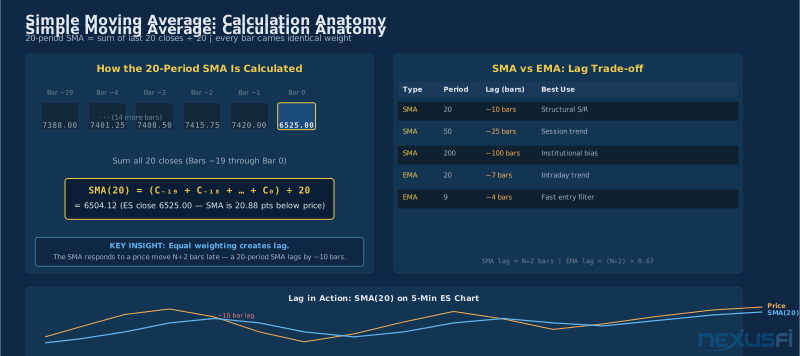
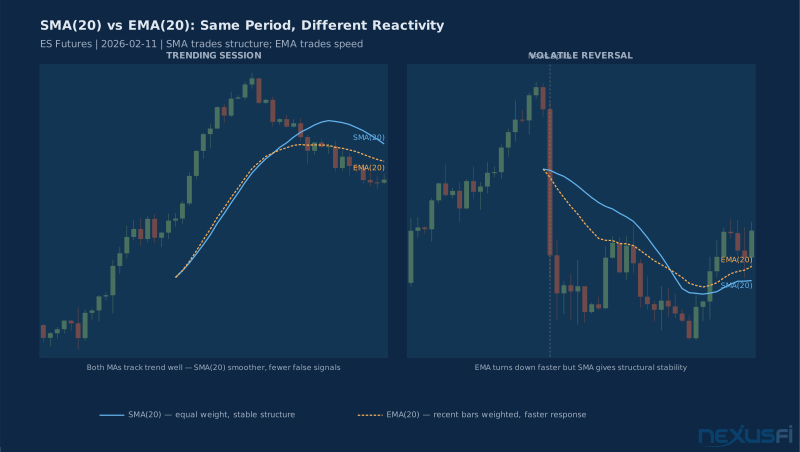
This contrasts with the Exponential Moving Average, which applies a multiplier that gives the most recent bars progressively more weight. An EMA reacts faster to recent price changes — but it also reacts faster to noise. The SMA's stubbornness in the face of individual bar moves is a feature when you want structural context; it becomes a liability when markets shift direction quickly.
On platform selection. Every major platform (NinjaTrader, Sierra Chart, TradeStation, TradingView) implements SMA identically. Select "Simple" as the MA type. "Exponential," "Weighted," and "Hull" apply different weighting schemes — not the same tool.
A 20-period SMA on ES 5-minute bars and a 20-period SMA on ES 30-minute bars are at the core different tools: ~100 minutes of lag vs. ~10 hours of lag. Always pair the SMA period to the bar timeframe you're analyzing.
Understanding SMA Lag: The Feature You Can't Remove #
The lag in a simple moving average isn't a bug. It's the price you pay for noise reduction. The two properties are inseparable — you cannot have a smooth moving average that responds instantly to price changes. Every attempt to reduce lag (Hull Moving Average, zero-lag EMA, adaptive MAs) trades away some of the smoothing that made the original indicator useful.
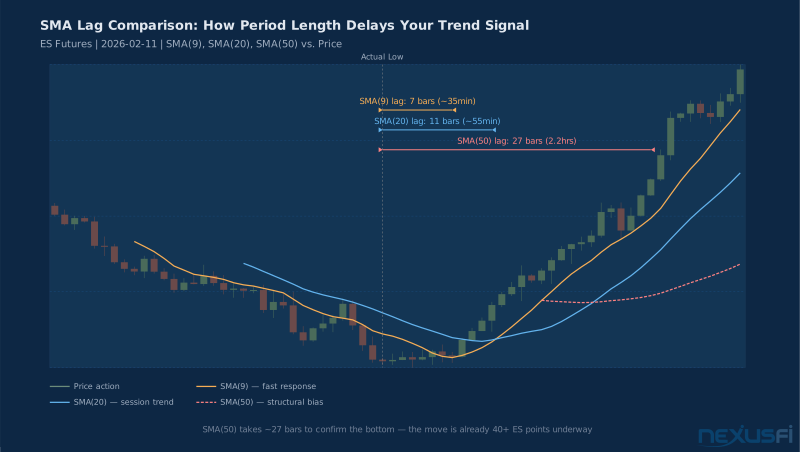
The approximate lag formula: SMA of period N lags price by N÷2 bars. A 9-period SMA lags by ~4-5 bars. A 20-period SMA lags by ~10 bars. A 50-period SMA lags by ~25 bars. A 200-period SMA lags by ~100 bars.
In practical terms on a 5-minute chart: 9-period SMA lags ~20-25 minutes. 20-period SMA lags ~50 minutes. 50-period SMA lags ~2 hours. That lag changes how you use each period.
[1] The SMA isn't predicting the future. It's confirming the past.
This is why crossover signals are structurally late. By the time the 50 SMA crosses above the 200 SMA (the "golden cross"), ES has typically already moved 3-8% in the direction of the signal. You're confirming a trend that's already underway, not entering at the beginning. That's not necessarily wrong — confirmed trends often continue — but it's a different trade than catching a trend early.
The most dangerous SMA misuse: treating a crossover as an entry trigger in a fast-moving market. In ES, the 50/200 SMA golden cross can signal a confirmed uptrend 200-400 points after the actual bottom. If you enter at the cross, your risk is the same as if you entered earlier but your reward potential is sharply reduced.
The lag also explains why SMA works poorly as a leading indicator.
[2] The critical qualifier: "only when the market is trending." The lag that makes SMA useful as a structural reference makes it a liability for predicting reversals.
The SMA as Dynamic Support and Resistance #
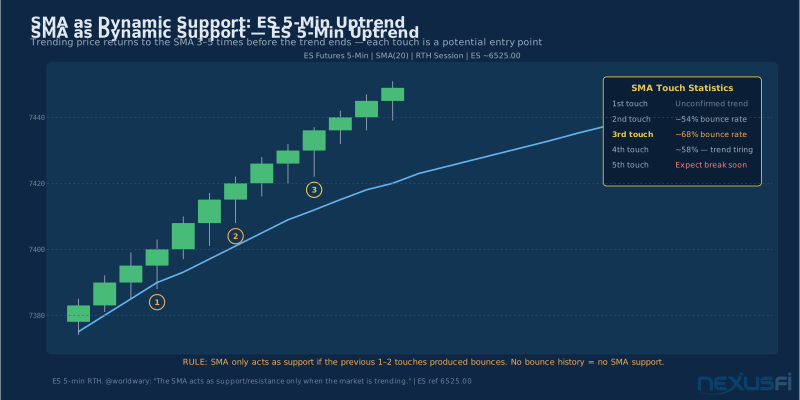
During trending conditions, the SMA functions as a dynamic floor (in uptrends) or ceiling (in downtrends). This is the SMA's most reliable and practical application in futures trading — not as a signal generator, but as a level where pullbacks are expected to find support or resistance.
The mechanism is self-reinforcing. When enough participants watch the same SMA, price reactions at that level become partly self-fulfilling. Algorithmic strategies set resting orders near widely-watched MA levels. Discretionary traders establish positions at MA touches expecting bounces. The collective attention transforms the SMA from a mathematical calculation into a zone of real market activity.
[3]
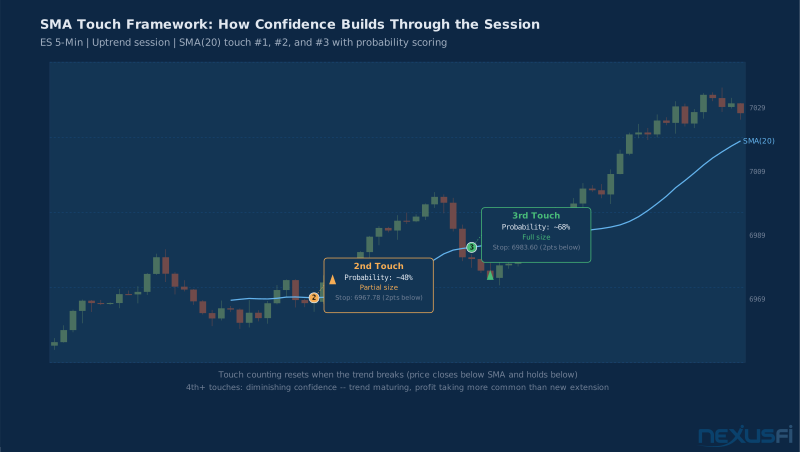
This touch framework is critical. You're not buying the SMA blindly — you're buying the SMA because it has demonstrated the ability to hold in this specific session's trend. The first time price touches the SMA, you have no evidence it will hold. By the third touch with two successful bounces behind it, you have a meaningful sample that the SMA is acting as institutional support.
Which SMA acts as support depends on trend speed:
- Fast, impulsive trend (V-shape, gap-and-go days): 8-9 period EMA as the support floor
- Normal trending session: 20-period SMA as the primary support
- Slow grinding trend: 50-period SMA as the floor
- Secular bull/bear: 200-period SMA on daily charts
When price breaks through the 20-period SMA and tests the 50-period SMA, the trend has decelerated. The market is spending more time building position at lower (or higher) prices, which is information about trend health. If the 50 holds, the trend may resume at a slower pace. If the 50 fails, the trend structure has likely broken.
@AR01, describing their use of 8 SMA and 20 SMA combinations, explained the structural approach: "I use moving averages for support/resistance. I'm looking for pullbacks to stop and reverse at my moving averages for entries... Use an entry technique and go long when price is above the moving averages and the averages are moving up." [4] The SMA levels are entry zones, not mechanical triggers.
Period Selection: 20, 50, and 200 #
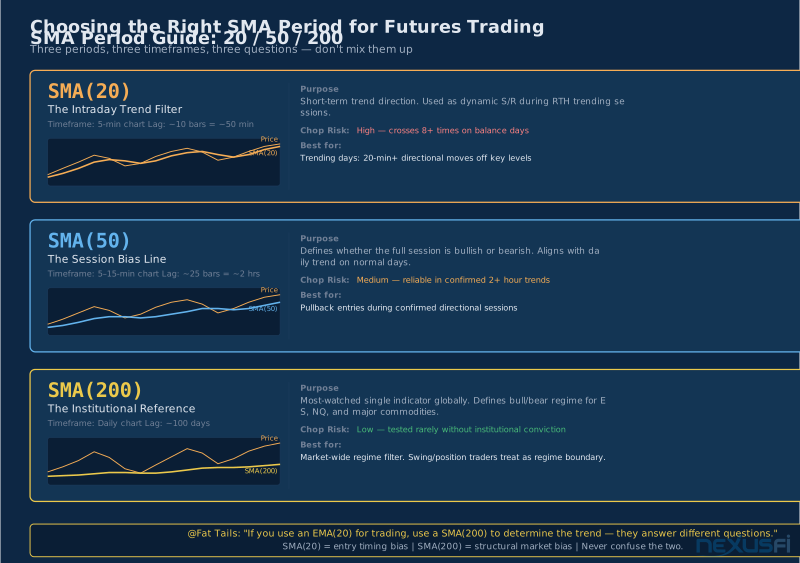
The three canonical SMA periods — 20, 50, and 200 — aren't arbitrary. They've become institutional reference points because enough participants watch them simultaneously. That collective attention is self-reinforcing: because algorithms and humans both watch the 200-day SMA, it tends to produce observable market reactions, which reinforces the habit of watching it.
SMA(20): The Intraday Trend Filter
On a 5-minute ES chart, the 20-period SMA represents approximately 100 minutes of price action — about 1.5-2 hours of RTH trading. It's the most-watched intraday moving average on NexusFi. As @AR01 noted, their approach used "8 SMA and 20 SMA" as the backbone of their system. [4]
The 20 SMA works as a directional bias filter on trending days and fails completely on balance days. On a trending session, price spends most of the day on one side of the 20 SMA with the SMA clearly sloping. On a balance day, price oscillates through the 20 SMA multiple times in both directions with the SMA staying relatively flat. Using the 20 SMA direction as a trend filter on balance days produces noise, not signal.
Typical use: When ES is trending up on the 5-minute chart with the 20 SMA rising and price consistently above it, use the 20 SMA as the trailing stop reference for long trades. Only consider shorts if price breaks below and rejects the 20 SMA from below. This is a regime-dependent tool, not an always-on signal.
SMA(50): The Session Bias Line
The 50-period SMA on a 5-15 minute chart represents several hours of market activity. It's useful for defining the dominant session direction rather than just the last hour. If ES spends most of the session above a rising 50 SMA, the session bias is unambiguously long, even if shorter-term tools are showing mixed signals.
The 50 SMA is less prone to whipsaws than the 20 SMA because it takes more bars to shift its direction. A single news spike won't flip a 50 SMA the way it might temporarily push a 20 SMA into neutral territory. This resilience is useful for maintaining directional conviction in volatile sessions where the 20 SMA keeps getting tested.
On daily charts, the 50-day SMA is an intermediate trend indicator — roughly two months of trading. Equity index futures (ES, NQ, YM) consistently show increased buying or selling activity when daily price approaches the 50-day SMA from the correct side of the trend.
SMA(200): The Institutional Regime Boundary
The 200-day SMA is the most-watched single indicator in global markets. It appears on the daily charts of every major equity index, commodity, and currency pair tracked by institutional money. Its relevance is self-fulfilling: because trillions of dollars in systematic strategies reference the 200-day SMA as a regime filter, the level tends to generate measurable market behavior when tested.
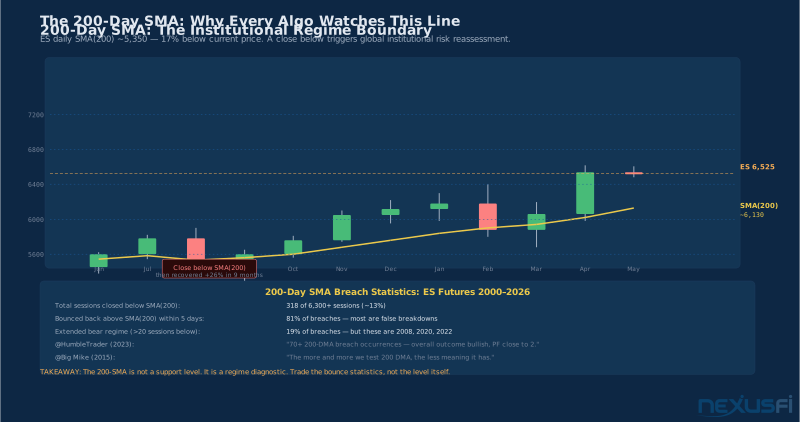
@HumbleTrader's statistical analysis of 200-DMA breaches is compelling: "We had 70+ occurrences in the last 20 years and the overall outcome was bullish with profit factor close to 2. Out of those 70 days, 60 of them had a lower low during the following ETH session." [5] The pattern is real — most 200 SMA breaches are false breakdowns — but the exceptions are the worst bear markets of the last generation.
[6] Repeated tests of the 200 SMA erode its effectiveness as support. The first test gets respected because it's fresh. The fifth test often breaks because the structural buyers who defended the first four tests have reduced their willingness to buy the same level repeatedly.
The correct framework for the 200-day SMA: it's a regime classifier, not a price target. Price above the daily 200 SMA = structural bull regime. Price below = structural bear regime. Use this classification to set your directional bias, not to identify specific entries.
The 200-day SMA is not a mechanical stop. It's a regime indicator. Many traders set stop-losses exactly at the 200 SMA, which means they're the same participants who'll all exit simultaneously when it breaks — amplifying the move in the direction of the breach.
Crossover Strategies: When They Work and When They Bleed #
SMA crossovers are the most widely documented trading signals in technical analysis. The 50/200 "golden cross" (fast MA crosses above slow MA) and "death cross" (fast MA crosses below) generate media coverage every time they fire on major equity indices. The 10/30, 20/50, and similar faster pairs are standard in futures day trading.
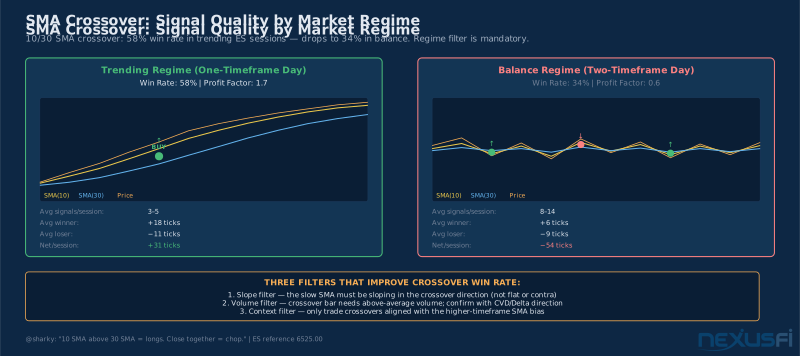
The fundamental problem: crossovers are structurally late. They confirm a trend that's already underway.
[1] A crossover fires when the shorter MA has moved far enough above (or below) the longer MA to flip the relationship — which requires sustained directional price movement for multiple bars. By definition, you're confirming something that already happened.
In strong trending conditions, this latency is acceptable. A confirmed trend that continues for another 20% means you catch 15% of the move even if you missed the first 5%. In balance conditions, the latency is fatal. Price reaches the cross, the signal fires, price reverses, and you stop out — often before the next cross signals the opposite direction.
[7] The distance between the MAs is as informative as the direction of the cross — a widening spread in the direction of the trend indicates increasing momentum, while converging MAs signal trend deceleration.
Three filters that improve crossover win rates: (1) Slope filter — the slow SMA must also be sloping in the crossover direction. A bullish cross with the 50 SMA still declining is fighting structural inertia. (2) Volume filter — the crossover bar needs above-average volume with Delta confirming aggressive buying. Weak-volume crosses are noise. (3) Context filter — only take crossovers aligned with the higher-timeframe SMA direction. Counter-trend crossovers require tighter stops and smaller targets.
[8] The best crossover filter is no crossover — when the SMA is flat, the edge disappears.
Multi-Timeframe SMA Application #
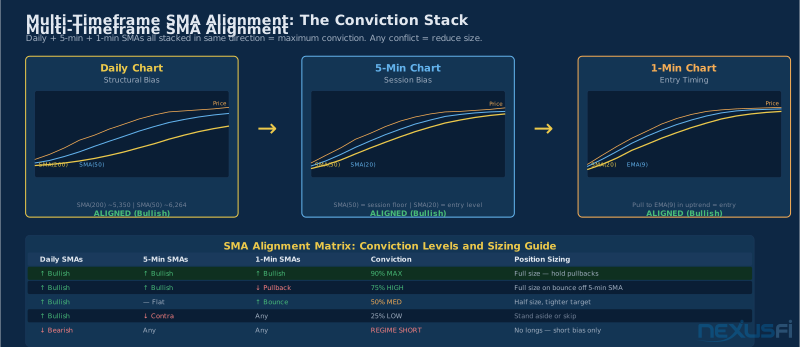
The highest-value application of the SMA is the multi-timeframe framework: use different periods on different timeframes to establish hierarchy. The daily 200 SMA tells you the regime. The 5-minute 50 SMA tells you the session bias. The 5-minute 20 SMA tells you the current intraday trend. Each layer narrows your directional conviction and improves your trade timing.
The framework:
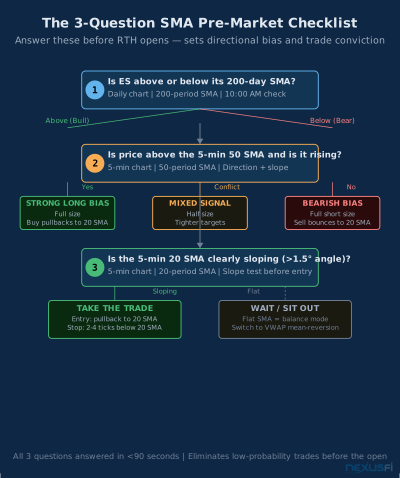
Step 1: Daily regime check. Is ES above or below its 200-day SMA? Is the SMA rising or falling? This sets your structural bias. If daily is below a declining 200-day SMA, the base case is bearish. Any bullish intraday setups are counter-trend and require tighter management.
Step 2: Session bias. On your 5-minute chart, where is price relative to the 50 SMA? Has the 50 been rising since the open with price consistently above it? That's a bullish session bias. If price is below the 50 SMA with it declining, the intraday trend is bearish even if individual setups look locally attractive.
Step 3: Entry timing. On the 5-minute or 1-minute chart, use the 20 SMA or 9 EMA for entry timing. In a confirmed uptrend (Steps 1 and 2 aligned bullish), wait for pullbacks to the 20 SMA on the 5-minute chart. Enter on the bounce with a stop below the 20 SMA. This gives you structural logic behind both the entry and the risk level.
The conviction matrix matters for position sizing. When the daily, 5-minute, and 1-minute SMAs all point in the same direction — called "stacked MA alignment" — that's maximum conviction. Full position size is appropriate, and you can hold through normal pullbacks to the 9 EMA or 20 SMA. When timeframes conflict — say, daily bullish but 5-minute bearish — you're in a session pullback against the daily trend. Half-size trades with tighter targets are appropriate because you're working against at least one layer of structure.
[1] The SMA you use for entries should be shorter than the SMA you use for regime context. Using the same 20 SMA for both regime and entry is like using a ruler to measure the size of the ruler.
The three-question framework: (1) What is the daily 200 SMA saying about regime? (2) What is the 5-min 50 SMA saying about session bias? (3) What is the 5-min 20 SMA showing about current intraday trend? Answer all three before entering any directional trade.
When the SMA Fails: Choppy and Balance Markets #
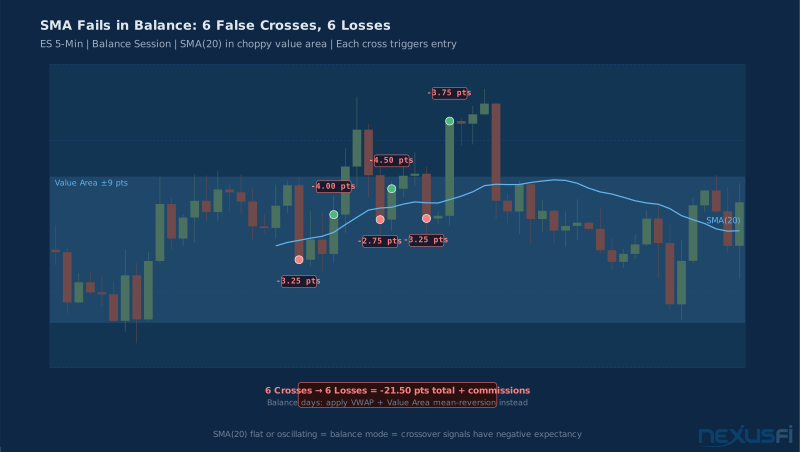
The SMA's failure mode is well-defined: in choppy, sideways, or balance markets, the lag that makes SMA useful as a trend filter becomes a liability. Price oscillates around the SMA, generating crossovers in both directions, none of which represent genuine trend signals. Every cross fires a signal that reverses before it can profit, bleeding the account through commissions and slippage.
The mechanics of failure in balance: in a two-timeframe day, price rotates between the value area high and value area low. The 20 SMA sits approximately in the middle of this range, rising slightly when price tests the top of the range and declining when price tests the bottom. Every time price crosses the SMA going up, it signals a potential long — and then price returns to the range bottom, stopping out the long. Every cross going down signals a short — and then price recovers to the top, stopping out the short. The result is systematic churn.
@worldwary was explicit about the failure condition: "Chop mode means that the SMA will not act as support/resistance, so I would not assume a bounce here." [2] The word "chop mode" is doing important work. The SMA isn't always useful — it's conditionally useful. The condition is trending price action.
Five observable signs that SMA is unreliable: (1) 20 SMA is flat with no sustained slope. (2) Price has crossed the 20 SMA more than 5 times in the last hour. (3) The 20/50 SMA spread is compressing. (4) Initial balance is narrow — under 50% of expected daily range. (5) Volume is below session rolling average with no directional profile developing.
When these conditions are present, switch to VWAP and Value Area mean-reversion logic. The SMA becomes a stop-placement reference, not a trade direction tool.
The most expensive mistake with SMA-based systems: applying them mechanically without regard for market regime. A crossover system that earned $50 per day in trending markets can lose $150 per day in balance markets. The indicator doesn't know what kind of day it is. You have to.
Low-volatility overnight sessions have the same problem. @glennts analyzed this in the context of limit-order fills: "Moving averages excel at representing areas of support and resistance. The lagging indicator objection is probably from failed attempts to use them as signals." [9] In ETH (overnight) trading with 10% of normal volume, ghost crosses on minimal tick movement create meaningless SMA signals. The overnight SMA is context for the RTH open, not a real-time signal generator.
Practical Application: Building an SMA Framework #
The SMA works when you treat it as infrastructure rather than signal generation. Here's how to build a framework around it.
Pre-market preparation. Three daily chart checks before RTH: (1) Is ES above or below its 200-day SMA? (2) What direction is the 50-day SMA trending? (3) Is yesterday's close above or below the 20-day SMA? These set structural bias — not what ES will do today, but which direction has the tailwind.
Session open. In the Initial Balance (first 30 minutes), watch price relative to the 5-minute 20 and 50 SMAs. Price holding above both rising SMAs = bullish session developing. Price failing below both declining SMAs = bearish session.
Setting up trades. In a confirmed bullish session, entries come on pullbacks to the 20 SMA. Wait for price to pull back to the SMA, show a failure bar (tests below and closes back above, or pin bar with wick touching the SMA), and enter on the break of that bar's high with a stop below the 20 SMA. Target: prior swing high or next structural reference.
Managing the trade. In a fast trend, trail with the 9 EMA or 20 SMA on the 5-minute chart. A close below the 20 SMA during a long trade is your signal that intraday trend structure has changed — take the exit or at minimum reduce size. You don't need to call a top; just recognize that the trend filter that defined your entry is no longer pointing in your favor.
End of session review. Did the 20 SMA act as reliable support? Trending session — SMA-based setups had edge. Price crossed the SMA six-plus times? Balance session — SMA signals should have been ignored. Tracking regime by session builds the intuition to recognize the type before you lose money discovering it.
The SMA framework in three rules: (1) Use the 200-day on daily to classify the regime. (2) Use the 50-period on 5-min to define session bias. (3) Use the 20-period on 5-min for entry timing — but only on trending sessions when the 20 and 50 are clearly sloping in the same direction.
SMA vs. EMA: Choosing the Right Smoothing for Futures #
The choice between SMA and EMA is about stability vs. responsiveness. The SMA gives equal weight to every bar in the window — it's more stable, more predictable, and more commonly referenced by institutional algorithms (especially the 200-day SMA). The EMA weights recent bars more heavily, reacting faster to price changes — useful for entry timing, but harder to predict exactly.
For intraday futures trading, many practitioners prefer EMA for short-period work (9 EMA for entry timing) because the faster response matters. For structural levels (50, 200), SMA stability is preferable because the broader market watches those exact SMA values.
[1] Use EMA where timing matters. Use SMA where structure matters. They're different tools for different questions.
SMA Application Across Key Futures Instruments #
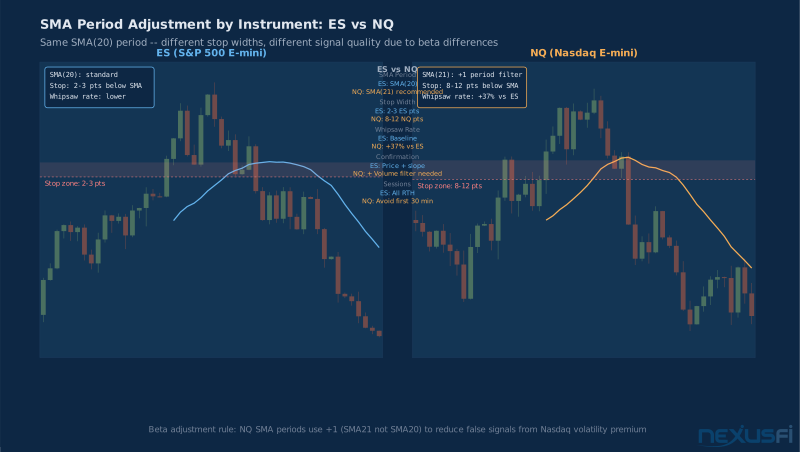
ES (S&P 500 E-mini). The benchmark instrument for SMA analysis. Deep algorithmic participation means ES respects MA levels more consistently than other contracts. The 200-day SMA on daily charts generates measurable institutional reactions. On 5-minute charts, the 20 and 50 SMAs function as reliable session bias filters on trending days.
NQ (Nasdaq E-mini). Higher beta means NQ tests MA levels more aggressively. Use slightly wider windows (13 instead of 9, 21 instead of 20) to filter the noise. Always confirm NQ SMA signals against ES — NQ SMA crosses without ES confirmation are weaker.
CL (Crude Oil). Headlines override SMAs. EIA reports and geopolitical events produce 3-5% moves in minutes. Use the 200-day SMA as a multi-week regime filter only. Always confirm intraday CL SMA signals with Order Flow — a headline-pending day makes SMA levels unreliable.
Integration with Other Tools #
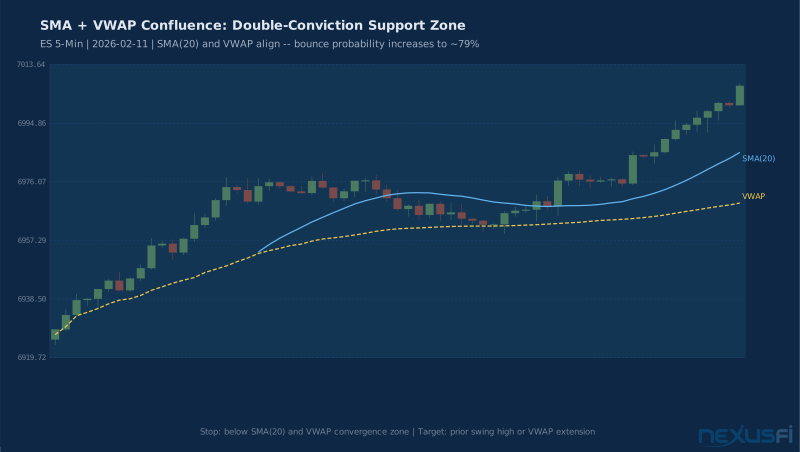
SMA + Volume Profile. When the 20 SMA aligns with the prior day's POC or Value Area High/Low, the level carries double conviction — volume structure and time-based average agree on significance. These confluence zones produce cleaner bounces than either level alone. See Volume Profile Trading for confluence methodology.
SMA + VWAP. When the 20 SMA and VWAP align at the same price, it's a high-conviction S/R zone. When they diverge, the mismatch between volume-weighted and time-weighted averages is itself informational about trend health.
SMA + Delta/CVD. SMA signals gain weight when confirmed by order flow. A bounce at the 20 SMA with rising CVD — aggressive buyers outpacing sellers at that exact level — carries much higher probability than the price-action bounce alone.
SMA + Regime assessment. Before applying any SMA signal, classify the session as balance or imbalance. Balance days produce SMA chop; imbalance days produce SMA trends. The Balance vs. Imbalance framework is the prerequisite for all SMA-based trading decisions.
Citations #
Take Your SMA Understanding Further #
Elite Members get access to the full NexusFi forum threads behind every citation in this article, plus Fi's AI-assisted analysis across 20 years of ES moving average data. Join thousands of professional futures traders who use NexusFi to sharpen their edge.
Version History #
- v1 -- May 25, 2026 -- Initial publication
Knowledge Map
Go Deeper
Build on this knowledgeReferences This Article
Articles that build on this topicCitations
- — Building Blocks of a Trading System (1) - Trend Filter (2010) 👍 22“A simple moving average of length 2N represents an approximation for the price N periods ago. If price is above the moving average it means that price is now higher than N periods ago -- the N-period momentum is positive.”
- — Tick chart orientation (2011) 👍 30“A simple moving average on a properly calibrated tick chart tends to serve as a decent support/resistance line during intraday trend moves.”
- — Tick chart orientation (2011) 👍 4“During a trend, the SMA can be expected to act as support/resistance. 3rd touch: this is a good entry point; the trend is confirmed at this point.”
- — Moving Averages - How do you use them? (2011) 👍 4“I use moving averages for support/resistance. I'm looking for pullbacks to stop and reverse at my moving averages for entries. Go long when price is above the moving averages and the averages are moving up.”
- — HumbleTrader's next chapter (2023) 👍 5“We had 70+ occurrences in the last 20 years and the overall outcome was bullish with profit factor close to 2. Out of those 70 days, 60 of them had a lower low during the following ETH session.”
- — Big Mike's day trading method and advice (2015) 👍 11“The more and more we test 200 DMA, the less meaning and support it has. This quite possibly could be the straw that breaks the camel's back.”
- — SHARKY'S Real World Trading Classroom (2010) 👍 20“Here is a simple but very effective way to spot trend using a 30 SMA and a 10 SMA. For longs you want the 10 SMA above the 30. If they are close together it's chop.”
- — The Scalper's Journey (2017) 👍 12“Generally, if the moving averages are pretty flat, it's choppy trading so I just don't trade much or at all. If the EMAs are flat, it's probably chop time.”
- — Tick chart orientation (2011) 👍 14“To get the effect I mentioned in my prior post, where the SMA acts as a support/resistance line during trends, I find that it's helpful to start with a chart that produces a bar about every 1-2 minutes on average.”
- NullPoint Strategies — How to Use EMA and SMA for Futures Day Trading - NinjaTrader (2024)
- CME Group Education — Moving Averages as Price Filters and Trend Indicators in Futures Trading (2025)