



Weighted Moving Average (WMA): The Linear-Weighted Trend Filter for Futures Traders
Overview #
The Weighted Moving Average sits between the SMA and EMA on the lag-vs-noise spectrum — and that middle ground is exactly where most discretionary futures traders live. It reacts faster than the Simple Moving Average while producing fewer false signals than the Exponential Moving Average during choppy sessions. For traders who've tried both and found the SMA too slow and the EMA too twitchy, the WMA is worth serious attention.
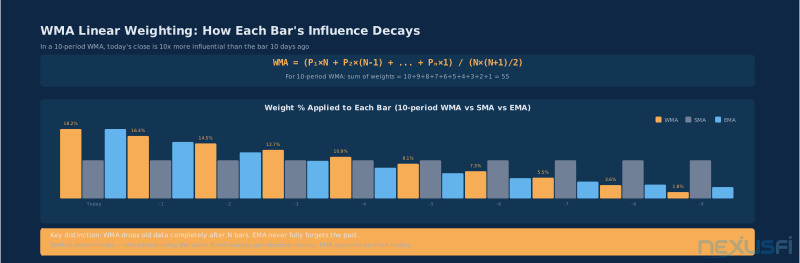
The core idea is straightforward: WMA assigns linearly increasing weights to price data, giving the most recent close the highest influence. In a 10-period WMA, today's bar carries 10 times more weight than the bar from 10 periods ago. This linear decay is deterministic — no hidden history, no recursive formulas. Two traders using the same period on the same chart will always calculate identical WMA values.
NexusFi members have been wrestling with moving average selection for years. In Fat Tails' foundational thread on building trading system trend filters, he lays out the core problem clearly: "The simplest trend filter that translates the idea 'that price is up' is the momentum or rate of change indicator." The WMA's slope behavior is basically a momentum signal dressed as a smoothing tool — and that dual nature is what makes it useful.
This article covers WMA from the math up through practical trading applications: calculation methodology, comparison to SMA and EMA, trend filter usage, pullback entry systems, the multi-period ribbon strategy, contract-specific parameter selection, choppy market behavior, and risk management integration. Platform code examples for NinjaTrader, TradingView, and Sierra Chart are included.
How WMA Is Calculated #
The formula is clean. For a period of N:
WMA = (P₁×N + P₂×(N-1) + P₃×(N-2) + ... + Pₙ×1) / (N×(N+1)/2)
Where P₁ is today's close, P₂ is yesterday's close, and so on. The denominator is the triangular number N×(N+1)/2 — the sum of all weights. For a 10-period WMA, that's 10+9+8+7+6+5+4+3+2+1 = 55.
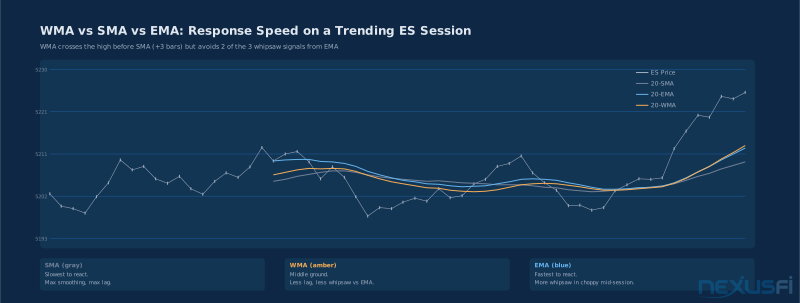
Concrete example with a 5-period WMA. Your last five ES closes are: 5,200, 5,210, 5,205, 5,215, 5,220 (oldest to newest).
- Weight 1 (oldest): 5,200 × 1 = 5,200
- Weight 2: 5,210 × 2 = 10,420
- Weight 3: 5,205 × 3 = 15,615
- Weight 4: 5,215 × 4 = 20,860
- Weight 5 (today): 5,220 × 5 = 26,100
- Sum: 78,195 / 15 = 5,213.00
Compare to the SMA of the same five bars: (5,200+5,210+5,205+5,215+5,220)/5 = 5,210.00. The WMA reads 3 points higher, pulled up by the recent strength. That 3-point difference is the lag reduction in action.
A critical technical distinction: WMA drops old data completely once it falls outside the lookback window. EMA never forgets — it carries influence from every bar in chart history, diminishing exponentially. This matters for systematic trading because two traders can set up an EMA from different chart start dates and get slightly different readings. WMA is fully deterministic given only the N most recent closes.
This also means WMA recalculates completely from scratch each bar, unlike EMA's recursive formula. For retail trading on NinjaTrader or Sierra Chart, this makes no practical difference. At HFT tick speeds, EMA's recursive efficiency becomes relevant — but that's not our context here.
Spreadsheet Verification Want to verify your WMA calculation? In Excel or Google Sheets: put your last N closing prices in a column, create a weight column (1 through N), multiply price by weight, sum the products, divide by N*(N+1)/2. This takes under 2 minutes and builds intuition for why recent bars dominate the reading.
WMA vs SMA vs EMA: Choosing the Right Average #
Three moving averages, three different tools. The choice isn't about which is "best" — it's about matching the tool to the market condition and trading style.
SMA (Simple Moving Average) gives equal weight to every bar in its window. A 20-SMA treats a close from 20 days ago with identical influence to today's close. This produces maximum smoothing and maximum lag. SMA is excellent for identifying structural levels (200-SMA on the daily) and for traders who want to minimize false signals at the cost of later entries. Where SMA fails: in fast-moving markets where the lag keeps you in losing positions too long after reversals begin.
EMA (Exponential Moving Average) applies exponentially decreasing weights into the past, with a smoothing factor k = 2/(N+1). A 20-EMA gives today's close 9.5% weight — vs 5% for a 20-SMA. EMA responds faster to price changes, making it the preferred tool for systematic algo strategies. It's also more sensitive to recent momentum shifts. The downside: in choppy, range-bound markets, EMA generates more false crossover signals than either SMA or WMA. Big Mike's MAGIC indicator thread (Moving Average Group Interactive Convergence) on NexusFi's Elite Circle explored multi-MA convergence patterns specifically to address the noise problem EMA introduces.
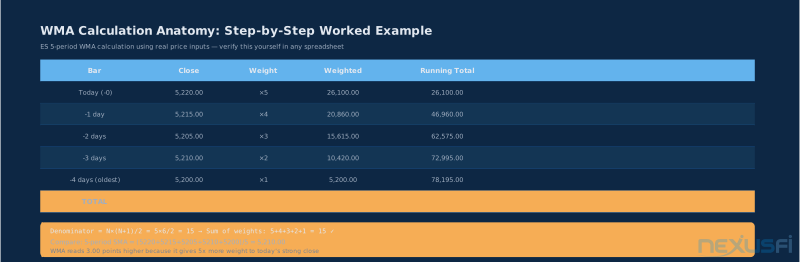
WMA (Weighted Moving Average) sits between the two. Linear weighting means recent bars dominate, but the decay is gentler than EMA's exponential curve. WMA doesn't retain historical influence beyond its lookback period. In practice: WMA reacts faster than SMA to trend changes, and produces noticeably less whipsaw than EMA during sideways sessions. It's the discretionary trader's compromise.
The key table to internalize:
| Attribute | SMA | WMA | EMA |
|---|---|---|---|
| Lag to trend change | Highest | Moderate | Lowest |
| False signals in chop | Low | Moderate | High |
| Intuitive to understand | Very high | High | Moderate |
| Used in systematic algos | Moderate | Less common | Most common |
| Best use case | Structural levels, filters | Active discretionary | Algo systems, momentum |
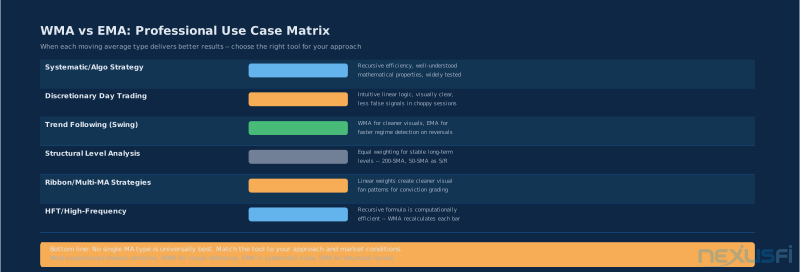
One honest caveat: professional systematic traders have largely moved to EMA for quantitative strategies. EMA's recursive efficiency and well-understood mathematical properties make it the industry default for algo trading. If you're building a systematic futures strategy, start with EMA. WMA's advantage is specifically for discretionary traders who need intuitive, visually clear signals with less noise.
A NexusFi member's observation in the ESFXtrader journal thread captures this well: discussing moving average selection, they noted that the "18 and 21" period equivalents behave differently across SMA/WMA/EMA implementations, and that the rolling moving average (RMA) sits between 19 and 20 EMA in responsiveness — exactly the middle-ground characteristic that makes WMA and its relatives appealing to active discretionary traders.
Using WMA as a Trend Filter #
The single most reliable use of WMA in futures trading is as a slope-based trend filter. The concept is simple: measure the WMA's direction to define whether you're in a long-biased, short-biased, or flat regime. This filter alone eliminates the majority of counter-trend trades that drain account equity in choppy sessions.
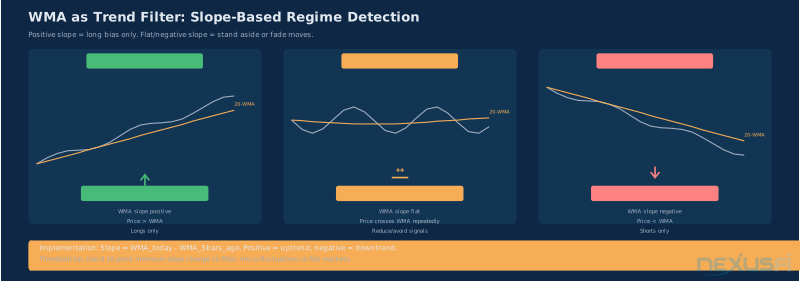
Implementation: Slope = WMA_today - WMA_5bars_ago. A positive slope signals upward trend momentum; negative signals downward; near-zero signals range. Use a minimum threshold of 0.10 points (for ES) to filter out micro-fluctuations in flat markets. The specific threshold should be calibrated to your contract's typical daily range.
The three regime rules:
- Positive WMA slope + price above WMA: Long bias only. Take long setups, avoid shorts except as quick scalps against the dominant direction.
- Flat WMA slope (near-zero): Range mode. Stand aside or use range-trading tactics. Mean reversion entries to the WMA. Reduced position size.
- Negative WMA slope + price below WMA: Short bias only. Take short setups, avoid longs.
Fat Tails on Trend Filters "The simplest trend filter that translates the idea 'that price is up' is the momentum or rate of change indicator. Momentum is very much compared to the trend filter" — @Fat Tails, from his foundational series on building trading system blocks at NexusFi. The WMA slope is exactly this: momentum expressed through a smoothing lens.
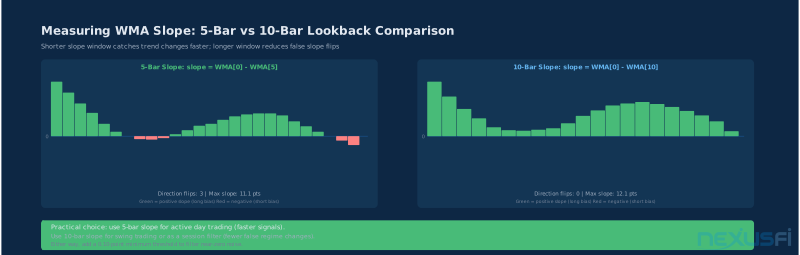
Fat Tails' thread on building trading system blocks makes the key point: "Momentum is very much compared to a trend filter." The WMA slope IS a momentum reading — it tells you whether the average price has been rising or falling over the lookback window. Combining the slope with the price-vs-WMA relationship gives you a two-dimensional filter that's strong across timeframes.
Timeframe selection matters for the trend filter period. The goal is to define the "larger context" for your trading timeframe:
- Scalping on 1-min charts: Use 20-WMA on the 5-min as the trend filter
- Day trading on 5-min charts: Use 50-WMA on the 15-min as the trend filter
- Swing trading on 1H charts: Use 50-WMA on the 4H or daily as the trend filter
The multi-timeframe approach described in Fat Tails' MTF indicator thread — where the multi-timeframe framework allows plotting higher-timeframe MA conditions on lower charts — is the professional implementation. You shouldn't need to switch chart timeframes manually; code the higher-TF WMA slope condition directly into your decision rules.
Pullback Entry Strategies with WMA #
Once the trend filter confirms direction, the WMA becomes a dynamic entry trigger for pullback trades. The most consistent approach is the two-WMA pullback system: a longer WMA establishes the trend, a shorter WMA times the entry.
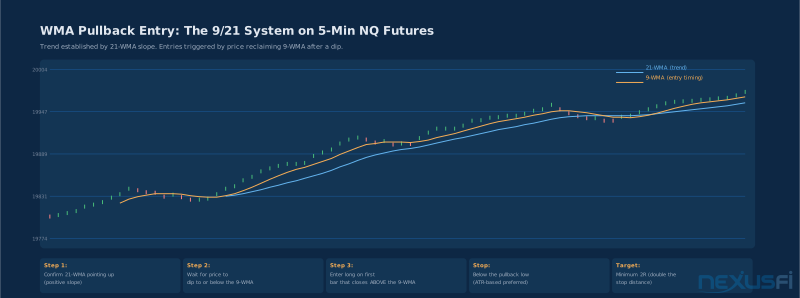
The 9/21 WMA System (5-min NQ and ES)
- Confirm trend: 21-WMA slope must be positive (for longs) and sustained for at least 5 bars
- Wait for pullback: Price dips to or below the 9-WMA
- Entry trigger: First bar that closes above the 9-WMA
- Stop: Below the pullback low (or 1.5x ATR below entry, whichever is wider)
- Target: Minimum 2R -- twice the stop distance
This setup appears 3-5 times per session in strongly trending markets. The best setups occur when the pullback to the 9-WMA happens after a clear breakout above a prior high, and volume on the pullback bars is visibly lighter than the breakout bars. That volume pattern confirms the pullback is a pause, not a reversal.
The 20/50 WMA combination works on longer timeframes with similar logic. On a 15-minute chart, the 50-WMA defines the trend and the 20-WMA times entries. The risk/reward structure is comparable — what changes is the timeframe of the trend you're trading.
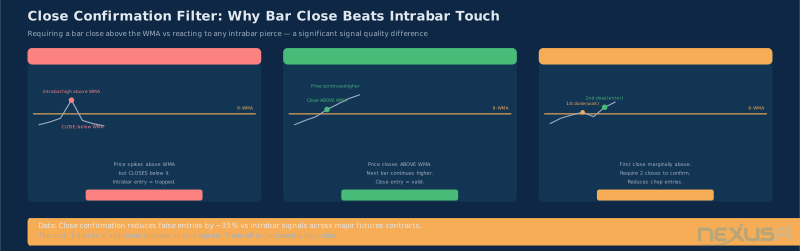
A critical execution detail: require a bar CLOSE above the 9-WMA, not just an intrabar pierce. This "close confirmation" rule eliminates false entries where price briefly pierces the WMA during high-activity moments and then retreats. The additional confirmation costs a few ticks but much reduces whipsaw entries.
Perry's method thread on NexusFi's Elite Circle addresses the fundamental limitation of all MA-based approaches: "There is no argument that any Moving average is based on historical data — this is a mathematical certainty." WMA doesn't overcome this. It reduces lag, but the signal is still backward-looking. The close-confirmation rule is how you mitigate the impact: you're waiting for the market to confirm the signal before acting, not the first tick that looks like a signal.
The WMA Ribbon: Multi-Period Trend Strength #
Stack multiple WMA periods on the same chart and you get a ribbon that quantifies trend conviction visually. The ordering of the lines relative to each other and to price tells you at a glance how strong the current trend is.
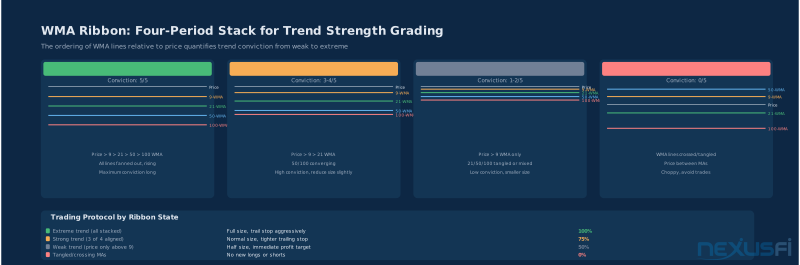
Four-period WMA ribbon: 9, 21, 50, 100
The ribbon's state determines your position size and aggressiveness:
- All four lines fanned upward, price above all: Maximum conviction. Full position size, trail stop aggressively. These are the sessions where the market is moving with purpose and pullback entries have the highest win rates.
- Three of four lines aligned: Strong trend, but be alert for a transition. Standard position size, tighten trailing stops slightly as the market may be approaching exhaustion.
- Only price above the 9-WMA, others converging: Weak trend. Half position or pass. The market may be in late-stage trend territory where reversals are more likely.
- Lines crossed or tangled: No new directional trades. Range tactics or flat. This is the critical filter -- ribbon tangles precede choppy sessions that destroy systematic trend followers.
Big Mike's MAGIC (Moving Average Group Interactive Convergence) indicator explored this concept of using multi-MA convergence patterns to grade trend quality — the WMA ribbon is the same concept applied systematically with four defined periods rather than adaptive intervals.
The ribbon is especially useful at session open. Check the ribbon state within the first 15-20 minutes of the regular trading hours session. If the ribbon is already fanned with price above all periods, the trend from overnight is continuing and you can size up on the first pullback setup. If the ribbon is tangled, wait for clarity before committing capital.
Parameter Selection by Contract and Timeframe #
There's no universal "best" WMA period. The right parameter depends on the contract's volatility characteristics and the chart timeframe. A 20-period WMA that works perfectly on ES 5-minute bars behaves differently on ZB 5-minute bars — because the price range per bar is different.
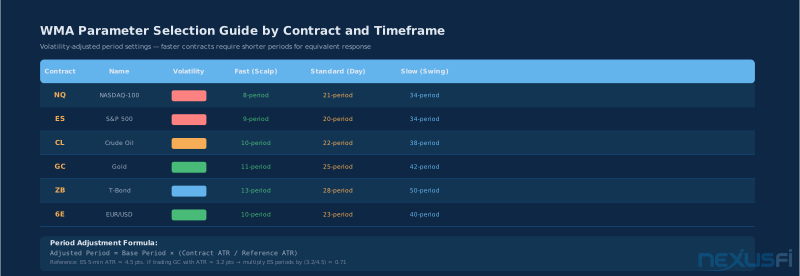
The adjustment formula: Adjusted Period = Base Period × (Target Contract ATR / Reference ATR)
Use ES 5-min ATR as your reference (typically 4-5 points during RTH). If you're trading GC (Gold) with a 5-min ATR around 3 points, multiply your ES periods by 3/4.5 = 0.67. A 20-period ES setup becomes approximately 13-14 periods on GC. The goal is similar "chart feel" — how many bars does the WMA span relative to the typical move size.
Starting parameter grid by contract type:
- NQ (NASDAQ-100): Fast 8, Standard 21, Swing 34. High volatility -- use shorter periods to match pace.
- ES (S&P 500): Fast 9, Standard 20, Swing 34. The reference contract for most parameter discussions.
- CL (Crude Oil): Fast 10, Standard 22, Swing 38. Similar to ES but slightly slower average velocity.
- GC (Gold): Fast 11, Standard 25, Swing 42. Medium volatility -- periods scale up moderately.
- ZB (T-Bond): Fast 13, Standard 28, Swing 50. Lower volatility requires noticeably longer periods.
- 6E (EUR/USD Futures): Fast 10, Standard 23, Swing 40. Moderate volatility, similar to GC.
These are starting points, not fixed rules. Always verify on 30-60 days of historical data before committing. Look at how many bars the WMA lags a major trend change — you want 2-4 bars of lag in trending conditions, and the ability to track price closely during sustained moves. If the WMA is constantly getting crossed every 3-5 bars, the period is too short. If the WMA barely moves after a 20-point swing, the period is too long.
Session adjustments: regular trading hours (RTH) and extended trading hours (ETH) have different volatility profiles. Consider using a slightly longer WMA period during ETH (or stand aside entirely) because lower liquidity produces more noise that can generate false signals.
WMA in Choppy vs Trending Markets #
This is where WMA's positioning relative to EMA matters most. The practical difference between WMA and EMA is most visible during range-bound sessions.
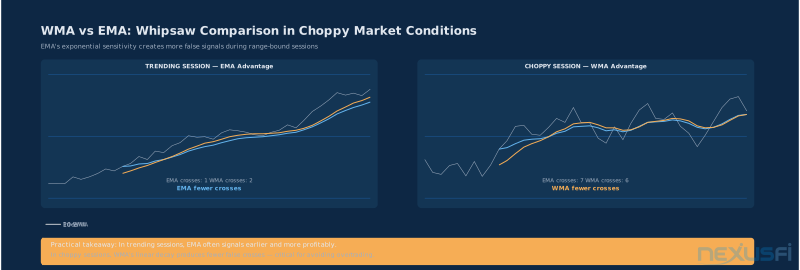
In strongly trending markets, EMA typically provides better entries — it reacts faster to price acceleration, crosses the MA earlier, and captures more of the initial thrust. The speed advantage is real and measurable. If you're trading a strategy that prioritizes catching trends early (momentum-following), EMA wins in trending conditions.
In choppy, range-bound conditions — which describe a significant portion of intraday futures sessions — EMA's sensitivity becomes a liability. Its exponential weighting responds to every brief price push, generating crossover signals that don't develop into trends. WMA's linear decay smooths out some of this noise, producing fewer crosses. The visual difference is often stark: during a 45-minute chop zone in ES, you can literally count the false signals and see WMA generating fewer.
The practical implication: if you trade predominantly trend-following approaches and are mostly active during strong directional sessions, lean EMA. If you trade across all market conditions and need a tool that degrades gracefully during choppy periods, WMA offers a meaningful edge. Many experienced NexusFi traders use EMA in their systematic rules and WMA as their visual reference precisely for this reason.
The adaptive MA thread exploring amaAdaptiveLaquerreFilter context highlights the broader search for moving averages that adjust to market conditions: "All 'adaptive' MAs aim to flatten out when price is not moving very strongly, and to speed up when it starts to move again." WMA isn't adaptive in this sense, but its linear decay naturally reduces sensitivity compared to EMA, giving it some of this behavior without the algorithmic complexity.
Regime detection tip: use ATR to identify choppy vs trending conditions. When the 14-period ATR on your chart is below its 20-period average, the market is contracting and choppy conditions are more likely. In these low-ATR periods, reduce position size or stop trading moving average signals entirely. This single filter will improve your WMA-based results dramatically.
Risk Management Integration #
WMA should never be a standalone signal generator. It's a trend identification tool — every WMA signal needs a proper risk management overlay to be executable.
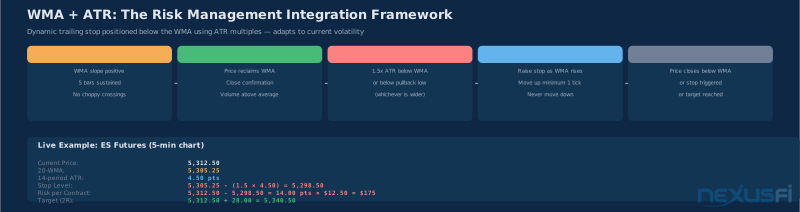
ATR-Based Dynamic Stop Placement
The most effective approach combines the WMA level with ATR to set a dynamic trailing stop:
- Enter long when price reclaims the WMA with close confirmation
- Set initial stop at: WMA_value - (1.5 × ATR_14)
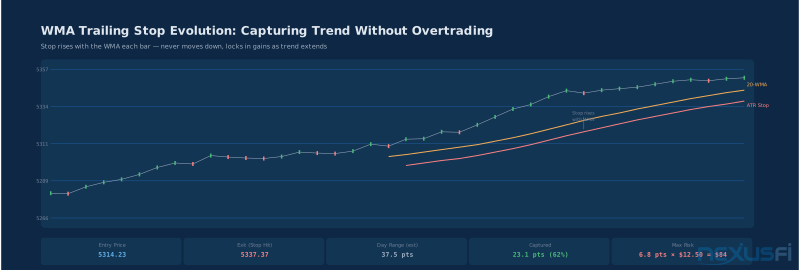
- As the WMA rises each bar, trail the stop up -- never move the stop down
- Exit when price closes below the WMA, or stop is triggered, or target is reached
Live ES example: Current price 5,312.50, 20-WMA at 5,305.25, 14-period ATR at 4.50 points. Stop = 5,305.25 - (1.5 × 4.50) = 5,298.50. Risk per contract = (5,312.50 - 5,298.50) × $12.50/point = $175. Target at 2R = 5,312.50 + 28.00 = 5,340.50.
The 1.5x ATR multiplier is a starting point — some traders prefer 1.0x ATR for tighter stops in clean trends, or 2.0x ATR for more volatile contracts like NQ. The principle is that the stop respects current volatility rather than being a fixed point distance. A fixed 10-point stop is too tight on high-volatility days and too wide on quiet days.
Position Sizing Based on WMA Distance
A secondary approach: scale position size based on how far price has extended from the WMA. When price is close to the WMA (within 0.5x ATR), the setup is higher probability and a full position is appropriate. When price has extended 2x ATR above the WMA, the risk of a sudden pullback increases — consider half size or wait for the next pullback to the WMA.
This isn't mechanical curve-fitting. It's the straightforward logic that mean reversion risk is proportional to deviation from the mean. WMA IS the mean — trading far from it carries higher mean-reversion risk, especially in range-bound markets.
Session Boundaries and Exit Protocol
Always exit WMA-based positions before the close of the regular trading session unless you have a defined overnight holding protocol. The WMA will reprice at the next session open based on the overnight session's price action, and the first bar of RTH frequently tests the WMA from the prior session. Don't let an overnight gap transform a clean trend trade into an undefined risk position.
Platform Implementation #
WMA is built into every major futures platform. Here are the exact implementation methods:
NinjaTrader 8:
// In indicator code:
WMA(Close, 20)          // 20-period WMA on close price
WMA(Close, 9)[0]        // Current bar value
WMA(Close, 21)[1]       // Previous bar value (for slope)

// Slope calculation:
double slope = WMA(Close, 20)[0] - WMA(Close, 20)[5];
bool uptrend = slope > 0.10;  // Threshold in points
TradingView (Pine Script v5):
wma9  = ta.wma(close, 9)
wma21 = ta.wma(close, 21)
wma50 = ta.wma(close, 50)

// Slope-based trend filter:
slope = wma21 - wma21[5]
uptrend = slope > 0.10

// Pullback entry:
pullback_setup = close[1] < wma9[1] and close > wma9  // Previous bar below, current above
entry_signal = pullback_setup and uptrend
Sierra Chart: Studies → Moving Average → Weighted. Sierra Chart's WMA implementation is especially flexible — you can specify the source data (Close, Typical Price, Weighted Close), apply volume weighting as an overlay, and configure paint bars based on WMA slope direction. For order flow integration, many NexusFi members plot the WMA on the same chart panel as a Volume Profile, using the WMA to define the directional bias while Volume Profile provides the key price levels.
// WMA function reference (from Big Mike's ZeroLagWMA example):
// https://nexusfi.com/showthread.php?t=3489&p=34129#post34129
vars: wma0(0), wma1(0);
// Standard WMA in EasyLanguage:
wma0 = WAverage(Close, 20);
Big Mike's ZeroLagWMA indicator thread shows an advanced WMA application built on top of standard WMA calculations — worth studying if you're implementing WMA in EasyLanguage for MultiCharts or TradeStation. The zero-lag modification applies a WMA to a WMA, reducing lag further while maintaining the intuitive linear weighting framework.
The Sharky classroom thread on real-world trading explored simplified multi-timeframe trend indicators built on MA ideas similar to WMA — the approach of using a single number to capture higher-timeframe context on a lower-timeframe chart is directly applicable to the WMA trend filter framework described in this article.
Period Optimization Warning Finding that a 23-period WMA backtested 0.3% better than a 20-period WMA over a specific historical window is curve-fitting. Use round numbers that align with conceptually meaningful intervals (10, 20, 50, 100) and test for robustness across multiple market conditions rather than optimizing for a single historical period.
Common Mistakes and How to Avoid Them #
Mistake 1: Using WMA as a sole entry trigger
Price crossing a WMA is a signal, not a trade. Every WMA cross needs validation: trend alignment, volume context, market structure. Treating WMA crosses as mechanical buy/sell signals without filters produces losing systems in all but the strongest trending conditions.
Mistake 2: Fixed period across all market conditions
The same 20-period WMA that works on a low-volatility Wednesday morning will generate constant false signals on an FOMC day with 3x normal ATR. Either avoid trading WMA signals during high-volatility news events, or dynamically adjust your period based on ATR regime — use shorter periods when ATR is below average, longer when above.
Mistake 3: Ignoring the session structure
The WMA's behavior during RTH versus ETH is meaningfully different. The Asian session often produces flat WMA signals due to lower volatility and range-bound conditions. The European open can produce trending conditions that look clear but then reverse at the US open. Always know what session you're trading in, and consider whether the WMA's current positioning reflects meaningful institutional activity or just overnight noise.
Mistake 4: Moving the stop below the WMA
If you're using a WMA trailing stop, only move it up, never down. The moment you widen a stop because price is approaching it, you've abandoned the system and introduced emotional decision-making. If the price is going to stop you out, let it. The next setup will come.
Mistake 5: Over-optimizing the period
Running a 3-year backtest and finding that 23-period WMA outperforms 20-period WMA on ES by 0.3% is curve-fitting, not signal. Use round numbers that align with conceptually meaningful intervals (10, 20, 50, 100) and focus on whether the WMA is providing genuine trend context, not optimized parameters.
Summary #
The Weighted Moving Average is a practical tool for traders who've found the SMA too sluggish and the EMA too noisy. Its linear weighting reduces lag compared to SMA while providing better noise rejection than EMA during choppy conditions — a trade-off that suits active discretionary futures traders well.
The key applications are:
- Trend filter: WMA slope defines your session bias -- trade only with the slope direction
- Pullback entries: 9/21 combination for timing entries in established trends
- Ribbon strategy: Four-period stack (9, 21, 50, 100) grades trend conviction and positions size
- Dynamic stop placement: WMA + ATR combination for trailing stops that adapt to volatility
WMA isn't a breakthrough tool and doesn't require exotic math. Its strength is in being intuitive, reliable, and honest about what it is: a smoothed representation of recent price action with a bias toward current data. Combined with proper risk management, structure-based context, and disciplined execution, it earns its place on the chart.
For traders building out their toolkit, start by reading about the EMA and SMA articles first if you haven't — understanding the full family of moving averages helps you choose the right tool for each market condition. The WMA fits naturally alongside VWAP Standard Deviation Bands for institutional reference levels and Hull Moving Average for situations where you need lag reduction beyond what WMA offers. For measuring trend momentum independent of price levels, pair WMA analysis with the Rate of Change (ROC) indicator to confirm whether momentum is building or fading.
Knowledge Map
Prerequisites
Understand these firstGo Deeper
Build on this knowledgeReferences This Article
Articles that build on this topicCitations
- — Building Blocks of a Trading System (1) - Trend Filter (2010) 👍 22“The simplest trend filter that translates the idea 'that price is up', is the momentum or rate of change indicator. Momentum is very much compared to the trend filter.”
- — MAGIC indicator (2009) 👍 32“Moving Average Group Interactive Convergence (MAGIC) -- I noticed several members using multiple moving averages and wanted to create a tool that visualizes their convergence patterns.”
- — Perry's Trading Method - Elite Members (2012) 👍 14“There is no argument that any Moving average is based on historical data - this is a mathematical certainty. I have always said that the MDAs are filters first, and signals second.”
- — WK's or ESFXtrader Journal & How I Read Price Action (2014) 👍 7“The 18 and 21 periods are my primary settings. I have not found an equivalent to the LSMAs. The RMA or rolling moving average is actually between 19 and 20 EMA in terms of responsiveness.”
- — SHARKY's Real World Trading Classroom (2011) 👍 13“I was trying to find if there is an easier way to find trend in a higher time frame and therefore wrote this indicator based on Sharky's ideas about using simple MA relationships for directional bias.”
- — EasyLanguage ZeroLagWMA indicator (2010) 👍 5“Function inputs: Price (NumericSeries), length (NumericSimple). The zero-lag WMA applies the WMA calculation to reduce lag further while maintaining the intuitive linear weighting framework.”
- — Coding Multi Time Frame (MTF) Indicators with NinjaTrader (2012) 👍 22“Upsloping and downsloping EMA and SMA: paint bars are available to detect the trend according to the indicator slope. The paint bars can be shown without plotting the indicator.”
- — amaAdaptiveLaquerreFilter (2021) 👍 3“All 'adaptive' MAs aim to flatten out when price is not moving very strongly, and to speed up when it starts to move again. So they are meant to be naturally sensitive to the current market environment.”
- CME Group Education — Moving Averages as Price Filters and Trend Indicators in Futures Trading (2025)
- NinjaTrader Documentation — WMA (Weighted Moving Average) Indicator Reference (2024)