



Palladium (PA) Futures: The Complete Trading Guide
# Palladium (PA) Futures: The Autocatalyst Metal That Moves Like Nothing Else
Overview #
Palladium is the market that punishes people who treat it like gold. Same precious metals label, completely different animal. Gold responds to inflation fears and central bank policy. Silver follows industrial cycles with speculative overlays. Palladium — the CME NYMEX PA contract — responds almost entirely to one thing: how many gasoline-powered cars are rolling off assembly lines and how many catalytic converters need to be replaced.
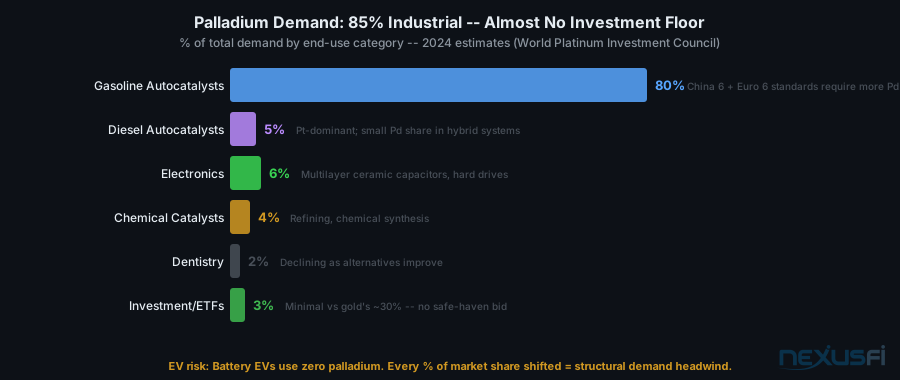
That concentration creates opportunity. When you understand the supply chain, the demand mechanics, and the structural positioning of this market, you get setups that are cleaner than gold because the fundamental driver is simpler. Autocatalyst demand is 85% of total palladium consumption. There's no central bank bid. There's no meaningful jewelry demand. There's no safe-haven rotation. It's industrial metal wrapped in a precious metals contract.
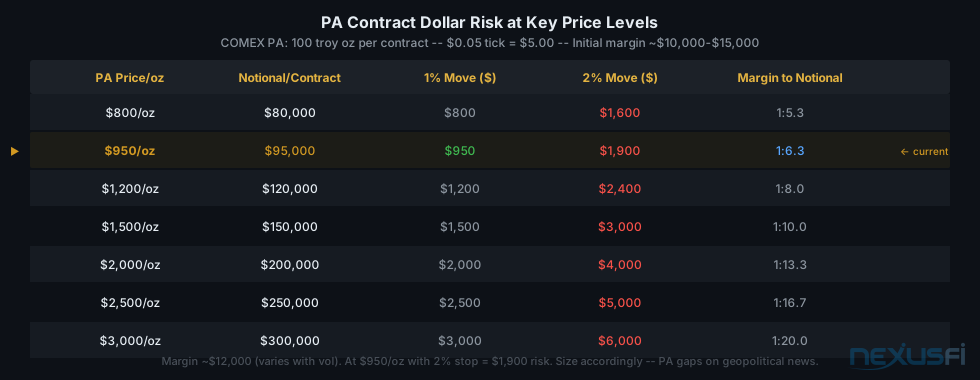
The PA contract trades on CME NYMEX, 100 troy ounces per contract. At $1,000/oz that's $100,000 notional. Volume runs 1,000 to 3,000 contracts per day — thin compared to gold's 200,000+ daily contracts but adequate for spread positions and well-sized directional trades.
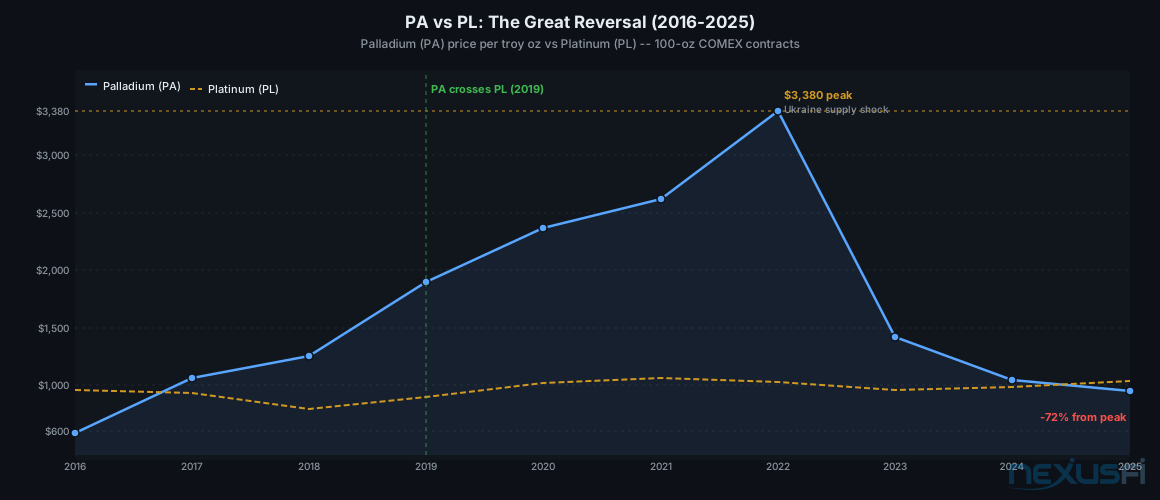
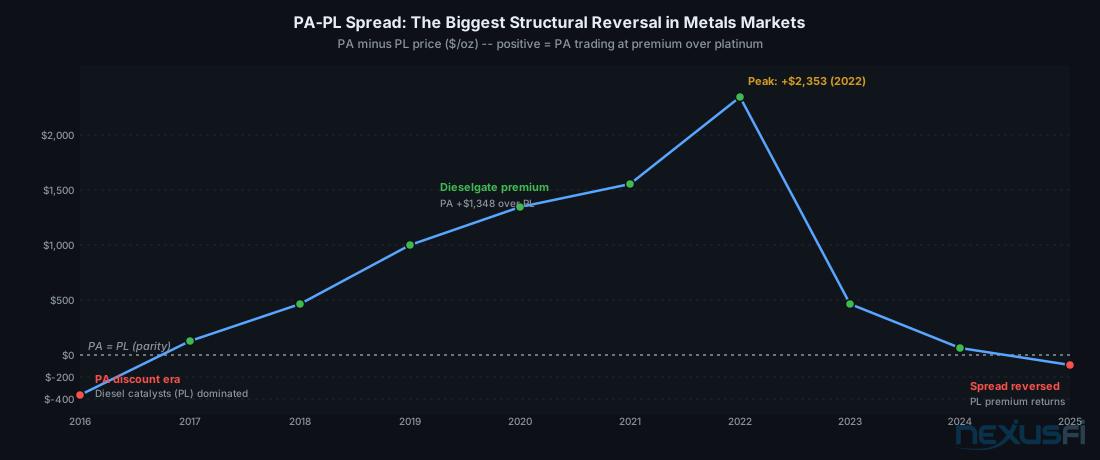
What makes this market compelling right now is where we are in the PA-PL spread cycle. Palladium traded at a $500-700 discount to platinum through 2016. By 2022 it was at a $2,200 premium. Today it's reversed — platinum is back to a modest premium. That's one of the most dramatic mean-reversions in modern commodity markets, and understanding why it happened is the key to trading PA going forward.
Key Concepts #
Autocatalyst — A device installed in a vehicle's exhaust system that converts harmful pollutants into less harmful emissions. Gasoline-powered vehicles use palladium. Diesel-powered vehicles use platinum. This is the single most important fact about palladium demand.
Byproduct mining — Palladium is not mined for palladium. In Russia it comes out of nickel ore. In South Africa it comes out of platinum group metal (PGM) mining. The production decision is driven by nickel prices or platinum prices, not palladium prices. This makes PA supply inelastic to PA price changes, which creates persistent supply/demand imbalances.
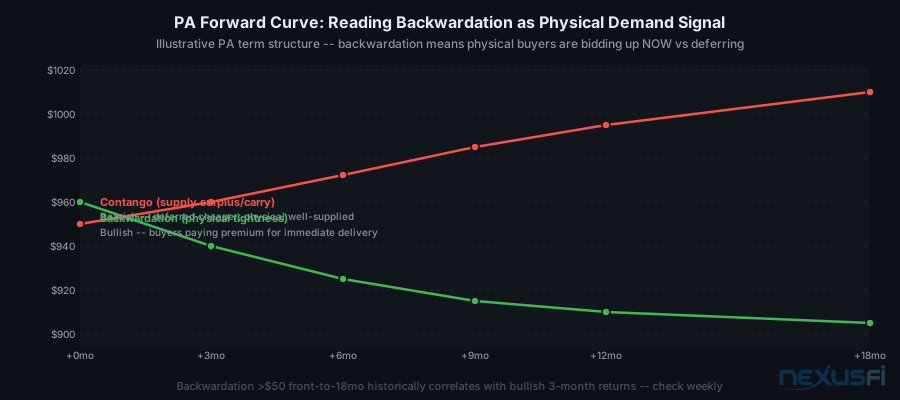
Forward curve / contango / backwardation — The price structure across futures delivery months. Contango is when later-dated contracts are more expensive than near-dated (normal for metals with storage costs). Backwardation is when near-dated contracts are more expensive than later-dated, signaling physical tightness.
(https://nexusfi.com/showthread.php?t=60230&p=892515#post892515). When PA goes into backwardation, that's a real physical shortage signal, not a financing quirk.
PA-PL spread — The price difference between palladium futures and platinum futures. This spread swung from -$700 (platinum premium) to +$2,200 (palladium premium) and back to roughly -$50 to -$150 (platinum premium again) within a decade — one of the most volatile commodity spreads on any exchange.
Primary vs secondary supply — Primary comes from mining. Secondary comes from recycling autocatalysts from scrapped vehicles. Secondary supply is procyclical: strong economy, high scrappage rates, more palladium recovery.
Substitution risk — The structural threat from battery electric vehicles. BEVs use no palladium. As the global fleet electrifies, terminal demand for automotive palladium declines.
Norilsk Nickel — Russian mining giant and world's largest palladium producer, controlling roughly 40% of global primary palladium supply.
Bushveld Complex — The geological formation in South Africa hosting the majority of the world's PGM deposits. South African mines produce approximately 38-40% of global palladium supply as a byproduct.
Contract Specifications & Market Microstructure #
| Specification | Details |
|---|---|
| Exchange | CME NYMEX |
| Symbol | PA |
| Contract Size | 100 troy ounces |
| Price Quotation | U.S. dollars and cents per troy ounce |
| Minimum Price Fluctuation | $0.05 per troy ounce ($5.00 per contract) |
| Trading Hours | Sunday - Friday, 6:00 p.m. -- 5:00 p.m. ET (60-min break daily at 5:00 p.m.) |
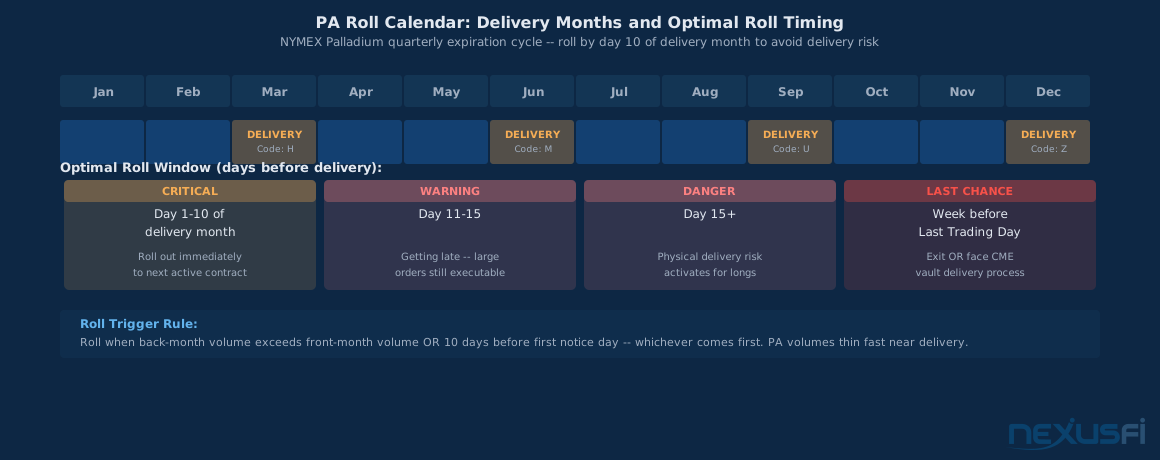
| Delivery Months | March (H), June (M), September (U), December (Z) |
| Settlement | Physical delivery, CME-approved vaults in New York |
| Initial Margin | ~$10,000-$15,000 per contract (volatility-dependent) |
| Notional at $1,000/oz | $100,000 per contract |
| Notional at $900/oz | $90,000 per contract |
Dollar Value of Price Moves
Run these numbers before you trade. Most traders coming from equity futures underestimate the dollar risk.
| Price Move | Dollar P&L Per Contract |
|---|---|
| $0.05/oz (1 tick) | $5.00 |
| $1.00/oz | $100.00 |
| $10.00/oz | $1,000.00 |
| $50.00/oz | $5,000.00 |
| $100.00/oz | $10,000.00 |
At $1,000/oz with $12,000 initial margin, a $120 adverse move wipes your entire margin. That's 12% of notional. PA regularly moves $50-100 on significant supply news. Gold traders who don't recalibrate for PA's volatility profile get hurt quickly.
Liquidity Profile
Daily volume of 1,000 to 3,000 contracts means PA is structurally thin. Bid-ask spreads run 1-3 ticks ($0.05-0.15) in normal conditions, wider during news events. Larger orders move the market. Off-hours execution is unreliable.
For the PA-PL spread specifically, the exchange-listed product solves part of this problem.
and "For exchange listed spreads, the bid-ask is often tighter than the bid-ask in the individual contracts and there is no slippage risk" (https://nexusfi.com/showthread.php?t=46668&p=713640#post713640). In a thin market, eliminating leg risk is a genuine execution edge.
Reading the Forward Curve
The PA forward curve provides real-time intelligence on physical market conditions.
Normal contango of $3-8/month between consecutive contracts reflects storage costs and cost of carry — that's noise. When the curve flattens or inverts to backwardation (front month more expensive than back months), physical buyers need near-term metal and can't wait for future delivery. That's your most reliable early supply stress signal. The 2021-2022 backwardation in PA confirmed the physical shortage well before prices hit $3,400.
Supply Fundamentals as Tradable Signals #
The Two-Country Problem
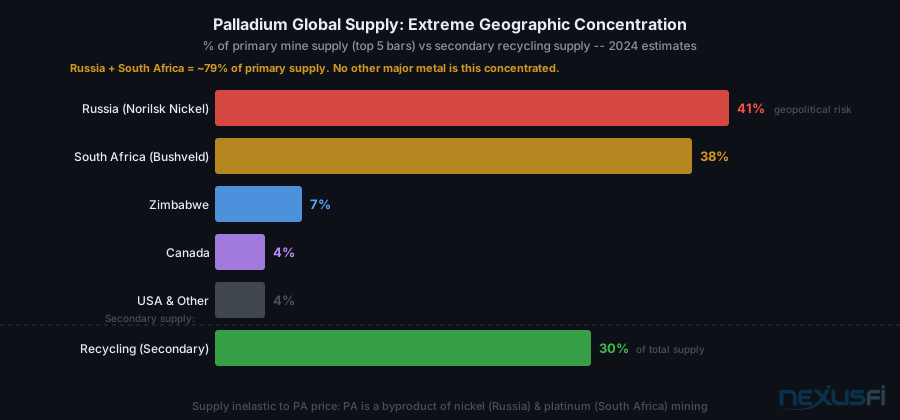
Russia and South Africa together account for roughly 78-80% of primary palladium production.
| Producer | Estimated Share | Primary Source |
|---|---|---|
| Russia (Norilsk Nickel) | ~40% | Byproduct of nickel mining |
| South Africa | ~38-40% | Byproduct of PGM mining |
| Zimbabwe | ~3-4% | PGM mining |
| Canada | ~2-3% | Nickel mining |
| United States (Montana) | ~1-2% | Stillwater Complex |
| Other | ~10% | Various |
Supply concentration this extreme means a single geopolitical event in Russia or a major mine disruption in South Africa moves the global market immediately. There's no large diversified producer base to absorb shocks the way copper or aluminum markets can.
The 2022 Russia-Ukraine conflict made this concrete in real time. CME suspended approved delivery status for major Russian refineries across the precious metals complex (@SMCJB, post 861465). Russian palladium faced equivalent dislocation, helping drive the $3,380 peak.
Why PA Supply Doesn't Respond to PA Price
This is the counterintuitive piece that most equity traders miss. In most markets, high prices bring more production. Not in PA.
Norilsk Nickel's production decisions are driven by nickel demand from stainless steel and battery supply chains, not palladium prices. Palladium is what they extract from ore that would otherwise be processed at cost. South African PGM mines make decisions based on platinum and rhodium prices — palladium is a byproduct sweetener.
Practical implication: when PA demand suddenly spikes, supply cannot respond within a 3-5 year timeframe even if producers wanted to respond. New mine development takes years. This supply inelasticity explains why PA is capable of $1,000+ moves over 12-18 months.
Secondary Supply: Recycling as a Market Signal
Recycling provides roughly 30% of total palladium supply from automotive trigger recovery. Secondary supply is procyclical — strong economy means more vehicles scrapped and more palladium recovered.
During COVID-19 lockdowns in 2020, secondary supply collapsed simultaneously with primary supply disruptions. Both hit at once, compounding the tightening that eventually pushed prices toward $3,400 by 2022.
Track automotive scrappage data as a leading indicator. It runs 3-6 months ahead of recovered palladium reaching the market.
Demand Dynamics: Why PA Moves Like No Other Metal #
The Autocatalyst Concentration
85% of palladium demand is autocatalyst. No other major commodity has this level of demand concentration in a single application.
| End Use | Approximate Share |
|---|---|
| Gasoline autocatalysts | ~85% |
| Industrial (electronics, chemical processing, dentistry) | ~10% |
| Investment | ~3-5% |
| Jewelry | ~1-2% |
This concentration is a feature for fundamental traders. You don't need to model 12 demand drivers. Model global gasoline vehicle production, emission standard tightening, and BEV substitution. That's the entire demand picture.
Gasoline vs Diesel: The Critical Distinction
Platinum handles diesel. Palladium handles gasoline. This isn't interchangeable in the short to medium term — converting a catalytic converter from one PGM formulation to another requires regulatory revalidation and manufacturing retooling. That takes years.
The post-2015 Dieselgate scandal was a demand inflection for PA. When Volkswagen's diesel emissions manipulation became public, European consumers and regulators pivoted away from diesel powertrains. Gasoline demand went up, palladium demand went up, platinum automotive demand fell. PA went from a $500-700 discount to platinum in 2016 to a $2,200 premium by 2022 — driven entirely by this single structural shift in powertrain preference.
China: The Swing Factor
China represents 25-30% of global automotive palladium demand. The China 6 emission standard, phased in starting 2020, is stricter than European standards and requires higher palladium loadings per vehicle. More palladium per car, plus growing Chinese vehicle production — that double-compounding drove significant incremental demand through 2018-2022.
Watch China auto production data monthly from the China Association of Automobile Manufacturers (CAAM). Significant beats or misses vs expectations move PA.
The EV Substitution Threat: Real But Slow
BEVs use no palladium. This is the structural long-term bear case and it's completely legitimate.
Global BEV penetration of new vehicle sales in 2024 was roughly 15-18% globally (China ~30%, Europe ~20%, US lower). 82-85% of new vehicles still require catalytic converters. At current palladium loadings, that's 70+ million ICE vehicles per year.
The price decline from $3,400 (2022 peak) to $900-1,100 (2023-2026) incorporated EV threat repricing, supply recovery, and the unwinding of the geopolitical premium. At current levels the market has done significant work discounting this structural risk.
Hybrid vehicles (non-BEV) still use catalytic converters and often use more palladium per vehicle than pure ICE because of cold-start frequency from engine cycling. Hybrid adoption partially offsets BEV cannibalization.
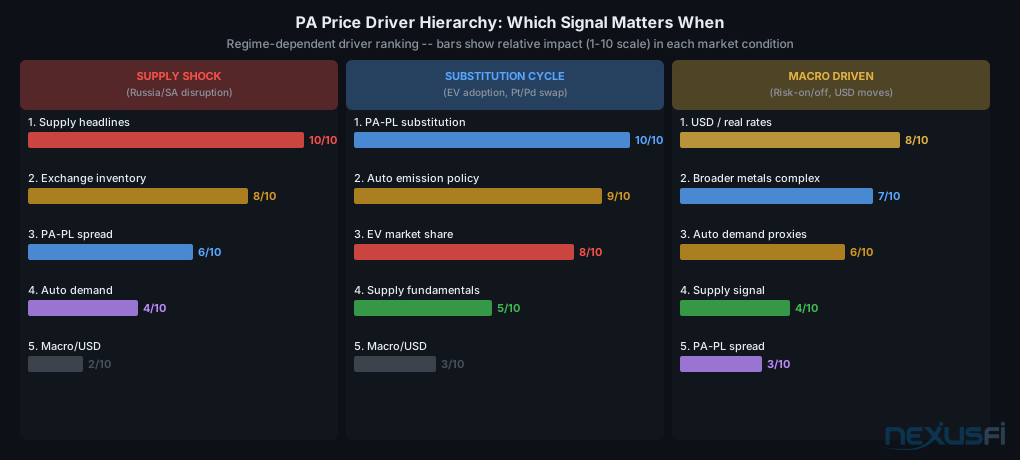
The Price Driver Hierarchy #
| Rank | Driver | Time Horizon | Typical Impact |
|---|---|---|---|
| 1 | Physical supply shock (Russia or S. Africa) | Days to months | $200-800+ |
| 2 | Automotive production data (esp. China) | Monthly | $50-200 |
| 3 | Emission standard changes | Years | Structural $100-300 |
| 4 | EV adoption trajectory | Multi-year | Structural bear |
| 5 | Dollar and rates | Ongoing | Modest, secondary |
| 6 | COT speculative positioning | Short-term | Amplifier, not driver |
Nothing moves PA like a physical supply threat. The 2022 Russia-Ukraine conflict added $500-800 within weeks. That's first order — everything follows from it.
The dollar effect is explicitly secondary for PA vs gold. Gold responds sharply to real rate changes because investment demand is 30%+ of total gold demand. PA's investment demand is 3-5%. A TIPS yield move that sends gold $80 higher might move PA $15. Don't expect PA to track the gold macro playbook.
Risk Management for PA's Volatility Profile #
Size Down From Gold Instincts
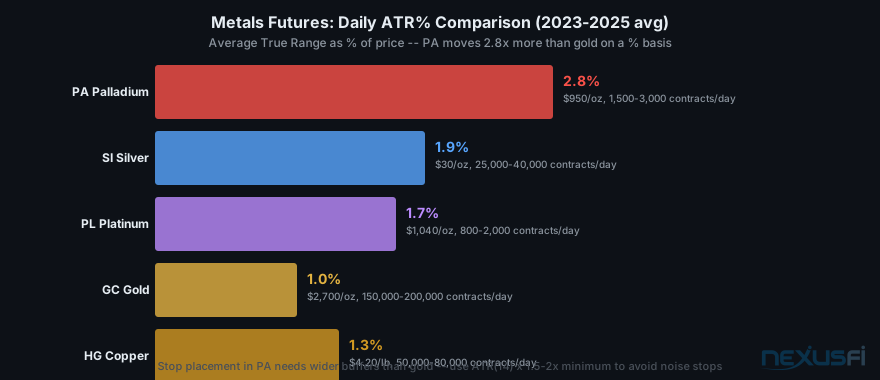
PA regularly sees 2-4% daily moves. Gold at 2-4% would be a major event. At $1,000/oz and a 3% daily range, you're looking at $3,000 of potential intraday move per contract. With $12,000 initial margin, that's a 25% intraday drawdown on a normal trading day in the wrong direction.
Start with one-third the contract count you'd use for gold until you have 50+ trades in PA and understand its movement characteristics in your setups.
Margin Buffer During Volatility Events
As @Fi noted in a NexusFi discussion on precious metals position sizing, margin management during volatile precious metals moves needs to account for percentage-based margin requirements (https://nexusfi.com/showthread.php?t=61329&p=909207#post909207). CME increases initial and maintenance margins during extreme PA events. If you're near fully margined when that happens, you're force-liquidated at exactly the wrong moment.
Keep a buffer of at least 50% above required margin during any PA position. PA's history shows margin hikes cluster with the largest adverse price moves.
Use 2x the 20-day ATR as minimum stop distance for PA position sizing. Static stops at $10-15 get chopped out in normal noise. At $1,000/oz that means $40-60 minimum stop.
Stop Placement
PA has more noise than gold relative to its trend moves. A $20-30 intraday range is normal even on quiet days. Stops at $10-15 from entry get repeatedly chopped out.
Data-driven minimums:
- Short-term trades: $30-40 from entry to clear daily noise
- Swing trades: 2x the 20-day ATR as minimum stop distance
- PA's ATR has ranged from $20 (quiet periods) to $80+ (high-volatility conditions)
If the trade requires a stop tighter than 2x current ATR, either your position size is too large or your entry precision claim isn't justified by the market structure.
Seasonal Patterns & Forward Curve Signals #
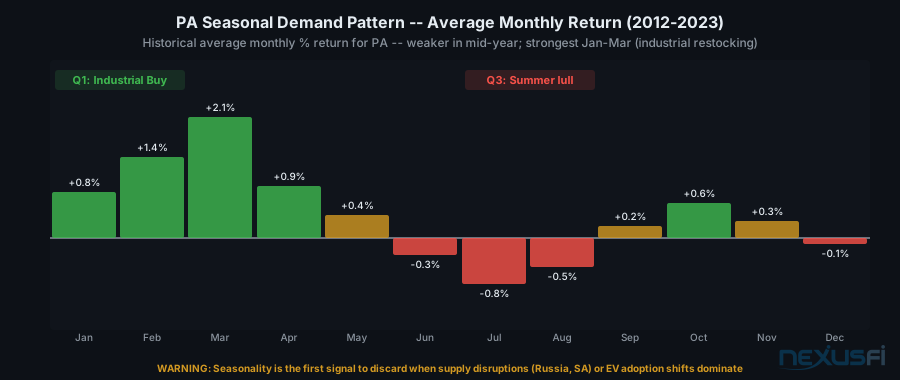
Seasonal Demand Calendar
| Quarter | Pattern | Driver |
|---|---|---|
| Q1 (Jan-Mar) | Firm | Auto production ramp post-holiday shutdowns |
| Q2 (Apr-Jun) | Firm | Strong global production, S. Africa labor negotiation season |
| Q3 (Jul-Sep) | Soft | European summer shutdowns, especially August |
| Q4 (Oct-Dec) | Strong | Auto manufacturers push volumes for year-end targets |
The most actionable seasonal setup: PA weakness in August-September creates lower-risk entry for Q4 demand exposure when the broader fundamental picture is intact (auto demand stable, no major EV acceleration, supply normal). Use seasonality to refine entry timing within a trend view, not as a standalone signal.
Forward Curve as a Leading Indicator
Normal PA contango ($3-8/month) is carry cost. What to watch:
Flattening curve: Early warning that supply is tightening relative to what storage costs alone explain.
Backwardation: Physical buyers need near-term metal and can't wait. This is the most bullish signal the PA forward curve produces. Persistent weekly backwardation during 2021-2022 confirmed the supply stress driving prices toward $3,400 well before financial markets fully priced it.
Roll spread turning positive for longs: When rolling from front to back month generates a credit, longs are getting paid to hold. That's a structural tailwind.
Don't trade against confirmed, sustained backwardation in PA. It represents real physical demand that storage arbitrageurs cannot solve.
The PA-PL Spread: Where Professional Traders Find Edge #
The Decade-Long Spread History
| Period | Spread | Driver |
|---|---|---|
| 2015-2016 | -$500 to -$700 (PL premium) | Diesel seen as clean future, PA oversupplied |
| 2017-2018 | Narrowing sharply | Dieselgate fallout, gasoline demand shift |
| 2019 | Crossed zero | First time PA exceeded PL |
| 2021-2022 | +$1,500 to +$2,200 (PA premium) | Russian supply risk + COVID tightness |
| 2023-2024 | Declining PA premium | EV threat, supply recovery, PL hydrogen demand |
| 2025-2026 | -$50 to -$150 (PL premium) | Full mean reversion |
The 2019-2022 PA premium was the anomaly. Whether the current PL modest premium is the new normal or the beginning of another cycle depends on your BEV adoption view and how quickly platinum's hydrogen economy role scales.
Spread Mechanics and Margin Advantage
(https://nexusfi.com/showthread.php?t=40925&p=708312#post708312). For PA-PL, correlation is high — both are PGMs from the same mining regions, affected by similar supply risks. The exchange provides significant margin credit reflecting this correlation.
The practical edge: as @SMCJB noted directly about spreads vs outright contracts, "Spreads behave very differently than outright contracts and can actually be easier to trade as they have less noise, they are also a lot cheaper from a margin perspective" (https://nexusfi.com/showthread.php?t=52683&p=790962#post790962). Lower margin, less noise, and no leg risk via the exchange-listed product — meaningful advantages in a thin market.
Spread P&L example: PA at $1,000, PL at $1,050, spread at -$50. If spread narrows to -$20 (PA outperforms PL by $30), a long PA/short PL position gains $30 x 100 oz = $3,000 per spread unit.
When to Trade Long PA / Short PL
The case for PA outperformance is strongest when:
- Supply disruption hits Russia specifically -- Norilsk Nickel disruptions hit PA harder than PL because Russia is ~40% of PA supply but a smaller share of PL production
- China auto production beats much -- more gasoline vehicles directly increases PA autocatalyst demand with no proportional PL benefit
- PA forward curve goes backwardated while PL remains in contango -- physical tightness specific to PA, not a generalized PGM shock
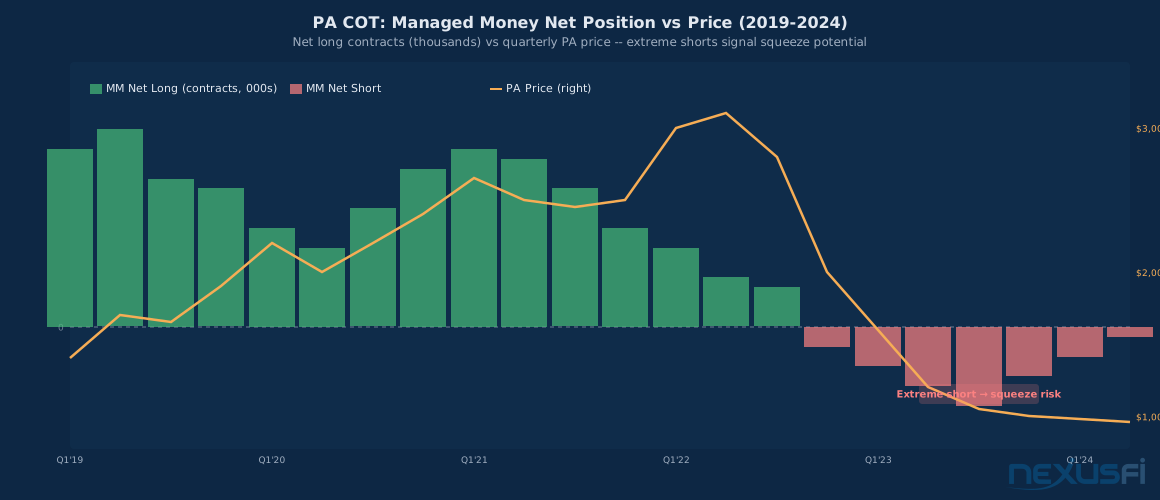
- COT shows extreme PA short positioning -- in a thin market, forced short covering produces violent moves -- when managed money is record net short and auto demand data beats, the squeeze can be fast
When to Trade Long PL / Short PA
The case for PL outperformance is strongest when:
- EV adoption accelerates faster than expected -- automotive is 85% of PA demand but a smaller share of PL (diesel, industrial, hydrogen). EV growth hits PA disproportionately
- Hydrogen economy catalysts appear -- PEM fuel cells use platinum, not palladium. Every major green hydrogen investment announcement is a PL positive with no PA component
- PA is trading at an extreme premium -- at +$2,200 premium (the 2022 peak), any credible demand threat to PA creates violent spread reversion
Always use the exchange-listed PA-PL spread product rather than manually legging two separate outright contracts. The execution quality difference in a thin market is material.
Practical Trade Setups #
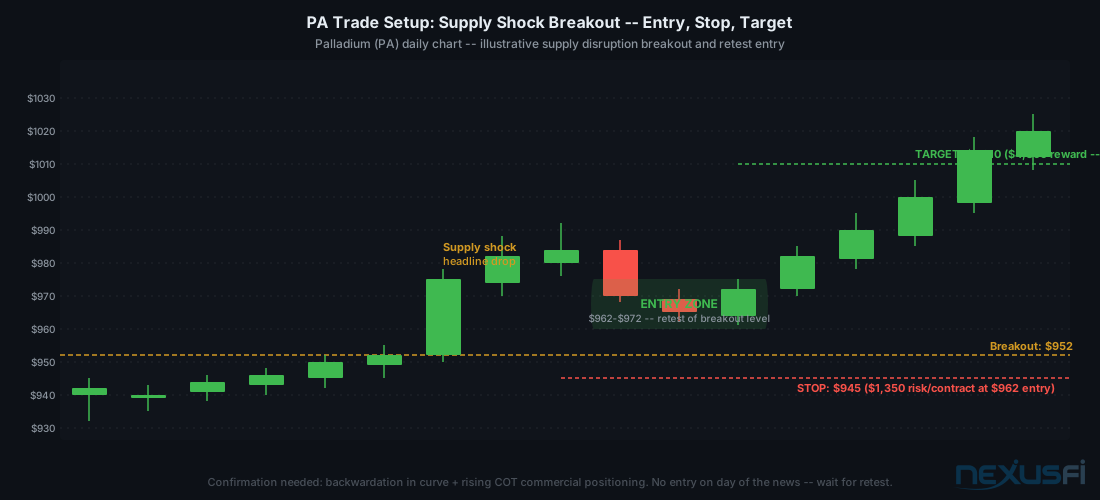
Setup 1: Supply Shock Breakout
Trigger: Geopolitical news affecting Norilsk Nickel or a major South African PGM mine production cut.
Entry: Don't chase the news candle. Wait for the first or second daily close above a defined resistance level. The close confirms the market is building on the move, not just headline-reacting.
Position size: 1-2 contracts initially. Add 1 contract if the forward curve goes into backwardation on a weekly close (physical tightening corroborating the news).
Stop: 1.5x current 20-day ATR below the breakout level.
Target: Measured move from breakout. Supply shocks in PA historically run $200-500 in the initial leg. The 2022 Russian supply fear move from $2,000 to $2,500 happened in 2 weeks.
Exit signal: Forward curve returns to normal contango or supply news is confirmed as less severe than initially reported.
Setup 2: Q3 Seasonal Entry
Context: August-September weakness from European production shutdowns creates lower-risk entry for Q4 demand exposure.
Entry criteria: PA shows 2-3 weeks of sideways to down price action in August into a prior support level with the fundamental picture intact (auto demand stable, supply normal).
Stop: Weekly close below the August seasonal low.
Target: Price recovery through October-November as Q4 auto production data confirms demand.
Setup 3: COT Extreme Short Squeeze
Signal: Managed money net short at historical extremes (bottom 10% of historical range).
Entry filter: COT at extreme short AND price makes 2 consecutive higher weekly lows. Enter long on the third week close above the prior week's high.
Stop: Below the recent swing low.
Target: 50% retracement of the decline that built the extreme short position. In a market with only 1,000-3,000 contracts of daily volume, forced short covering produces fast, violent recoveries.
Setup 4: PA-PL Spread Mean Reversion
Entry criteria for long PA/short PL: Spread reaches -$200 or wider (PL premium over $200) AND a PA-specific supply trigger appears AND auto production data beats. Use the exchange-listed spread product.
Stop: $100 adverse spread movement per spread unit ($10,000 per 100-oz pair).
Target: Spread returns within $50 of the entry level's starting point.
Limitations & When PA Fails #
When Fundamentals Break Down
Macro correlation events: During risk-off episodes, PA falls 20-30% regardless of autocatalyst supply/demand balance. Global recession expectations reset auto production forecasts lower and PA reprices for demand destruction. The fundamental framework doesn't disappear — it operates at a new lower demand baseline.
EV narrative sell-offs: Every major BEV announcement can knock PA 5-10% even when it has no near-term demand impact. The market reprices its EV adoption timeline and that hits PA. These moves look technically clean but are narrative-driven, not fundamental. Counter-trend positions require patience — physical demand hasn't changed but sentiment has.
Dollar dislocation: A 10%+ USD move in a short period forces PA to track the currency more than the physical market temporarily. This reverses, but it can produce weeks of confusing price action disconnected from your fundamental thesis.
Liquidity Constraints Are Real
You cannot scale PA the way you scale gold. A 20-contract position in gold is institutional noise. A 20-contract position in PA is 0.7-2% of the daily market. You move the book entering or exiting at that size.
During high-volatility news events, PA gaps $100-200 at open and runs into a thin order book. Stop orders execute 3-5 ticks below expected levels. Slippage is wider and less predictable than in deep markets.
The PA-PL Spread Fails Under Correlated Shocks
The spread breaks down when shocks hit both metals simultaneously. A major South African mining disruption hits both PA and PL supply — both are extracted from Bushveld Complex mines. In that scenario the spread barely moves even though both outright prices are volatile. If the news affects both metals proportionally, the spread is the wrong instrument. During global liquidity crises, cross-asset correlations go to 1 and all spread relationships break down temporarily.
Structural Upside Cap
At $3,400/oz (2022 peak), autocatalyst manufacturers faced serious cost pressure — paying $34,000 in palladium content for a catalytic converter on a $30,000 vehicle. That immediately incentivized thrifting (less palladium per converter through redesign), platinum-based formulation research, and accelerated EV transition.
The 2022 spike contained the seeds of its own reversal. At current $900-1,100 prices, there's room for a significant move — $1,500-2,000 is plausible before demand-side responses kick in. But $3,400 requires a 2022-magnitude supply shock without any substitution response, which is unlikely to repeat with the same force.
PA rewards traders who do the supply/demand work, understand the single dominant driver, and position with appropriate respect for the volatility that comes from a thin, at the core concentrated market. The data is unambiguous: $2,500 gained in two years, $2,400 given back in two years. This is not a mechanical strategy market. It's a fundamental market with occasional speculative overlays — and when you have both pointing the same direction, it moves fast and far.
Knowledge Map
Prerequisites
Understand these firstGo Deeper
Build on this knowledgeReferences This Article
Articles that build on this topicCitations
- — Spoo-nalysis ES e-mini futures S&P 500 (2014) 👍 21“One of the most overlooked aspects of trading futures is the shape of the futures curve. For precious metals and commodities the curve tells you whether the physical market is tight or loose.”
- — Spreads brokers? (2019) 👍 7“An exchange listed spread is where the exchange will execute the spread as a single trade, with no leg risk. The bid-ask is often tighter than the bid-ask in the individual contracts.”
- — Trading ratios long term (2020) 👍 4“Spreads behave very differently than outright contracts and can actually be easier to trade as they have less noise, they are also a lot cheaper from a margin perspective.”
- — Grains & Beans (2019) 👍 3“Inter commodity spreads consist of two legs of different commodities. Margin depends on the correlation of the two legs.”
- — Reminiscences of a Bean Trader (2014) 👍 15“Producers who are long product must sell futures to hedge -- the result was backwardation caused by a producer premium with a shortage of specs to take the other side of the trade.”
- — CFD hedging (2023) 👍 2“For precious metals like @GC it is a function of storage costs and cost of carry/interest rates. @CL is backwardated. No amount of storage is going to allow you to arbitrage a backwardated market.”
- — Gold Futures (GC) main discussion (2022) 👍 4“CME (or COMEX) has suspended the approved status for warranting and delivery of Russian brands of gold and silver -- JSC Krastsvetmet, JSC Novosibirsk Refinery, JSC Uralelectromed.”
- — Rollover dates for GC, SI, ZC and ZS (2013) 👍 13“For commodity futures this is not the case [fixed roll dates], but most participants roll according to volume or open interest crossover.”
- — LIQUIDITY SHOCK (2011) 👍 16“Commodity futures exchanges were intended to be a venue for price discovery, risk transference, and price speculation -- physically deliverable contracts keep the market anchored to real-world supply and demand.”
- — CME Switches to Percentage-Based Precious Metals Margins (2026) 👍 1“The practical difference for your GC/SI trading: fixed dollar margins stay put regardless of price, but percentage-based floats with notional value. If gold rips another 10%, your margin requirement jumps even if you are just holding an existing position.”
- CME Group — NYMEX Palladium Futures Contract Specifications (2024)