



Silver Futures (SI): The Complete Trading Guide to the Most Volatile Precious Metal
Overview #
Silver futures are the benchmark derivatives contract for the world's most volatile precious metal. Traded on COMEX (a division of CME Group), the SI contract gives traders direct exposure to silver through standardized 5,000-troy-ounce contracts with defined tick sizes, delivery mechanics, and margin requirements that scale with price. The micro SIL contract (1,000 troy ounces) offers the same market at one-fifth the risk.
Silver occupies a unique space in the commodity world — roughly half its demand comes from industrial applications (solar panels, electronics, medical devices) and the other half from monetary and investment demand (safe-haven flows, ETFs, physical accumulation). That dual-demand profile makes silver at the core different from gold, and it's the reason silver regularly delivers twice gold's percentage moves in both directions.
This article covers what experienced futures traders need to trade silver effectively — contract mechanics, session behavior, price drivers, the gold-silver ratio, margin dynamics, and execution considerations. If you're already comfortable with futures contract mechanics and margin requirements, you're in the right place.
Key Concepts #
Before diving in, here's the shorthand you'll encounter throughout:
- SI — Standard Silver Futures (5,000 troy oz per contract, COMEX/CME)
- SIL — Micro Silver Futures (1,000 troy oz per contract, COMEX/CME)
- COMEX — The Commodity Exchange division of CME Group where silver futures trade
- Tick — Minimum price increment ($0.005 per troy ounce)
- Tick Value — Dollar P&L per tick ($25.00 for SI, $5.00 for SIL)
- Gold-Silver Ratio — Gold price divided by silver price. Measures relative value between the two metals. Historical mean sits around 60-80.
- London Fix — The daily benchmark pricing process (12:00 PM London time) that serves as the reference price for physical silver transactions
- COMEX Vault Inventory — Physical silver held in CME-approved warehouses. Changes in registered vs. eligible inventory signal delivery demand.
- Paper-to-Physical Ratio — The ratio of outstanding futures contracts to deliverable physical silver. Higher ratios indicate more speculative positioning relative to physical supply.
Contract Specifications #
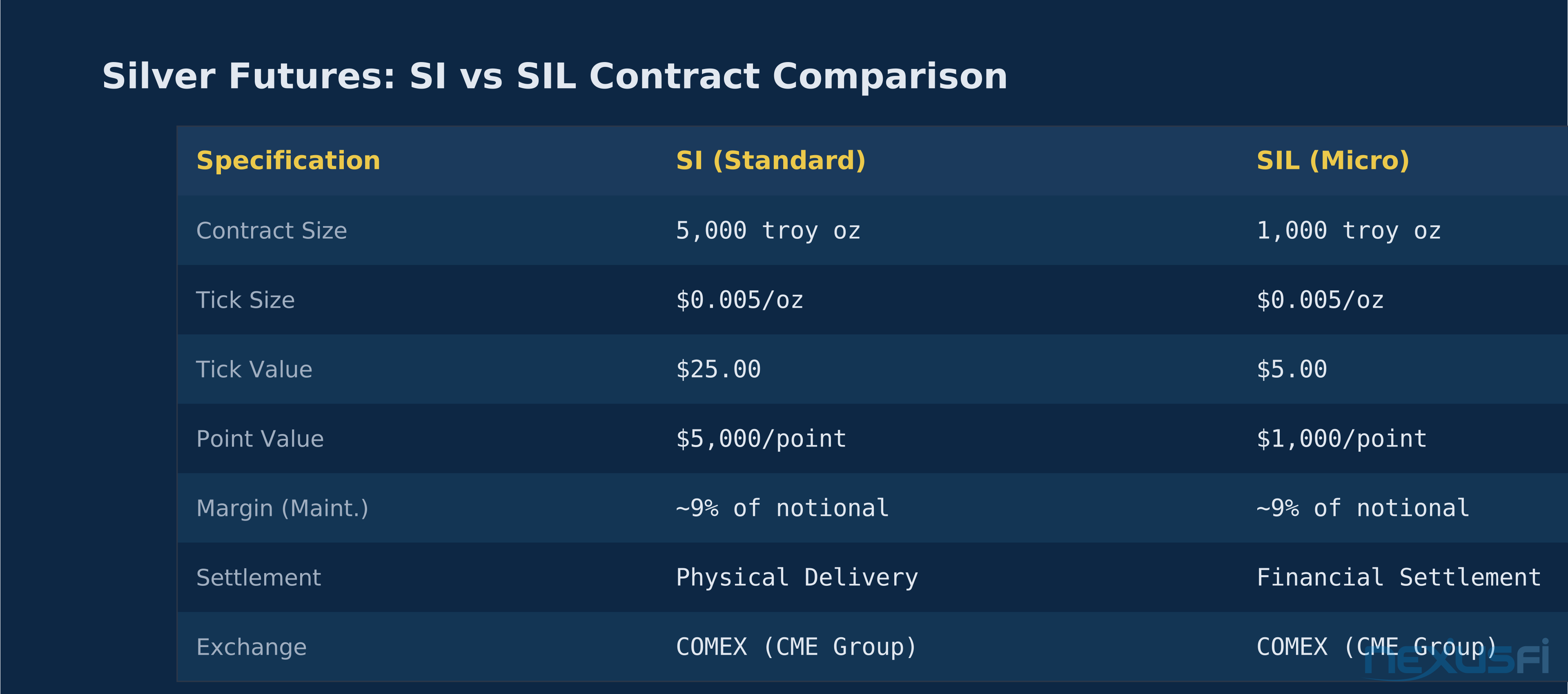
Silver futures come in two sizes on COMEX. Same exchange, same tick grid, very different risk profiles.
SI — Standard Silver Futures #
The full-size contract represents 5,000 troy ounces of silver. At $75/oz, that's $375,000 in notional value — serious leverage against typical maintenance margin of around $34,000 (9% of notional under CME's current percentage-based system). Each $0.005 tick moves your P&L by $25.00. A full $1.00 point move = $5,000 per contract.
As @Fat Tails [broke down on NexusFi] [1], the math is straightforward: "Value per tick = 5,000 troy ounces × $0.005 = $25. Value per full point = 5,000 troy ounces × $1 = $5,000." That $5,000-per-point exposure is what makes SI one of the more aggressive commodity contracts available.
SI is physically deliverable. Silver delivered under this contract must assay to 999 fineness (99.9% pure). Fewer than 1% of contracts result in actual delivery, but you need to roll your position before First Notice Day or risk assignment. Most active traders roll to the next front month 2-3 weeks before expiration.
Contract months are listed for 26 consecutive months plus any July and December in the nearest 60 months. The most liquid months are typically March, May, July, September, and December — the traditional delivery months.
SIL — Micro Silver Futures #
The micro contract represents 1,000 troy ounces — one-fifth of the standard SI. Same $0.005 tick size, but tick value drops to $5.00 and point value to $1,000. At $75/oz, notional value is $75,000 with roughly $6,750 in maintenance margin.
SIL settles financially rather than physically — no delivery risk, no rolling required. This makes it cleaner for short-term trading and position sizing. As @Japhro [noted on NexusFi] [3], "I have been trading SIL the mini/micro version of SI silver futures... it is much more liquid than the ICE micro silver contract YI." Volume has surged in recent years — CME reported micro silver contract volume jumped 127% in December 2025 alone.
Trading Hours #
Silver futures trade nearly 24 hours on CME Globex: Sunday through Friday, 6:00 PM to 5:00 PM Eastern Time, with a 60-minute break each day beginning at 5:00 PM ET. That's 23 hours of continuous price discovery, five days a week.
Trading at Settlement (TAS) is available from 6:00 PM to 1:25 PM ET, allowing execution at the daily settlement price plus or minus 10 ticks.
How Silver Trades -- Session Behavior and Liquidity #
Silver's 23-hour trading day isn't uniform. Liquidity concentrates in predictable windows tied to the global precious metals market.
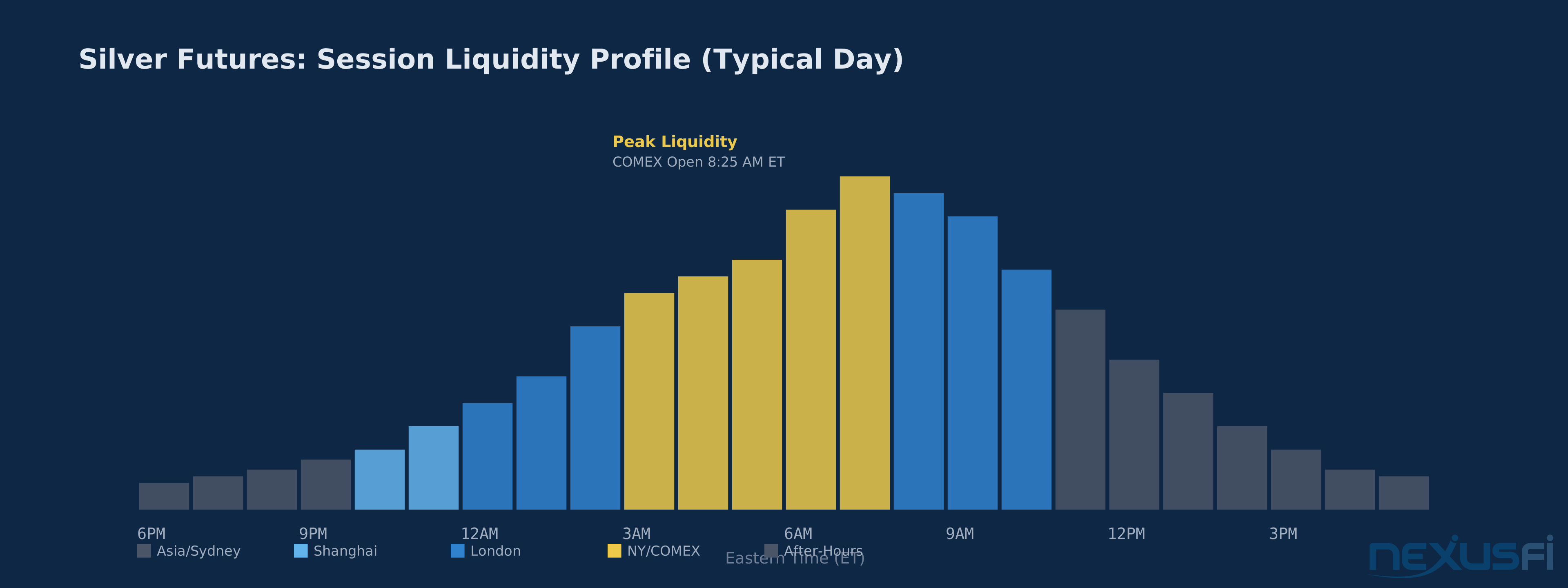
Asia/Sydney (6 PM - 1 AM ET): Thin but not dead. The Shanghai Futures Exchange (SHFE) opens at approximately 9 PM ET and provides a liquidity bump. Spreads are wider than NY hours. This session sets the tone for Asian physical demand — when China is actively buying or selling physical silver, price moves here can carry into London.
London (2 AM - 8 AM ET): The London Bullion Market Association (LBMA) runs the daily silver benchmark (the "London Fix") at 12:00 PM London time (7:00 AM ET during summer, 8:00 AM ET during winter). Liquidity builds through the European morning. Institutional flows from European banks and commodity desks show up here.
NY/COMEX (8 AM - 1:30 PM ET): This is where the action is. COMEX floor trading (now mostly electronic) opens at 8:25 AM ET. The overlap between London and New York creates the deepest liquidity pool of the day. Most of the daily volume concentrates in this window. If you're day trading silver, this is your session.
After-Hours (1:30 PM - 5 PM ET): Volume drops sharply after the London close. Spreads widen. This is maintenance time — adjusting positions, not initiating new ones, unless you're specifically trading the Asian open.
Volatility Profile #
Silver is volatile. Substantially more volatile than gold on both an absolute and percentage basis. Daily ranges of 2-4% are normal. During stressed markets, 5-8% intraday moves happen regularly. The March 2020 COVID crash saw silver drop 15% intraday.
This volatility is both the opportunity and the danger. A $2.00 move in silver on one SI contract = $10,000 P&L. That same $2.00 move is a perfectly routine daily range at current price levels. Position sizing that works for ES or GC can blow up an account in SI if you don't respect the volatility.
What Moves Silver #
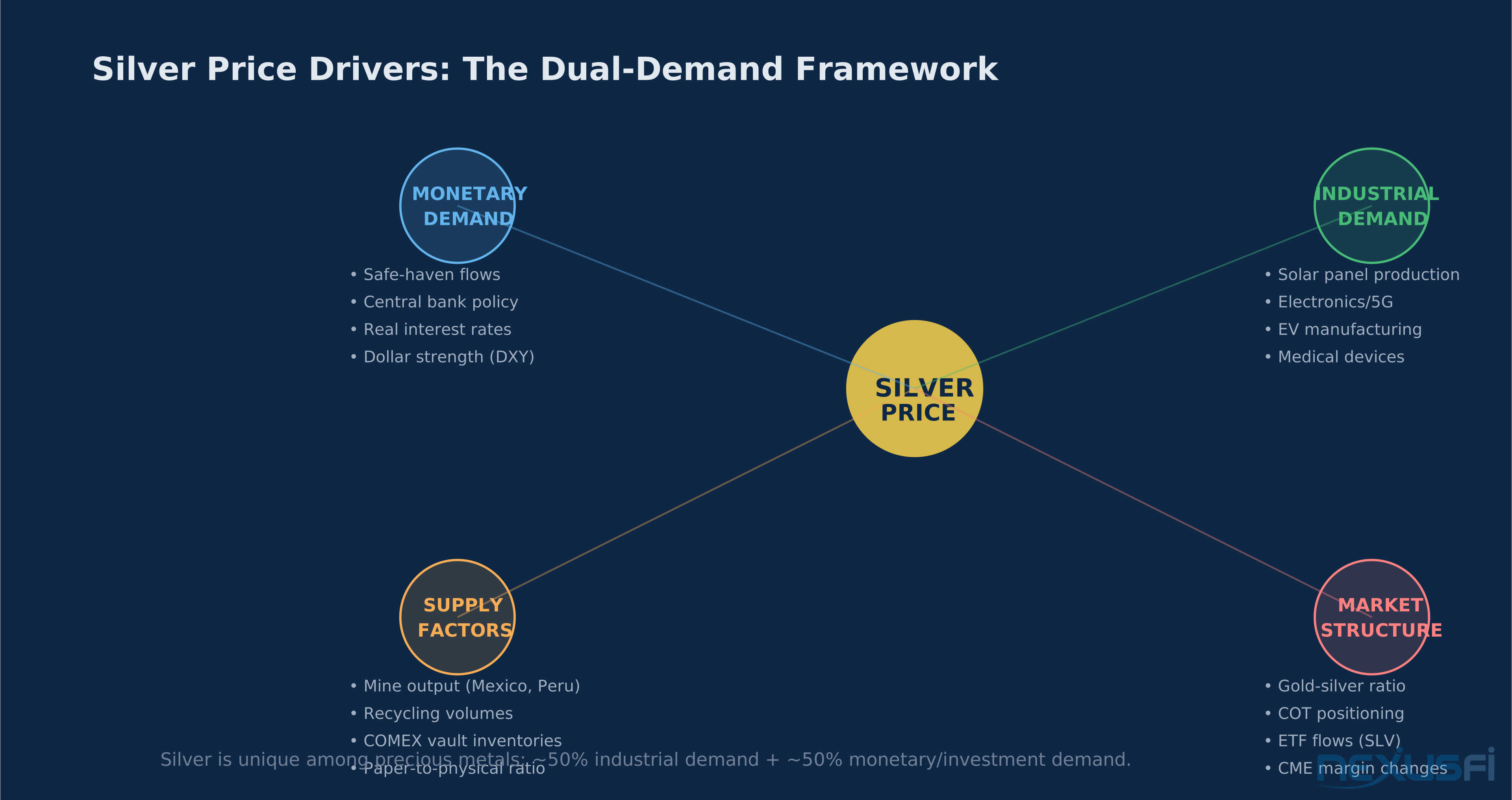
Silver's dual-demand profile creates a unique sensitivity matrix. Understanding which driver dominates in any given regime is the difference between trading silver and gambling on it.
Monetary and Safe-Haven Demand #
Silver tracks gold as a monetary metal. When real interest rates fall (Treasuries yield less than inflation), precious metals become more attractive. When the U.S. Dollar Index (DXY) weakens, metals priced in dollars tend to rise. Central bank policy — especially Fed rate decisions and quantitative easing — is the macro signal that matters most.
But silver amplifies gold's moves. When gold rallies 5%, silver often rallies 8-12%. When gold corrects 3%, silver may drop 5-8%. As @petergunz [put it on NexusFi] [2]: "Gold is to hold. Silver is for trading. This is extremely important." That higher beta cuts both directions.
Industrial Demand #
Unlike gold (where industrial demand is roughly 10% of total), silver's industrial consumption represents approximately 50% of annual demand. The fastest-growing segment is photovoltaic (solar panel) production — silver is a critical conductor in solar cells, and the global push toward renewable energy has driven silver demand to record levels.
Electronics, 5G infrastructure, electric vehicle components, and medical devices all use silver for its unmatched electrical conductivity. When industrial activity accelerates — especially in China, the world's largest manufacturer — silver demand tightens independently of any precious metals sentiment.
This creates a scenario gold traders don't face: silver can rally on economic strength (industrial demand) AND economic weakness (safe-haven demand). It can also get caught in a tug-of-war where the two forces partially cancel out.
The Gold-Silver Ratio #
The gold-silver ratio (gold price divided by silver price) is the most-watched relative value metric in precious metals trading. The historical average sits roughly between 60 and 80, though it's spent extended periods outside that range.
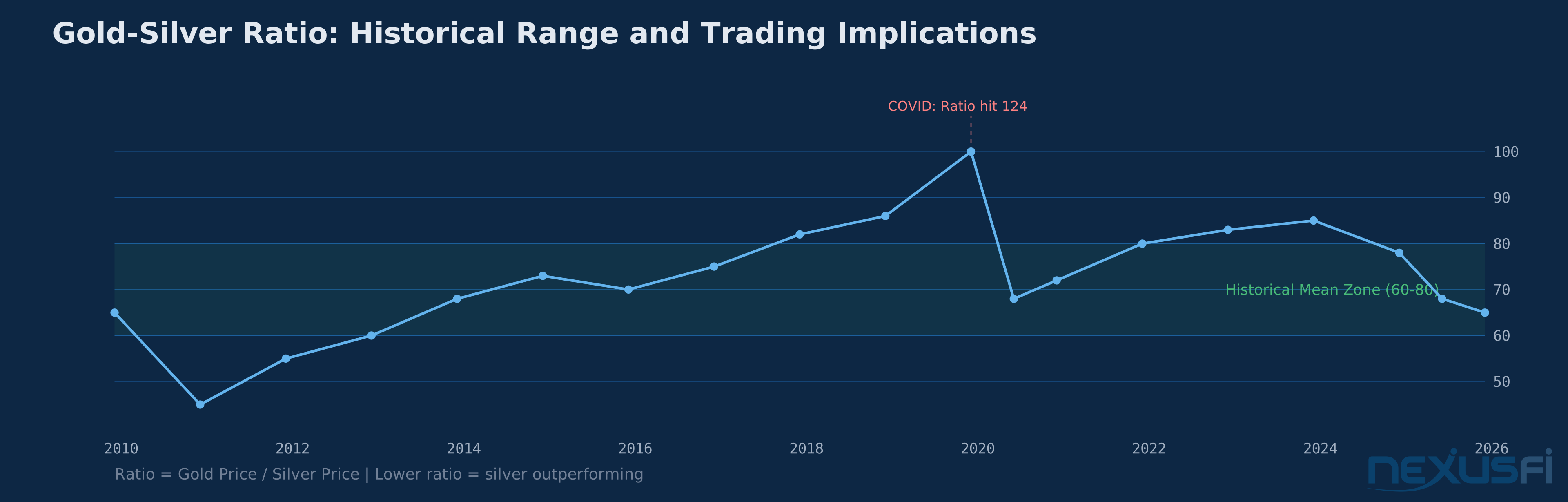
During the COVID crash in March 2020, the ratio spiked above 120 — an extreme that hadn't been seen since the 1991 recession. It subsequently compressed back toward 70 over the following year. As @Fi [noted in the NexusFi Commodities forum] [4]: "Worth watching the gold-silver ratio. It's sitting at historically extreme levels right now. If gold does roll over, silver tends to get hit harder on the downside, but a mean-reversion setup could emerge if the ratio compresses."
Traders use the ratio for:
- Mean-reversion spread trades: Long silver/short gold when the ratio is historically high, expecting compression
- Regime identification: A rising ratio (silver underperforming) often signals risk-off conditions. A falling ratio (silver outperforming) typically signals risk-on precious metals flows
- Entry timing: When the ratio hits extremes (above 90 or below 50), the odds of mean-reversion increase — though "extreme" can persist longer than most traders' patience
Key Data Releases That Move Silver #
Silver reacts to the same macro events as gold, plus some unique industrial triggers:
- Federal Reserve decisions (FOMC): Rate changes and forward guidance move real yields, which drive all precious metals
- Non-Farm Payrolls (NFP): Strong jobs data = stronger dollar = pressure on metals. Weak data = reverse
- CPI/PCE inflation: Higher inflation supports precious metals as real yields compress
- Chinese manufacturing PMI: China's industrial output directly impacts silver's industrial demand
- COMEX inventory reports: Changes in registered silver inventories signal delivery demand
- COT (Commitment of Traders) reports: Net speculative positioning shows crowding. Extreme net long positions often precede corrections
Supply Side #
About 75% of mined silver comes as a byproduct of copper, gold, zinc, and lead mining. Mexico, Peru, and China are the largest producers. This means silver supply doesn't respond quickly to price changes — you can't just "mine more silver" because most silver mines are primarily mining something else.
COMEX vault inventories matter. When registered silver (metal that's been certified for delivery) drops relative to open interest, the paper-to-physical ratio expands. By late 2025, that ratio was estimated at 356:1 — meaning there were 356 paper ounces of silver futures for every physical ounce available for delivery.
Practical Considerations #
Margin Dynamics — The Percentage-Based Shift #
Since January 13, 2026, CME calculates silver margins as a percentage of notional value rather than fixed dollar amounts. Silver maintenance margin sits at approximately 9% (9.9% for higher-risk accounts). This is a structural change, not a temporary adjustment.
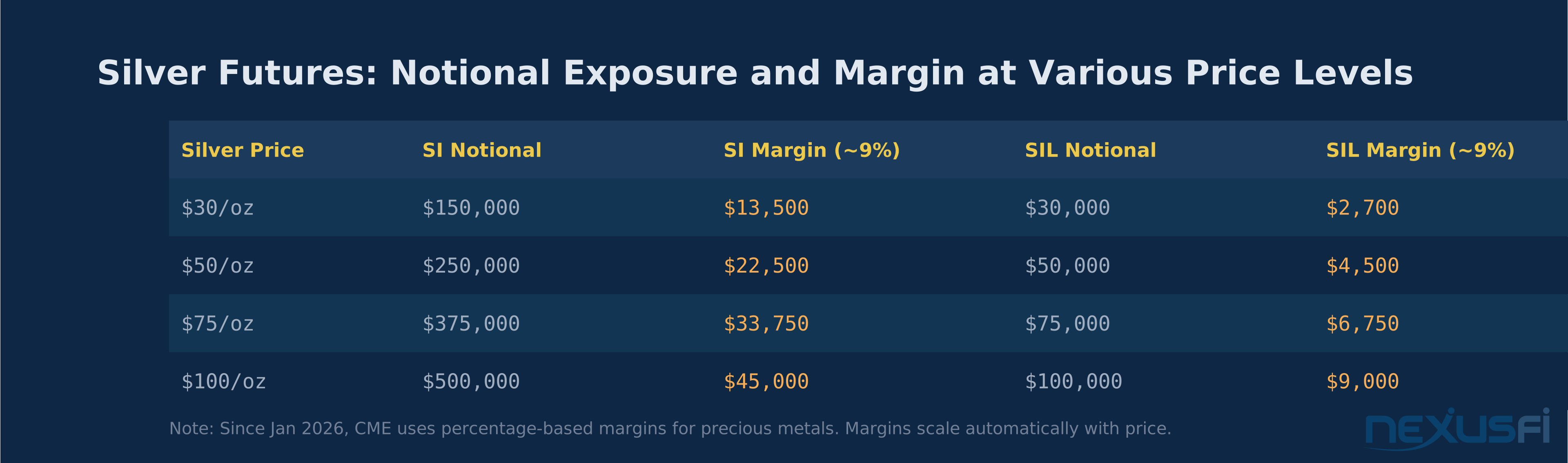
The implication: as silver rallies, your margin requirement increases automatically even if you don't add contracts. As @Fi [explained on NexusFi] [5]: "Percentage-based floats with notional value. If silver rips another 10%, your margin requirement jumps even if you're just holding an existing position. No new contracts added, but suddenly you need more capital to maintain."
This means position sizing for silver needs to account for margin expansion during rallies. A position that starts with comfortable margin headroom can trigger a margin call on a winning trade if price moves fast enough.
Position Sizing for Silver #
Silver's volatility demands respect. A practical approach:
- Calculate your dollar risk per trade using your account size and risk tolerance (typically 1-2% of account per trade)
- Measure the Average True Range (ATR) for your timeframe — daily ATR on SI regularly exceeds $1.50-$2.00, which translates to $7,500-$10,000 per contract
- Set your stop distance based on the market structure, not a fixed dollar amount
- Size the position so your stop distance × contract size × number of contracts ≤ your dollar risk
For a $100,000 account risking 1% ($1,000) per trade with a $1.50 stop in SI: $1,000 / ($1.50 × $5,000) = 0.13 contracts. You can't even trade 1 standard SI contract at that risk level. This is exactly why the micro SIL contract exists — at $1,000 per point, the same trade allows roughly 0.67 contracts, still small.
Silver forces either larger accounts, wider risk tolerances, or the micro contract. There's no hack around the math.
Execution Considerations #
Spreads: During peak NY/COMEX hours, SI typically trades with 1-2 tick spreads ($0.005-$0.010, or $25-$50 per contract). During Asian and after-hours sessions, spreads can widen to 3-5 ticks. SIL spreads are consistently wider due to lower volume.
Slippage: Silver can gap between ticks during fast markets, especially around economic releases. Stop orders in SI during NFP or FOMC announcements can fill 3-5 ticks from the stop price. Limit orders are safer but risk not getting filled.
Roll strategy: For the standard SI contract, roll 2-3 weeks before First Notice Day. The spread between front and back months varies with the term structure — contango (back month higher) is typical, but backwardation appears when physical demand tightens. Watch the calendar spread to time your roll.
When Silver Doesn't Behave #
Silver isn't always a precious metal. During acute risk-off events (2008 financial crisis, March 2020 COVID crash), silver can sell off with industrial commodities even as gold rallies. The 2020 crash saw gold drop 5% while silver cratered 35%. The industrial demand component becomes a liability when the global economy contracts sharply.
Also watch for CME margin hikes during volatile periods. As [Fi reported] [6], CME raised precious metals margins twice in a single week during January 2026 volatility, with "silver margins seeing the most aggressive hikes." Margin calls from exchange increases — not from losing trades — have forced position liquidation at the worst possible times.
Integration with Other Tools #
Silver doesn't trade in a vacuum. Professional precious metals traders use multiple confirmation layers:
- Gold Futures (GC): The primary correlation. Track the gold-silver ratio and gold's trend for regime context. Silver rarely sustains a trend that gold doesn't confirm.
- DXY (U.S. Dollar Index): Inverse correlation. Dollar weakness supports silver, dollar strength pressures it. Monitor this daily.
- Real Yields (TIPS): When real yields fall, precious metals benefit. The 10-year TIPS yield is arguably the single most important macro input for silver direction.
- VWAP and Volume Profile: For intraday execution, VWAP provides the institutional reference price. High-volume nodes from overnight sessions often act as support/resistance during COMEX hours.
- COT Reports: Weekly positioning data from the CFTC. Extreme net speculative long or short positions are useful contrarian signals.
- Copper (HG): As the primary industrial metal, copper's trend signals the health of global manufacturing. When copper and silver diverge, pay attention — one of them is wrong.
Knowledge Map
Go Deeper
Build on this knowledgeReferences This Article
Articles that build on this topicCitations
- — HELP in determining the Gain/Loss per move in SI,PL,NG,LE,etc..... (2013) 👍 2“Value per tick = 5,000 troy ounces x $0.005 = $25. Value per full point = 5,000 troy ounces x $1 = $5,000.”
- — Gold Futures (GC) main discussion (2020) 👍 8“Gold is to hold. Silver is for trading. This is extremely important.”
- — SIL CME mini Silver Futures (2016) 👍 1“I have been trading SIL the mini/micro version of SI silver futures... it is much more liquid than the ICE micro silver contract YI.”
- — Gold Battles $5,000 After a 74% Year-Over-Year Rally (2026) 👍 1“Worth watching the gold-silver ratio.”
- — CME Switches to Percentage-Based Precious Metals Margins (2026) 👍 1“Percentage-based floats with notional value.”
- — CME Raises Precious Metals Margins Twice in One Week (2026)“Silver margins seeing the most aggressive hikes.”
- CME Group — Silver Futures Contract Specs (2026)
- — Silver Crosses $100/oz Milestone (2026)“Silver joined gold in record territory.”