



Solana (SOL) Futures: The Complete Trading Guide
Overview #
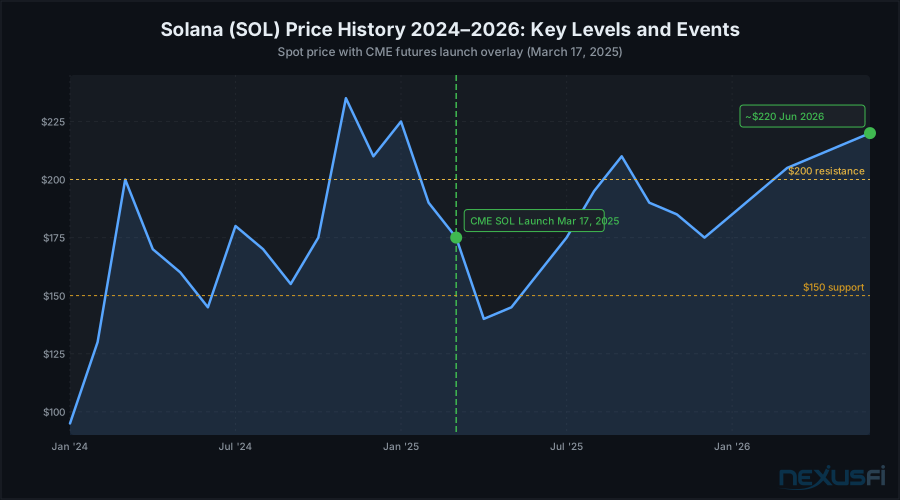
Solana (SOL) futures launched on CME Group on March 17, 2025, giving futures traders regulated access to one of crypto's most actively developed networks for the first time. Two contract sizes trade simultaneously: the standard SOL contract at 500 SOL per contract and the Micro SOL (MSL) at 25 SOL — a 1/20th size option designed for traders who want exposure without the full notional weight of the standard contract.
This matters for NexusFi traders for a specific reason. SOL is not just another altcoin. It's a high-throughput Layer 1 blockchain that has built a significant DeFi ecosystem — and those network fundamentals create price drivers that operate independently of Bitcoin. You get BTC macro correlation on risk-on/off moves, plus SOL-specific catalysts when network activity, staking dynamics, or competitive positioning with Ethereum changes. That combination produces a futures market with distinct trading characteristics worth understanding on their own terms.
What follows is the complete trading guide: exact contract specifications, price drivers, correlation mechanics, strategy frameworks, settlement details, margin requirements, and the risk management framework specific to SOL's volatility profile.
When @SMCJB confirmed CME had launched SOL futures back in March 2025, he noted the key advantage: "CME has crypto futures, Bitcoin, Ether, Solana and Ripple/XRP. US regulated futures exchange. None of the 'issues' you see with the other, mostly non-US, mostly unregulated crypto exchanges." That regulated infrastructure is the starting point for everything in this guide.
Contract Specifications: SOL and MSL #
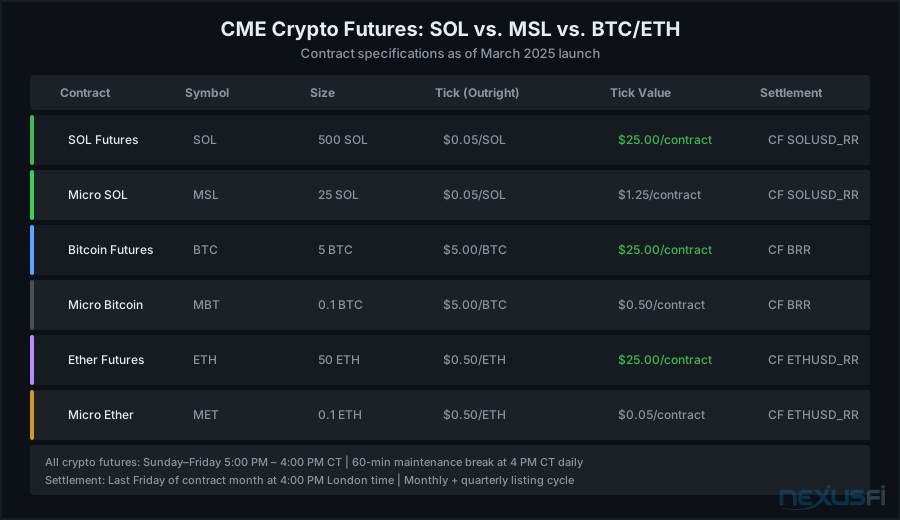
The two CME Solana futures contracts share the same underlying reference rate but differ sharply in notional size:
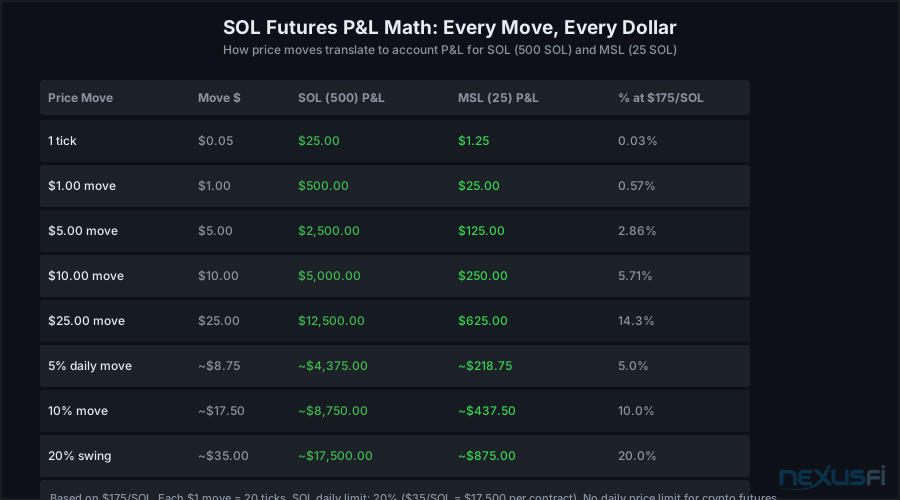
- SOL Futures (ticker: SOL) -- 500 SOL per contract. At $175/SOL, each contract controls $87,500 in notional value. Minimum price increment: $0.05 per SOL = $25.00 per contract (outright). Calendar spreads and BTIC orders use a tighter $0.01 per SOL increment = $5.00 per contract.
- Micro SOL Futures (ticker: MSL) -- 25 SOL per contract. At $175/SOL, each contract controls $4,375 notional. Outright tick: $0.05 per SOL = $1.25 per contract. Calendar spread tick: $0.01 per SOL = $0.25 per contract.
Both contracts cash-settle to the CME CF Solana-Dollar Reference Rate (SOLUSD_RR), published daily at 4:00 PM London time. Final settlement occurs on the last Friday of the contract month at 4:00 PM London time.
Trading hours: Sunday through Friday, 5:00 PM to 4:00 PM Central Time, with a 60-minute maintenance break daily at 4:00 PM CT. This 23-hour-per-day access means SOL futures trade through most crypto market moves — but the one-hour gap at 4 PM CT creates an overnight risk window traders must account for.
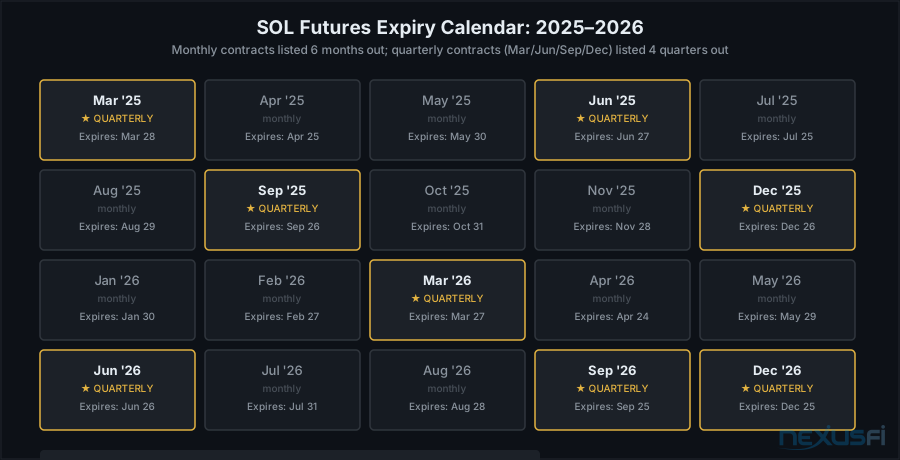
The listing cycle gives traders good forward visibility: monthly contracts for six consecutive months, plus quarterly contracts (March, June, September, December) listed four quarters out. Trading at Settlement (TAS) is available on both SOL (ticker TSL) and MSL (ticker TMS), enabling traders to transact at the daily settlement price with offsets of up to +/-20 ticks. Block trade minimum: 10 contracts (SOL) or 5 contracts (MSL).
@"SOL - Solana Futures - size 500 Index Points - Tick 0.05 = $25 / MSL - Solana Futures - size 25 Index Points - Tick 0.05 = $1.25" — <a href="https://nexusfi.com/showthread.php?t=60948&p=905024#post905024">@SMCJB, Feb 28, 2025</a> (10 thanks)
What Drives Solana's Price #
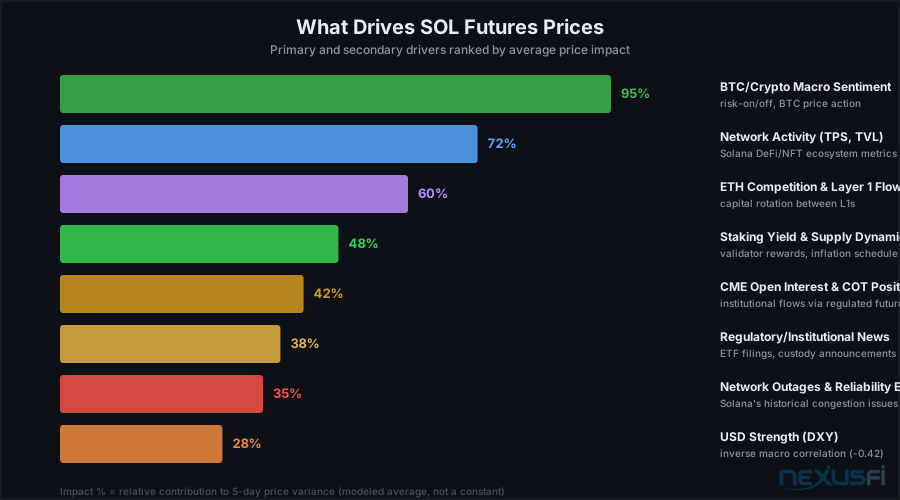
SOL futures traders need a layered mental model of what moves the price. The drivers operate on different timescales and interact in ways that aren't always obvious from the price chart alone.
BTC macro sentiment dominates. The 30-day correlation between SOL and Bitcoin runs approximately 0.78, meaning roughly 60% of SOL's variance is explained by BTC price action. When Bitcoin enters a sustained uptrend, SOL amplifies the move. When Bitcoin corrects sharply, SOL corrects harder — it's a high-beta position on crypto risk sentiment. Any trader positioning in SOL futures needs a view on the broader crypto market first.
Network activity is the SOL-specific driver. Solana's on-chain metrics — transactions per second (TPS), DeFi total value locked (TVL), NFT trading volumes, and protocol usage — create demand for SOL that operates independently of BTC. When Solana's DeFi ecosystem was growing rapidly in 2024-2025, SOL outperformed BTC during certain windows. When network outages or congestion events occurred (Solana has a historical pattern of this), SOL underperformed even in risk-on conditions. DeFiLlama and Solscan track these metrics in real time.
Staking economics matter at the margin. SOL validators earn staking rewards, and the staking yield relative to other asset yields affects whether capital stays deployed in the network. A validator community vote that adjusts the emission rate is a trigger worth monitoring.
Ethereum competition creates capital rotation signals. SOL and ETH compete for DeFi developer attention and capital. When Solana is winning market share from Ethereum Layer 2s, TVL flows into SOL. The SOL/ETH price ratio tracks this competitive dynamic directly.
SOL vs. Bitcoin and Ethereum: The Correlation Story #
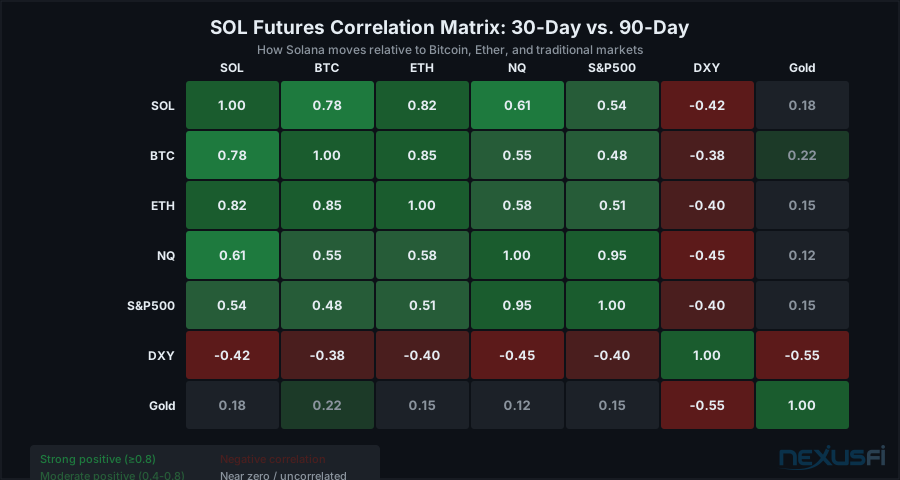
SOL's 30-day correlation to BTC runs 0.75-0.85 under normal conditions. The correlation with ETH runs 0.80-0.88 — higher than the BTC correlation, reflecting the fact that both Solana and Ethereum compete in the DeFi space and often attract similar capital flows. These correlations are not constants. They shift based on market regime:
- Risk-on markets: Correlations strengthen. SOL acts as leveraged BTC beta. A 5% BTC rally might produce an 8-12% SOL move.
- Risk-off markets: Correlations spike further. Every holder liquidates together. SOL often underperforms on the way down because of its lower liquidity profile relative to BTC.
- SOL-specific trigger periods: Correlations temporarily weaken. A major Solana ecosystem event -- protocol launch, network upgrade, institutional partnership -- can move SOL independently of BTC for days at a time.
The practical implication: hedging SOL futures exposure with BTC or ETH futures works reasonably well in trend-following regimes but breaks down in stress events and SOL-specific catalysts. The -0.42 correlation with the US Dollar Index (DXY) is the macro signal that matters most. When the dollar strengthens sharply — typically during risk-off episodes or Fed tightening cycles — crypto assets compress broadly.
Vanguard's December 2025 reversal on crypto — opening its $11T platform to Bitcoin, Ether, XRP, and Solana ETFs — was a signal of broad institutional legitimacy. As reported on NexusFi, these ETF flows now interact with SOL futures markets during U.S. trading hours, making correlation tracking even more important for active traders.
Basis and Term Structure: Trading the Futures-Spot Gap #
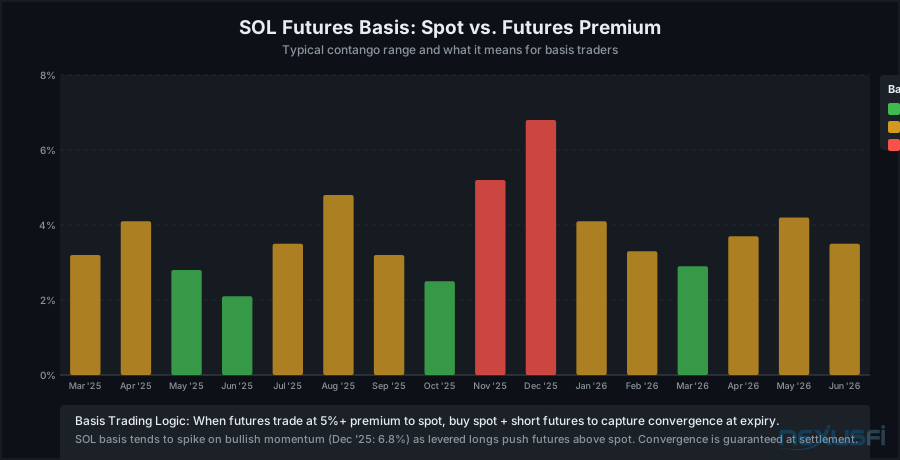
SOL futures typically trade at a premium to spot — a condition called contango. The premium exists because traders are willing to pay to get leveraged exposure through futures rather than holding spot SOL on an exchange. This premium is the basis, and it creates a trading opportunity when it diverges from fair value.
The typical SOL futures basis ranges 2-5% annualized in normal conditions. During bullish momentum periods, leveraged buyers push futures above spot and the basis expands to 6-8% or more. That's when the cash-and-carry trade becomes attractive: buy spot SOL (on an exchange with solid custody), short an equal notional amount of SOL futures, and collect the basis as it converges to zero at settlement.
The mechanics: if SOL spot is at $175 and the front-month SOL futures contract trades at $180 with 30 days to expiry, the annualized basis is approximately (5/175) x (365/30) x 100% = 34.8%. At settlement, the futures price must equal the reference rate (derived from spot), guaranteeing convergence.
The risks in basis trading are operational, not directional. You need reliable spot custody to hold the SOL without exchange risk, sufficient margin to maintain the short futures position if SOL rallies sharply before settlement, and discipline to hold through temporary basis widening.
@"CME has crypto futures, Bitcoin, Ether, Solana and Ripple/XRP. US regulated futures exchange. None of the 'issues' you see with the other, mostly non-US, mostly unregulated crypto exchanges." — <a href="https://nexusfi.com/showthread.php?t=61062&p=906553#post906553">@SMCJB, Jun 2025</a> (2 thanks)
Calendar Spreads: Capturing Roll Yield #
Calendar spreads — simultaneously buying one SOL expiry while selling another — offer a lower-margin alternative to outright directional trades. The margin requirement for calendar spreads is roughly 25% of the outright contract requirement, making them capital-efficient even at SOL's elevated crypto margin tiers.
The basic calendar spread structure: buy the deferred month, sell the front month (long-the-calendar position). If the term structure is in normal contango, a long calendar position profits when the spread widens — typically when demand for near-term exposure increases, pulling front-month prices up relative to deferred.
In practice, SOL calendar spreads behave differently from traditional commodity spreads because there's no physical delivery and no storage cost. Key calendar spread catalysts include roll periods (as front-month holders roll to the next month), network upgrade windows where demand for a specific expiry window increases, and ETF-related hedging when managers concentrate in specific expiry months. The reduced margin requirement makes calendar spreads the preferred structure for traders who want SOL exposure but find the outright contract's margin requirements too capital-intensive.
Directional Trading: Riding Solana's Momentum #
SOL futures are genuinely momentum-driven markets. Solana has demonstrated one of the strongest trend-following characteristics among CME crypto contracts — rallies sustain longer and corrections go deeper than most traders expect coming from equity index trading backgrounds.
The directional framework that works in SOL futures borrows from trend-following methodology: trade in the direction of the dominant trend across multiple timeframes, enter on pullbacks to moving averages during the trend, and use ATR-based stops rather than tight technical stops. SOL's average true range typically runs 5-10% per day ($8-17 at $175/SOL), meaning a $1 stop gets triggered multiple times per session. Position sizing should start from the dollar risk you're willing to accept, then solve for contracts — not the other way around.
Specific directional setup characteristics in SOL futures:
- BTC alignment required: Long SOL directional trades have much higher win rates when BTC is in an uptrend. Fading the BTC trend in SOL -- going long SOL while BTC corrects -- is a low-probability setup.
- Network activity confirmation: TVL and TPS metrics confirming increasing network usage provide a fundamental overlay for directional positions. Rising price with rising TVL is a more sustainable setup than rising price with declining ecosystem activity.
- Expiry timing: Avoid carrying large directional positions through settlement. Price pressure around the reference rate calculation window (4 PM London time on the last Friday) creates unpredictable intraday swings.
Settlement Mechanics and Expiry Windows #
When CME launched SOL futures in March 2025, the official announcement on NexusFi confirmed cash settlement to the CME CF Solana-Dollar Reference Rate (SOLUSD_RR), calculated and administered by CF Benchmarks. The reference rate uses volume-weighted pricing data from major regulated exchanges, with the final reference rate published at 4:00 PM London time on the last trading day.
Final settlement is cash: the difference between trade price and final settlement price, multiplied by contract size. If you're long one SOL futures at $175 and it settles at $180, you receive $2,500 ($5 x 500 SOL). No physical delivery. No custodying actual SOL. The cash settlement structure removes the operational complexity that institutions face with crypto spot.
Daily settlement: 2:59 PM to 3:00 PM CT, CME calculates the daily settlement price using VWAP of Globex trades. This is used for daily mark-to-market P&L and margin calculations.
Final settlement: On the last Friday of the expiry month, the 4:00 PM London time reference rate is the settlement price. Traders holding into final settlement should expect increased volatility in the hour preceding the reference rate calculation as participants attempt to transact near the anticipated settlement price. Reduce or close large positions 48 hours before final settlement unless you specifically want to hold through settlement.
Margin Requirements and Risk Management #
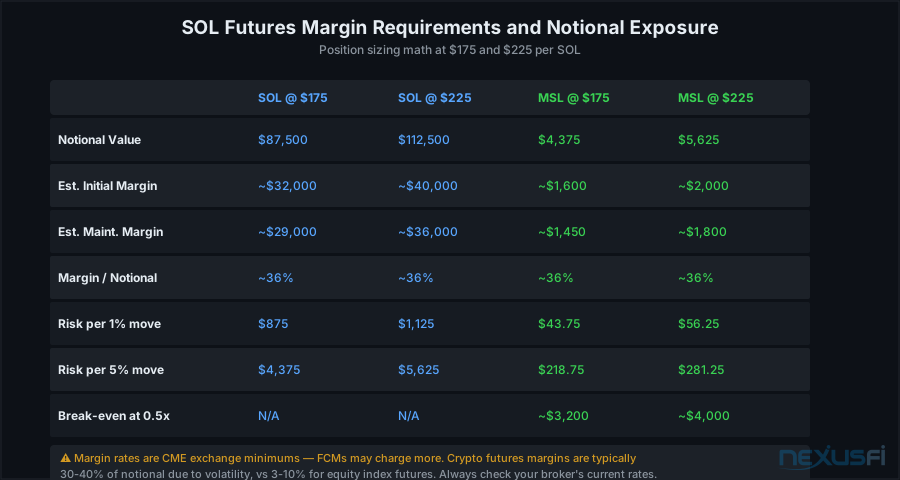
Margin in SOL futures operates at a different scale than equity index or agricultural futures. CME requires roughly 30-40% of notional value as initial margin for crypto futures, reflecting the asset class's volatility profile. At $175/SOL, a single SOL contract (500 SOL = $87,500 notional) requires approximately $30,000-$35,000 in initial margin. A Micro SOL (25 SOL = $4,375 notional) requires approximately $1,500-$1,800.
Portfolio margin offsets are available for traders holding multiple CME crypto contracts. A BTC long offset against a SOL short (or vice versa) reduces total margin requirements by 15-20%, reflecting the correlation between the positions.
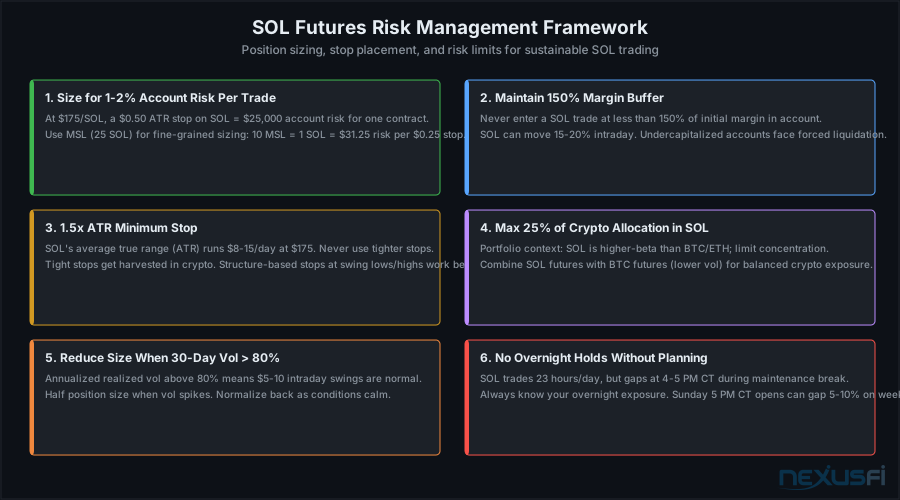
The risk management framework for SOL futures has six non-negotiable elements:
- Size for dollar risk, not contracts. Decide maximum dollar loss acceptable per trade, then solve backward: ($loss) / (stop distance in $) = contracts.
- Maintain 150% margin buffer. Never enter a SOL position with less than 150% of initial margin available. Intraday margin calls at the wrong moment force exits at worst prices.
- Use structure-based stops, not percentage stops. SOL's ATR is often $10-15. Structure-based stops (below swing lows, below key profile levels) are the only stops that survive SOL's normal volatility.
- Limit SOL to 25% of crypto allocation. SOL is higher-beta than BTC/ETH. Concentration creates portfolio outcomes that are asymmetric to the downside in risk-off periods.
- Reduce size when 30-day realized vol exceeds 80%. Half position size when vol is elevated.
- Plan overnight exposure explicitly. Know your exposure before the close. Sunday 5 PM CT re-opens often gap 3-8% from Friday.
The Micro SOL (MSL): When Smaller Is Better #
The 25 SOL Micro SOL contract is a precision instrument for traders who need fine-grained position sizing, risk management in high-volatility conditions, or access to SOL futures without the capital requirements of the full contract.
Practical use cases for MSL over SOL:
- Account size calibration: If your account is $25,000-$50,000, one full SOL contract commits too large a portion to a single instrument. Five to ten MSL contracts give equivalent directional exposure with controllable margin allocation.
- Volatility scaling: When SOL's 30-day realized vol spikes above 80%, dropping from SOL contracts to MSL contracts achieves position sizing reduction without exiting the position entirely.
- Calendar spread precision: Building a spread using MSL contracts allows tighter ratio management than rounding to whole SOL contracts.
- Strategy validation: A new entry model can be validated on MSL positions at 1/20th the dollar risk of SOL contracts before scaling.
The caveat: MSL bid-ask spreads may be wider than SOL in less liquid sessions, especially during Asia hours (midnight to 8 AM ET). Execute during US session core hours (8 AM to 3 PM CT) for tightest spreads and deepest book depth.
Reading the COT Report for SOL Positioning Extremes #
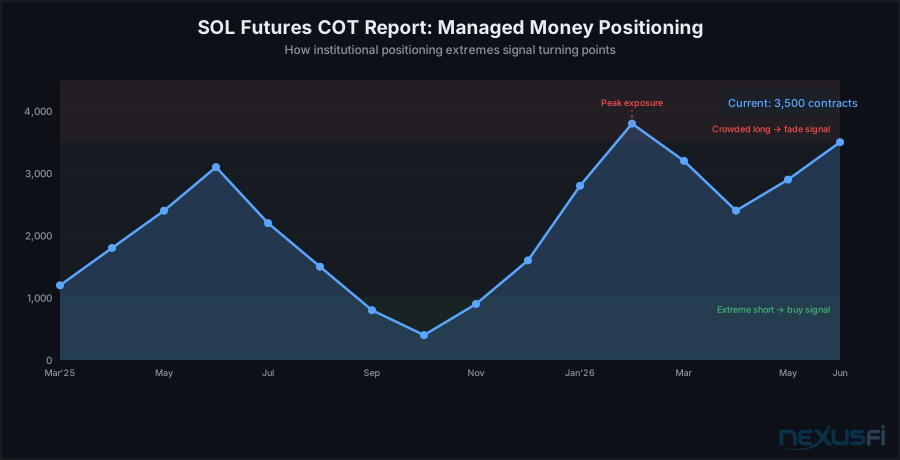
The CFTC publishes Commitments of Traders (COT) data for all CME-listed futures, including SOL, every Friday at 3:30 PM ET, covering positions held through the prior Tuesday. The key category to watch: Managed Money (hedge funds, CTAs, algorithmic funds). When managed money net long contracts reach extreme levels — historically above 3,000-3,500 contracts — the market is crowded long and vulnerable to a reversal on any negative trigger. When managed money is net short at extremes (below 500 contracts), most leveraged participants have already exited, and subsequent rallies face minimal selling pressure.
The COT signal works best as a filter, not a primary entry. It identifies when a directional trade has tailwind (low crowding in the direction of your trade) or headwind (high crowding against you). A strong SOL breakout with managed money at only moderate net long levels is a better trade than the same breakout when the crowd is already maximum long.
Network Activity: The On-Chain Edge for SOL Futures Traders #
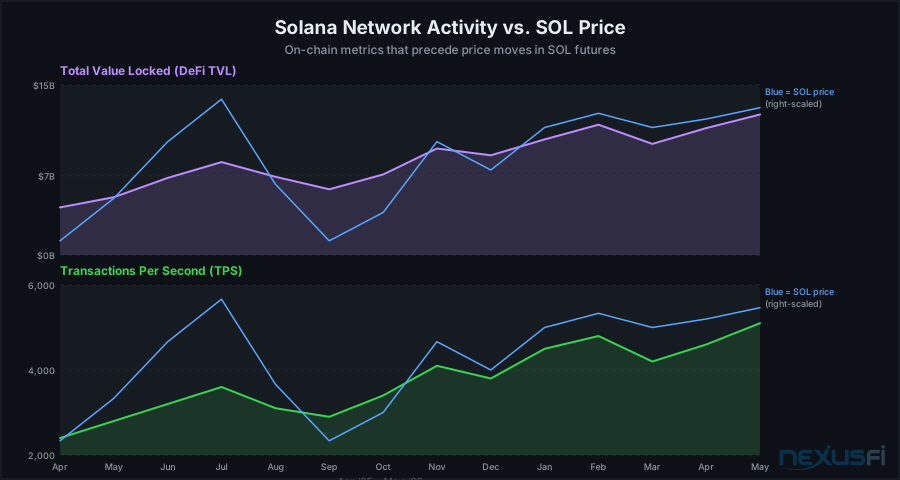
Unlike equity index futures where fundamental data arrives quarterly, SOL futures traders have access to real-time on-chain metrics that precede price moves with meaningful lead time. Two metrics carry the most weight:
DeFi Total Value Locked (TVL): Available at DeFiLlama in real time, TVL measures the total capital deposited in Solana's decentralized finance protocols. Rising TVL signals that users are actively deploying capital into the ecosystem, creating organic demand for SOL. Interactive Brokers' 2026 stablecoin funding support — specifically including Solana as a supported blockchain alongside Ethereum and Base — confirmed Solana's institutional legitimacy as a settlement layer. As noted on NexusFi, USDC is now supported on Solana for near-instant brokerage account funding, a signal of ecosystem maturation that directly supports sustained TVL growth.
Transactions Per Second (TPS): Solana's fundamental value proposition is high throughput. Network TPS above 3,000 indicates a healthy, actively-used network. Sustained TPS above 4,500 has historically accompanied SOL's strongest rally phases. Solana has also experienced network outages and congestion events that drove TPS to near-zero — these are immediate bearish catalysts for SOL futures. Both metrics are freely available at Solscan.io, Dune Analytics, and DeFiLlama.
SOL in the Context of CME's Expanding Crypto Suite #
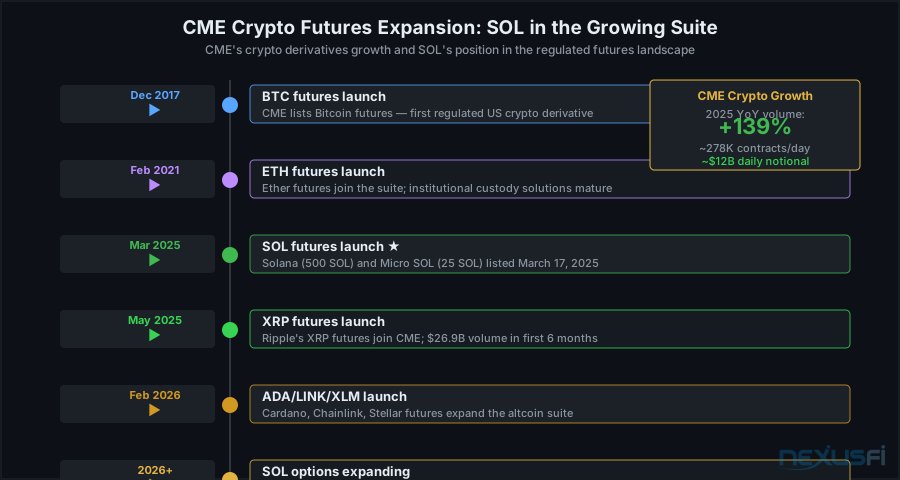
SOL launched into a CME crypto ecosystem that was already growing rapidly. Bitcoin futures (2017) and Ether futures (2021) established the institutional foundation. When SOL launched in March 2025, it joined XRP (May 2025) in a second wave of altcoin contract listings. As @SMCJB confirmed on NexusFi after the actual March launch date: "I believe CME launched SOL futures back in March and XRP futures in May!"
The expansion accelerated in 2026: Cardano (ADA), Chainlink (LINK), and Stellar (XLM) futures launched February 9, 2026, after CME's crypto derivatives business recorded 139% year-over-year volume growth in 2025, averaging 278,000 contracts and $12 billion in daily notional value.
@"These join CME's existing crypto suite including Bitcoin, Ether, XRP, and Solana futures and options. CME crypto derivatives business recorded 139% year-over-year growth in 2025, with average daily volume reaching 278,000 contracts worth $12 billion." — <a href="https://nexusfi.com/showthread.php?t=61324&p=909109#post909109">@Fi, Jan 16, 2026</a>
For SOL specifically, CME's expanding suite creates several trading opportunities: portfolio margin across CME crypto contracts, alt/BTC pair trades entirely within the regulated futures framework, and growing institutional counterparty depth. As of May 2026, CME extended continuous 24/7 trading to all cryptocurrency futures and options. As reported on NexusFi, this eliminates the maintenance gap that previously created SOL weekend gap risk — a significant development for overnight position holders.
Common Mistakes SOL Futures Traders Make #
Two populations arrive at SOL futures with dangerous defaults: spot crypto traders who don't understand futures mechanics, and traditional futures traders who don't understand crypto volatility. Both groups make expensive mistakes in the same market.
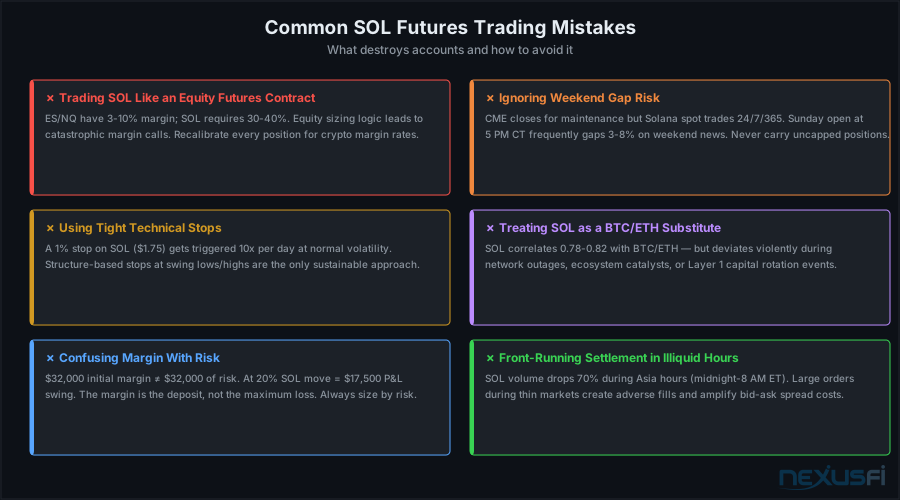
Applying equity-style position sizing. A trader accustomed to ES futures — where margin is 3-5% of notional — applies the same logic to SOL and ends up 8-10x more leveraged than intended. Crypto margin is 30-40% of notional for exactly this reason: the exchange demands high collateral because the asset moves 5-20% intraday. Always recalculate position sizing when transitioning between asset classes.
Ignoring weekend gap risk. Solana spot markets trade 24/7. Weekend news — regulatory announcements, major network events, BTC ETF flows — moves spot price while CME is closed. The Sunday 5 PM CT re-open regularly gaps 3-8% from Friday's close. (Note: As of May 2026, CME's 24/7 extension eliminates this specific risk — but only after the changeover date.) Carrying large uncapped positions through weekends without a risk plan was gambling, not trading — and confirms what the 24/7 extension was addressing.
Using tight technical stops. A $1.75 stop (1%) on a $175 SOL position is noise-level at current volatility. SOL moves through 1% levels multiple times per session. The only stops that work in this market are placed at structural levels — swing lows, volume profile nodes, key reference areas — that represent actual invalidation of the trade thesis.
Confusing initial margin with maximum risk. $32,000 in margin does not mean $32,000 maximum loss. At 20% SOL move (which has happened multiple times), the P&L swing is $17,500 per contract — the equivalent of losing more than half your initial margin deposit. The margin is the deposit; the risk is determined by position size and stop placement.
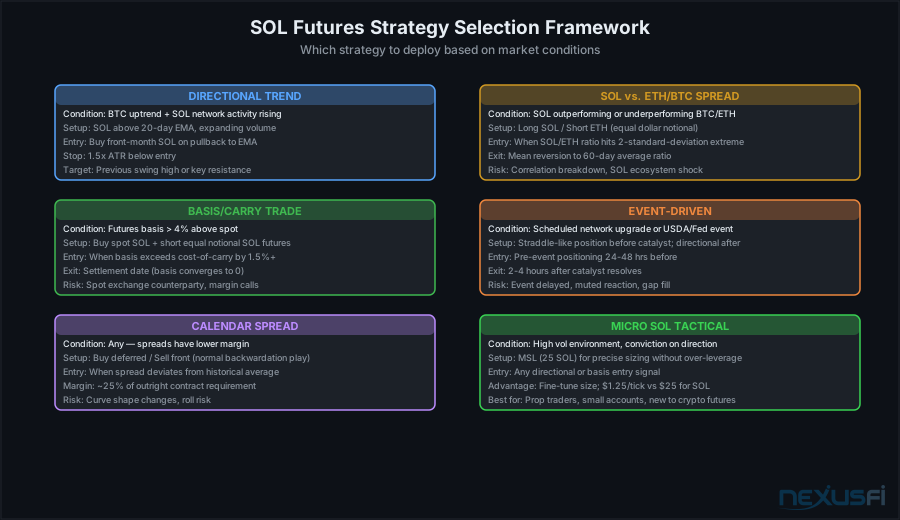
Practical Strategy Comparison #
Resources for SOL Futures Traders #
- CME Group SOL Futures page (cmegroup.com/markets/cryptocurrencies/solana) -- official contract specs, margin requirements, daily settlement prices, volume and open interest data
- CFTC Commitments of Traders (cftc.gov) -- weekly COT reports released Fridays at 3:30 PM ET. SOL is listed under cryptocurrency futures
- DeFiLlama (defillama.com/chain/Solana) -- real-time Solana DeFi TVL across all protocols
- CF Benchmarks (cfbenchmarks.com) -- publishers of SOLUSD_RR, the settlement reference rate
For related instruments, see the NexusFi Academy articles on Ethereum Futures (ETH) and Crypto Derivatives Trading. For position sizing methodology applicable across all futures instruments, see Position Sizing for Futures Trading. For the CME ecosystem SOL now trades within, see CME XRP Futures.
Knowledge Map
Prerequisites
Understand these firstGo Deeper
Build on this knowledgeCitations
- — Feb & Mar'24 New Ag Micros & New Solana Crypto Futures (2025) 👍 10“SOL - Solana Futures - size 500 Index Points - Tick 0.05 = $25 / MSL - size 25 Index Points - Tick 0.05 = $1.25”
- — Is Bitcoin done? take a look... (2025) 👍 2“CME has crypto futures, Bitcoin, Ether, Solana and Ripple/XRP. US regulated futures exchange.”
- — CME Solana and XRP Futures Launch December 15, 2025 (2025) 👍 1“I believe CME launched SOL futures back in March and XRP futures in May!”
- — Is Bitcoin done? take a look... (2025) 👍 1“CME crypto futures changed the game - institutional grade without the exchange risk.”
- — CME Group Expands Crypto Suite: Cardano, Chainlink, Stellar Futures Launch February 9 (2026)“CME crypto derivatives business recorded 139% year-over-year growth in 2025, with average daily volume reaching 278,000 contracts worth $12 billion.”
- — New Micro Contract: Micro Ether coming 5-Dec-21 (2021) 👍 10“Micro Ether | 0.1 Ether, Notional ~ $0.45k -- fee structure makes it 25x more expensive to trade than full size per contract unit.”
- — The Essential Guide to Solana Futures (2025)
- — CME Group to Launch Solana (SOL) Futures on March 17 (2025)
- — CME Solana and XRP Futures Launch December 15, 2025 (2025)“CME Group will list Solana (SOL) and XRP futures contracts on December 15, 2025. The new products include both full-size (500 SOL) and micro-size (25 SOL) contracts, settling to regulated CF Benchmarks Reference Rates.”