



CME XRP Futures: The Complete Guide to Regulated XRP Derivatives Trading
Overview #
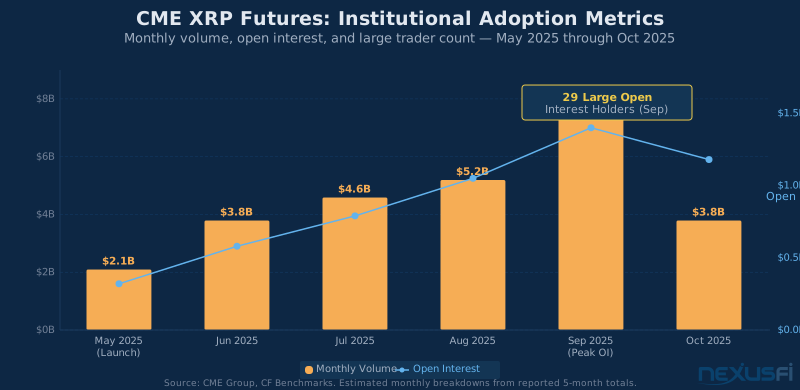
XRP spent years as one of the most actively traded cryptocurrencies without a viable regulated futures market. That changed in May 2025 when CME Group listed XRP futures contracts, bringing Ripple's native token into the same regulatory framework that governs Bitcoin and Ether derivatives. The institutional response was immediate: $26.9 billion in notional volume across the first five months, 567,000+ contracts traded, and open interest hitting a record $1.4 billion in September 2025.
For futures traders, CME XRP contracts solve a persistent problem: how do you take a directional position on XRP without touching an unregulated exchange, dealing with funding rate uncertainty on perpetual swaps, or holding actual crypto? The answer is the same mechanism that made Bitcoin futures mainstream — cash-settled CFTC-regulated contracts on a standardized exchange with familiar margin treatment.
This guide covers everything you need to trade CME XRP futures and Micro XRP futures: contract specifications, settlement mechanics, the funding rate advantage over perpetuals, correlation dynamics with Bitcoin for hedging, and the four primary trading strategies that institutional participants are using with this product.
What Is XRP and Why Does the Futures Market Matter #
XRP is the native token of the XRP Ledger (XRPL), a decentralized blockchain developed by Ripple Labs. Unlike most cryptocurrencies, XRP's primary designed use case is cross-border payment settlement — enabling financial institutions to move value internationally in seconds rather than days. Ripple's enterprise products, including RippleNet and the On-Demand Liquidity (ODL) service, use XRP as a bridge currency between fiat pairs.
Market capitalization places XRP consistently in the top five cryptocurrencies globally, and trading volume often surpasses assets with larger market caps due to its payment-network use case. This liquidity depth makes it a meaningful derivatives market, not a speculative fringe product.
The futures market matters for several reasons. First, institutional participants — hedge funds, proprietary trading firms, asset managers — often cannot or will not trade unregulated crypto venues. CFTC-regulated CME contracts sit within their compliance perimeter. Second, futures allow short exposure without the mechanics of crypto lending (margin rates, availability uncertainty). Third, the futures basis sometimes diverges meaningfully from spot, creating arbitrage and basis trading opportunities for those with access to both markets.
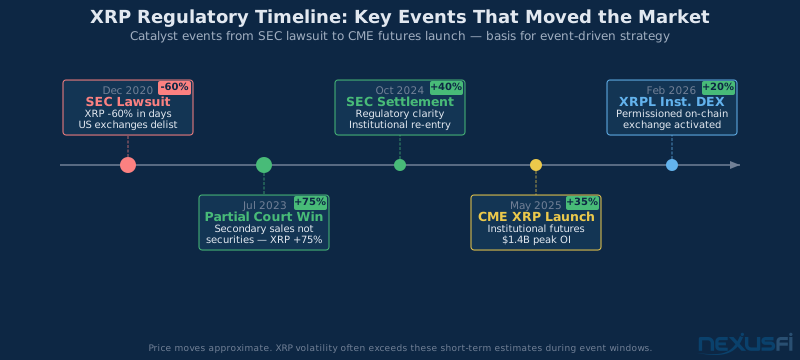
The long-running SEC vs. Ripple litigation created a decade of regulatory uncertainty that specifically suppressed institutional XRP participation in US markets. The 2023 court ruling establishing that XRP sales on secondary markets don't constitute securities transactions — and Ripple's subsequent settlement in 2024 — cleared the path for CME to list the product. The timing matters: XRP futures launched into a regulatory environment where clarity had just been established, not before it.
How CME XRP Futures Work: Contract Specifications #
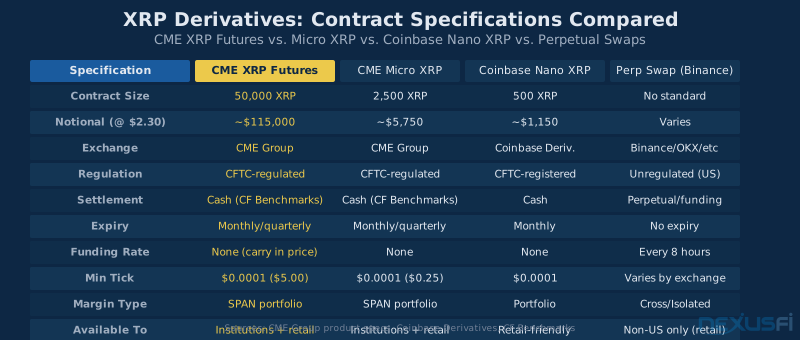
The standard CME XRP futures contract represents 50,000 XRP. At $2.30 per XRP, one contract carries roughly $115,000 in notional value. That's a significant commitment for retail traders, which is why CME also listed the Micro XRP contract at 2,500 XRP — approximately $5,750 per contract at the same price. Coinbase Derivatives runs a competing Nano XRP futures product at 500 XRP per contract, further reducing the minimum exposure for retail participants.
Settlement is cash-based, tied to the CF XRP-Dollar Reference Rate (XRPUSD_RTM) published by CF Benchmarks. This is the same benchmark rate provider used for Bitcoin and Ether CME futures. The rate is a volume-weighted average price calculated across major spot exchanges over a one-hour window at 4:00 PM London time. Using a regulated reference rate rather than any single exchange's price makes settlement manipulation-resistant.
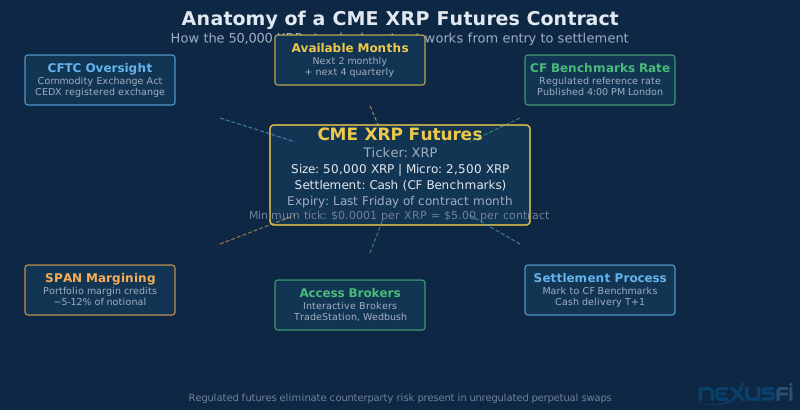
Contract months follow the standard CME crypto pattern: the nearest two calendar months plus the next four quarterly months. This gives traders continuous front-month exposure with quarterly options for longer-dated positioning. The last day of trading is the Thursday immediately preceding the last Friday of the contract month, with final settlement the following day using the CF Benchmarks rate.
Minimum tick size is $0.0001 per XRP, which translates to $5.00 per tick on the standard contract and $0.25 per tick on the Micro. Daily limits are set by CME and expand during periods of extreme volatility, consistent with the exchange's dynamic price limit program used across all crypto futures.
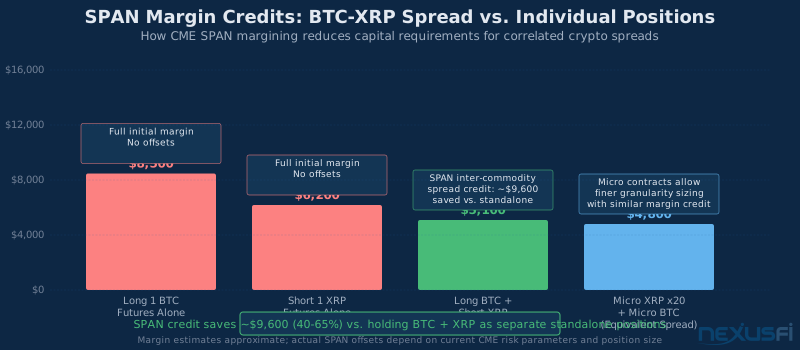
Initial margin for the standard contract runs approximately 5-12% of notional value depending on market conditions and account tier. SPAN (Standard Portfolio Analysis of Risk) margining allows traders with correlated positions across CME crypto contracts to receive portfolio offsets — a meaningful advantage for traders running BTC-XRP spread positions. The margin treatment differs substantially from crypto native exchanges where cross-margin and isolated margin rules vary by platform and change without notice.
Institutional Adoption: The Volume Story #
The adoption numbers for CME XRP futures are notable even by crypto futures standards. Five months after launch: $26.9 billion in notional volume, 567,000 contracts traded, and 29 large open interest holders as of the September 2025 report. That last metric — large open interest holders — is the institutional signal. CME defines "large traders" as those holding positions exceeding reportable thresholds under CFTC large trader reporting rules. Twenty-nine such participants appearing within five months indicates hedge funds and institutional desks, not retail accumulation.
Forum member @SMCJB put the $26.9 billion volume figure in sharp perspective: "ES trades over $0.5 Trillion/day!" [1] That comparison cuts both ways. XRP futures at $213 million in daily average volume is meaningful for a product in its first year — but it's a fraction of the liquidity in established equity index futures. Spread costs and slippage in XRP futures are higher than in deep-liquid products, and that affects execution quality for large positions.
@author="SMCJB" source="https://nexusfi.com/showthread.php?t=61213&p=908336"
The parallel Coinbase Derivatives launch — which includes Webull's expanded offering of Nano XRP, Nano Solana, and several other contracts via CFTC-registered infrastructure — has been building a retail-accessible XRP derivatives ecosystem alongside CME's institutional-grade product. [2] The same underlying XRP-dollar rate anchors both venues.
Ripple's institutional infrastructure has also grown alongside the futures market. Ripple Prime joined Nodal Clear as a clearing member in March 2026, opening access to Coinbase Derivatives contracts for its institutional clients. [3] The combination of CME futures, Coinbase Derivatives, and Ripple Prime's clearing access creates a regulated XRP derivatives ecosystem that simply didn't exist two years ago.
The XRP Ledger's own institutional DEX activation in February 2026 (XLS-81 amendment) added another dimension: a permissioned trading venue built on-chain with KYC/AML embedded at the protocol level. [4] This is not futures trading — it's spot on-chain — but it signals the direction of regulatory accommodation for institutional XRP participation.
CME XRP Futures vs. Perpetual Swaps: The Real Cost Comparison #
Most traders come to XRP futures from perpetual swaps. Understanding what you're giving up and what you're gaining matters for strategy selection.
The perpetual advantage is simplicity and continuous exposure. No expiry to manage, no rollover cost, no calendar spread mechanics. You open a position and hold it until you close it. The perpetual disadvantage is the funding rate: a payment exchanged between longs and shorts every eight hours based on the premium or discount between the perpetual price and spot. During bull markets, funding rates for XRP perpetuals have reached 0.1% per eight hours — equivalent to 27% annualized. On a $110,000 position (50,000 XRP at $2.20), that's over $30,000 per year in funding costs against your long.
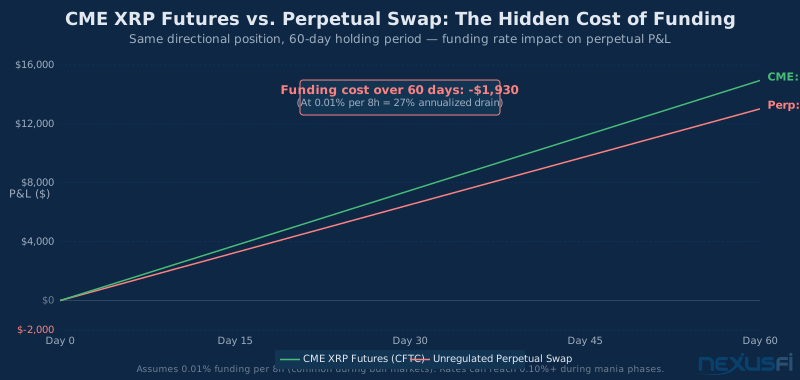
CME futures don't have funding rates. The cost of carrying a long CME futures position is embedded in the price — the forward premium above spot reflects the carry, equivalent to holding the underlying and financing the position. During normal markets, this carry cost is modest and predictable. During periods of high crypto excitement, perpetual funding can spike to levels that make the CME futures mechanically cheaper to hold despite the rollover friction.
Key decision rule: If your intended holding period exceeds two weeks AND you expect the crypto bull market to persist (funding rates elevated), CME futures will typically have lower total cost than holding equivalent size on a perpetual swap.
The regulatory comparison is equally stark. CME contracts operate under CFTC oversight, exchange-cleared margins, and established bankruptcy protection for customer funds (similar to futures broker segregated fund rules). Unregulated perpetual exchanges have no such protections — exchange insolvencies have resulted in complete loss of customer funds. For institutional participants, this isn't an abstract consideration; it's a compliance requirement.
Use CME XRP futures when: You hold positions for weeks or months, you trade during high-funding environments, you need CFTC compliance, you're running portfolio margining with other CME products.
Perpetual swaps might suit short-term traders better when: You hold for hours to days, funding rates are near zero, you need granular position sizing below the Micro contract threshold, you need 24/7 execution including weekends.
One underappreciated factor: CME markets close at 4:00 PM CT daily and don't trade on weekends. Cryptocurrency markets are 24/7/365. A position in CME XRP futures carries weekend gap risk — if XRP moves sharply Saturday morning, you can't exit until Sunday 5:00 PM CT when CME Globex reopens. Perpetual traders don't face this limitation, but they face funding rate risk instead.
Settlement and Expiration: What Happens at Contract End #
CME XRP futures expire on the last Friday of each contract month. The final settlement price is the CF XRP-Dollar Reference Rate published on that Friday at approximately 4:00 PM London time. Most traders — especially those without specific basis or calendar spread strategies — close their positions before expiration day to avoid final settlement mechanics and last-day slippage.
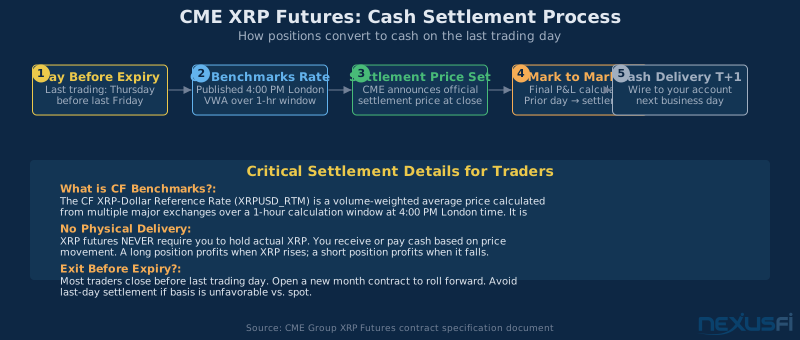
The CF XRP-Dollar Reference Rate is designed for tamper resistance. It aggregates trade data from multiple regulated spot exchanges over a one-hour calculation window, weighting by volume. The methodology mirrors the Bitcoin Reference Rate (BRR) and Ether Reference Rate (ERR) that have governed CME crypto futures since 2017. No single exchange dominates the rate, and the broad aggregation window reduces the impact of short-duration price spikes or manipulation attempts near settlement.
Rolling forward works the same way as any futures roll: before expiration, close the front-month position and open the same directional position in the next contract. The roll cost is the spread between front and back month — during normal markets this reflects carry; during backwardation (when spot is above futures), rolling forward can generate roll yield for long holders.
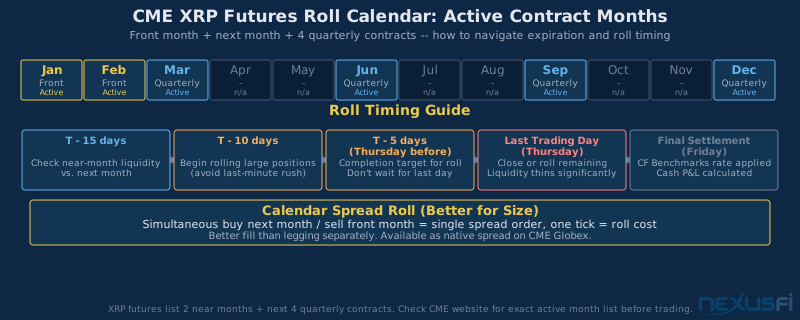
Avoid holding XRP futures to final settlement unless you specifically intend to. Last-day liquidity thins, the basis can behave unusually, and forced settlement prevents discretionary exit timing. Roll to the next contract no later than the Thursday before the last trading week.
Trading XRP Futures: Four Approaches That Work #
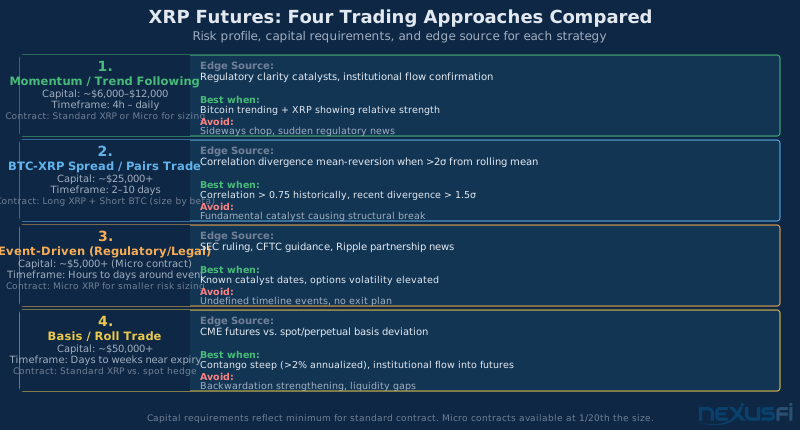
XRP futures inherit the same analytical frameworks as other futures markets, but XRP-specific factors create distinct strategy variations. The four approaches below are the ones that show up consistently in institutional and sophisticated retail usage.
Momentum and Trend Following
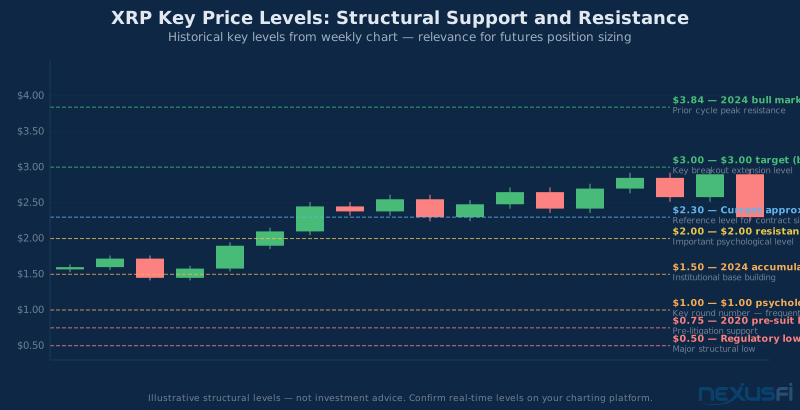
XRP trends during two specific conditions: broad crypto bull markets where institutional capital rotates through the space sequentially (BTC first, then ETH, then altcoins including XRP), and XRP-specific trigger events driven by regulatory clarity, Ripple partnership announcements, or CBDC adoption news. Momentum traders look for relative strength — XRP showing stronger price action than BTC during a risk-on environment signals institutional rotation. Entry triggers include breakouts above resistance zones with volume confirmation, especially when the BTC-XRP correlation is high (XRP moving together with BTC suggests macro crypto buying rather than idiosyncratic flow).
BTC-XRP Spread Trading
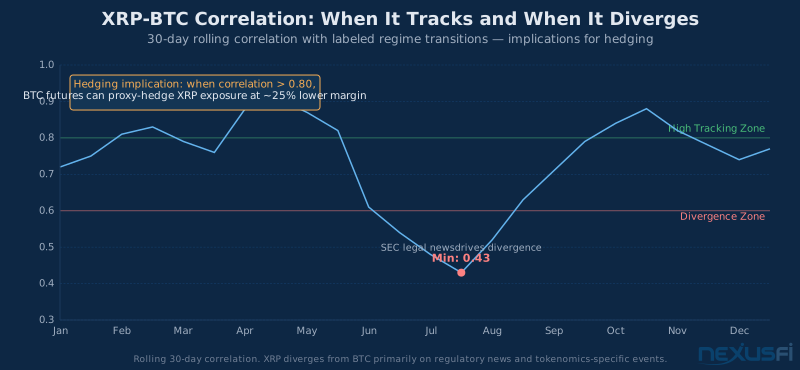
When XRP and BTC are highly correlated (rolling 30-day correlation above 0.80), their price ratio tends to mean-revert. If XRP has underperformed BTC by more than 2 standard deviations relative to its rolling mean, a long XRP / short BTC position bets on that ratio reverting. The spread trade is directionally neutral — you don't care whether crypto goes up or down overall, only whether XRP and BTC converge to their historical relationship.
SPAN margining at CME provides portfolio offsets for correlated positions. A long XRP / short BTC position held at CME captures margin credits that unregulated venues don't offer — this can meaningfully reduce capital requirements for the spread trade compared to running it on separate crypto native platforms.
The critical risk: XRP breaks correlation for fundamental reasons (regulatory news, XRPL-specific events, Ripple corporate actions) rather than noise. When correlation drops below 0.60, the spread trade premise weakens substantially. Position sizing should reflect the correlation regime, reducing exposure when the 30-day rolling correlation signal deteriorates.
Event-Driven Trading
XRP's regulatory history creates a distinct class of trigger events: CFTC guidance on digital assets, SEC enforcement actions or settlements, Ripple partnership announcements with central banks (especially in emerging markets), and CME product expansions (options on futures, new contract sizes). These events can move XRP sharply and asymmetrically relative to the broader crypto market.
The Micro XRP contract (2,500 XRP, ~$5,750 notional) is the preferred instrument for event-driven plays requiring tight risk sizing. At 2-4% risk per trade, the Micro allows clean position sizing without the all-or-nothing nature of the standard contract for smaller accounts. The trade setup is typically: identify the trigger, establish directional bias, size for defined risk, set a binary stop (wrong about direction = full stop, right about direction = trail).
Basis and Roll Trading
The futures basis — the difference between the CME futures price and the spot XRP price — fluctuates based on supply/demand in the futures curve, carry costs, and arbitrage efficiency. When the basis is unusually wide (futures trading at a significant premium to spot), traders with access to both markets can short the futures and buy spot, collecting the convergence as the contract approaches expiry. This requires a spot crypto account alongside the CME futures account, and the transaction costs need to stay below the basis spread to remain profitable.
Calendar spreads within the futures curve (long near month, short far month or vice versa) capture roll dynamics without requiring spot exposure. These are lower-risk, lower-reward trades suitable for participants who want XRP market exposure without strong directional conviction.
Accessing XRP Futures: Brokers, Platforms, and Account Requirements #
CME XRP futures are accessible through any broker that offers CME crypto futures. The access stack runs from institutional prime brokers down to retail-friendly platforms with low minimums.
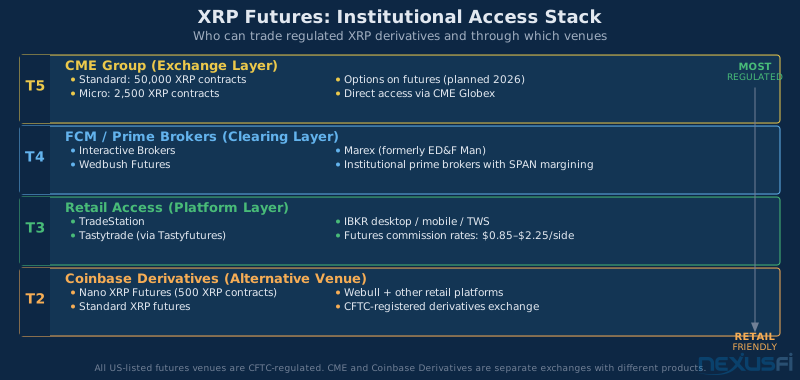
For retail traders, Interactive Brokers offers CME XRP futures with competitive commission rates ($0.85/side for futures). TradeStation and Tastyfutures (Tastytrade's futures arm) are other established options. NinjaTrader provides platform access to CME products for active traders who prefer the NinjaTrader interface for order management and charting.
Minimum account sizes vary by broker. Most require $5,000-$10,000 minimum for futures accounts, though actual margin for the Micro XRP contract at standard CME initial margin rates runs $300-$700. The practical minimum to trade XRP futures responsibly (with proper stop placement and multiple contracts for position management) is closer to $5,000-$10,000 for the Micro, $15,000-$25,000 for the standard contract.
The Coinbase Derivatives exchange provides an alternative for traders who prefer working through crypto-native infrastructure. Webull expanded its crypto futures offering through Coinbase Derivatives' partnership, including Nano XRP (500 XRP per contract), with commission rates competitive with traditional futures brokers. [5] The underlying CF Benchmarks reference rate is the same for Coinbase Derivatives and CME products, ensuring consistent settlement benchmarks.
Account opening for CME crypto futures typically requires: standard futures account application (NFA-required disclosures, risk acknowledgments), minimum account funding (varies by broker: $2,500-$10,000 common), futures trading approval (separate from equity/options approval at most brokers), and no cryptocurrency custody involved — all settlement is cash.
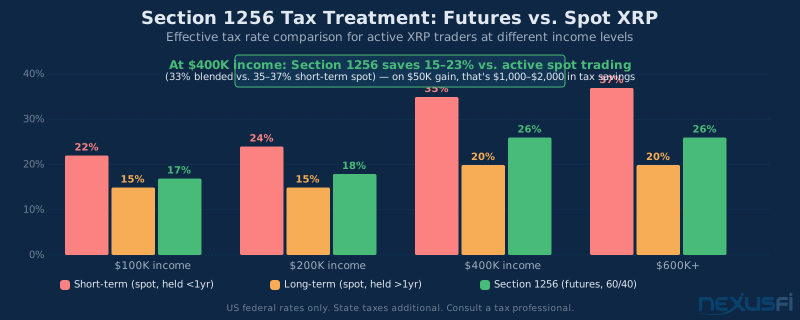
Tax treatment: CME XRP futures qualify as Section 1256 contracts under US tax law, receiving the favorable 60/40 treatment (60% long-term capital gains rates, 40% short-term) regardless of holding period, with mark-to-market treatment at year-end. This is a meaningful tax advantage over spot XRP, which is taxed at ordinary income rates for short-term gains.
Risks and Considerations #
XRP futures carry the standard futures risks plus XRP-specific factors that demand distinct management.
Regulatory tail risk: XRP's legal history demonstrates that regulatory actions can move the price sharply and non-linearly. The 2020 SEC lawsuit announcement caused XRP to lose over 60% of its value in days as major exchanges delisted it in the US. Future regulatory actions — globally, not just in the US — remain a real risk for any XRP position. Stop placement needs to account for gap-down scenarios that can easily exceed initial margin levels in extreme cases.
Weekend gap risk: CME markets close Friday afternoon and reopen Sunday evening. A major XRP event Saturday (Ripple news, CFTC action, exchange hack affecting the reference rate) hits while you have no ability to exit. This is different from perpetual swap holders who can exit immediately. Smaller position sizes or options-based hedges reduce this risk without eliminating it.
Liquidity relative to Bitcoin: CME XRP futures are liquid by crypto standards but thin by CME standards. The bid-ask spread is wider than Bitcoin or Ether futures. Market orders on size can move the market, and limit order fills during fast markets may be slower than equivalent orders in CME equity index products. This affects execution quality for larger positions and suggests limit orders as the default execution method for entry and exit.
Position sizing must account for XRP's binary risk events. A 2% account risk per trade at a 50-tick stop may underestimate actual risk if a regulatory headline gaps XRP down 20% overnight. Consider sizing to "announcement risk" for large positions, not just technical stops.
Correlation instability: XRP-BTC correlation can collapse quickly on XRP-specific news. Spread traders and hedged positions built on historical correlation assumptions can lose their hedge suddenly. Monitoring rolling correlation and reducing exposure when correlation deteriorates is not optional — it's risk management.
Ripple corporate governance: Ripple Labs holds a significant XRP allocation (held in escrow, released monthly). Large Ripple sales in the market are disclosed via XRP Ledger transparency but can create sustained supply pressure. This is different from Bitcoin or Ether where no centralized entity controls large supply allocations with regular sell schedules.
Practical Setup: From Opening an Account to First Trade #
Getting set up to trade CME XRP futures is straightforward once you have the right broker and understand the mechanics.
Step 1 — Broker selection: Choose based on your primary platform preference. NinjaTrader users: NinjaTrader Brokerage gives direct CME access within the platform. Interactive Brokers users: CME crypto futures are available in the same TWS account alongside equities and options. Tastyfutures: optimized for options-on-futures workflows once that product launches. Avoid specialty crypto-only brokers that don't offer the full CME product range — the margin offsets from SPAN only apply when all positions are at the same clearing firm.
Step 2 — Margin setup: Fund with at least 3x the initial margin for your intended position size. If initial margin on the Micro XRP contract is $600, fund with $1,800 minimum — ideally more. Futures mark to market daily, and you need buffer to absorb adverse days without a margin call forcing premature exit.
Step 3 — Understand the roll calendar: Know when contracts expire before you trade them. Most futures platforms show a roll reminder, but confirm the last trading date (Thursday before the last Friday of each month) before your intended holding period crosses an expiry. Calendar spreads are free to execute at most brokers if you want to roll without manual timing.
Step 4 — Set position sizing rules: For directional trades, define your maximum risk per trade as a percentage of account equity (2-4% is typical). Calculate backward from that risk to determine contract count based on the distance to your stop. With the Micro contract at $0.25/tick, a 50-tick ($12.50) stop on a $5,000 account with 2% risk ($100) allows up to 8 contracts. The math matters — size to the stop, not to the account.
The Micro XRP contract (2,500 XRP, ~$5,750 notional) is the right starting instrument for most traders. It allows position sizing down to $0.25/tick risk, enabling proper 2-4% account risk management without being forced into oversized positions by contract granularity. The standard 50,000 XRP contract is for traders with $50,000+ accounts or specific institutional execution needs.
Step 5 — Monitor the CF Benchmarks rate: The settlement rate (XRPUSD_RTM) is published daily at approximately 4:00 PM London. During the window leading up to expiry, the futures price converges toward this rate. For traders managing positions near expiry, watching the real-time rate versus the futures price reveals whether basis is widening or contracting into the close.
Knowledge Map
Prerequisites
Understand these firstGo Deeper
Build on this knowledgeReferences This Article
Articles that build on this topicCitations
- — CME Group XRP Futures Hit $26.9B in Trading Volume as Institutional Demand Surges (2025) 👍 3“ES trades over $0.5 Trillion/day! -- context for XRP's $213M daily average”
- — CME Group XRP Futures Hit $26.9B in Trading Volume as Institutional Demand Surges (2025)“CME reported $26.9 billion in notional volume, 567,000+ contracts, 29 large open interest holders, $1.4B record OI in September”
- — CME Group's XRP Futures Hit $26.9 Billion in Trading Volume Over Five Months (2025)“$26.9B volume, 567,000 contracts, 29 large open interest holders, $1.4B OI, ~$213M daily average volume”
- — CME Solana and XRP Futures Launch (2025)“CME listing SOL and XRP futures contracts with CF Benchmarks Reference Rate settlement, SPAN margining”
- — CME Solana and XRP Futures Launch (2025) 👍 1“XRP futures launched in May, SOL in March -- context on CME crypto product timeline”
- — XRP Ledger Activates Institutional Members-Only DEX (2026)“XRP Ledger activated XLS-81 amendment enabling permissioned DEX with KYC/AML embedded at protocol level”
- — Ripple Prime Joins Nodal Clear as Clearing Member (2026)“Ripple Prime became clearing member of Nodal Clear, opening Coinbase Derivatives contracts to institutional clients”
- — Webull Expands Crypto Futures Lineup via Coinbase Derivatives Partnership (2025)“Webull added Nano XRP, Nano Solana, DOGE, LTC via Coinbase Derivatives CFTC-registered exchange”
- CME Group — XRP Futures Contract Specifications (2025)
- CF Benchmarks — CF XRP-Dollar Reference Rate (XRPUSD_RTM) Methodology (2025)