



Market-on-Close (MOC) Imbalances: How Institutional End-of-Day Flow Moves ES and NQ Futures
Overview #
Every trading day ends with a race. At 3:50 PM ET, the NYSE publishes an imbalance feed showing exactly how many shares need to buy or sell at the closing price. Seconds later, every algorithmic desk in the country recalculates their hedge positions. ES and NQ futures move — sometimes hard — before the cash market has even closed. If you're trading the final hour without watching MOC imbalance data, you're missing the most transparent late-day signal in equity markets.
Market-on-Close (MOC) orders are instructions to execute at the official 4:00 PM ET closing price. Mutual funds rebalancing to a benchmark, ETFs absorbing inflows, institutions closing out positions with minimum tracking error — all of them use MOC orders. When buy-side demand and sell-side supply are mismatched going into the close, the exchange publishes that imbalance so the market can equilibrate. That's the MOC imbalance data, and it's the cleanest directional signal the close window produces.
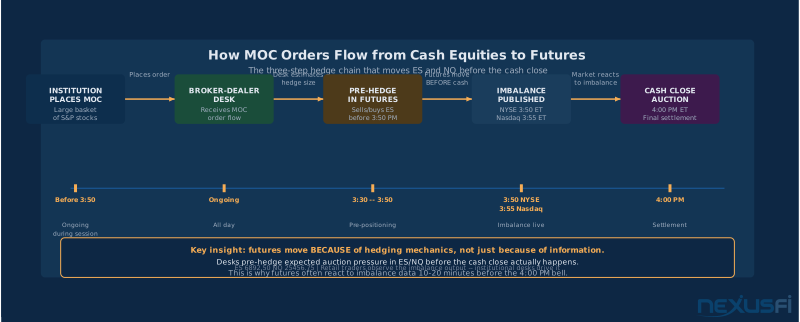
The mechanism matters. Futures react to MOC data not because of information asymmetry but because of hedging mechanics. Broker-dealer desks receive large MOC order flow, pre-hedge their exposure in ES or NQ before the close, then unwind that hedge as the cash auction clears. The futures market reflects the demand for those hedges — which means ES can start moving 20 minutes before any cash stock has actually printed its close. @jlabtrades on NexusFi described watching buy imbalances publish at 3:50 and seeing ES rip 3 handles within two minutes while the cash market was still in normal trading. That reaction is the hedge, not the trade.
Key Concepts #
MOC order: An instruction to buy or sell a specified quantity at the official closing price of the session. No price condition — execution guaranteed at the close print, whatever that price is.
MOC imbalance: The net difference between total buy-side MOC orders and total sell-side MOC orders for a specific stock or group of stocks. A $600M buy imbalance means there are $600M more shares wanting to buy at the close than sell. The exchange publishes this to attract offsetting liquidity.
NYSE imbalance feed: NYSE begins publishing indicative MOC imbalance data at 3:50 PM ET, updating continuously through 3:58 PM. The data includes imbalance direction (buy or sell), paired volume, total imbalance quantity, and a reference price. Final update at 3:58 PM.
Nasdaq NOII (Net Order Imbalance Indicator): Nasdaq's equivalent feed, beginning at 3:55 PM ET and updating every second through the Nasdaq Closing Cross. For Nasdaq-heavy indices like NQ futures, the NOII can provide additional confirmation signal after the NYSE publication.
Closing Cross: The mechanism by which exchanges match and execute all MOC orders at a single clearing price. Nasdaq's Closing Cross is especially important for NQ since major tech components like AAPL, MSFT, NVDA, and AMZN are Nasdaq-listed.
Pre-hedge: When a broker-dealer desk receives institutional MOC order flow, they often trade futures in the opposite direction before the cash close to offset their exposure. This is the mechanism that makes futures react to imbalance data before cash stocks do.
Index arbitrage: Simultaneous trading of futures and the underlying basket of stocks to capture basis spreads. (See Auction Market Theory for the broader price discovery framework.) Program trading desks run continuous index arb that keeps ES and SPX in alignment, and that same pipeline makes ES highly sensitive to signals about where the cash close will print.
How Exchanges Publish MOC Imbalance Data #
The NYSE starts the clock at 3:50 PM ET. That's when they publish the first indicative imbalance for NYSE-listed stocks — the net buy or sell pressure accumulated from confirmed MOC submissions. The feed shows the imbalance direction, total imbalance size in shares, paired volume (matching buy and sell orders), and an indicative clearing price if the close happened right now.
This isn't a final number. Late-arriving MOC orders, floor broker interest, and institutional D-orders can shift the picture until 3:58 PM when NYSE publishes its final update before the auction. The imbalance you see at 3:50 is the best estimate with the information available at that moment — and it updates. If a $400M buy imbalance becomes a $900M buy imbalance in the 3:55 update, you'll see a secondary leg in the futures reaction.
Nasdaq's NOII begins at 3:55 PM ET, five minutes after NYSE, updating every second until the Closing Cross executes. For NQ specifically, the NOII carries more direct weight since NQ's component stocks (AAPL, MSFT, NVDA, GOOGL, AMZN, META) are all Nasdaq-listed. A massive buy imbalance in Nasdaq NOII at 3:55 while NQ futures are already moving is confirmation signal, not a new trade trigger. The trade already happened.
Traders access imbalance data several ways. Bloomberg and Reuters terminals carry the raw feeds. Many retail data platforms (including some available through brokers like Interactive Brokers) publish delayed or aggregated imbalance data. The NYSE publishes same-day imbalance files for research. What most retail traders see is a simplified buy/sell direction and aggregate dollar size — which is enough to get the directional read, even if not enough to trade at institutional latency.
One practical note from the community: @wldman on the Spoo-nalysis thread noted that "market on close imbalance is something that I believe you can view" but many traders don't know where to find it. The simplest access for ES traders is to have a data terminal that aggregates the NYSE and Nasdaq feeds into a single dollar figure and direction. Most intraday traders use this as a directional signal 10-15 minutes before close, not as a precise execution input.
Why ES and NQ Futures React to Imbalance Data #
The confusion about MOC imbalances is thinking they're an information signal. They're not. The reason futures move is mechanically simpler and more important: hedging demand.
Here's how it works. A pension fund needs to buy $800M of S&P 500 stocks at the close to rebalance their portfolio against an index. They submit $800M in MOC buy orders through their broker-dealer. The broker-dealer desk receives this order flow and immediately faces a problem: they need to sell $800M of equities to their client at the close, but they don't own $800M of equities right now. To hedge that future delivery obligation, they buy ES futures — because ES futures track the same underlying basket and they can execute in size immediately.
This pre-hedge is what you see in ES when a large buy imbalance publishes. The futures rip not because someone read the imbalance and decided to go long — the futures rip because institutional desks are hedging delivery obligations they already have. The imbalance data just makes the hedging demand visible.
Then at 4:00 PM when the cash close prints, the desk delivers the stocks, receives payment, and unwinds their ES hedge. That's the mechanical force that can cause ES to fade slightly off session highs right at 4:00 PM — the hedge coming off.
Index arbitrage adds another layer. Program trading desks continuously monitor the spread between ES futures fair value and the SPX cash index. When imbalance data suggests the cash close will print higher than current futures-implied fair value, arb desks buy ES and sell cash stock baskets — which also moves ES higher before the close. The convergence mechanics of index arb mean the cash and futures markets stay tightly linked even through the imbalance-driven volatility window.
@josh on the Spoo-nalysis thread described watching a 3:50 MOC algo start affecting the last-hour pattern: "This 3:50 MOC algo has changed how I trade the close — before all of this, there was no volatility spike at 3:50." He's describing the same phenomenon: algorithmic hedging behavior that's become consistent and predictable enough to be a feature of the close window.
@josh describes this institutional dynamic precisely: "ES is the hedging vehicle for SPX options which is the go-to facility for all institutions worldwide to manage their equity exposure. SPX market makers hedge using ES." [10] This is the mechanical foundation of MOC imbalance reactions — the market is dominated by institutional hedging, not retail directional bets.
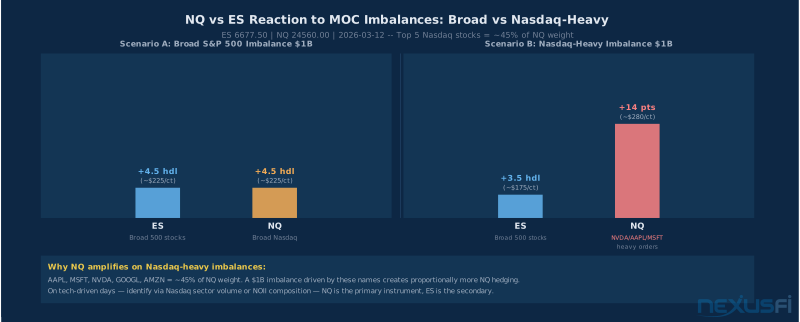
NQ typically shows a stronger reaction than ES for tech-heavy imbalances because Nasdaq-listed mega-caps have concentrated index weight. NVDA alone is roughly 5% of NQ. A $1B Nasdaq buy imbalance driven by NVDA MOC orders creates proportionally more NQ futures hedging than the same dollar figure spread across 500 S&P 500 stocks.
The Close Window: Timing and Price Behavior #
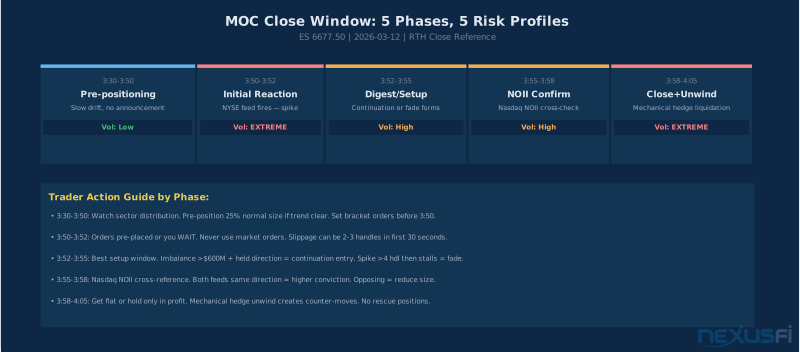
The close window isn't one event. It's a sequence of distinct phases, each with its own character.
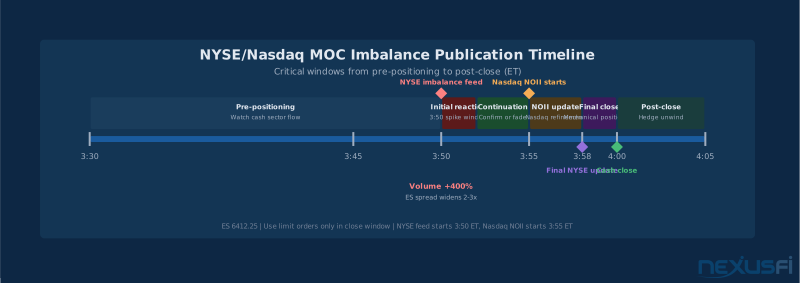
3:30-3:50 PM: Pre-positioning. Volume starts building in the cash market as institutional desks begin routing MOC orders. Watch the sectors — if tech is seeing unusual buy volume in the final 30 minutes before 3:50, that's an early signal that Nasdaq-heavy imbalance is building. ES and NQ start drifting in the expected direction as desks pre-position before the official publication. The move is slower and less decisive here because nobody's shown their cards yet.
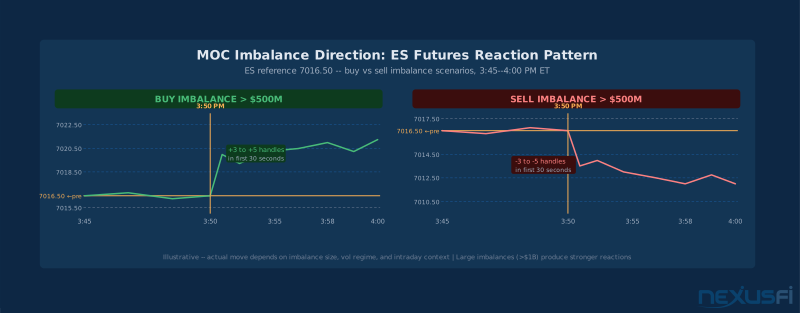
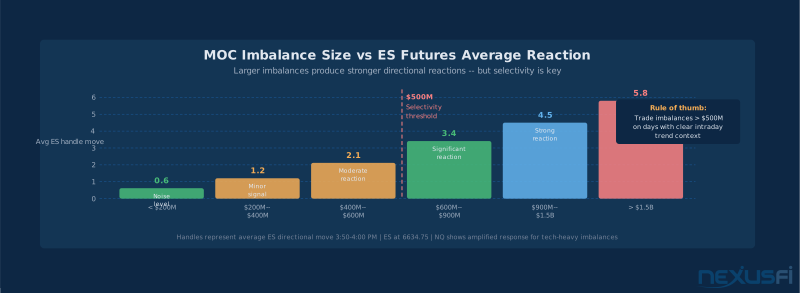
3:50:00-3:52 PM: Initial reaction. This is the sharpest window. The NYSE imbalance feed goes live and every algorithm in the market recalculates simultaneously. Large imbalances — $500M and above — can move ES 3-5 handles within the first 30-60 seconds. Volume spikes 400%+ versus mid-day averages. Bid-ask spreads widen to 2-3 ticks. Market orders in this window are execution suicide — slippage eats 1-2 handles on a bad day. Limit orders only.
3:52-3:55 PM: Digest and continuation. The initial spike either finds follow-through or consolidates. If the imbalance is directionally consistent with the intraday trend and price is holding near a key technical level (VWAP, prior close), this is where continuation setups form. If ES spiked 4 handles on a buy imbalance and immediately faded 2 handles, you're getting an early warning that the initial read was noise or the imbalance is smaller than the reaction implied.
3:55-3:58 PM: Nasdaq NOII + secondary adjustment. The Nasdaq feed goes live and updates every second. For NQ specifically, this window can produce a secondary leg if the NOII confirms the earlier NYSE signal. It can also produce a reversal if the two feeds are telling different stories. A $700M NYSE buy imbalance paired with a neutral Nasdaq NOII is a weaker signal than both confirming in the same direction.
3:58-4:00 PM: Final positioning. NYSE's last update. Desks are finalizing hedge positions. Volume is high but the moves become more mechanical — less interpretable, more dangerous. Many experienced traders who trade imbalance setups get flat or reduce size heading into this window because the final 2 minutes before close have the worst signal-to-noise ratio of any time window. @GruttePier documented this in his journal: he uses VWAP confluence with MOC direction but steps back from active trading in the final 2 minutes unless the setup is extremely clean.
4:00-4:05 PM: Post-close unwind. The cash close prints. Hedges start unwinding. This often produces a brief counter-move as institutional hedges come off — which is why ES can fade a few handles immediately after the 4:00 PM print even when the day's bias was bullish. Don't read the post-4:00 fade as a directional signal. It's mechanical hedge liquidation.
Technical Levels That Matter at the Close #
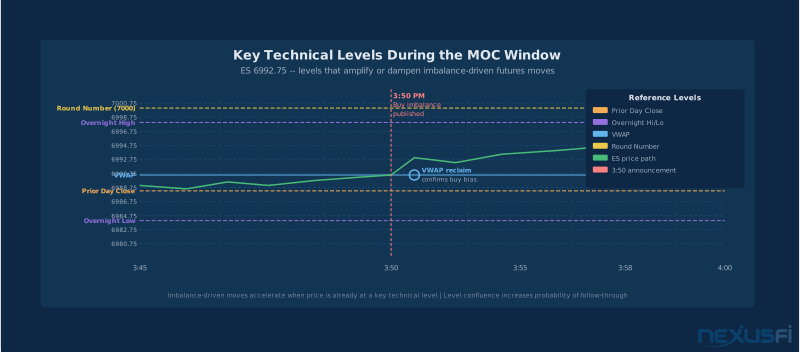
MOC imbalance data gives you a directional signal. Technical levels tell you how much force that signal will meet. An imbalance pushing price into a clear resistance level produces a different reaction than the same imbalance with price in open space.
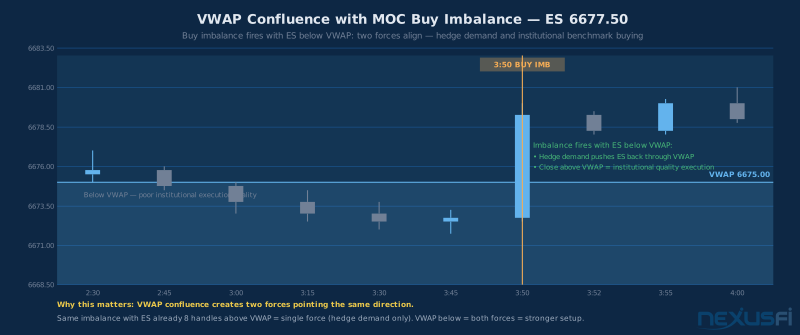
VWAP: The most important level for close-window trading. Program traders and institutional desks use VWAP as a benchmark for execution quality — buy below VWAP is considered "good" execution, sell above VWAP is "good" execution. When a buy imbalance pushes ES back above VWAP heading into the close, you get a technical and mechanical signal pointing the same direction. That confluence is what produces the strongest close setups.
Prior day's close: The settlement reference from yesterday. Large institutional funds track performance relative to prior close. When a buy imbalance is pushing ES back above yesterday's settlement, you can see additional mechanical buying from managers who want to show a "green day" close — which isn't just psychology, it's tied to performance benchmarking that drives real order flow.
Overnight high/low: The extremes of the Globex session. These levels marked where overnight participants drew the line. When the day session has respected these levels as support or resistance, late-day imbalance-driven moves that push through them can trigger stop cascades that amplify the initial imbalance reaction.
Round numbers and key handles: In ES, major whole numbers and key half-handle levels attract both resting orders and mechanical stop placement. When a buy imbalance is pushing ES toward a round number that's acted as resistance all day, the imbalance strength needed to push through is higher. When it breaks through, the move accelerates because stops trigger above the level.
Options pin levels: On expiration days (especially OPEX third Fridays and quarterly expirations), options market makers are managing gamma exposure that makes certain strike prices act as strong attractors. A large buy imbalance on OPEX that's pushing toward a major open interest strike will hit dealer hedging counterflow — the close print has mechanical gravity toward high-OI strikes.
The setup that works best: large imbalance + price near a key level that it can reclaim or break through. A $750M buy imbalance with ES sitting right at VWAP and below yesterday's close is a much cleaner trade than the same imbalance with ES already 8 handles above VWAP. The first setup has multiple catalysts stacking in the same direction. The second is a continuation trade with nothing technical to lean on.
How to Trade MOC Imbalances #
Three setups, clear conditions, specific execution rules. If you can't articulate exactly when you're in and out before 3:50 hits, you're not ready to trade the close.
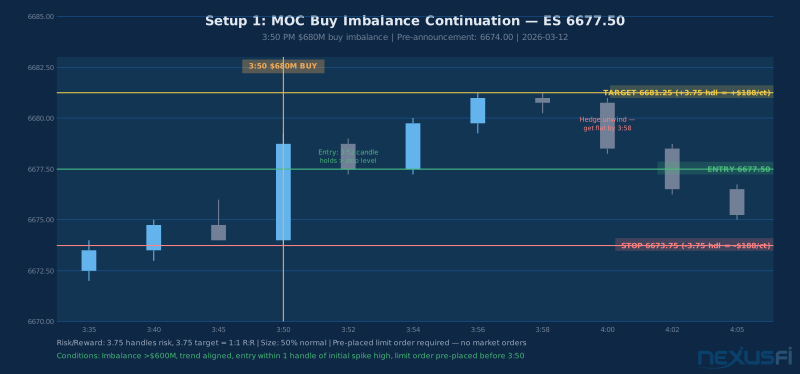
Setup 1: Imbalance continuation (3:52-3:55 PM)
Conditions: Imbalance >$600M, direction aligns with intraday trend, ES holding within 1 handle of the initial reaction high (buy) or low (sell).
Entry: On the first 2-minute candle close after 3:50 that's in the imbalance direction, if price hasn't already extended more than 3 handles from the pre-announcement level.
Target: Prior day close (if below for buy) or VWAP (whichever is closest and higher). Or simply hold to 3:58 PM.
Stop: 2 handles beyond the 3:50 PM low (buy) or high (sell). Period.
Size: Reduce normal size by 50%. Not optional — volatility in this window is 2-3x intraday average.
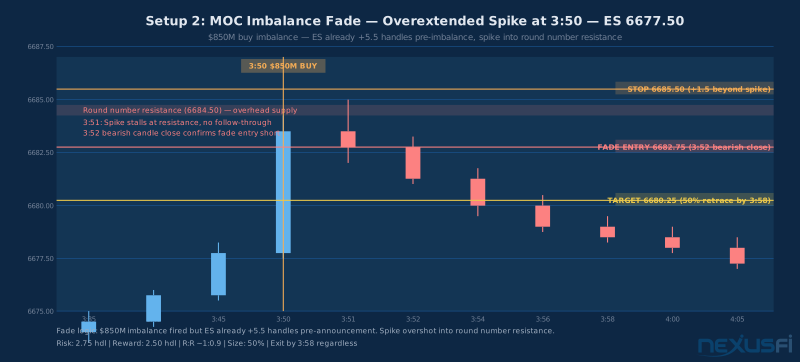
Setup 2: Imbalance fade (3:52-3:55 PM)
Conditions: Imbalance >$800M but price already moved 4+ handles in the imbalance direction within the first 90 seconds. Price is at or above a key resistance level (round number, overnight high, major VWAP deviation band).
Entry: When a 1-minute candle closes counter to the imbalance direction, showing the initial reaction has stalled.
Target: 50-60% retracement of the initial spike by 3:58 PM.
Stop: Beyond the 3:50 spike extreme by 1.5 handles.
Logic: When the hedge-driven move overshoots technical resistance in the first 90 seconds, the unwind trades toward a more rational level before the actual close.
Setup 3: Pre-imbalance positioning (3:40-3:50 PM)
This is the hardest and highest-risk setup. Conditions: unusually high volume in cash market sector that corresponds to the index (tech sectors for NQ, broad S&P distribution for ES), combined with consistent late-session directional drift over the previous 30 minutes.
Entry: Small size (25% normal) anticipating imbalance direction.
Exit: Immediately — on the first candle after 3:50 — if imbalance is opposite to your position. Do not hold a counter-imbalance position into the close.
This is the "local knowledge" trade that gets blown up regularly. Play it only with reduced size and absolute discipline on the 3:50 exit rule.
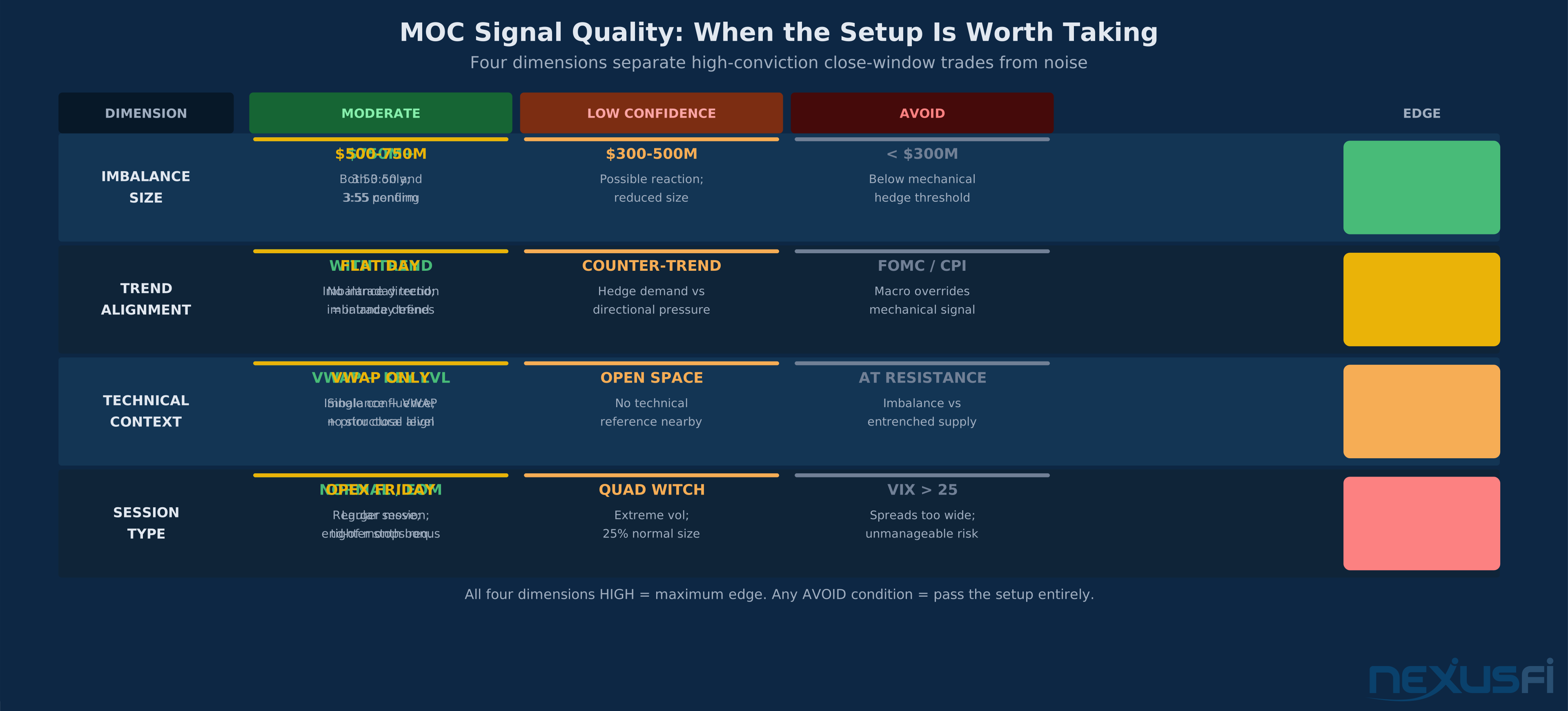
What to skip: Any imbalance under $400M. Any imbalance day where a major macro event (FOMC meeting, CPI release, geopolitical shock) is dominating price action — the macro will overwhelm the mechanical signal. Any day where the imbalance number changes direction between the 3:50 and 3:55 update — the flip means the data is unstable and you're trading noise.
Execution mechanics: Limit orders only. Set them before 3:50 PM, not after the spike fires. If you're using NinjaTrader or Sierra Chart, have bracket orders ready. The first 30 seconds after 3:50 are not the time to be clicking. They're the time to be watching your pre-placed orders fill or miss.
Set limit orders BEFORE 3:50 PM hits. The first 30 seconds after NYSE imbalance publishes are not the time to place orders — spreads widen to 2-3 ticks and ES can move 3+ handles. Pre-place bracket orders in NinjaTrader or Sierra Chart so you can watch the fill, not the order entry screen.
Risk Management in the Close Window #
The close window has specific risk characteristics that don't apply to mid-session trading. Adjust or don't trade it.
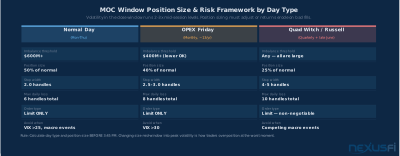
Position size reduction is mandatory. Volatility in the 3:50-4:00 PM window runs 2-3x the mid-day average. A position size that's comfortable at 1 PM is dangerous at 3:51 PM. Standard practice is 50% of normal position size, and some professional traders go lower on high-volatility days or around major expiration events.
Limit orders only. Market orders into the close window will get filled at prices you don't expect. Spreads widen to 2-3 ticks in the first 30 seconds after 3:50 PM. An ES market order in that window can mean 2-3 handles of slippage on a bad day. Every fill you need in the close window should be placed as a limit before the imbalance publishes.
Know your maximum loss before 3:50 hits. Decide: if I'm wrong on this trade, what's the maximum I'll lose before I get out? Calculate it in handles, calculate it in dollars, have the stop order placed. The close window is no place for discretionary stop management — you'll second-guess yourself through every tick.
Don't hold ambiguous positions into 4:00 PM. If your position is underwater at 3:58 PM and the imbalance signal was valid but just didn't work, take the loss. Holding through the mechanical close mechanics hoping for a last-minute rescue is how traders turn a 2-handle loss into a 4-handle loss. The post-4:00 PM unwind frequently runs counter to the imbalance direction as hedges come off.
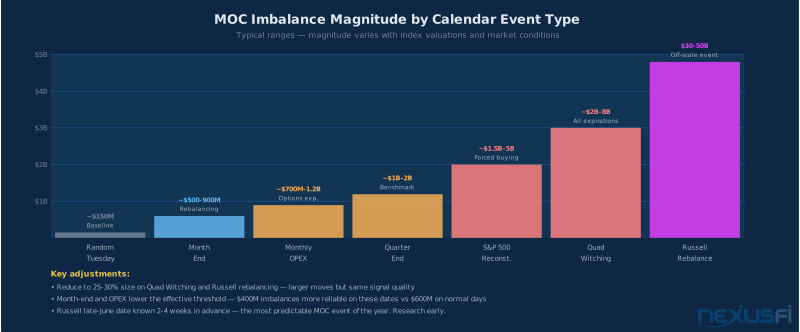
Enhanced caution on special calendar days. MOC imbalances are larger — and more volatile — on these dates:
- Monthly OPEX (third Friday of every month) -- options expiration creates additional mechanical flow
- Quarterly OPEX (triple/quadruple witching, third Friday of March, June, September, December) -- multiple expiration types stack
- S&P 500 index reconstitution days -- additions and deletions create billion-dollar imbalances
- Russell rebalancing (late June) -- small-cap rebalancing produces some of the largest annual imbalances
- End of month/quarter -- portfolio managers window-dress with MOC orders
On these days, imbalances can run $2-5B or more. The signals are cleaner — large imbalances produce clearer reactions — but the moves are also larger and faster. Adjust position size down, not up, even when the signal is strong.
Mistakes Traders Make With MOC Data #
MOC imbalance trading has a specific failure pattern: traders see the initial spike, wait for confirmation, then buy or sell right into the exhaustion high or low. Here's what goes wrong and why.
Chasing the 3:50 spike. The fastest reaction happens in 30-60 seconds. By the time you've seen the imbalance, processed the number, and decided to enter, ES has already moved 3 handles. If you're chasing that move with a market order, you're buying the top of the initial spike and entering at the worst possible moment. @jlabtrades tracked specific price levels around the 3:50 window and documented that ES often pulled back 1-1.5 handles after the initial spike before any continuation. The entries that worked were on that pullback, not on the initial spike.
Ignoring imbalance updates. The 3:50 number isn't final. The 3:55 Nasdaq NOII update can change the picture. If you enter long on a $600M buy imbalance at 3:52 and the 3:55 update shows a revised $400M imbalance (lower than threshold), the mechanical support for your trade has weakened. Have a plan for imbalance revisions, especially if they flip direction.
Trading every imbalance. The natural bias is to look for a trade whenever there's a published imbalance. Most imbalances under $400M don't produce tradeable moves — the mechanical hedging demand is too small relative to normal close-window noise. Set a minimum threshold and stick to it. Forcing trades on small imbalances adds commission drag without edge.
Ignoring intraday context. An imbalance signal that runs counter to a strong intraday trend usually loses. If ES has been in a downtrend all day, rejected every bounce attempt, and then a $600M buy imbalance publishes at 3:50 — that's a weaker setup than the same imbalance on a flat-to-slightly-bullish day. The mechanical hedge buying has to overcome the existing directional sell pressure. It can, but the success rate is lower and the fade risk is higher.
Applying the same size as mid-session trading. This is the most expensive mistake. Normal position sizing assumptions break down in the close window because volatility is structurally higher. @josh noted that the 3:50 algo "ruined the close for trading" in terms of being able to trade it with normal size and expectations. The increased volatility isn't noise to trade through — it's a risk parameter to respect.
Treating every day the same. OPEX Fridays, Russell rebalancing days, and quarter-end sessions produce imbalances 3-5x larger than normal. Those days need separate rules — tighter stops, smaller size, higher confirmation thresholds — not the same playbook you run on a random Tuesday.
When MOC Imbalance Data Matters Most #
Not every session makes the close worth trading. The MOC window produces its best signals when several conditions align: large imbalance, clear intraday context, and a meaningful technical level nearby.
High-conviction days:
- Imbalance >$750M in a consistent direction (both 3:50 and 3:55 updates confirm)
- Intraday trend is clear and directionally aligned with imbalance
- ES or NQ is within 2 handles of a key technical level (VWAP, prior close, overnight range boundary)
- Market regime is trending (ADR above 20-day average, intraday range expanded)
Calendar events that amplify MOC signals:
Russell 3000 reconstitution happens every year in late June. The index rebalances by adding and removing companies, which forces index funds tracking the Russell to buy additions and sell deletions — all via MOC orders on rebalancing day. In a typical year, Russell reconstitution generates $30-50B of index-driven MOC volume, dwarfing any normal day. The signal is so clean on Russell day that it's become a widely known event trade. The NexusFi community discusses this annually in the Emini and Stocks forums. @TraderTS documented the MOC mechanism early: "It's when Big Boys rebalancing and hedging at MOC. The NYSE broadcasts stock imbalances for the pending MOC order at 3:45 pm ET." [9]
S&P 500 reconstitution (additions and deletions) also generates large MOC flows when announced. Standard practice is to announce changes with several days' notice, which allows the market to pre-position — but the official close on effective date still generates large imbalances as index funds complete required rebalancing.
End of month and end of quarter sessions consistently produce above-average imbalances as institutional managers rebalance to target allocations. The last trading day of each month is worth watching specifically for MOC imbalance data — the mechanical rebalancing demand is predictable and historically consistent.
Low-value days to avoid:
- Days with major macro releases after 3:30 PM (Fed speeches, geopolitical events) -- macro dominates mechanical signal
- Days with VIX above 25 -- close-window volatility becomes unmanageable, spreads too wide
- Holiday-shortened sessions -- reduced participation makes imbalance data less reliable
- Days where the imbalance flips direction between 3:50 and 3:55 updates -- unstable data means unstable market
The NexusFi Emini and Emicro Index forum has active discussion around close-window trading during major calendar events. The Spoo-nalysis ES e-mini futures S&P 500 thread in the Elite Circle regularly covers MOC imbalance readings on significant close days, providing a real-time reference for how experienced traders interpret the data.
Accessing MOC Imbalance Data #
You don't need a Bloomberg terminal to use MOC imbalance data, but you do need a data source that publishes it in real time. Here's the practical environment.
Exchange feeds (direct): NYSE publishes the imbalance feed through their market data infrastructure. Nasdaq publishes the NOII similarly. Access requires a direct market data subscription, which most retail traders don't have. Latency on these feeds is in the hundreds of milliseconds even for retail — more than enough to use them as directional signals, not enough for front-running mechanical arb.
Broker platforms: Interactive Brokers, TD Ameritrade thinkorswim, and TradeStation all offer some form of imbalance data through their platforms, either in the scanner or as an alert. The quality and timing varies — check your specific platform's documentation for where MOC imbalance data lives.
Data aggregation services: Several services (SquawkBox, Benzinga Pro, Trade-Ideas) publish simplified imbalance summaries — typically just the direction (buy or sell) and a dollar estimate. This is sufficient for the close-window setups described above. Most don't need second-by-second updates at the retail level.
Free sources: NYSE publishes end-of-day imbalance files for research purposes, available at nyse.com. These are useful for back-testing historical imbalance patterns against subsequent ES closes, but obviously not for real-time trading.
What you actually need to see: Direction (buy or sell imbalance), magnitude (dollar estimate), and the time (is this the 3:50 or 3:55 update). Everything else is secondary. You don't need constituent-level data to trade this. You need to know: buy or sell, how big, and has it updated in the same direction or flipped.
The NexusFi community has discussed imbalance data access at length in the Emini and Emicro Index forum. The consensus is that real-time aggregate data (direction + size) is available through most professional-grade data platforms, and that's sufficient for the close-window setups most retail ES and NQ traders run.
Knowledge Map
Go Deeper
Build on this knowledgeCitations
- — Does anybody use Market on Close (MOC) imbalance values in their trading? (2023) 👍 2“ES prices during that time (from 1min candle close on min before) - 30 min before close 4502”
- — Does anybody use Market on Close (MOC) imbalance values in their trading? (2023) 👍 1“This 3:50 MOC algo has ruined the close for trading (for me anyway) for the last few years”
- — Spoo-nalysis ES e-mini futures S&P 500 (2020) 👍 3“The actual MOC orders aren't executed until the closing print I think, but NASDAQ does publish the official MOC number at 3:50”
- — Spoo-nalysis ES e-mini futures S&P 500 (2020) 👍 7“I have always assumed these were existing MOC orders being executed”
- — GruttePier's trading journal to getting profitable (2020) 👍 7“Many market participants look at stuff like VWAP, swingpoints, floor trader pivots, HOD/LOD”
- — GruttePier's trading journal to getting profitable (2018) 👍 7“Price pulls back to VWAP -- VWAP is confluencing with another price level”
- — Spoo-nalysis ES e-mini futures S&P 500 (2020) 👍 6“Market on Close imbalance is something that I believe you can view”
- Nasdaq Market Intelligence — How Much Does the MOC Imbalance Matter? (2019)
- — 3:50 price action - why (2018) 👍 2“It's when Big Boys rebalancing and hedging at MOC=Market On Close. The NYSE broadcasts stock imbalances for the pending MOC order at 3:45 pm ET”
- — Is it correct to say ES is Institutionally driven (2025) 👍 5“ES is the hedging vehicle for SPX options which is the go-to facility for all institutions worldwide to manage their equity exposure. SPX market makers hedge using ES.”