



Triple Witching and Quad Witching in Futures Trading: The Quarterly Event Every ES and NQ Trader Must Understand
Overview #
Four times a year, the market turns into something it isn't the other 248 trading days. Volume surges. Price action gets weird. Stops that should hold don't. Breakouts that look clean reverse immediately. Traders who've been trading ES for years still get caught off guard by it.
That's triple witching. And if you trade futures without understanding what happens during these quarterly expiration events, you're flying blind through the most mechanically complex trading environment of the calendar.
Triple witching occurs on the third Friday of March, June, September, and December when three major derivative classes expire simultaneously: stock index futures, stock index options, and stock options. The result is a concentrated collision of hedging flows, institutional rebalancing, and settlement mechanics that at the core distorts the normal relationship between supply, demand, and price.
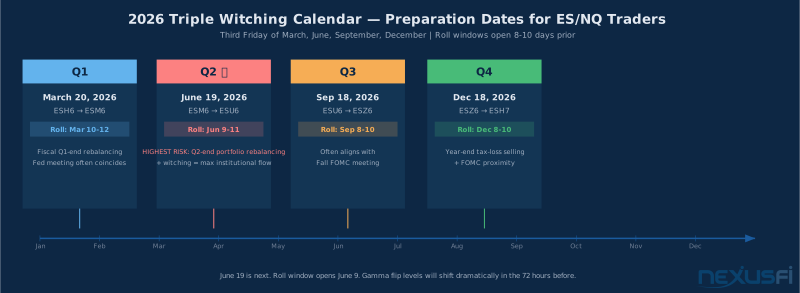
The 2026 dates: March 20, June 19, September 18, December 18. June 19 is two weeks away as of this writing. If you trade ES or NQ, you need this before then.
This isn't just options traders' problem. Pure futures traders — no options in sight — still get damaged on witching days because options hedging pressure transmits directly into the futures market through arbitrage and basis relationships. The ES you're trading isn't isolated from the SPX options market. It's the hedge vehicle. When options dealers need to adjust their hedges, they do it in futures. You feel every one of those adjustments whether you know it or not.
The goal here is to give you a complete framework: what witching actually is mechanically, how it affects price action, where the real risks live (pin risk, gamma exposure, the witching hour), and how to adjust your approach from conservative to active depending on your capabilities and risk tolerance.
What Triple Witching Actually Is #
Start with what "expiration" means for each of the three instrument classes and why simultaneous expiration creates chaos.
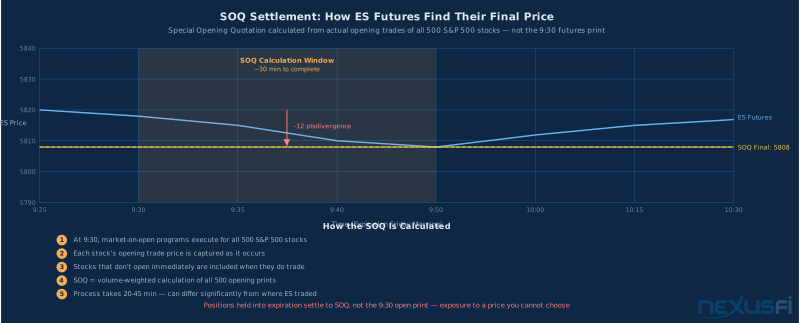
Stock index futures settle quarterly. The ES (E-mini S&P 500), NQ (E-mini Nasdaq), YM (E-mini Dow), RTY (E-mini Russell) — all of these have quarterly expiration contracts. On expiration day, the front-month futures contract stops trading and settles to the Special Opening Quotation (SOQ) — a price calculated from the actual opening prices of the 500 constituent stocks of the S&P 500. This settlement price isn't the 9:30 AM print you see on your chart. It's a volume-weighted opening calculation that can take 30+ minutes to finalize, and it can differ meaningfully from where ES was trading at the open.
Stock index options (SPX, NDX, etc.) expire at the same time, and many expire on the same schedule. Monthly options tied to the quarterly cycle also expire on the third Friday. These contracts are cash-settled and create the hedging flows you'll feel most strongly.
Individual stock options expire on the third Friday of every month, including the quarterly months. During triple witching, the combination of index options and stock options means dealers are managing hedges across thousands of individual positions simultaneously.
When all three expire on the same day, the combined hedging requirement is multiplicative, not additive. Dealers adjusting their index futures hedges while simultaneously managing individual stock option hedges while simultaneously navigating the SOQ settlement window creates a market where normal price discovery is temporarily suspended and replaced by mechanical flows driven by mathematical hedge ratios.
As @tigertrader — one of NexusFi's most respected ES traders — observed while analyzing option overlay structures:
That observation applies broadly: large institutional option structures create silent, persistent hedging pressure that futures traders rarely see explicitly but always feel in price behavior.
The Three Expirations That Converge #
Understanding each component separately makes the combined event easier to read.
Quarterly Index Futures Settlement (SOQ) #
The SOQ settlement is the most direct concern for futures traders. On expiration day, the March/June/September/December ES contract settles to a calculated opening price, not the market-determined futures price. This means:
- Basis compression occurs in the final days before expiration as the futures price converges to fair value relative to the underlying index.
- Any significant position held into expiration is settled at SOQ, not at a price you can choose.
- Arbitrageurs push the basis toward zero, which creates mechanical buy/sell programs in constituent stocks during the opening period.
The practical implication: if you're holding a futures position into expiration Friday morning, you're exposed to settlement price risk. The market-on-open programs needed to establish the SOQ can create large, sudden moves in the first 30-60 minutes that have nothing to do with fundamental direction.
Stock Index Options (SPX/NDX/RUT) #
This is where gamma exposure and pin risk originate. Large institutional portfolios routinely own protective puts, covered calls, and collars on index exposure. At expiration, all of these need to be either closed, exercised/assigned, or rolled. The hedging required to manage this creates the flows futures traders actually feel.
Key mechanics of options hedging:
- Options dealers (market makers) maintain delta-neutral books. When they sell a call, they buy futures to hedge the delta. As the underlying moves, that delta changes, and they need to continuously adjust.
- Near expiration, gamma (the rate of delta change) spikes. A small move in the underlying now causes a large change in the delta hedge required.
- This gamma-driven hedging creates feedback loops: price moves → dealers hedge → hedging causes more price movement → more hedging required.
Individual Stock Options #
The third leg adds breadth to the expiration effect. With thousands of stock options expiring, market makers across the equity tape are all making delta adjustments simultaneously. Many of these hedges are in individual stocks, but the aggregate effect flows through to index futures via the constituent stock relationships.
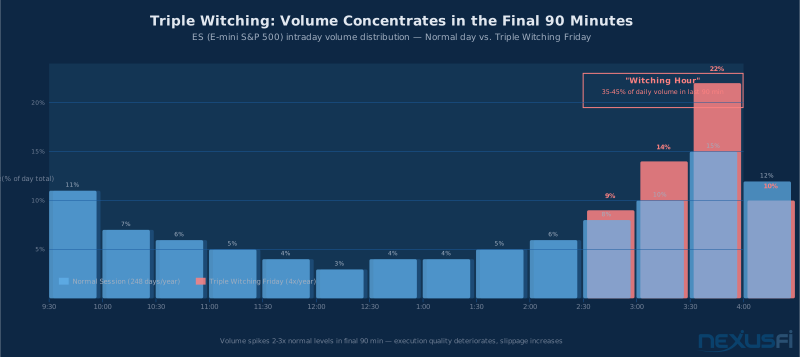
The combined hedging demand from all three classes is why witching volume routinely runs 2-3x normal daily levels and why the final 60 minutes — the "witching hour" — is often the single busiest trading period of the quarter.
Volume and Price Action Characteristics #
Triple witching doesn't behave like a high-volatility day. It behaves like a market where normal signals are temporarily less reliable. Understanding why helps you calibrate what to expect.
The Intraday Volume Profile #
Normal days have predictable volume profiles: high open, midday lull, moderate close. Triple witching looks like this instead:
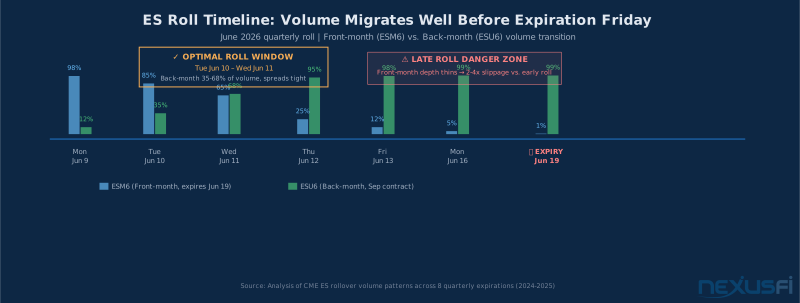
Pre-expiration week (Monday-Thursday): Gradual volume build as institutions begin rolling futures positions. Calendar spread activity (selling front-month, buying back-month) peaks on Thursday. By Thursday afternoon, the front-month ES contract often sees thinner book depth as liquidity migrates to the next contract.
Expiration Friday morning: SOQ settlement creates an opening volatility window. Market-on-open programs for constituent stocks of the S&P 500 execute simultaneously, which can create large opening moves in ES that don't reflect broader market conviction.
Expiration Friday midday: Relative calm if price has pinned near a dominant option strike. Choppy and frustrating if price is between major strikes — not trending, not clean mean-reversion, just noise.
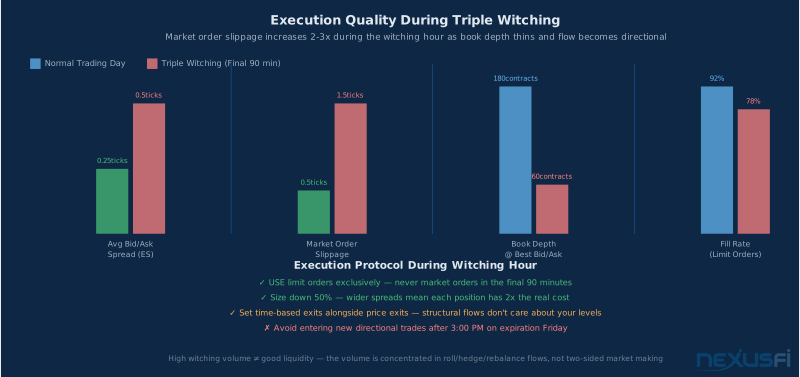
Final 60-90 minutes (witching hour): Volume surges. This is where the chaos concentrates. Dealers unwinding expiring hedges, large institutions adjusting their post-expiration book, retail traders trying to front-run moves that don't materialize the way they expect. Execution quality deteriorates. Slippage increases. Price action becomes genuinely erratic.
As @max-td documented in the NexusFi rollover discussion: "Rollover is 8 days before expiration. You should move to the next contract when the volume in the next contract eclipses the current contract."
That guidance — roll before the chaos, not into it — is the most important practical advice in this article.
In other words, the back-month contract captured 93.5% of the front-month's volume during the transition. By the time expiration Friday arrives, most institutional money has already moved. What's left in the front-month is the noise you don't want to be trading through.
The Calm Before the Storm Pattern #
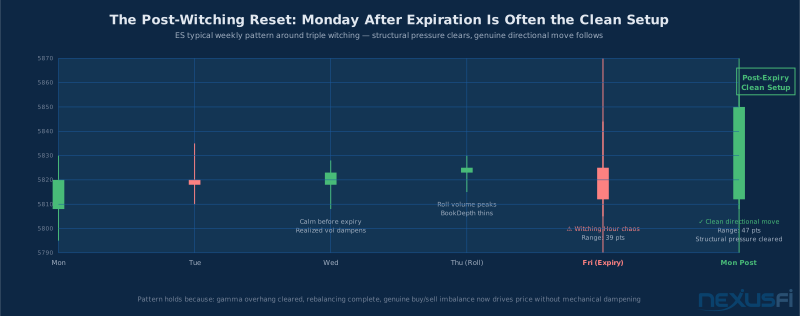
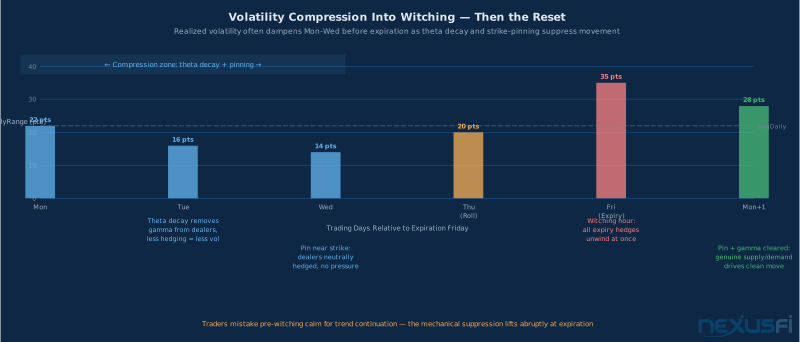
Here's a pattern that repeatedly fools traders: realized volatility often dampens in the days immediately before triple witching. The market feels quieter than normal. Ranges compress. This isn't random — it reflects two forces:
- Theta decay: Options lose time value accelerating into expiration. Dealers who are long options (hedging their short books) experience less gamma exposure as theta works against their positions. Less gamma = less hedging = less volatility.
- Strike pinning: If price is near a heavily trafficked option strike, dealer hedging actually suppresses volatility. Near the strike, dealer delta exposure is roughly neutral, so they're not buying or selling much. This creates artificial calm.
Then expiration arrives and the structural pressure dissipates. Post-expiration Mondays often see the market reset sharply as the mechanical suppression lifts. Traders mistake the witching calm for low-volatility continuation, get caught overly positioned, and take unnecessary losses on the Monday open.
Pin Risk: How Strikes Shape Market Behavior #
Pin risk is the tendency for the underlying to "stick" near a heavily traded strike price as expiration approaches. It's the most misunderstood aspect of witching for traders who don't actively track options exposure.
The Mechanics of Pinning #
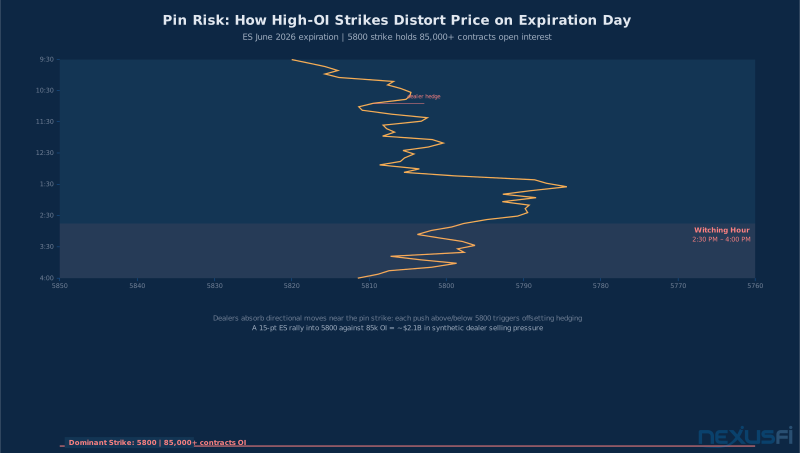
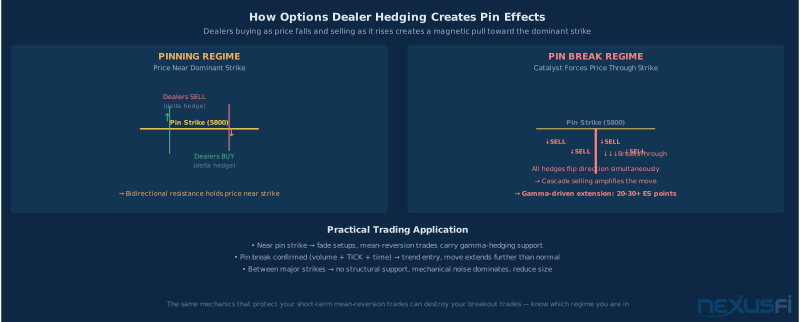
A strike becomes a pin magnet when it has massive open interest — thousands of option contracts. Market makers who've sold (and thus are short) those options have a specific hedge at each price level. When price is exactly at the strike, the option is at-the-money and the dealer's hedge is roughly zero or flat. When price is above the strike, dealers who are short calls need to own the underlying to hedge. When price is below the strike, they don't.
As price crosses the strike threshold, the hedge requirement flips. Dealers are buying as price approaches from below (to hedge calls), and selling as price approaches from above (covering puts). This creates bidirectional price support exactly at the strike — the market makers' hedging activity mechanically holds the underlying near the strike.
@datahogg, in the NexusFi pin risk discussion, clarified the futures-specific version: "For futures (ES, NQ, etc.) there is pin risk. If you are caught in a vertical [spread] pinned between the short and long at expiry, you face early assignment risk."
For purely directional futures traders, the risk isn't assignment — it's that your directional thesis gets neutralized by the gravitational pull of a nearby strike.
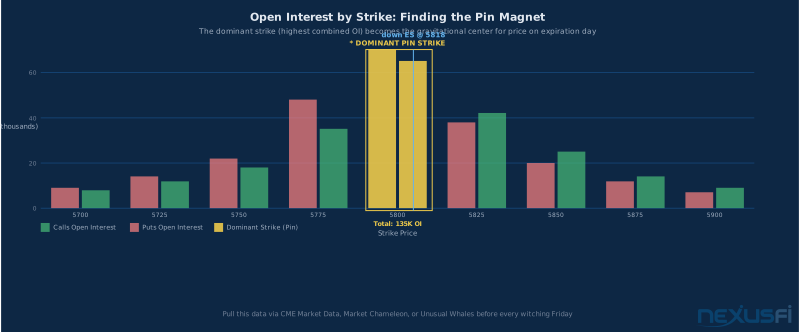
The practical consequence: if a 5800 strike on SPX has the highest open interest heading into June's triple witching, and ES is trading near 5800, your breakout trade above 5820 has a headwind. Dealers absorbing upside momentum. Faders getting reinforced by options hedging flows. The market feels like it's fighting you even when your setup looks technically perfect.
How to Identify the Dominant Pin Strike #
You need SPX open interest data, not just price charts:
- CME's Market Data platform provides options chain data for SPX and ES options. Look at the total open interest by strike for the expiring monthly series.
- Barchart, Market Chameleon, and Unusual Whales all provide visual OI displays that show where the concentration is.
- Look specifically at the at-the-money and slightly out-of-the-money calls and puts. The strike with the highest combined OI is typically the strongest pin magnet.
The key insight from @mtzimmer1's expiration tracking: "High OI Strikes Exp 4/24/20: SPY: 200, 260, 280, 283 (order from highest OI to lowest). SPX: 2600, 2400, 2800, 2550." Knowing which strikes are dominant before expiration gives you the playbook — those are the gravitational centers where price may spend disproportionate time.
When Pinning Fails #
Pinning doesn't always happen. When it breaks, the move can be violent.
If price is pinned near a strike and then a trigger arrives, the pin breaks directionally. Dealers who were neutrally hedged suddenly need to aggressively buy or sell. The cascade of hedging all in one direction creates a gamma-driven acceleration that looks nothing like normal price action. Moves can cover 30+ ES points in minutes with almost no pullback, because every dealer is hedging in the same direction simultaneously.
The shift from passive to aggressive in the options tape is the tell.
Gamma Exposure and the Gamma Flip #
Gamma exposure — covered in depth at /a/market-structure/gamma-exposure-dealer-hedging-market-structure — is the most actionable analytical framework for trading around witching. It tells you whether the market is in a volatility-dampening regime or a volatility-amplifying regime.
Positive vs. Negative Gamma #
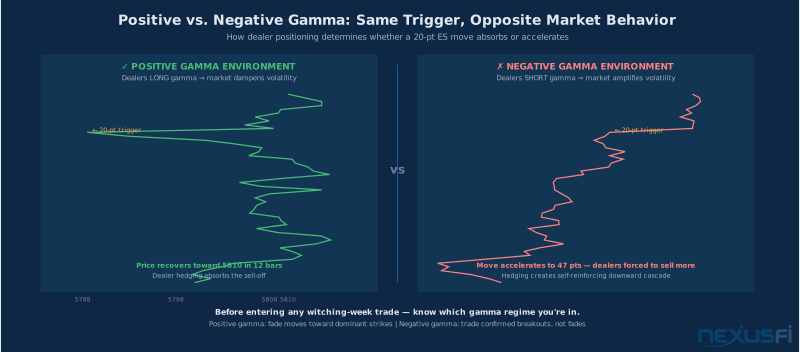
Positive gamma environment (dealers long gamma): When dealers have sold puts and/or bought calls to hedge, they're long gamma. This means their delta exposure decreases as price moves against them. When ES drops, their hedge requires them to buy less, not more. The result: volatility is dampened. Large sell-offs get absorbed. The market feels "sticky" and mean-reverting. This is the environment where fade setups work.
Negative gamma environment (dealers short gamma): When dealers have sold calls and/or bought puts in large size, they're short gamma. Their delta exposure increases as price moves against them. When ES drops, they need to sell more to maintain their hedge. Selling pressure begets more selling begets more selling. Rallies get sold aggressively. This is the environment where breakdowns accelerate into free-fall and breakouts reverse sharply. Trending trades work. Stop-loss hunting becomes real.
Near triple witching, the gamma environment shifts dramatically as expirations remove massive amounts of options from the board. A market that's been in a positive gamma regime (calm, range-bound) can flip to negative gamma almost instantly as the dominant open interest expires.
The Gamma Flip Level #
The gamma flip — sometimes called the "zero-GEX level" — is the price where the market transitions between positive and negative gamma. Below this level, dealer hedging amplifies moves. Above it, hedging dampens them.
Several data services now calculate and publish gamma exposure levels daily. SpotGamma, Squeezemetrics, and Market Maker Move (MMM) all provide GEX estimates. @tigertrader referenced SpotGamma commentary in the Spoo-nalysis thread specifically because these gamma metrics provide context that pure price analysis can't. "For those of you who haven't subscribed to SpotGamma yet, here is his Friday afternoon commentary — the VIX decline inevitably pushed markets higher."
For practical purposes: if you know the gamma flip level is at 5750 and ES is at 5780, you're in positive gamma territory — expect range compression and mean-reversion setups to work better than breakouts. If price drops to 5740 (below the flip), regime changes and breakdowns can extend unexpectedly.
Secondary Greek Effects: Vanna and Charm #
Two secondary effects compound the gamma picture near expiration:
Vanna measures how delta changes with implied volatility. When implied volatility drops as expiration approaches, dealers who are short puts see their delta hedges unwind. This can create systematic buying pressure on ES as IV falls.
Charm measures how delta changes with time. Even without price movement, the passing of time changes dealers' hedge ratios. In the final days before expiration, charm effects are largest — dealers are making hedging adjustments continuously even in quiet markets. This explains why witching Friday can have erratic price action in the morning with no news: it's pure mechanical delta rebalancing from charm decay.
The practical implication: in the final 30-60 minutes of witching Friday, these effects are all compressing simultaneously. Vanna, charm, and gamma hedging are all unwinding at once. This is why the witching hour is so unreliable for normal trading approaches.
Roll Timing: When and How to Move to the Next Contract #
Rolling well is the single most actionable skill improvement most futures traders can make around triple witching. The cost of rolling poorly — either too late or with poor execution — compounds over four quarters into meaningful drag.
When to Roll #
The ES quarterly expiration cycle follows a consistent calendar: the front-month contract goes into settlement (SOQ) on the third Friday of the quarterly month. Understanding the full mechanics of futures contract rolls is worth a separate deep dive. The volume-based rollover — when the next contract eclipses the front-month in trading volume — typically happens on the Thursday of expiration week, roughly 7-8 days before the SOQ settlement.
The roll decision is actually a liquidity decision, not a calendar decision. You should roll when the back-month contract has sufficient depth to fill your orders without meaningful slippage. For ES and NQ, that threshold is typically reached by Tuesday-Wednesday of expiration week. By Thursday, the roll is basically complete for most institutional participants.
Roll too late: You're trading a contract with thinning liquidity, wider spreads, and erratic depth. Fill quality degrades. The final Monday-Tuesday before expiration, the front-month can look liquid on screen but have poor depth behind the best bid/ask.
Roll too early: You pay a small liquidity premium on the back month before it's fully liquid. This cost is typically smaller than the late-roll alternative.
The research on ES rollover shows specific patterns. As @SMCJB documented: during the transition from June to September contracts, the September contract reached 93.5% of June's volume within the rollover window. The transition is faster than most retail traders realize — by Thursday, waiting creates unnecessary execution risk.
Calendar Spread Mechanics #
The roll transaction itself involves trading a calendar spread — simultaneously selling the front-month and buying the back-month (if you're long) in a single transaction. CME offers "roll" order types that execute both legs simultaneously, reducing legging risk.
The calendar spread price (the "roll") reflects:
- Cost of carry — interest rate differential between holding ES futures vs. cash
- Dividend expectations — expected dividends on S&P 500 constituents between contract months
- Supply/demand imbalances — if too many traders are trying to roll simultaneously, the roll price can widen
During heavy institutional roll periods (typically the week before expiration), the ES roll price can move much as everyone tries to roll at once. Rolling a week earlier avoids this crowding effect and typically captures a cleaner roll price.
Continuous Contracts and Data Integrity #
For traders using backtesting platforms, triple witching creates another issue: continuous contract stitching. When you roll your data series from front-month to back-month, the gap between contracts (the basis) creates an artificial price discontinuity unless you use a backwards-adjusted or Panama continuous contract series. Many platforms default to unadjusted data, which can create false signals in backtests around every quarterly expiration.
Check your platform's documentation for continuous contract adjustment methodology.
Specific Strategies for Trading Witching Events #
Three approaches, ordered by complexity and required infrastructure. Choose based on your tools and experience level.
Strategy 1: Reduce and Observe (Most Common, Most Appropriate) #
This is the right play for most traders. The witching environment doesn't reward normal trading approaches. Price action is noisier, stops get tagged more frequently by mechanical hedging flows, and the risk/reward of any given setup deteriorates because the behavior is harder to model.
Implementation:
- Reduce position size by 50% on expiration Friday, especially in the last 2 hours.
- Avoid new directional entries in the final 60-90 minutes.
- Tighten stops on any existing positions, not because the setup is weaker but because mechanical price swings can be larger than normal without actually invalidating the directional thesis.
- Look for opportunities the following Monday. Post-expiration sessions often show clear directional moves as the artificial structural pressure from witching dissipates.
Why it works: Most retail losses on witching day come from trading the same way in an environment where normal statistical assumptions no longer hold. Doing less is genuinely the edge.
@tigertrader, in his pre-open preparation notes, observed specific seasonality around quad-witching: "In 2015, there was a very pronounced seasonality around the 3rd Friday of the month, where the market would ramp higher going into both quad-witching."
That historical pattern exists because institutional rebalancing tends to be net buying, creating upward pressure into the settlement close. But it's not reliable enough to position into — it's context for understanding the bias, not a tradeable setup.
Strategy 2: Fade the Pin (Intermediate) #
If you've identified the dominant option strike and price is pinning to it, mean-reversion setups in the vicinity of the strike carry a genuine edge driven by dealer hedging.
Setup requirements:
- Identify the dominant SPX/ES option strike via OI data (see earlier section)
- Price has been within 5-10 ES points of that strike for at least 30 minutes
- Volume is elevated but not directionally skewed (both sides absorbing)
- DOM shows balanced book with large resting bids and asks
Entry logic:
- When price pushes away from the strike, fade the extension
- Targets: back to the pin strike or VWAP
- Stops: beyond the nearest significant market structure level
What kills this trade: A news event, volume imbalance, or gamma flip break. If price breaks decisively beyond the structure and volume surges in one direction, you're no longer in a pin environment. The hedging has shifted. Exit immediately — don't wait for the stop.
Strategy 3: Trade the Gamma Break (Advanced) #
When pin fails and gamma flips, the resulting move can be one of the cleanest directional trades of the quarter. Everything that was suppressing volatility is now amplifying it. Dealers who were buying as price fell are now selling. The market has no support from options hedging — only fundamental buy/sell imbalance matters.
Setup requirements:
- Price has been pinning near a strike for 30+ minutes
- Trigger arrives (news, data, or simply price punching through decisively)
- Volume surges directionally — you can see it in TIME AND SALES and DOM
- TICK confirms: sustained extreme readings (+/-800 and holding)
Execution:
- Enter on the first confirmed directional break beyond the strike
- Do NOT enter on the first candle that breaks — that's often the fake
- Enter on the confirmation: price holds beyond the strike for at least 3-5 minutes with supportive TICK and volume
- Targets: next significant open interest concentration (the next dominant strike) or a proportional extension based on the daily ATR
How this helps: The gamma-accelerated break removes the one force that was dampening volatility. Once the pin fails and dealers shift to aggressive hedging in one direction, moves extend further and faster than normal because the feedback loop now runs in reverse.
Risk Management Checklist for Witching Week #
Going through this before every expiration week takes 15 minutes and prevents the most common witching-related losses.
Monday (or weekend before):
- Identify 2026 witching date for the upcoming quarter
- Pull dominant option strikes via OI data — mark on charts
- Map current market's gamma regime (positive or negative GEX)
- Plan roll timing — target Wednesday execution at latest
Tuesday-Wednesday:
- Execute futures roll if you hold overnight positions
- Reduce speculative exposure in advance of Friday
- Note where gamma flip level sits relative to current price
Expiration Friday:
- Start day with 50% reduced size
- Mark pin strike levels prominently on charts
- Set alerts at gamma flip level
- Add time-based exit rules: any trade entered in the final 60 minutes requires a specific time stop, not just a price stop
- For any witching-specific trades: use limit orders, not market orders — slippage on market orders during the witching hour can be significant
Post-expiration Monday:
- Remove reduced-size protocol — normal sizing resumes
- Watch for the post-expiration directional reset (structural pressure from witching has cleared)
- Check VIX/VVIX for disconnects that often precede Monday moves
- Review your witching day trades: did pin behavior play out? Did you get caught by the witching hour?
The Post-Witching Edge: Monday after triple witching is often the cleanest directional day of the quarter. All mechanical hedging pressure has cleared. Pure supply/demand drives price. Many traders burn energy fighting witching Friday only to miss the high-quality Monday setup that follows.
2026 Triple Witching Calendar #
All dates are third Friday of the month:
| Quarter | Date | Expiring Front-Month | Roll Window |
|---|---|---|---|
| Q1 | March 20, 2026 | March (H) contracts | March 10-12 target |
| Q2 | June 19, 2026 | June (M) contracts | June 9-11 target |
| Q3 | September 18, 2026 | September (U) contracts | September 8-10 target |
| Q4 | December 18, 2026 | December (Z) contracts | December 8-10 target |
2026 next event: June 19 — two weeks away. If you hold ES/NQ positions, your roll target is June 9-11 (Tuesday-Thursday of the prior week).
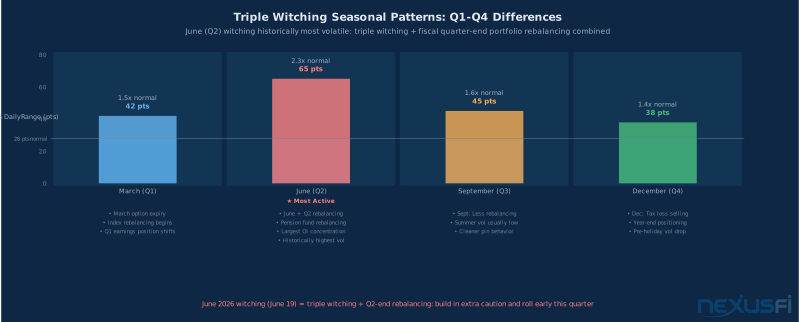
Note that the June witching also coincides with end-of-second-quarter rebalancing for equity portfolios. The combination of quarterly witching plus fiscal quarter-end rebalancing often makes Q2 witching the most volatile of the year. Institutional portfolios reallocating across asset classes, combined with the full expiration mechanics, creates additional uncertainty.
Common Mistakes Futures Traders Make #
Mistake 1: Trading the witching hour like a normal session. The final 60-90 minutes of expiration Friday follows rules that don't apply the other 248 trading days. What looks like a breakout is often a mechanical hedge flip. What looks like a breakdown is often an expiring position being forced to close. Reduce size or step aside.
Mistake 2: Ignoring the post-expiration setup. The Monday after triple witching is often one of the cleanest directional sessions of the quarter. The structural pin pressure, the gamma suppression, the hedging noise — all of it is gone. What remains is genuine supply/demand. Many traders spend energy on witching Friday and ignore Monday. That's backwards.
Mistake 3: Assuming high volume means good liquidity. Witching volume is high but it's concentrated in specific types of flow — rollers, hedgers, and institutional rebalancers. The depth behind the best bid/ask in the front-month contract deteriorates in the final two sessions before expiration. High volume ≠ tight spreads ≠ good fills.
Mistake 4: Rolling too late. (See also: Quadruple Witching in Futures Trading for the monthly vs. quarterly expiration breakdown.) This probably costs more money in aggregate than anything else on this list. Every additional day of delay toward expiration Friday means thinner book depth, wider spreads, and worse roll execution. The data from @SMCJB shows that volume transition to the back month is largely complete by Thursday of expiration week. Be done before then.
Mistake 5: Treating pin risk as optional information. If you're trading ES and you haven't checked where the dominant SPX open interest concentrations are, you don't know what you're trading against. Pin risk isn't theoretical — it's the reason your "perfect" breakout trade at 3:30 PM on expiration Friday failed despite all technical signals aligning. Check the OI data before witching Friday.
The Bottom Line #
Triple witching is the one quarterly event that turns futures markets into something at the core different from their normal selves. The difference isn't subtle — volume doubles, price action gets mechanical, and the normal toolkit becomes unreliable in specific windows.
The traders who profit around witching fall into two camps: those who simply reduce risk and let the noise pass (most effective for most traders), and those who understand the microstructure well enough to trade the gamma mechanics specifically (powerful but requires real options flow data and execution discipline).
The traders who lose are almost always in a third camp: those who trade witching Friday as if it's a normal high-volume day. It isn't. The volume is real but the motivation behind it has nothing to do with fundamental supply and demand. You're trading against institutions that are forced to transact by expiration mathematics, not conviction.
Roll early. Know your pin strikes. Respect the witching hour. Watch Monday for the clean setup once the mechanics clear.
The next one is June 19. You've got time to prepare. Use it.
Knowledge Map
Prerequisites
Understand these firstGo Deeper
Build on this knowledgeReferences This Article
Articles that build on this topicCitations
- — Spoo-nalysis ES e-mini futures S&P 500 (2022) 👍 12“The elephant in the room is JPM's Dec. 30 put collar spread. It has resulted in reducing volatility by creating synthetic hedges.”
- — Rollover Days - some Quick Facts about (2009) 👍 8“Rollover is 8 days before expiration. You should move to the next contract when the volume in the next contract eclipses the current contract.”
- — eMini & Micro volumes at rollover (2020) 👍 15“ESM0 100%, ESU0 93.5%, M0/U0 25.8%. The back-month captured 93.5% of the front-month volume during the transition.”
- — Pin Risk (2022) 👍 6“For futures (ES, NQ, etc.) there is pin risk. If you are caught in a vertical pinned between the short and long at expiry, you face early assignment risk.”
- — Zimmer's Day-Trading Journey (2020) 👍 9“High OI Strikes Exp 4/24/20: SPY: 200, 260, 280, 283 (order from highest OI to lowest). SPX: 2600, 2400, 2800, 2550.”
- — Spoo-nalysis ES e-mini futures S&P 500 (2020) 👍 18“If you want to know how options volume translates into actionable signals, you can look at a chart of May2850 Puts. Notice the spike in volume at key levels.”
- — Paps pre open prep (2017) 👍 11“In 2015, there was a very pronounced seasonality around the 3rd Friday of the month, where the market would ramp higher going into both quad-witching.”
- — Spoo-nalysis ES e-mini futures S&P 500 (2020) 👍 7“For those who haven't subscribed to SpotGamma yet, here is his Friday afternoon commentary -- the VIX decline inevitably pushed markets higher.”
- — @ES vs ESU20 price difference (2020) 👍 5“The ESU20 is no longer the front month. The front month contract rolled over to December (ESZ20) on Thursday, and the September contract will go out of existence on expiration.”
- — CME Group: E-mini S&P 500 Futures Contract Specifications
- — CME Group: Special Opening Quotation Settlement Procedures