



Quadruple Witching in Futures Trading: The Quarterly Expiration Window Every ES and NQ Trader Must Navigate
Overview #
Four times a year, the market puts on a show unlike any other. Quadruple witching — the simultaneous expiration of stock index futures, stock index options, individual equity options, and (historically) single stock futures — compresses into a single Friday what normally unfolds over weeks of gradual positioning adjustment. For ES and NQ futures traders, understanding what actually drives price on these days isn't optional. It's the difference between getting whipsawed out of clean trades by structural noise and positioning to capitalize on the mechanics everyone else is reacting to blindly.
The good news: quad witch days aren't random chaos. They follow predictable structural patterns driven by dealer hedging, gamma dynamics, and institutional rebalancing flows. Once you understand the mechanics, these sessions become readable — not as directional plays, but as microstructure events with specific risk windows, specific setup types, and a very clear playbook for what to adjust and why.
What Quadruple Witching Is (And Isn't) #
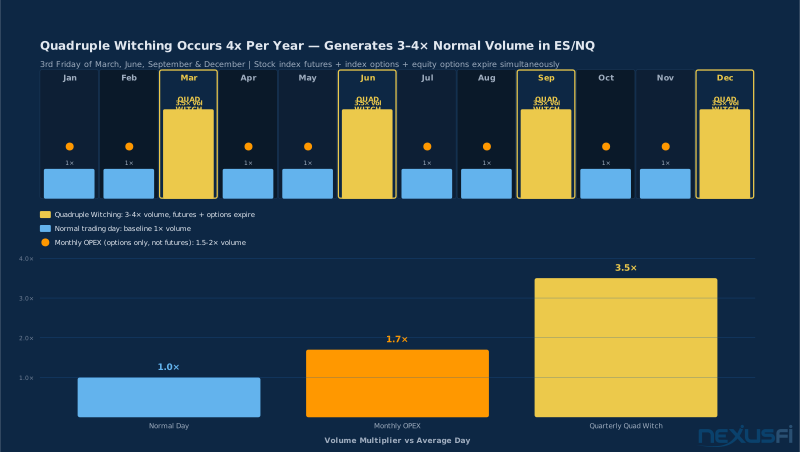
Quadruple witching occurs on the third Friday of March, June, September, and December. It's the confluence of four derivative contract expirations:
- Stock index futures — The quarterly ES, NQ, YM, and RTY contracts expire on these dates. Any trader holding a March ES contract must either roll to June or close by the third Friday of March.
- Stock index options — SPX, NDX, and other cash-settled index options expire, generating enormous hedging flows as market makers settle positions.
- Individual equity options — Monthly equity options on hundreds of stocks expire simultaneously, adding additional dealer hedging pressure across the market.
- Single stock futures — Technically still part of the "quadruple" classification, but U.S. single stock futures no longer trade meaningfully. The event is functionally a triple witch despite the legacy name.
What quad witch is not: it's not a directional indicator. Historical analysis across quad witch sessions since 2000 shows no consistent upward or downward bias. The event is a microstructure event — one that creates predictable structural patterns in volume, volatility, and price behavior without telegraphing direction. Traders who try to trade quad witch as a directional setup ("the market always rallies into quad witch") are trading noise, not signal.
The edge comes from understanding where dealers are positioned, which strikes carry the most open interest, and how mechanical hedging flows affect the session.
The Mechanics: Why Price Behaves Differently #
Gamma Exposure and Dealer Hedging #
The core driver of quad witch price action is gamma exposure — specifically, how dealers who've sold options must hedge their resulting delta exposure as those options approach expiration.
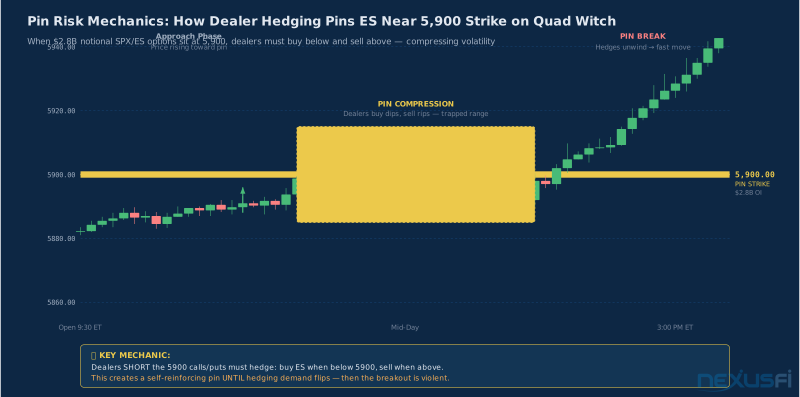
When a dealer sells a call or put to a buyer (typically an institutional investor buying protection), the dealer has an options position with significant gamma. Gamma measures how quickly delta — the option's sensitivity to price moves — changes as the underlying price changes. A dealer short a 5,900 ES call who needs to remain delta-neutral must sell ES when price rises toward 5,900 and buy ES when price falls away from 5,900.
This creates a feedback loop: when price approaches a strike with large open interest, dealer hedging activity pushes price back toward that level. The strike acts like a gravitational center. This is pin risk.
The pin effect works like this: Imagine $2.8 billion in notional open interest concentrated at the 5,900 ES strike. Dealers short those options are continuously adjusting their hedge. Price rises to 5,903? Dealers sell ES. Price drops to 5,897? Dealers buy ES. The result is a compressed trading range centered around the dominant OI strike — the "pin."
But pins don't hold forever. When the gamma position rolls off as expiration approaches, or when a large enough order breaks the pin's equilibrium, the sudden removal of that hedging support can produce a fast, violent move. Traders positioned for the pin breakout — rather than the pin itself — often see the most cleanly executable trades of the day.
SPX 0DTE Amplification #
Modern quad witch days have a new wrinkle that older historical studies miss: 0DTE (zero days to expiration) SPX options. These daily-expiring options have become the most actively traded instruments in the options market, and on quad witch Fridays, they pile gamma concentration on top of the existing quarterly expiration dynamics.
The compound effect is significant. You're not just dealing with quarterly gamma hedging — you're simultaneously dealing with the most gamma-sensitive instruments in the market (0DTE SPX calls and puts) settling on the same day. This is why modern quad witch days tend to produce sharper intraday regime changes than historical data from the pre-0DTE era would predict.
The practical implication: the final hours of a quad witch session are more volatile than pre-0DTE historical averages would suggest. The 3:00--4:00pm ET danger window has widened and intensified.
Reading the Gamma Exposure Map #
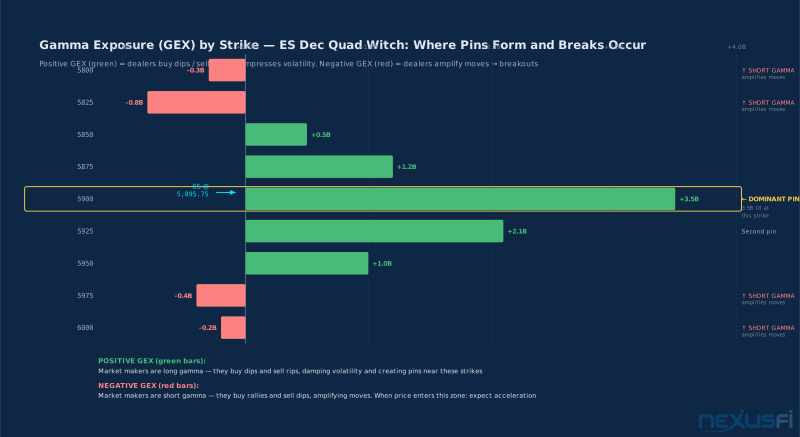
Professional traders and institutional desks that trade around quad witch use gamma exposure (GEX) data to identify where pins are likely to form and where breaks are likely to accelerate. GEX is the aggregate gamma of all outstanding options at each strike, signed by dealer position.
Positive GEX (dealers long gamma) means dealers buy dips and sell rallies. Price compresses toward these strikes. High positive GEX zones are pin candidates.
Negative GEX (dealers short gamma) means dealers buy rallies and sell dips — the opposite. Moves into negative GEX territory tend to accelerate rather than dampen. When the dominant OI strike cluster sits in negative GEX, you should not expect pinning behavior. Expect amplification.
On a typical ES quad witch session:
- The dominant positive GEX strikes (the pins) are usually at round numbers — 5,900, 5,925, 5,950
- Below the lowest positive GEX cluster, there's often a zone of negative GEX where momentum trades have more follow-through
- The transition from positive to negative GEX is where the "pin escape" trades form
You don't need a Bloomberg terminal to access this data. SpotGamma, GEX Metric, and SqueezeMetrics all publish GEX data in accessible formats. Building the habit of checking GEX before quad witch sessions — and mapping dominant positive GEX levels onto your chart — gives you a structural edge that most retail traders skip entirely. See Options Flow Analysis and GEX.
Intraday Volume Distribution and Time-Based Risk #
Quad witch sessions follow a distinctive volume pattern that differs from normal days — and the differences have direct trading implications.
The Opening Surge (9:30--10:30am ET) #
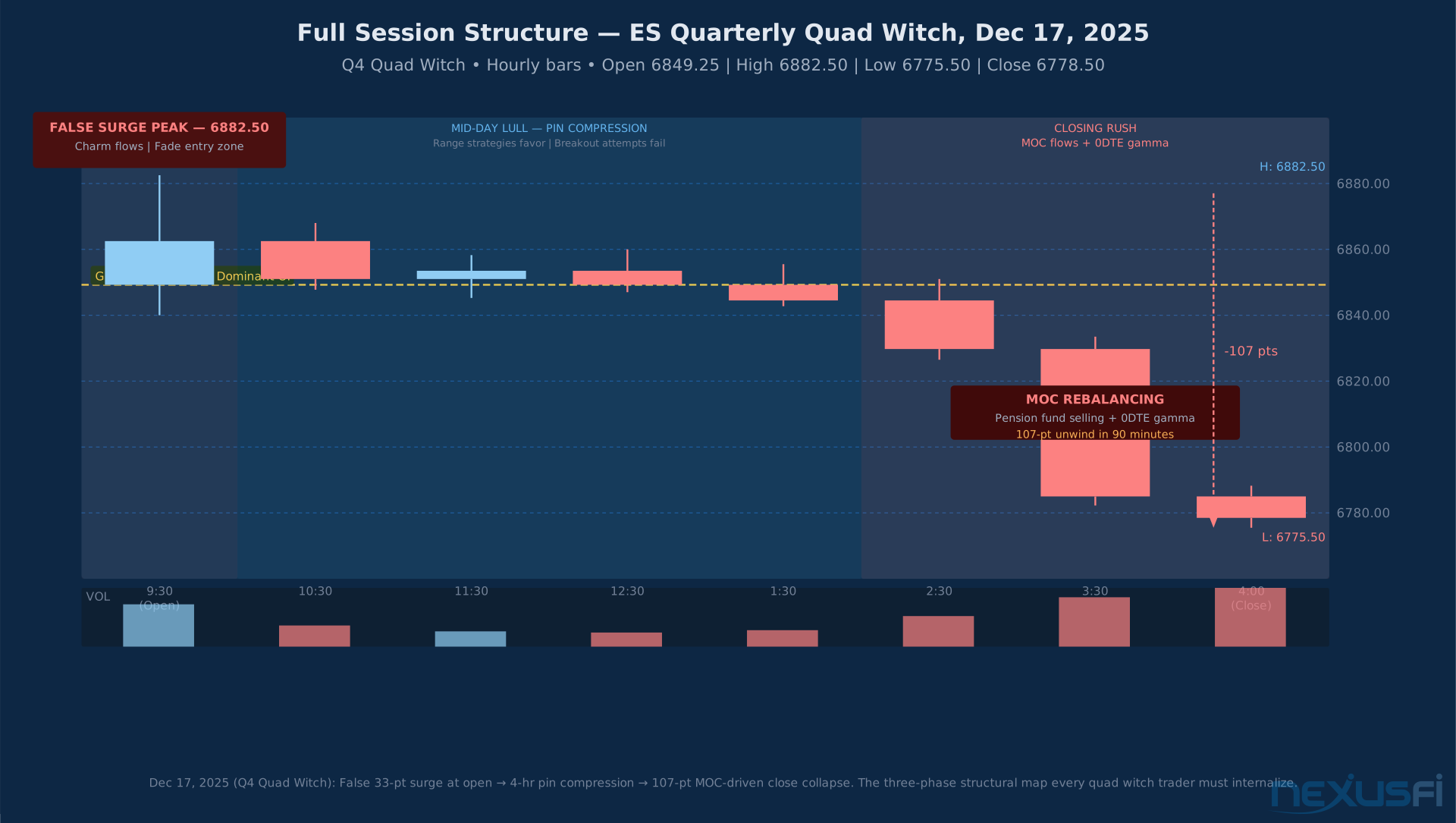
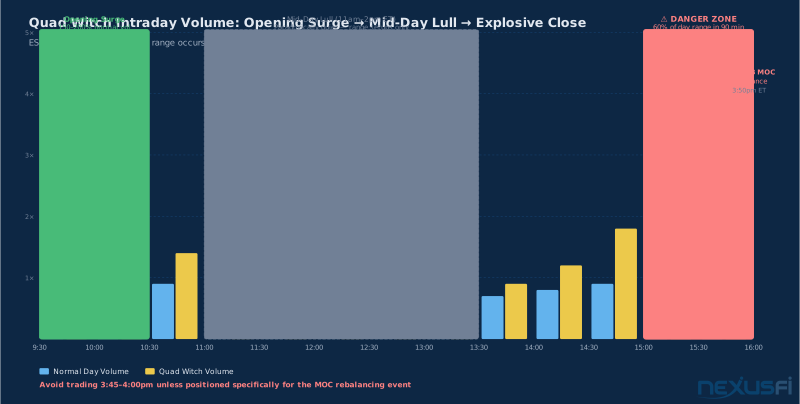
The first 30--60 minutes of a quad witch session often see 150--200% of normal opening volume. This is driven by traders establishing positions relative to key GEX strikes, roll activity continuing from the prior day, and overnight positioning getting unwound at the open.
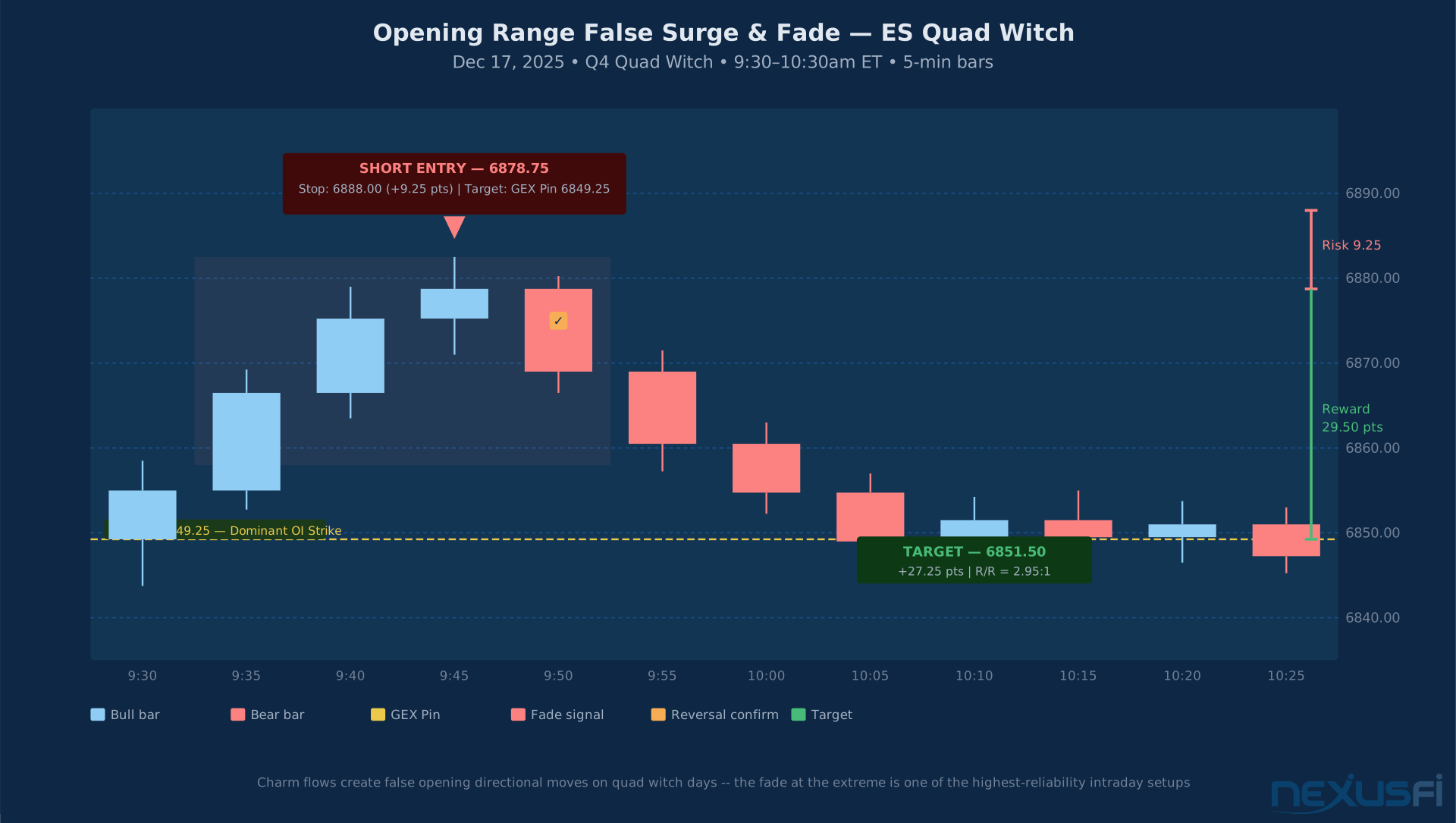
The opening surge frequently produces false directional moves. "Charm flows" — the daily decay of delta in existing options — often create early momentum that reverses by mid-morning. This is why fade setups (mean-reversion trades against extreme opening moves) have higher reliability on quad witch days than on normal sessions. The first 20 minutes of aggressive directional movement should be treated with skepticism until structure confirms.
The Mid-Day Lull (11:00am--2:00pm ET) #
After the opening activity subsides, quad witch sessions often go paradoxically quiet. Volume drops below normal levels, ranges compress, and the market develops a tight auction structure around dominant OI strikes.
This is the pin compression phase. For range-bound traders, it can be productive. For breakout traders accustomed to using this period to establish momentum positions, it's a trap. Range breakouts initiated during the mid-day lull on quad witch days fail at a much higher rate than on normal sessions.
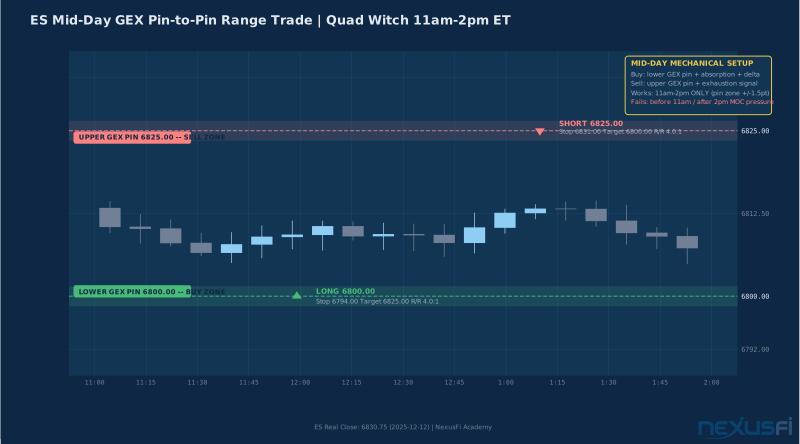
This mid-day lull is often the best window for range-based strategies — trading between key GEX levels rather than attempting to predict the breakout.
The Closing Rush (2:00--4:00pm ET) #
The final 90 minutes of a quad witch session contain approximately 60% of the day's total price range. This is where volume surges back, gamma hedging becomes most acute, and the major moves occur.
The dynamics driving this closing rush:
- Options expiration pressure: As expiration approaches, near-the-money options go from having significant time value to being binary — worthless or in-the-money. The gamma spikes dramatically in the final hour.
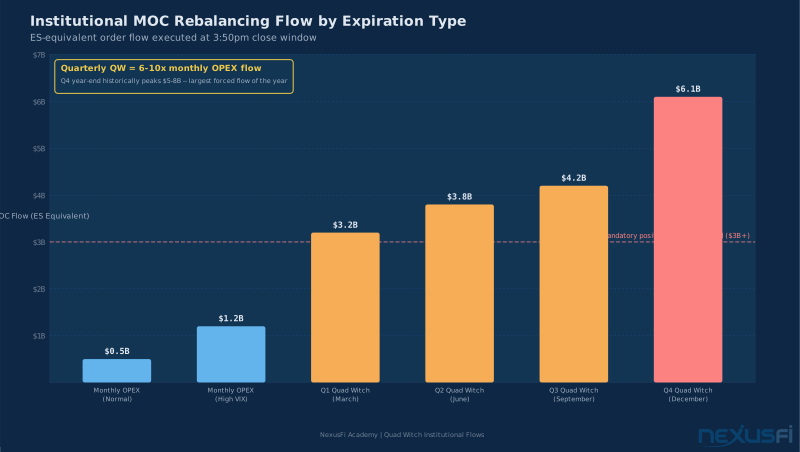
- MOC (market-on-close) rebalancing: Pension funds and large ETFs execute quarter-end portfolio rebalancing through MOC orders. The NYSE publishes MOC imbalances around 3:45pm ET. Imbalances of $3--5 billion in ES equivalent are not uncommon on quarterly quad witch days.
- Position closing: Traders holding near-the-money positions must decide to roll or close before expiration. This creates forced buying and selling pressure.
The 3:45--4:00pm ET window is the highest-risk period. Experienced traders reduce exposure ahead of MOC publication and re-enter after the initial imbalance settles. For most retail traders, not trading this window is the correct default posture.
The 3:45--4:00pm ET window on quarterly quad witch days is a genuine account risk. The MOC imbalance — which can represent $3--5 billion in forced buying or selling — executes in seconds. Without the published imbalance data, holding a leveraged ES or NQ position into this window means you are trading against institutional flow with no warning. Default posture: reduce to half-size before 3:45pm on quarterly quad witch days. Only traders who have the published MOC imbalance and are already positioned in the right direction should stay full-size.
Institutional Rebalancing Flows #
Quarter-end brings concentrated institutional activity that compounds the options expiration effects. On quarterly quad witch days, you're dealing with gamma dynamics and institutional rebalancing simultaneously.
What Institutional Rebalancing Means in Practice #
Large pension funds and balanced mutual funds run target-weight allocations between asset classes. As the quarter ends, equity allocations have either grown (if markets ran up) or shrunk (if they fell) relative to bonds. To restore target weights, they sell equities if stocks outperformed, or buy if stocks underperformed.
This rebalancing flow executes almost entirely through MOC orders in the final minutes of the quarter-end session. The magnitude depends on how far equities moved relative to bonds during the quarter. After a strong equity quarter, the rebalancing selling pressure can be significant.
The ETF Arbitrage Effect #
ETF creation/redemption mechanics add another layer. When large ETFs rebalance their baskets for index changes or quarter-end flows, authorized participants trade ES futures as part of the hedge, creating coordinated buying or selling pressure that can move ES much in a short window.
How to Use This Information #
The practical application isn't to predict direction from rebalancing flows (that's a fool's errand without institutional-level data). It's to respect the risk:
- Position sizes should be reduced ahead of the 3:45--3:50pm window
- Stop distances should account for potential 10--15 point ES spikes in either direction
- If the MOC imbalance is published and confirms your directional bias, the trade can be taken — but only with appropriate sizing for the volatility
This principle applies nowhere more directly than on quad witch days.
The Trading Playbook: What to Adjust and Why #
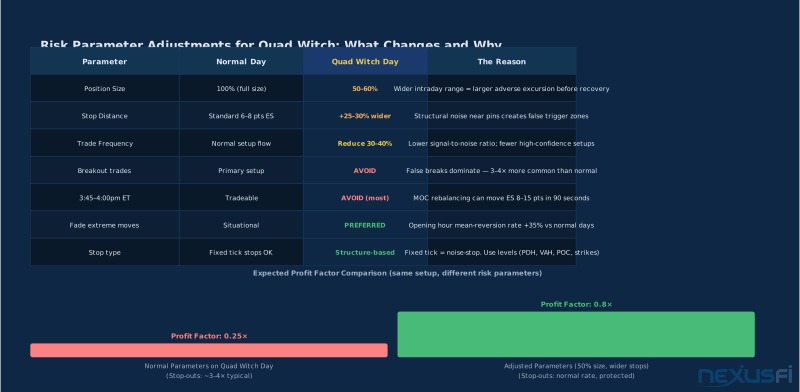
Quad witch requires specific adaptations to normal trading parameters. Using normal-day parameters on a quad witch session produces 2--3× more stop-outs from structural noise before the real moves occur. Here's what to change and the mechanical reason why.
Position Sizing: Cut to 50--60% of Normal #
The intraday range on quad witch days runs 15--25% wider than average sessions. If your normal stop distance is 8 ES points, you're effectively risking the same dollar amount — but the price excursions against you before recovery are larger. Either widen your stop (accepting more risk per trade) or cut size while keeping your stop (maintaining the same dollar risk with fewer trades). The latter is usually correct.
Reducing to 50--60% of normal size means you can hold through the noise without being stopped out repeatedly. It also means you're not chasing losses if the early session goes against you.
Pre-commit to 50% position size before the quad witch session opens — not after you get stopped out twice. The wider range is structural and does not improve mid-session. Setting size at the start prevents the common pattern of escalating position size while trying to recover early losses, which is exactly when quad witch volatility destroys accounts. Your journal entry the night before should read: "Tomorrow is quad witch. Max size = 50% of normal."
Stop Distance: Widen 25--30% or Switch to Structure-Based #
Fixed-tick stops work on normal days because the noise around your entry is normally distributed within a predictable range. On quad witch, the pin zones and dealer hedging activity create structured bounces that can temporarily breach your fixed stop before returning to your expected path.
The better approach: use structural levels as stops rather than fixed tick distances. If you're long above the 5,900 GEX pin level, your stop isn't "8 ticks below entry" — it's "below the developing value area low" or "below the prior session's low." Structural stops naturally account for the wider noise characteristic of witching days.
Setups to Prioritize #
1. Opening Range Fade (9:30--10:00am)
The opening surge on quad witch days frequently produces false directional moves driven by charm flows and overnight positioning unwinding. When the first 30 minutes produce an extreme move (>150% of average opening range), the fade setup has much elevated reliability. Entry triggers: rejection of the initial extreme, recovery of the prior session's reference levels, or a failed breakout attempt at the opening range extreme.
2. Strike-to-Strike Range Trading (Mid-Day)
During the 11am--2pm lull, identify the two dominant GEX positive levels and trade the range between them. This is mechanical: buy at the lower pin level when you see absorption and delta confirmation, sell at the upper pin level when you see the same. The mid-day lull is the window where this works; don't try to force it outside this time window.
3. Pin Break / Escape Trade
This is the highest-probability setup of the entire quad witch day, but it requires patience to set up correctly. The sequence:
- Price pins near a dominant GEX strike for extended period (1+ hours)
- A structural trigger (often related to MOC flow or news) breaks price out of the pin range
- Price retests the former pin level from the other side
- The retest holds, confirming the escape
This setup has high reliability because you're trading after structural confirmation rather than predicting which direction the pin breaks. The risk/reward is often 3:1 or better because your stop can be placed just inside the former pin zone.
4. Post-Expiration Momentum (Monday Following)
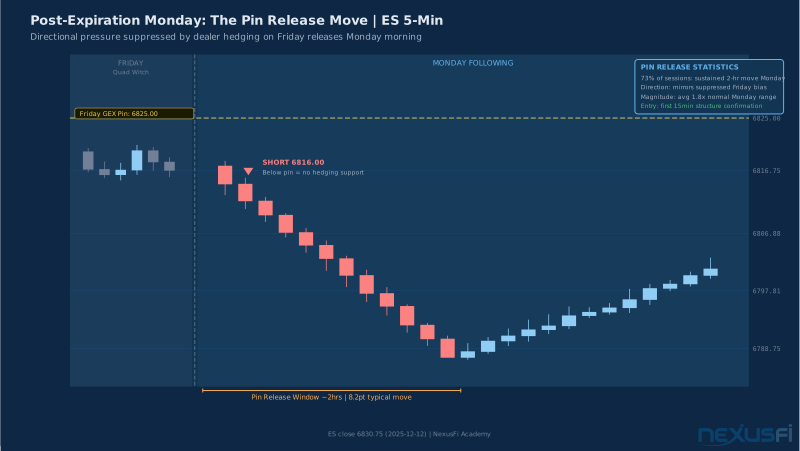
This isn't a quad witch day trade — it's the day after. When gamma support collapses at Friday's close, Monday often sees a significant directional move as suppressed pressure expresses in the first 1--2 hours. Monitor this window.
Setups to Avoid #
Breakout trades during mid-day lull: The single most common quad witch mistake among retail traders. The compressed mid-day range looks like a coiling setup. It often is — but the timing of the breakout is structural (driven by MOC imbalances), not technical. Initiating a breakout position 2 hours before the structural trigger creates a waiting period filled with false signals.
Directional bias trades without GEX context: Trading quad witch as a "strong market day = follow momentum" or "sell the rally" framework ignores the primary driver. The structural pin levels matter more than technical setup patterns on these sessions.
New entries into the 3:45--4:00pm window: Unless you're specifically positioned to trade the MOC imbalance with appropriate sizing, new entries in the final 15 minutes are speculative rather than strategic. The move is driven by institutional flow, not your setup.
Quarterly Quad Witch vs. Monthly OPEX #
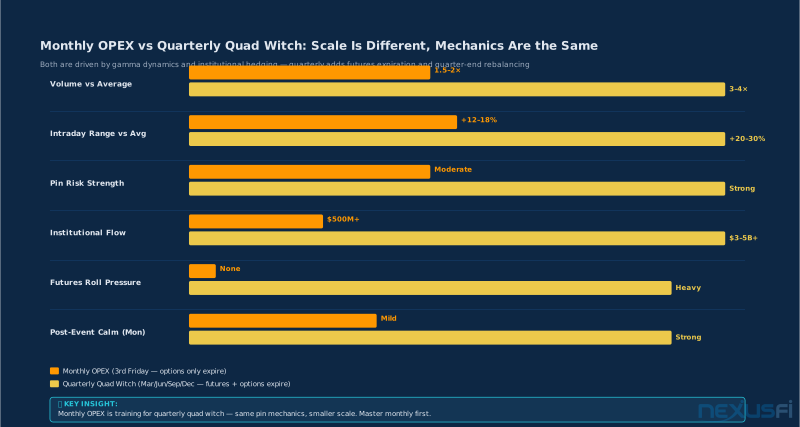
Not every third Friday is a quarterly quad witch day. In January, February, April, May, July, August, October, and November, the third Friday is a monthly OPEX (options expiration) day — where individual equity and index options expire but futures do not. The pin risk mechanics work the same way, but at smaller scale.
Understanding the distinction matters for calibrating your expectations:
| Dimension | Monthly OPEX | Quarterly Quad Witch |
|---|---|---|
| Volume vs. average | 1.5--2× | 3--4× |
| Intraday range | +12--18% wider | +20--30% wider |
| Pin risk | Present but moderate | Strong to very strong |
| Institutional flow | $500M+ | $3--5B+ |
| Futures roll pressure | None | Heavy (contract migration) |
| Post-event Monday calm | Mild | Often significant |
Monthly OPEX days still warrant adjusted parameters — especially during high-volatility market regimes or when the dominant OI strike sits close to current price. But the scaling is different. A monthly OPEX might justify reducing size by 20--25% and widening stops slightly. A quarterly quad witch justifies the full 40--50% size reduction.
The pattern isn't always consistent across market regimes, but the structural flow dynamics are always present.
Monthly OPEX gives you eight lower-stakes practice sessions per year to develop GEX literacy before the four high-intensity quarterly events.
How to Prepare for a Quad Witch Session #
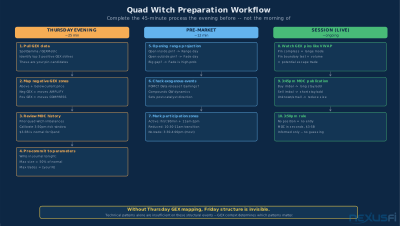
Proper quad witch preparation happens the day before, not the morning of.
Thursday Evening Preparation #
Identify dominant GEX strikes: Using SpotGamma, GEX Metric, or similar services, identify the three largest positive GEX concentrations near current price. These are your pin candidates for the following day. Mark them on your chart as horizontal reference lines.
Map the negative GEX zones: Find where GEX turns negative above and below current price. These are the "escape velocity" zones where moves accelerate. Knowing these levels lets you correctly characterize whether a given move will dampen or amplify.
Check the MOC imbalance history: Review recent quad witch sessions to understand the typical magnitude of imbalances at close. This calibrates your expectations for how violent the 3:50pm window can be.
Reduce your planned trade count: Pre-commit to a maximum number of trades for the session — typically 50--60% of your normal quota. Fewer, more selective trades on quad witch days outperform normal-frequency trading.
Pre-Market Preparation #
Opening range projection: Based on overnight range and pre-market activity, estimate whether the session will open inside or outside the dominant GEX pin zone. An open inside the pin zone favors range strategies. An open outside (especially if there's significant gap) often favors the fade.
Check if there's a FOMC meeting, economic release, or major news that day: Exogenous catalysts compound the quad witch dynamics and can break pins that would otherwise hold. In these cases, the structural framework still applies, but the direction of the break is less structural and more news-driven.
Set your participation zones: Define your three zones for the session:
- Active trading zone (high-confidence setups only): first 90 minutes, and 11am--2pm if pin structures are clear
- Reduced activity zone (only high-conviction setups): 10:30am--11am transition
- No-trade zone (structural caution): 3:30--4:00pm ET for most traders
During the Session #
Watch the dominant GEX levels the way you normally watch VWAP or POC. When price is compressing into a pin, you're in range mode. When price begins to test the outer boundary of the pin zone with increasing volume and delta, you're approaching a potential escape. Wait for structural confirmation (level acceptance or rejection) rather than anticipating.
Track the published MOC imbalance when it comes out around 3:45pm. A large buy imbalance in an uptrend doesn't just confirm direction — it telegraphs the magnitude of the forced buying. In clear directional setups, being positioned before the MOC print and riding the institutional flow to the close can be the session's best trade. But it requires being already positioned, not entering into the surge.
What Breaks Traders on Quad Witch Days #
Treating it like a normal day: Using normal stop distances, position sizes, and setup selection on a quad witch session creates consistent underperformance — systematic erosion. Every stop-out before a recovery, every false breakout, every time the market moves 20 points at 3:55pm in the wrong direction — these add up.
Over-leveraging due to "elevated opportunity": The volatile moves look like outsized profit opportunities. They are — for traders who understand the structural drivers. For everyone else, they're outsized trap opportunities. More volatility with normal position sizing means larger adverse excursions. The path goes against you harder before it comes back.
Holding through the 3:50pm window uninformed: The MOC imbalance can move ES 8--15 points in 90 seconds. Without knowing whether the imbalance is buy-side or sell-side, holding a leveraged position into this window is basically guessing. Professional traders who hold into this window do so because they have the imbalance data and have sized so. Retail traders without this information are better served by reducing to half-size before 3:45pm and adding back after the initial imbalance reaction settles.
Ignoring the post-expiration Monday: The structural support provided by dealer hedging disappears at Friday's close. The Monday following a quarterly quad witch often sees the suppressed directional pressure express itself. Traders who correctly identify this direction often find Monday more cleanly executable than the quad witch session itself.
Quad Witch Dates for 2026 #
For your calendar:
- March 20, 2026 — Q1 Quad Witch
- June 19, 2026 — Q2 Quad Witch
- September 18, 2026 — Q3 Quad Witch
- December 18, 2026 — Q4 Quad Witch
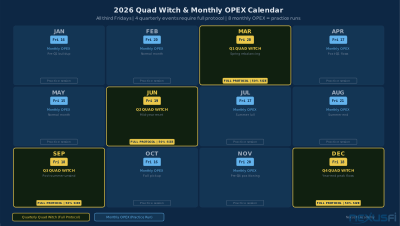
Monthly OPEX occurs on the other 8 third Fridays. Use these sessions to practice GEX reading and the structural framework at lower intensity.
Key Takeaways #
- Understand price drivers: Gamma hedging and institutional rebalancing drive price — not news or technical momentum. Read GEX, not just chart patterns.
- Respect the time structure: Opening surge (fade), mid-day lull (range), closing rush (reduce exposure). Each window requires a different approach.
- Size down: 50--60% of normal position size on quarterly quad witch. The wider ranges punish normal sizing.
- Target pin-based setups: Range-within-GEX during the lull and pin-break with retest confirmation near close are the highest-probability trades.
- Train on monthly OPEX: Eight practice sessions per year at lower intensity to build GEX literacy before quarterly events.
Quad witch days are about reading structure, not predicting direction. Prepare properly and the edge is there.
Knowledge Map
Prerequisites
Understand these firstGo Deeper
Build on this knowledgeReferences This Article
Articles that build on this topicCitations
- — Paps pre open prep (2017) 👍 8“In 2015, there was a very pronounced seasonality around the 3rd Friday of the month, where the market would ramp higher going into both quad-witch options expiration, and non-quarterly expiration, and then mean revert lower post expiration.”
- — Spoo-nalysis ES e-mini futures S&P 500 (2020) 👍 23“The last two monthly expirations have seen turning points the Monday following OPEX, and considering we are at/near zero gamma the stage is set for a turn.”
- — Spoo-nalysis ES e-mini futures S&P 500 (2020) 👍 16“The VIX decline inevitably pushed markets higher into the close. We have an interesting setup next week into Monthly OPEX with large puts and calls at 2800, 2900 and 3000.”
- — A Cowboy's Trading Journal (2016) 👍 5“To compensate for the additional risk of being stopped out, you could move your stops out further. Of course once your stops are further away, you need to scale back your size.”
- — Trading Futures with Context (2014) 👍 7“Nice attempts at equilibrium going into Opex on Friday. January Opex is one of the few expiration weeks with bearish tendencies.”
- — Spoo-nalysis ES e-mini futures S&P 500 (2022) 👍 12“The chart is accurate and GEX or gamma exposure (represented by the orange line) is 261,538,294. Which means the market flipped from negative gamma to positive gamma.”
- — Spoo-nalysis ES e-mini futures S&P 500 (2020) 👍 19“If you want to see how options volume translates into actionable signals, look at a chart of May2850 Puts. A spike in put buying left the dealer short puts, having to sell futures to hedge -- it led to a ~15 point selloff in /ES.”
- — Spoo-nalysis ES e-mini futures S&P 500 (2020) 👍 18“Eventually and often around expiration there will be tremendous pressure around high gamma (read open interest) strikes. The only way becomes hit or take stock.”
- — Spoo-nalysis ES e-mini futures S&P 500 (2021) 👍 12“There is a natural dealer flow from vanna and charm. The dealers know about where the index or stock will close, and they have the liquidity available to fill their orders.”
- — Spoo-nalysis ES e-mini futures S&P 500 (2022) 👍 5“Both the March OPEX and the August OPEX, which saw the market sell off after expiration, took place in a positive gamma (call weighted) environment. All the other expirations were in a negative gamma (put weighted) environment.”