



Futures Contract Rollover and Expiration: When, How, and What Can Go Wrong
Overview #
Every futures contract has an expiration date — and if you don't plan around it, the market plans for you. Rollover is the process of closing your position in an expiring contract and opening the same position in the next contract month. It sounds simple. For equity index futures, it mostly is. For physically delivered commodities, getting it wrong can mean delivery notices, forced liquidation, or trading a contract with no liquidity and erratic pricing.
This guide covers the mechanics of when and how to roll across every major asset class, the critical difference between first notice day and last trading day, and how continuous contract construction affects your technical analysis. If you trade futures, rollover is infrastructure — you need to understand it the same way you understand margin or session hours.
Contract Month Codes and Expiration Cycles #
Every futures contract carries a standardized month code:
| Code | Month | Code | Month | Code | Month | Code | Month |
|---|---|---|---|---|---|---|---|
| F | January | H | March | K | May | N | July |
| G | February | J | April | M | June | Q | August |
| U | September | ||||||
| V | October | ||||||
| X | November | ||||||
| Z | December |
ESH6 = E-mini S&P 500, March 2026. CLK6 = Crude Oil, May 2026. ZNM6 = 10-Year Treasury Note, June 2026.
Not every contract month is active for every product. Equity index futures trade quarterly (H, M, U, Z). Crude oil trades every month. Treasury futures trade quarterly. Gold trades February, April, June, August, October, December — though not all months are liquid. As @Fat Tails noted when discussing gold rollover, "the October contract is illiquid" and using it for back-adjustment "results in a false offset." [1]
Rollover vs. Expiration -- Two Different Dates #
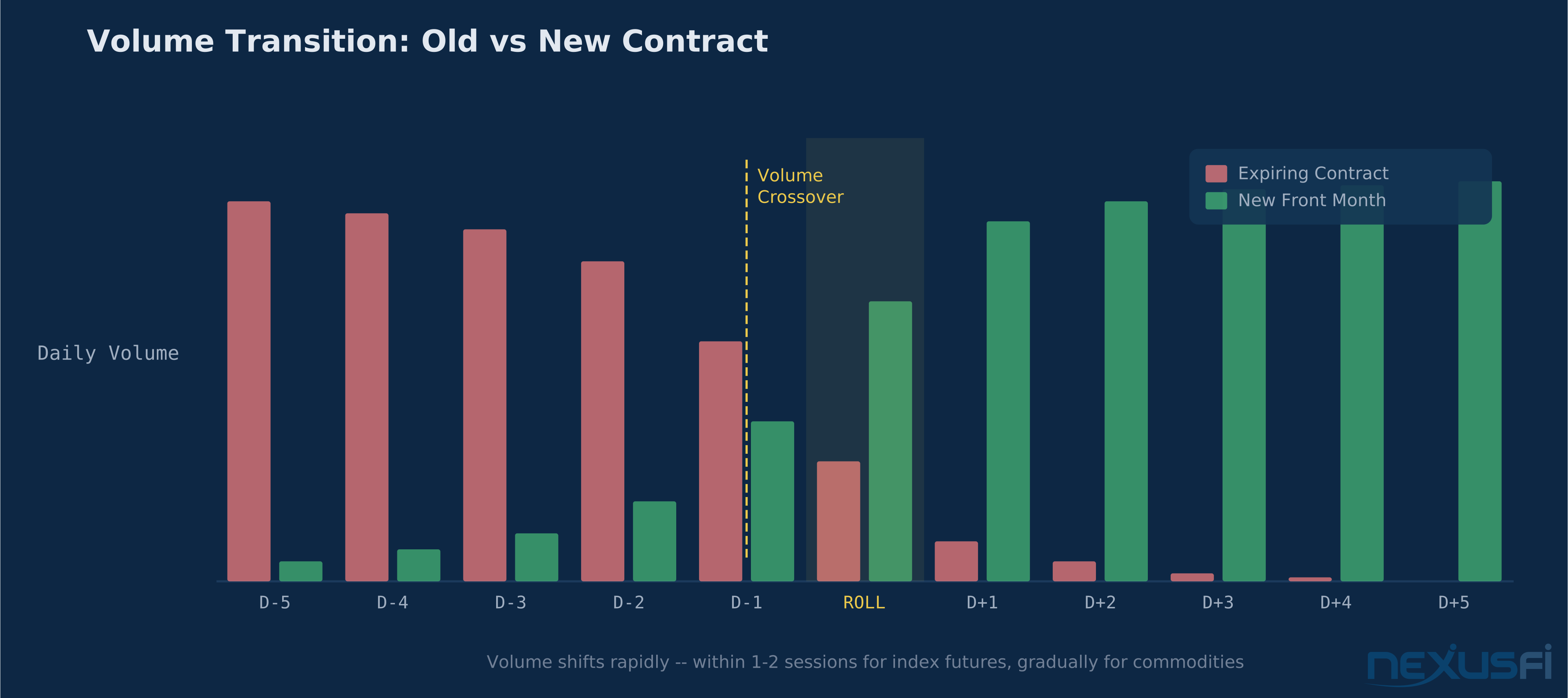
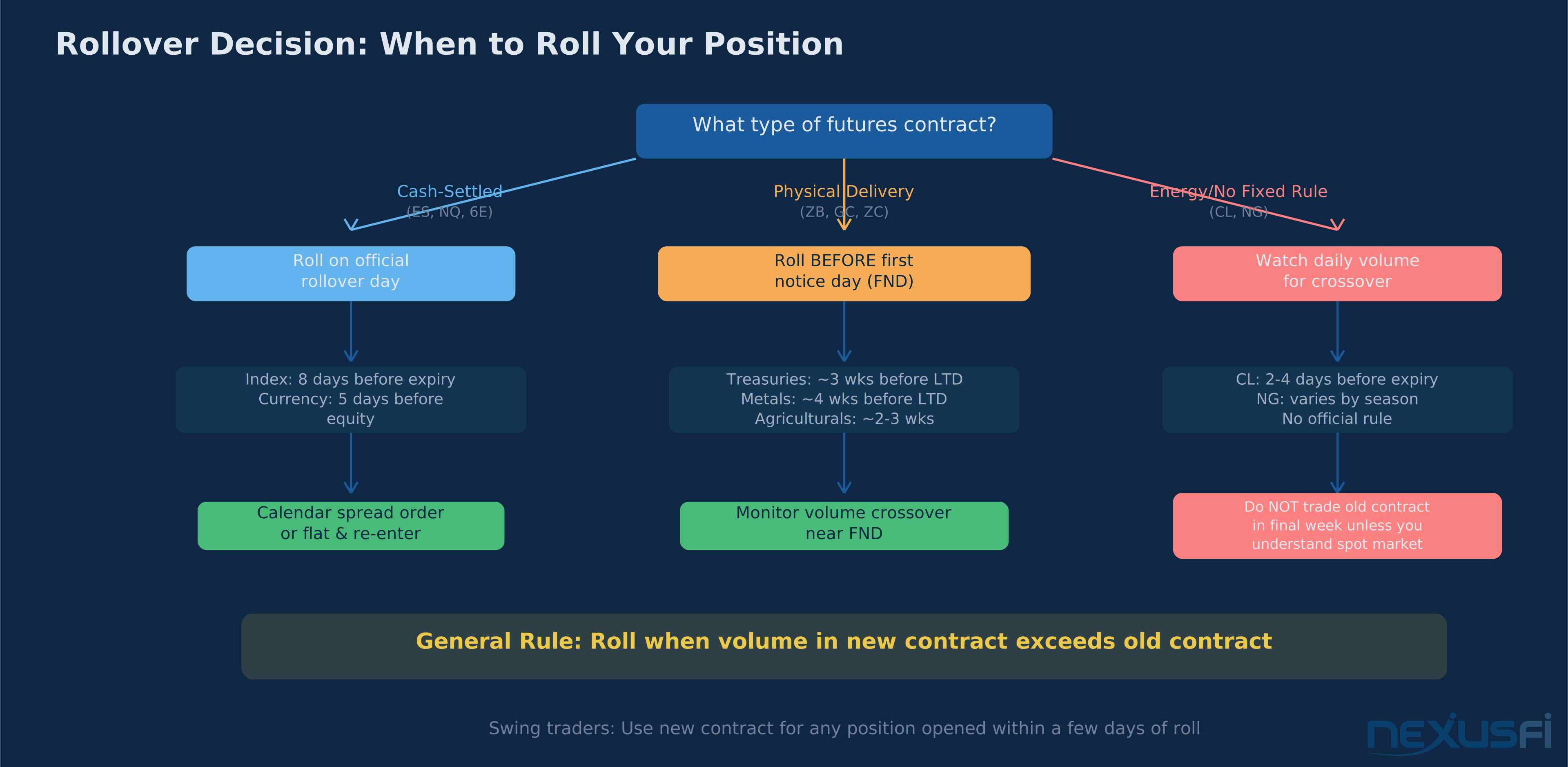
Rollover day and expiration day are not the same thing. Expiration is the exchange-defined last trading day. Rollover is the day when volume shifts to the next contract month — and that's when you want to move.
The distinction matters because liquidity drives execution quality. On the day after rollover, the old contract still exists but spreads widen, depth thins, and fills deteriorate. As @max-td summarized it: "Volume shifts to the new contract at market open on Rollover day. New day trading or swing trading positions opened on rollover day should use the new contract month irrespective of when you plan to close it." [2]
Rollover Dates by Asset Class #
Equity Index Futures (ES, NQ, YM, RTY) #
These are the most predictable. The rules, as documented by the NexusFi community: [2]
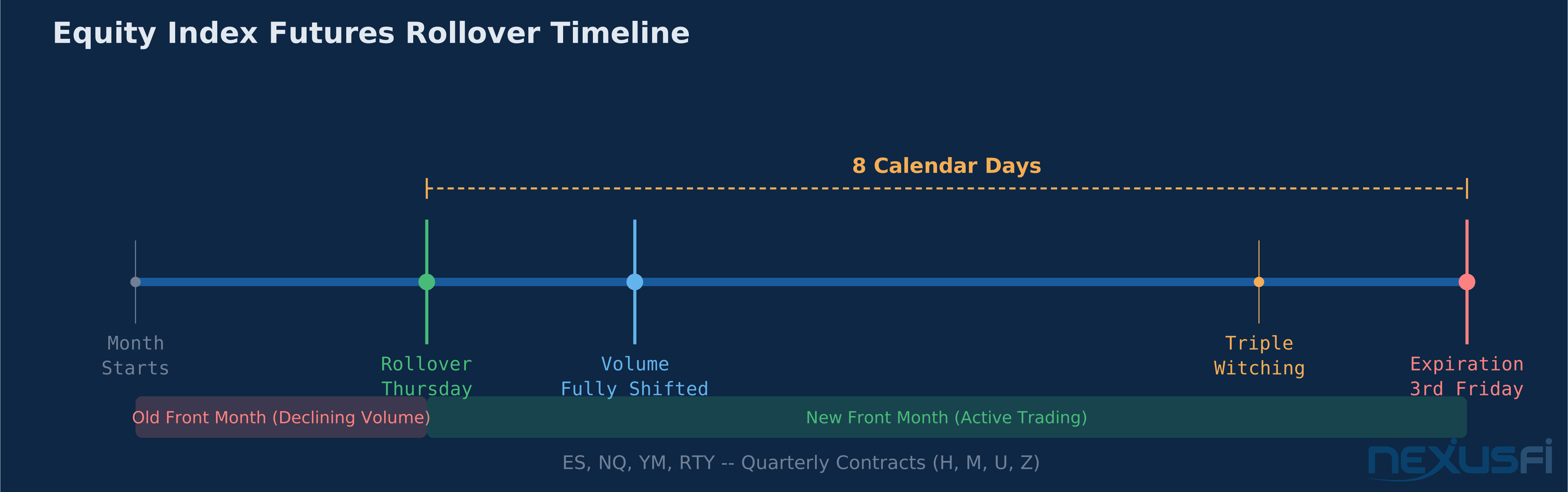
- Expiration: Third Friday of each quarter month (March, June, September, December)
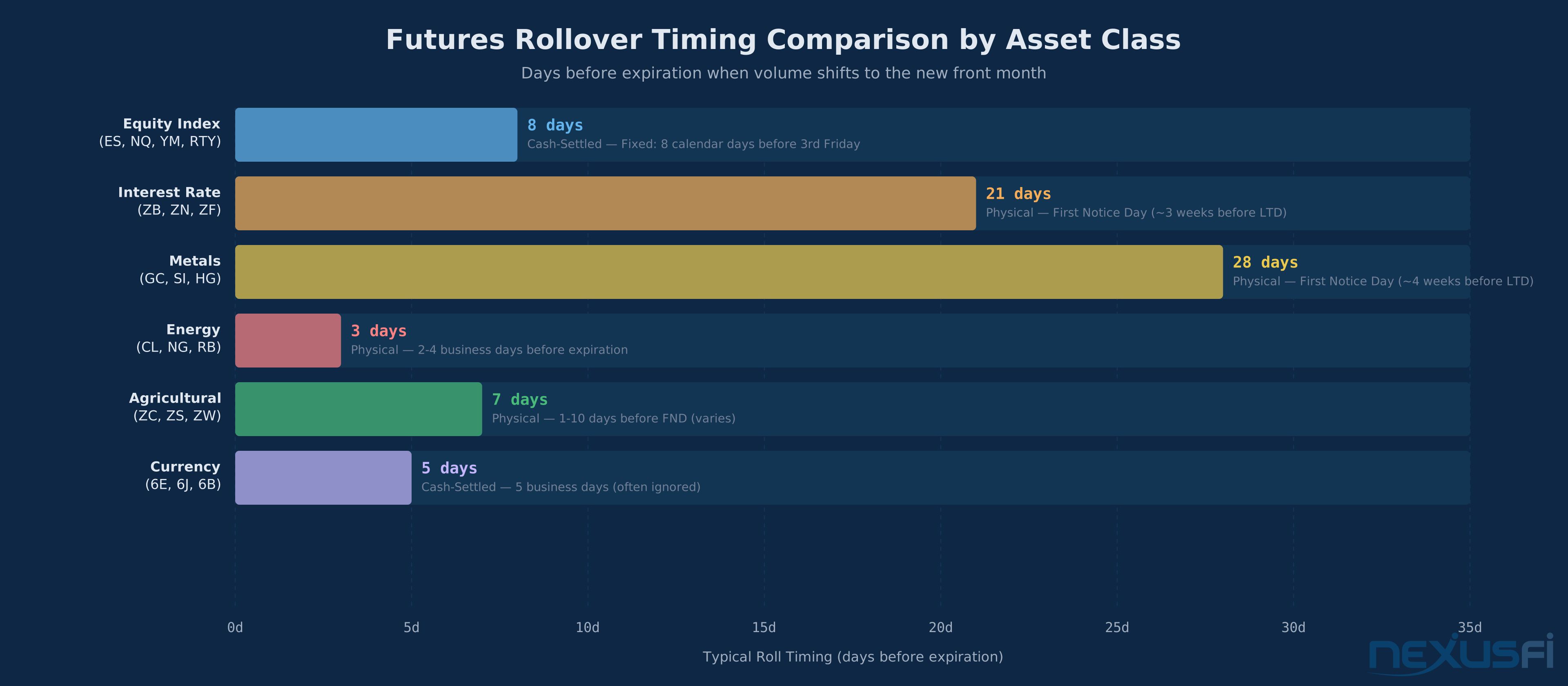
- Rollover: 8 calendar days before expiration — always a Thursday
- Rule of thumb: Usually the second Thursday of the month, but the first Thursday if the month starts on a Friday
- Volume shift: Nearly complete at the Globex open on rollover day
This is straightforward because CME publishes official equity index roll dates [11] and basically all participants follow them. Data vendors, brokers, and chart platforms all switch on the same day. As @Fat Tails observed, "most of the data vendors roll index futures on Wednesday evening" of the week preceding rollover Thursday, meaning the Thursday session opens on the new contract. [3]
Interest Rate Futures (ZB, ZN, ZF, ZT) #
Interest rate futures follow first notice day, not a fixed rollover calendar.
- Rollover: First notice day, typically the last business day of the month preceding the contract month
- Expiration: About 3 weeks after first notice day
- Volume shift: Occurs on first notice day
Treasury futures are physically delivered — the short delivers actual Treasury securities. If you hold a long position past first notice day, you can be assigned delivery. Most brokers force-close positions before this happens, but you don't want to rely on that safety net.
Energy Futures (CL, NG, RB, HO) #
Energy futures have no fixed rollover rules. Volume shifts based on market conditions, typically 2-4 business days before expiration.
Crude oil is the instructive example — the NYMEX WTI contract specifies physical delivery of light sweet crude at Cushing, Oklahoma, with detailed grade and quality requirements [12]. @Fat Tails gave a blunt assessment of the risks: "The real problem here is that CL futures are physically settled with delivery in Cushing, Oklahoma. This is a pipeline storage in the middle of nowhere... The old contract often shows an erratic behaviour. This may create an extremely high volatility in the old contract, as either shorts are squeezed or longs are pillaged." [1]
The September 2008 crude oil short squeeze is legendary — headlines reported a 16% single-day oil spike, but it was the expiring front month that moved from $104 to $130 intraday while the next month showed only a 6% increase. Traders caught in the old contract faced devastating moves driven by local Cushing delivery dynamics, not global oil prices. [1]
The practical rule for CL: Don't trade the old contract in the week prior to expiry unless you understand the physical spot market. For day traders, monitor volume daily during the transition period and switch when the new month consistently shows higher volume.
Metals Futures (GC, SI, HG) #
Metals follow a pattern similar to interest rate futures:
- Rollover: 1-2 days before first notice day
- First notice day: Usually the last business days of the month preceding the contract month
- Liquid months for gold: February, April, June, August, December (bi-monthly)
- Silver and copper: Also roll 1-2 days before first notice day
Agricultural Futures (ZC, ZS, ZW, CT, KC) #
Agriculturals are the trickiest to roll because each contract month may represent an entirely different crop year with different supply/demand dynamics.
"If you roll a contract to a new delivery month, this may be a different crop with entirely different conditions for supply and demand," @Fat Tails explained. "Agriculturals are perishable goods, and if they are stocked until the expiry of the contract, you may well have a different product." [5]
There are no precise rollover dates for agriculturals. Volume tends to shift to the new front month 1-10 days before first notice day. Monitor volume and open interest crossover rather than following a fixed calendar.
Currency Futures (6E, 6J, 6B) #
CME currency futures have published rollover dates but traders largely ignore them.
- Expiration: Second business day before the third Wednesday of the contract month
- Official roll: 5 business days before expiration
- Reality: Rollover dates "are completely ignored" by many participants, as @Fat Tails documented [3]
Currency futures are cash-settled, so there's no delivery risk. The rollover gap is typically tiny — just a few pips — making the exact roll date far less important than for commodities.
First Notice Day vs. Last Trading Day #
This distinction has cost traders real money. Understanding it is non-negotiable for anyone holding overnight positions.
Last Trading Day (LTD): The final day the contract trades on the exchange. After this, the contract ceases to exist. This applies to every futures contract, including cash-settled ones like ES and 6E. [6]
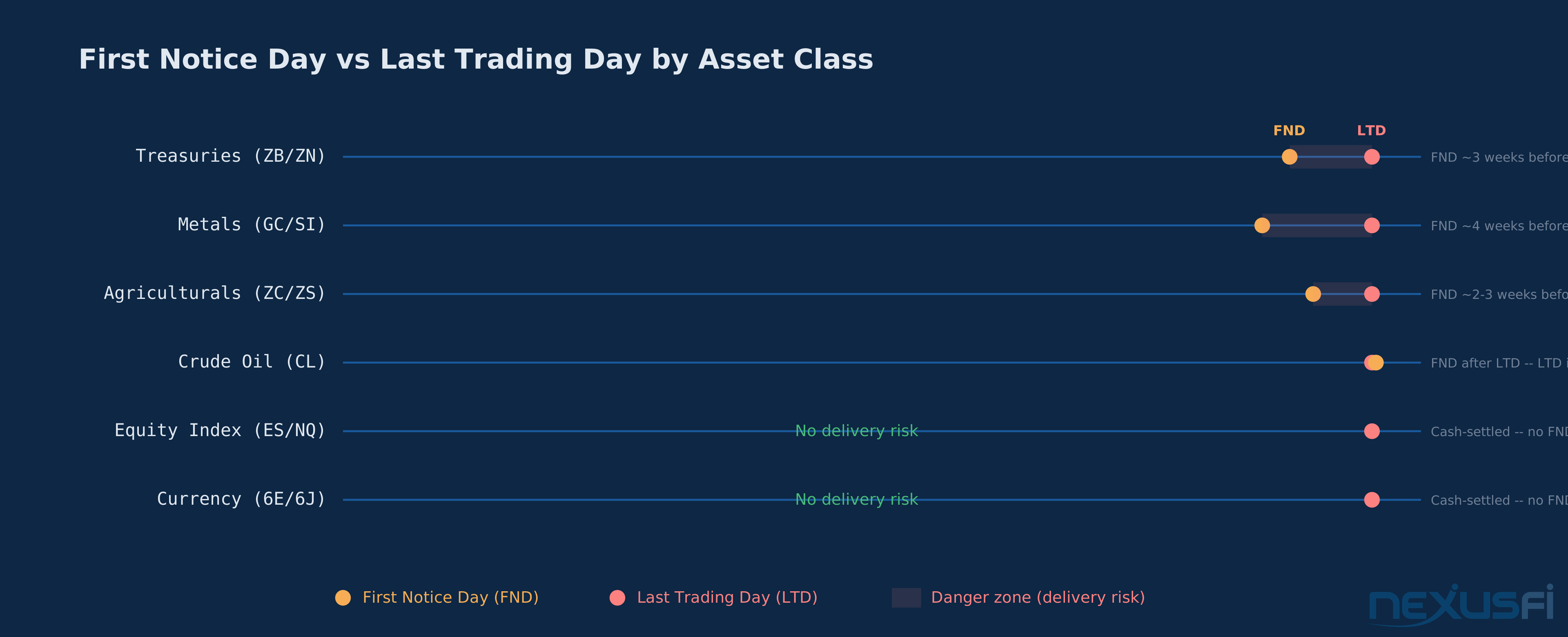
First Notice Day (FND): The first date the exchange can notify long position holders of delivery assignment. This only applies to physically deliverable contracts. If first notice day comes before last trading day — and it often does — you must be out before FND if you hold a long position.
The timing varies dramatically by asset class:
| Asset Class | FND Relative to LTD | Practical Impact |
|---|---|---|
| US Treasuries | ~3 weeks before LTD | Must roll very early |
| Metals (GC, SI) | ~4 weeks before LTD | Must roll even earlier |
| Agriculturals | ~2-3 weeks before LTD | Varies by product |
| Crude Oil (CL) | After LTD | LTD is the binding constraint |
| Equity Index (ES) | N/A (cash-settled) | Only LTD matters |
| Currency (6E) | N/A (cash-settled) | Only LTD matters |
The assignment process works as follows: the short notifies the exchange of delivery intent. The exchange then assigns a long — oldest positions first. As @Fat Tails warned, "The risk is higher for older positions, as positions that were set up first will be assigned first for physical delivery." [7]
As @SMCJB confirmed from professional experience, when you hold a physically delivered contract past first notice day, "risk will email me to ask my plans" — and if you're a retail trader, your broker will likely just liquidate your position. [8]
How to Execute the Roll #
There are two approaches, each with tradeoffs.
Method 1: Flat and Re-Enter #
Close your position in the expiring contract, then open the same position in the new contract as two separate transactions.
Pros: Simple execution, full control over each leg Cons: Market risk during the gap between trades, paying the spread twice, two sets of commissions
Method 2: Calendar Spread Order #
Trade the spread between the old and new contract as a single order. This is the professional approach.
Pros: Eliminates market risk (both legs fill simultaneously at a known differential), single commission on the spread Cons: Requires understanding spread order mechanics, spread might not be available for all contracts
For liquid contracts like ES or CL, calendar spread orders are the clear winner. The spread itself is actively quoted with tight markets. For less liquid contracts, the flat-and-re-enter method may be the only practical option.
Continuous Contracts: How Your Charts Handle Rollover #
When you pull up a "continuous" ES chart going back 5 years, you're looking at an artificial price series stitched together from dozens of individual contract months. How those months are joined matters enormously for technical analysis.
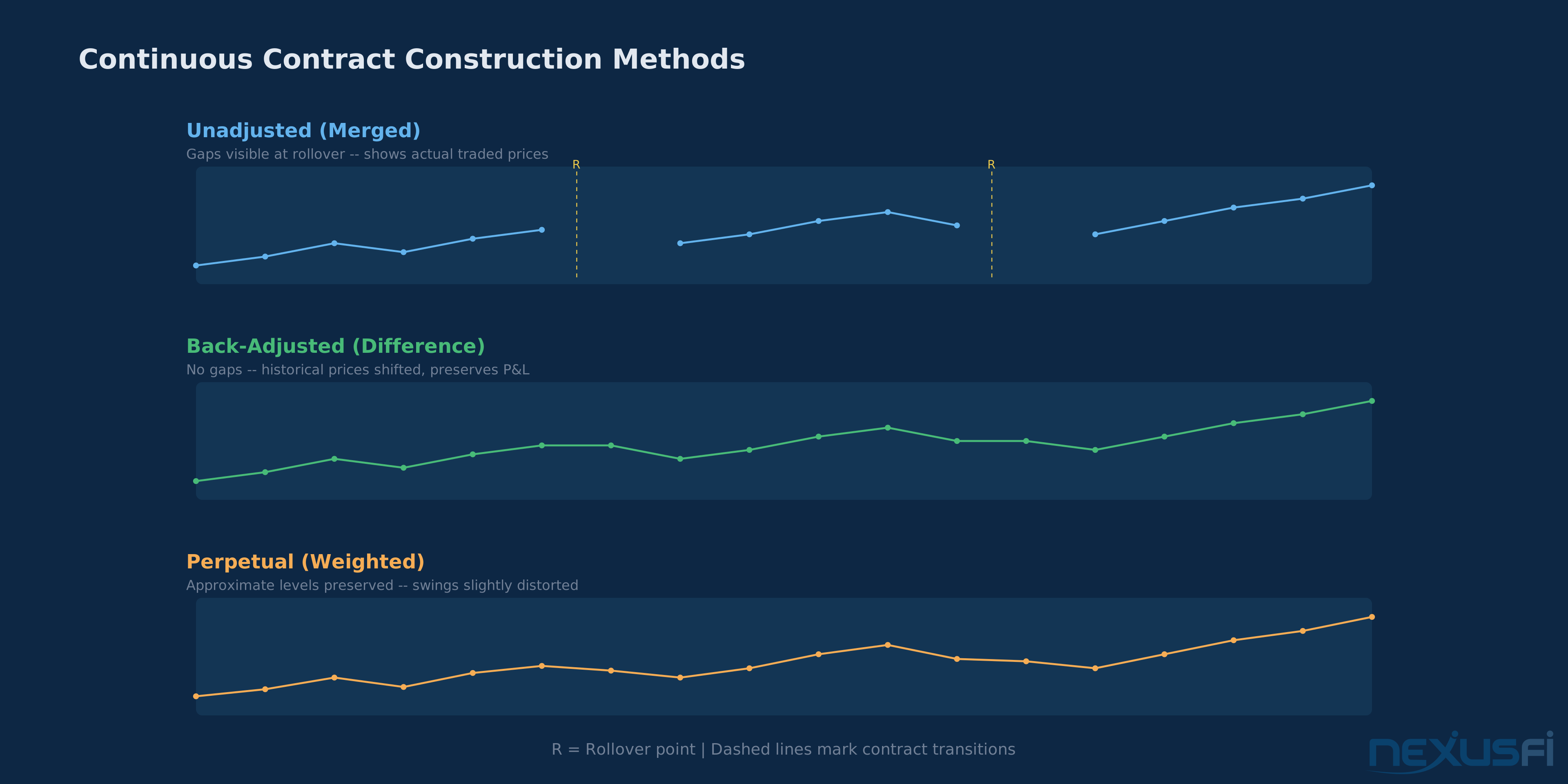
Unadjusted (Merged, Non-Adjusted) #
Individual contract months are joined end-to-end with no price modification. Gaps appear at every rollover date where the old and new contract prices differ.
What it preserves: Actual traded prices — every price on the chart was a real transaction What it breaks: Trendlines, moving averages, and any indicator that spans rollover dates. The gaps create false signals. Best for: Identifying round-number support/resistance levels, which must reference actual traded prices
Back-Adjusted (Difference Method) #
The most common method. At each rollover date, all historical prices are shifted by the difference between the old and new contract prices. This eliminates gaps while preserving the exact dollar-per-contract profit/loss of holding through each period.
What it preserves: Correct relative price movements, accurate P&L for backtesting What it breaks: Absolute price levels. For monthly-rolled contracts like CL, historical prices can deviate dramatically from reality. @Fat Tails documented that back-adjusted CL charts showed crude oil touching $185.88/barrel in 2008 when the actual high was $141.89 — a $44 distortion caused by cumulative Cushing contango adjustments. [9] Best for: Backtesting, swing analysis, indicators like moving averages
Ratio-Adjusted #
Instead of subtracting the gap, each historical price is multiplied by the ratio of new/old contract prices. This preserves percentage returns rather than dollar returns.
As @kevinkdog pointed out, "Typical backadjusted continuous futures contracts work well with price DIFFERENCES, but will give incorrect results for RATIO calculations." [10]
What it preserves: Percentage-based calculations, log returns What it breaks: Dollar-based P&L, absolute levels Best for: Long-term ratio analysis, percentage-based strategies
Continuous/Perpetual (Weighted Average) #
A synthetic price series created as a weighted average of two consecutive contracts, with weights shifting over time. The advantage is that absolute price levels stay roughly accurate over long periods.
What it preserves: Approximate absolute price levels over long timeframes What it breaks: Exact swing sizes, tick-precise levels, short-term accuracy Best for: Long-term trend analysis and position trading — "not suited for short term traders and daytraders" [9]
Which Method for Which Analysis? #
There's no single right answer. @Fat Tails laid it out clearly: [9]
| Technical Tool | Best Contract Type | Why |
|---|---|---|
| Pivots, prior highs/lows | Back-adjusted | Preserves swing sizes and relative levels |
| Fibonacci retracements | Back-adjusted | Swing proportions must be accurate |
| Long-term trendlines | Continuous or cash chart | Back-adjusted distorts multi-year slope |
| Short-term trendlines | Back-adjusted | Most accurate within a few weeks |
| Round number S/R | Unadjusted | Only chart showing actual traded prices |
| Backtesting | Back-adjusted | Only legitimate chart for testing P&L |
Rollover Impact on Technical Analysis #
Rollover creates specific artifacts that can fool technical systems:
False gap signals: On unadjusted charts, the rollover gap looks like a price gap. Gap-fill strategies applied to rollover gaps will lose money — there's no actual gap to fill, just a contract transition.
Indicator discontinuities: Moving averages, VWAP, and other cumulative indicators reset or jump at rollover boundaries. If your 20-period SMA spans a rollover date on an unadjusted chart, those 20 bars include data from two different contracts at different price levels.
Volume spikes and collapses: On rollover day, volume in the old contract drops sharply while the new contract picks up. Volume-based indicators (VWAP, volume profile, OBV) can produce misleading signals during the transition period.
Spread behavior around rollover: The calendar spread between the old and new contract can widen or narrow based on carry costs, storage costs, and market expectations. For equity index futures, this spread is typically small and predictable. For commodities, especially crude oil, spread behavior around rollover can be violent.
Practical Rollover Checklist #
Before rollover day:
- Know your contract's rollover date, first notice day, and last trading day
- If holding physically delivered contracts, verify you'll be flat before FND
- Mark the dates in your calendar — don't rely on memory
On rollover day:
- Switch to the new contract for all new positions
- Roll existing positions via calendar spread orders when available
- Update your chart symbols to the new contract month
- Verify your data feed switched correctly — some platforms require manual symbol changes
After rollover day:
- Don't trade the old contract — liquidity is gone
- Check that your continuous contract charts look correct (no unexpected gaps or price jumps in your back-adjusted data)
- Verify any automated systems are trading the correct contract month
For swing traders: As @max-td advised, "New swing positions might be better opened using the new contract if opened within a few days of rollover day." [2] Don't open new positions in the soon-to-expire contract just because it's technically still the front month.
For system traders: Ensure your backtesting uses the same continuous contract construction method as your live data feed. A strategy backtested on back-adjusted data but executed against unadjusted prices will show different results.
For the broader exchange infrastructure that makes all of this possible, see Futures Exchanges. For trading session mechanics, see Futures Trading Hours. For margin requirements that change around rollover, see Futures Margin Requirements.
Knowledge Map
Go Deeper
Build on this knowledgeReferences This Article
Articles that build on this topicCitations
- — Rollover Days - some Quick Facts about (2010) 👍 12“The real problem here is that CL futures are physically settled with delivery in Cushing, Oklahoma...”
- — Rollover Days - some Quick Facts about (2009) 👍 22“Rollover is 8 days before expiration. Volume shifts to the new contract at market open on Rollover day.”
- — Rollover Days - some Quick Facts about (2012) 👍 6“Most of the data vendors roll index futures on Wednesday evening, so that is what I am doing.”
- — Contract Periods (2013) 👍 3“For interest rate futures rollover day = first notice day and in any case you should roll prior to first notice day.”
- — Rollover dates for GC, SI, ZC and ZS (2013) 👍 13“For commodity futures this is not the case, but most participants roll according to volume or open interest crossover.”
- — Futures Expirations Question (2013) 👍 7“As a holder of a long position, close your position prior to last trading date AND prior to first notice date.”
- — Contract Rollover, and what to do when (2015) 👍 4“Rather than selling the July contract and buying the August contract, you would go long the calendar spread.”
- — Futures Close-Out Policy (2024) 👍 3“If I still have a position on the day of expiration/day before 1st delivery date risk will email me to ask my plans.”
- — Back-adjusted, Continuous contracts - best for support and resistance? (2012) 👍 30“The backadjusted contract correctly shows the relative price movement, but the absolute values shown are only correct for the last contract shown on the chart.”
- — Backadjust futures contracts for spread trading backtesting (2023) 👍 3“Typical backadjusted continuous futures contracts work well with price DIFFERENCES, but will give incorrect results for RATIO calculations.”
- — Equity Index Roll Dates (2026)
- — Light Sweet Crude Oil Futures Contract Specifications (2026)