



Corporate Earnings Event Contracts: Trading Quarterly Results on Kalshi and CME
Overview #
Earnings season runs four times a year and every time it does, futures traders watch the same ritual: NVDA gaps $40, TSLA rips 15% after-hours, AAPL drops 8% on guidance. The underlying futures markets react. Index spreads blow out. Position sizing becomes a coin flip around scheduled announcements.
There's another way to play it. Corporate earnings event contracts let you trade the reporting outcome directly — not the stock price, not the index reaction, but the specific question: did this company beat or miss the consensus EPS threshold? On Kalshi and CME, these contracts pay $0 or $1 depending solely on whether a defined condition was met. Beat consensus by at least $0.02? Contract settles YES. Miss? Settles NO.
This isn't volatility trading. It's probability estimation applied to a discrete corporate event, with a settlement rule you can read in the listing description. For a futures trader already comfortable with scheduled event risk — FOMC, CPI, NFP — earnings binaries are a natural extension. The mechanics transfer directly. The edge sources are different. The mistakes are specific.
This article covers contracts whose settlement is determined solely by a corporate earnings outcome. It doesn't address trading the underlying stock, equity-options strategies, or broader macro-event markets. For foundational prediction market mechanics, see Introduction to Prediction Markets. For hedging existing positions with event contracts, see Hedging Futures Trigger Risk with Event Contracts.
What Earnings Event Contracts Are #
An earnings event contract pays based on whether a company's next reported quarterly result meets a predefined condition. Common structures include: "EPS beats consensus," "EPS above $X.XX," "revenue beats consensus." You're not trading the stock — you're trading the market's collective probability estimate that a specific accounting metric will clear a specific threshold.
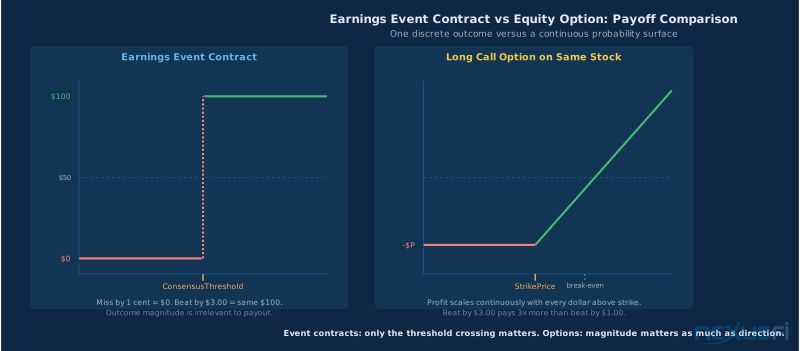
Contract Structures: Kalshi vs CME
Kalshi earnings contracts are listed per company and describe the threshold in plain language: "Will NVDA report adjusted EPS greater than $X.XX for Q2 FY2026?" The consensus source is defined in the listing — either a specific data provider or an exchange-published estimate at a fixed cutoff date. Settlement occurs after the release is confirmed and the relevant data is published. (see @bobwest's analysis of CME event contracts)
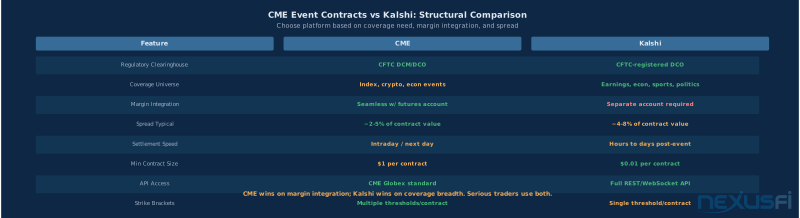
CME event contracts (where available) are exchange-standardized with cleaner margin integration into the existing futures ecosystem. They often list multiple strike brackets across a range of EPS thresholds, creating spread opportunities unavailable on Kalshi. CME coverage is narrower — focused on the largest-cap names — while Kalshi offers broader coverage including mid-caps where prediction market pricing is less sophisticated.
Settlement Rules: The Only Thing That Matters
Settlement rule precision is where most traders stumble. Four components to understand for every contract:
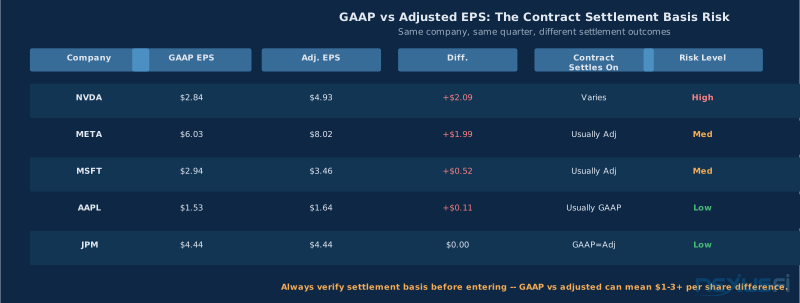
EPS basis — GAAP vs adjusted. This is the most consequential distinction in earnings event trading. GAAP EPS includes everything: restructuring costs, impairments, stock-based compensation. Adjusted EPS strips out items the company deems non-recurring. A company can show adjusted EPS of $4.20 while reporting GAAP EPS of $3.10 because of a goodwill impairment. If you're trading a contract that settles on GAAP while thinking it settles on adjusted, your probability estimate is systematically wrong.
Always verify the specific label: "GAAP diluted EPS," "non-GAAP diluted EPS," "adjusted earnings per share." These are not interchangeable. The reference source matters too — some contracts rely on what the company reports as "adjusted," while others use a third-party data provider's classification.
Beat/miss definition. "Beat consensus" sounds simple until you need to know: beat according to whose consensus figure, computed at what time cutoff, with what rounding precision? If the contract references Refinitiv consensus at market close T-1 day before earnings, and your model uses Bloomberg consensus from T-3 days, you're estimating probability against the wrong number.
Threshold rounding. A contract at EPS ≥ $3.50 and a reported EPS of $3.495 — does that settle YES? The answer depends on how the exchange applies rounding. Read the settlement rules before you're in the position.
Timing mechanics. Contracts enter lockout — no new positions allowed — hours before the scheduled earnings release. Settlement occurs after the release is published and verified by the designated data source. Position sizing needs to account for the timing gap between lockout and final settlement.
How Earnings Contracts Differ from Equity Options
Equity options price the entire distribution of the underlying stock price — the full implied volatility surface, path dependence, and expected move. IV crush after earnings is a defining feature. Earnings event contracts price the probability that one specific metric crosses one specific threshold. There's no vol surface. No gamma. The price is an implied probability that reprices based on information arrival and consensus revision.
A stock that "beats" by $0.40 on adjusted EPS but "misses" on GAAP settles the contract based on which definition the contract specifies — the stock's subsequent move is irrelevant to settlement. That makes the product cleaner in some ways and trickier in others: the entire edge lives in correctly identifying which metric, which consensus source, and what probability the market is pricing.
How Price Encodes Probability #
The EV Math
A YES contract paying $1.00 trading at $0.62 implies roughly 62% probability of the event occurring. The expected value calculation for buying YES at $0.62 when your true probability estimate is q:
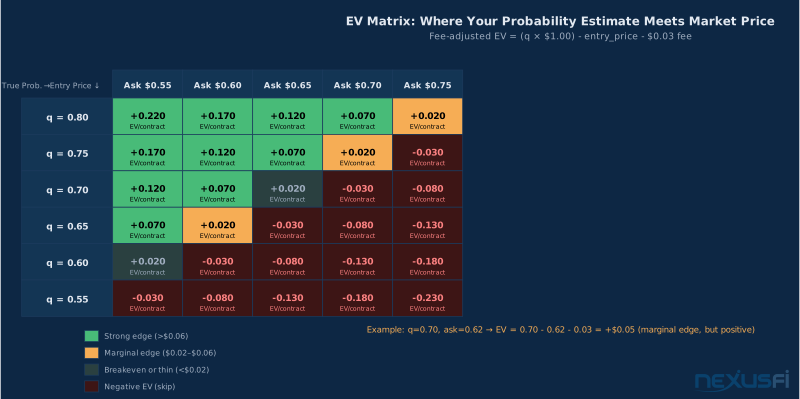
EV = q - entry_price = q - 0.62
This is the question @trendisyourfriend raised about event contracts: how does the exchange determine each side's probability? The answer is price discovery — participant estimates expressed through bids and offers.
If your model says q = 0.70, EV = $0.08 per dollar of payout. But this only holds at mid. The practical calculation uses your expected fill price, not mid:
fee-adjusted EV = (q × payout) - entry_price - fees
On Kalshi, take the ask as your entry price for a buy. If YES is quoted 0.62/0.66 with a $0.03 fee per $1 contract, your actual cost is $0.69. Break-even probability is 0.69. Your model needs to show at least 69% true probability before this trade has positive EV.
@SMCJB calculated the commission math on CME event contracts in detail: at standard exchange plus FCM fees, a trader needs 57.5-62% win rate to break even on a theoretically 50:50 contract. Fee-adjusted EV is the only number that matters at entry.
Spread Distortions Near Lockout
Three forces drive spread widening near earnings lockout:
Adverse selection risk. Near lockout, market makers know informed traders are more likely to take liquidity. They widen spreads to compensate.
Jump-to-settlement risk. Unlike futures where you can re-hedge continuously after a data release, earnings contracts jump directly to YES or NO. No re-hedging possible once data is out. The market maker prices that jump risk into the spread.
Reference uncertainty. In the final hours, there's sometimes ambiguity about which consensus figure will be used for settlement if last-minute analyst revisions come in.
In the final 2-6 hours before lockout, the spread premium can represent 5-15% of contract notional. If your model shows positive EV at mid, that doesn't mean you have positive EV at the executable price. Re-run your EV calculation using the actual offer, not mid.
Calibration: Turning Signals into Probabilities
You need a probability estimate, not just a directional view. "NVDA is going to crush it" isn't a probability. "My model says 67% chance NVDA beats adjusted EPS consensus of $5.84" is a probability.
A practical calibration workflow: for each past quarter, record the implied probability from the contract price at a fixed time (T-7 days is a common benchmark), and the actual outcome. After 8-12 quarters per name, compute empirical hit rates by probability bin. If NVDA beat-probability contracts at 0.55-0.65 have historically resolved YES at a 72% rate, the market is underpricing NVDA beats in that range. That's calibration edge.
Don't build calibration from fewer than 8-10 outcomes per bin — binary variance is high enough that 4 samples can show 75% hit rates on events genuinely priced at 60%.
Where the Edge Lives #
Edge Type 1: Consensus Dispersion
Consensus isn't a single number — it's a distribution of analyst estimates that evolves over the weeks before a report. When AAPL consensus is $1.85 and estimates cluster tightly between $1.83 and $1.87, that's different from when estimates range from $1.74 to $1.96. Wide dispersion often signals genuine uncertainty that the beat probability estimate should reflect — not just a single consensus number.
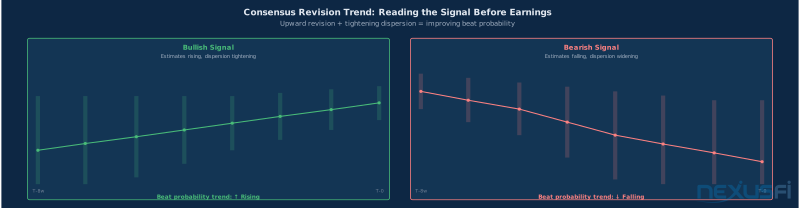
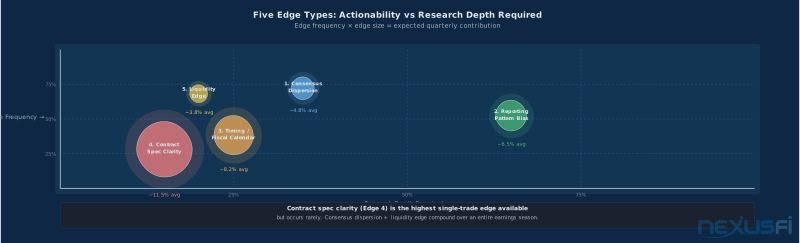
What drives edge here is the direction and compression of revisions. If consensus started 4 weeks ago at $1.80 and has been revised upward consistently to $1.85, analysts are seeing improving signals. When revisions cluster upward and dispersion is tightening, beat probability is typically higher than the raw consensus level implies. Failure mode: dispersion tightens from analyst herding on management guidance, not independent convergence — consensus can still be wrong.
Edge Type 2: Reporting Pattern Bias
Some companies have persistent reporting behaviors: "beat early, guide cautiously," "miss on adjusted EPS but beat on revenue," "one-time adjustments create GAAP noise." These patterns show up in multi-quarter beat-rate data for the specific contract type.
The edge is specific: for some companies, the adjusted-vs-GAAP split runs consistently large in one direction. If you know the contract settles on adjusted and the company has run large positive adjustments for six straight quarters, beating adjusted consensus is structurally easier than the market prices. Failure mode: regime shift. Major product-cycle transitions, management changes, or accounting methodology changes invalidate historical patterns completely.
Edge Type 3: Timing and Fiscal Calendar
Most companies report on a fiscal calendar that doesn't align with the calendar quarter. Apple's fiscal Q4 ends in September. Microsoft's fiscal Q4 ends in June. If you're trading "Q2 FY2026" for a company with a non-standard fiscal year, verify exactly which three-month period that covers before your probability estimate means anything.
Consensus drifts in the week before earnings. Use a consistent measurement time — T-7 days or T-48 hours — across all contracts. Computing probability against T-14 consensus when the contract settles against T-1 consensus means estimating edge against a stale number.
Edge Type 4: Contract Spec Misunderstanding
Traders who don't understand the spec get burned. If you understand it better than the market, you capture the mispricing. The most common confusion: GAAP vs adjusted. If the market is pricing a NVDA beat contract at 0.72 because traders are thinking about adjusted EPS but the contract settles on GAAP, the true probability might be 0.58. The difference between adjusted and GAAP for NVDA can run $1-2 per share in quarters with large stock-based compensation charges.
Protection: make spec verification a hard pre-trade rule, not optional. It takes 2 minutes to read the settlement description. It costs $0. Skipping it costs the full position value when you're wrong.
Edge Type 5: Liquidity Edge
If you know the microstructure better than your counterparty, you can capture edge that has nothing to do with earnings forecasting. Key observation: bid-ask spreads on Kalshi earnings contracts don't widen linearly as the event approaches — they spike nonlinearly in the final 30-90 minutes before lockout.
Traders who enter 24-48 hours before lockout consistently pay tighter spreads. A NVDA earnings contract that trades at 0.66/0.70 at T-48 hours might show 0.68/0.76 in the final 2 hours before lockout — effective spread cost jumps from 4 cents to 8 cents while implied probability is the same. If your model edge is 6 cents, early entry is positive EV and late entry destroys it.
Strategy Toolbox #
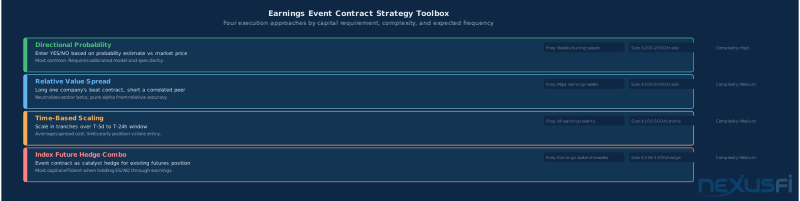
Directional Probability Trades
The straightforward case: your model shows true probability of 0.70, the contract trades at 0.62, and your minimum fee-adjusted break-even is 0.65. You have $0.05 edge per dollar of payout. You buy YES.
The discipline required isn't in the setup — it's in saying no. Most quarters, for most companies, prediction market prices are reasonably well-calibrated. You're looking for specific cases where your probability estimate differs from the market's for a concrete, defensible reason — not a narrative that a tech company is "doing well." Failure modes: model miscalibration in a new regime, late consensus revisions you didn't incorporate, spec mismatch between what you modeled and what settles.
Relative-Value Spreads
When a company reports EPS and revenue separately, contracts on both metrics can diverge. If the market prices an EPS beat at 0.72 and a revenue beat at 0.68 when the correlation between those outcomes is 0.85+ for this company, revenue is underpriced relative to EPS. If you expect the quarter to beat both, the revenue side offers better value.
Where CME offers multiple EPS threshold brackets, build range trades: buy "above $3.50" and sell "above $4.50" to express a distribution view. Failure mode: EPS/revenue correlation isn't stable quarter-to-quarter.
Time-Based Scaling Into Lockout
Scale in across the pre-lockout window rather than entering the full position at once. A common structure: 40% at T-72 hours, 40% at T-24 hours, 20% at T-2 hours (only if spread is still within acceptable range). Your probability estimate may update as new information arrives. The first two tranches capture reasonable spreads. The final tranche allows for updating — but only if the execution cost hasn't deteriorated.
Set a max spread threshold before you commit to the late-tranche structure. In contracts with sharp spread widening into lockout, the late tranche destroys EV even if your probability estimate was right. If the spread has blown out, the final tranche stays flat.
Hedging with Index Futures
For mega-cap names — AAPL, NVDA, MSFT — the earnings release moves the index. NVDA earnings can shift ES by 20+ points. If you're long YES on a NVDA beat and already long NQ, reduce NQ by the notional beta equivalent heading into the release. But don't overcomplicate a binary position — if sizing is appropriate and your edge is in the binary outcome, the index hedge adds basis risk without improving EV. Keep it simple.
Microstructure and Execution #
Liquidity Lifecycle of an Earnings Contract
Earnings contracts on Kalshi follow a predictable arc. In the 5-10 days after listing (often 3-4 weeks before the report), the book is thin and spreads are wide — price discovery is happening with limited information. Volume and depth build as the report approaches, typically peaking at 24-48 hours before lockout for major names.
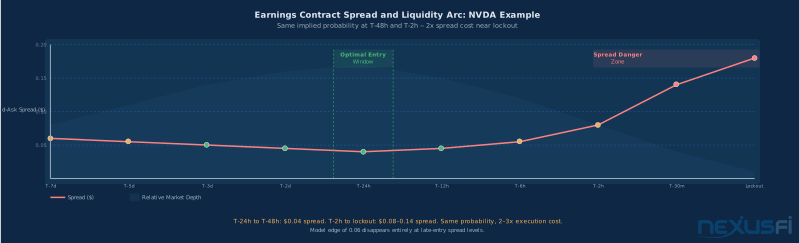
Then, in the final 2-6 hours before lockout, liquidity often inverts. Market makers pull back. The book may show more size on one side as participants with later information try to exit or add. Volume spikes while conditions for good execution deteriorate simultaneously. For large-cap names, the best execution window is the 24-48 hour period before lockout. For less liquid names, extend that to 48-72 hours.
Limit vs Market Orders
Use limit orders, always. Prediction market spreads are wide enough that market orders consistently overpay. Set your limit at the ask (for a buy), wait 30-60 seconds, and step up by one increment only if your model still shows positive EV at the new price. If you need to exit before lockout and the book has become one-sided, the decision depends on your current probability estimate — if you still believe 65%+ YES, holding is correct on EV regardless of the mark-to-market. Either size every position for hold-to-settlement or don't enter.
CME vs Kalshi: Structural Differences
CME event contracts integrate into CME clearing infrastructure — margin treatment, account management, and execution flow through systems futures traders already use. Book depth is typically better for large-cap names, and professional market makers with CME relationships keep spreads tighter on liquid contracts.
Kalshi's advantage is breadth. CME corporate earnings coverage is limited to major names; Kalshi lists dozens of companies including mid-caps where pricing is less sophisticated. Retail traders betting on narrative outcomes rather than calibrated probabilities create exploitable mispricings that don't exist in the CME book.
Risk Management for Binary Events #
Sizing for Serial Event Exposure
Earnings contracts look like small contained bets — maximum loss is defined, payout is clear. The risk creeps in through seriality. Q1 earnings season runs 3-4 weeks with dozens of major reports. If you're trading 5-10 earnings contracts per quarter, you're taking on serial correlated risk — macro conditions, investor sentiment, and sector dynamics affect multiple companies simultaneously.
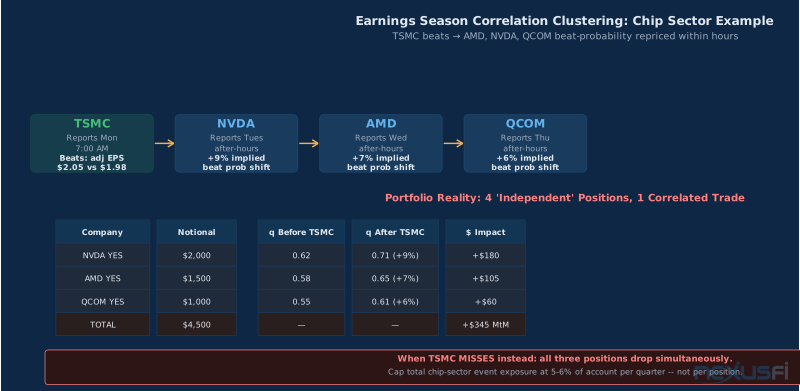
Don't treat a collection of earnings contracts as independent positions. If your per-trade limit is 2% of account and you take 8 trades in the same sector during peak earnings week, you have 16% of account at risk in correlated positions. That's a concentrated bet on the tech earnings season, not 8 independent trades. Cap total event exposure per sector per quarter at 5-6% of account. Cap total earnings contract exposure in any single week at 8-10%.
Jump Risk and the Binary Payoff
Every futures trader knows gap risk from holds over major announcements. Earnings contracts take this to an extreme: the position goes from $0.68 to $0.00 or $1.00 in an instant. No closing tick, no partial fill, no opportunity to adjust. Your risk management has to happen before the position is opened.
Before entering, ask: if this settles NO at zero, what's the drawdown as a percentage of account? Max-loss-defined doesn't mean the risk is small. A 2% instant binary loss has a different psychological impact than a 2% gradual drawdown — size binary positions so.
Correlation Clustering During Earnings Season
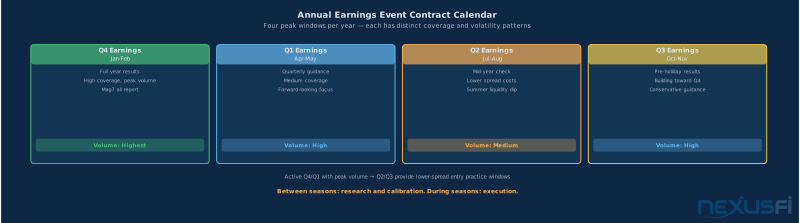
Peak earnings season — the second and third weeks of January, April, July, and October — concentrates dozens of major reports into a short window. Macro conditions during those weeks affect the entire batch. A surprise Fed statement mid-week, a geopolitical event, an unexpected data print — any of these shifts how investors interpret every earnings report that follows.
Sector contagion is real. TSMC reporting strong chip numbers shifts beat probabilities for AMD, NVDA, and Qualcomm — all reporting the same week. Multiple positions move together, making risk more concentrated than individual position sizes imply.
Model Risk
Your edge in earnings contracts is a probability model. That model can be wrong in specific, high-consequence ways:
Wrong EPS definition. Your model estimates probability of beating adjusted EPS. The contract settles on GAAP. Even a small systematic difference turns positive edge into negative edge consistently.
Stale consensus inputs. Analyst revisions in the final week can move consensus 3-5 cents. If your model locked in consensus at T-14 days and the contract settles against T-1 consensus, your beat probability estimate can be materially off in close calls.
Regime shift. A company in a product transition or acquisition doesn't behave like historical data suggests. Beat-rate calibrations built on the old regime become noise. Reset when you see major strategic announcements, management turnover, or accounting methodology changes.
Common Mistakes and Contract-Spec Traps #
The GAAP/Adjusted Gap
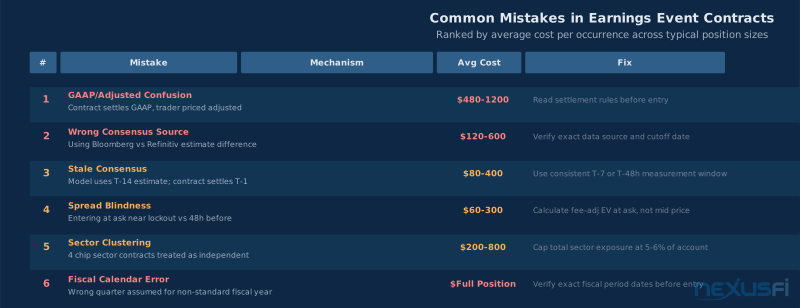
The most costly systematic error. Experienced traders who've spent years watching quarterly reports on Bloomberg or FactSet default to thinking in adjusted EPS terms because that's what analysts discuss. But contracts sometimes settle on GAAP, and GAAP can be dramatically different. — a view @SMCJB described as "enabling degenerate gambling," though regulatory classification as CFTC derivatives rather than state-licensed gambling has generally prevailed
Consider a quarter where a company takes a significant goodwill impairment. Adjusted EPS comes in at $4.20 and beats consensus of $4.05. GAAP EPS is $2.80 due to the impairment. Contract settling on adjusted: YES. Contract settling on GAAP: NO. Same quarter, same company, opposite outcomes depending on which spec you read. The protection: make spec verification a hard pre-trade rule, not optional. Two minutes to read the settlement description eliminates the single costliest error class.
Fiscal Quarter Calendar Mismatch
Apple's fiscal Q4 ends September 30 and reports in late October. If you see "AAPL Q4 FY2025 EPS" and assume it covers July-September because that's calendar Q3, you're analyzing the wrong quarter's data entirely. Apple's fiscal Q3 covers April-June and reports in late July. Fiscal and calendar calendars diverge by one quarter.
The fix: before building a probability estimate, confirm which three months the contract covers and which earnings release resolves it. A 10-second check against the company's investor relations calendar prevents the mismatch.
Overcounting Narrative Edge
"NVDA always beats" is not a trading strategy. It's a narrative. As @Syntax documented in their earnings trading journal, the edge in earnings trading comes from structured probability estimation — not directional narrative. Event contracts require the same discipline: quantify edge before entry or the trade doesn't exist.
Mean reversion in consensus kills narrative edge. When NVDA has beaten 8 quarters in a row, consensus revises upward to absorb it. Beat probability against elevated consensus may be no different from the first quarter. "Always beats" priced into consensus isn't edge — it's already priced in. Quantify: if your model shows 0.65 and the contract is priced at 0.62, you have 3 cents. After fees requiring 0.64 to break even, there's no trade.
Missing the Settlement Source Timing
Settlement rules specify consensus as of a specific moment. If the rule says "consensus at close of business the day before the release" and an analyst drops a revision at 9:35 AM the morning of the release, that revision doesn't count. The contract settles against the previous day's figure.
This edge case matters: a late revision moves live consensus while settlement consensus remains unchanged. In a tight beat scenario where reported EPS falls between the two consensus levels, you can be right directionally while wrong about settlement.
Performance Measurement #
Brier Scoring for Calibration
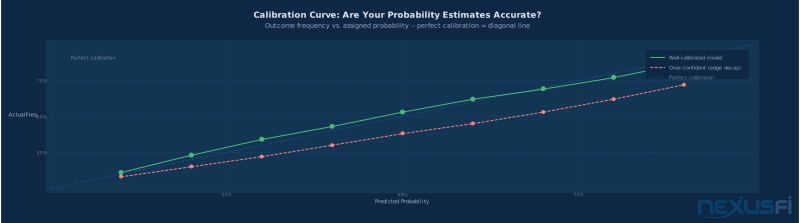
Standard P&L tracks whether you made money. Brier scoring tracks whether your probability model is accurate. Both matter, but Brier scoring is uniquely valuable for binary event trading because it diagnoses miscalibration that P&L alone can mask: you can be profitable over a short run while being systematically wrong, and that systematic error eventually creates a loss cluster.
Calibration Is the Competitive Edge Most participants in earnings event contract markets price based on gut feel or loose directional views. Traders who build explicit probability estimates from consensus revision data and historical beat rates are operating in a different category. A model with a Brier score below 0.18 on a sample of 30+ predictions is rare. That's the edge.
Brier score for a single prediction: (q - y)² where q is your probability estimate and y is 0 or 1. Lower is better. Averaged across all predictions, a Brier score below 0.20 indicates reasonable calibration. A score above 0.25 on a large sample suggests your probabilities aren't matching outcomes at the rate you estimated.
Compute Brier scores separately by company, EPS definition, and sector. A low aggregate score can mask a high score for a specific company type. NVDA and TSLA require different calibration curves than industrials due to larger and more erratic non-GAAP adjustments.
Attribution: Model vs Execution vs Timing
When a position loses, it failed for one of three reasons: probability estimate wrong (model failure), paid too much vs fair value (execution failure), or poor entry timing inflated spread cost. Track all three separately. Model attribution: compare your q to mid-price at entry. Execution attribution: compare fill price to mid at fill time. Timing attribution: compare your spread cost to average spread across the pre-lockout window. Consistent execution slippage signals a fixable process problem. Consistent model failure signals a calibration problem.
Fee-Adjusted Edge Tracking
Track fee-adjusted EV = (q × payout) - entry_price - platform_fee for every trade. A $0.08 EV trade that settles NO is good process with a bad outcome. A -$0.02 EV trade that settles YES is bad process with a lucky outcome. Tracking EV separately from P&L separates skill from variance over any meaningful sample size.
Spec Verification Is Non-Negotiable Before entering any earnings event contract, confirm three things: (1) GAAP vs adjusted — read the exact settlement description, not the contract title; (2) which consensus source at which cutoff date; (3) what fiscal period is covered. This takes 2 minutes. Skipping it is responsible for the highest-cost errors in earnings event trading.
Pre-Trade Checklist #
Before placing any earnings event contract trade:
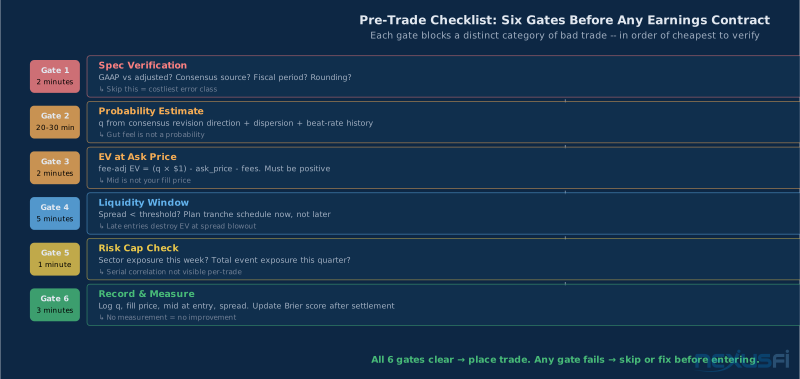
Spec verification (non-negotiable): GAAP vs adjusted, exact settlement description, consensus source and cutoff, fiscal period, rounding rules. Two minutes eliminates the costliest error class.
Probability estimate with calibration: Build q from consensus revision direction, historical beat rates, and estimate dispersion. Quantified probability calibrated against outcomes — not directional narrative.
Execution price vs break-even: Run fee-adjusted EV at ask price, not mid. If it doesn't clear the break-even threshold, pass.
Liquidity window decision: Build the tranche schedule before entry based on current spread vs lockout timing — not reactively.
Risk caps: What's total earnings contract exposure this week? This sector this quarter? Adding this position over the clustering risk limit means either passing or reducing another position to make room.
Post-trade measurement: Record q, fill price, mid at entry, and spread. Update Brier score after settlement. The measurement is part of the trade.
Earnings event contracts are a focused, processable form of event trading. The mechanics are straightforward once you've internalized probability over prediction. The edge sources are specific and repeatable if you build calibration from actual data. The mistakes are avoidable with discipline around spec verification and execution timing. What makes this hard isn't the concepts — it's the patience to apply a rigorous process when the narrative says the outcome is obvious. The outcome is never obvious until it settles.
Knowledge Map
Go Deeper
Build on this knowledgeCitations
- — Event Contracts - New Way to trade the CME Futures markets: Trade your opinion (2022) 👍 6“These new CME 'event contracts' are listed on the CME and probably available through many of the usual futures brokers. Similar to binary options: you bet that x instrument will be higher/lower than some level, and it's 100% win or lose.”
- — Kalshi, Polymarket, Prediction Markets etc (2025) 👍 4“Nothing against Kalshi/Polymarket etc but I do think this is just enabling degenerate gambling and violating gambling laws. But then so is the lottery (aka the stupid tax) but that's legal and flourishing.”
- — Kalshi Hits $1 Billion in Super Bowl Trading Volume (2026) 👍 1“$27 million to $1 billion in 12 months. Institutional-grade volume is arriving -- a billion-dollar trading day puts Kalshi in the same conversation as established futures markets.”
- — CFTC Withdraws Biden-Era Prediction Market Ban, Signals New Regulatory Framework (2026)“CFTC Chairman Selig withdrew both the 2024 rule proposal that would have prohibited political and sports-related event contracts AND a 2025 staff advisory. 'It is time for clear rules and a clear understanding that the CFTC supports lawful innovation in these markets.'”
- — Kalshi Raises $1B Series E - $11B Valuation (2025)“This represents remarkable validation of prediction markets as a legitimate financial asset class. For futures traders, the explosive growth of event contracts signals where retail trading interest is heading.”
- — How Earnings Event Contracts Work (2025)
- — CME Event Contracts Product Guide (2024)
- — Probability Calibration and the Brier Score (2023)
- — Event Contracts - New Way to trade the CME Futures markets: Trade your opinion (2022) 👍 2“One question I have is how do they determine the probability of each side Yes or No?”
- — Event Contracts - New Way to trade the CME Futures markets: Trade your opinion (2022) 👍 2“So you need to win 62.02% of the time to breakeven on a 50:50 bet! [When entering at mid with standard exchange and FCM commission structure]”
- — Learning to Profit - A journey in algorithms and options (2021) 👍 5