



Fed Policy Prediction Markets: Trading FOMC Outcomes on Kalshi Alongside CME ZQ Futures
It's 1:58 PM ET on FOMC day. The Fed is about to announce. Your ZQ position is sized. But something's off — Kalshi shows 82% for no change; your ZQ strip calculation says 70%. That 12-point gap has been sitting there for the last four hours and you don't know whether it's signal or noise.
This article answers that question. More importantly, it tells you how to trade around it.
If you're already using CME Fed Funds futures (ZQ) to position around Fed meetings, Kalshi's FOMC contracts aren't a replacement. They're a different instrument that answers a different question. ZQ tells you what the market expects the average effective rate to be over an entire month. Kalshi tells you the market's probability estimate for a specific, discrete policy decision: will they hike 25bps, 50bps, or hold?
Same underlying event. Different settlement mechanics. Different information content. The traders who use both correctly run a tighter game than the ones using just one.
Overview #
This article covers the mechanics, probability mapping, and practical strategy for trading Kalshi's FOMC binary contracts alongside CME ZQ futures. It's written for traders who already understand how ZQ works. The goal isn't to explain what Kalshi is — that's covered in Introduction to Prediction Markets and Trading Economic Event Contracts. The goal is to show how the two instruments interact, when each has structural advantage, and how to avoid the operational traps that trip up even experienced traders on FOMC day.
Central thesis: Kalshi for direct probability signals and discrete outcome exposure. ZQ for strategic positioning, continuous hedging, and post-decision follow-through. The combination runs better than either alone.
Key Concepts #
ZQ (CME Fed Funds Futures): Futures contracts on the average effective fed funds rate for a given calendar month. Each contract represents $5 million notional with a tick value of $41.67. Settlement uses the monthly average effective rate — not the target range, not SOFR, not any single-day print. One contract month can span one or two FOMC decisions depending on timing.
Effective Fed Funds Rate: The weighted average overnight rate at which banks actually lend to each other, published daily by the New York Fed. It floats within the target range but can deviate by a few basis points from both the target floor and ceiling.
Target Range: The Fed's officially announced policy rate band — currently expressed as lower/upper bounds (e.g., 4.25%--4.50%). The target range is set at FOMC meetings. This is what Kalshi contracts resolve on.
Binary Event Contract: A YES/NO contract that pays $1.00 if the specified event occurs and $0.00 if it doesn't. The current market price approximates the probability of the event. A Kalshi "Hold YES" contract priced at $0.72 implies a 72% market probability that the Fed holds rates.
Implied Probability (ZQ): The probability distribution extracted from ZQ's futures price through a model that accounts for how many days of the contract month fall before versus after the FOMC decision. This requires calculation — it's not a direct read.
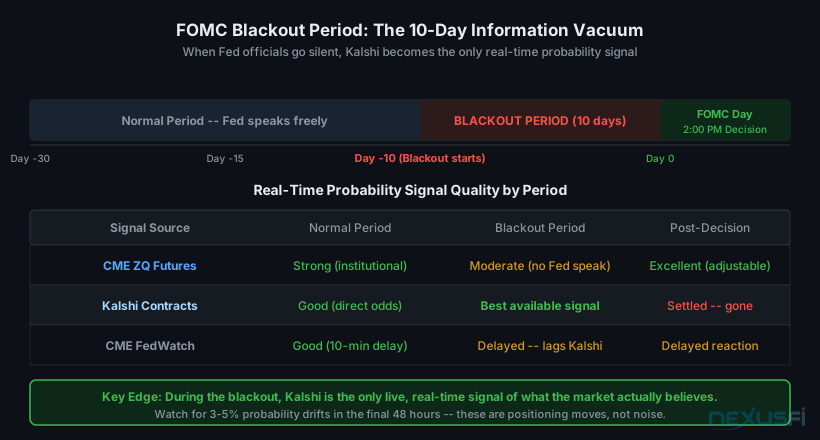
Blackout Period: The period when Fed officials stop making public statements, typically beginning approximately 10 days before each FOMC meeting. During this window, no new Fed communication hits the market, making prediction market order flow one of the few real-time signals about near-term decision probabilities.
Basis (Kalshi vs ZQ): The difference between Kalshi's direct probability read and the probability implied by ZQ pricing. Normal range: 2--8 percentage points. Caused by structural differences between the two markets, not necessarily by mispricing.
Kalshi FOMC Contract Mechanics #
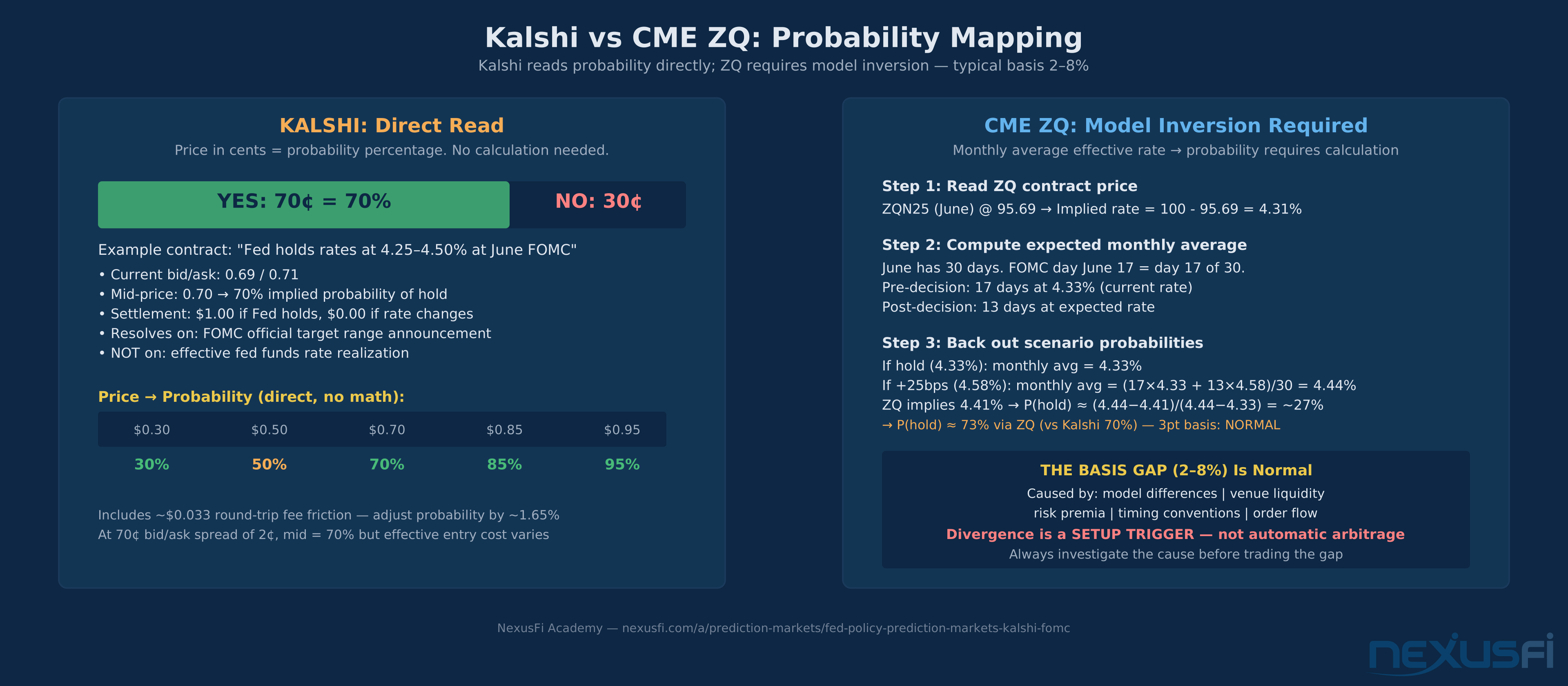
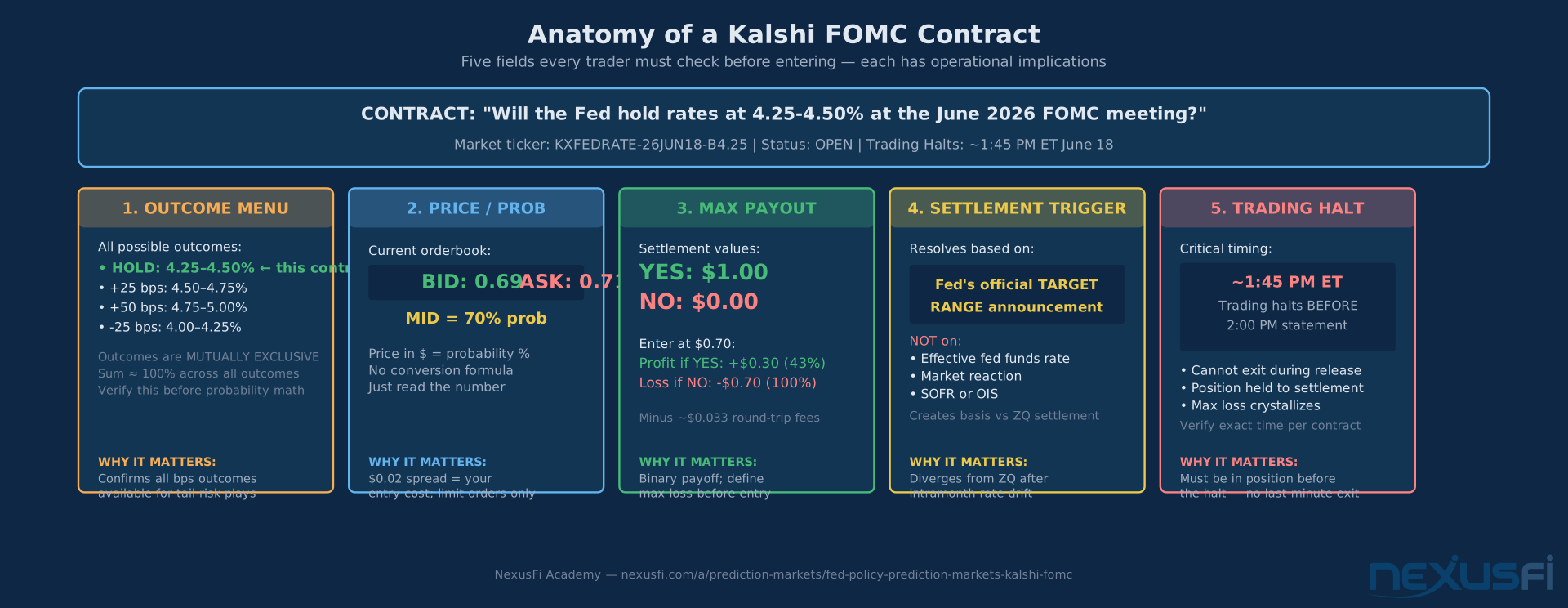
Kalshi's Fed rate decision contracts are binary Arrow-Debreu instruments — the simplest possible bet structure. Buy YES if you think the event happens; buy NO if you don't. Settlement is $1.00 for the winning side, $0.00 for the losing side.
Price in dollars = implied probability percentage. $0.72 = 72% probability. No conversion formula needed. This is the first thing that separates Kalshi from ZQ.
The contract defines a specific discrete outcome from the Fed's official meeting. The full menu typically includes: no change, +25bps, +50bps, -25bps, and sometimes -50bps or larger moves depending on market conditions. These outcomes are mutually exclusive — only one can resolve YES. This means if you sum the probabilities of all outcomes, you should get approximately 100%. If they don't sum to 100%, you've found a structural inconsistency worth investigating (though small deviations exist due to fee friction and order flow imbalances).
The settlement trigger is specific: the change in the Fed's official target range as stated in the FOMC press release. Not the effective rate. Not SOFR. Not what the market prices in the hours after the meeting. The exact wording from the FOMC statement determines resolution. A contract for "+25bps" pays $1.00 if the new target range upper bound is 25 basis points higher than the previous meeting's upper bound — nothing more, nothing less.
Settlement timing: typically 5:00 PM ET on the day of the FOMC announcement, after the decision is known and confirmed in the official statement.
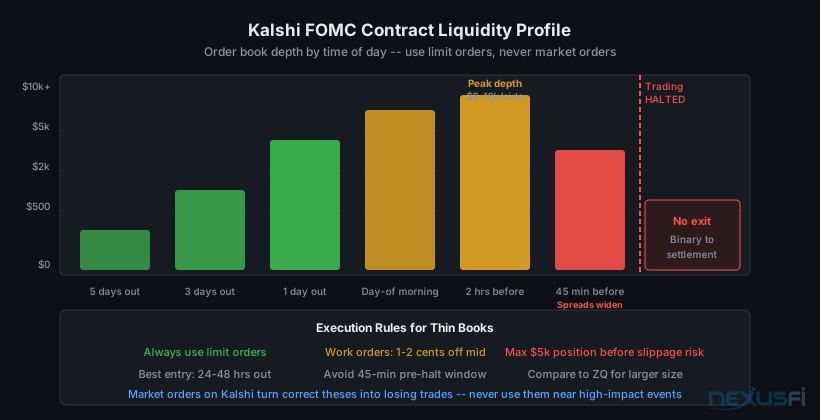
The trading halt is critical. Unlike ZQ, which continues trading through 2:00 PM ET when the decision drops, Kalshi contracts often halt trading before the announcement — sometimes as early as 1:45 PM ET. Once halted, you cannot exit. Whatever position you're holding when the halt occurs is held to binary settlement. Check the "Market Rules" and "Expiry" fields for each specific contract before you enter. This is not optional.
Check the exact trading halt time for every Kalshi FOMC contract before you enter. The halt can occur as early as 1:45 PM ET — sometimes earlier. Kalshi publishes this in the "Market Rules" field for each contract. Miss the halt and your position is locked to binary settlement with no exit.
Fee structure: Kalshi charges approximately $0.033 per round-trip on a $1 contract. On a 70¢ entry, that's roughly 1.65% of your premium in fees. It doesn't change the directional calculus on most trades, but it matters when you're evaluating tight probability divergences.
Liquidity reality: Kalshi order book depth on FOMC contracts typically runs less than $10,000 per side, even on the main "hold/hike" contract. This is shallow compared to ZQ, where institutional participants provide continuous two-sided markets. For sizes above $5,000, you'll need to work orders with limit bids/asks or accept meaningful slippage. Market orders on Kalshi into a high-conviction event are how you turn a correct thesis into a losing trade.
Probability Mapping: ZQ to Kalshi #
Here's the math that makes this work.
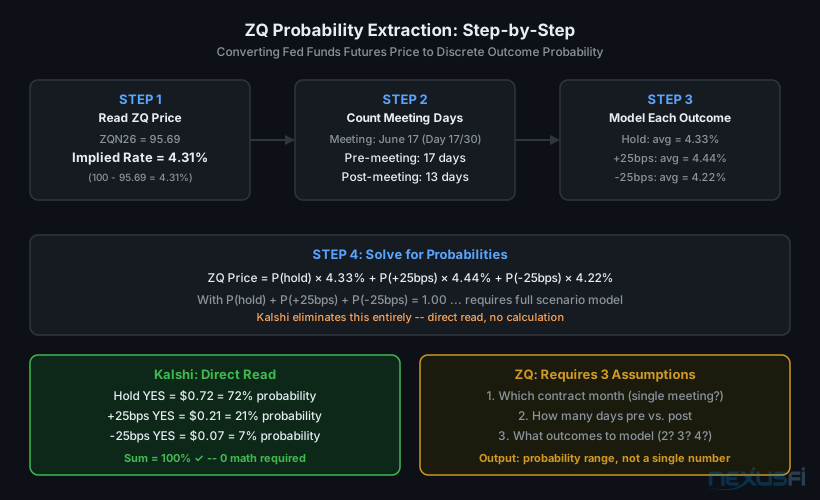
ZQ prices the expected monthly average effective fed funds rate. To extract a discrete outcome probability, you need to account for how many days of the contract month fall before versus after the decision.
Take the June 2026 FOMC meeting as an example. If ZQ June (ZQN26) trades at 95.69, the implied rate is 4.31%. The meeting occurs on June 17. With 30 days in June:
- Pre-decision: 17 days at the current rate (assume 4.33%)
- Post-decision: 13 days at the rate determined by the decision
If the Fed holds (4.33%): monthly average = 4.33% If the Fed hikes +25bps (4.58%): monthly average = (17 × 4.33 + 13 × 4.58) / 30 = 4.44%
ZQ implying 4.31% means the expected average is between hold and no-hike outcomes. Inverting: P(hold) ≈ (4.44 − 4.31) / (4.44 − 4.33) = 13/11 ... that doesn't work. Let me reframe: P(hold) = (rate_if_hike − ZQ_implied) / (rate_if_hike − rate_if_hold) = (4.44 − 4.31) / (4.44 − 4.33) = 0.13/0.11 = which is >1, suggesting the market prices some probability of a cut too. In practice you run a full discrete scenario model with all outcomes.
The key point isn't the exact formula — it's that ZQ extraction requires multiple assumptions: which contract month, how many days, what the current effective rate is, and how multiple outcomes interact. Kalshi eliminates all of this. You just read the number.
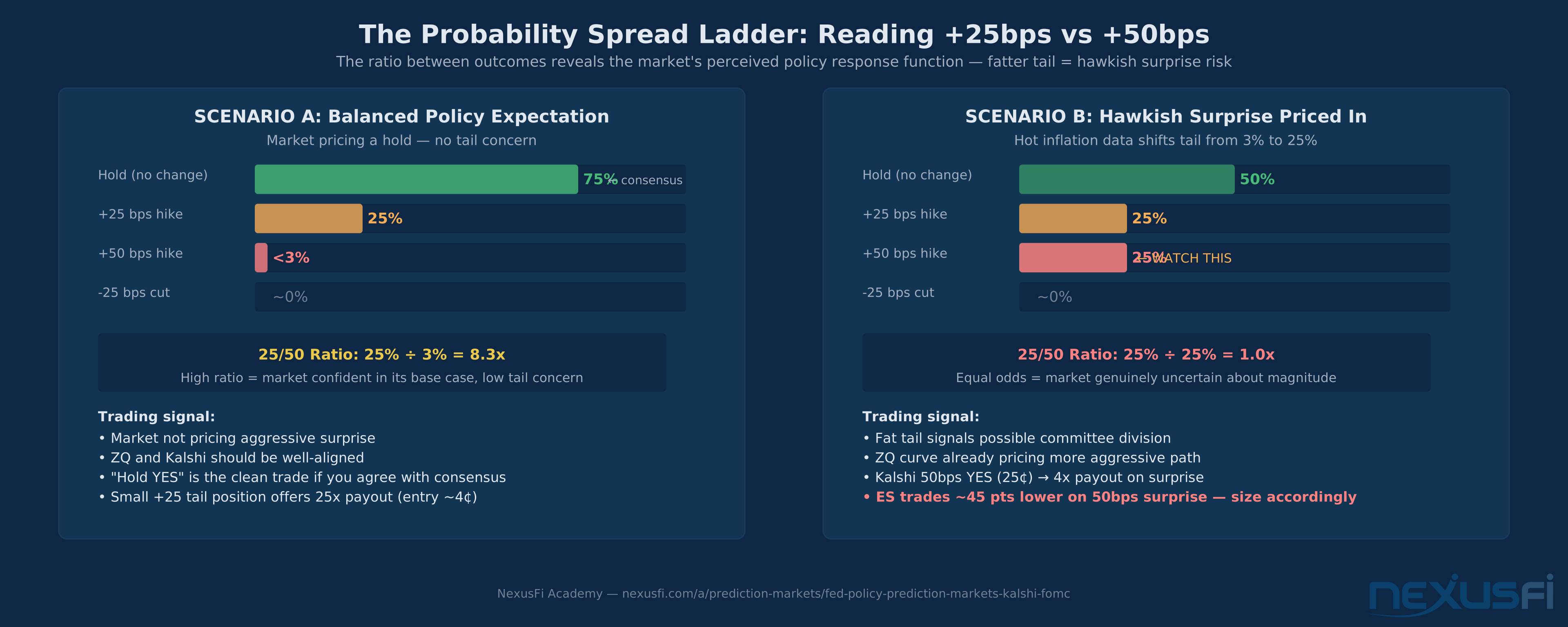
Typical divergence between platforms: 2--5% in normal conditions, occasionally 3--8% including fee friction. You'll see Kalshi showing 70% for hold while your ZQ calculation shows 65--67%. This is not arbitrage. It's structure. The divergence exists because:
- ZQ is driven by institutional hedgers, duration managers, and traders with multi-meeting views
- Kalshi attracts event traders with single-meeting conviction
- ZQ embeds the monthly averaging effect; Kalshi prices the discrete decision
- Risk premia differ across the two venues
- Timing differences in when each market reacts to new information
When the gap exceeds 10%, you have a setup trigger. Not a guaranteed trade — a trigger for investigation. Ask: why is Kalshi so much higher/lower than ZQ? Is institutional money repositioning in ZQ but retail hasn't moved in Kalshi yet? Has a data print moved one market faster than the other? Is there a structural reason (like FedWatch being delayed 10 minutes while Kalshi is live)?
If you can identify the driver and it resolves toward the mean, you have a trade. If you can't identify it, you don't have a trade — you have a speculation on a gap you don't understand.
This economist/market divergence is exactly the type of gap that now shows up between ZQ-implied and Kalshi pricing. [cite:https://nexusfi.com/showthread.php?t=13452&p=510043#post510043] Markets price what they think is priced in; Kalshi prices what participants actually believe.
What Kalshi Reveals That ZQ Doesn't #
Four structural advantages. Not theoretical — operational edges that change how you approach FOMC days.
Edge 1: Direct discrete outcome probabilities without strip calculation.
ZQ gives you an expected rate. Kalshi gives you explicit odds for each possible decision. When you're trying to assess whether the market is pricing a one-and-done hike versus a multi-hike path, Kalshi answers the immediate question directly. If Kalshi shows +25bps at 62% and no change at 38%, you know exactly what the market is pricing for this meeting. ZQ shows you an expected average rate that blends current, post-decision, and forward-path expectations.
Edge 2: Real-time sentiment during the blackout period.
This is Kalshi's most underappreciated advantage. The Fed's blackout begins approximately 10 days before each meeting. For the final 10 days, no official communication shapes expectations. Kalshi continues to trade in real time. ZQ also continues trading, but the CME FedWatch tool — the standard way traders visualize ZQ-implied probabilities — runs on a 10-minute delay. During the blackout, if a piece of economic data moves the market's estimate of what the Fed will do, Kalshi shows you that shift in real time while FedWatch catches up later.
More importantly, the blackout concentrates belief. With no new Fed speak to parse, order flow in Kalshi becomes the purest available signal of what institutional traders are actually doing. The "last positioning" dynamic often produces late-meeting probability drifts of 3--5 percentage points that aren't visible in ZQ's smooth forward curve.
Edge 3: Tail risk visualization through the probability spread.
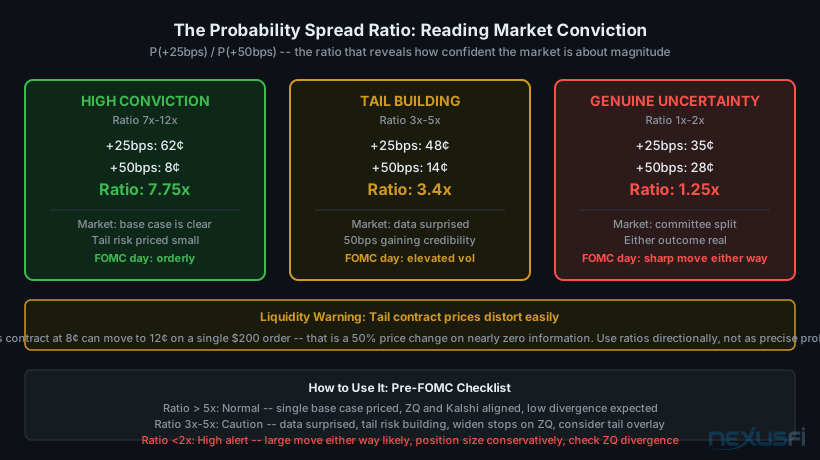
The difference between Kalshi's P(+25bps) and P(+50bps) prices is something ZQ simply doesn't show you cleanly. When +25bps trades at 62¢ and +50bps trades at 8¢, the 7.75x ratio tells you the market is pricing policy consistency. When +25bps is at 35¢ and +50bps is at 30¢, that near-1:1 ratio signals genuine committee uncertainty and a fatter tail than the ZQ curve probably reflects.
This spread is valuable because it captures the market's assessment of the Fed's reaction function slope. A hotter-than-expected CPI that makes a 50bps hike credible shows up immediately in the Kalshi spread — often faster than it shows in the ZQ strip, where multi-meeting path expectations smooth out the single-meeting tail risk.
Edge 4: Cumulative path contracts for multi-meeting views.
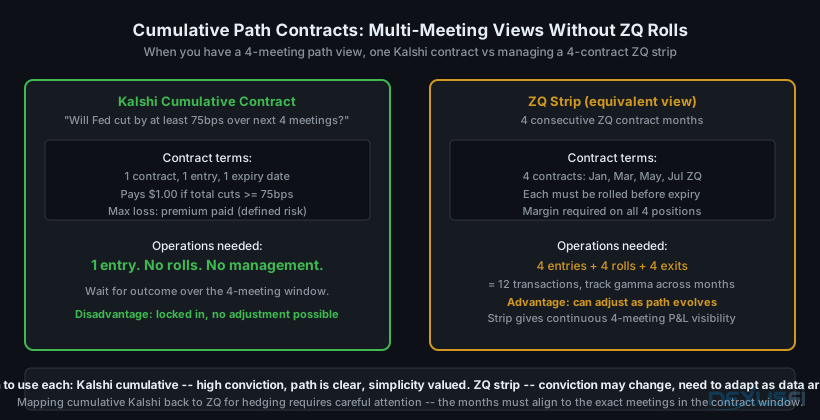
Some Kalshi series offer cumulative rate-path contracts: "Will the Fed cut by at least 75bps over the next four meetings?" These aggregate across discrete decisions in a way that's cleaner than trying to synthesize a view from multiple ZQ months. If you have a conviction about the total magnitude of policy adjustment over a horizon, a single cumulative contract captures it without the roll management complexity of a ZQ strip position.
Caveat: mapping cumulative contracts back to ZQ for hedging requires careful attention to which ZQ months correspond to which meetings. Get this wrong and your hedge is cross-gamma, not delta.
The Three-Phase FOMC Day Timeline #
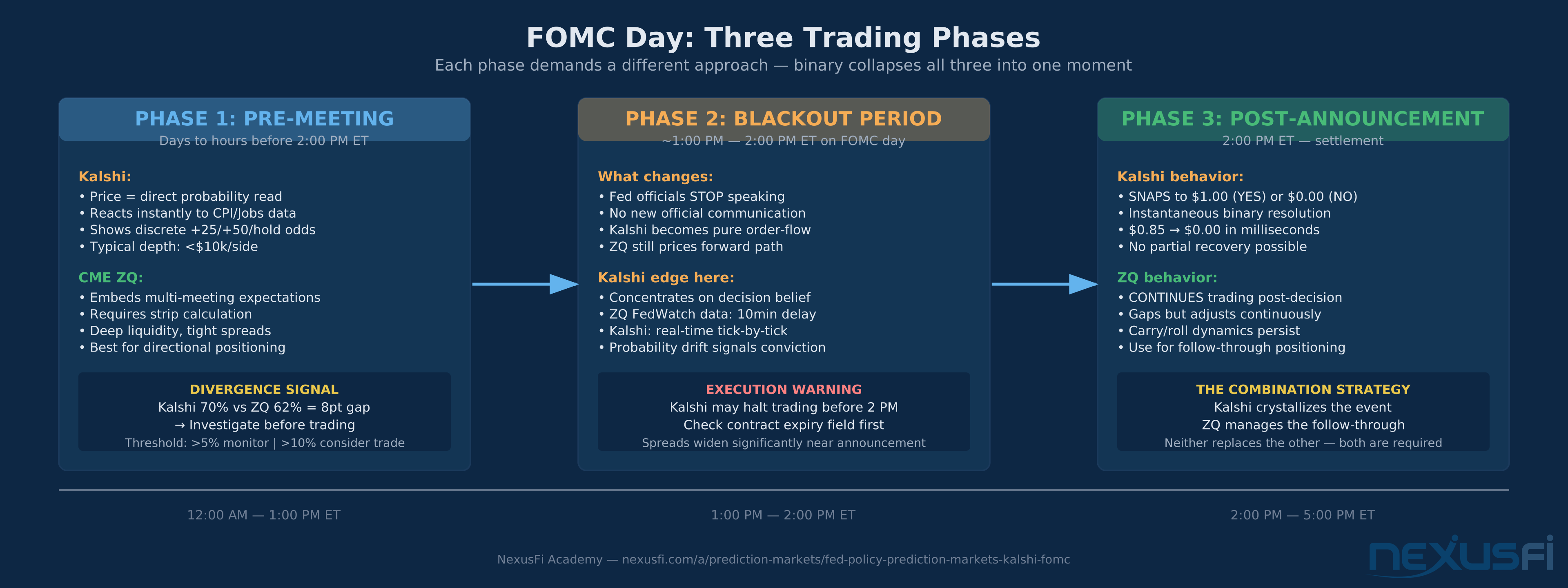
FOMC day isn't one event — it's three distinct trading environments, each requiring a different approach for prediction market participants.
Phase 1: Pre-Meeting (Days to hours before the 2:00 PM announcement)
Both Kalshi and ZQ update continuously based on incoming macro data, positioning flows, and any stray commentary that escapes the blackout. The key dynamic here is information arrival rate. A CPI print that comes in 30bps above consensus will move Kalshi's "hold" contract from 72% to 55% within minutes. The same print moves ZQ, but ZQ's response embeds not just the immediate meeting but the meetings after it — so the per-meeting signal is diluted.
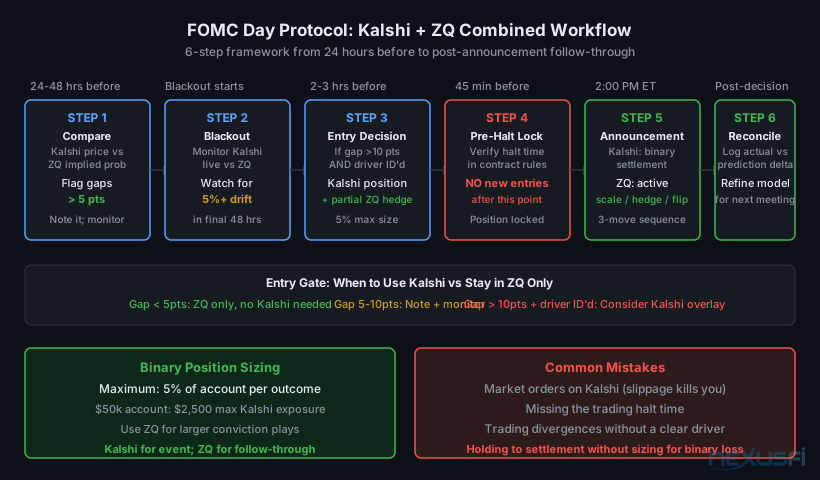
Pre-meeting is where you compare implied probabilities and evaluate divergence. If the Kalshi/ZQ gap is within 5 percentage points, alignment is normal — stay in your existing ZQ position, no Kalshi action required. If the gap is 5--10 points, note it and monitor. If it exceeds 10 points, that's your setup trigger.
The risk in Phase 1 is entering Kalshi positions too early. At 5 days out, order book depth is thinner than at 12 hours out. And your probability estimate has the most uncertainty. If you're going to take a binary position, the best risk-adjusted timing is typically within 24--48 hours of the meeting, after the bulk of economic data is in.
Phase 2: The Blackout (1:00 PM — 2:00 PM ET on FOMC day)
This is Kalshi's home field. Fed officials have been silent for 10 days. Kalshi is ticking live. ZQ still trades, but it's increasingly driven by cross-asset flows (equities, credit, FX) rather than rate-specific information.
Watch for probability drift. If Kalshi's "hold" contract moves from 70% to 78% in the 30 minutes before the halt, something is moving institutional positioning — either late data, positioning updates from large accounts, or early signal leakage. A 5%+ move in Kalshi during blackout without a corresponding ZQ move is worth noting.
Critical execution point: Kalshi halts trading before the 2:00 PM announcement. Confirm the exact halt time for your specific contract. If you're planning to hold through the announcement, your position must be in place before the halt. Missing this is an operational mistake that can't be undone.
Phase 3: Post-Announcement ($1.00 or $0.00)
The moment the FOMC decision hits the wire, Kalshi binary positions resolve. There's no "close it and take partial profit" — you either settle at $1.00 or at $0.00. This is the fundamental difference between binary event contracts and continuous futures.
ZQ continues trading post-announcement with full adjustability. If the decision surprises, ZQ can gap 12--15 ticks in the first seconds, then continue repricing over the next hour as the press conference unfolds. Traders who took risk in ZQ can scale out, add to winners, hedge the gap, or flip direction. Binary holders in Kalshi have no such flexibility.
@tigertrader's framework for FOMC day trading applies here: "the way I usually trade FOMC days is trade the 3rd move... the initial reaction to the announcement, the countermove, and then THE move." For ZQ traders, this three-move sequence is executable. [cite:https://nexusfi.com/showthread.php?t=13452&p=874911#post874911] For Kalshi holders, the first move is the only move — you're settled before the countermove even starts.
This asymmetry is why experienced practitioners use Kalshi for the event itself and ZQ for the follow-through. Different instruments for different horizons in the same trigger.
Reading the Probability Spread Ladder #
The Kalshi probability spread — specifically the relationship between P(+25bps) and P(+50bps) — is one of the most useful derived signals available on FOMC day. Here's how to read it.
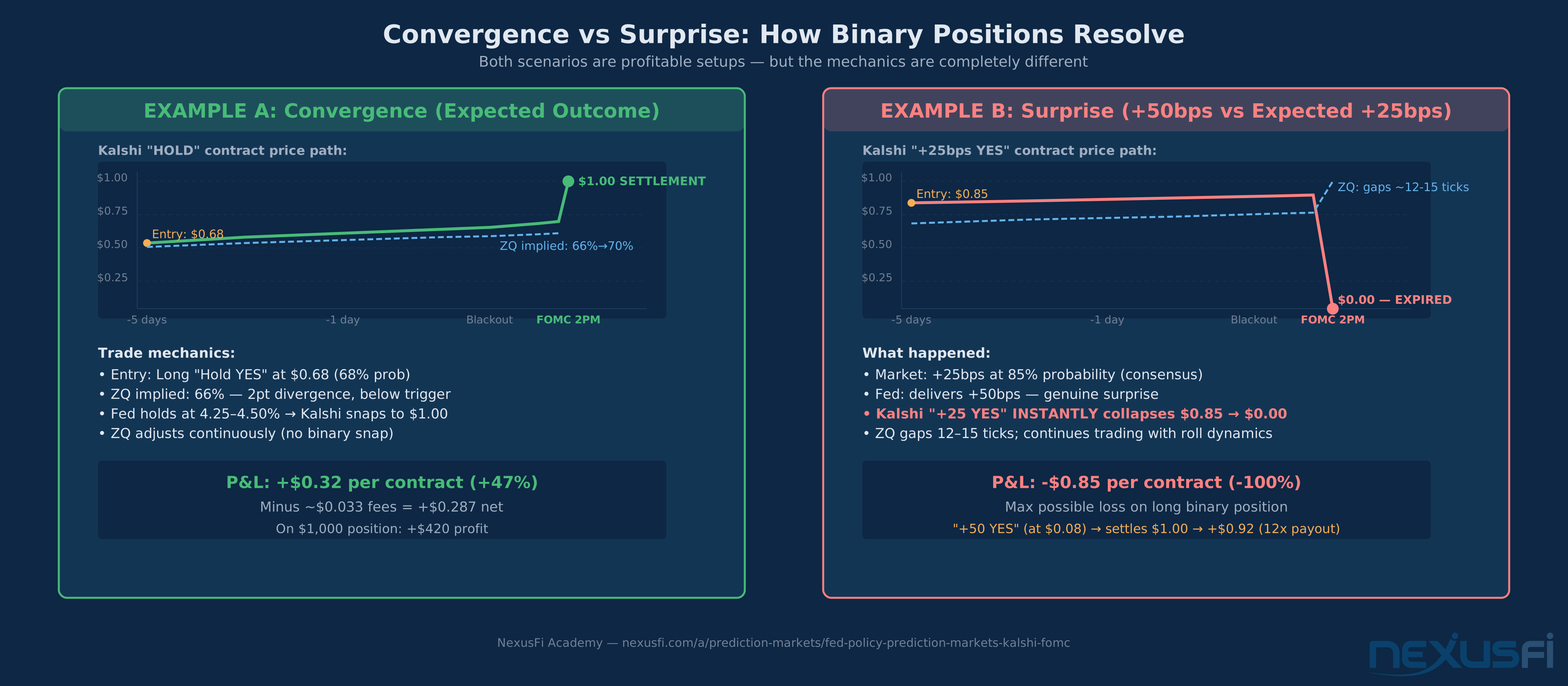
Start by pulling both contract prices. If +25bps is trading at 62¢ and +50bps at 8¢, compute the ratio: 62/8 = 7.75x. A high ratio (above 5x) means the market is confident in the base case magnitude. The committee is expected to move a specific amount; the tail is small. This is normal in stable policy environments.
If the ratio drops toward 2--3x, tail risk is building. The market is pricing meaningful probability of a more aggressive move than the base case. This usually happens after a data surprise — a hot CPI print, an employment report well above consensus, or hawkish language from a non-blackout Fed official.
If the ratio approaches 1:1 (equal probabilities for +25 and +50), the market is genuinely uncertain about the magnitude. This is relatively rare and typically precedes significant volatility regardless of the outcome. Even if the base case (+25bps) resolves correctly, the uncertainty premium means implied volatility in ZQ options will be elevated — and the actual ES reaction post-decision will be larger than in the high-ratio scenario.
One important caveat: thin liquidity in tail contracts distorts these ratios. A +50bps contract at 8¢ might move to 12¢ on a single $200 order. That's a 50% price move on almost no information. Don't treat Kalshi tail probabilities with the same confidence you'd give to ZQ mid-curve pricing. The signal is directional and qualitative, not precise.
The synthetic combination trade: if you believe the market is underpricing the +50bps tail, you can buy the +50bps YES contract directly. If you believe the market is overpricing the +25bps contract relative to the +50bps (the ratio is too high), you can buy +50bps YES and sell +25bps YES simultaneously. The net exposure is: you profit if the Fed does exactly 50bps, and you lose if they do 25bps. The cost is the net premium paid. This isolates the magnitude question from the direction question.
Risk Management #
Binary event contracts are different from futures in three specific ways that require explicit risk rules.
Liquidity risk. Kalshi's order book on Fed contracts typically shows less than $10,000 per side. Compare this to ZQ, where institutional market makers provide continuous two-sided quotes and you can transact millions of notional without moving the market. In Kalshi, a $2,000 order at market can move the probability by 2--3 percentage points. Use limit orders. Period. If you can't get your price within 1--2 cents of mid, the trade isn't worth forcing.
The 5% position size rule for binary Kalshi contracts isn't conservative — it's the upper bound. Binary positions can go to zero instantly on settlement. At 5% of account per trade, a wrong call hurts but doesn't impair your ability to keep trading. Larger size and you're gambling, not trading.
The sizing rule: cap binary exposure at 5% of account per outcome. If you have a $50,000 trading account, don't put more than $2,500 into any single Kalshi binary position. The all-or-nothing payoff means your loss on a wrong call is 100% of the premium. At 5% position size, a loss is manageable. At 25%, it's a risk-of-ruin event.
For larger views, use ZQ as the primary instrument with Kalshi as a signal/confirmation layer. If ZQ and Kalshi both confirm the same direction and the Kalshi divergence exceeds 10%, size the ZQ position normally and add a small Kalshi position as an event overlay.
Timing risk. Binary positions have no mechanism for "good enough" outcomes. A ZQ long that's profitable can be trimmed; a Kalshi YES contract can only be held to settlement or sold at the current market price before halt. The moment the trading halt triggers, your position is locked. This eliminates the ability to cut losses mid-event — a protection ZQ traders take for granted.
The practical implication: don't buy Kalshi insurance "just in case." Either you have a specific thesis about the discrete outcome and you express it through a binary, or you stay in ZQ where you have continuous adjustability. Kalshi as a "hedge" without a specific thesis is a premium burn.
Counterparty risk. CME-cleared futures carry the CME Group's clearinghouse guarantee — an institutional-grade backstop with decades of history. Kalshi is a CFTC-regulated designated contract market with its own clearinghouse structure, but the operational and counterparty framework is different. Don't allocate more to Kalshi than you'd be comfortable holding in a regulated but non-exchange-cleared product. The risk is real even if historically rare.
The ZQ delta hedge. If you want to take a larger binary position than the 5% rule permits — for example, if you have very high conviction and want $10,000 in a "hold YES" at 70¢ — consider hedging 20--30% of the ZQ equivalent exposure. If "hold YES" at 70¢ represents roughly $10,000 notional exposure to the "hold" outcome, add approximately 0.2 ZQ contracts (or equivalent ZQ options) to partially offset the delta. This reduces your all-or-nothing exposure without eliminating the binary leverage.
[cite:https://nexusfi.com/showthread.php?t=56948&p=840990#post840990] For Kalshi traders, this discipline applies to sizing — be conservative going in, because there's no reaction trade available after settlement.
When to Use Kalshi vs CME ZQ #
The instruments aren't competitors. They answer different questions.
Use Kalshi when:
- You have a specific view on a single meeting's discrete outcome (hold vs +25bps vs +50bps)
- You want defined max loss with no margin call risk
- You're trading during the blackout period and want real-time signal
- You're reading the probability spread to assess tail risk
- Your position is sized within the $10k/side liquidity constraint
Use CME ZQ when:
- You're positioning on the rate path across multiple meetings
- You need to manage a position post-announcement with continuous pricing
- You're hedging a portfolio against Fed policy risk
- You need institutional liquidity for large size
- Your thesis is about the average effective rate, not the discrete decision
The combination workflow (FOMC day protocol):
- 24--48 hours before: compare Kalshi probabilities to your ZQ-implied calculation. Flag gaps >5 points.
- Blackout begins: shift primary probability monitor to Kalshi real-time vs ZQ FedWatch.
- 2--3 hours before: if gap exceeds 10 points and you can identify the driver, consider Kalshi position with partial ZQ hedge.
- 45 minutes before halt: confirm Kalshi position is sized correctly. Verify exact trading halt time. No new entries after this.
- 2:00 PM: ZQ continues trading — this is where your carry, follow-through, and hedging work happens.
- Post-announcement: reconcile Kalshi settlement vs ZQ P&L. Log the probability-vs-price delta for model refinement.
@bobwest's hard-won FOMC lesson: "The two lessons are that (1) Early FOMC is too quiet too often to be worth messing with, and (2) I do need to figure out some better way to assess volatility." [cite:https://nexusfi.com/showthread.php?t=32236&p=718868#post718868] For Kalshi traders, lesson (2) translates directly: the probability spread is your volatility indicator. When it's compressed, the market is confident and FOMC day is a grind. When it's expanded, expect the sharp move.
Two Worked Examples #
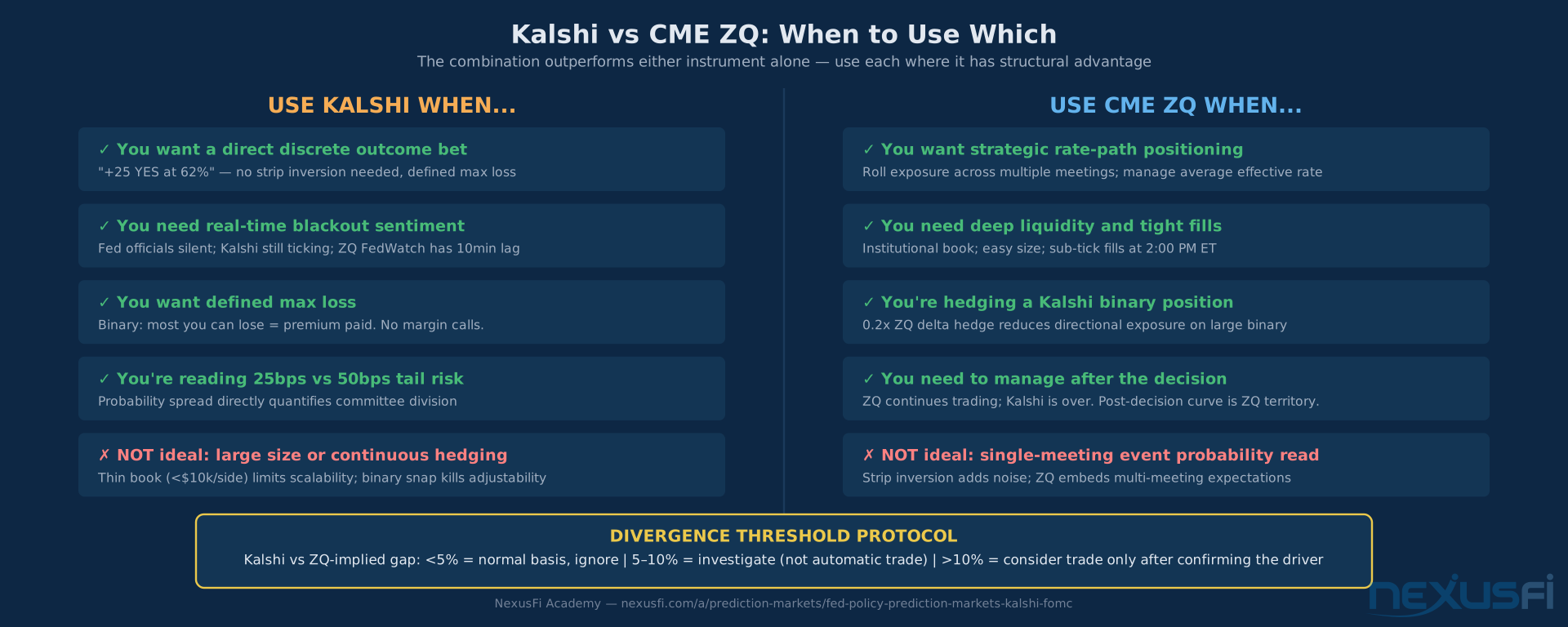
Example A: Convergence (Normal FOMC)
Setup: It's 9:00 AM on FOMC day. Kalshi "Hold YES" (4.25--4.50%) trades at $0.70 (70% probability). ZQ strip calculation shows P(hold) ≈ 66%. The 4-point gap is within normal range — the basis is structural, not signal.
You have a thesis: Fed holds. The last three CPI prints were in-line, labor market is cooling, and the dot plot showed no urgency to move. Your conviction is 75%+ that this is a hold.
Entry: Long "Hold YES" at $0.70. Limit order placed with 1¢ patience ($0.69 bid). Position size: $2,500 (5% of a $50,000 account). Max loss: $2,500. Max gain: $750 if settlement = $1.00.
Trading halt: 1:45 PM ET. You confirm this in the contract "Market Rules" field.
2:00 PM: Fed holds at 4.25--4.50%. Kalshi "Hold YES" settles at $1.00.
P&L: +$750 gross, minus $0.033/contract fees. Net ≈ +$667 on $2,500 at risk (27% return on premium).
ZQ side: your existing ZQ long (if you had one) also benefits as the forward curve reprices toward a slower path. The two instruments complement each other — Kalshi crystallized the event; ZQ captured the follow-through.
Example B: Surprise (Fed delivers +50bps when market expected +25bps)
Setup: March 2022 context. Kalshi "+25bps YES" trades at $0.85 (85% probability). "+50bps YES" is at $0.08 (8%). The 10.6x ratio implies the market is highly confident in the magnitude. ZQ is also pricing a 25bps move.
Your read: hot inflation data and multiple Fed speakers (before the blackout) signaled "we might need to move more aggressively." You bought "+50bps YES" at $0.08. It's a 12.5x payout if right.
Trading halt: 1:45 PM ET.
2:00 PM: Fed delivers +50bps. This hadn't happened in 22 years.
What happens to Kalshi:
- "+25bps YES" (the 85-cent contract): instantly collapses to $0.00. The $0.85 holders just lost 100% of their premium. This is the binary snap — there's no gradual repricing, no second chance, no cut-the-loss opportunity. The decision resolved; the contract settled. Full stop.
- "+50bps YES" (the 8-cent contract): instantly moves to $1.00. 12.5x payout in seconds.
What happens to ZQ:
- Gaps approximately 12--15 ticks (50bps move was not in the contract month average expectation)
- Continues trading as traders recalibrate the forward path
- ZQ holders who are wrong can cut, hedge, or manage the position
The contrast: Kalshi's binary resolution is instant and irreversible. ZQ's continuous repricing allows adjustment. In a surprise scenario, the Kalshi loss crystallizes immediately; the ZQ loss can be managed.
[cite:https://nexusfi.com/showthread.php?t=55124&p=895169#post895169] — the market's initial bars after announcement are often misleading, and the real direction emerges later. For Kalshi, that "real direction" is irrelevant — you're settled before the market figures out what to do.
Limitations: When This Approach Breaks Down #
The Kalshi/ZQ combination has specific failure modes that experienced traders need to understand before they rely on it.
When the meeting is binary in an unexpected way. Prediction markets work best when outcomes are within the discrete menu offered. If the Fed takes an historically rare action — an emergency cut between meetings, a surprise policy framework change, or a statement without a rate change — Kalshi contracts may resolve in ways you didn't anticipate. The resolution criterion is the official target range change, but edge cases exist. Read the contract rules.
When liquidity evaporates at the wrong moment. During the period right before the trading halt, Kalshi spreads widen much. If you need to exit a position in the 15 minutes before halt, you may face a 4--5 cent spread on a contract that was trading 1 cent wide an hour earlier. This slippage can materially affect returns on round-trip trades timed close to the announcement.
When the probability gap is structural, not signal. A persistent 8-point gap between Kalshi and ZQ-implied probability might simply reflect the different participant bases and settlement mechanics — not mispricing. Trading this gap aggressively without understanding the driver is a reliable way to lose the basis multiple times before catching a real divergence once.
When your ZQ model has errors. The strip inversion from ZQ to implied probability for a single meeting is sensitive to assumptions. If you're using a simplified two-scenario model (hold vs. hike) when the true distribution is three or four outcomes, your ZQ-implied number will be wrong — and your "divergence signal" will be noise.
During overlapping macro catalysts. If a CPI print or jobs report drops on the same day as an FOMC meeting (rare but it happens), both markets will be moving on data that affects the decision. Kalshi may react to the data specifically for this meeting while ZQ prices the full forward curve impact. The divergence can be real and large, but the driver is identifiable — and tradeable.
The Federal Reserve's own research paper on Kalshi and macro markets (published 2026) found that prediction market probabilities provide statistically independent information beyond what CME futures price — especially for non-consensus outcomes and in the 48-hour window before decisions. The incremental informational value is real. But so is the liquidity and execution risk.
The right framing: Kalshi is a precision instrument with limitations. Use it for what it does uniquely well — direct discrete probabilities, defined max loss, real-time blackout signal — and stay in ZQ for everything else.
Knowledge Map
Prerequisites
Understand these firstGo Deeper
Build on this knowledgeReferences This Article
Articles that build on this topicCitations
- — Spoo-nalysis ES e-mini futures S&P 500 (2015) 👍 9“september fed funds futures contract is discounting about 4 of 10.5 bp or about a 40% chance of a hike for which economists say there is more than an 80% chance”
- — Spoo-nalysis ES e-mini futures S&P 500 (2022) 👍 9“the way I usually trade FOMC days is trade the 3rd move -- the initial reaction, the countermove, and then THE move”
- — Making a Living with the Micros (2021) 👍 11“I was FLAT going into the news at 2:00 pm ET. I have learned the hard way that I must not trade the news, but just the REACTION to the news”
- — Trade Journal (2019) 👍 12“Early FOMC is too quiet too often to be worth messing with. I do need to figure out some better way to assess volatility.”
- — Diary of a simple price action trader (2024) 👍 5“On the charts the high and the low of the 4th 10min bar (signal bar) after the release of the FOMC Statement are marked”
- — Spoo-nalysis ES e-mini futures S&P 500 (2022) 👍 5“I looked at the fed funds futures for November, priced as 100-{price} as the average daily rate for the month”
- — Diary of a simple price action trader (2024) 👍 2“Tom Hougaard tested every FOMC day he could get data on -- found something specific on the 10min chart, the 4th bar after the announcement”
- — Is the WH trying to engineer a recession? (2025) 👍 2“The Z25 contract closed at 96.35 last night which implies a Fed Funds rate of 3.65% in December. Current rate is 4.33%.”
- — Prediction Markets vs CME Fed Watch: A New Age of Forecasting Federal Reserve Decisions (2024)
- — Prediction Markets and the Macroeconomy: Kalshi and the Rise of Macro Markets (2026)
- — ES News Releases (2019) 👍 6“The most important one is FOMC announcements. It is wise not to be trading right at 2:00 PM -- the initial move is often misleading and the real direction emerges later.”