



Position Sizing for Funded Trading Accounts: Matching Lot Size to Your Drawdown Rules
Overview #
Here's what kills most funded traders: they size like they're trading their own account.
They see "$50,000" in the account name and treat it like they have $50,000 to work with. They don't. They have their drawdown budget — usually $2,500 to $3,000 — and that's the only number that matters for position sizing. The $50k label is a marketing convention, not a risk parameter.
This distinction sounds simple. It isn't. Applying it correctly requires a completely different sizing framework from anything you've used in a personal account. Most funded trader guides skip the math that makes it work and focus on strategy tips instead. This article covers exactly the math.
The framework here applies to any funded evaluation account — Apex, Topstep, Earn2Trade, Leeloo, and similar structures. The mechanics vary by firm, but the core principle is universal: your position size flows from your drawdown budget, not your margin availability.
The Funded Account Reality: What "$50K" Actually Means #
A typical $50,000 funded account gives you:
- $50,000 in nominal account balance (the marketing number)
- Day trading margins — usually $500-$1,000 per contract for ES, $50-$100 for MES
- A maximum drawdown of $2,500-$3,000 before account termination
That last number is your actual account size from a risk perspective. Run the math:
On a personal $50,000 account with a 2% per-trade risk rule, you'd risk $1,000 per trade. On a funded $50,000 account with a $2,500 trailing drawdown, risking $1,000 per trade means a single bad trade wipes out 40% of your termination buffer. Three losses at that size and you're done, regardless of your win rate on the other trades.
The margin availability creates a trap. Your broker may let you run 50 ES contracts on a $50k funded account — the margin is there. But 50 ES contracts that move 2 points against you is $5,000, doubling your max drawdown in a single trade. Margin capacity and sizing capacity are completely different animals in funded accounts.
Anchor everything to the drawdown number. It's the only one that matters.
How Trailing Drawdown Actually Works #
Before touching sizing, understand exactly what terminates your account — because there's a critical mechanic that most traders miss until it costs them.
Most funded accounts use a trailing drawdown: the termination floor rises as your account peaks, and it never drops back down once set. The calculation typically uses open P&L (unrealized), not just closed trades.
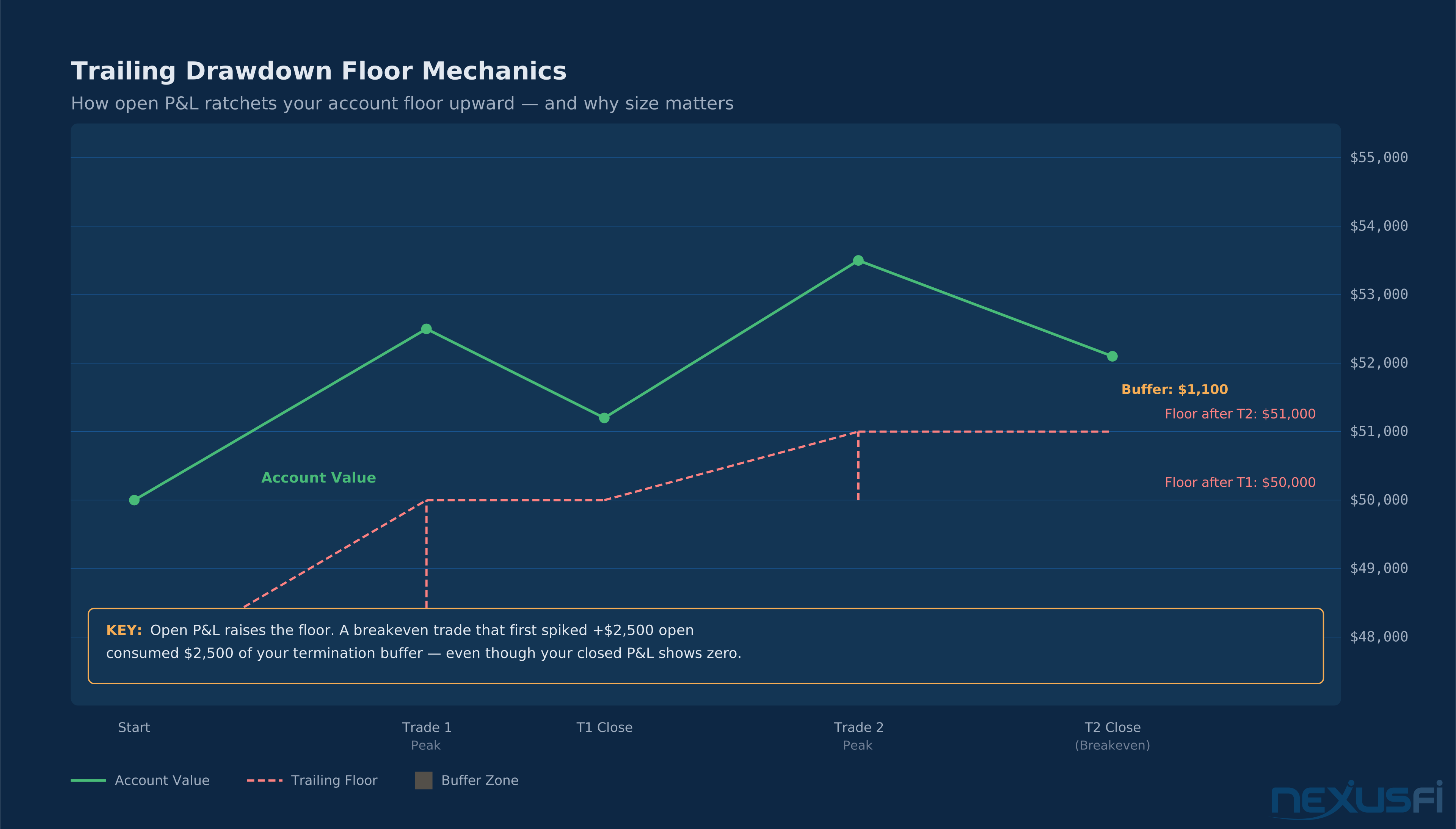
Here's how the math plays out on a $50k Apex-style account with $2,500 trailing drawdown:
- Starting balance: $50,000
- Initial floor: $47,500 (balance minus max drawdown)
You buy 3 ES contracts. Price runs 15 points in your favor.
- Open P&L: +$2,250 (3 contracts x $50/point x 15 points)
- Account high water mark: $52,250 (open, real-time)
- New floor: $52,250 - $2,500 = $49,750
Price reverses. You get stopped out at breakeven. Closed P&L: zero.
- Account balance: $50,000 (unchanged)
- But floor is now: $49,750
You burned $2,250 of your termination buffer from a breakeven trade. The $50,000 account now has just $250 of buffer before termination — and you haven't lost a single dollar on closed P&L.
This is not a flaw in the rules — it's the mechanism. Build your sizing model around it.
Never track funded account floor risk solely on closed P&L. Your real-time floor is calculated on open P&L. Check your platform's "Account Overview" or "Balance" panel for the trailing stop-out value during live trading — that number changes as your open positions move.
The Foundational Formula: Size from Drawdown, Not Margin #
The core sizing equation for funded accounts:
Maximum contracts = (Trailing drawdown remaining x risk fraction) / (stop loss in ticks x tick value)
Where:
- Trailing drawdown remaining: Current account balance minus current floor
- Risk fraction: How much of that buffer you're risking per trade (typically 8-12%)
- Stop loss: Your stop distance in ticks
- Tick value: Dollar value per tick for the instrument
Working example — $50k funded account, $2,500 initial buffer, 10% risk fraction:
Available to risk per trade: $250 (10% x $2,500)
ES trade with 4-tick stop:
- 4 ticks x $12.50/tick = $50 risk per contract
- $250 / $50 = 5 contracts maximum
But check the contract limit first. Most $50k accounts cap at 3-5 ES contracts. If the limit is 3:
- 3 ES contracts x $50 tick risk = $150 risk per trade
- That's 6% of a $2,500 buffer per trade
- After 16 consecutive full-stop losses with zero wins, you'd hit termination
That last number matters: 16 consecutive losses at max stop before termination, assuming zero unrealized gains ratchet the floor upward. In practice, any winning trades that run before reversing will reduce that buffer faster — which is why the open P&L mechanic compounds this.
Max Contracts = (Drawdown Buffer x Risk Fraction) / (Stop Ticks x Tick Value)
Example: ($2,500 x 10%) / (4 ticks x $12.50) = $250 / $50 = 5 contracts
Compare this to sizing a personal $50,000 account at the same 10% risk level:
- Available to risk: $5,000 per trade (10% of $50,000)
- $5,000 / $50 = 100 contracts — obviously subject to margin and common sense
The difference is stark. Funded accounts demand roughly 1/20th the position size of a personal account at the same risk-fraction-to-balance ratio, because the relevant balance is the drawdown budget, not the nominal figure.
The Consecutive Bad Days Framework #
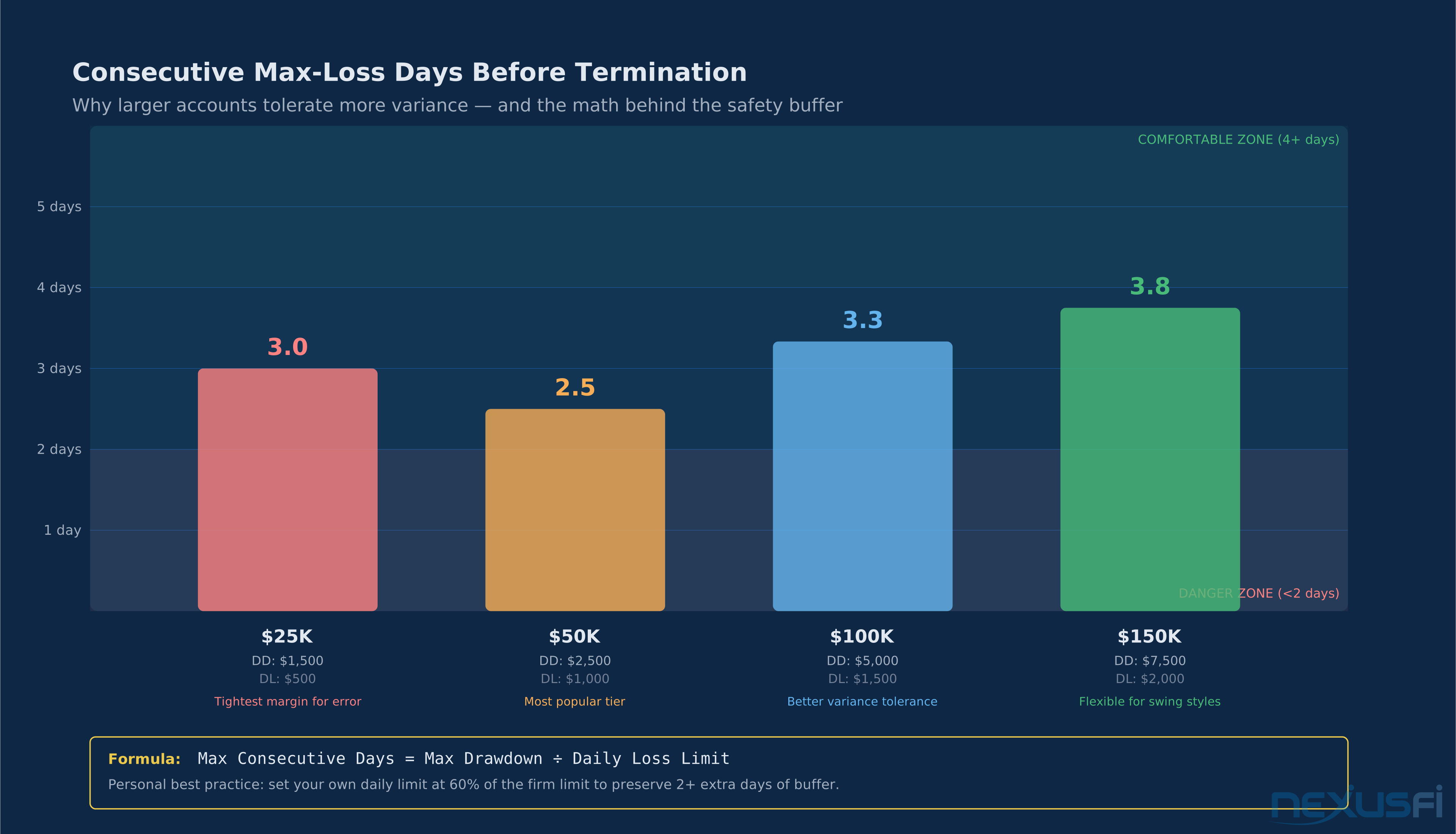
The most practical way to calibrate funded account sizing isn't top-down (account balance to position size). It's bottom-up: how many consecutive maximum-loss days can your account absorb before termination?
Max consecutive max-loss days = Trailing drawdown / Daily loss limit
For a $50k account with:
- Trailing drawdown: $2,500
- Daily loss limit: $1,000
Max consecutive max-loss days: 2.5 — meaning after 2 full days at -$1,000 and hitting a third day with just -$500, you're terminated.
@shokunin described this approach precisely when discussing Earn2Trade funded accounts:
The key insight from @shokunin's breakdown: the $100k account at Earn2Trade offers 7 consecutive max-loss days of tolerance versus 3 on the $25k account. That's not just more capital — it's at the core different trading psychology. Seven bad days in a row before termination means you can weather real drawdown sequences without panic-trading. Three bad days is almost a toss-up with variance alone.
Typical buffer comparisons across major account tiers:
| Account | Max Drawdown | Daily Limit | Consecutive Max Days |
|---|---|---|---|
| $25K | $1,500 | $500 | 3.0 |
| $50K | $2,500 | $1,000 | 2.5 |
| $100K | $5,000 | $1,500 | 3.3 |
| $150K | $7,500 | $2,000 | 3.75 |
The $50k account is often the worst in terms of consecutive day tolerance relative to its size. The math is tighter than traders expect when they choose it for the lower monthly fee.
Daily Loss Limit Backward Engineering #
Your daily loss limit is the most important number in your sizing model. Everything flows from it.
Start with the daily loss limit and work backward:
Step 1: Set your personal daily limit below the firm's limit.
If the firm allows -$1,000/day, set your personal limit at -$600 to -$650. This gives you 1.5+ extra days of buffer before the firm's automated shutdown would trigger. It also prevents the firm's system from liquidating you in a fast market — if you self-stop at -$600, there's room for the platform's automation to execute cleanly at -$1,000 if something goes wrong.
Step 2: Calculate per-trade risk from your personal daily limit.
Personal daily limit / expected maximum trades per day = max risk per trade
Example: $600 personal limit, 3-4 trades per day expected maximum
- $600 / 4 = $150 per trade maximum risk
Step 3: Calculate max contracts from per-trade risk.
$150 / (stop ticks x tick value) = contracts
For ES with a 4-tick stop:
- $150 / $50 = 3 contracts maximum
That's the architecture — personal limit as the daily stop, firm limit as the catastrophic backstop.
The trap @matthew28 ran into illustrates why this has to be tight: once the rules "screwed down tighter" at the funded stage versus the evaluation, the risk budget changed, but traders often don't recalculate their sizing for the new constraints.
Don't assume your evaluation sizing carries directly to the funded account. Funded stage rules often differ from evaluation rules — lower daily limits, tighter trailing drawdown, different contract caps. Recalculate all sizing parameters when you transition.
The Open P&L Trap: Unrealized Gains Are Floor Poison #
This is the mechanic that blindsides traders who've been managing risk only on closed P&L their entire careers.
In funded accounts, every open position that runs in your favor moves the trailing floor upward. When price reverses and stops you out, your closed account balance may be unchanged — but your floor has risen, consuming your buffer permanently.
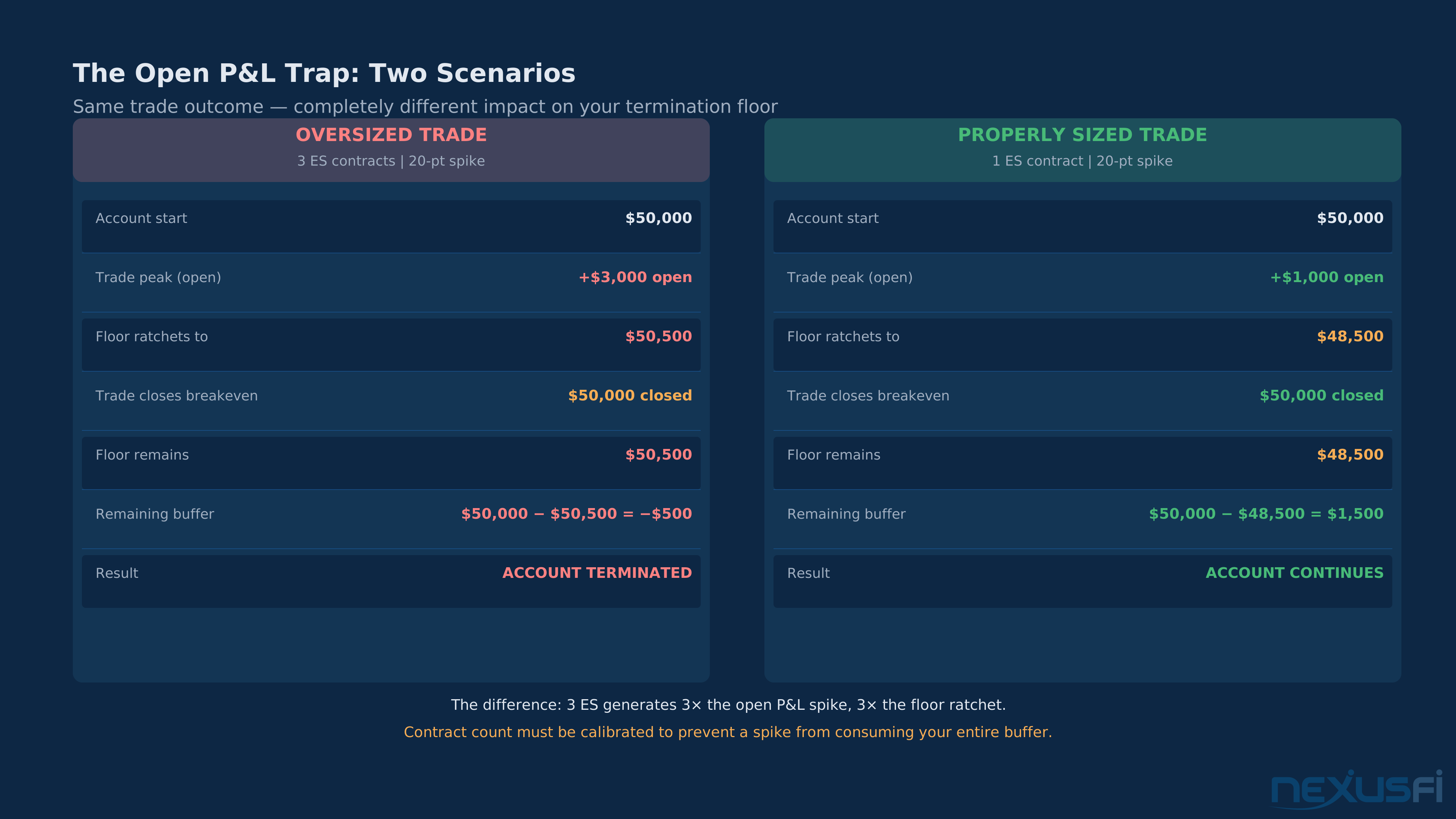
@Mordecai documented this dynamic precisely while trading a Leeloo 150k evaluation:
The key principle: size positions such that even a maximum adverse open run (price going your direction before reversing) won't consume more than 20-30% of your remaining buffer.
Practical guidelines:
- Scale size to contain spike risk: If your buffer is $2,000 and a trade could theoretically run $1,500 in your favor before reversing, your size is too large for the buffer.
- Use profit targets, not open-ended trails: Funded accounts are not compatible with "let winners run indefinitely." The trailing floor mechanic punishes this behavior. Take partial profits at predetermined levels.
- Watch open P&L in real-time: Most platforms display your real-time trailing stop-out value. Use it. The number you care about during a live position isn't your P&L — it's how far your current floor is from your current account value.
- Buffer calculation uses HWM, not closing balance: Your floor is set by the highest open account value, not just by your best closed day. A session that peaked at +$2,000 before closing at +$500 sets the floor at the +$2,000 level.
Sizing by Buffer Health: The Three-Tier System #
Not all trading days start with the same buffer. Your sizing should adjust dynamically based on how much drawdown budget remains.
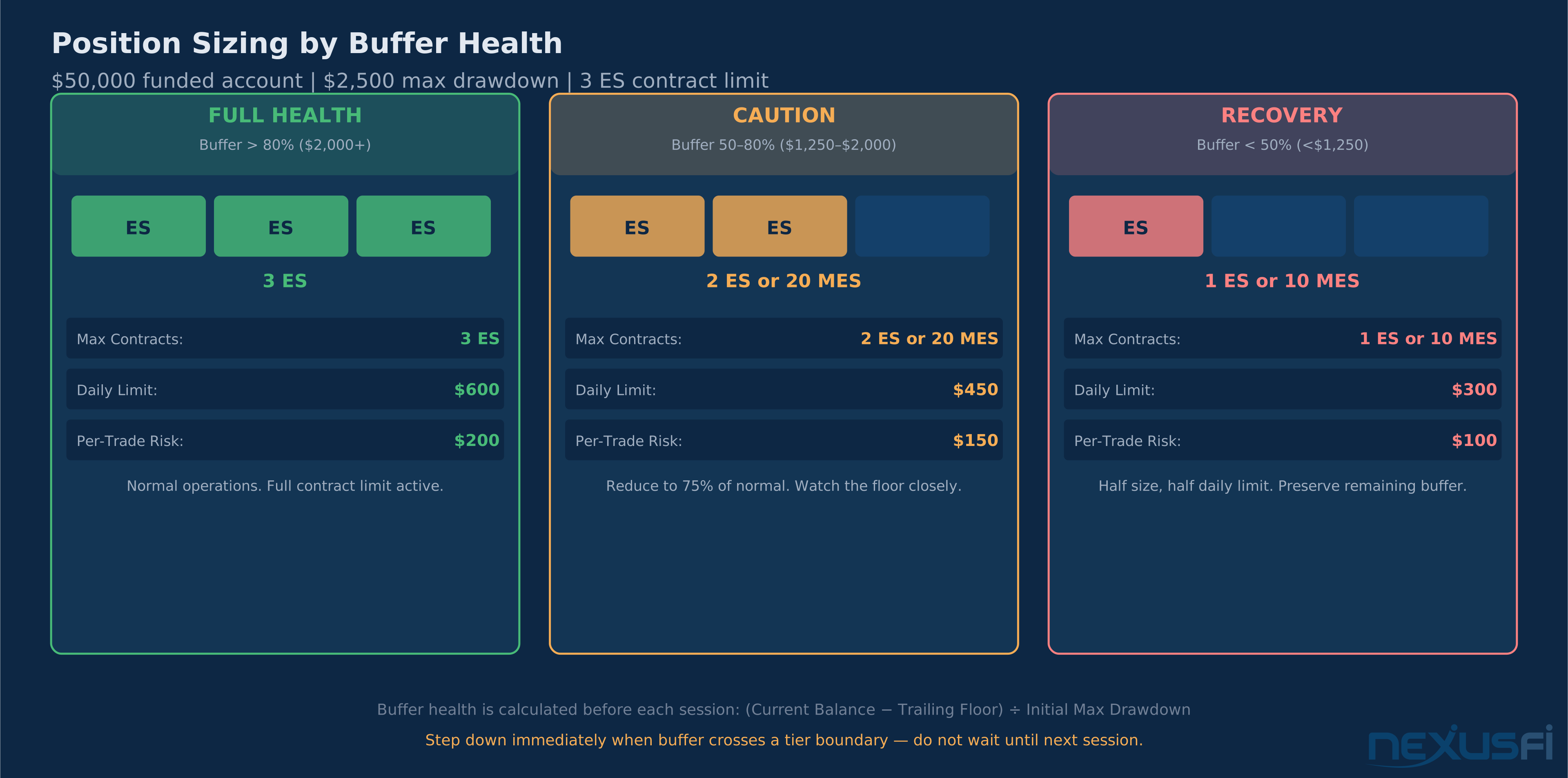
Buffer health = (Current balance - Current floor) / Initial max drawdown
| Buffer Health | Threshold | Action |
|---|---|---|
| Full | >80% | Normal sizing, full contract limit |
| Caution | 50-80% | Reduce to 75% of normal size |
| Recovery | <50% | Half size, half daily limit |
For a $50k account with $2,500 initial drawdown:
Full health (>$2,000 remaining): 3 ES, $600 personal daily limit, $200 per-trade risk
Caution ($1,250-$2,000 remaining): 2 ES or 20 MES, $450 personal daily limit, $150 per-trade risk
Recovery (<$1,250 remaining): 1 ES or 10 MES, $300 personal daily limit, $100 per-trade risk
The step-down happens before the session, not reactively during trading. Checking buffer health mid-session and then reducing size is better than nothing — but the decision lag has already cost you during the opening moves.
@trekke runs this protocol explicitly on NQ funded accounts:
The NQ equivalent of this framework: once the trailing buffer drops below $2,200, the full NQ is off the table. Micros take over at a proportionally reduced risk level. The contract changes but the underlying math stays constant — risk scales with available buffer.
Buffer health drives contract count. Calculate it before every session. The difference between trading a $2,400 buffer and an $800 buffer on the same 3-contract position is the difference between still having an account next week or not.
Micro vs. Full Contract Strategy #
The availability of micro contracts — MES (micro ES), MNQ (micro NQ), MCL (micro crude) — changes the funded account sizing game dramatically. Funded firms generally allow micros at the same 10:1 contract count as their full equivalents, so a firm that caps you at 3 ES typically caps you at 30 MES.
Use case 1: Buffer preservation in caution or recovery mode
Rather than trading 1 ES when your drawdown formula says you shouldn't run full size, trade 7-10 MES. The risk-per-trade is basically equivalent but the granularity is 10x better. You can scale out of a winning position at 2 MES at a time rather than going from 1 ES to flat. You can add back 1-2 MES when conditions confirm rather than committing to a full ES contract.
Use case 2: Step-down protocol after drawdown
When the trailing buffer drops below 50%, transitioning from ES to MES at proportionally equivalent size gives you control through a recovery period. The binary nature of a single ES contract — you either own it or you don't — becomes a liability when you need to manage risk at granular levels.
Use case 3: The hybrid approach
Some funded traders use a hybrid entry: initial position in MES (say, 5 MES = 0.5 ES equivalent), scaling to full ES contracts only after the trade confirms direction. This limits the open P&L spike risk during the uncertainty phase of the trade while preserving the ability to run with a full position once direction is established.
The math doesn't change — 10 MES equals 1 ES in terms of P&L — but the execution flexibility improves substantially when you're managing a funded account under tight drawdown constraints.
Contract Limits and Tier Scaling #
Every funded account has a contract limit — the maximum number of contracts you can trade simultaneously. This is separate from what your drawdown math would allow, and it often binds before the math does.
Typical limits by nominal account size:
| Account | Standard ES Limit | MES Equivalent |
|---|---|---|
| $25K | 2-3 ES | 20-30 MES |
| $50K | 3-5 ES | 30-50 MES |
| $100K | 5-10 ES | 50-100 MES |
| $150K | 10-15 ES | 100-150 MES |
Many firms also scale contract limits based on profitability milestones.
This creates a specific optimization problem: early in the account life, when your drawdown math might support 3 contracts, you're capped at 2. The answer is to treat the early period as a runway phase — build cushion, not P&L. The contract ceiling unlocks as you demonstrate profitability, at which point your drawdown buffer has also typically grown.
The practical conflict: after a profitable run, the higher buffer health suggests you could run larger size, and the contract limit has now unlocked to allow it. This is when oversizing typically happens. Just because the contract limit says 5 ES doesn't mean your drawdown math supports 5 ES. Check both.
The size decision rule: Take the lower of (drawdown formula output) and (current contract ceiling). Never use either in isolation.
Recovery Sizing: Adjusting After a Drawdown Sequence #
When the trailing buffer has thinned, the standard response is to reduce size. The specific formula:
Recovery contracts = Normal contracts x (Remaining buffer / Initial buffer)
Example — $50k account, initial buffer $2,500, currently at $1,200 remaining:
- Recovery ratio: $1,200 / $2,500 = 0.48
- Normal size: 3 ES
- Recovery size: 3 x 0.48 = 1.4 — round to 1 ES (or 12-14 MES)
This is conservative by design. The alternative — maintaining normal size while the buffer is thin — means a single bad day eliminates what's left.
Recovery sizing must also include a proportional daily limit reduction:
- If normal daily limit is $600, at 0.48 buffer ratio: $600 x 0.48 = $290 — round up to $300
The recovery trap: The instinct after losing is to make it back quickly with larger size. This is how funded accounts spiral:
Bad day — oversized to recover — second bad day — account terminated.
The correct protocol is the opposite: reduce size, reduce daily limit, preserve the buffer. A funded account with $500 remaining can still be rebuilt. An account at termination cannot.
Mandatory step-down threshold: When buffer falls below 40%, mandatory switch to micros only, daily limit cut by 50%. This is non-negotiable. The math at <40% buffer makes normal sizing a near-certain termination path within 1-2 sessions.
When Funded Account Sizing Fails #
The sizing framework breaks down in three specific scenarios:
1. Volatility spike mid-trade
You sized for a 4-tick stop on ES ($50 per contract x 3 contracts = $150 risk). A FOMC statement or NFP print hits and price gaps 20 ticks through your stop before you can exit. Actual loss: 20 ticks x $12.50 x 3 contracts = $750 — five times your planned risk, consuming 30% of a $2,500 buffer in a single trade.
Mitigation: During high-impact scheduled events (FOMC, CPI, NFP, JOLTS), cut size to 1 contract maximum or stay flat entirely. The funded account's drawdown limits make news trading a negative-EV proposition at normal size, because the gap risk far exceeds the daily limit protections.
2. The daily limit automation gap
Funded platforms run automated daily loss limit closures, but they're not instant. In fast markets, the system may liquidate at materially worse prices than the limit value. Set your personal limit $100-$200 inside the firm's limit, giving the automation room to execute properly.
3. The floor miscalculation
The floor is calculated in real-time on open P&L. If you lose track of where the floor actually is while positions are open — especially after a trade that spiked strongly in your favor — you may believe you have more buffer than you do. Most platforms display the stop-out value in real-time. Check it before adding to a position, not after.
High-impact news events kill funded accounts at normal sizing. The volatility premium during news windows — gaps through stops, slippage on liquidation, bid-ask spread blowout — can exceed your daily loss limit on a single trade. Know the economic calendar. Be flat or at minimum size during high-impact releases.
Practical Application: Pre-Session Sizing Checklist #
Before every session, run this checklist. It takes two minutes and prevents the most common funded account mistakes.
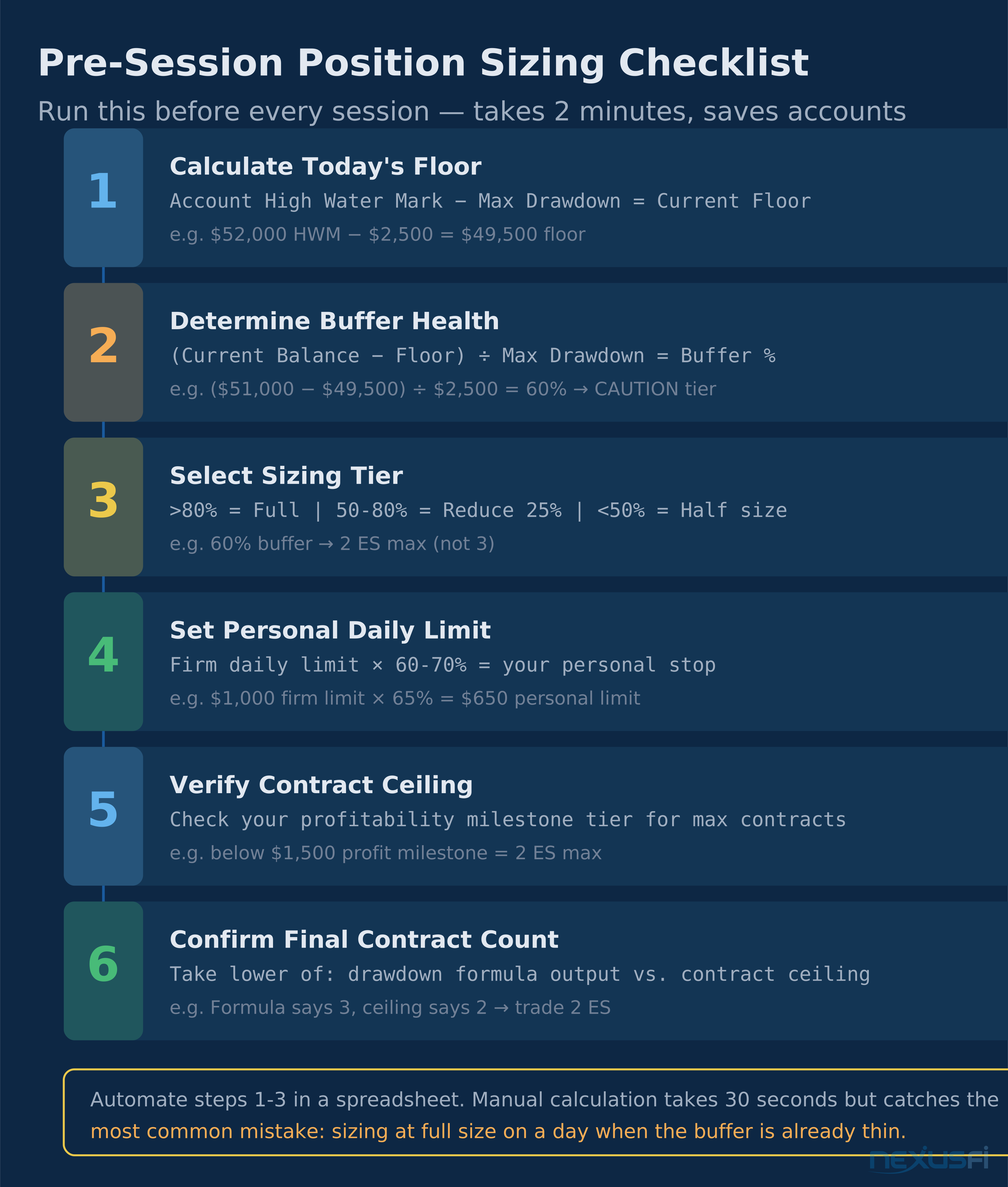
Step 1: Calculate today's trailing floor.
- Account high water mark (from yesterday's close) minus max drawdown = current floor
- Platform displays this, but verify manually if you had any open positions that ran much in either direction
Step 2: Calculate remaining buffer.
- Current account balance minus floor = buffer remaining
- If balance is close to floor, treat this as a warning sign even if it's not at the mandatory step-down threshold yet
Step 3: Determine buffer health tier and corresponding size.
- >80%: Full tier (3 ES, $600 personal limit)
- 50-80%: Caution tier (2 ES or 20 MES, $450 personal limit)
- <50%: Recovery tier (1 ES or 10 MES, $300 personal limit)
Step 4: Check contract limit for profitability milestone.
- Are you above or below the profitability threshold that unlocks additional contracts?
- If below the milestone, cap at the lower contract count
Step 5: Confirm today's personal daily limit.
- This should be set in your platform before you place a single order
- Most platforms allow hard stop-out settings at a user-defined loss amount
Step 6: Set final contract count as the lower of (tier maximum) and (contract ceiling).
- Document this in a session log, not just in your head
- If you're tempted to go above this number during the session, refer back to the log
This checklist should become mechanical. The decisions that feel easy in the morning ("I'll just size normally today, the buffer's fine") are the ones that blow funded accounts in the afternoon.
Integration with Other Funded Account Rules #
Position sizing doesn't operate in isolation. Three funded account rules interact directly with sizing:
Consistency requirements: Many firms require no single day's profit to exceed a percentage of total account profits — typically 30-50% of total profits in a single day. This constrains your upside sizing as well as your downside. Swinging for a large one-day profit may void payout eligibility even if you stay within drawdown limits. If your firm has consistency rules, your sizing ceiling in both directions is tighter than drawdown math alone would suggest.
Overnight and weekend positions: If your firm allows overnight holds, the sizing model changes. Overnight gaps can bypass daily loss limit protections entirely — a Sunday evening gap on ES can open far outside any intraday limit. Standard adjustment: reduce overnight size to 25-50% of intraday sizing, with all stops placed before market close. Never rely on next-morning stop placement.
Maximum position duration: Some firms have maximum hold time rules (e.g., no positions held more than 3 minutes). If your sizing assumes being able to let positions develop, but the rules require rapid exits, your planned stop distances may be unrealistic — which changes the sizing math entirely.
Read your funded account agreement carefully on each of these. Sizing correctly within the drawdown framework but violating another rule terminates accounts just as efficiently.
Knowledge Map
Go Deeper
Build on this knowledgeReferences This Article
Articles that build on this topicCitations
- — Funded Trader platforms (2024) 👍 8“When your value goes from $2,500 to $4,000, open profit or not, it's yours. Not taking any profit there is the same thing as choosing to buy at that level and put in a stop.”
- — Earn2Trade Trader Career Path (2022) 👍 3“My strategy requires trading a position size based on the trailing drawdown available, not the margin available.”
- — Leeloo 150k Tryout Scalping Journal (2022) 👍 4“The aim is to avoid a big spike into profit, as unrealized profit moves the trailing DD.”
- — My NQ Trading Journal (2024) 👍 4“At the end of each day I calculate the trailing threshold for each account.”
- — m28 End of Week Journal (2019) 👍 20“I choose $460 which I thought would allow me two full day losses before reaching the maximum weekly loss of $1,000.”
- — Advice from traders with 5+years experience (2019) 👍 82“[QUOTE=jsd45;189371]I graduated college and have been trading for about 7 months....For the more experience traders, what are somethings you did as rookie trader that you look back on and wish you hadn't? Any other advice would be greatly appreciated to...[/QUOTE] Educate yourself. The [URL="http”
- — Battle of the Bots - NinjaTrader Algorithmic Strategy Development (2019) 👍 79“[IMG]https://nexusfi.com/images/battle_of_the_bots.gif[/IMG] How about a fun challenge to those who believe they can create an automated strategy that is profitable? My intention is to start a discussion where algo traders can show off their strategies and learn something in the process. This is t”
- — THE CLIFFS NOTES VERSION OF MY APPROACH TO TRADING (2019) 👍 60“[COLOR=#000000][FONT=Verdana]This article is intended for the edification of all who are interested, but is especially intended for those who are just starting out. There is not any information in this text that experienced traders haven’t seen before. In fact, everything that is mention”
- — Trading fast markets (2019) 👍 57“Here we go. I applied for a Combine yesterday and today is my first trading day. I have introduced myself in my first thread now moved from Elite to regular forum, so if you are interested - feel free to check it out. It also includes my pre-combine practice with both methodology and CTS T4 platform”
- — The PandaWarrior Chronicles (2019) 👍 48“Today I want to present a snap shot of my journey with some bullet points detailing some difficulties, lessons learned and then finish it off with a freeze frame of where I am currently and a projection of the future in terms of actions I am taking and will take. Some of what I post here I have not”