



Prop Firm Risk Rules and Drawdown Mechanics: The Constraints That Shape Every Funded Trader's Strategy
Overview #
You hit your profit target on day 14. Three days later, your account is terminated — while you're still net profitable for the month. You didn't blow up on a bad trade. You didn't violate the daily loss limit. You got caught by trailing drawdown, the rule that quietly ratchets the floor beneath you every time you make money.
That scenario plays out constantly across funded trading evaluations. The rules aren't just guardrails — they're the game itself. Misunderstand them and a strategy that's profitable on paper will blow the account in a week.
This article breaks down the core risk rules across major futures prop firms, explains how they mechanically work, and covers how they should reshape your strategy from the ground up.
Key Concepts #
Daily Loss Limit — The maximum realized loss permitted on a single trading day. Hit it and your account is typically terminated immediately. On a $50,000 evaluation, daily limits commonly range from $1,000 to $2,500 depending on the firm.
Maximum Drawdown — The total cumulative loss allowed from a reference point, usually the starting balance. This is your overall survival constraint.
Trailing Drawdown — A drawdown floor that rises with your equity peaks. As you make money, the "line in the sand" moves up, locking in profits as a new baseline. This is the most complex and misunderstood rule in prop firm trading.
Profit Target — The minimum profit required to "pass" the evaluation, typically achieved within a set timeframe or number of trading days. Once achieved, your payout structure and profit split determine what you actually take home.
Consistency Rules — Guardrails that prevent lottery-style trading — minimum trading days, restrictions on earning the entire target in one trade, or minimum performance metrics.
How the Core Rules Work #
Daily Loss Limits: Your First Gate #
The daily loss limit is the most fragile constraint. On most $50K evaluations, you're looking at a $1,000-$2,500 cap on single-day losses — Topstep sits at $1,000 on their $50K account, while other firms range from $1,100 to no daily limit at all. Breach it intraday — even with an open position — and you're done.
Here's why this matters more than traders realize: with a $1,000 daily limit and a 10-tick stop on ES ($12.50/tick), you can run exactly 8 contracts before a single stop-out ends your day. Factor in slippage — realistic at 1-2 ticks in fast markets — and that number drops to 6-7.
That personal limit is the right instinct. You don't size to the wall — you size to leave room for the unexpected.
Static vs. Trailing Drawdown #
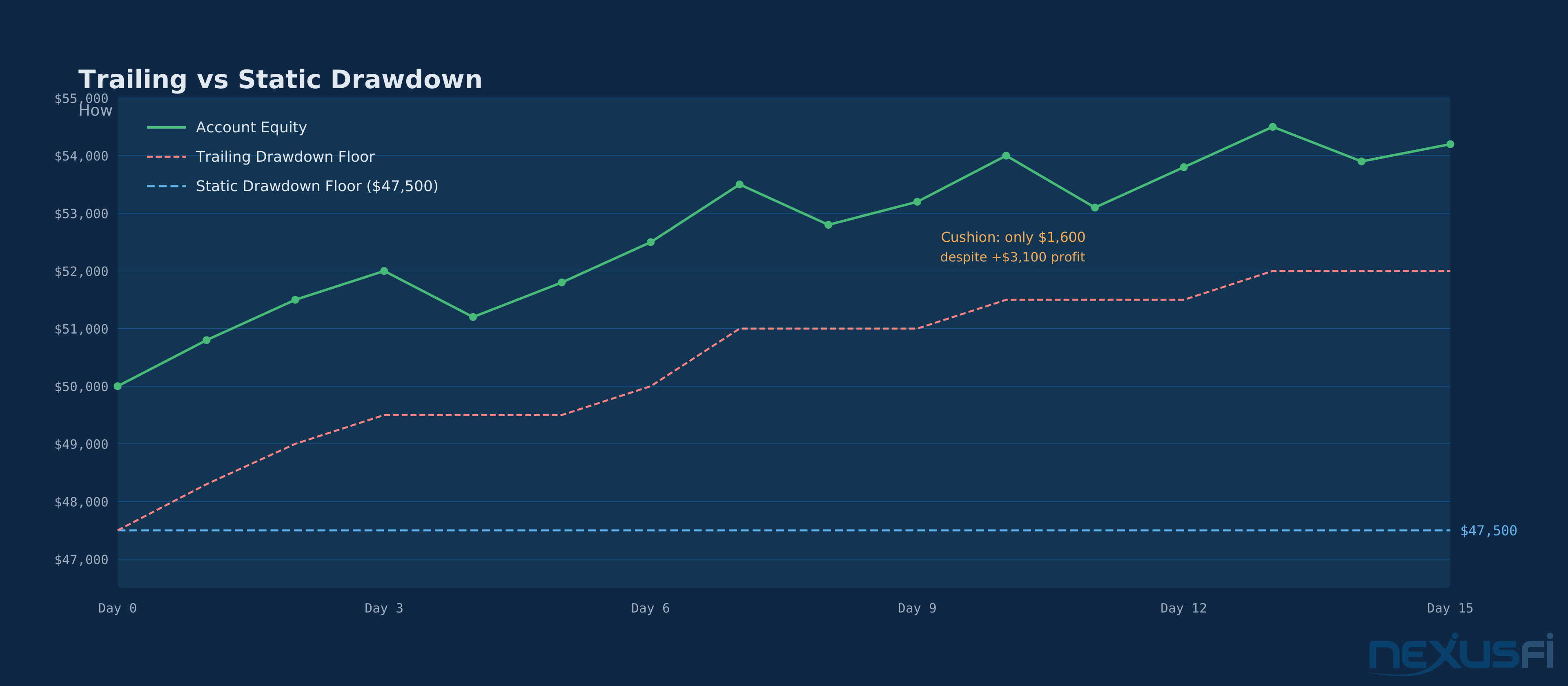
Static drawdown is straightforward: you start with $50,000, the max drawdown is $2,500, and if your account drops below $47,500 at any point, you fail. The floor never moves.
Trailing drawdown is where most traders get tripped up. The drawdown floor follows your equity upward but never moves back down. Start at $50,000 with a $2,500 trailing drawdown — your floor is $47,500. Make $1,000 in profit? Your floor is now $48,500. The $2,500 cushion remains the same, but it's measured from your new peak.
A winning trade that pulls back can simultaneously raise the drawdown floor and bring your equity closer to it. You can be net profitable for the evaluation and still violate trailing drawdown because of a single giveback day. This is the most common "unfair" failure in prop firm trading — and it's entirely mechanical.
That detail — the floor stops trailing once it reaches starting balance — is firm-specific and critical. Topstep's published evaluation rules document this cap explicitly: the trailing floor ascends with profits but stops once it reaches the account's starting balance. Some firms trail indefinitely. Read your specific rules.
The Trailing Drawdown Paradox #
Consider this scenario on a $50K account with $2,500 trailing drawdown:
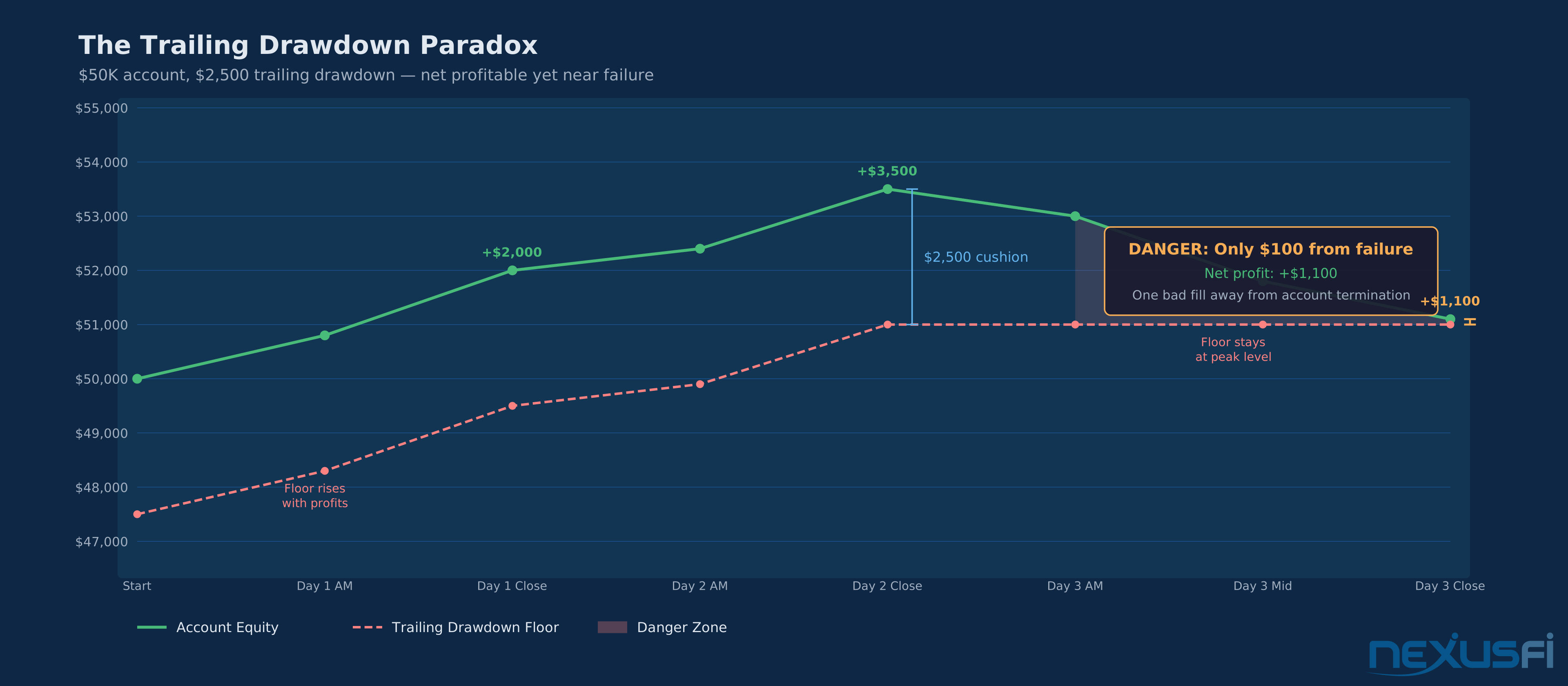
| Day | Action | Account Balance | Drawdown Floor | Cushion |
|---|---|---|---|---|
| Start | -- | $50,000 | $47,500 | $2,500 |
| Day 1 | +$2,000 profit | $52,000 | $49,500 | $2,500 |
| Day 2 | +$1,500 profit | $53,500 | $51,000 | $2,500 |
| Day 3 | -$2,400 loss | $51,100 | $51,000 | $100 |
You're up $3,100 on the evaluation. And you're one bad fill from failing. This is the trailing drawdown paradox — the better you do, the tighter the rope gets unless you actively de-risk.
Consistency Rules: Anti-Lottery Guardrails #
Most firms won't let you pass with a single massive trade. Common constraints include minimum trading days (typically 5-10), maximum profit from a single day as a percentage of the total target, and minimum trade counts.
These rules exist because the firm's business model depends on traders demonstrating repeatable edge, not coin-flip volatility. A trader who makes $6,000 in one lucky trade and sits for the rest of the evaluation tells the firm nothing about sustainable profitability.
How Risk Rules Reshape Strategy #
The Fundamental Shift: Expectancy to Survival #
In a personal account, you improve for expected value — maximum long-run profit per trade. In a prop evaluation, you improve for P(survival). The distinction is critical.
A strategy with 2.0 R:R and 45% win rate has excellent long-run expectancy. But in a constrained evaluation with a $1,000 daily loss limit, three consecutive losers end your day. With realistic losing streaks (which a 45% win rate delivers regularly), you'll burn through evaluation attempts faster than the strategy can demonstrate its edge.
Prop firm rules reward:
- Higher win rates with controlled reward
- Tight, defined stops
- Fast trade resolution (scalping and short-term over swing)
- Defensive sizing that prioritizes survival
Position Sizing Derives from Rules, Not Account Size #
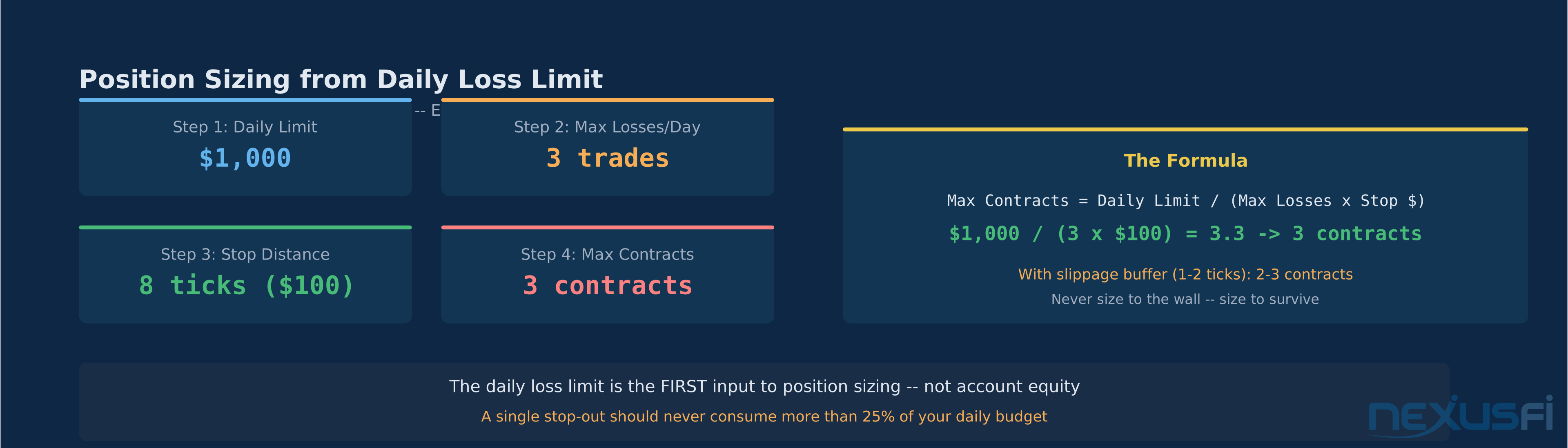
In a funded evaluation, the correct sizing calculation starts with the daily loss limit — not your account equity or margin.
Step 1: What's my daily loss limit? ($1,000 on a $50K) Step 2: How many losing trades can I absorb? (Set a personal max of 2-3) Step 3: What's my stop distance? (e.g., 8 ticks on ES = $100/contract) Step 4: Max contracts = Daily limit / (Losses allowed x Stop distance)
Example: $1,000 / (3 x $100) = 3.3, round down to 3 contracts.
Build a slippage buffer on top: assume 1-2 ticks of slippage per stop, which on 3 ES contracts is $37.50-$75 extra per loss. Your effective max becomes closer to 2-3 contracts.
That's the hard ceiling. Your personal ceiling should be 40-60% of that.
Stage-Based Risk Management #
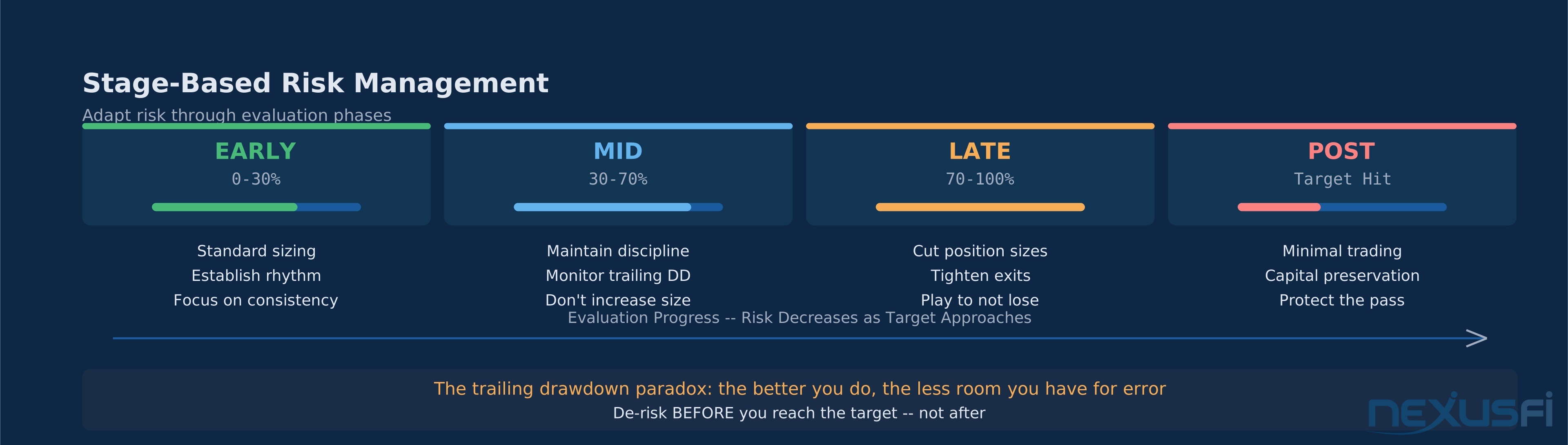
Risk should scale with where you are in the evaluation:
Early Stage (0-30% of target): Standard sizing. Focus on establishing rhythm and consistency. Don't try to hit the target fast.
Mid Stage (30-70%): Maintain discipline. Start monitoring trailing drawdown proximity. If you're running hot, don't increase size — the trailing floor is rising with you.
Late Stage (70-100%): Cut position sizes. Tighten exits. If your intraday edge degrades, stop trading. You're playing to not lose, not to win bigger.
Post-Target: Protect the pass. Minimal trading, maximum capital preservation. Many traders fail AFTER reaching their target because they kept trading aggressively.
The Kill Switch: Non-Negotiable #
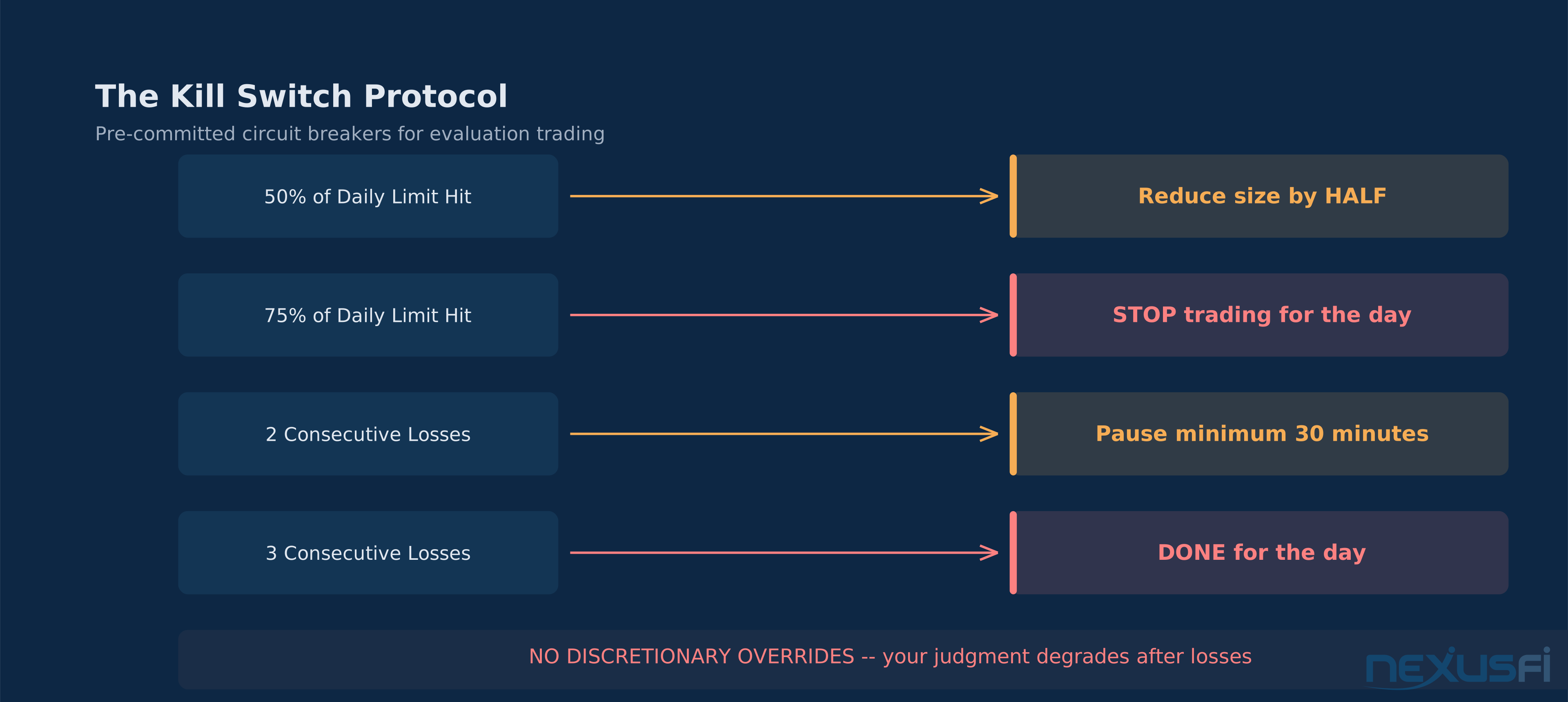
Every evaluation trader needs hard circuit breakers:
- At 50% of daily loss limit: reduce size by half
- At 75% of daily loss limit: stop trading for the day
- After 2 consecutive losses: pause minimum 30 minutes
- After 3 consecutive losses: done for the day
No discretionary overrides. No "one more trade." The kill switch exists because your judgment degrades after losses — every trader knows this, few act on it.
That's the right framework — your daily personal limit should be a fraction of the maximum allowed.
Common Failure Patterns #
Recovery Trading #
The number one account killer. After a loss or series of losses, the trader increases size or frequency to "get it back." This converts a manageable $400 loss into a $1,000 daily limit breach in one impulsive trade.
The math is unforgiving: if you've lost $600 of a $1,000 daily limit, you have $400 of room. One ES contract with a 10-tick stop risks $125. You can take exactly 3 more attempts. Most revenge traders take a 5-lot.
Trailing Drawdown Ignorance #
Traders think "I'm up $3,000 overall, I have plenty of room." But trailing drawdown means your cushion hasn't grown — it's still the same $2,500 it was on day one. The only thing that changed is where the floor sits.
Strategy-Rule Mismatch #
Wide-stop swing strategies consume too much drawdown budget per trade. A 40-tick stop on ES ($500/contract) means a single 2-lot position risks $1,000 — your entire daily limit on many evaluations. These strategies might be profitable long-term but they're structurally incompatible with tight drawdown constraints.
Execution Friction #
Backtested results don't include slippage, partial fills, or spread widening during volatility. A $500 theoretical stop can become $800 realized in fast markets. Traders who size to the theoretical maximum get burned by the practical reality. Build a 20-30% slippage buffer into every risk calculation.
The Risk Budget Framework #
Think of your evaluation as a finite risk budget allocated across three tiers:
Per-Trade Budget: Maximum risk on any single trade. Should be 15-25% of your daily loss limit. On a $1,000 daily limit, that's $150-$250 per trade.
Daily Budget: Your personal daily loss limit, set at 40-60% of the firm's maximum. On a $1,000 firm limit, stop at $400-$600.
Evaluation Budget: Your total available drawdown. Allocate it across estimated trading days. If you have $2,500 drawdown and plan to trade 15 days, your theoretical daily budget is ~$167 — but that's too tight. Accept that some days will be larger drawdowns and plan for variance.
The key insight: these three budgets are nested constraints, not independent limits. Exceeding your per-trade budget cascades into your daily budget, which cascades into your evaluation budget. Discipline at the smallest level protects the largest.
Practical Takeaways #
Prop firm success isn't about finding a magical strategy. It's about applying disciplined risk management to an adequate strategy within specific constraints.
- Size from the daily limit down, not from account equity up
- Implement hard kill switches at predetermined loss levels
- De-risk as you approach the target — the trailing drawdown paradox punishes late-stage aggression
- Build slippage buffers into every calculation — 20-30% above theoretical stop distances
- Match strategy to constraints — tight stops, fast resolution, higher win rates beat wide stops and home-run approaches
- Treat each evaluation as a risk management exercise, not a trading competition
The firms that survive are the ones backing traders who demonstrate consistent, controlled execution. The rules exist to find those traders. Work with the constraints, not against them.
Knowledge Map
Prerequisites
Understand these firstGo Deeper
Build on this knowledgeReferences This Article
Articles that build on this topicCitations
- — m28 End of Week Journal (2019) 👍 20“Max daily drawdown $1,000. Personal daily loss limit $460.”
- — Trade Journal (2016) 👍 9“The trailing max drawdown reaches the original balance and then it stops trailing.”
- — TST Combine results and strategies for passing (2013) 👍 4“Any strategy you devise should be built around controlling risk.”
- — My MES Live Account Journal (OneUp) (2019) 👍 4“The maximum negative excursion on any day is $1,250 on the $50k account.”
- — bwolf's ES Daily Trading Journal (2023) 👍 3“I had lowered my max loss to just over a day's normal profit ($500).”
- — Leeloo 150k Tryout Scalping Journal (2022) 👍 4“Trailing drawdown is the key metric -- it's $5k.”