



Trailing Drawdown vs Static Drawdown: How Your Prop Firm's Rules Reshape Your Entire Trading Strategy
Overview #
Every funded trader eventually learns the same lesson: the drawdown rule isn't just a risk limit. It's the invisible hand that shapes every trade you take, every stop you set, and every sizing decision you make. Get this wrong and it doesn't matter how good your edge is — the rule will kill you before your strategy has time to work.
Here's the core distinction most traders miss: static drawdown and trailing drawdown aren't just different loss limits. They're at the core different mathematical constraints that reward different trading behaviors. A strategy that thrives under one model can self-destruct under the other.
Static Drawdown: The Fixed Floor #
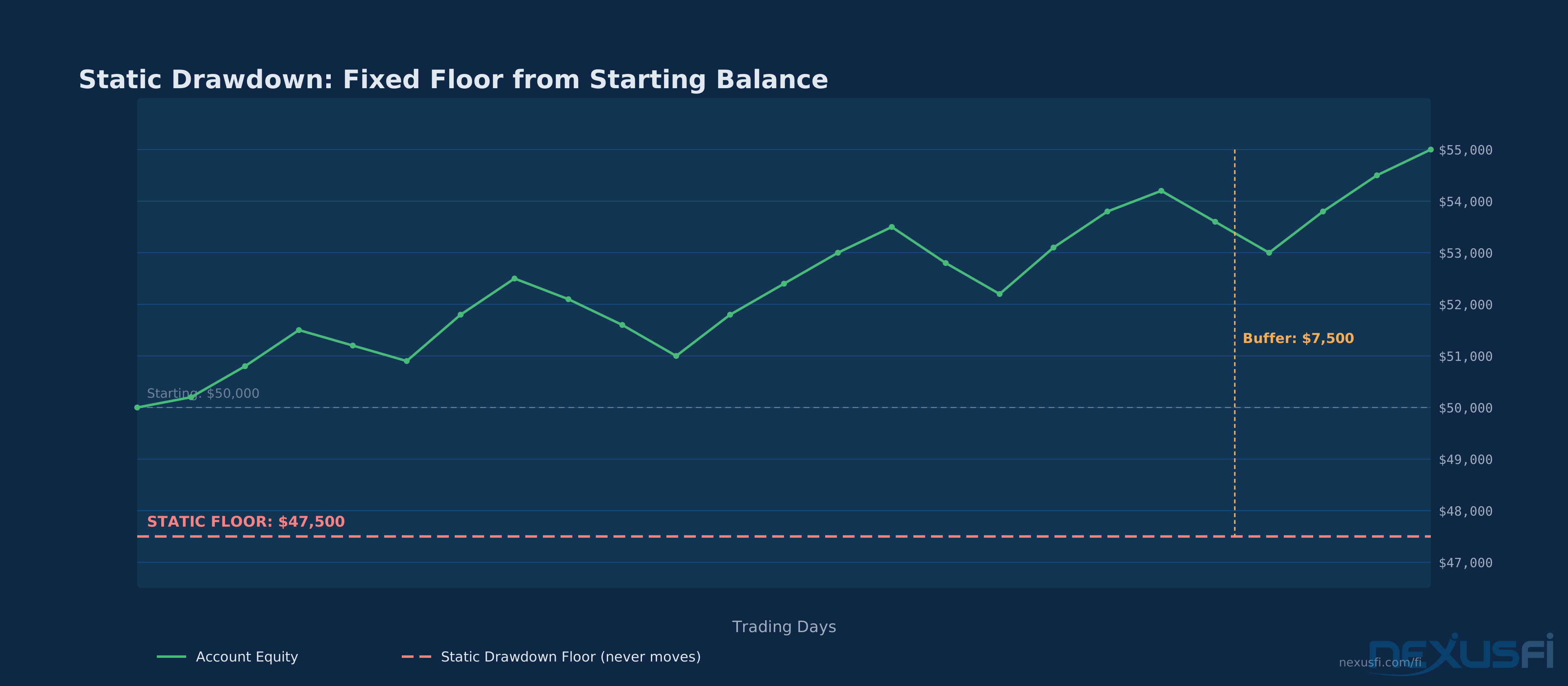
Static drawdown is the simpler model. You start with an account balance — say $50,000 — and a maximum loss limit calculated from that starting point. If the max drawdown is $2,500, your kill line sits permanently at $47,500. Period.
The math is straightforward:
Survival condition: min(equity at any time) ≥ starting balance - max drawdown
That $47,500 floor never moves. Not when you're up $5,000. Not when you've been grinding for three months. Not when you hit a new equity high every day for a week. The floor is anchored to where you started, and it stays there until you either pass the evaluation or breach it.
What this means practically: Static drawdown is path-independent. The only thing that matters is whether your account ever touches the floor. Two traders with identical final P&L but wildly different equity curves get identical outcomes — as long as neither hit the barrier.
This is why static drawdown accommodates wider stops and longer holding periods. If your edge involves holding through 10-point adverse excursions on ES before the trade works, static drawdown gives you room to do that — provided the cumulative effect never breaches the floor.
The danger with static drawdown is complacency. That fixed floor can feel generous, especially early. Traders overleverage, reasoning they have "$2,500 to play with." But $2,500 on a 50K account is 5% — and a bad day on ES with 10 contracts can burn through that in minutes. The floor doesn't care about your conviction.
[CITATION=josh;899104]Let's look at Apex's trailing drawdown rule. Basically, it is calculated this way: the high water mark of your account, determined using open P/L (not closed P/L), less the max drawdown for the account size.[/CITATION]
Trailing Drawdown: The Moving Floor #
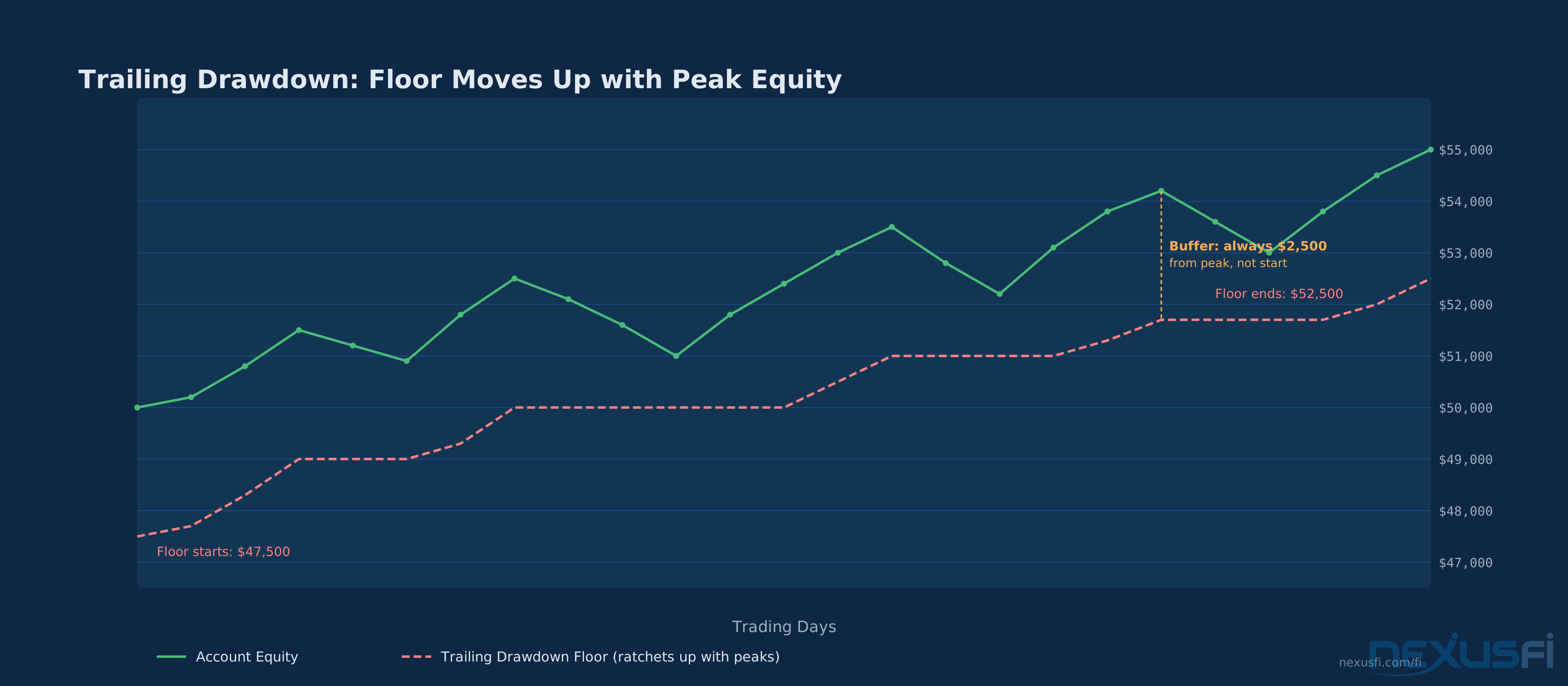
Trailing drawdown changes the game entirely. Instead of anchoring to your starting balance, the floor tracks your peak equity — and it only moves in one direction: up.
The math:
Survival condition: equity ≥ peak equity - trailing limit, at all times
If your peak equity is Pt (the highest your account has ever been at time t) and the trailing drawdown limit is d, then your floor at any moment is Pt - d. Every new equity high ratchets the floor higher. It never comes back down.
Start at $50,000 with a $2,500 trailing drawdown. Your floor is $47,500 — same as static. But now you hit $52,000. Your floor jumps to $49,500. Hit $54,000? Floor is now $51,500. That floor is above your starting balance. You can now lose your funded account without ever going negative on the overall position.
This is the mechanic that kills most funded traders. Not overleveraging. Not bad entries. The trailing floor catches traders who win big, then experience a normal pullback that would be survivable under static rules but is fatal under trailing ones.
[CITATION=RobWa;899505]Their trailing drawdown works from the MAX ACCOUNT VALUE and is a meager $2500 on a $50k account. This means, you get into an awesome 10 point ES trade, your account went from $50k to $52.5k during the trade.[/CITATION]
Unrealized vs Realized P&L: The Hidden Killer #
Some firms calculate the trailing high water mark using open (unrealized) P&L. Others use only closed (realized) P&L. This distinction is massive.
Under unrealized tracking: if you're in a trade that's up $3,000 unrealized, your peak equity has already risen by $3,000 — and your trailing floor has risen too. If that trade reverses and you close flat, you've effectively lost $3,000 of trailing buffer without booking any actual profit.
Under realized tracking: your peak only moves when you close trades. This gives you more control over when the floor ratchets up, because you can manage your closing sequence to preserve buffer.
[CITATION=ejg0;897404]While I do think some firms have predatory rules (unrealized trailing drawdown), and you pretty much have to take on too much risk to make it worthwhile.[/CITATION]
Read the fine print. "Trailing drawdown" means different things at different firms. Some trail on unrealized equity. Some trail on end-of-day balance only. Some trail during the evaluation but lock the floor at a fixed point once you reach the funded stage. The label is the same; the math is not.
[CITATION=idude;866968]They all use 3 different types of drawdowns: Live drawdown, End of Trading Day drawdown, and End of Day (11:59pm ET) drawdown.[/CITATION]
The Comparison That Matters: Same Trades, Different Fates #
Here's where the rubber meets the road. Take the exact same sequence of trades — same entries, same exits, same P&L per trade — and run them through both models.
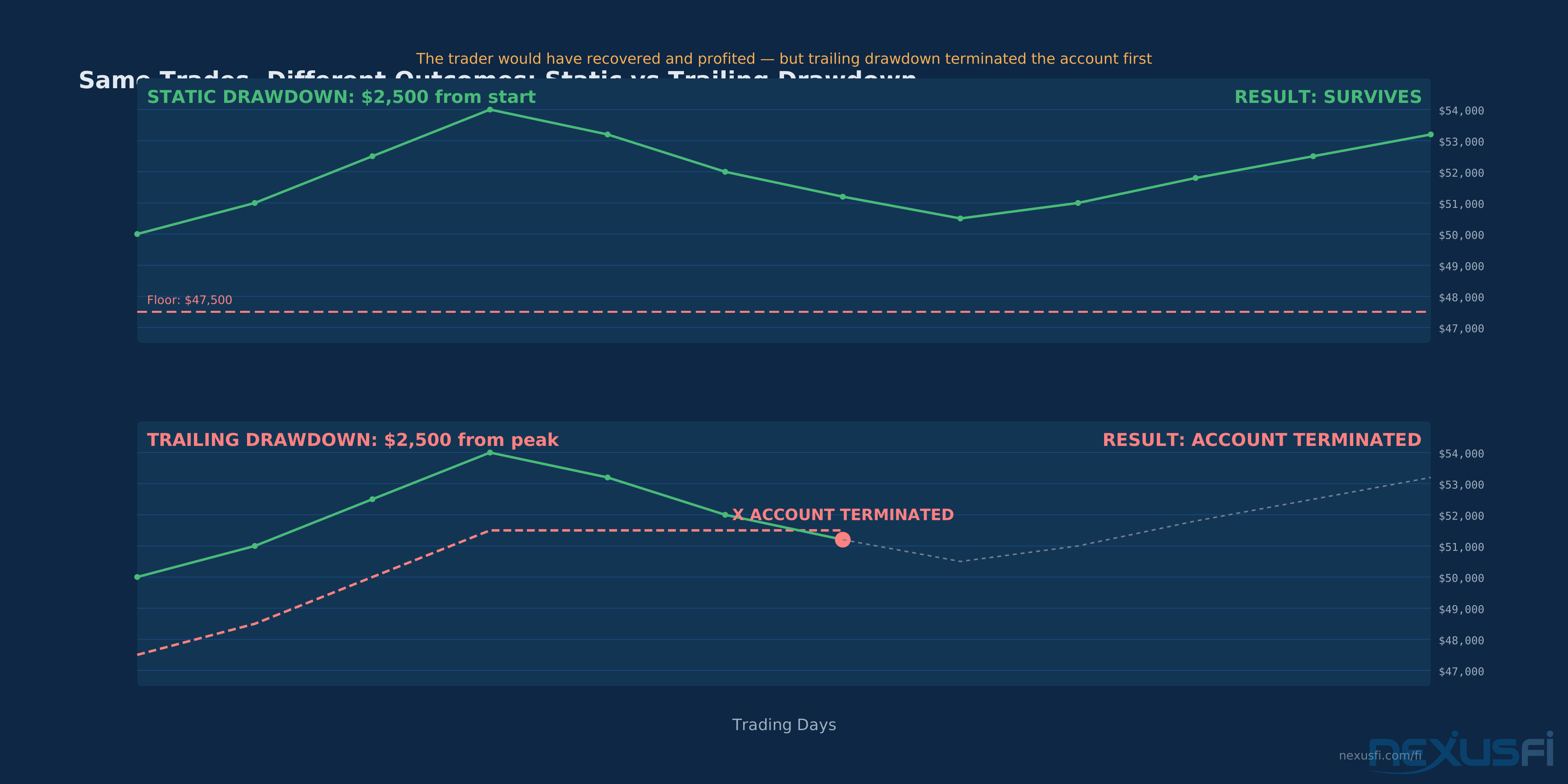
Consider a trader who starts at $50,000 with a $2,500 drawdown limit under both models. They have a strong first week, pushing the account to $54,000. Then they hit a rough patch — three losing days in a row, dropping equity to $50,500.
Under static drawdown: Floor is at $47,500. Current equity of $50,500 is $3,000 above the floor. The trader survives with plenty of room. They go on to recover and profit.
Under trailing drawdown: Peak equity hit $54,000, so the floor ratcheted up to $51,500. Current equity of $50,500 is $1,000 below the floor. Account terminated. Game over. The trader would have recovered to $55,000+ if given the chance — but the trailing rule didn't give them the chance.
Same trades. Same edge. Same eventual profitability. One model lets you live; the other kills you.
This isn't a theoretical exercise. This exact scenario plays out thousands of times per month across funded trading evaluations. Traders with genuine edges get terminated not because their strategy failed, but because the drawdown model penalized their equity path — the shape of their path, not the destination.
EOD vs Intraday: When the Check Happens Changes Everything #
Beyond static vs trailing, there's another critical dimension: when does the firm check your equity against the limit?
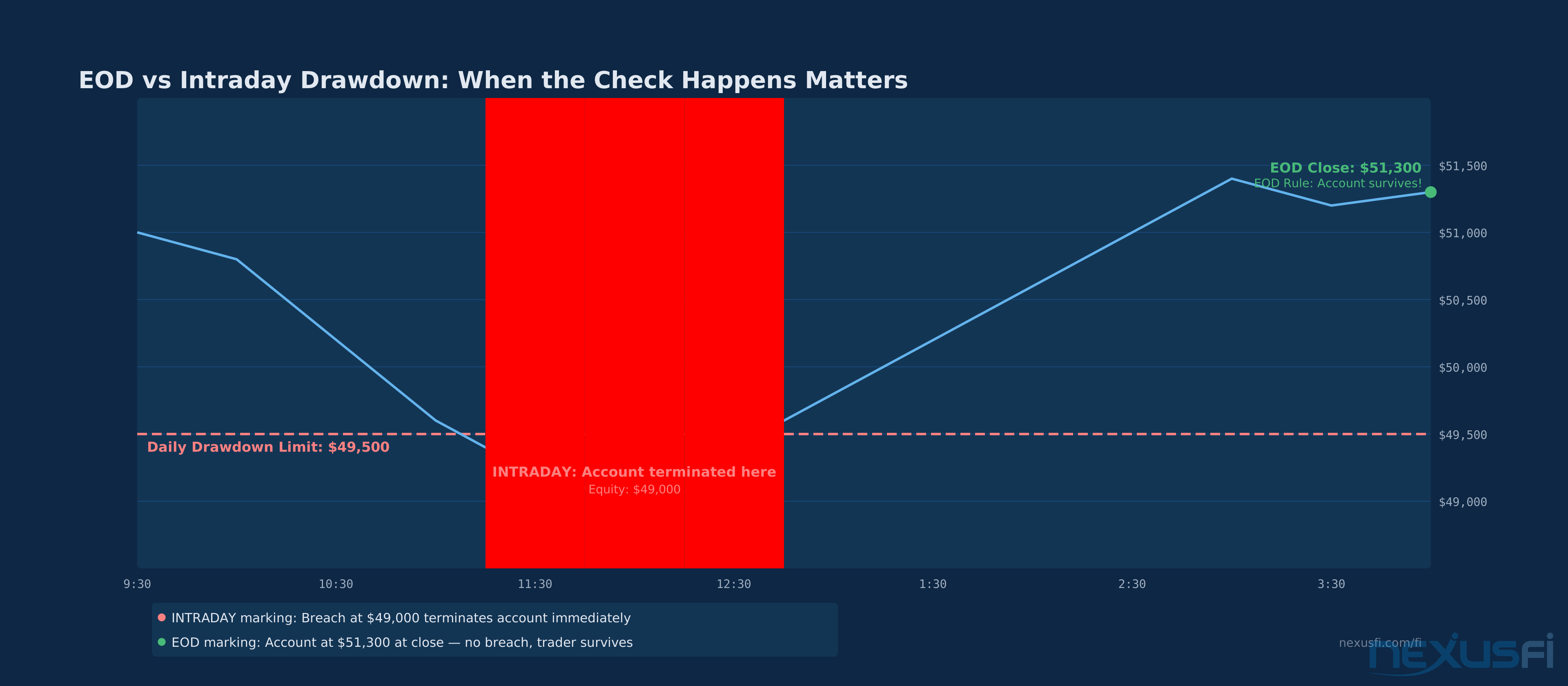
Intraday marking means the firm monitors your equity in real-time (or near real-time). If your equity dips below the limit at any point during the session — even for a single tick — you're done. That 11:00 AM selloff that recovered by lunch? Doesn't matter. You breached.
End-of-day (EOD) marking means the firm checks equity at a specific timestamp — typically the daily settlement or a fixed time like 4:15 PM ET for futures. Intraday excursions that recover before the mark are invisible. You could be down $5,000 at noon and flat by close — the EOD model only sees the close.
[CITATION=Topstep;659468]The Trailing Max Drawdown is only calculated on an account's end of day balance in all of our accounts. However, in a Funded Account, if your loss exceeds that level intraday, we will close out the account as an added risk measure.[/CITATION]
The difference between these two models is stark for certain trading styles:
- Mean-reversion traders who enter counter-trend and endure adverse excursions before the trade works benefit enormously from EOD marking. Their strategy naturally involves intraday drawdowns that resolve by close.
- Scalpers with tight stops are less affected by the marking method because their individual trade risk is small. But even scalpers can face issues during volatile sessions where multiple small losses compound intraday.
- Swing traders holding through session close are exposed under both models — but EOD marking at least means overnight gaps don't trigger termination until the next day's mark.
The Trailing Drawdown Paradox: More Profit = Less Safety #
Here's the counterintuitive truth that catches even experienced funded traders off guard:
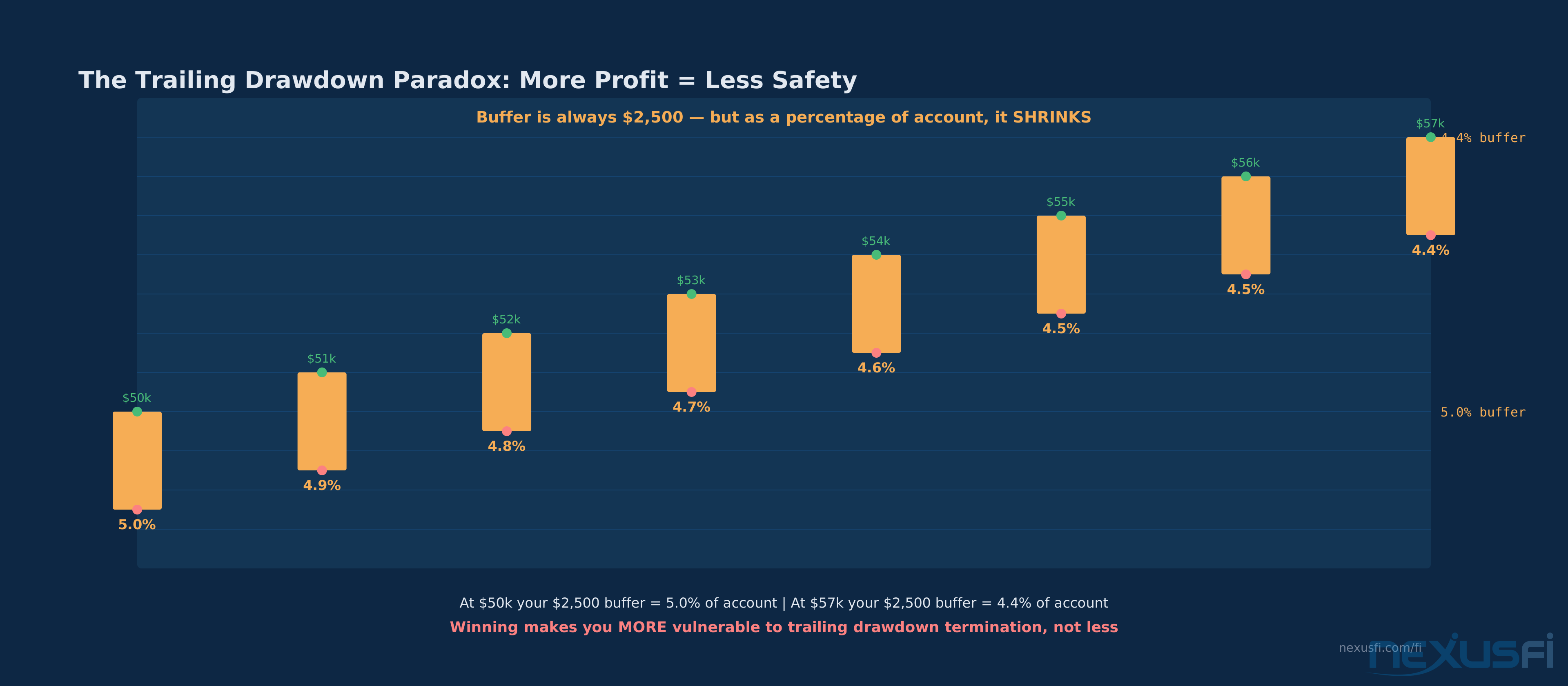
Under trailing drawdown, your $2,500 buffer is always $2,500 in absolute terms. But as your account grows, that $2,500 represents a smaller percentage of your equity.
- At $50,000: your $2,500 buffer = 5.0% of account
- At $55,000: your $2,500 buffer = 4.5% of account
- At $60,000: your $2,500 buffer = 4.2% of account
If you're sizing positions as a percentage of account equity (which is standard risk management), your dollar risk per trade grows as the account grows. But your dollar buffer stays the same. This creates a divergence: your risk expands while your safety margin shrinks.
The math is brutal. A trader risking 1% of a $60,000 account ($600 per trade) has a 4-trade losing streak tolerance before breaching a $2,500 trailing drawdown. At $50,000, risking 1% ($500 per trade), they can absorb 5 consecutive losers. The "safer" account balance is actually the smaller one under trailing rules.
The adaptation: Under trailing drawdown, you must either cap your dollar risk per trade at a fixed amount (not a percentage) or deliberately reduce your risk percentage as the account grows. Neither feels natural. Both are necessary.
Strategy Adaptation Framework #
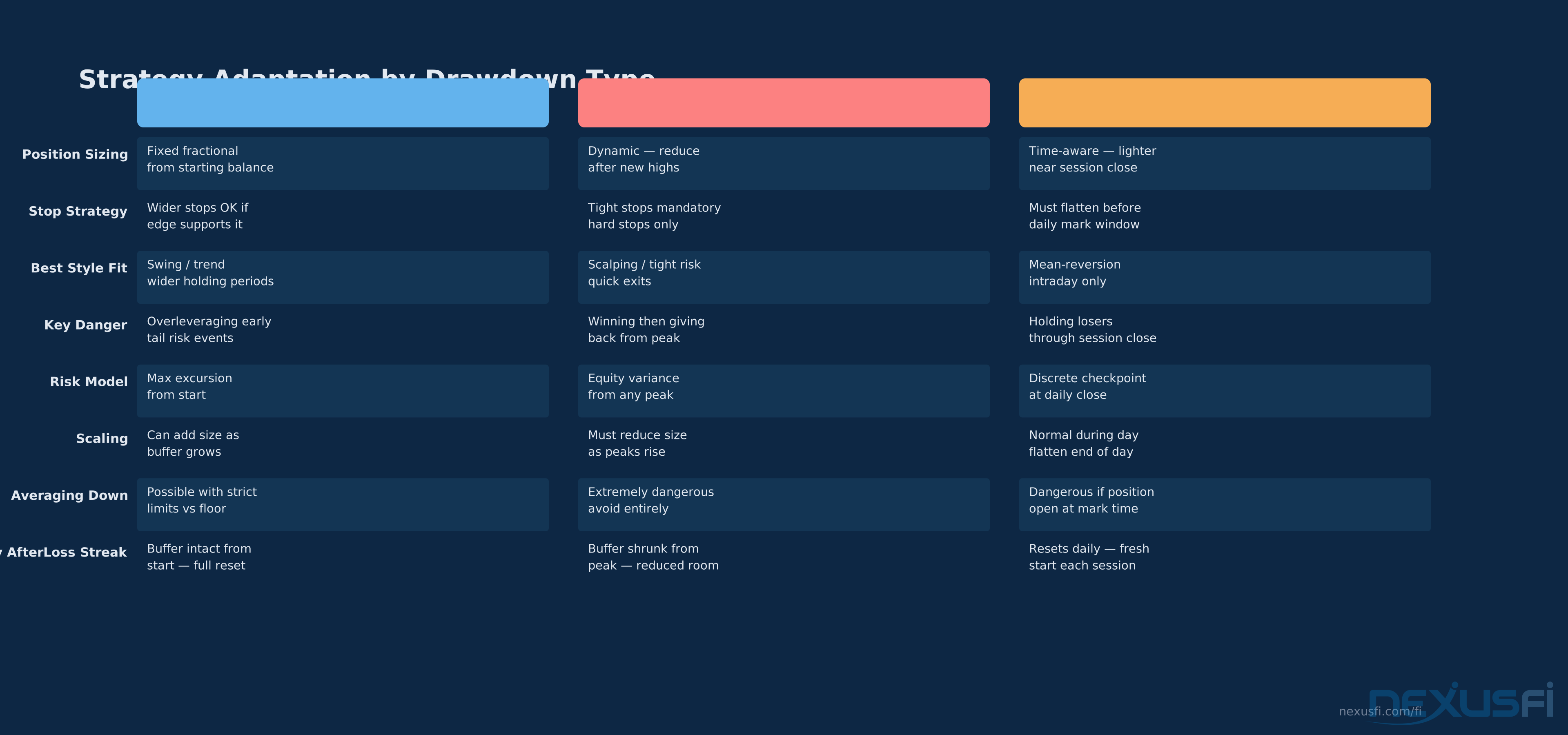
Different drawdown models demand at the core different strategic approaches:
Adapting to Static Drawdown #
Position sizing: Fixed fractional from starting balance works. Your buffer from the static floor is clear and calculable. If you're $3,000 above the floor, you know exactly how many losing trades you can absorb at your current risk level.
Stop placement: Wider stops are viable — provided the expected value of the trade justifies the variance. Static drawdown accommodates strategies that need room to breathe.
Scaling: You can increase position size as profits grow because the floor doesn't move. Your buffer expands with every winner.
The failure mode: Overleveraging early, before you've built any buffer. The floor is close when you start, and one bad day can end the evaluation before it begins.
Adapting to Trailing Drawdown #
Position sizing: Dynamic sizing is mandatory. After reaching new equity highs, reduce risk. The trailing buffer resets to the same fixed distance from an ever-higher peak, meaning the effective safety margin tightens with success.
Stop placement: Tight stops, hard stops. No mental stops. Under trailing rules, a single runaway loser that exceeds your plan can ratchet the floor up during the adverse excursion (if unrealized P&L counts) and then terminate you when price reverses. Hard stops at the exchange level cap worst-case outcomes.
Scaling: Reduce size after wins, not increase. This is the opposite of normal trading psychology and normal risk management. It feels wrong. It's correct.
Averaging down: Don't. Under static drawdown, averaging down has risks but at least the floor stays put. Under trailing drawdown, averaging into a loser while your peak equity sits well above current levels is how accounts die in minutes.
[CITATION=bobwest;861253]They also all have some kinds of rules like the trailing drawdown rules, which are loss-control rules. A trader in a live account should have something of the sort for themselves as well.[/CITATION]
The failure mode: Winning early and then experiencing a normal losing streak. The trailing floor has risen with your wins; the losing streak that follows gets measured from the peak. This is the most common cause of funded account termination among profitable traders.
Adapting to EOD Drawdown #
Position sizing: Normal during the session, but time-aware. Reduce or flatten positions before the daily mark window.
Session management: Flatten before close if carrying unrealized losses that could breach the EOD mark. This means knowing your firm's exact marking time and building it into your trading plan.
The failure mode: Holding a losing position through the mark, or getting caught by a late-session move that can't be managed before the timestamp.
Stress Testing Your Strategy Against the Rule #
Before trading any funded account, run this analysis:
1. Estimate your per-trade distribution. What's your average winner, average loser, win rate, and maximum adverse excursion? Be honest — use actual data, not projections.
2. Monte Carlo simulate 1,000 equity paths using those parameters. For each path, check:
- Under static: does the equity ever drop below (start - max drawdown)?
- Under trailing: does the equity ever drop more than the trailing limit from its running peak?
3. Compare survival rates. The difference will be eye-opening. A strategy with a 90% survival rate under static drawdown might have a 55% survival rate under trailing drawdown — despite identical expected returns.
4. Factor in loss clustering. Losing trades don't arrive uniformly. They cluster around regime changes, volatility spikes, and mean-reversion failures. Add autocorrelation to your simulation: losses tend to follow losses. This makes trailing drawdown survival rates materially worse than simple Monte Carlo would suggest.
[CITATION=Baudo;861260]You need to properly size your trades, it probably can be done with 2-4 micro's. Know your risk parameters and chose the right position size, it is not that complicated.[/CITATION]
5. Model slippage and execution costs. In futures, slippage during volatile reversals can easily add $50-100 per contract per trade beyond expected costs. Under tight trailing drawdown limits, those extra costs compound into real survival risk.
Choosing the Right Drawdown Model for Your Style #
Not all prop firms offer a choice. But many do — sometimes as different evaluation tiers, sometimes as entirely different products. Here's the decision matrix:
Choose static drawdown if:
- Your strategy requires holding through multi-point adverse excursions
- You trade trends or swings with wider stops
- Your edge comes from patience — letting trades develop over hours or days
- Your win rate is moderate (40-55%) but your average winner much exceeds your average loser
- You're comfortable with higher per-trade variance
Choose trailing drawdown if:
- You scalp or day-trade with tight risk per trade
- Your win rate is high (60%+) with relatively small wins
- You can maintain consistent, low-variance returns
- You don't need to hold through large adverse moves
- You can commit to reducing size after new equity highs
Choose EOD drawdown firms if:
- Your strategy involves intraday mean-reversion that often requires enduring temporary drawdowns
- You always flatten by a specific time
- Your edge depends on intraday volatility patterns that create temporary adverse moves before resolution
[CITATION=Merkd1904;852695]After taking a couple resets ended up picking up the 100k static w/625 max drawdown. I now am on day five on two of them and have better luck with that set up as I like to take positions and let them run.[/CITATION]
The Bigger Picture: Drawdown Rules as Strategy Filters #
Here's what most traders get wrong about prop firm drawdown rules: they view them as obstacles to overcome rather than constraints to design around.
The firms that use trailing drawdown aren't trying to steal your money (well, some might be, but that's a due diligence problem, not a drawdown problem). They're filtering for a specific type of trader — one who produces consistent, low-variance returns. That's a legitimate business need for firms that are actually routing orders to live markets.
The firms that use static drawdown are filtering for traders who can manage absolute risk — the same skill required when trading your own capital with a hard stop-loss on the account.
Understanding this changes how you approach the evaluation. You're not fighting the rule. You're demonstrating that your trading style fits the constraint the firm is selecting for. If your natural trading style produces high-variance equity curves, a trailing drawdown evaluation is going to be an uphill battle no matter how good your edge is. Choose the model that matches how you actually trade.
[CITATION=matthew28;866268]People simply need to read the rules properly and decide if the firm is a good fit for their trading style.[/CITATION]
Practical Checklist Before Starting Any Funded Account #
Before committing money to an evaluation, extract these five data points from the firm's documentation:
- Is the drawdown static, trailing, or hybrid? Some firms trail during evaluation but lock to static at the funded stage. Others trail forever. The answer changes your entire approach.
- Does the firm track unrealized or realized P&L for the trailing high water mark? This is the single most impactful variable for trailing accounts. Unrealized tracking means your floor can ratchet up during a trade you haven't closed.
- Is the drawdown checked intraday or EOD? And if EOD — what exact timestamp? Some firms use CME settlement times; others use midnight ET. The difference can matter during volatile after-hours sessions.
- Does the trailing floor ever "lock"? Some firms stop trailing once you've earned a certain profit threshold or reached the funded stage. This creates a at the core different risk profile at different stages of the account.
- What happens during overnight holds and weekend gaps? If the firm checks equity at market open and your position gapped against you overnight, does that count as an intraday breach? The answer determines whether holding overnight is viable.
Don't take the firm's marketing summary at face value. Read the actual contract terms. If the contract is ambiguous, ask support for clarification in writing. Your entire strategy depends on understanding exactly how the constraint works — not approximately, but precisely.
Knowledge Map
Prerequisites
Understand these firstGo Deeper
Build on this knowledgeReferences This Article
Articles that build on this topicCitations
- — Funded Trader platforms (2024) 👍 8“Maybe this is a good opportunity to discuss that rule, which most people despise. Let's look at Apex's trailing drawdown rule.”
- — Funded Trader platforms (2024) 👍 4“Hey all, I just paid for elite status for other reasons and this thread caught my eye. I scanned over some of the responses and thought I'd throw in my 2c. It's my personal belief that these CAN work despite all the hurdles they throw at you.”
- — Funded Trader platforms (2024) 👍 2“While I do think some firms have predatory rules (unrealized trailing drawdown), and you pretty much have to take on too much risk to make it worthwhile as stated earlier in this post, I do think these firms are good. Buyer beware though.”
- — TST/OneUp/LeeLoo/Earn2Trade (2022) 👍 5“As of today, there are quite of few props out there and their drawdowns differ from each other. Some even have a different name for drawdown like "trailing threshold" or something like that! They all use 3 different types of drawdowns: - Live drawdow...”
- — Topstep's Nick Dolby (Social Media and Community Coordinator) - Ask me Anything (AMA) (2017) 👍 3“Bob - thanks for the question and thanks for the kind words about Trader Support. In a Funded Account, the trailing max drawdown is still calculated based off of the end of day balance of your high water mark (realized P&L at the end of day).”
- — ApexTraderFunding.com experience and review (2022) 👍 10“I think that, without getting too far into the details of a particular company's offering, the point with all these funding companies is that the "$50,000" or "$150,000" accounts are just sim accounts with pretend "balances.”
- — TST/OneUp/LeeLoo/Earn2Trade (2021) 👍 1“So, it's funny you bring up the static drawdown. I recently started an eval with ApexFunding and they have that same option.”
- — Most Funding Firms are a Scam (2022) 👍 8“Totally agree that a trailing drawdown based on unrealized profit isn't good (for example an account has a $1000 drawdown limit for the day the trader has a good trade on for $2000 in profit and they are holding as they think there is more potential...”
- — ApexTraderFunding.com experience and review (2022) 👍 5“it's best for both a trailing drawdown is a type of consistency rule so it's keeps the trader aware to respect reasonable loss limits if profit target is 3k, and trailing drawdown is 2.”