



Position Sizing in Prop Firm Evaluations: The Math That Separates Funded Traders from Failed Ones
Position sizing in prop firm evaluations isn't about whether your strategy works. It's about whether your sizing survives the rules long enough for your strategy to work.
Overview #
Most traders who fail prop firm evaluations don't fail because their entries were wrong. They fail because they sized into a trade that was consistent with their usual approach — and the rules ate them alive.
Prop firm evaluations impose three hard constraints that interact in ways that break traders who haven't done the math: a daily loss limit (DLL) that caps how much you can lose on any single day, a maximum drawdown that defines the floor below which your account gets terminated, and often a profit target that creates time pressure. Each constraint limits how many contracts you can trade. The catch is that optimizing for one without considering the others is exactly how accounts blow up.
This article is the math layer that sits under everything else about evaluation strategy. You need this before you pick your entry method, before you set your stop, before you decide how many contracts to run.
The Three Constraints and How They Interact #
Every prop firm evaluation runs on three numbers: the daily loss limit, the maximum drawdown, and the profit target. These numbers don't operate independently — each one changes what the others mean for your position sizing.
The Daily Loss Limit (DLL) is a hard floor on what you can lose in a single trading session. Hit it and you're done for the day — your account gets locked until market close. Most evaluations set the DLL at 2-3% of the nominal account size. A $50K evaluation typically carries a $1,000 DLL. A $100K evaluation might allow $2,000.
The DLL sets your maximum position size for the day. The formula is direct:
Max Contracts (DLL-constrained) = Daily Loss Limit ÷ Maximum Stop Loss per Contract
Example: $1,000 DLL ÷ $50/contract (4-tick stop on ES at $12.50/tick) = 20 contracts max
That's the ceiling. Trade more than that and a single stopped trade takes you out for the day.
The Maximum Drawdown defines the lowest your account can go before it's terminated. Some firms use a static drawdown (fixed dollar amount below starting balance), while others use a trailing drawdown that follows your highest equity. The trailing version is more punishing because it moves against you when you're winning.
For a $50K account with a $2,500 trailing drawdown:
- Day 1, account at $50,000: Floor = $47,500 ($50K - $2.5K)
- After winning $1,200 (account at $51,200): Floor jumps to $48,700 ($51.2K - $2.5K)
- If you then give back $1,000 (account at $50,200): You're $2,700 above the floor — still safe
But notice: winning compressed your buffer. You started with $2,500 between you and termination. After a good day, that gap is still locked at $2,500 — but your floor moved up. The trailing drawdown ratchets upward every time you hit a new high-water mark, and it never comes back down.
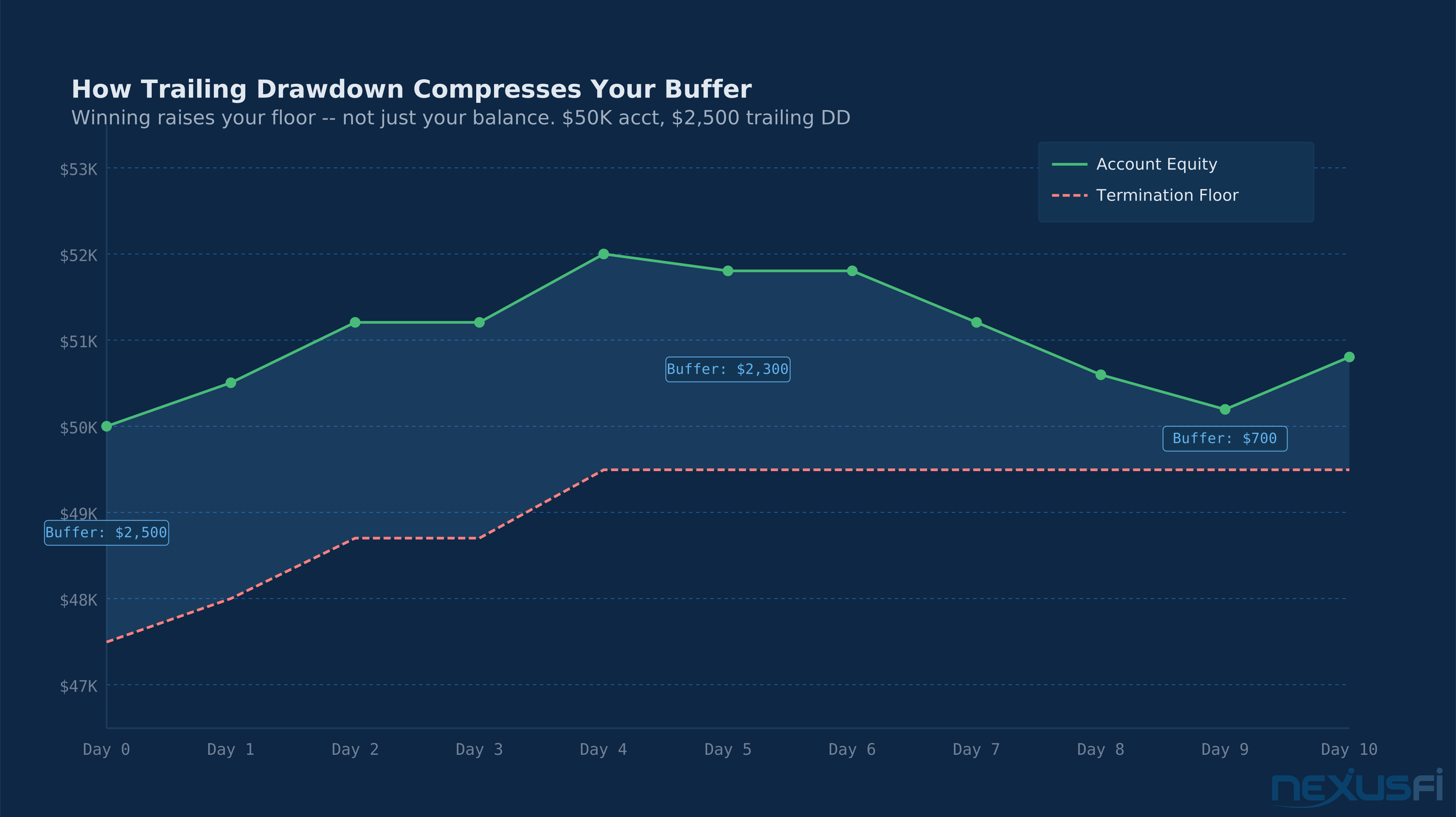
This creates a sizing constraint that evolves throughout the evaluation. The formula for drawdown-constrained max:
Available Buffer = Current Account Value - (Highest Account Value - Trailing DD Amount)
Max Contracts (DD-constrained) = (Available Buffer × Risk Threshold) ÷ Max Stop Loss per Contract
Example: $1,700 buffer × 65% threshold ÷ $50/contract = 22 contracts (The 65% threshold keeps $595 as a safety cushion — never bet 100% of the buffer)
Your actual session max = minimum of the DLL-constrained limit and the drawdown-constrained limit.
The Profit Target creates time pressure that pushes traders toward oversizing. You have 20 trading days to make $3,000 on a $50K account. That's $150/day average — which sounds achievable. But bad days and flat days eat into that average, and the natural response is to size up on good days. That impulse is where most evaluation failures begin.
As @kevinkdog noted analyzing multiple TST Combine attempts:
That's the right framing. The constraints define the field. Optimization happens inside them.
The Max Contracts Calculation: Step by Step #
Here's how to calculate your max position size before every session. This takes five minutes at most. Skipping it costs evaluations.
Step 1: Calculate your stop loss per contract in dollars
Stop loss in dollars = (stop in ticks) × (tick value)
Key tick values:
- ES (mini S&P 500): $12.50 per tick
- NQ (mini Nasdaq 100): $5.00 per tick
- CL (crude oil): $10.00 per tick
- MES (micro ES): $1.25 per tick
- MNQ (micro NQ): $0.50 per tick
If you place stops at 4 ticks on ES: 4 × $12.50 = $50 per contract. If you place stops at 8 ticks on NQ: 8 × $5.00 = $40 per contract.
Use your maximum stop, not your average stop. On the worst trade of the day — your widest stop, your most uncertain setup — that's what determines your position cap. If you'd ever place an 8-tick stop on ES, your calculation uses $100, not $50.
Step 2: DLL-constrained maximum
Max from DLL = DLL ÷ max stop per contract
$1,000 DLL ÷ $50 = 20 contracts. $2,000 DLL ÷ $100 = 20 contracts (wider stops compress this just as hard).
Step 3: Drawdown-constrained maximum
Calculate your current buffer:
Current buffer = current account value - (highest account value - trailing DD amount)
Apply a 65% safety threshold (never use 100% of your buffer):
Risk allocation = buffer × 65%. Max from DD = risk allocation ÷ max stop per contract.
If buffer is $1,700: ($1,700 × 0.65) ÷ $50 = 22 contracts.
Step 4: Apply the firm's contract maximum
Every firm publishes a maximum number of contracts per account size. This is separate from the DLL-based calculation. A $50K evaluation might cap you at 10 ES contracts even though the DLL math would allow 20.
Check the firm's rules. Many traders discover this cap only after calculating a larger number from the DLL formula.
Step 5: Take the minimum
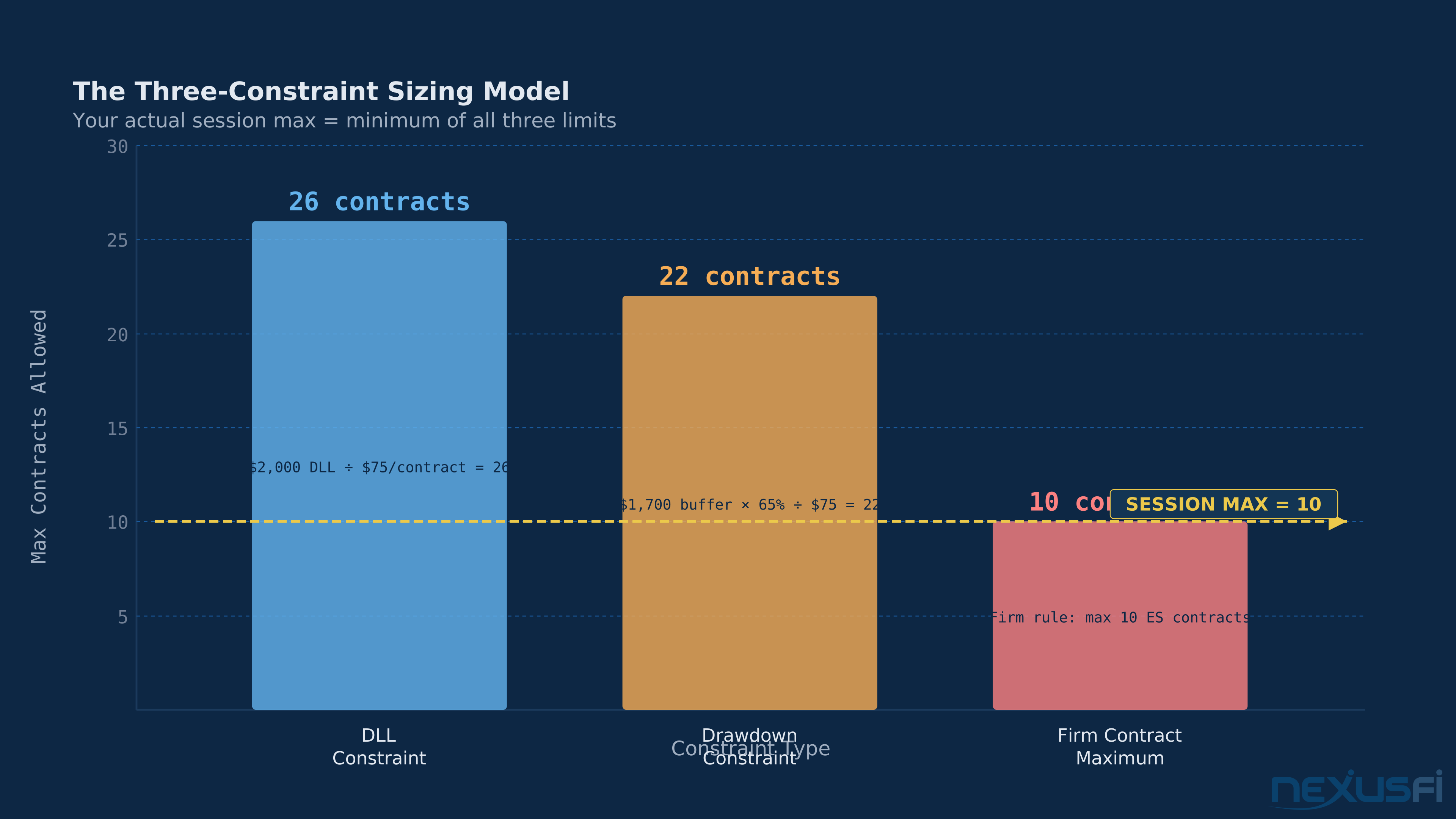
Session maximum = min(DLL max, DD max, firm contract max).
This number doesn't change during the session unless you've built in planned review points. The decision is made before the open, when your thinking is clear. During a trade is not the time to recalculate.
Most traders who blow evaluations by oversizing didn't make a deliberate decision to violate the rules. They made a sequence of small decisions — one more contract, one wider stop, one quick add to a winner — that compounded into a violation. The only defense is a hard number written down before the session starts and treated as inviolable.
Sizing Models for the Evaluation Window #
Once you know your session maximum, you still have to decide how to deploy size across the evaluation period. Three models dominate the thinking here, with different tradeoffs.
Model 1: Constant Contract Size #
Trade the same number of contracts every session — the minimum of DLL-constrained, DD-constrained, and firm max, calculated once at the start of the evaluation.
Simple. Removes intraday decision fatigue. The problem: it doesn't account for the fact that your buffer changes day by day. If you have a bad early run, your DLL-constrained max stays the same but your drawdown-constrained max has shrunk. You can find yourself in a position where your "constant" size violates the drawdown math on a bad day.
Best for: Traders with very small stops relative to their DLL, where the DLL constraint is always the binding limit and the drawdown constraint has plenty of headroom.
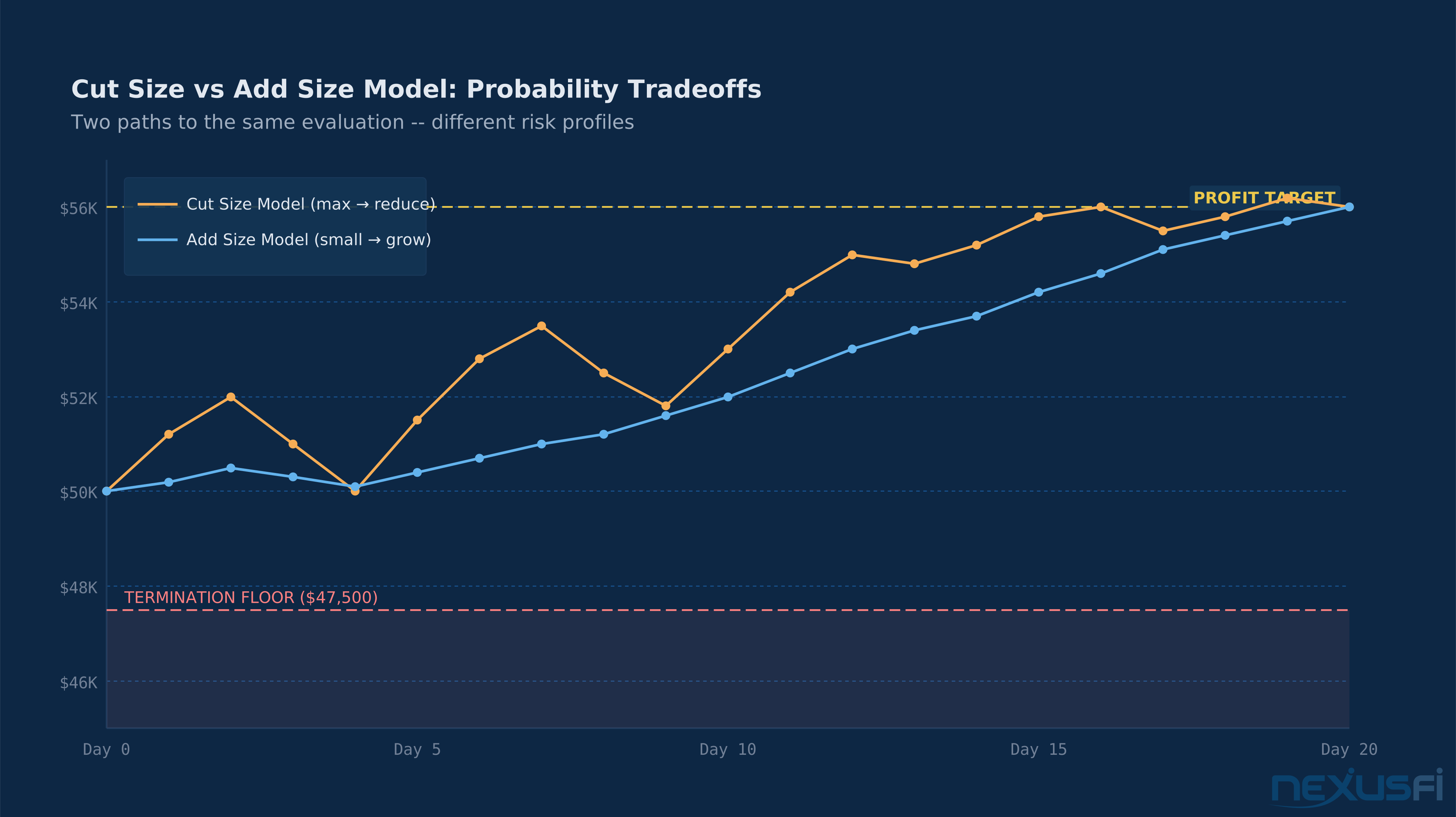
Model 2: Cut Size as Drawdown Shrinks #
Start at the maximum allowed, then reduce position size in steps as your remaining buffer decreases.
This is what @kevinkdog analyzed in detail during his TST Combine:
The cut size model maximizes your probability of hitting the profit target, because you're trading at maximum size when you're ahead and scaling down only when protecting. The tradeoff: if you get a bad run in the first few days, you're scaling down from an aggressive starting position.
This model suits traders who are confident in their edge and can absorb early drawdown without emotional interference.
Model 3: Add Size as Equity Grows #
Start conservatively (1-3 contracts), then increase as your account grows above the starting level.
@trekke uses a variant of this with a specific schedule tied to drawdown remaining for his funded NQ accounts:
The add size model substantially reduces your probability of hitting the profit target because you're starting small. For traders in competitive evaluations with tight time windows, starting at 1 contract on a 20-day window with a 10% profit target is often too conservative to succeed.
Model 4: The Hybrid Approach #
Start at the add-size model's conservative starting point, but allow yourself to step up size at fixed equity milestones — not based on feeling, but on predetermined account levels.
Example for a $50K evaluation:
- Account at $50,000-$51,000: 2 contracts
- Account at $51,001-$52,500: 4 contracts
- Account at $52,501-$54,000: 6 contracts
- Account at $54,001+: max allowed
The decision to move up is automated by account equity, not by the trader's confidence in the current setup. This removes the emotional component from the sizing increase decision.
The critical add: the schedule steps back DOWN if the account falls below a milestone. If you reach $52,000 and then give back $1,500, you drop back to 2 contracts. The step-down is non-negotiable.
Run a Monte Carlo simulation on your recent performance data before starting an evaluation. @kevinkdog's analysis showed that a system performing fine for one account size might be completely wrong for a different account size — the ratios between DLL, max drawdown, and profit target shift the optimal sizing model. Don't assume what worked in one evaluation transfers to a different firm or account tier.
The right model depends on your system's stats and the evaluation structure. If you have 30 days and a 6% target, add size can work. If you have 10 days and need 15%, constant or cut size is more appropriate — and the tradeoffs should be simulated before you start.
The model you choose matters less than choosing a model in advance and following it. The worst outcome is ad hoc sizing — going bigger on strong conviction days, smaller when you're nervous. That's emotional sizing, and it will destroy your evaluation performance even if your entries are good.
The Consistency Rule: The Hidden Sizing Constraint #
Some firms impose a consistency rule: no single trading day can generate more than a set percentage of your total profit target. The specific percentages vary across firms, but 30-40% is common territory.
Here's how it affects sizing:
$3,000 profit target × 30% consistency rule = $900 maximum any single day.
If you're up $800 on a great morning setup and see a new trade forming — you have $100 of headroom before triggering a violation. Taking that trade at full size is a trap. A 1-contract winner of $50 is fine. A 5-contract winner of $250 puts you in violation and can result in evaluation disqualification even if your balance is above the profit target.
The consistency rule prevents you from having one lucky day that inflates your average. The firm wants to see consistent, repeatable performance across the evaluation window — not one outstanding day surrounded by mediocrity.
Practical implications:
- Track your daily P&L against the consistency ceiling before every new trade
- When within 20% of the daily ceiling: reduce to 1 contract or stop for the day
- When at 90% of the ceiling: stop entirely. One more trade isn't worth the risk.
This rule also explains why the "big recovery day" strategy fails. After three bad days, you need to make it up fast. But the consistency rule caps how much you can recover in one session — and trying to sidestep it by running larger size is the most efficient way to end an evaluation before it's over.
The consistency rule means a large winning day isn't necessarily a good day for an evaluation trader. A $900 day on a $3,000 target is the ceiling, not the objective. Traders who understand this reframe their target: not "how much can I make today?" but "how much can I make while staying within the daily ceiling?" That reframe changes the entire risk posture.
When Sizing Goes Wrong: The Failure Modes #
Failure Mode 1: Trading at the Firm's Maximum Allowed Contracts #
Firms publish maximum contract limits — a $50K evaluation might allow up to 10 ES contracts. That limit isn't a recommendation. It's a ceiling imposed to prevent unlimited leverage risk. Trading at the maximum is almost never the optimal strategy, because the maximum is determined by the firm's risk model, not yours.
The maximum is a trap for undercapitalized thinking. It assumes you're right about every trade. You won't be.
Failure Mode 2: Sizing Up After a Win Streak #
Four winning days in a row. Account is up $1,200. Confidence is high. The natural impulse is to increase size to capitalize on momentum.
In a trailing drawdown structure, four winning days means your floor has risen by $1,200. Your buffer hasn't grown — it's still $2,500 (the DD limit). You're now at $51,200 with a floor at $48,700. Sizing up now means any reversal back toward the floor comes faster, from higher up.
The psychological state that makes traders want to size up (consecutive wins, high confidence) is exactly the state where the floor is closest in relative terms. The math runs opposite to the emotion.
Failure Mode 3: The Recovery Trap #
You're down $600 on the evaluation. Five days left. You consider sizing up to compress the recovery timeline.
This is the most dangerous decision in evaluation trading. Larger size on a stressed account means any further loss brings you to the termination floor faster. The math requires the opposite response: reduce size, extend the runway, and accept that base-hit trading over five days is the only viable path to recovery.
@MarketMage, describing lessons learned across multiple funded accounts:
The urgency to recover is a psychological response that conflicts with the mathematical reality. More size increases variance, and in a constrained environment, increased variance means increased probability of termination — not recovery.
Failure Mode 4: Ignoring Intraday Scaling Risk #
A trader places a 5-contract ES trade with a 4-tick stop ($250 risk). Seeing it go their way, they add 3 more contracts at a better fill. Now they're in 8 contracts at the original stop level — risk has jumped to $400.
Still within the DLL. But the stop was set for 5 contracts' worth of loss, not 8. If the market reverses to the stop level, the position delivers a loss 60% larger than originally planned.
Account for your maximum potential position, including planned additions, when calculating session caps. Total risk = total planned contracts × max stop, not entry contracts × max stop.
Failure Mode 5: Correlated Risk Across Multiple Accounts #
Many prop firms allow running multiple evaluation accounts simultaneously. Traders manage each one independently — but correlated P&L hits all accounts the same way. A day that pushes one account to its DLL likely pushes all three, because you're trading the same market with the same strategy.
Treat your combined exposure across accounts as your actual risk on any given day, not each account in isolation. Total combined contracts × max stop should still fit within your personal daily loss tolerance.
Evaluation vs. Funded Phase: Different Constraints, Different Sizing #
The evaluation has a profit target and the option to reset. The funded phase removes the profit target and, in most cases, removes the ability to reset.
This asymmetry means the funded phase requires more conservative sizing, not less. The excitement of having passed the evaluation creates a psychological pull toward increasing size, but the math doesn't support it.
The Topstep team addressed this directly in a community AMA:
The smart transition: treat the first month of funding as another evaluation period with the same size constraints, the same discipline. The only meaningful difference is you're now building a track record that justifies the firm's scaling plan.
The funded phase failure rate is high specifically because traders loosen their sizing discipline after passing. They interpret "I passed the evaluation" as evidence that their system and sizing are sound — then use larger size in the funded account, where the drawdown rules are less forgiving and there's no reset option.
The Pre-Session Sizing Protocol #
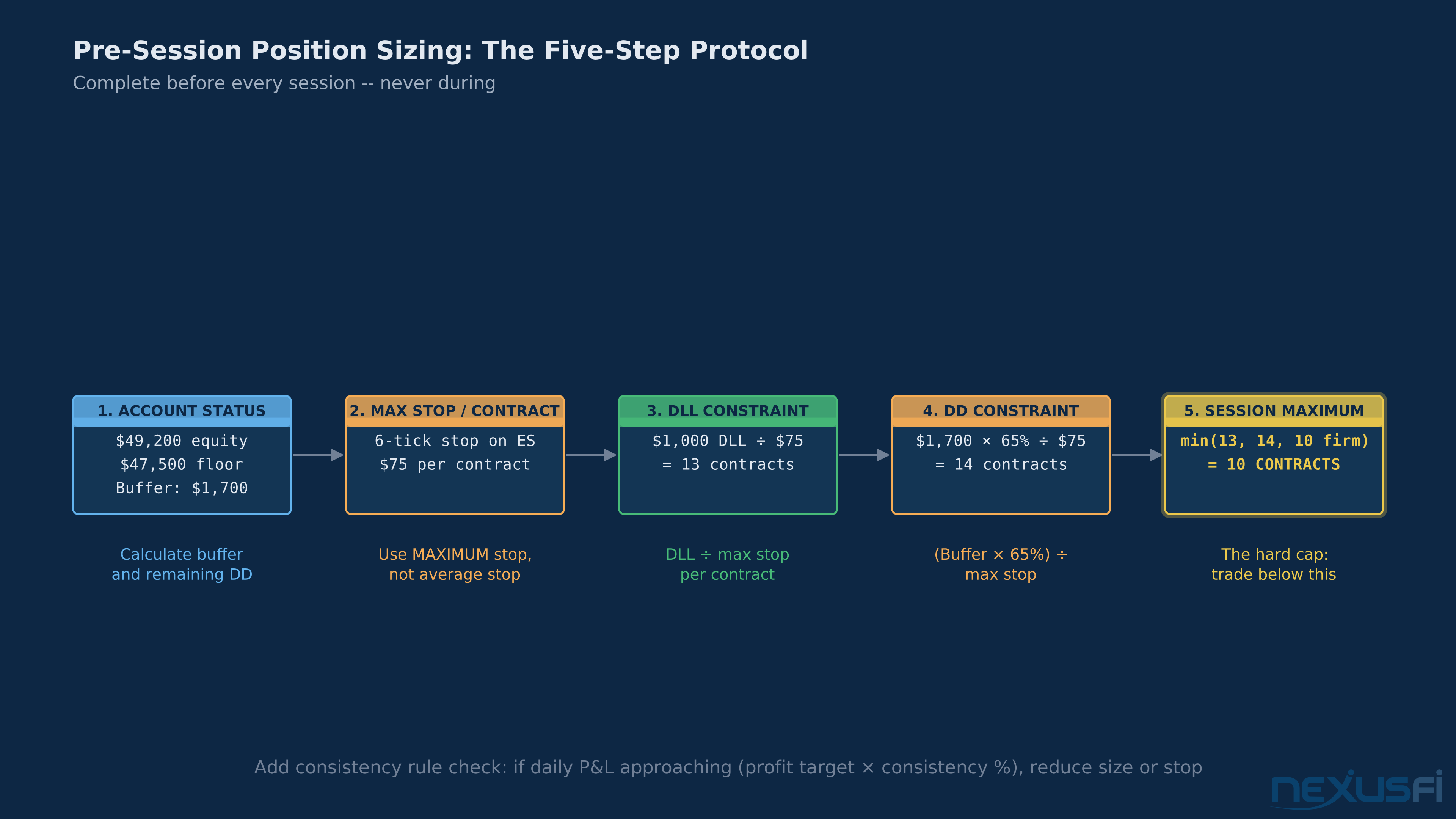
Sizing decisions belong before the session, not during it. Here's the complete pre-session process:
1. Update your account metrics
- Current equity: (starting account balance) + (cumulative net P&L)
- High-water mark: highest equity point reached so far
- Floor: high-water mark - trailing DD amount
- Buffer: current equity - floor
2. Calculate worst-case stop What's the widest stop you'd ever place today? Use that number, not your average.
3. DLL calculation DLL max contracts = daily loss limit ÷ worst-case stop per contract.
4. DD calculation DD max contracts = (buffer × 65%) ÷ worst-case stop per contract.
5. Apply firm maximum Check the firm's published contract limit for your account tier.
6. Record your session cap min(DLL max, DD max, firm max) = session max contracts. Write it down. Don't change it during the session.
7. Check consistency rule Current P&L / profit target = your consistency ceiling progress. Daily ceiling = profit target × consistency percentage. Remaining headroom = daily ceiling - today's P&L so far. If headroom is less than two winning trades at your target: plan to stop early or trade at 1 contract.
As @kevinkdog put it after his detailed analysis:
That's it. The discipline is in the planning, not the trading.
A Working Example: $100K Apex Evaluation #
Account structure:
- Starting balance: $100,000
- Daily Loss Limit: $2,000
- Maximum Drawdown: $3,000 trailing
- Profit Target: $6,000
- Time Window: 20 trading days
- Firm max: 10 ES contracts
You trade ES with stops at 6 ticks ($75 per contract).
Day 1 Pre-Session:
- Account: $100,000. High-water: $100,000. Floor: $97,000
- Buffer: $3,000
- DLL max: $2,000 ÷ $75 = 26 contracts
- DD max: ($3,000 × 65%) ÷ $75 = 26 contracts
- Firm max: 10 contracts
- Session cap: 10 contracts
Day 5, up $2,500:
- Account: $102,500. High-water: $102,500. Floor: $99,500 (trailing with high-water at $102,500)
- Buffer: $3,000 (trailing DD still $3K — floor rose with high-water)
- DD max: still 26 contracts
- Session cap: 10 contracts (firm max still binding)
Day 8, after giving back $1,800 (account at $100,700):
- Account: $100,700. High-water: $102,500. Floor: $99,500
- Buffer: $100,700 - $99,500 = $1,200
- DD max: ($1,200 × 65%) ÷ $75 = 10.4 → 10 contracts
- Session cap: 10 contracts (DD constraint now matches firm max — barely)
Day 9, down another $500 (account at $100,200):
- Account: $100,200. High-water: $102,500. Floor: $99,500
- Buffer: $700
- DD max: ($700 × 65%) ÷ $75 = 6 contracts
- Session cap: 6 contracts (DD constraint is now binding — below firm max)
This is the critical inflection point most traders miss. The drawdown constraint starts binding before you're close to the floor. Many traders running 10 contracts at this point are three bad trades from termination. They're operating at a limit defined by the firm, not by the math of their actual situation.
The firm's contract maximum is a ceiling, not a daily target. Your actual safe position size — derived from your available drawdown buffer — is often substantially lower than the firm's published maximum, especially after any drawdown. Calculate this number every morning. Trade below it every day.
Quick Reference: Common Evaluation Structures and Sizing Caps #
| Account | DLL | Trailing DD | 6-tick ES stop ($75) | DLL Max | Notes |
|---|---|---|---|---|---|
| $25K | $500 | $1,500 | $75/contract | 6 contracts | Firm max often 3-5 |
| $50K | $1,000 | $2,500 | $75/contract | 13 contracts | Firm max often 5-10 |
| $100K | $2,000 | $3,000 | $75/contract | 26 contracts | Firm max often 10-15 |
| $150K | $3,000 | $4,500 | $75/contract | 40 contracts | Firm max often 15-20 |
| $200K | $4,000 | $5,000 | $75/contract | 53 contracts | Firm max typically 20+ |
Firm maximums almost always bind before DLL math does. The DLL max tells you what's mathematically possible, not what's appropriate.
Knowledge Map
Prerequisites
Understand these firstGo Deeper
Build on this knowledgeReferences This Article
Articles that build on this topicCitations
- — Kevin's TST Combine Journal (2013) 👍 7“If equity > $150,000: 6 contracts. This model improves the odds of staying above the max drawdown without too much of a drop in the odds of meeting the profit target.”
- — Kevin's TST Combine Journal (2013) 👍 1“It is pretty much as many contracts as I can trade, and still respect the Daily Loss Limit and Max Drawdown.”
- — Kevin's TST Combine Journal (2013) 👍 5“Position size decisions are not made in the heat of the moment (which almost never ends well).”
- — My NQ Trading Journal (2024) 👍 4“My position sizing for the 50K accounts which start with a $2500 drawdown is fairly aggressive at the outset, but as my drawdown decreases I lower my overall risk of ruin by moving quickly to micros.”
- — Any long term success stories from funded traders in these get-funded programs? (2021) 👍 5“People are in a hurry and they yolo, often not realizing the insanity of their position sizing. Using size that is too large is one of the only reasons traders fail.”
- — Topstep's Nick Dolby AMA (2017) 👍 7“Some traders would come onto the Funded Account and begin trading right away with larger size and unfortunately quickly hit their loss limits.”
- — APEX 300K+: The Journey (2023) 👍 7“That's how they get you -- they let you trade up to 15 lots, traders go for the gusto, and then bamm, they're out.”
- — Advice from traders with 5+years experience (2019) 👍 82“[QUOTE=jsd45;189371]I graduated college and have been trading for about 7 months....For the more experience traders, what are somethings you did as rookie trader that you look back on and wish you hadn't? Any other advice would be greatly appreciated to...[/QUOTE] Educate yourself. The [URL="http”
- — Battle of the Bots - NinjaTrader Algorithmic Strategy Development (2019) 👍 79“[IMG]https://nexusfi.com/images/battle_of_the_bots.gif[/IMG] How about a fun challenge to those who believe they can create an automated strategy that is profitable? My intention is to start a discussion where algo traders can show off their strategies and learn something in the process. This is t”