



Funded Trading Evaluations: How Prop Firm Challenges Work and How to Choose One
Overview #
Funded trading evaluations let you prove you can trade without risking your own capital. Pass the challenge, get a funded account, and split profits with the firm. That's the pitch — and for disciplined futures traders, it's a legitimate path to trading real size.
But the details are where traders get destroyed. Trailing drawdown rules that punish profitable trades. Reset fees that compound into thousands. Consistency requirements buried in page 14 of the terms. The difference between a firm that works for your style and one that's designed to churn your fees is entirely in the mechanics.
This guide breaks down how funded evaluations actually work, what the key decision factors are, and where the hidden costs live — so you can make a clear choice instead of signing up for whichever firm had the best promo code this week.
How Funded Evaluations Work #
The basic model is straightforward: you pay a monthly evaluation fee ($50-$200/month depending on account size and firm), trade a simulated account under specific rules, hit a profit target without breaking drawdown limits, and receive access to a funded account where you keep a percentage of profits.
Most programs follow a two-step process. Phase 1 (the "Combine" or "Challenge") tests your ability to hit a profit target — typically 6-10% of the nominal account balance. Phase 2 (the "Verification" or "Funded Trader Preparation") tests consistency with a lower profit target and tighter risk rules. Some firms offer single-step evaluations where you pass directly to funding.
Here's what you need to understand right away: a "$50,000 account" is not a $50,000 account. As @bobwest explains, "the '$50,000' or '$150,000' accounts are just sim accounts with pretend 'balances.' They give you the 'margin' that you can lose before you have blown up the account, which is going to be just a few thousand sim dollars, nothing like the advertised face value." [1] A $50K account with a $2,500 maximum drawdown is effectively a $2,500 account with high leverage. Think in terms of the drawdown limit, not the headline number.
The Drawdown Question: The Single Biggest Decision #
Drawdown rules are the #1 differentiator between evaluation firms and the #1 cause of failure. There are three types, and the differences are not subtle.
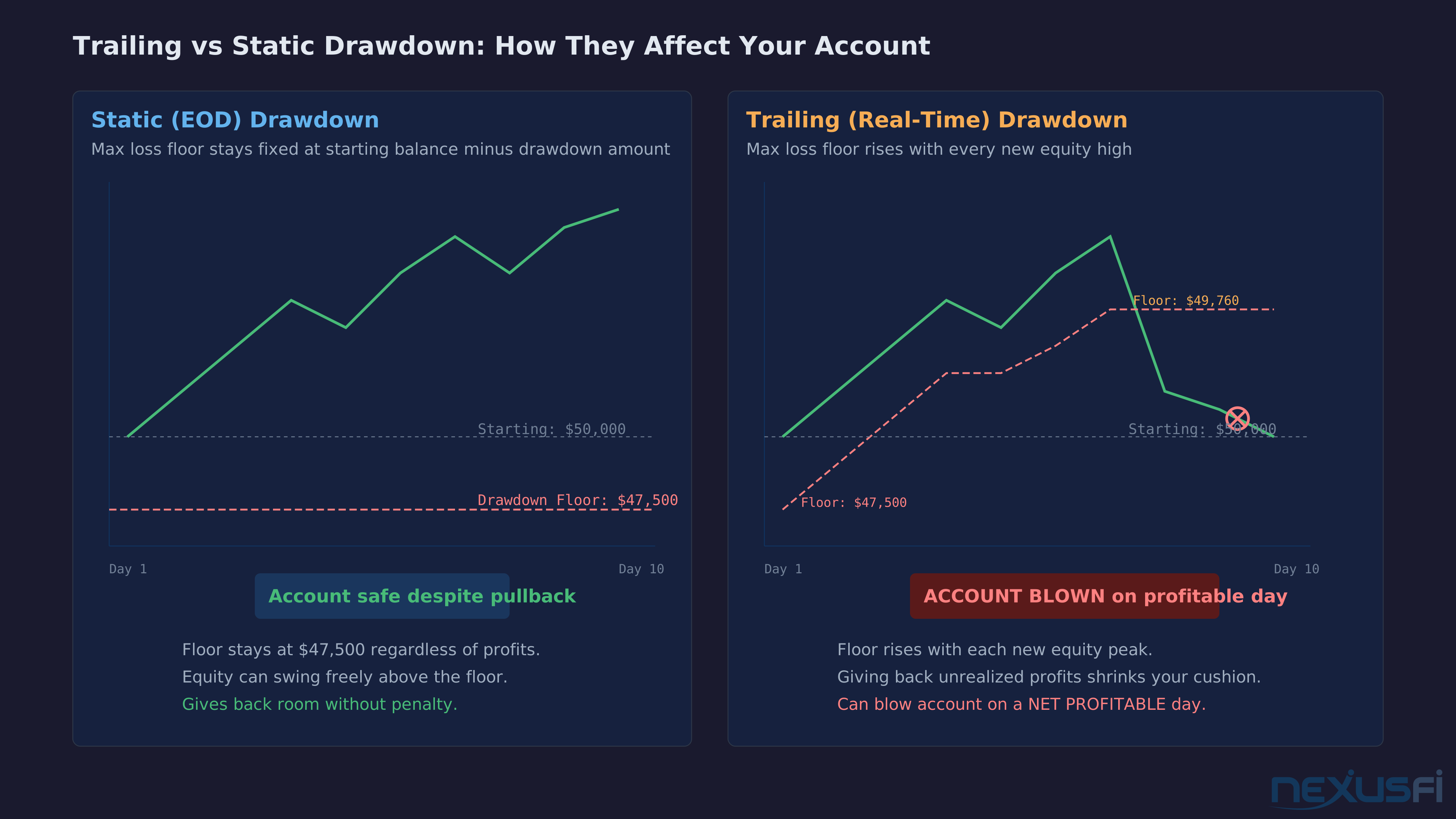
Static (Fixed) Drawdown — Your maximum loss floor is set at account start and never moves. If you start with a $50K account and a $2,500 drawdown, your floor is $47,500 forever. Doesn't matter if you run the account to $60K — you can give back all of it and still survive as long as you stay above $47,500.
End-of-Day (EOD) Trailing Drawdown — Your maximum loss floor trails your end-of-day closing equity, not your intraday peaks. If your account closes at $53,000, the floor rises to $50,500 (assuming $2,500 drawdown). But intraday swings don't count. You could be up $5,000 mid-session, give it all back, and close flat — the floor doesn't move. This is what firms like Topstep use.
Real-Time Trailing Drawdown — Your maximum loss floor trails your highest intraday equity, including unrealized profits. This is the rule that generates the most community anger, and for good reason. As @josh explains, "the high water mark of your account, determined using open P/L (not closed P/L), less the max drawdown for the account size." [2]
The real-time trailing drawdown creates scenarios that feel absurd.
That said,
[2] The trailing drawdown forces tight profit-taking — which is actually a legitimate risk management discipline. Traders who adapt to it learn to scale out aggressively and never let winners run too far.
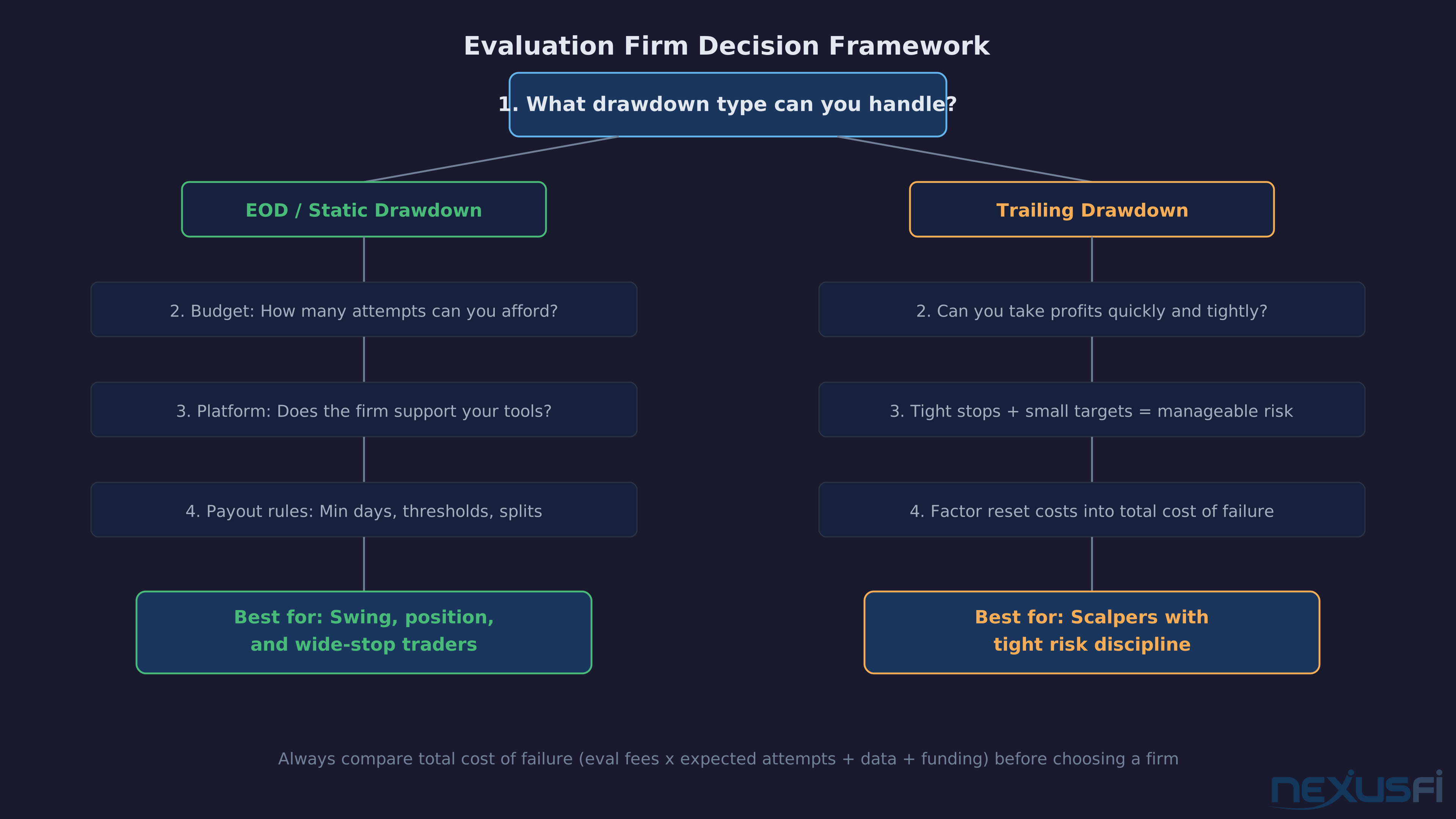
The decision: If you trade with wide stops, hold positions for multiple bars, or let winners run — choose EOD or static drawdown. If you're a scalper with tight stops and quick exits, trailing drawdown is manageable because your unrealized P&L never gets far from closed P&L.
Fee Economics: What Getting Funded Actually Costs #
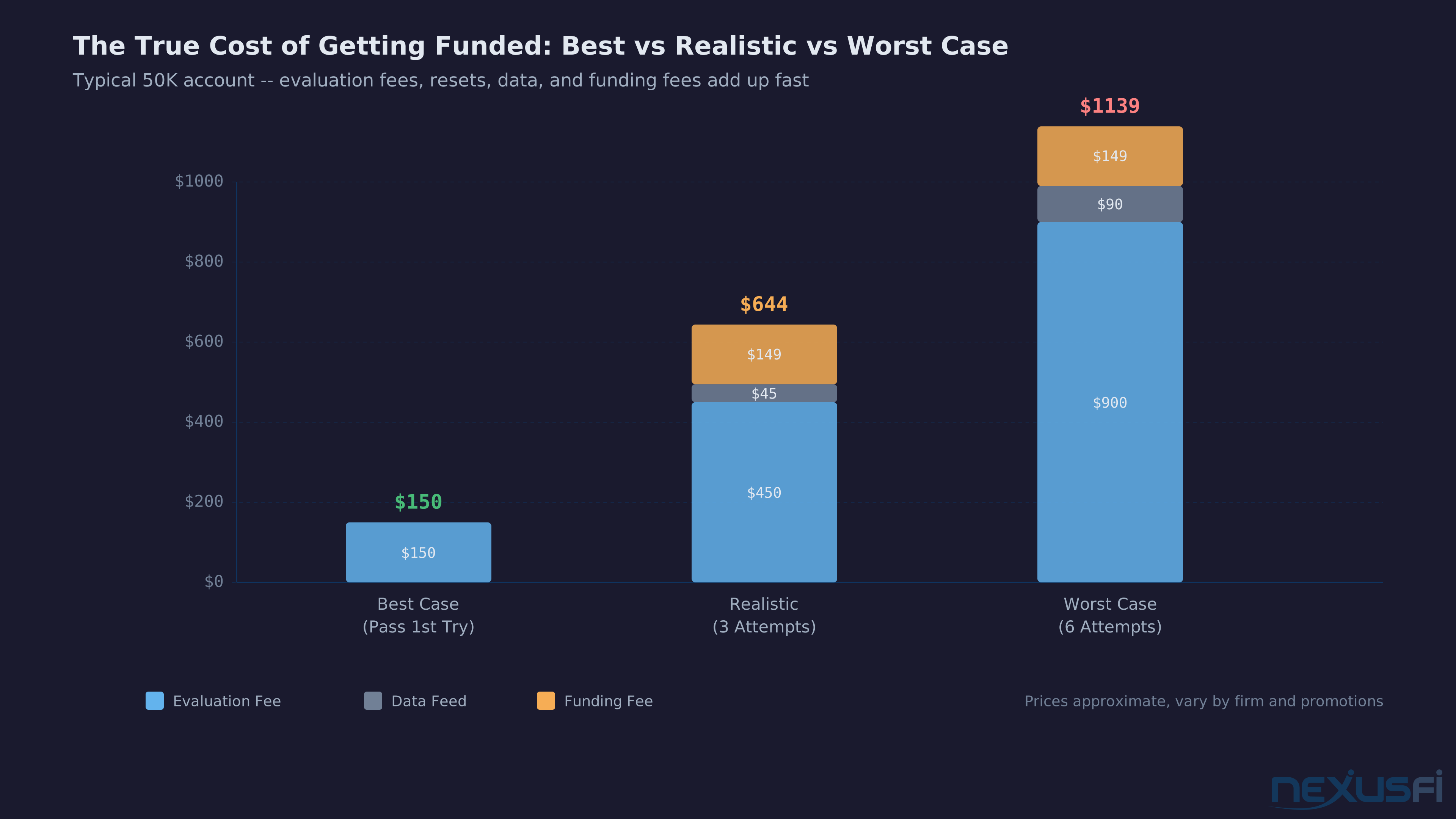
The evaluation fee is just the tip. Here's the full cost stack for a typical $50K account:
- Monthly evaluation fee: $50-$200/month (varies by firm, frequent promos drop this to $17-$85)
- Reset/retake fee: $100-$300 per failed attempt (some firms offer free resets)
- Funding activation fee: $100-$200 (one-time charge when you pass)
- Data feed fees: $0-$45/month (some include CME data, others charge separately)
- Platform fees: $0-$55/month (depends on whether firm provides proprietary platform)
@jlabtrades, who has been funded across multiple firms, shares current all-in rates: "$70 for one month at MFF, $199 for one month at TopStep, $197 for one month at Apex, $215 for one month at Take Profit Trader." [5] These prices shift constantly with promotional codes — which is exactly the point. Firms compete on headline price while making real money on resets and ongoing fees.
The critical calculation is total cost of failure. If you expect to need 3 attempts to pass (a reasonable estimate for a competent trader), your true cost is 3x the evaluation fee plus any reset fees, data fees, and activation fees. A "$50/month" evaluation that takes three months of attempts costs $150 in eval fees plus $200+ in resets — now you're at $350+ before you've earned a dollar.
@canoekoh makes the structural argument: "Once you come to the realization that the trailing DD based on unrealized PnL is literally the LIFEBLOOD of the profit structure of these companies, do you still want to waste your time and money on a game that's rigged against you?" [6] While this framing is harsh, the underlying economics are real — firms profit from evaluation fees and reset churn, not from your funded trading profits.
Profit Splits and Payout Mechanics #
Once funded, you keep a percentage of profits. Typical splits range from 80/20 to 90/10 in the trader's favor, with some firms offering higher splits at larger account sizes or after scaling milestones.
But the headline split doesn't tell the full story. Key payout mechanics to investigate:
Minimum profitable days before payout — Most firms require 5-30 profitable trading days (at $200+ profit each) before your first withdrawal. TopStep uses a "30 days of profit" rule that
First payout caps — Some firms limit your initial withdrawal. You might earn $5,000 but only be allowed to withdraw $2,500 initially. This keeps you trading (and exposed to drawdown risk) longer.
Withdrawal buffers — Many firms require you to maintain a minimum balance above the drawdown floor, effectively reducing your withdrawable equity. @matthew28 notes that some firms enforce rules where "they can't withdraw profit for 30 trading days, or three months once funded, or there is a consistency rule in the Funded Account." [8]
Payout frequency — Weekly to monthly, with some firms adding processing delays. Compare not just the split percentage but how often and how quickly you can actually access the money.
Consistency Rules: The Silent Account Killer #
Beyond drawdown and profit targets, most firms layer on consistency requirements that catch traders off guard:
Maximum single-day profit percentage — Some firms cap your best day at 30-50% of the total profit target. This prevents traders from gambling on one big trade to pass the evaluation. Take Profit Trader enforces this: "I can't exceed 50% of profit goal in one day." [9]
Minimum trading days — You must trade a minimum number of days (often 5-15) regardless of how quickly you hit the target. No passing in 2 days with one home-run trade.
Daily loss limits — Separate from overall drawdown, a daily loss limit ($500-$1,000 on a 50K account) shuts you down for the day if triggered. Some firms treat this as a "soft" limit (trade again tomorrow), others blow the entire account.
Scaling requirements — In the funded phase, your initial contract allowance is often limited. You earn the right to trade more contracts by demonstrating consistent profits at the smaller size.
What Evaluation Firms Don't Advertise #
Here's what the marketing pages won't tell you.
The sim-to-live gap. Many "funded" accounts are still simulated. The firm may not be placing your trades in the live market at all — they're running a simulation that pays you from their own revenue. This isn't necessarily bad (you still get paid if profitable), but it means the firm profits when you fail and has a structural incentive to maintain rules that produce high failure rates.
Rule changes mid-evaluation. Firms regularly update their terms. @jlabtrades stopped using Apex partly because "their payout schedule really was a bear to deal with and honestly was just taking too much mental capital to manage." [10] Rules that seemed favorable when you signed up can shift.
Platform limitations. Firms using Rithmic routing or proprietary platforms can have execution quality that differs from what you'd experience at a retail broker. Stop orders may behave differently. Partial fills happen. And during volatility events, platform instability can trigger drawdown violations you couldn't prevent.
The evaluation is easier than the funded phase. Once funded, many firms add tighter rules — stricter consistency requirements, different drawdown calculations, or contract limitations that didn't apply during the evaluation. Read the funded account terms separately from the evaluation terms.
Decision Framework: Matching Your Style to a Firm #
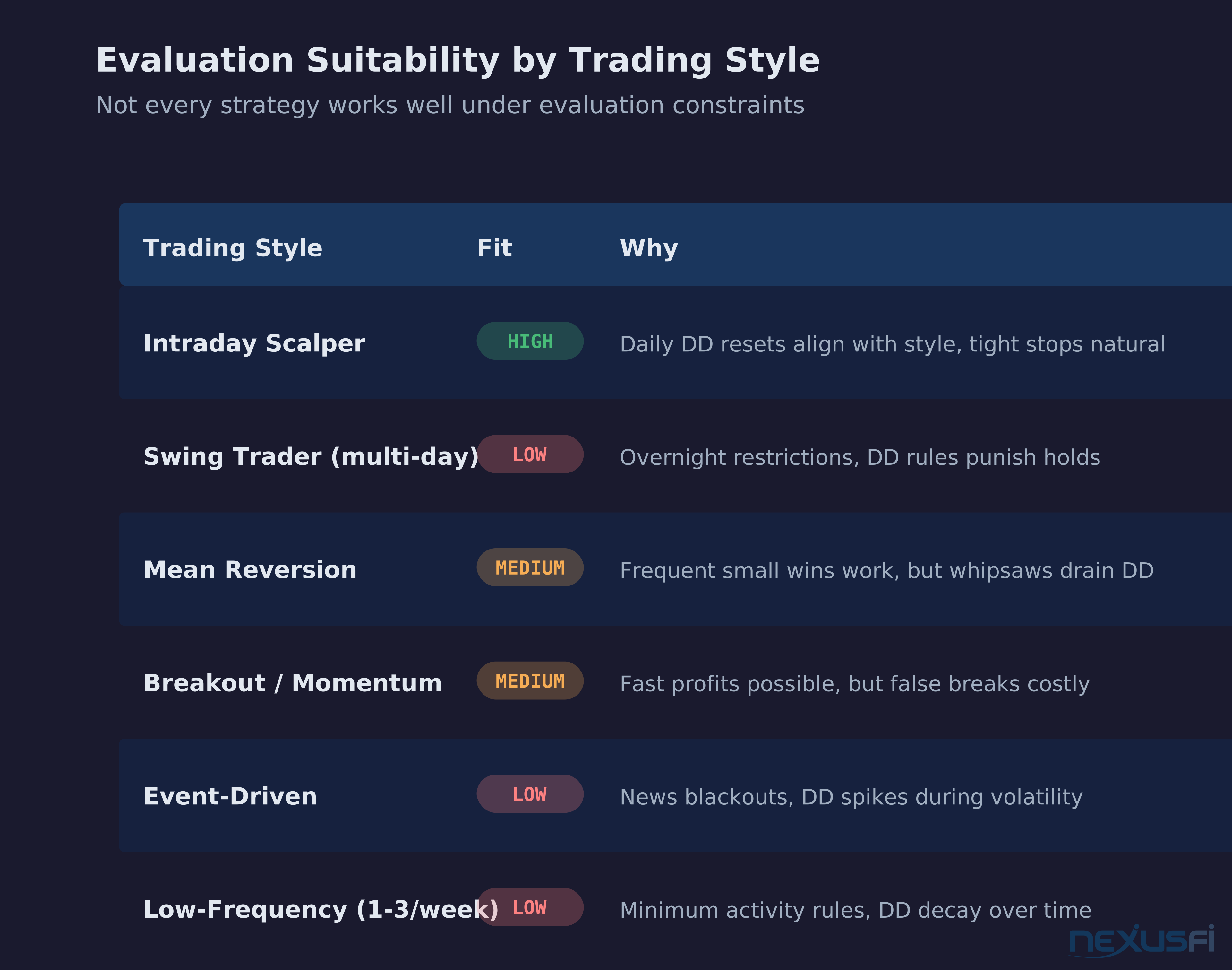
The right firm depends on how you trade, not which has the best coupon code this week. Here's the framework:
If you're a scalper with tight stops (2-5 tick stops, 4-10 tick targets): Trailing drawdown is manageable because your unrealized P&L stays close to realized P&L. Prioritize: low commissions, fast platform, generous contract limits. Evaluate: total cost of 3 attempts including data fees.
If you trade with wider stops (10-30 tick stops, 20-50 tick targets): Choose EOD or static drawdown exclusively. Real-time trailing will destroy you because normal price excursion on wider-stop trades will ratchet the floor up before you capture the full move. Prioritize: drawdown type over price.
If you hold overnight or multi-day: Most evaluations restrict overnight positions or charge overnight data fees. This style is poorly suited to the evaluation model in general. Consider funding your own account instead.
If you trade events (FOMC, NFP, earnings): Many firms blackout trading during major events or add intraday position restrictions around announcements. Check the news trading rules explicitly — some firms blow accounts for holding through high-impact events.
What to Check Before You Sign Up #
Before committing to any firm, verify these items explicitly. Don't assume — read the terms.
- Drawdown type and measurement basis. Is it static, EOD trailing, or real-time trailing? Does it measure from starting balance or peak equity? Does unrealized P&L count?
- Total cost of 3 attempts. Assume you won't pass the first time. Calculate: (eval fee x 3) + (reset fee x 2) + data fees + funding fee. That's your realistic investment.
- Funded account rules vs. evaluation rules. Are they identical or different? Many firms have tighter drawdown or additional consistency rules in the funded phase.
- Payout mechanics. Minimum days before withdrawal, payout caps, withdrawal frequency, processing time. How long from your first profitable trade to cash in your bank account?
- Platform support. Does the firm support your existing platform (NinjaTrader, Sierra Chart, TradingView, etc.) or force you onto a proprietary one?
- Allowed instruments and hours. Can you trade the products you know? Are there restrictions during overnight Globex hours or around news events?
- Consistency rules. Maximum single-day profit percentage, minimum profitable days, contract scaling requirements. These are the rules that catch people who didn't read the terms.
The Honest Assessment #
Funded evaluations work for a specific type of trader: someone with a proven, consistent strategy that generates small, regular profits with controlled drawdowns. If that's you — and you don't yet have the capital to trade at the size you want — evaluations are a legitimate funding path.
They don't work for traders who are still learning, who trade high-variance strategies, or who can't maintain discipline under artificial rule constraints. The evaluation environment is harder than a personal account because of the layered rules, and the fees add up if you're churning through resets.
[11] Micro futures (MES, MNQ, MCL) have made self-funding more accessible than ever. Sometimes the best evaluation firm is no evaluation firm at all.
Knowledge Map
Prerequisites
Understand these firstGo Deeper
Build on this knowledgeReferences This Article
Articles that build on this topicCitations
- — ApexTraderFunding.com experience and review (2022) 👍 10“the 50000 or 150000 accounts are just sim accounts with pretend balances”
- — Funded Trader platforms (2024) 👍 8“the high water mark of your account determined using open P/L less the max drawdown”
- — ApexTraderFunding.com experience and review (2022) 👍 9“according to the trailing drawdown rule your account just got eliminated”
- — Legends Trading AMA (2024) 👍 5“Trailing open equity is a suicide pact between you and the prop”
- — Get funded firms 2023/2024 (2024) 👍 5“70 for one month at MFF 199 for one month at TopStep”
- — Most Funding Firms are a Scam (2022) 👍 5“trailing DD based on unrealized PnL is literally the LIFEBLOOD of the profit structure”
- — Topstep experience and review (2024) 👍 7“30 days of profit rule builds good habits”
- — Most Funding Firms are a Scam (2022) 👍 8“people simply need to read the rules properly”
- — Supertradersam Thread Journal on NQ/MNQ (2024) 👍 4“I cant exceed 50% of profit goal in one day”
- — jlabtrades apex prop firm and personal trading journal (2024) 👍 1“their payout schedule really was a bear to deal with”
- — Which get-funded program is the best these days? (2020) 👍 6“you could put 1500 into a Futures account to trade the micros”