



Prop Firm Evaluation Strategies: How to Actually Pass a Funded Trading Challenge
Overview #
Overview #
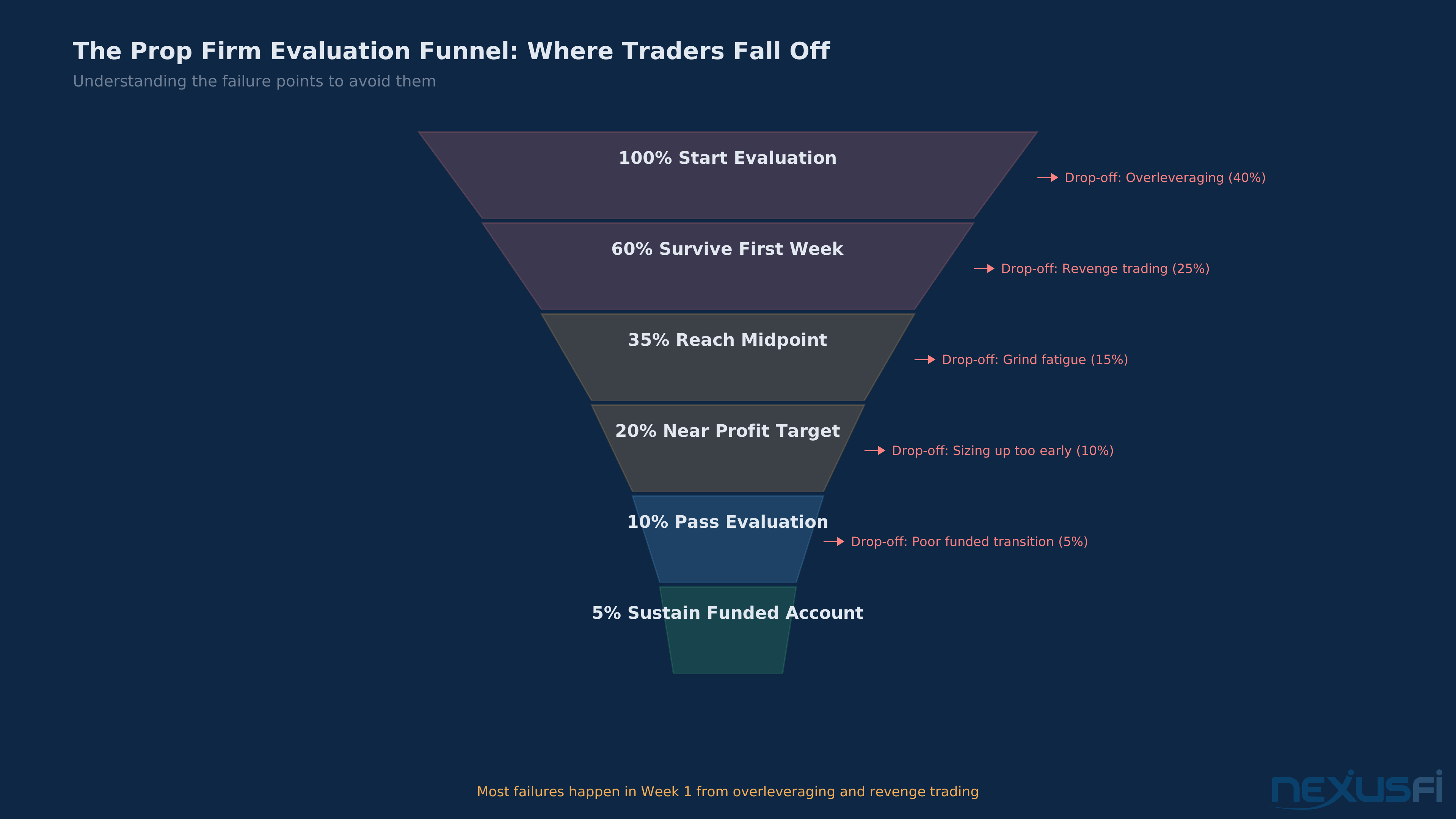
Here's the number everyone in the prop firm space knows but nobody wants to hear: roughly 95% of traders fail evaluations [13]. Of the 5% who pass, somewhere around 80% blow their funded account within 90 days. The math is brutal, and most of the failure comes down to one thing — risk management, or the lack of it.
The firms don't care if you're the next Paul Tudor Jones. They care whether you can generate consistent returns without ever triggering a drawdown violation. That's the game. Once you understand that the evaluation tests discipline rather than trading genius, the path forward becomes clearer.
Prop firm evaluations test whether you can grind out gains without ever triggering a drawdown violation. This article lays out the framework for passing evaluations at firms like Apex Trader Funding, Topstep, Earn2Trade, TakeProfitTrader, and similar futures-focused prop firms.
The strategy isn't a specific entry system — it's a risk management framework that works regardless of what you trade or how you find entries.
The Real Test: Risk Management, Not Trading #
Every evaluation has three components: a profit target, a drawdown limit, and time. That's it. Strip away the marketing language about "finding the best traders" and what remains is a math problem.
Consider a $50K Apex evaluation account. The profit target is $3,000 and the trailing drawdown is $2,500. As @josh [1] frames it, this is really a $2,500 account with a $3,000 profit target — and that reframe changes everything about how you approach the evaluation.
The expected value math works like this: with a 50% win rate, 1.6 profit factor, and 3% risk per trade ($75 risk on a $2,500 account), your expected value per trade is $22.50. At 2 trades per day, you hit the $3,000 target in roughly 67 trading days. The cost is 3-4 months of subscription fees. These aren't impossible numbers, but they require patience most traders don't have.
The traders who fail almost always fail for the same reason: they try to hit the profit target fast. They overtrade, oversize, or both. The evaluation rewards grinding, not swinging for the fences.
Know Your Drawdown Type #
Before spending a dollar on an evaluation, understand what kind of drawdown the firm uses. This single variable changes everything about how you trade the account.
End-of-Day (EOD) Drawdown
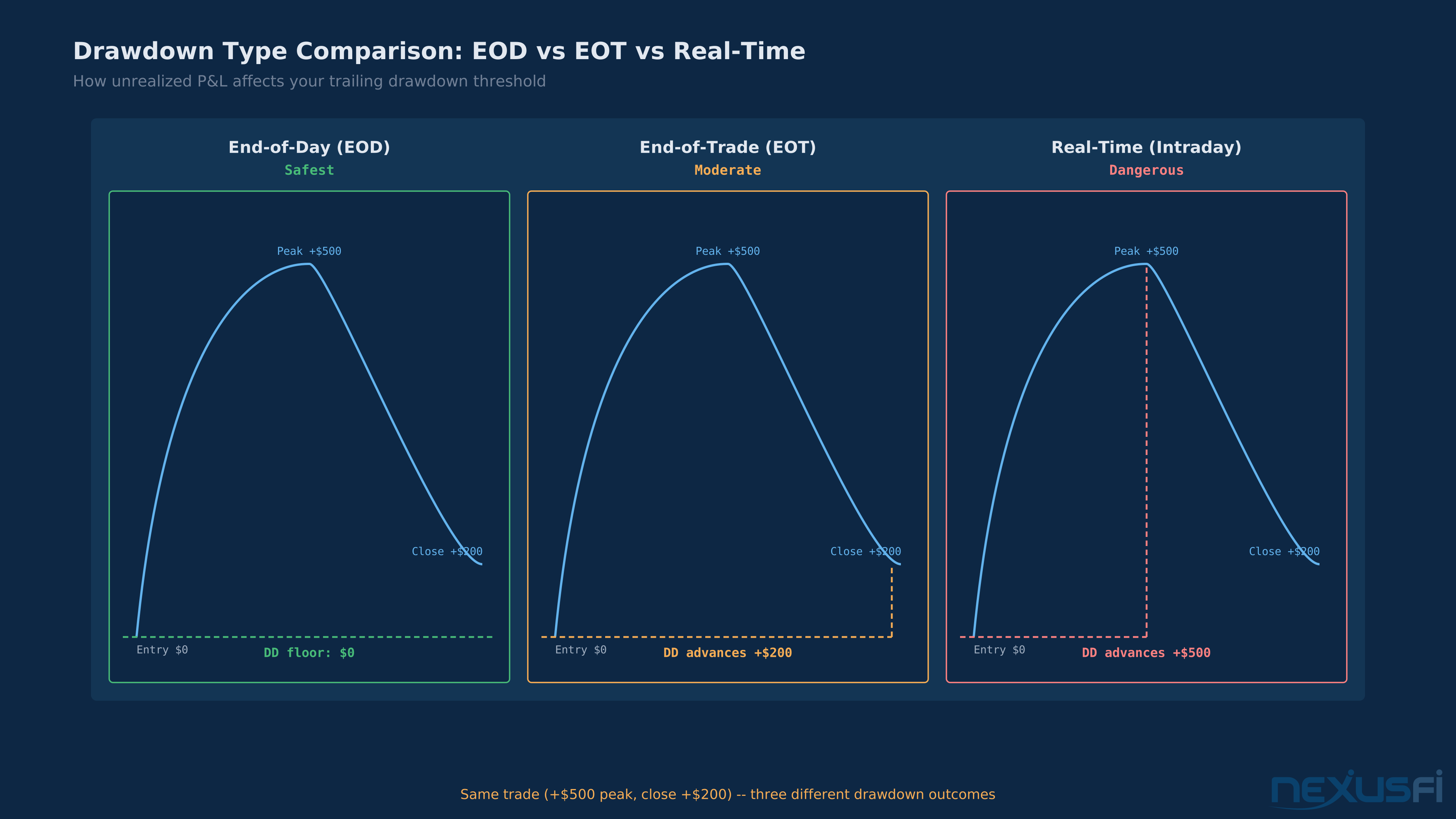
The most trader-friendly option. Your drawdown threshold only updates at the end of each trading session (typically 5:00 PM ET). If you're up $500 intraday but close the day flat, the trailing drawdown doesn't move. As @idude [2] puts it plainly: "It is obvious that the best plan is EOD."
EOD drawdown gives you room to let trades breathe. An intraday spike in unrealized profit won't eat into your safety margin. Firms using EOD drawdown include Topstep (in certain products) and Uprofit Trader.
End-of-Trade (EOT) Drawdown
The drawdown threshold updates when you close each trade. If you enter a trade that runs $500 in your favor but you close it for $200, the trailing drawdown advances by the $500 peak — not the $200 you actually kept. This makes EOT drawdown more punishing than EOD, because it tracks unrealized highs at the trade level.
Real-Time (Intraday) Trailing Drawdown
The most dangerous variant. Your drawdown threshold updates tick-by-tick based on unrealized P&L. @Howard Roark [3] illustrates the problem with a vivid example: a trader with a 100% win rate racks up $19K in profits, then gets eliminated because a single trade's unrealized profit spiked $6,000 before being closed for $4,000. "Does this sound like a company that's funding traders?"
With real-time trailing drawdown (used by Apex and others), you must use take-profit orders on every trade. Letting winners run is a luxury you don't have until the trailing drawdown caps at your starting balance.
The Trail Cap
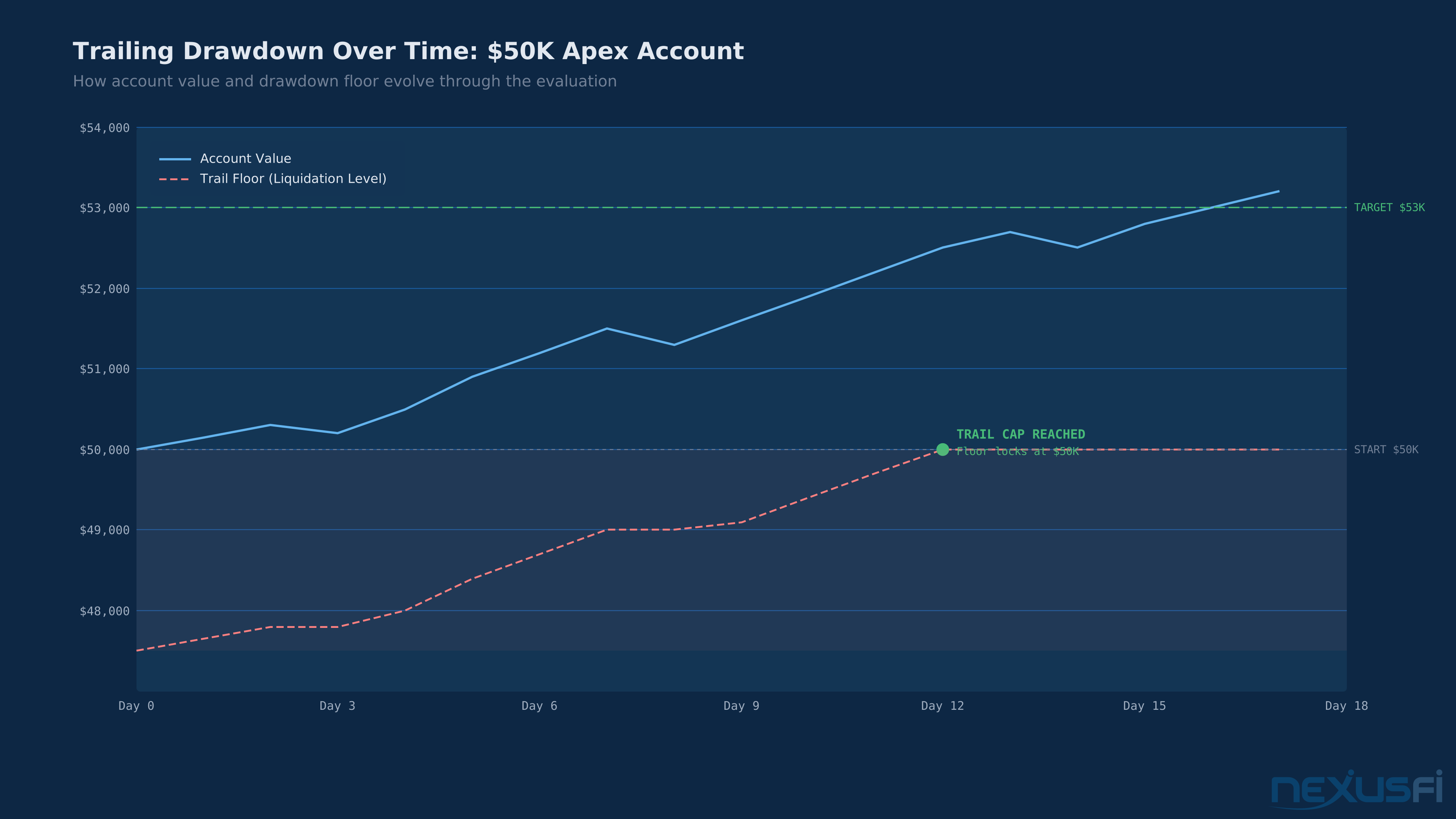
Ask any firm: does your trailing drawdown cap at the starting account balance? If yes, once you've earned enough profit to push the drawdown floor up to $50,000 (on a $50K account), you're trading with a static drawdown from that point forward. At Apex, this happens when you earn $2,500 in profit — once the drawdown floor locks at the starting balance, it stops advancing regardless of how much more you earn.
Until you reach the trail cap, every tick of unrealized profit costs you safety margin. After you reach it, you're trading a normal account with a fixed stop-out level.
Position Sizing: The Only Lever That Matters #
If there's one sentence that captures 17 years of evaluation experience, @blackgrey45 [4] nailed it: "Position sizing and stop losses. Going into a position that is too large inevitably leads to blown up accounts. I now risk 2-3% of my account on each trade."
Position sizing is where 90% of evaluation failures originate. The math is straightforward:
The 2% Rule for Evaluations
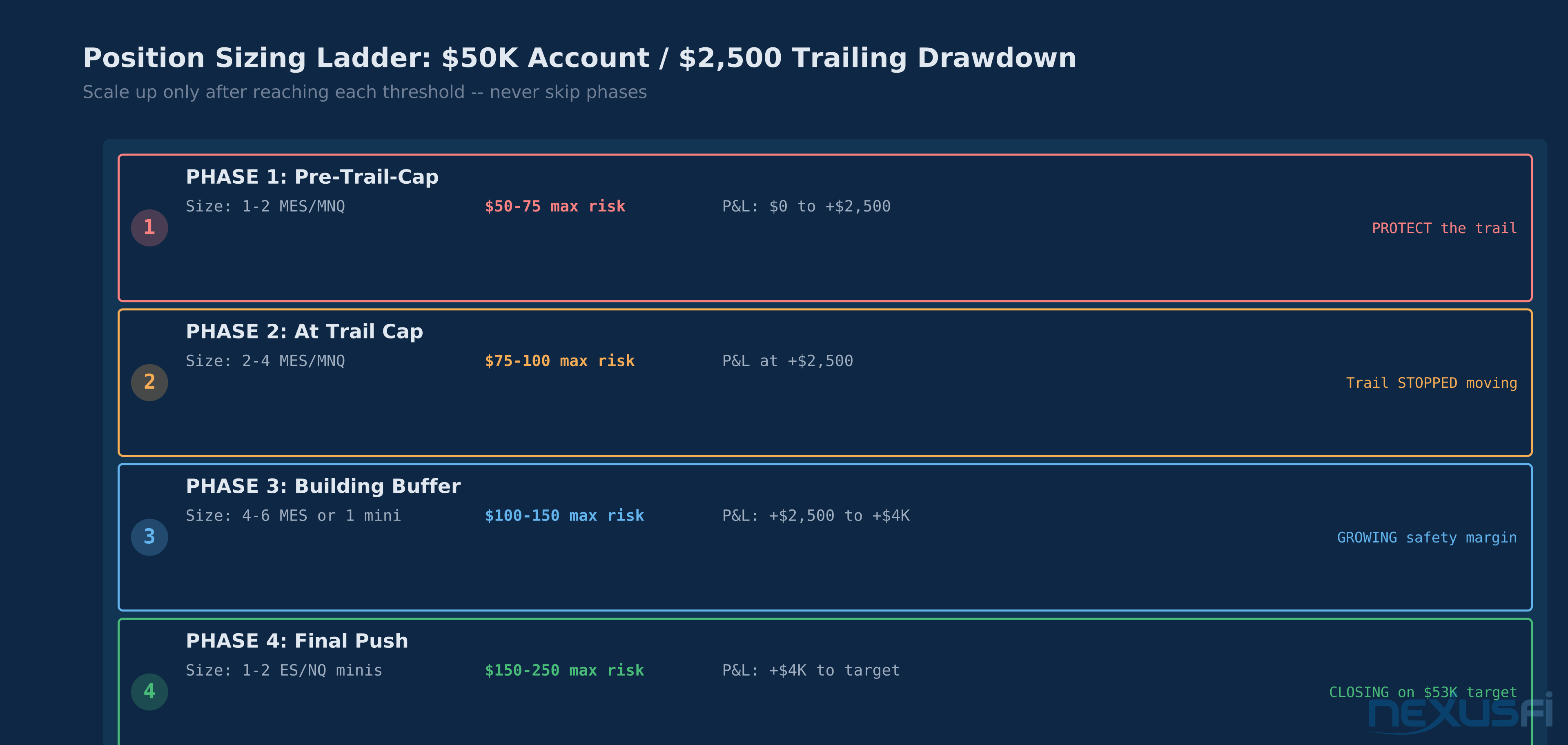
Risk no more than 2% of your actual drawdown limit per trade. [15] On a $50K Apex account with a $2,500 trailing drawdown, that's $50 per trade. On a $150K Leeloo account with a $5,000 drawdown, that's $100 per trade.
For ES futures: $50 risk = 1 point stop with 1 contract, or 2 point stop with 1 MES (micro). For NQ: $50 risk = 2.5 point stop with 1 MNQ.
Start with Micros
This isn't glamorous advice, but @sstheo [5] passed a OneUp evaluation trading single contracts with an average winner of $36 and average loser of $98 — proving that you don't need big winners to pass. Consistency and discipline beat home runs every time.
Starting with micros accomplishes two things:
- Keeps the trailing drawdown manageable -- with MES at $1.25/tick, even a 20-tick adverse move costs only $25. On a $2,500 drawdown that's 1% risk, giving you plenty of room for losing streaks without approaching the violation threshold.
- Builds the psychological foundation -- trading small removes the emotional charge from each trade. When a loss costs $25 instead of $250, you make better decisions. The habits you build at micro size carry directly into larger positions after you've earned the buffer.
Scale up only after reaching the trail cap. Once the trailing drawdown stops advancing, your risk tolerance effectively doubles.
Managing the Trailing Drawdown #
The trailing drawdown is the single most complained-about mechanic in prop firm evaluations. @josh [6] argues it's not actually unfair — it simply requires a different trading approach. The trailing drawdown punishes undisciplined profit-taking, but it rewards traders who bank gains methodically and protect their buffer.
Phase 1: Pre-Trail-Cap (Earning Your Buffer)
This is the most dangerous phase. Every dollar of unrealized profit advances the trailing drawdown floor.
Rules:
- Use hard take-profit orders on every trade. @Mordecai [7] learned this the hard way: "The aim is to avoid a big spike into profit, as unrealized profit moves the trailing DD. If I had been in a profitable trade with SL at breakeven and no TP, the 60-point spike in ES would have moved the trailing DD up by +$6K, and the retracement would have blown the account."
- Target small, consistent gains -- $50-100 per trade is plenty. The goal is to accumulate toward the profit target without ever giving the drawdown floor a reason to jump.
- Never let a winner run past your take-profit target during this phase
- If a trade hits your TP level, take the money. Don't move the target.
Phase 2: Post-Trail-Cap (Playing With House Money)
Once the trailing drawdown caps at your starting balance, you can breathe. The drawdown floor stops advancing and you're trading with a fixed safety net.
Rules:
- Loosen take-profit targets -- with the floor locked, letting a winner run an extra few ticks no longer costs you safety margin.
- Scale up position size incrementally (see sizing ladder)
- The urgency shifts from "protect the drawdown" to "reach the profit target"
- You still can't afford big losing days, but single-trade risk tolerance increases
Phase 3: Final Push (Closing the Gap to Profit Target)
Within striking distance of the profit target, the temptation to "go big" is massive. Resist it.
Rules:
- Don't increase size. The worst outcome is blowing the account when you're $300 from passing.
- If you need $500 more to pass and your daily average is $100, it takes 5 days. That's fine.
- Trade only A+ setups. If nothing's there, don't trade.
Strategy Selection Under Evaluation Constraints #
Not every trading strategy works under prop firm constraints. The trailing drawdown mechanic specifically punishes:
- Trend following with wide stops (trail advances on every unrealized tick)
- Swing positions held overnight (overnight gaps can spike the trail)
- High-volatility approaches that generate large P&L swings
What works:
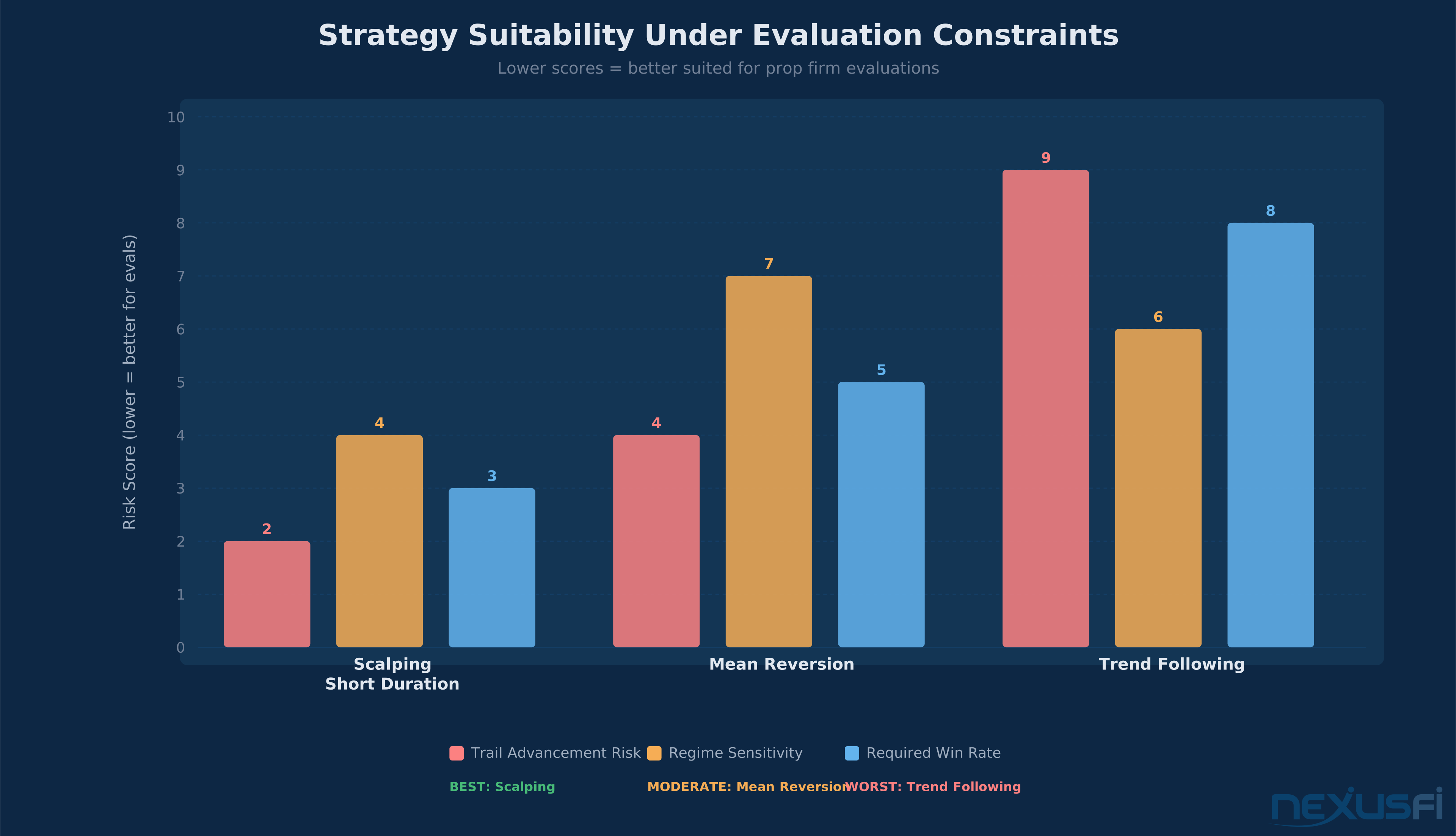
Scalping / Short-Duration Trades
Quick in, quick out. Keep trade duration under 30 minutes. Target 4-8 ticks on ES, exit immediately at target. This minimizes exposure to trail advancement.
Win rate matters more than reward/risk in evaluations. A 70% win rate at 1:1 R:R generates consistent daily P&L without large drawdown spikes. @sstheo's evaluation journal demonstrates exactly this — small, frequent scalps on MES with tight stops and modest targets, grinding out daily gains of $30-50 that compound over weeks into a passed evaluation.
Mean Reversion in Range Days
Range-bound days are evaluation gold. The market oscillates around a level, reversals are frequent, and stops are tight. Identify the value area, trade the edges.
The problem: trend days. On trend days, mean reversion gets destroyed. If you don't recognize the regime shift early, one trend day can erase a week of grinding. This is where the daily loss limit saves you.
Fixed Daily Loss Limit
This is non-negotiable for evaluation trading. Set a daily loss limit that is 20-25% of your total trailing drawdown.
On a $2,500 trailing drawdown: stop trading after losing $500-625 in a single day. This ensures you can survive 4-5 consecutive losing days without triggering the evaluation's drawdown limit.
@Mordecai [8] had it right: "If I hit -$1K for the day, I stop trading. This should allow me 3 bad days in a row with sufficient headroom under the trailing drawdown."
The Daily Playbook #
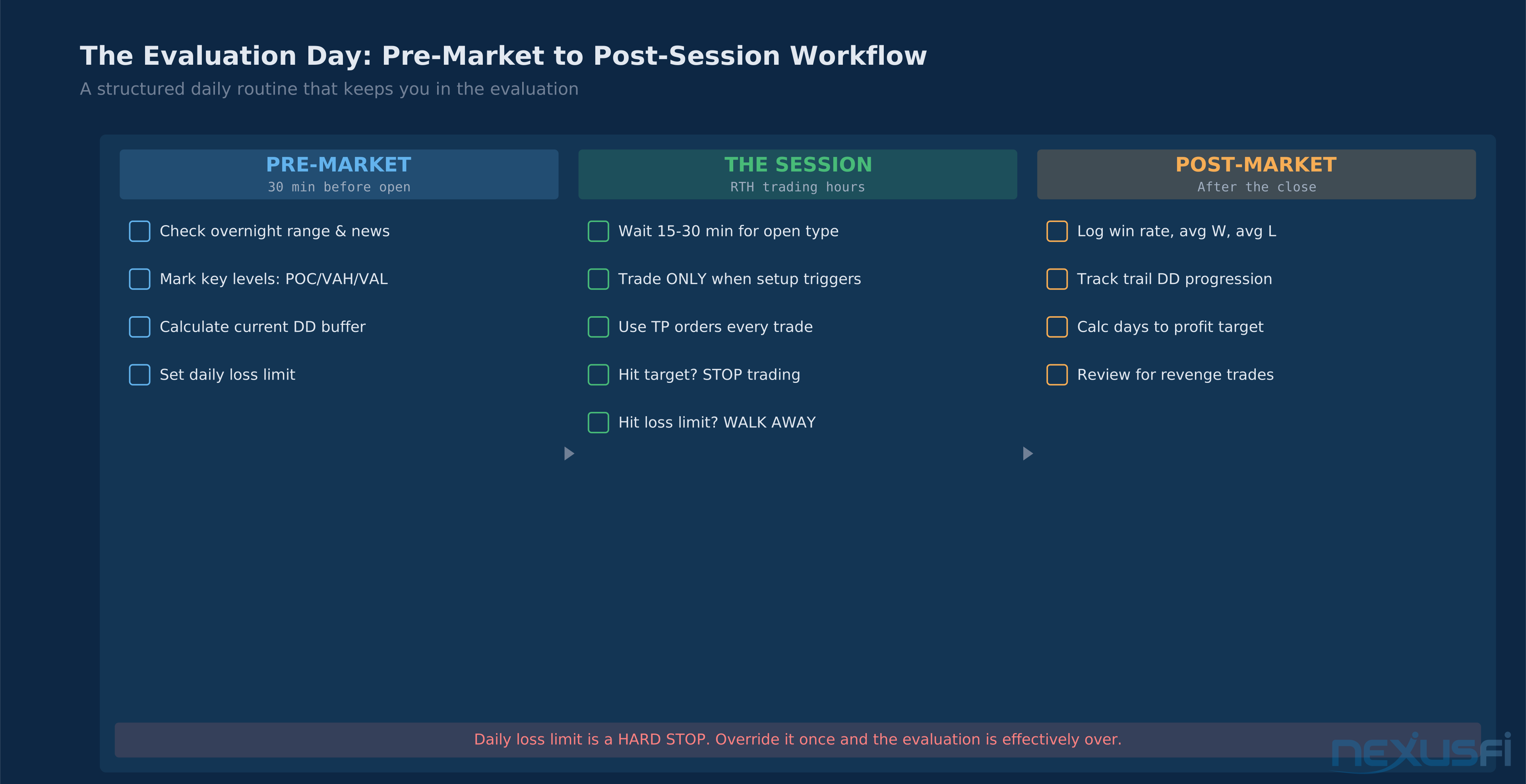
Pre-Market (30 minutes before open):
- Check overnight range and any news catalysts
- Identify key levels -- prior day high/low, overnight high/low, VWAP, and any obvious support/resistance from the daily chart.
- Check your current trailing drawdown position -- know exactly how much room you have before violation. This number drives your position sizing for the day.
- Set the daily loss limit in your platform. Hard stop, no override.
The Session:
- Wait for the first 15-30 minutes. Let the open type develop. Don't chase the opening move.
- Trade only when your setup appears. If nothing triggers, don't trade.
- Use take-profit orders. Every trade, every time (especially pre-trail-cap).
- After hitting daily profit target ($100-200), stop or reduce size dramatically.
- After hitting daily loss limit, stop. Walk away. No exceptions.
Post-Market:
- Log every trade. Win rate, average winner, average loser, max drawdown of the day.
- Track trailing drawdown progression. Where is the floor now? How far from trail cap?
- Calculate days remaining to profit target at current daily average.
The Consistency Rule Trap #
Some firms impose a "consistency rule" requiring that no single day accounts for more than a certain percentage of total profits. @idude's warning is direct: "By all means do not join any prop with this rule. The markets are too inconsistent and trading with this rule is like having a shotgun pointing at you."
If a firm has a consistency rule:
- You must avoid big winning days just as much as big losing days
- One solid day can disqualify you even if total P&L meets the target
- This artificially constrains your upside without reducing your downside
Avoid firms with consistency rules if possible. If you choose a firm with one, keep daily profits under 30% of the total target and plan for a longer evaluation timeline to spread profits evenly across trading days.
When the Evaluation Strategy Fails #
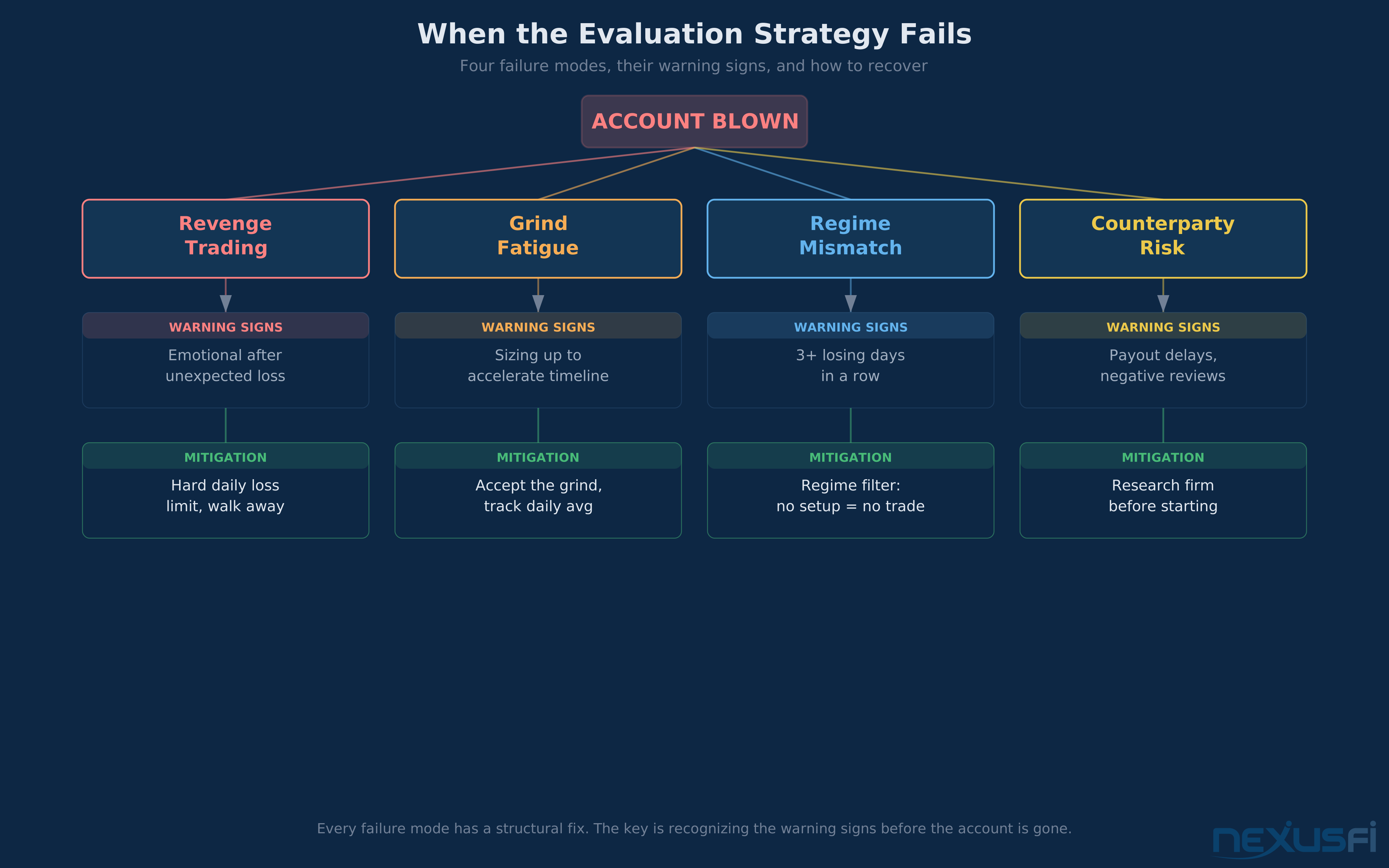
Revenge Trading
The #1 killer. @Mordecai [9] was brutally honest about it: "Most of the time I'm OK with routine losses. However, unexpected losses really mess with my head. When they happen I try to recover the loss immediately. It doesn't work and leads to revenge trading. Then I bust the account, undoing days of careful trading."
There's no strategic fix for revenge trading — it's a trading psychology problem, not a strategy problem. The only reliable defense is a hard daily loss limit enforced by your platform, not your willpower.
The Grind Fatigue
Trading 1-2 micros, targeting $50-100/day, for 2-3 months straight is psychologically exhausting. It doesn't feel like "real" trading. The temptation to size up and accelerate the timeline is constant.
This is where most technically competent traders fail evaluations. They can trade. They just can't trade slowly enough, long enough.
Regime Mismatch
Your strategy works in range markets but the market trends for 3 weeks straight. Or vice versa. The evaluation doesn't care about market regimes — the profit target and drawdown limits stay the same regardless of whether the market is chopping sideways or trending relentlessly.
The fix: have a regime filter. If today's market doesn't match your strategy, don't trade. A flat day doesn't hurt you. A losing day does.
Counterparty Risk
Once funded, your counterparty is the prop firm, not CME. As @josh [10] notes: "With a funding company, they are your counterparty, and your risk is that they won't pay you. This to me is the only real risk here." Research the firm's payout history before investing time and money.
The Multi-Account Approach #
Some traders run multiple evaluation accounts simultaneously. @dredmond19800 [11] runs 12 Apex PAs: "Each Apex PA has cost me $160. I plan to make $200 a day per account with a trade copier. When that's multiplied out it's $2,400 over the 12 accounts."
The economics:
- 12 accounts x $160 each = $1,920 total investment
- If each account generates $200/day via trade copier = $2,400/day
- Break-even in under 1 day of successful trading
The reality check:
- Trade copiers don't work perfectly across all accounts simultaneously
- Each account has independent drawdown tracking
- One bad trade copies across all accounts, multiplying the damage
- The trailing drawdown is harder to manage when copying entries at slightly different prices
Multi-account strategies work best after you've proven you can pass a single evaluation consistently. Using them as a shortcut before developing the discipline leads to multiplied losses, not multiplied profits. Before scaling to multiple accounts, make sure you understand the payout structures each firm offers — the economics only work if payouts are reliable and timely.
On-Exchange vs Off-Exchange: A Non-Negotiable #
@MarketMage [12] makes a critical distinction: "The NT8/Rithmic-based props are great. The MT4/MT5/proprietary platform ones like FTMO I would advise anyone to think hard on. It's a giant difference to stick with an on-exchange prop if you are serious."
On-exchange evaluation firms (Apex, Topstep, Earn2Trade, TakeProfitTrader) route your trades through CME via Rithmic or CQG [14]. You're trading real market data with real order matching even during evaluation. Off-exchange firms use synthetic feeds and proprietary matching engines, which means your evaluation fills may not reflect real market conditions — and the transition from evaluation to funded can feel like a different market entirely.
For futures traders: stick with on-exchange firms. The execution and data quality during the evaluation mirrors what you'll experience when funded.
The Discipline Dividend #
@MarketMage made a point worth repeating about what evaluations actually teach you: "Going prop was the best thing I ever did for my trading. I wasn't capital challenged, I was discipline challenged. The props gave me the discipline to follow strict rules and motivation." [12]
Even if you have personal trading capital, the evaluation process forces risk management discipline that self-funded trading doesn't. When your own money is on the line, it's too easy to override your rules. When the prop firm's rules are the line, you either follow them or you fail. That external accountability has value regardless of whether you ultimately trade funded or use the discipline to trade your own account better.
@sstheo's trajectory bears this out: "I also intend to take the profits from MES and try with my personal account again, but hopefully leverage my positive experience here into the success I should have had when I started futures trading many years ago." [5]
The evaluation isn't just a path to funded capital. It's a risk management boot camp with a financial incentive — and the discipline you build here is exactly what carries over when you start scaling your funded account after passing.
Knowledge Map
Prerequisites
Understand these firstGo Deeper
Build on this knowledgeReferences This Article
Articles that build on this topicCitations
- — Funded Trader platforms (2024) 👍 17“Consider instead a $50k evaluation account with a $2500 loss limit and a $3000 profit goal.”
- — TST/OneUp/LeeLoo/Earn2Trade (2022) 👍 5“It is obvious that the best plan is EOD.”
- — ApexTraderFunding.com experience and review (2022) 👍 9“Does this sound like a company that's funding traders?”
- — Blackgrey45 Journal (2025) 👍 2“Position sizing and stop losses.”
- — My MES Live Account Journal (OneUp) (2019) 👍 21“184 trades over 15 days, average net profit of $17 per trade.”
- — Funded Trader platforms (2024) 👍 8“Not taking any profit there is just poor risk management.”
- — Leeloo 150k Tryout Scalping Journal (2022) 👍 4“The aim is to avoid a big spike into profit.”
- — Leeloo 150k Tryout Scalping Journal (2022) 👍 4“If I hit -$1K for the day, I stop trading.”
- — Leeloo 150k Tryout Scalping Journal (2022) 👍 5“Unexpected losses really mess with my head.”
- — Funded Trader platforms (2024) 👍 17“They are your counterparty, and your risk is that they won't pay you.”
- — Funded Trader platforms (2024) 👍 8“Each Apex PA has cost me $160.”
- — Any long term success stories from funded traders? (2021) 👍 7“The NT8/Rithmic-based props are great.”
- QuantVPS — Prop Firm Statistics 2026: Pass Rates, Payouts & Trends (2026)
- CME Group — Rithmic, LLC u2014 CME Group Certified Technology Vendor (2026)
- Van Tharp Institute — Van Tharp Teaches Position Sizing Strategies and Risk Management (2024)