



Prop Firm Fees and Costs: The Complete Economics of Funded Trading
Overview #
Overview #
Every prop firm evaluation ad leads with the same pitch: pass our challenge, trade our capital, keep most of the profit. The evaluation fee looks reasonable — $100 to $400 depending on account size. That's the number traders fixate on. It's also the smallest line item in what funded trading actually costs.
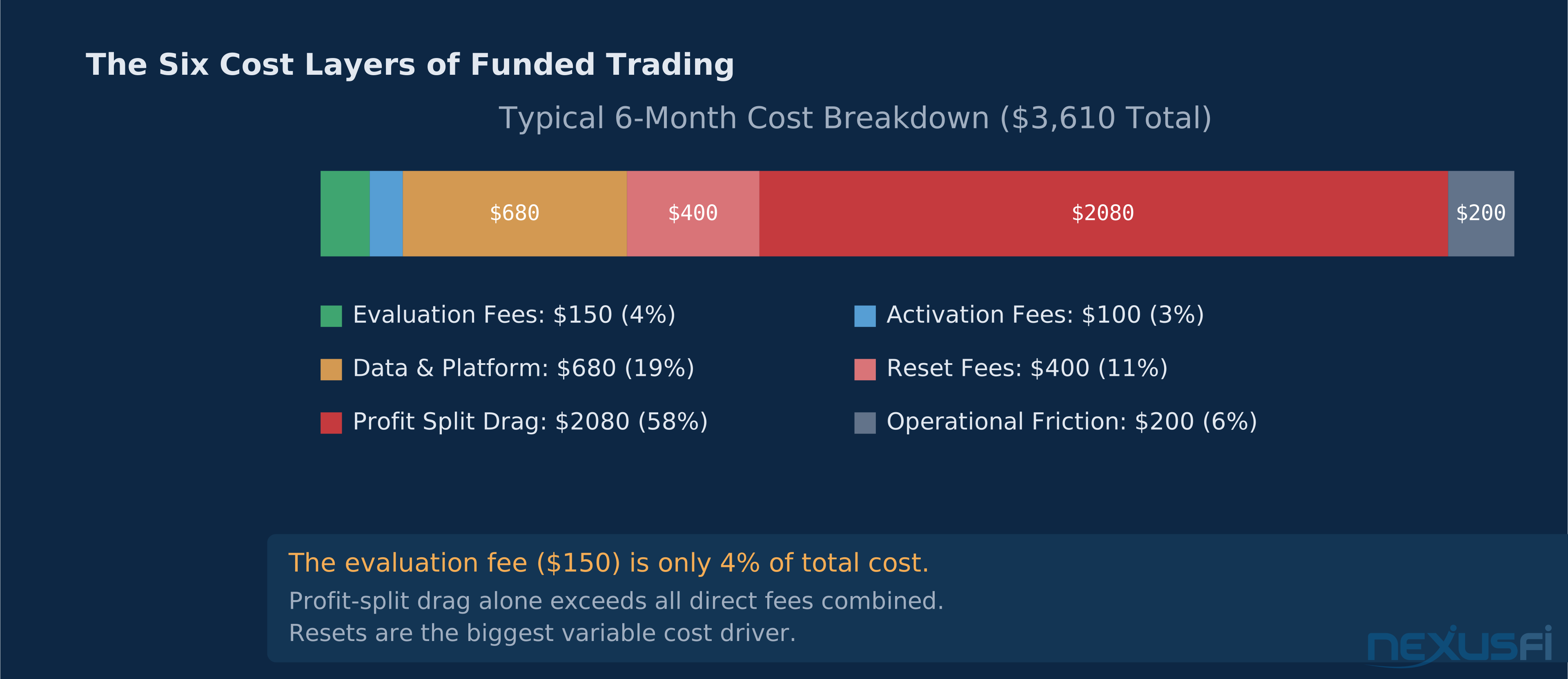
The real economics of prop firm trading play out across six cost layers that most traders never model until they're deep into the process. Evaluation fees. Activation charges. Monthly platform and data subscriptions. Reset fees when things go sideways. Profit-split mechanics that eat more than the headline number suggests. And operational frictions — slippage, execution differences, trading restrictions — that don't show up on any invoice but hit your P&L hard.
This article breaks down every cost category, shows you how to calculate your true total cost of ownership over a realistic 6-to-12-month horizon, and gives you the framework to compare firms on economics rather than marketing. The evaluation fee is typically 10-20% of what funded trading actually costs. The rest comes from categories most traders don't account for until the bills arrive.
Key Concepts #
Total Cost of Ownership (TCO): The complete economic cost of participating in a funded trading program over a defined period — not just the upfront fee, but every recurring charge, event-driven expense, and performance-linked deduction that reduces your net take-home.
Effective Profit Split: What you actually keep after all deductions — commissions, clearing fees, platform charges, and payout administration — are subtracted from your gross profit. This is almost always lower than the advertised split.
Reset Risk: The probability-weighted cost of account breaches requiring paid restarts. For most traders, resets are the single largest cost driver beyond profit splits.
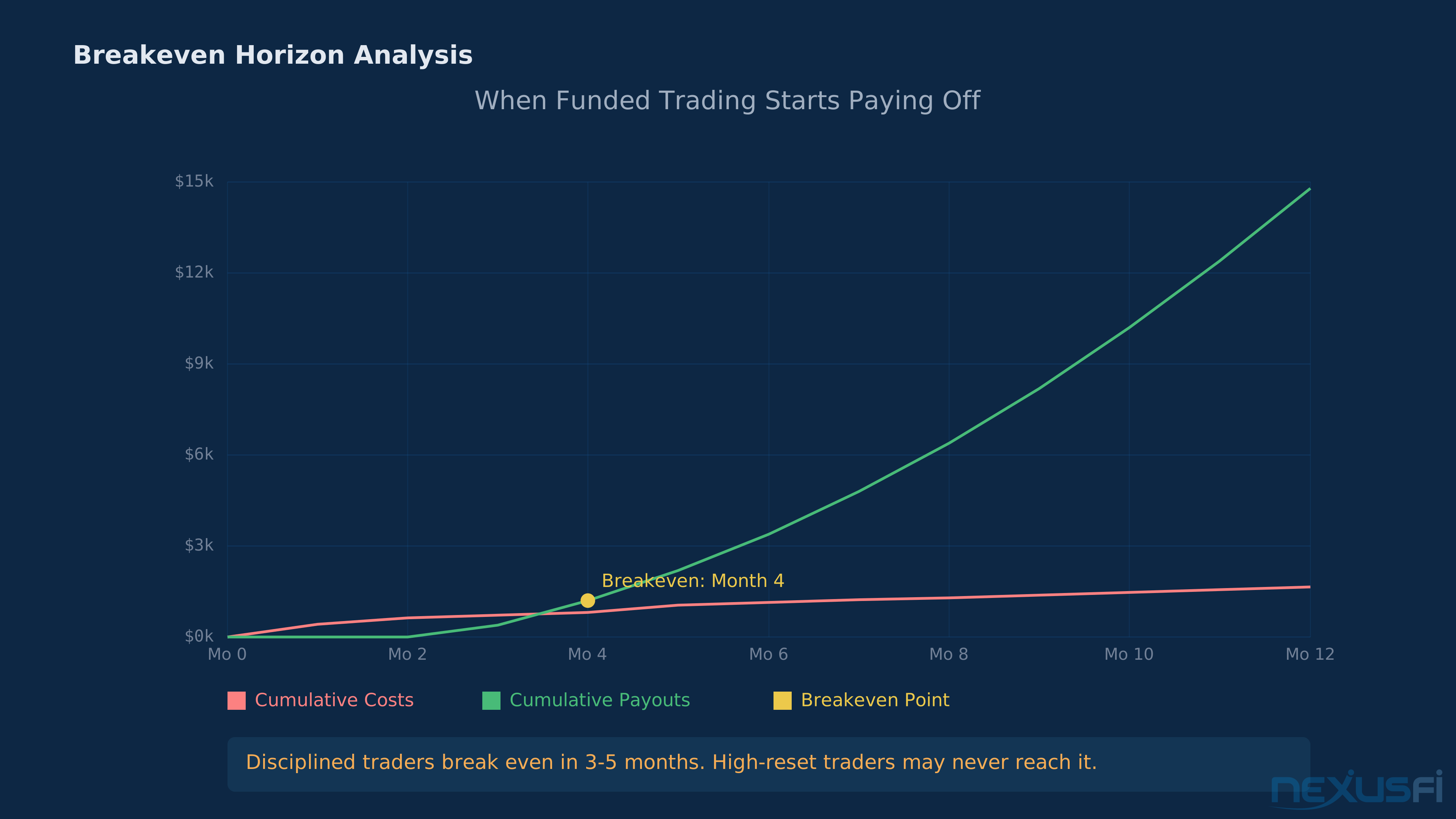
Breakeven Horizon: The point at which cumulative payouts exceed cumulative costs (evaluation + resets + data + activation + lost profit-split margin). Many traders never reach this point.
Operational Friction: Non-fee costs that reduce realized performance — execution quality differences between evaluation and funded environments, trading restrictions that force suboptimal behavior, and instrument limitations that degrade strategy performance.
The Six Cost Layers of Funded Trading #
Layer 1: Evaluation Fees -- The Visible Cost
This is the number on the sales page. For major futures prop firms, evaluation fees typically range from $100 for smaller accounts (25K-50K) to $400+ for larger ones (150K-300K). Some firms run near-permanent "sales" that discount these fees by 50-80%.
for evaluation accounts.
https://nexusfi.com/showthread.php?t=60507&p=897379#post897379
The evaluation fee is the most visible cost and the least significant one over any meaningful time horizon. If you're funded for six months, it's probably 5-15% of your total expenses. Treating it as "the cost" of funded trading is like pricing a car by the down payment alone.
Layer 2: Activation and Onboarding Fees
Most firms charge a one-time fee when you transition from passed evaluation to funded status. This ranges from $0 to $150 depending on the firm and program tier. Some firms roll this into the first settlement cycle rather than billing it separately, which makes it less visible but no less real.
mean the fees stop — activation charges multiply with each account, and traders running multiple evaluations face compounding upfront costs.
https://nexusfi.com/showthread.php?t=48548&p=862135#post862135
The activation fee itself isn't dramatic. But combined with reset costs (Layer 4), the total upfront spend before your first payout can be significant.
Layer 3: Monthly Platform and Data Fees
This is where traders get blindsided. During evaluation, market data is often bundled — you're trading, you see quotes, everything works. Once funded, the economics change.
Platform fees range from $0 to $100/month depending on the firm. Some firms absorb this entirely. Others pass it through as a recurring charge regardless of whether you're actively trading.
Market data fees are the bigger variable. CME professional data — which many funded accounts require — runs much more than non-professional rates. As @matthew28 pointed out after getting funded:
"You pay professional CME data fees, some companies charge for all, some give the first free so that's okay if you only trade one."
https://nexusfi.com/showthread.php?t=59021&p=873887#post873887
The combined monthly overhead — platform plus data — can run $85 to $200/month for active funded traders. That's $510 to $1,200 over six months before you've kept a single dollar of profit. And critically, these fees accrue whether you're profitable or not. During drawdown recovery periods, when you're scaling back risk and taking smaller positions, monthly fees eat into whatever margin you have left.
@matthew28 also compared the economics directly: "$85/month when funded rather than the CME professional data fees per exchange" — noting that some firms bundle data costs into a single monthly charge while others break them out separately.
https://nexusfi.com/showthread.php?t=57707&p=852718#post852718
The data tier trap: If your funded account doesn't include full depth-of-market data, your order-flow strategies degrade. Traders who relied on DOM-based execution during evaluation discover that their funded environment provides less granular data, leading to worse fills and more false signals. The "cost" here isn't a fee — it's degraded performance that shows up as lost P&L.
Layer 4: Reset Fees -- The Cost Multiplier
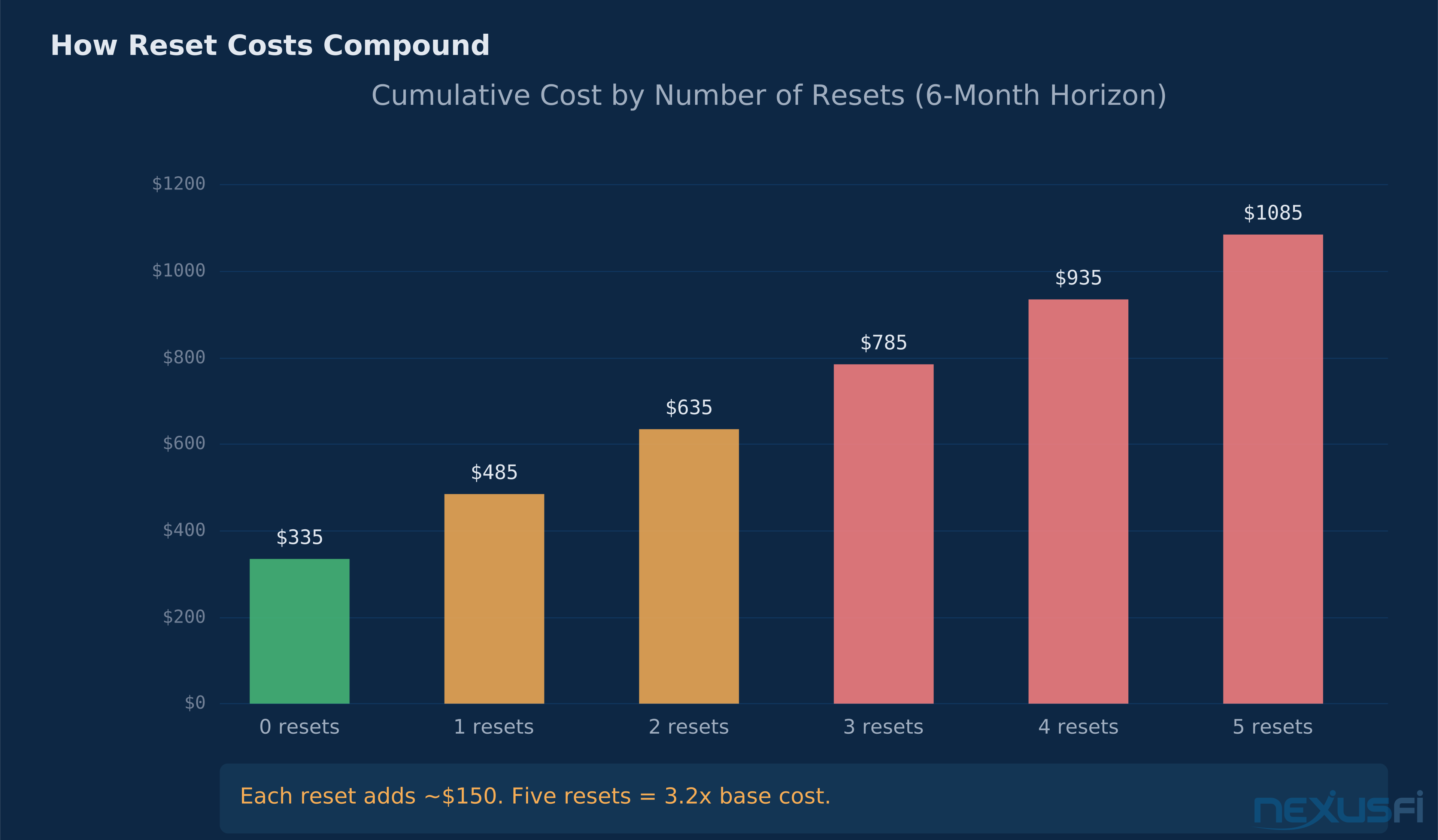
Resets are where total cost becomes nonlinear. Every time you breach a max loss threshold, daily loss limit, or consistency rule, the account terminates. Getting back in costs a reset fee — typically 20-40% of the original evaluation fee — plus the opportunity cost of time lost and any unrealized profits forfeited.
https://nexusfi.com/showthread.php?t=46796&p=821232#post821232
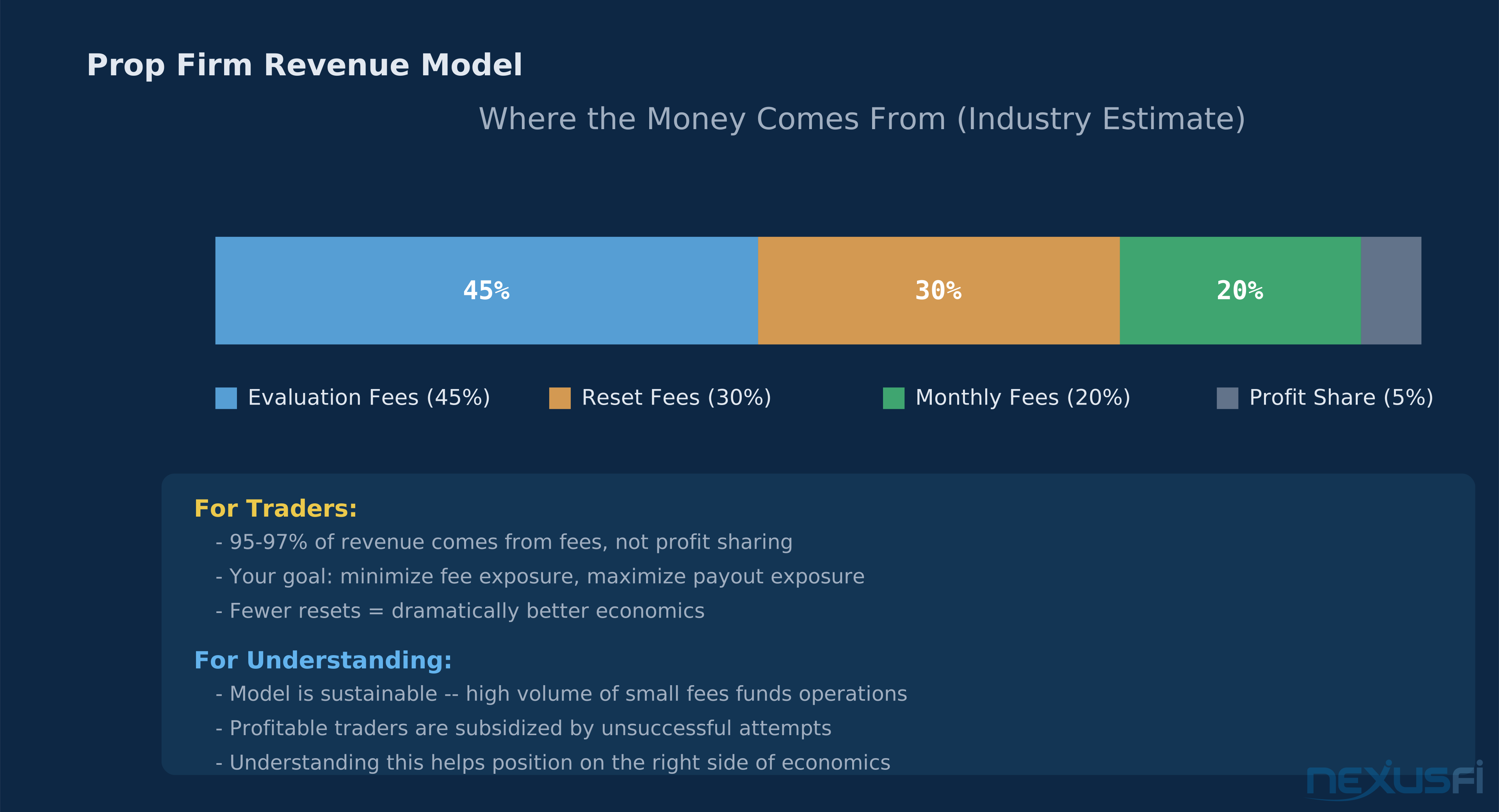
This isn't a criticism — it's the structural reality. @biotic was more direct about the revenue composition: "Likely the income of most of the prop companies is 97-99% from fees and resets."
https://nexusfi.com/showthread.php?t=57707&p=877544#post877544
Why resets dominate the cost model: The math is brutal. If your strategy has a 30% chance of hitting max drawdown in any given funded period, your expected cost per attempt isn't just the evaluation fee — it's the evaluation fee plus 0.3 x (reset fee + time value + forfeited profits). Over multiple attempts, resets compound faster than most traders expect.
Consider a trader who pays $150 for evaluation, $100 for activation, and needs three funded attempts before achieving consistent payouts. That's $150 + $100 + (2 x $100 in resets) + (2 x $100 in re-activation or restart costs) = $650 minimum in direct fees — over four times the headline evaluation cost.
https://nexusfi.com/showthread.php?t=57707&p=876694#post876694
The reset probability problem: Most traders dramatically underestimate their reset probability. If your win rate is 55% and you're trading near the drawdown limit, even a normal losing streak of 4-6 trades can trigger a breach. The evaluation rules are designed around statistical filters — consistency requirements, daily loss limits, trailing drawdowns — that ensure a meaningful percentage of otherwise profitable traders get stopped out.
Layer 5: Profit Split Mechanics -- The Largest Long-Term Cost
Over any extended trading horizon, the profit split is the dominant cost. An 80/20 split means the firm takes 20% of every dollar you earn. A 90/10 split takes 10%. But the headline split rarely tells the full story.
What reduces the effective split:
1. Commission embedding: Some firms deduct commissions from gross profit before applying the split. If commissions run $5 per round turn and you're doing 20 round turns per day, that's $100/day deducted before the split calculation. On a $500 gross profit day, your split isn't 80% of $500 ($400) — it's 80% of $400 ($320). Your effective take is 64% of gross, not 80%.
2. Clearing and exchange fees: NFA, exchange, and clearing fees may be passed through and deducted before the profit split applies.
3. Minimum payout thresholds: Many firms require $50-$500 minimum before processing a withdrawal. Below that threshold, your profits sit with the firm — technically earned but not accessible.
4. Payout frequency caps: Some firms limit withdrawals to bi-weekly or monthly. Your capital is productive but illiquid between windows.
@seattle7 laid out the accumulating deductions: "Obviously the loss of a fraction of your profits, eg, if they payout 80%, you lose the last 20%, which they keep... Meanwhile, you're paying monthly fees to the prop shop."
https://nexusfi.com/showthread.php?t=60507&p=897669#post897669
The effective split calculation:
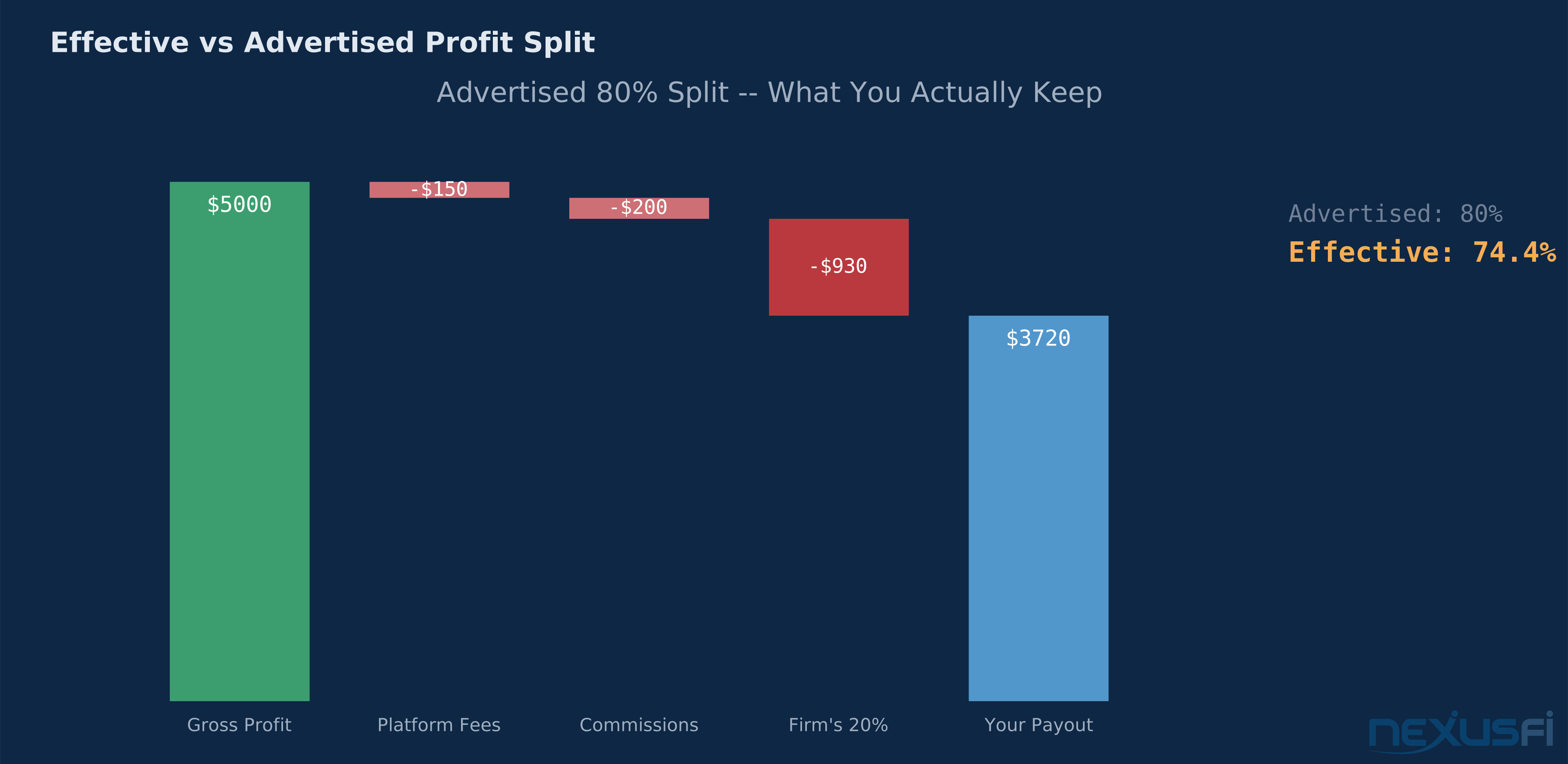
Take your gross monthly profit. Subtract: platform fees, data fees, commissions (if not already netted), any admin charges. Apply the profit-split percentage to what remains. Subtract withdrawal fees if applicable.
On $5,000 gross monthly profit with $150 in monthly fees, $200 in commission netting, and an 80/20 split:
- Net profit before split: $5,000 - $150 - $200 = $4,650
- Your share (80%): $3,720
- Effective take: $3,720 / $5,000 = 74.4%
That's not 80%. It's 74.4%. The gap widens on lower-profit months and narrows on higher-profit months, because fixed costs are a larger percentage of smaller numbers.
https://nexusfi.com/showthread.php?t=57229&p=856214#post856214
Layer 6: Hidden Operational Frictions
These costs never appear on an invoice. They reduce your realized performance compared to what your strategy "should" produce, and they're the hardest to quantify.
Execution quality gaps: Evaluation environments often use simulated fills where every limit order gets filled at the quoted price. Funded accounts — especially those trading through Rithmic or CQG in simulated-live environments — can experience different fill quality. That gap between evaluation performance and funded performance is a real cost.
Trading restriction friction: Rules about news trading, weekend holding, session-time limits, and maximum daily trades force behavior changes that may not align with your strategy's optimal execution. If your edge comes from trading FOMC announcements but your funded account prohibits positions during high-impact news, you're leaving money on the table.
Consistency rule overhead: Many firms impose consistency requirements — no single day can account for more than 30-40% of total profit. This forces traders to throttle winning sessions and flatten early on strong days. As covered in Consistency Rules in Funded Trading, these rules reshape your entire trading approach and can reduce the expected value of a strategy that naturally produces lumpy returns.
The instrument eligibility issue: Some funded programs limit which instruments you can trade, especially in early tiers. If your strategy is designed for CL (crude oil) but your initial funded account only allows ES (E-mini S&P), the strategy degradation is a direct cost — you're trading suboptimally because of account constraints, not market conditions.
Calculating Your True Total Cost of Ownership #
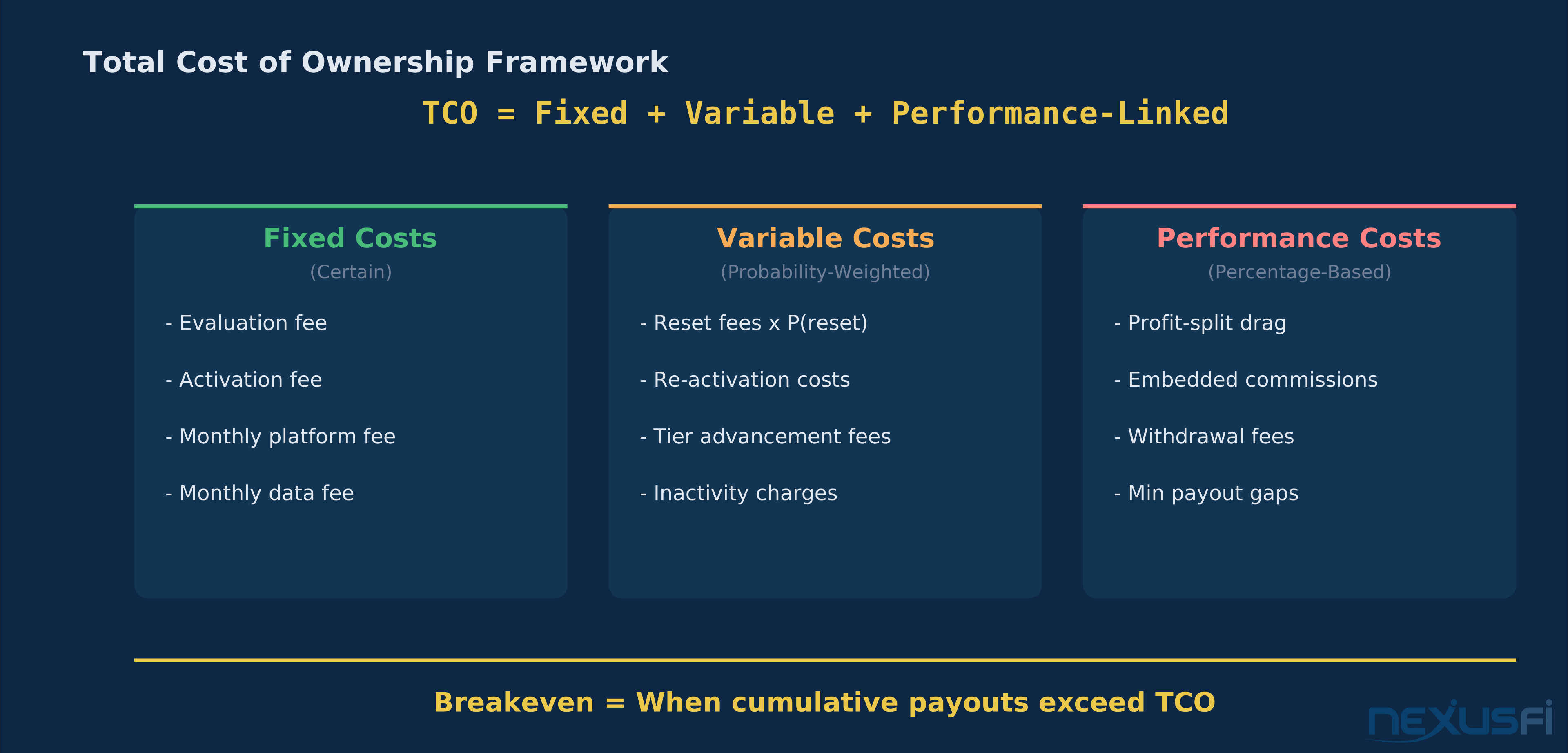
Here's the framework. Plug in your specific numbers for each firm you're evaluating.
Fixed Costs (Certain)
- Evaluation fee
- Activation/onboarding fee
- Monthly platform fee x expected months funded
- Monthly data fee x expected months funded
Variable Costs (Probability-Weighted)
- Reset fee x expected number of resets
- Re-activation fee per reset
- Scaling/tier advancement costs
Performance-Linked Costs (Percentage-Based)
- Gross profit - embedded commissions = Net pre-split profit
- Net pre-split profit x (1 - your split %) = Firm's take
- Withdrawal fees per payout x expected payouts
TCO = Fixed + Variable + Performance-Linked
Your cumulative payouts must exceed TCO before you're in the black. The breakeven point depends on how quickly you reach consistent profitability, how many resets you need, and your average monthly net profit after all deductions.
NexusFi member @puapwr documented this business-expense framing: tracking "all my accounts, evaluations, funded accounts, challenge fees, activation fees, resets, even has section for you to input normal business expenses."
https://nexusfi.com/showthread.php?t=61182&p=907911#post907911
Realistic Cost Scenarios #
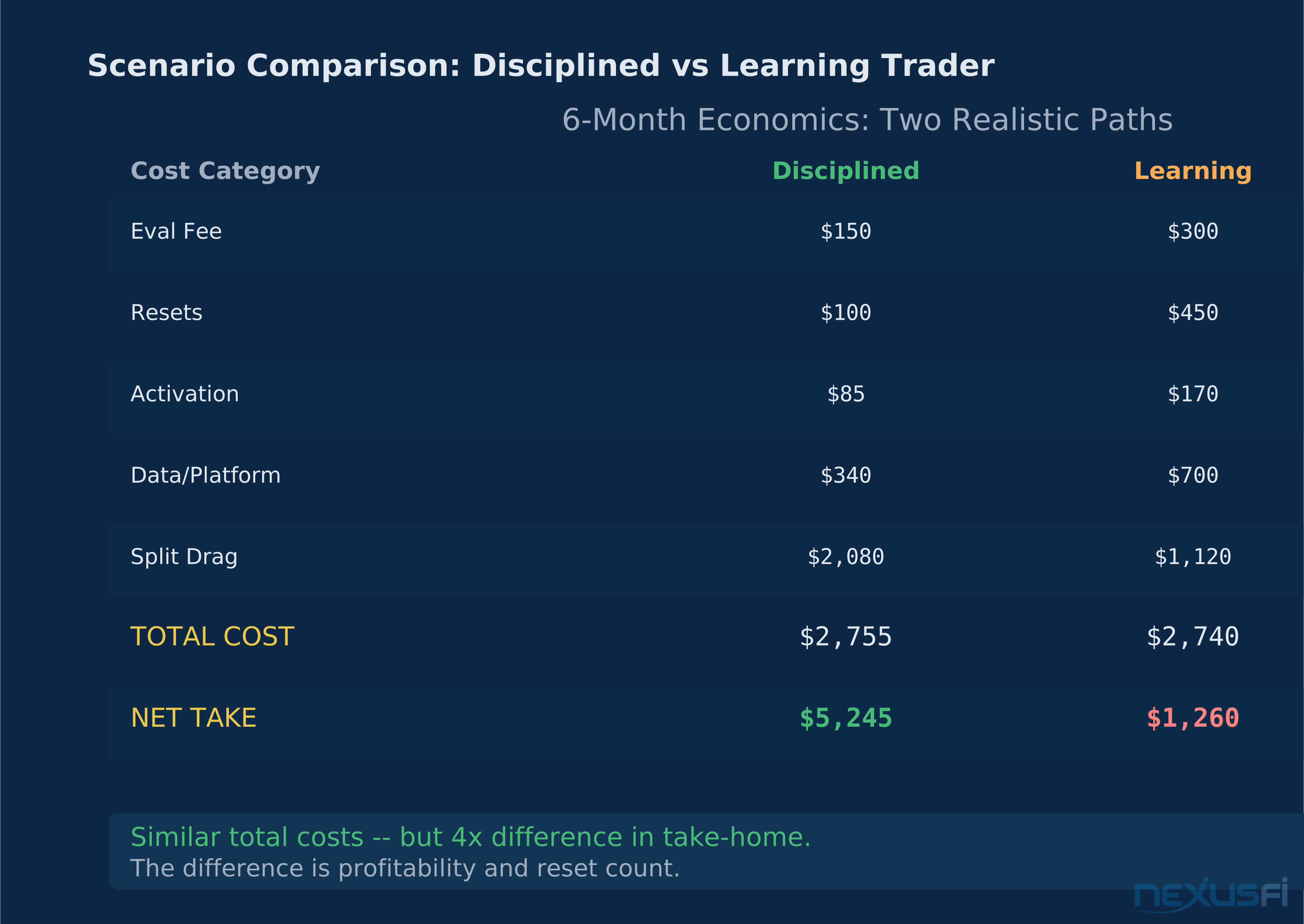
Scenario A: The Disciplined Trader (6-Month Path)
| Cost Category | Amount |
|---|---|
| Evaluation fee | $150 |
| 1 reset | $100 |
| Activation | $85 |
| Data fees (4 months funded) | $340 |
| Platform fees (4 months) | $0 (bundled) |
| Direct costs | $675 |
| Profit-split drag on $8,000 gross (effective 74%) | $2,080 |
| Total economic cost | $2,755 |
| Net take-home | $5,245 |
Scenario B: The Learning Trader (6-Month Path)
| Cost Category | Amount |
|---|---|
| Evaluation fee | $300 |
| 3 resets | $450 |
| Activation (x2 accounts) | $170 |
| Data fees (6 months) | $600 |
| Inactivity month | $100 |
| Direct costs | $1,620 |
| Profit-split drag on $4,000 gross (effective 72%) | $1,120 |
| Total economic cost | $2,740 |
| Net take-home | $1,260 |
The difference isn't just profitability — it's the number of resets and months under fee exposure. The learning trader pays nearly the same total cost but keeps dramatically less.
The Prop Firm Revenue Model -- Understanding the Other Side #
This isn't about vilifying prop firms. It's about understanding the business model so you can work through it with clear eyes.
https://nexusfi.com/showthread.php?t=57707&p=877545#post877545
But @biotic also added key nuance: "It is not ponzi-ish, more mosquito-ish" — the model is sustainable because evaluation fees fund operations, and the small percentage of consistently profitable traders who earn payouts are covered by the much larger volume of fee revenue from unsuccessful attempts.
https://nexusfi.com/showthread.php?t=57707&p=877544#post877544
@Binkius reinforced this: "The funding companies, the ones that are operating like CFD bucket-shops make all of their profit from account churn."
https://nexusfi.com/showthread.php?t=60507&p=897832#post897832
Understanding this model matters because it tells you what to improve for: minimize your exposure to the fee side of the business (fewer resets, shorter evaluation periods, efficient use of funded time) and maximize your exposure to the payout side (consistent profitability, optimal position sizing within rules, smart payout timing).
When Funded Trading Makes Economic Sense #
Funded trading makes sense when the total economic cost is less than the cost of equivalent self-funded trading. That comparison involves:
Self-funding costs: Capital requirements (margin), opportunity cost of that capital, full commission rates, full data costs, full platform costs, 100% of drawdown risk.
Funded trading costs: Everything in the TCO framework above, but with limited drawdown risk (your max loss is your cumulative fees, not your trading capital) and no capital requirement.
For traders with limited capital, the math often favors funded accounts even with all the fees — the leverage effect of trading with the firm's capital outweighs the cost drag. For traders with significant capital and a proven track record, self-funding almost always wins on economics.
https://nexusfi.com/showthread.php?t=36684&p=589572#post589572
That framing is useful. You're not "getting free capital." You're entering an employment-like arrangement where your compensation is the net payout after the firm takes its share. Judge the economics like you would any job offer: total compensation, not just the headline salary.
Practical Recommendations #
Before Signing Up
1. Build the TCO spreadsheet. Fill in every cost category for your specific firm. Don't skip the probability-weighted reset costs — be honest about your win rate and drawdown probability.
2. Calculate your effective split. Take the advertised number, subtract embedded commissions and monthly fees as a percentage of expected profits. The real number is almost always 5-15 percentage points lower than the headline.
3. Model your reset probability. If your strategy has a >30% chance of hitting max drawdown in a 30-day period, resets will dominate your cost structure. Consider whether tighter risk management would reduce reset probability enough to change the economics.
4. Compare across firms on TCO, not evaluation fees. A $150 evaluation with $200/month in data fees is more expensive over six months than a $300 evaluation with bundled data. The cheapest evaluation isn't the cheapest program.
During Funded Trading
5. Track your effective split monthly. Compare gross P&L to actual payouts received. If the gap between advertised and effective split exceeds 15 percentage points, investigate why.
6. Treat funded trading as a business. Track every cost. Categorize expenses. As @puapwr documented, use tracking tools for "all my accounts, evaluations, funded accounts, challenge fees, activation fees, resets." These are Schedule C business expenses for tax purposes — treat them with that level of discipline.
7. Improve for reset avoidance. Every dollar spent on risk management that prevents a reset saves multiples of that dollar in reset fees, re-activation costs, and time value. See Prop Firm Risk Rules and Drawdown Mechanics for specific approaches.
Knowledge Map
Go Deeper
Build on this knowledgeReferences This Article
Articles that build on this topicCitations
- — Funded Trader platforms (2024) 👍 11“Let's consider a more optimized scenario, because $99 a month is too much, and $3000 LL with a $6000 PT is not optimum at all. Consider instead a $50k evaluation account with a $2500 loss limit and”
- — Quest to Funding (2022) 👍 3“Funding Companies/Evaluations: A thought So during my journey to finally getting funded, I traversed through many companies, several are center-stage to thousands of would-be traders looking to get”
- — What's the problem with prop trading firms? (2022) 👍 6“Following on from my earlier reply, I obviously think in general the online funding companies can be a valid alternative when starting out. But if one does become funded and can trade consistently for”
- — ApexTraderFunding.com experience and review (2021) 👍 11“And on top of that they offer: No daily loss limit Only 10 days for an eval you can hold positions through econ prints, news, and holidays $80 resets And then The first 10k is the trader”
- — LeeLoo by Natural Trading (anybody used them before?) (2020) 👍 5“I have live funded account now, mostly trade 1-2 contracts in NQ with a $500 - $750 per Day Goal, usually no mare than 3 trades in a day, frequently only 1 . Sometimes I trade 2 contracts, and I can t”
- — ApexTraderFunding.com experience and review (2023) 👍 4“In conclusion it's mostly fees and reset that fund payouts, not profit splitts, so yeah livesim is kind of ponzi-ish. I can not fully agree with your conclusion. Yes, without doubt fees and resets”
- — ApexTraderFunding.com experience and review (2022) 👍 2“I'm not sure I have this right, so if someone who knows how it actually works can tell me, I would appreciate it. But do I understand that once you get funded with Apex, you also have to pay them a”
- — Funded Trader platforms (2024) 👍 2“Some of my concerns re prop-shop trading: 1. You lose the IRS Section 1256 60/40 long- vs. short-term capital gains tax treatment. 2. The possibility of the prop-shop's front-running your trad”
- — Any long term success stories from funded traders in these get-funded programs? (2021) 👍 5“IMO the product value offered by the prop firms is optimal for traders who already have an edge and are at least potentially winning traders, who may just lack capital and/or discipline. The opport”
- — Trading is a Business (2025) 👍 8“It seems like most traders get into trading because they saw an advertisement and were led to believe that options, or penny stocks, IPOs, Futures, Crypto, Forex!!! Was going to make them rich! Needle”
- — ApexTraderFunding.com experience and review (2023) 👍 3“Apex look awful to me, I've had a look at their payout policy and it states that they won't pay out on trades that don't fit in with your trading plan. They have a rule that one day can't be more tha”
- — Funded Trader platforms (2024) 👍 2“Finally, stock brokers hold inventory of common stock and when you place an order with your broker to buy AAPL, there's a good chance you're buying it from them. They only have guarantees as far as NB”
- — A Cowboy's Trading Journal (2016) 👍 4“I didn't think you could! As far as your idea, I think that you are on to something! The problem with these things is the fact you have to do Funded Traders Prep which is pretty much a second comb”