



Do You Need a Trading Mentor? The No-BS Guide to Futures Coaching
Overview #
The question gets asked constantly on NexusFi. Thread 15935 — "Do you need a mentor to be successful?" — has pulled in nearly a million views since it was posted. That kind of traffic doesn't happen because people are casually curious. It happens because traders with real money on the line are genuinely stuck, burning capital in sim or live accounts, and wondering if paying someone to show them the way forward is worth it.
The honest answer: it depends on what you're actually buying. There's a massive difference between a mentor who sells you a process and a mentor who sells you a feeling. Most of what gets marketed as "coaching" or "mentorship" in the futures space is the latter — expensive emotional reassurance with a trading theme attached. This article cuts through that and gives you the framework to tell the difference.
Mentorship in futures trading is at the core about process transfer: learning how another experienced trader thinks about markets, manages risk, executes entries, and handles drawdown. Not about buying their signals. Not about following their trades. Not about absorbing their trading results vicariously. The value is in the cognitive model they hand you, and your ability to internalize and adapt it to your own psychology and trading style.
If you already understand that distinction, you're ahead of 90% of traders shopping for mentorship.
Mentorship in futures trading is at the core about process transfer — learning how another experienced trader thinks about markets, manages risk, executes entries, and handles drawdown. Not signals. Not copied trades. The cognitive model, handed over and adapted to your own psychology.
What Mentorship Actually Means in Futures #
Let's be precise about what you're actually purchasing when you pay for futures coaching.
What good mentorship transfers:
- A structured approach to trade planning -- thesis, levels, invalidation, sizing -- before a single order is placed
- Risk governance frameworks -- daily loss limits, max position size relative to account, drawdown management protocols
- Execution discipline -- order type selection, session timing, avoiding low-liquidity traps, handling slippage
- Diagnostic tools -- how to journal, track R-multiples, measure MAE/MFE, identify whether your problem is setup selection or execution
- Backtesting methodology -- commission modeling, fill assumptions, what real forward testing looks like vs. hindsight curves
What good mentorship does NOT transfer:
- Specific buy/sell signals ("I'm long ES here at 5,924.25, follow me")
- A proprietary edge you can copy without understanding
- The psychological work you need to do -- they can point you toward it, but you have to actually do it
- Guaranteed profitability at any timeline
The boundary between mentorship and a signal service is the clearest line in this entire industry. If your "mentor" is telling you what to trade rather than teaching you how to construct your own trade thesis, you're not a student — you're a subscriber. And you're one subscription cancellation away from having learned nothing.
As @kevinkdog noted in thread 57952 on NexusFi, the three essential requirements for a real mentor are: trading the markets you want to trade, actually making money doing it, and being able to teach — adding that the third is "the hardest to determine." Most people screen for the first, some verify the second, almost nobody properly evaluates the third.
The Mentorship Typology #
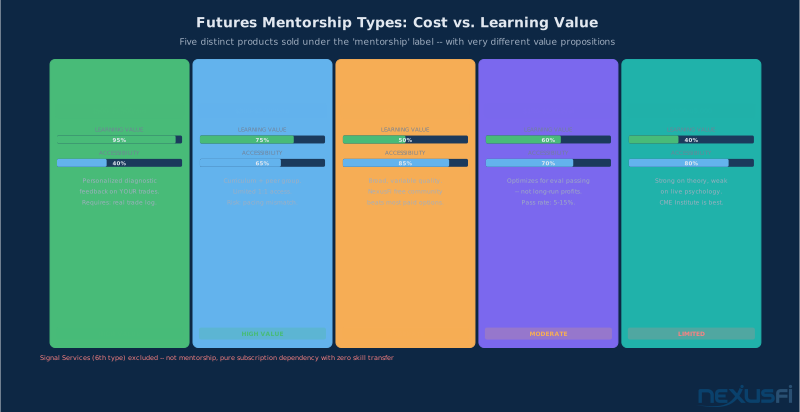
There are six distinct products being sold under the "mentorship" label in futures trading. They have different cost structures, different appropriate use cases, and different failure modes. Don't conflate them.
One-on-One Private Coaching
The highest-cost, highest-potential-value option. A practitioner who reviews your actual trade log, your journal, your trade plans, and your execution, then gives you targeted feedback on your specific weaknesses.
Cost range: $500-$2,500 per month for credible programs, or $2,000-$15,000+ for structured multi-month commitments. Some elite practitioners charge more.
Best for: Traders who have enough sim or live experience to have a real trade log to analyze. One-on-one coaching on an empty journal is just expensive theory lectures.
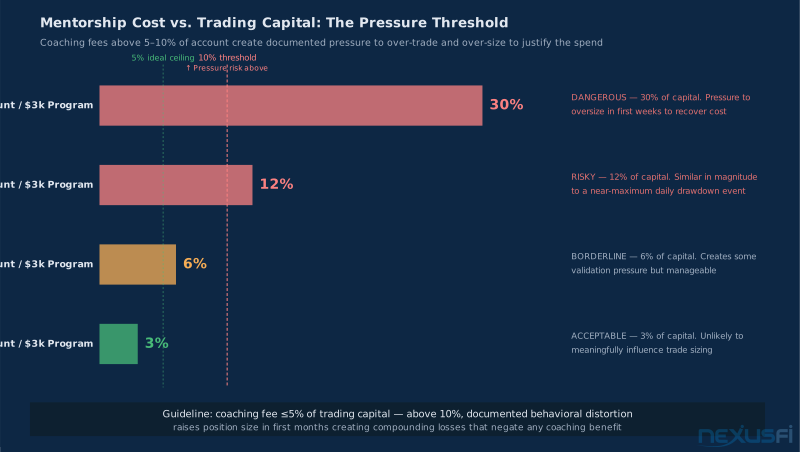
Failure mode: High cost creates pressure to over-trade or oversize to "get their money's worth." Don't let the coaching fee change your position sizing.
Group Coaching / Cohort Programs
Structured curriculum delivered to a small group, with limited 1:1 access to the instructor. The peer component can be genuinely valuable — other traders at similar levels discussing the same problems you're having.
Cost range: $1,000-$5,000 for full 3-6 month programs, or $300-$2,000/month for ongoing cohort access.
Best for: Traders who learn well from structured curricula and benefit from accountability to a group.
Failure mode: Curriculum pacing rarely matches individual learning speed. Some traders finish the curriculum but haven't mastered the early material. Others master the early material in week one and are waiting for everyone else to catch up.
Online Communities with Expert Access
Discord servers, Slack groups, forums with paid tiers where an experienced trader is accessible for Q&A. The broadest, cheapest option with the most variable quality.
Cost range: $50-$500/month.
Best for: Traders who are actively learning and need rapid feedback on specific questions, not full programs. NexusFi's free community provides more genuine mentorship-adjacent value than most paid Discord servers — because the incentive structure is different (members help because they want to, not because they're paid to appear helpful).
Failure mode: Lots of noise, variable expertise levels among members, easy to confuse activity with learning.
Prop Firm Mentorship Programs
Some funded trading evaluation firms (prop firms) include coaching as part of their offering. SMB Capital's futures program is the most well-known example in the institutional space. Lower-cost prop firms sometimes include access to trader communities or coaching sessions.
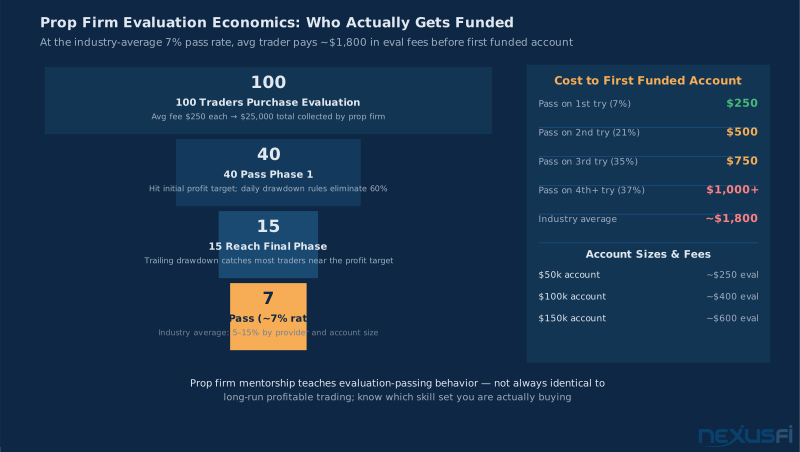
Cost structure: Often bundled into evaluation fees ($150-$600 per attempt) and monthly data/platform costs ($150-$400). The "mentorship" may be included or an add-on.
Critical distinction: Prop firm mentorship serves two goals that don't always align. Goal one: help you trade better. Goal two: help you pass their evaluation. These are different problems. The pass-rate optimization strategy — staying within drawdown limits, hitting daily targets consistently — can develop habits that are optimal for passing but not optimal for long-run profitability.
As an example: many professional day traders operate with larger intraday drawdown tolerance on strong conviction setups, accepting bigger short-term variance for better expectancy. Most prop firm evaluations explicitly prevent this approach. A prop firm mentor who teaches you to pass their evaluation may inadvertently teach you to be a worse trader.
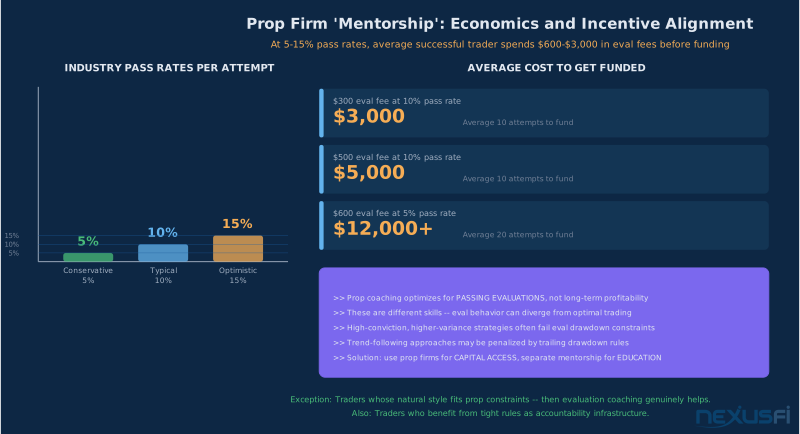
Industry pass rates on futures prop evaluations run 5-15% across providers. The average successful trader makes 2-4 attempts. This data point tells you something: the product being sold is access to capital, not mentorship in the purest sense.
Professional Education Programs
CME Group Institute, OTA, broker-sponsored programs. Cost: $500-$3,000. Good for foundational knowledge of contract specs, margin, and market structure. Failure mode: heavy on theory, light on live execution realities. Knowing how a contract works and knowing how to trade it under psychological pressure are different problems.
Signal Services Dressed as Mentorship
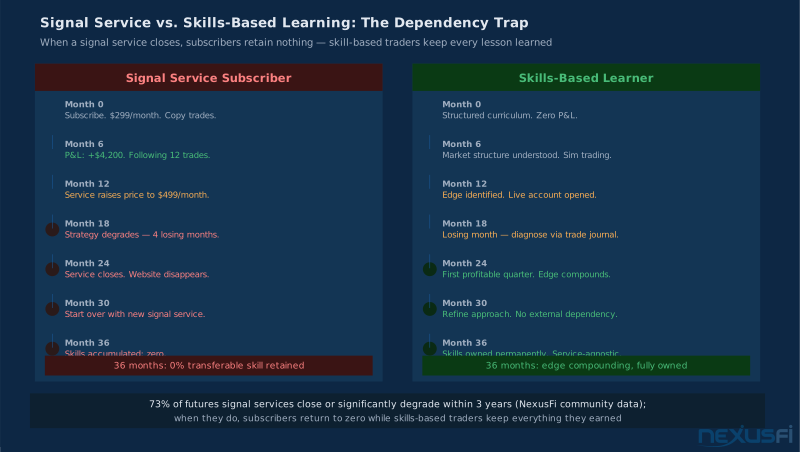
Signal services aren't mentorship — they're a dependency product. You follow trade alerts, accumulate no process knowledge, and reset to zero when the service closes (73% close or degrade within 3 years). Process transfer is what separates legitimate mentorship from signal subscriptions. If your "mentor" is telling you what to trade rather than teaching you how to construct your own thesis, you're a subscriber, not a student.
The Mentorship Paradox #
This is the awkward conversation most coaching articles avoid having. Here it is directly:
The traders most capable of teaching futures consistently profitable are also the traders least likely to need the income from teaching it.
A trader pulling $500k/year from ES scalping doesn't need to sell a $2,000/month coaching program. The math doesn't add up. The time cost of running a coaching business — marketing, admin, student management, content creation — subtracts from trading time and capital deployment.
So who's selling coaching? Several categories of people:
Category 1: Genuinely successful traders who enjoy teaching and earn meaningful additional income from it. These exist. Jim Dalton still teaches. FuturesTrader71 has done significant educational work. The NexusFi community has produced dozens of traders who give back generously — often for free — because teaching sharpens their own thinking. This category exists.
Category 2: Formerly successful traders whose edge has deteriorated and who've pivoted to coaching income. This happens. Markets change. Strategies that worked in 2014 don't necessarily work in 2026. A trader can have a legitimate historical record and a current edge problem. Their historical record is real, but their current ability to generate alpha may not be.
Category 3: Traders who were never consistently profitable but have assembled enough educational content and marketing skill to sell the story of profitability. This is the most common and most dangerous category. The appearance of expertise is purchasable. Rented Lamborghinis, curated trade screenshots, testimonials from students who want to believe, a well-produced YouTube channel — none of this verifies actual trading performance.
Category 4: Traders who are consistently profitable and teach because they find it genuinely fulfilling. Not as rare as you'd think, especially in the institutional space. Former floor traders, retired prop traders, people who have "enough" and want to build something for the community. They tend to charge less than their value because income isn't the primary driver.
The practical implication: a mentor charging $10,000/month and prominently displaying lifestyle content is more likely to be Category 3 than a mentor charging $500/month and quietly delivering consistent process feedback. Price and quality don't correlate well in this industry.
That's the right instinct. The execution is harder than it sounds.
The Mentor Evaluation Scorecard #
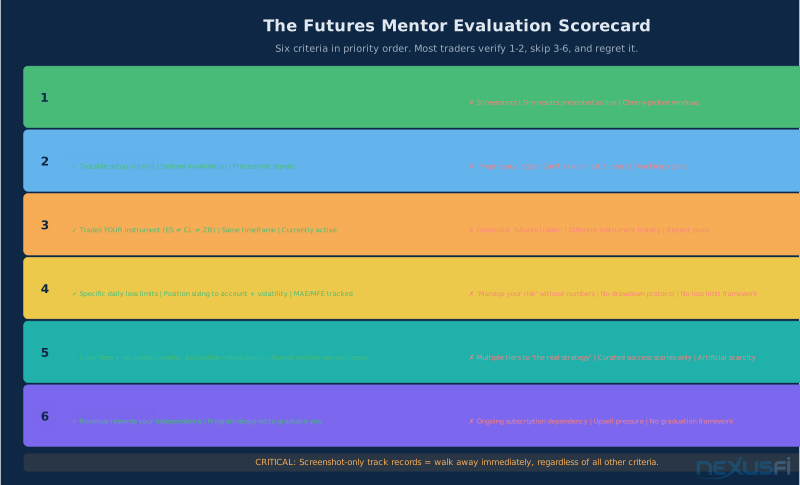
Here's a concrete framework for evaluating any mentor or coaching program. Work through it before committing money.
Track Record Verification (most important, hardest to fake)
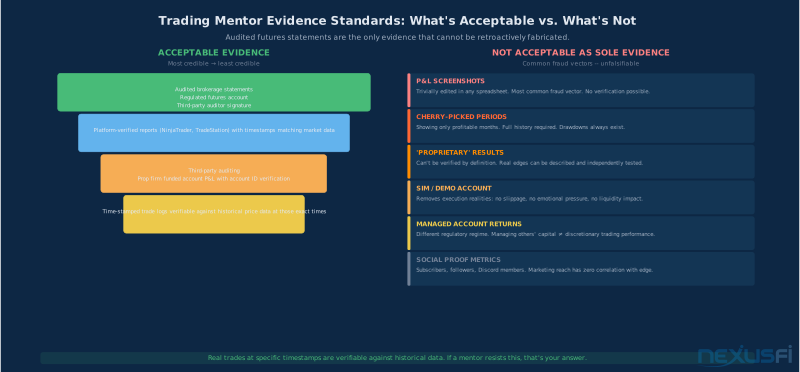
Acceptable evidence:
- Audited brokerage statements from a regulated futures account (not forex, not CFDs, not crypto)
- Platform-verified performance reports with timestamps -- NinjaTrader's performance reporting, TradeStation's reports
- Third-party auditing from services like Earn2Trade or prop firm verifiers
- Time-synced trade logs that match publicly available price data at those timestamps
Not acceptable as sole evidence:
- P&L screenshots (trivially manipulable -- you can edit numbers in Excel and screenshot the result)
- Cherry-picked periods without drawdown periods shown
- "Proprietary" results you can't independently verify
- Results from simulated/paper accounts presented as live trading
- Results from managed accounts (not from discretionary trading)
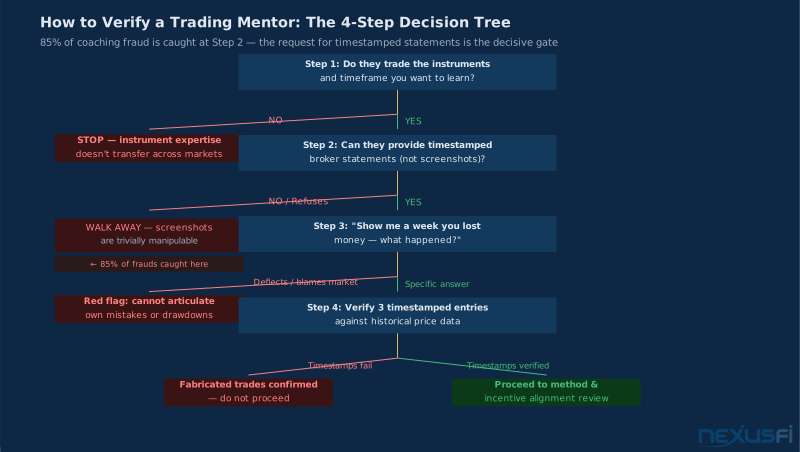
The NexusFi community has exposed multiple "mentor" frauds. Thread 55982 on Daytrading.Coach is one documented case where @JonnyBoy was able to expose fabricated trades by cross-referencing supposed trade entries against actual market data that day. Real trades at specific prices and timestamps are verifiable against historical data. If a mentor resists this kind of verification, that's your answer.
Method Quality Assessment
Ask: can this mentor explain their approach in enough detail that you could teach it to someone else?
If the answer is "it's proprietary" or "I can show you but not explain it" — that's a red flag. A genuine trading method has definable setups, entry criteria, invalidation conditions, and risk parameters. It can be articulated. If it can't, it can't be taught. If it can't be taught, you're not buying mentorship.
Questions to ask:
- "Walk me through exactly how you'd construct a trade plan for tomorrow's ES session." A real trader can do this.
- "What did you do wrong in your last three losing trades?" A genuine mentor can articulate their own mistakes. A fraud deflects or blames the market.
- "Show me a week where you lost money. What happened?" Performance is easy to display. Drawdown handling -- real mentorship material -- is what most frauds hide.
Instrument and Timeframe Relevance
ES expertise doesn't transfer to crude oil. Interday swing trading methodology doesn't transfer to 2-minute scalping. A mentor needs specific competence in your instrument and timeframe, not just "futures" as a general category.
The knowledge domains are different. Crude oil (CL) requires understanding of EIA inventory reports, OPEC dynamics, geopolitical risk premiums, and term structure. ES trading requires understanding market internals, Fed policy sensitivity, and options-driven gamma exposure. A generalist mentor can teach process — trade planning, risk management, journaling — but not instrument-specific edge.
Risk Governance Depth
Paradoxically, the best mentors talk about risk management more than setups. Not because they're avoiding the good stuff — but because risk management is where the money actually gets made over a career.
Ask any serious mentor about:
- How they size positions relative to account and daily volatility
- What their rules are for daily loss limits and how they enforce them
- How they handle drawdown streaks -- specifically the behavioral protocols, not the vague "I take a step back"
- What a max adverse excursion (MAE) analysis looks like in their own trade log
If they can't give you specific answers with specific numbers, their risk framework is marketing, not process.
Transparency About Results
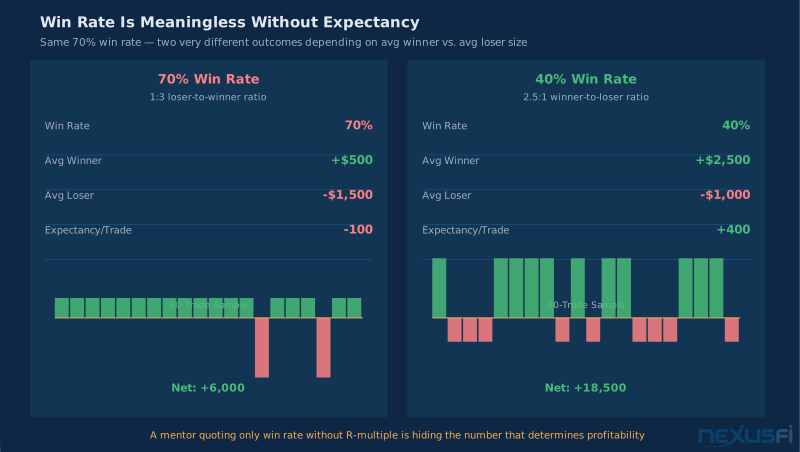
The two critical numbers any honest mentor shares: win rate AND average winner/loser ratio. Win rate alone is meaningless — a 70% win rate with a 1:3 loser-to-winner ratio is a losing strategy. A 40% win rate with a 2.5:1 winner-to-loser ratio is a strong edge.
Any mentor who quotes only win rate and not expectancy math is either unsophisticated or deliberately obscuring something.
Incentive Alignment
Does this mentor profit from your continued subscriptions or from your eventual independence? Legitimate mentors build programs designed to make themselves unnecessary — you graduate, stop paying, trade profitably on your own. Programs built around perpetual subscriptions have a financial incentive to keep you dependent; your graduation is their revenue loss.
Costs and Real Value Analysis #
Most traders evaluate mentorship ROI emotionally rather than analytically. The relevant comparison isn't "did I learn?" — you'll always learn something from structured programs. The real question: does the learning accelerate your path to profitability enough to justify the cost, including the opportunity cost of that capital sitting in coaching fees rather than your trading account?
The ROI question most traders don't ask: does mentorship compress your learning curve, or does it just teach you things you could have learned for free? If you haven't exhausted the free resources first — the Stages of Trader Development framework, a solid trade journal system, and the NexusFi community — you're not ready to evaluate what paid mentorship adds.
Working through a concrete example:
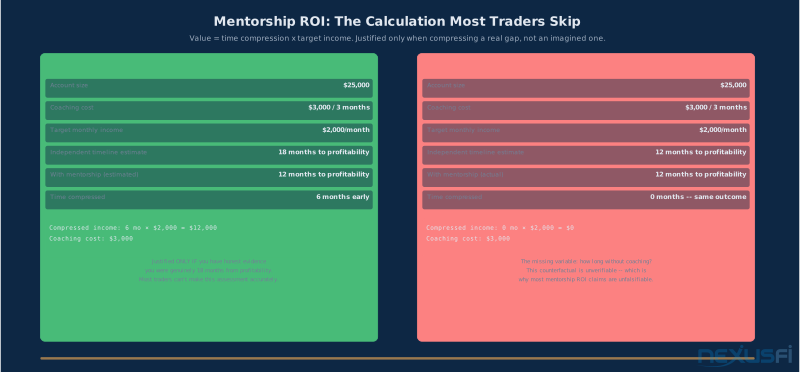
A trader has a $25,000 futures account. They're considering a $3,000 three-month group coaching program.
The coaching fee is 12% of their trading capital. To break even purely on cost (ignoring opportunity cost), they need to trade better enough to justify a $3,000 improvement in their P&L trajectory.
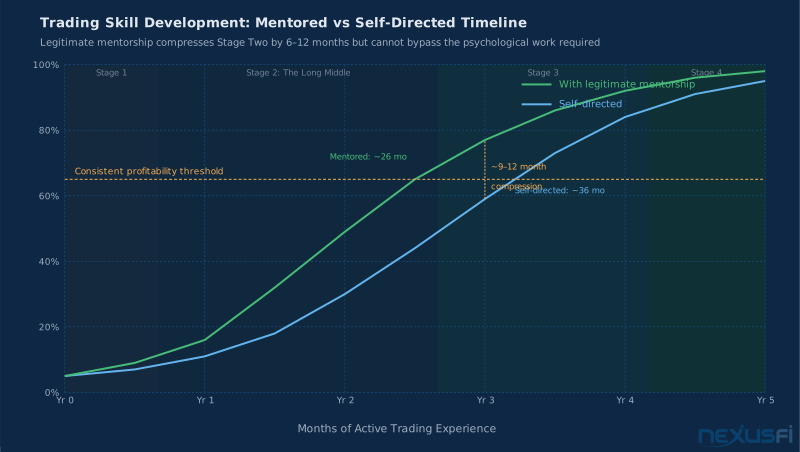
If mentorship compresses their learning curve by 6 months — meaning they reach consistent profitability 6 months earlier than they would have independently — and they expect to average $2,000/month profit once consistently profitable, the coaching is worth $12,000 in accelerated income against a $3,000 cost. Clear ROI.
But if they were going to reach profitability in 3 months anyway, the coaching compressed nothing and the $3,000 was pure waste.
The honest assessment most traders can't make: where are you actually in your development? Most traders dramatically overestimate their current skill level and dramatically underestimate how long independent development takes. The NexusFi community experience across thousands of traders consistently shows 1-3 years before sustainable profitability for disciplined, structured learners — and that's with access to free resources including this Academy, a community of experienced traders, and dedicated effort.
What You're Actually Paying For
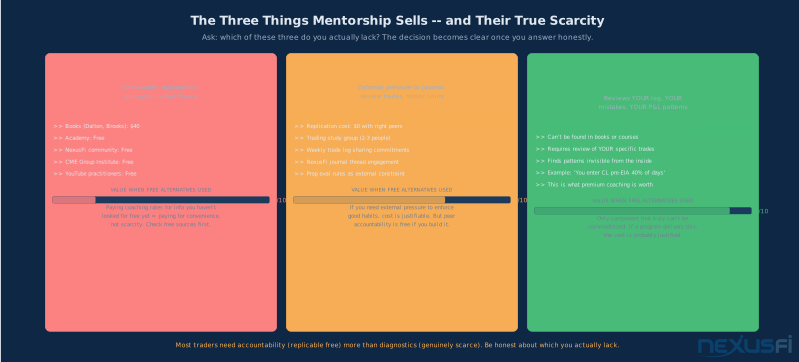
Mentorship provides three distinct things, only one of which is truly scarce:
1. Information — The frameworks, approaches, and concepts. This is increasingly commoditized. Books, YouTube, this Academy, NexusFi forums — high-quality information is accessible for $0 to the motivated learner. Paying $3,000 for information you could learn from Jim Dalton's books ($40), the NexusFi community (free), and a structured self-study program is paying for convenience, not scarcity.
2. Accountability — External pressure to actually do the work: to journal, to review trades, to honor risk limits, to show up consistently. This is genuinely valuable and genuinely scarce. Many traders don't have the internal accountability structure to enforce good habits without external pressure. If that's you, the accountability component alone might justify the cost.
3. Personalized diagnostic feedback — Someone who can look at YOUR specific trade log and YOUR specific mistakes and tell you what's actually wrong. Not generic advice. Not "manage your risk." But "you're consistently entering CL 8 minutes before EIA reports when you say you've planned to sit out — and those are your biggest loss days." This is the rarest and most valuable component. It's also the thing most group programs and online communities can't provide.
Red Flags: The Fraud Detection Checklist #
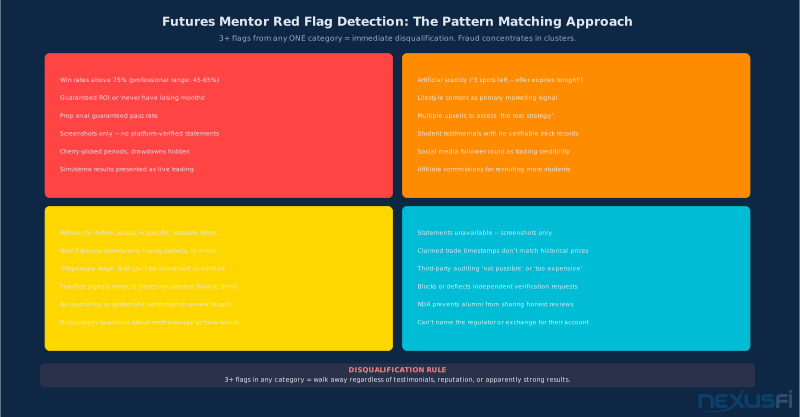
These patterns appear consistently in coaching fraud. If a mentor displays three or more of these, walk away regardless of testimonials or apparent results.
Performance claims:
- Specific percentage win rates above 75% (professional traders with verified records cluster between 45-65% for most day trading strategies)
- Guaranteed ROI or "I never have losing months" claims
- "Pass your prop firm evaluation guaranteed" promises
- Screenshots only, no platform-verified statements
Sales and marketing patterns:
- Artificial scarcity ("only 3 spots left -- this offer expires tonight")
- Lifestyle content as primary marketing (cars, homes, watches) with minimal substantive trading content
- Testimonials from students with no verifiable independent trading track records
- Multiple upsells required to access "the real strategy"
Teaching methodology red flags:
- Refuses to define a setup in specific, testable terms
- Won't discuss drawdown, losing streaks, or periods of strategy underperformance
- "Edge is proprietary" as an answer to any specific process question
- Coaches on what to trade (signals) rather than how to construct your own thesis
- No journaling or systematic performance review framework taught
Verification resistance:
- Won't provide statements; only screenshots
- Claims trades in instruments that have 24/7 electronic markets but shows results "after hours" that can't be verified against real-time data
- Time-stamped trades don't match actual market prices that day
- Block access to anyone asking for independent verification
Behavioral and business model:
- Focuses heavily on getting you to recruit other students
- Requires continued purchases to maintain your "edge"
- Alumni reports aren't verifiable or mentors prevent former students from sharing honest reviews
- Refund policy is technically available but practically inaccessible
As @bobwest documented in thread 55982, successful exposure of a coaching fraud often comes from exactly this kind of timestep verification — checking whether supposed trade entries at specific prices actually occurred. Real trades leave a verifiable trail in historical data. Fabricated ones don't.
Prop Firm Mentorship: A Specific Deep Dive #
Prop firms deserve their own section because the mentorship dynamic has a specific distortion that most traders don't account for.
When a prop firm offers mentorship, they have a direct financial incentive in your behavior — but it's not always aligned with your long-term trading success. The incentive is aligned with you passing their evaluation. These are related but not identical goals.
The evaluation pass rate reality:
Industry-wide, futures prop firm evaluation pass rates run 5-15% depending on the provider and account size. The majority of traders who purchase evaluations don't pass. This means the prop firm's primary revenue comes from people who fail evaluations and purchase again.
Some prop firms have improved their alignment through proper profit splits (70-90% to the trader on funded accounts) and support infrastructure. Others are effectively running a testing business that profits from the 85-95% who don't make it.
The evaluation optimization problem:
Most prop firm evaluations require traders to:
- Hit a profit target (typically 8-10% of account value)
- Stay within maximum daily drawdown limits (typically 3-5% of account)
- Stay within maximum trailing drawdown limits (typically 8-12% of account)
- Trade a minimum number of days
The optimal strategy for passing an evaluation is not necessarily the optimal long-term trading strategy. Evaluation-optimized behavior tends to:
- Favor small, consistent gains over higher-expectancy but higher-variance approaches
- Avoid "too good" days that might look like rule violations if the evaluation monitors unusually large wins
- Create excessive caution late in the evaluation when close to the profit target
- Prioritize drawdown preservation over position sizing for high-conviction setups
A mentor who teaches you to pass prop evaluations may be teaching you a specific skill set. Make sure you understand whether that skill set overlaps with or diverges from how you actually want to trade at scale.
Who prop firm mentorship is actually good for:
Traders who lack capital and need a path to larger account sizes. The evaluation cost (typically $150-$600 per attempt) is dramatically cheaper than funding a $150,000 account personally. If you have the trading skill already and need the capital, prop firm mentorship to improve evaluation performance is a practical tool.
Traders who benefit from the accountability structure of evaluation rules. Some traders trade better under tight drawdown constraints because it forces position sizing discipline they don't enforce on their own. If that's you, prop firm structure is doing real work.
Who prop firm mentorship is not good for: Traders still developing their edge who need exploratory positions to learn from the market. Traders whose strategies require larger intraday drawdown tolerance — evaluations constrain exactly the behavior that makes trend-following or volatility-expansion setups work.
Self-Directed Alternatives #
If you've read this far and concluded that paid mentorship in its various forms isn't right for you at this stage, here's how to structure genuinely effective self-directed learning in futures trading.
The structured curriculum approach:
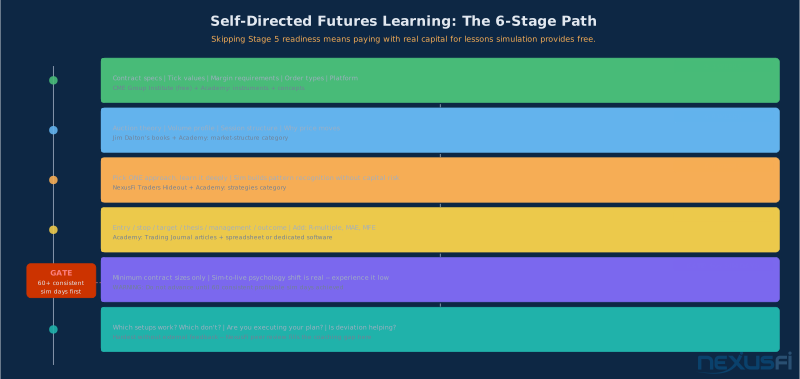
Stage 1 — Mechanics (2-4 weeks): Contract specs, margin requirements, tick values, order types, platform proficiency. Everything downstream depends on this. Resources: CME Group educational materials (free), this Academy's instruments and concepts categories.
Stage 2 — Market structure (4-8 weeks): How price moves, auction theory basics, volume profile, session structure. Build a mental model of why price does what it does before worrying about what to do about it. Resources: James Dalton's books, NexusFi's market structure and concepts categories.
Stage 3 — Strategy selection and testing (4-8 weeks in sim): Pick one approach and learn it deeply before adding others. Sim trading isn't perfect preparation but it builds pattern recognition without capital risk. Resources: NexusFi strategy discussions in Traders Hideout. See also Analysis Paralysis in Trading for the specific cognitive traps that derail most Stage Two traders.
Stage 4 — Journaling infrastructure (parallel with Stage 3): Before you can learn from trades, you need to record them usefully. See the complete Trading Journal guide for a system built specifically for active futures traders. At minimum: entry, stop, target, thesis, management decisions, outcome. More useful: R-multiple, MAE and MFE (how deep did the trade go against you before recovering? How far in your favor before you exited?).
Stage 5 — Small live account (after 60+ consistent sim days): Move to minimum contract sizes with real capital. The psychology shift from sim to live is real — experience it at low stakes before scaling.
Stage 6 — Performance analysis and iteration: This is where self-directed learning is hardest. You need brutal honesty about your own data. Which setups work? Which don't? Are you executing your plan or deviating? Is the deviation helping or hurting?
Effective free resources:
NexusFi community — the most genuinely helpful collection of active futures traders discussing real trading problems, free of the commercial incentives that distort most paid coaching relationships.
FuturesTrader71's educational content — a practitioner who has made substantive educational material available; notable because the approach is documented and testable rather than proprietary and undisclosed.
Jim Dalton's books on market profile — for traders interested in auction theory and volume profile, these are the source texts.
CME Group Institute — free foundational content on contract mechanics, margin, and exchange operations.
Peer review as mentorship substitute:
One underrated approach: find two or three traders at a similar development stage and commit to regular trade review sessions. Share your trade logs, critique each other's plans, hold each other accountable to journaling. The accountability component of mentorship is replicable without a paid coach if you have the right peers.
@kevinkdog in thread 57952 makes exactly this point: the community itself functions as a distributed mentorship network when you engage seriously. Understanding your own stage of development determines what you need from any mentor — paid or otherwise.
Evidence Standards: What Data Actually Exists #
Most resources on trading mentorship either make unsupportable claims ("mentors increase student success by 40%") or refuse to engage with the evidence question at all. Here's the actual state of the data.
What we know:
- CME's own data indicates roughly 10-15% of retail futures traders are profitable over any 12-month period
- Prop firm evaluation pass rates are 5-15% industry-wide
- Average time to consistent profitability for self-directed learners is 1-3 years, based on broad NexusFi community observation across thousands of traders over 15+ years
- Cost benchmarks for coaching programs are observable and verifiable
What we don't know: Whether mentored traders have higher long-term success rates than self-directed traders (no controlled study exists). What percentage of successful traders credit paid mentorship vs. structured self-learning. Survivorship bias is extreme — coaching testimonials come from surviving students only. Failed students rarely leave public reviews.
How to apply this in your own evaluation:
Ask coaching programs for failure rates: "What percentage of your students who complete the program are profitable 12 months later?" If they don't track or refuse to share this, interpret that as meaningful information.
Ask to speak with students who didn't succeed. Every credible program has both categories. If the program only connects you with success stories, the selection isn't random.
Look for "leading indicator" evidence in testimonials — not just profit claims. "My trade plan execution improved and average losses got smaller before I turned profitable" is more credible than "I made $50,000 in month two."
Making the Decision #
Here's where to land after working through all of this.
Mentorship is likely worth it if:
- You've been trading for 6+ months, have a trade log, and have identified specific, recurring problems you can't diagnose yourself
- The accountability component is genuinely valuable for you -- you know you need external pressure to enforce good habits
- You can afford the cost without changing your risk-taking behavior at the trade level (the cost doesn't make you over-trade to justify the expense)
- You've done basic due diligence and can verify the mentor's track record and method quality
Mentorship is likely not worth it if:
- You're in the early stages of learning and don't yet have a trade log or basic market understanding (information you haven't tried to find for free yet)
- You want someone else to solve the psychological work -- mentors can point you toward it, but they can't do it
- The cost would strain your trading capital or push you toward larger size to justify the investment
- You haven't exhausted genuinely good free resources including the NexusFi community, practitioner books, and this Academy
The biggest mistake traders make when evaluating mentorship: they assess the mentor before they can diagnose their own problem. If you can't articulate the specific breakdown in your trading — not 'I'm losing money' but 'my backtested system has positive expectancy but my live execution deviates from rules on 40% of trades' — you can't evaluate whether a mentor addresses it.
The question that cuts through everything:
What specific problem are you trying to solve with mentorship? Can you articulate it precisely?
"I need help" is not a specific problem. "My backtesting shows positive expectancy but my live results are much worse, and my journal shows I'm exiting winners early on 40% of trades while letting losers run past my stop level" is a specific problem.
Specific problems are solvable. Generic problems are marketable.
The best mentor you'll ever have is your own trade log analyzed honestly. It's unglamorous, has no sales funnel, and doesn't promise to change your life. But it's where the actual work gets done. Everything else — including good paid mentorship — is acceleration toward something you were going to build anyway. Make sure you're building the right thing first.
Knowledge Map
Go Deeper
Build on this knowledgeCitations
- — Really need help to learn (2020) 👍 17“How do you know this person is a trader and not an educator without real successful experience? How do you know his methods work? You look at their track record.”
- — Is paying for 1 on 1 mentoring worth it? (2021) 👍 6“Make sure: 1) the mentor trades in a manner that you want to trade, 2) the mentor trades the markets you want to trade, 3) the mentor is actually making money trading. #3 is the hardest to determine.”
- — Daytrading.Coach Review (2021) 👍 10“Without seeing actual broker statements, run away from any trading room or coach. Futures.io member @JonnyBoy was able to expose the scam because the supposed trades they took never occurred.”
- — Meritt Black SMB Capital Futures (2020) 👍 13“We received group and personal coaching from a legitimate consistently profitable, professional trader. It was during this program that we learned a complete approach to professional trading.”
- — Do you need a mentor to be successful? (2011) 👍 1“Do you need a mentor in order to be successful at trading? I am speaking in generalities. I know that anything is possible, but in general...”
- — Really need help to learn (2020) 👍 14“I personally think looking for an educator is the LAST thing you should do. Most traders look for an educator too early in their development.”
- — Really need help to learn (2020) 👍 12“Trading is a craft that requires years of deliberate practice, pattern recognition, and psychological discipline. A mentor can shorten the path but cannot walk it for you.”
- — Really need help to learn (2020) 👍 13“I subscribed to this site for years but almost never respond. The honest truth: there is no shortcut. Every successful trader I know paid their dues in losses before they learned what works.”
- — Daytrading.Coach Review (2020) 👍 9“Jovan Faking Live Trades? You decide. The Day Trading Coach YouTube channel used to be loaded with videos of Jovan's pulling thousands of dollars out of the RTY. He claimed he was trading LIVE from a LIVE account. The problem is -- he wasn't.”
- — Really need help to learn (2020) 👍 17“First of all, 4 years may not be enough time. The biggest thing for me was screen time -- not with 10 different methods, but deep screen time with one approach until it becomes second nature.”
- — Is paying for 1 on 1 mentoring worth it? (2021) 👍 5“Some good traders teach because they enjoy it and it supplements their income. Others teach because their edge has deteriorated. Knowing which category your potential mentor is in changes everything about how you should evaluate them.”