



Deliberate Practice for Trading Performance: How to Convert Screen Time into Genuine Expertise
Overview #
Screen time alone does not build trading skill. Psychologist Anders Ericsson's research shows that structured, feedback-driven practice — deliberate practice — is what drives improving traders past those who plateau. This article covers what deliberate practice actually is, how to implement it through market replay and performance journaling, and how to measure whether it is working.
Why 10,000 Hours Isn't Enough #
When psychologist Anders Ericsson published his landmark research on expert performance, a critical nuance got lost in the pop-science retelling. Malcolm Gladwell's "10,000 hours" framing focused everyone on the quantity of practice. Ericsson's actual finding was about the quality of practice — specifically, a structured approach he called deliberate practice.
For traders, this distinction is the difference between a decade of screen time that produces marginal improvement and a targeted program that builds genuine expertise. Brett Steenbarger, who spent years studying trading performance and authored Enhancing Trader Performance, applied Ericsson's framework directly to markets. His conclusion: most traders practice naively, accumulating hours without the structure that converts experience into skill.
What Deliberate Practice Actually Is #
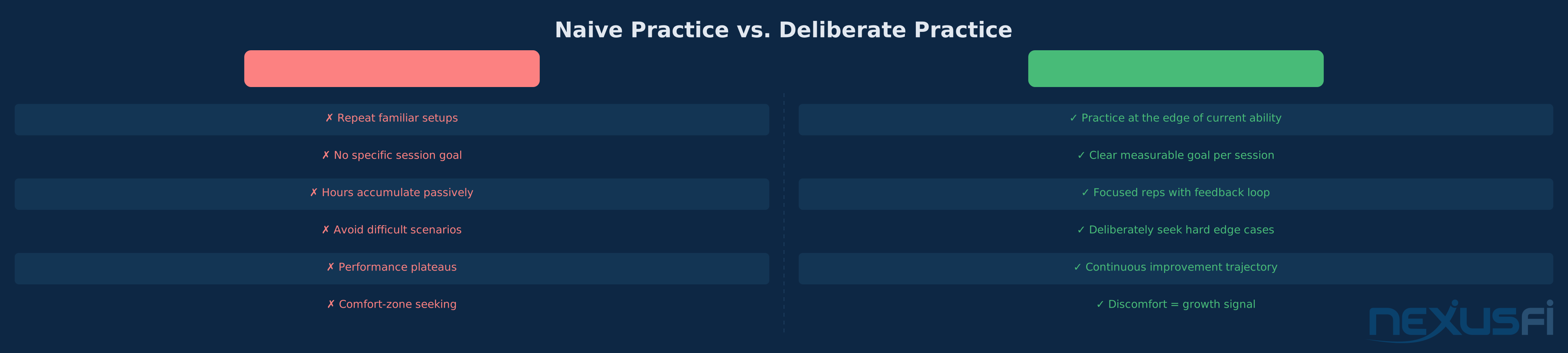
Deliberate practice is not simply doing something repeatedly. It is structured repetition at the edge of current ability, with immediate feedback, and a focus on correcting specific weaknesses rather than reinforcing existing strengths.
Ericsson's research across chess masters, concert pianists, surgeons, and athletes identified four defining characteristics that separate deliberate practice from mere experience accumulation:
1. Operates at the Edge of Competence
Deliberate practice is uncomfortable by design. The work targets skills you cannot yet execute reliably — not skills you've already mastered. When a drill feels easy, it has stopped being deliberate practice and become reinforcement of existing patterns. For traders, this means deliberately creating scenarios around your weakest setups, not your strongest.
NexusFi member @tigertrader articulated this directly in the Psychology forum: the research on expert performance consistently shows that meaningful improvement requires pushing beyond what feels comfortable.
"Deliberate practice is not fun in the conventional sense. It requires focused attention, addresses weaknesses directly, and produces discomfort. That discomfort is the signal that learning is occurring."
-- @tigertrader, PATIENCE AND PRACTICE, Psychology and Money Management
2. Has Specific, Measurable Goals
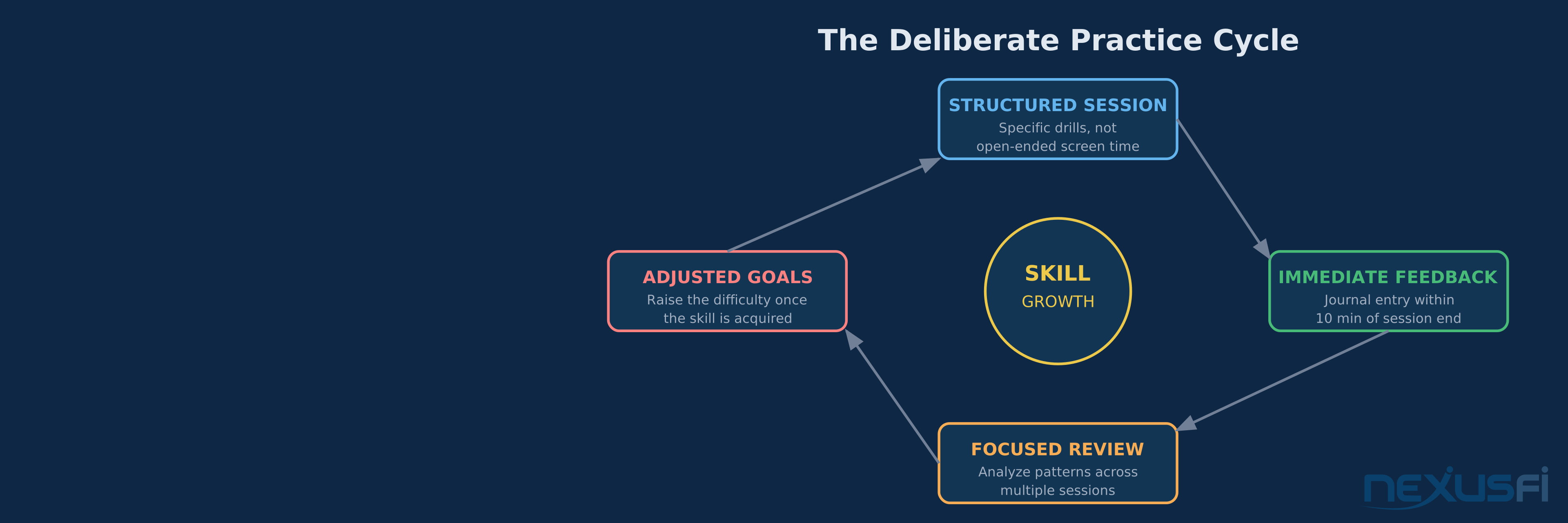
Each deliberate practice session should begin with a single, concrete behavioral objective — not "be profitable" but something like "correctly identify trade invalidation before entering" or "execute stop placement consistently per my rules." Vague goals produce vague improvement.
Steenbarger's framework emphasizes that peak performers in every domain keep score. They don't just practice; they measure specific dimensions of performance so they know exactly what is improving and what isn't. Without measurement, there's no feedback. Without feedback, there's no deliberate practice.
From @mfbreakout's journal, quoting Steenbarger directly:
"What makes a peak performer? What turns any activity into a peak performance activity is keeping score — and then using that score to guide further development."
-- Steenbarger, via Trading Futures with Context, Elite Trading Journals
3. Includes Immediate, High-Quality Feedback
Feedback delayed by days becomes diluted. In deliberate practice, feedback comes within minutes of the activity — or in real time. This is why market replay is such a powerful tool: it creates the same immediacy of feedback as live trading, without capital at risk.
The feedback loop in trading has three components: the decision (entry/exit/management), the outcome, and — critically — the reasoning behind the decision. Without capturing the reasoning, you can't distinguish a good decision that had a bad outcome from a bad decision that happened to work. Expert traders track process quality independent of P&L.
4. Requires Full Mental Engagement
Deliberate practice cannot be done on autopilot. It requires sustained concentration and conscious focus on the specific skill being developed. This is why session length matters: most research suggests deliberate practice sessions beyond 90 minutes produce diminishing returns due to cognitive fatigue. Quality of attention, not duration of exposure, determines skill acquisition rate.
The Skill Acquisition Curve #
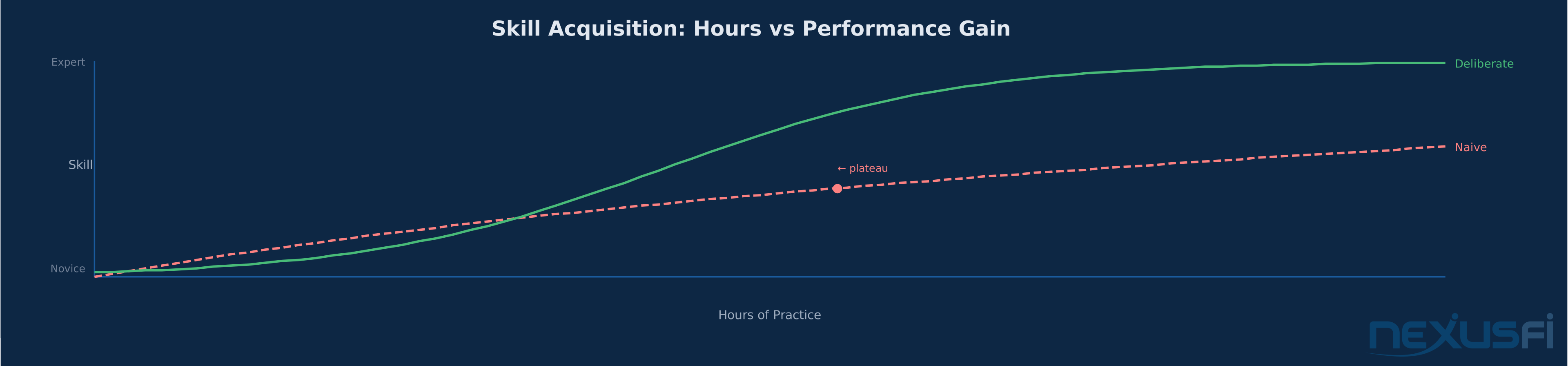
Traders who practice naively — watching charts, placing trades, reviewing results without a structured feedback loop — typically follow a logarithmic improvement curve. They learn quickly at first (there is much to learn from initial market exposure), plateau within 6-18 months, and then make incremental improvements at a rate that doesn't justify the time invested.
Traders who implement deliberate practice follow a sigmoid (S-curve) trajectory. Initial progress may be slower because the practice is harder and more uncomfortable. But the ceiling is dramatically higher, and improvement continues long after naive practitioners have plateaued.
The critical insight from Ericsson's research: the plateau experienced by most practitioners is not a natural ceiling. It is an artifact of practice methodology, not a limit of ability. Switching from naive to deliberate practice typically produces a resumption of improvement even in experienced traders who believed they had hit their ceiling.
Market Replay as the Trading Practice Ground #
Market replay software (available in NinjaTrader, Sierra Chart, and most professional platforms) transforms historical data into a deliberate practice environment. Unlike paper trading, which happens in real time and requires waiting hours for setups, replay allows you to compress time and drill specific scenario types repeatedly.
The NexusFi community has documented the market replay approach extensively. @lancelottrader describes his method for sharpening pattern recognition:
"I slow it down to real time and decide to either take the trade or not. This type of practice really has sharpened my skills. I also will pick random weeks and just manually scroll through charts and when I see a setup, I take it."
-- @lancelottrader, The Beast Slayer, Lance's NQ Trading Journal
The Replay Protocol in Detail
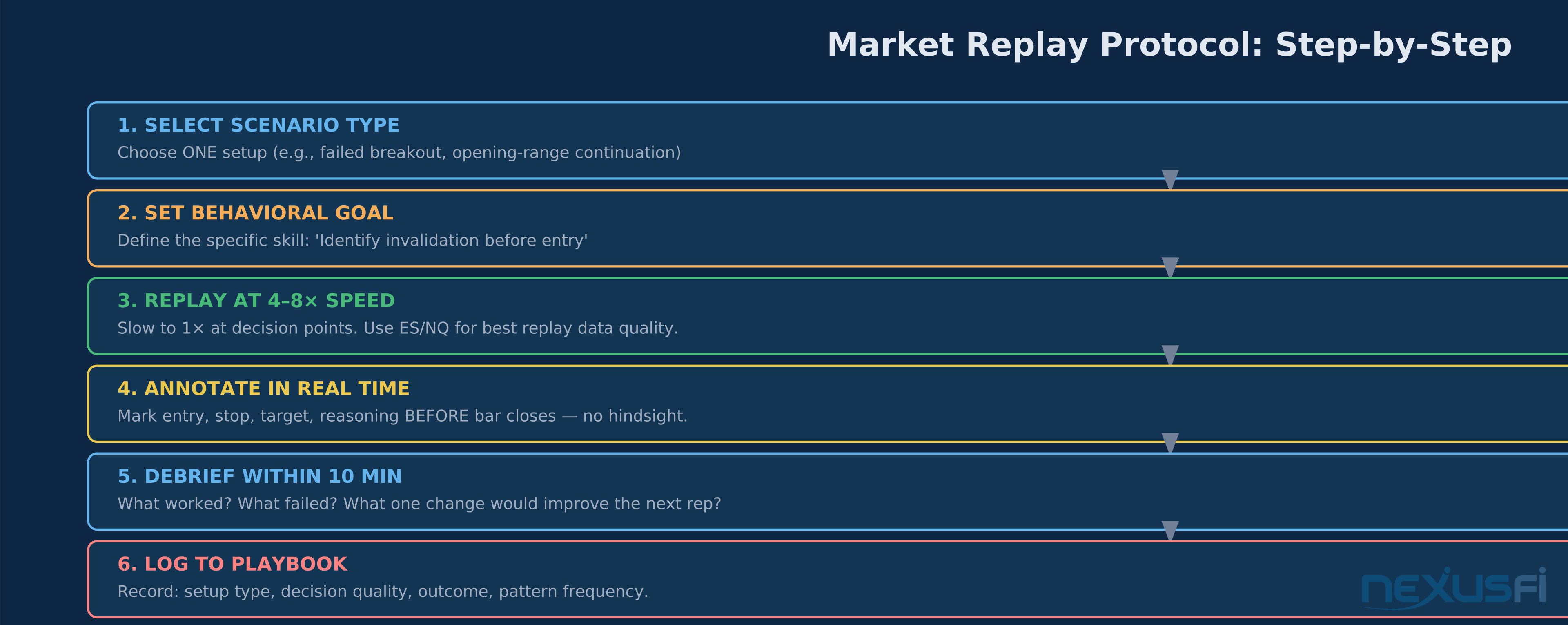
The following six-step protocol converts market replay from passive chart watching into structured deliberate practice:
Step 1: Select a specific scenario type. Don't replay random historical data. Choose a setup type you're actively developing: failed breakouts, opening-range continuations, poor-high retests, balance breakouts at session boundaries. Specificity is essential — "ES trading" is not a scenario type.
Step 2: Set a behavioral goal, not a P&L goal. The goal should describe an action you can control. "Correctly identify trade invalidation within 2 bars" is a behavioral goal. "Make $500 in replay" is not — it conflates process quality with outcome quality and teaches the wrong lesson.
Step 3: Replay at 4--8× speed for context, 1× at decision points. Running at high speed allows you to build contextual awareness efficiently. Slowing to real-time at decision points preserves the cognitive challenge of executing under uncertainty. Skipping straight to decision points eliminates the context-building that separates expert pattern recognition from naive setup identification.
Step 4: Annotate in real time. Before a bar closes — before you know the outcome — write down your reasoning. "This is an aggressive entry because X. Stop at Y because of Z. Target at W because of V. Trade is invalid if A." This forces you to articulate your reasoning rather than confabulating it after the fact.
GruttePier described this discipline of realistic simulation:
"He man, I like to have everything as realistic as possible. I can imagine it might be tempting to increase speed or jump to interesting areas..."
-- @GruttePier, GruttePier's trading journal, Elite Trading Journals
Step 5: Debrief within 10 minutes. The debrief is where deliberate practice produces its compounding effect. Ask three questions: What specifically did I do well in this scenario? What specifically failed? If I repeated this scenario tomorrow, what is the one thing I would do differently?
Step 6: Log to your playbook. Record the scenario type, the key decision you faced, your decision quality (not P&L), and the outcome. Over weeks of replay, this data reveals patterns you cannot see in live trading: setup frequency, decision accuracy, contexts where your pattern recognition breaks down.
Choosing Replay Data Wisely
Not all replay data is equally useful. For deliberate practice:
- Use ES or NQ futures for primary drilling. These instruments have the highest replay data quality and provide maximum scenario density -- high-volume markets produce more clean setups per hour of replay than thinly traded instruments.
- Select dates with specific market context. If you're drilling failed-breakdown recovery setups, choose dates with known range consolidation followed by expansion. Don't drill in trending environments if trending is already your strength.
- Rotate through market regimes deliberately. Expert traders can recognize when they're in a trending, ranging, or transitioning regime and adjust behavior so. This context-switching ability can be trained explicitly through regime-targeted replay sessions.
Performance Journaling: Building the Feedback Loop #
Market replay provides practice repetitions. Performance journaling provides the feedback that converts those repetitions into durable skill. Without the journal, replay practice accumulates observations that never get synthesized into behavior changes.
@Big Mike described the key failure mode in journal feedback directly:
"If you want my feedback... Your journal reads more like a spreadsheet consisting of net profit. You should instead focus more on why you entered the trade, what your thesis was, where the invalidation was."
-- @Big Mike, ES entries/targets & risk/rewards, Trading Journals
P&L tracking is outcome-based feedback. Deliberate practice requires process-based feedback — an honest assessment of decision quality independent of whether the trade made money.
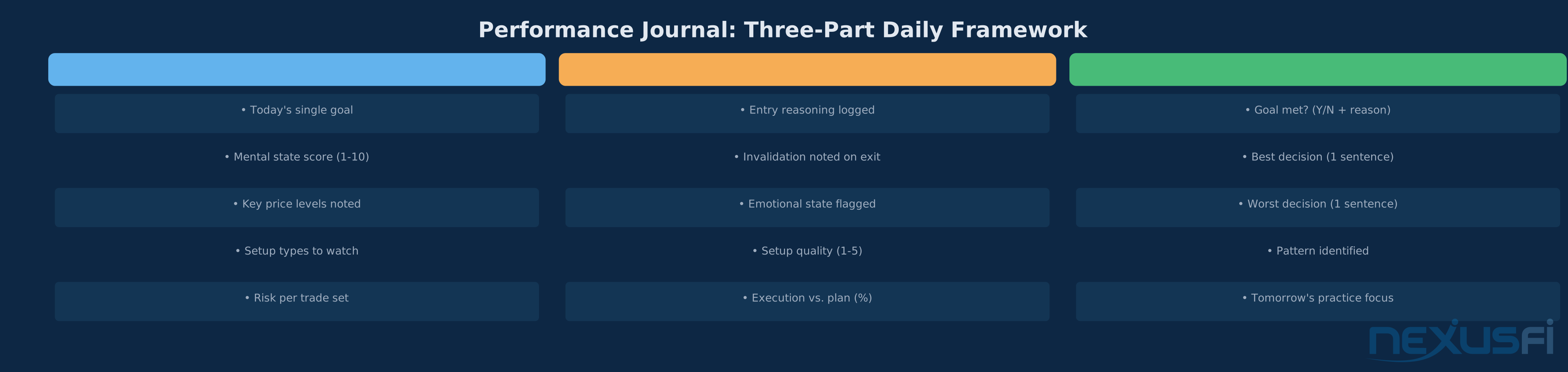
The Three-Part Journal Structure
Pre-Session (5-10 minutes)
Before the trading session or replay session begins:
- State today's single behavioral goal. Write it in specific, observable terms. Not "trade well" but "execute stops without widening on any trade today."
- Record your mental state. Rate focus, confidence, and emotional stability on a 1-10 scale. You are building a dataset that will later reveal whether performance correlates with mental state -- for most traders, it does, but the relationship is specific to the individual.
- Identify key levels and setup types to watch. This forces premarket preparation and creates a checklist that prevents reactive, context-blind entries.
- Set your risk parameters explicitly. Write down maximum risk per trade and maximum daily loss before the session begins. This converts an abstract rule into a behavioral commitment.
Intraday Logging (1-2 minutes per trade)
Immediately after each entry or exit decision:
- Entry reasoning in one sentence. "Entered long at X because the market tested the value area low and held, with improving delta on the touch." Not "went long because it looked like it would go up."
- Invalidation condition. Where specifically does this trade fail? What price action would tell you the thesis is wrong? Recording this before outcome forces you to define trade invalidation before you're emotionally invested in the position.
- Emotional state flag. One word: Neutral, Anxious, Confident, Frustrated, Bored. Over weeks, this creates a map of which emotional states precede your best and worst trades.
Post-Session Review (10-20 minutes)
The post-session review is where the feedback loop closes. The goal is pattern extraction — finding systematic tendencies in your decision-making that you can address with targeted practice.
- Goal assessment. Was the behavioral goal achieved? If yes: what enabled it? If no: what specific decision broke down?
- Best decision of the session. Identify the single best process decision -- good decisions that produced bad outcomes count here, bad decisions that produced good outcomes don't.
- Worst decision of the session. The one moment you would reverse if you could. Be specific and honest. This is the primary input for tomorrow's practice goal.
- Pattern identification. After 10+ trading days, review your post-session notes for recurring patterns. "I widen stops after 3+ consecutive losses" or "I take profits too early when up on the day." These patterns are the targets for your next month of deliberate practice.
Weekly Review Protocol
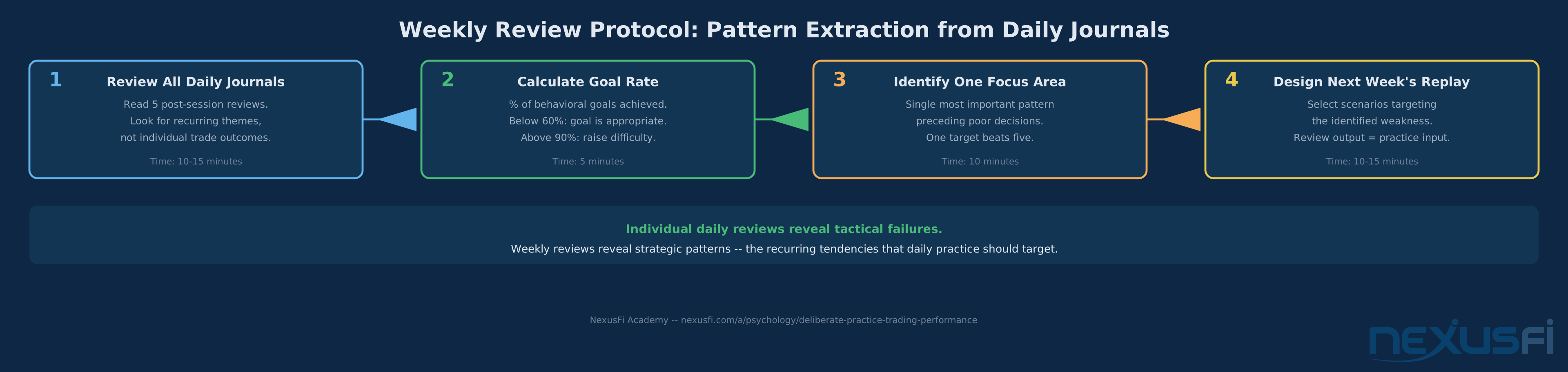
Individual daily reviews reveal tactical failures. Weekly reviews reveal strategic patterns. Set aside 30-45 minutes every Friday or Sunday for a structured weekly review:
- Review all daily journal entries from the past week. Look for recurring themes, not individual trade outcomes.
- Calculate behavioral goal achievement rate. If you set a specific behavioral goal each day, what percentage did you achieve? Below 60% suggests the goal is appropriate and you're working on a genuine weakness. Above 90% suggests the goal is too easy and needs to be raised.
- Identify the single most important behavioral pattern to address next week. Focus creates compounding improvement. Addressing five weaknesses simultaneously addresses none of them.
- Design next week's replay practice around the identified weakness. The weekly review output is next week's deliberate practice input.
Designing a Deliberate Practice Schedule #
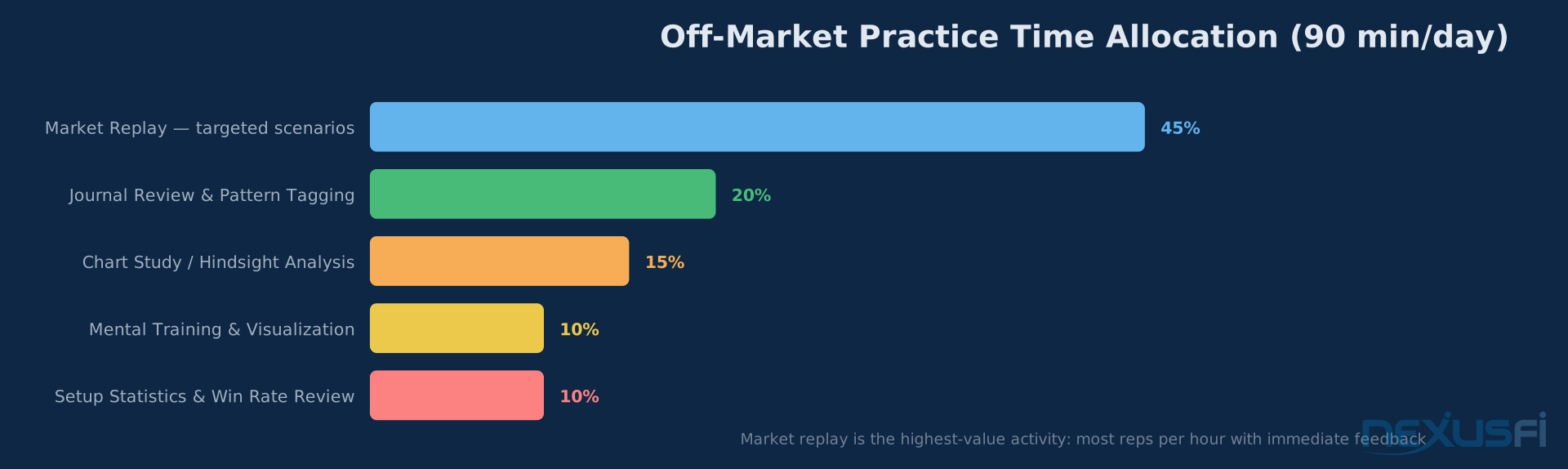
Research on expert performance consistently shows that deliberate practice is most productive in concentrated blocks of 60-90 minutes, with full rest between sessions. Four 90-minute deliberate practice sessions per week produce more measurable improvement than seven hour-long sessions without adequate recovery time.
For the Developing Trader (0-3 Years)
Structure is the priority at this stage. Before developing pattern recognition, you need to build behavioral discipline — executing your rules consistently regardless of outcome. A developing trader's deliberate practice should be heavily weighted toward:
- Market replay (45 minutes daily minimum): 3-4 specific setup types, rotated weekly. Focus on identifying setups in context, not on P&L optimization.
- Rule compliance drills: In replay, deliberately create scenarios where your rules are tested -- exactly the situations where developing traders deviate. Practice rule-following under simulated pressure.
- Post-session journaling (20 minutes minimum): Every session. The feedback loop must be operational from the beginning.
For the Intermediate Trader (3-7 Years)
Pattern recognition is typically established at this stage; the primary challenge is contextual application — knowing which setups work in which regimes. Deliberate practice should focus on:
- Regime-specific drilling: Replay sessions in identified trending, ranging, and transitional regimes. Build the explicit knowledge of how your setups perform across market types.
- Scenario-based decision drills: Focus on the specific decision points where your data shows you underperform -- the moment of entry in choppy conditions, management decisions in fast-moving markets.
- Pattern tagging in the journal: Develop a systematic tagging system that allows you to query performance across setup type × market regime × time of day. This creates a personal edge map.
For the Advanced Trader (7+ Years)
Advanced practitioners typically face a different challenge: they have significant pattern recognition but their deliberate practice has become routine — they're practicing their strengths, not their weaknesses. The deliberate practice program should focus on:
- Edge cases and failure modes: Replay specifically the scenarios where your typical setups fail. Force yourself to operate in your worst-performing contexts.
- Mental game under adversity: Create replay scenarios designed to induce the emotional state where your worst decisions occur -- drawdown sequences, fast-moving markets, or whatever personal trigger your data identifies.
The "Wax On / Wax Off" Principle #
NexusFi member @Rory described the deliberate practice philosophy using the classic training metaphor:
"Wax on / wax off applies to every new element you identify as a discrete skill or 'deliberate practice' as it is put. I saw the application to trading very clearly."
-- @Rory, GruttePier's trading journal, Elite Trading Journals
The training metaphor captures something important: the discrete skills of trading — reading auction dynamics, executing stops, managing positions under uncertainty, identifying regime changes — can each be isolated and drilled independently before they are integrated into live trading decisions.
The "wax on / wax off" principle is exactly what Ericsson described: master the component skills in isolation, then integrate them. Most traders try to learn all trading skills simultaneously in live markets, which is the equivalent of learning a language by immersion before learning any vocabulary — theoretically possible, but extraordinarily inefficient.
Measuring Whether Deliberate Practice Is Working #

Deliberate practice without measurement becomes naive practice. The following six metrics should be tracked weekly:
1. Setup Recognition Speed
In replay sessions, measure how quickly you identify your primary setup from context. As pattern recognition improves, this decreases — you need fewer confirming bars before the setup is clear. Track average "bars to recognition" per setup type across sessions.
2. Execution Quality Score
After each trade in replay or live, score your execution against pre-defined criteria on a 1-5 scale: Did you enter where your rules said to enter? Did you place your stop where your rules said to place it? Did you size correctly? Execution quality should trend upward over weeks. Flat or declining execution quality means the practice isn't translating to behavior change.
3. Replay Volume
Count deliberate practice repetitions per week. Research on skill acquisition suggests a minimum of 50 scenario reps per week to maintain improvement momentum. Below 20 reps weekly, improvement is unlikely to compound. This isn't about hours — it's about specific, annotated scenario reps with immediate debrief.
4. Stop Loss Adherence Rate
Track the percentage of your planned stops that were executed without widening. This measures emotional regulation under pressure — the specific moment where most trading performance is won or lost. A trader who executes 90% of planned stops is at the core more advanced than one who executes 70%, regardless of win rate or P&L.
5. Scenario Accuracy Rate
In replay practice, before advancing the chart, state your prediction: "This is an A-grade setup for long entry" or "This looks like a false breakout." Track how frequently your pre-outcome assessments match the actual outcome. Improving scenario accuracy is the clearest signal that pattern recognition is developing.
6. Journal Consistency
Track journal completion rate: how many trading days per week include a complete pre-session goal and post-session review. Target is 5 of 5 trading days; minimum for meaningful feedback loop is 3 of 5. Below 3 of 5, the feedback loop is insufficiently consistent to drive improvement.
When Deliberate Practice Fails #
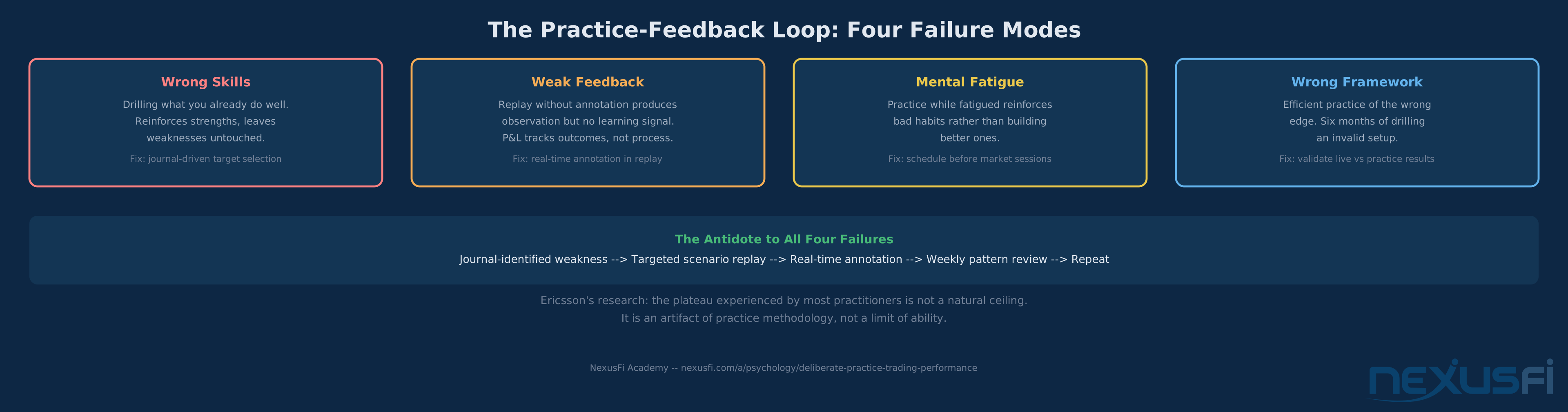
Deliberate practice is not a guaranteed path to expert performance. Several conditions limit or prevent its effectiveness:
Practicing the Wrong Skills
Drilling setups you already execute well is not deliberate practice — it is confidence maintenance. The performance journal's most important function is identifying the specific weakest links in your trading process so practice can target them. Without honest self-assessment, practice reinforces strengths and leaves weaknesses unaddressed.
Insufficient Feedback Quality
Replay without annotation produces observation without feedback. A journal that only tracks P&L produces outcome feedback without process feedback. The feedback loop requires explicit, in-the-moment articulation of reasoning and explicit identification of what specifically failed or succeeded.
Mental Fatigue Without Recovery
Deliberate practice requires full cognitive engagement. Sessions conducted while mentally fatigued produce suboptimal practice — you are reinforcing bad habits, not building better ones. Most traders underestimate how dramatically fatigue degrades decision quality. Scheduling deliberate practice sessions immediately before or after market sessions is a common implementation error.
Correct Execution of Wrong Framework
Deliberate practice efficiently develops skills toward your current understanding of edge. If your understanding of edge is incorrect, deliberate practice efficiently makes you very good at the wrong things. This is why the practice framework must be regularly reviewed against live performance data. A trader who practices aggressively for six months and sees no improvement in live performance should question whether the skills being practiced are the right ones.
GruttePier's Ericsson Insight
GruttePier captured the essential tension in skill development — the gap between knowing what deliberate practice is and implementing it consistently:
"Thanks to @Rory's post, I've been reading some interesting articles about the work of Anders Ericsson. Making enough flight hours is not enough — it's the quality of those hours that matters."
-- @GruttePier, GruttePier's trading journal, Elite Trading Journals
"Flight hours" in trading corresponds to time at the screens. Ericsson's research shows that flight hours become expert performance only when structured around deliberate practice principles. The same insight applies to every component of trading education: reading books, watching charts, attending webinars — all accumulate information without producing skill unless paired with structured practice and feedback.
Integration with Your Trading System #
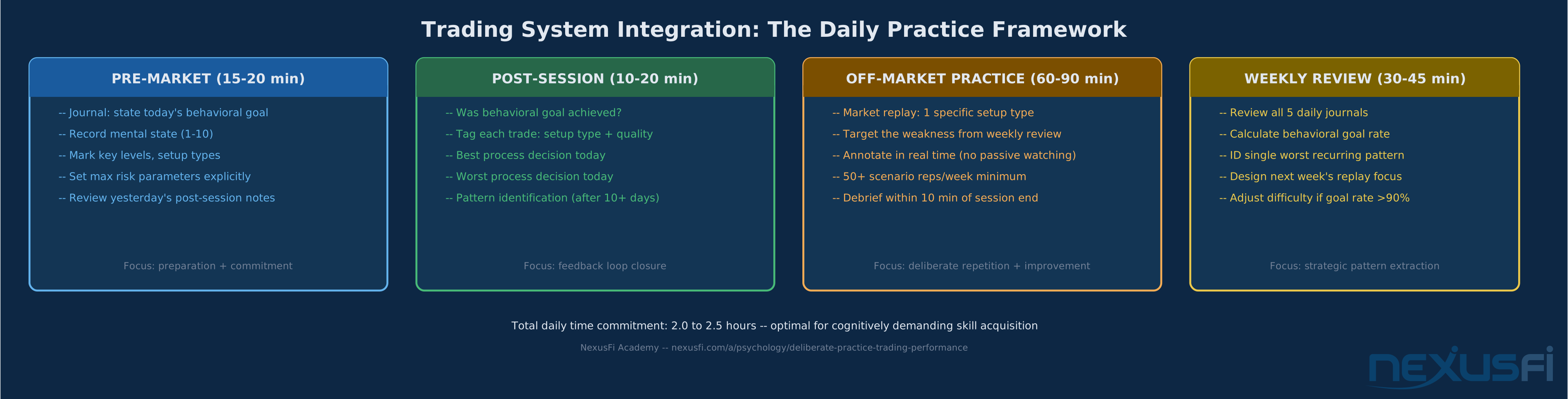
Deliberate practice is not a separate activity from trading — it is the development infrastructure that makes trading improvement systematic rather than accidental.
The practical integration looks like this:
- Morning pre-market (15-20 min): Journal pre-session goal, mental state, key levels. Review yesterday's post-session notes.
- Post-session (10-20 min): Complete post-session journal. Tag trades by setup type and execution quality.
- Off-market practice (60-90 min, 4-5 days/week): Market replay drills targeting the weakness identified in the weekly review. Annotated replay only -- no passive chart watching.
- Weekly review (30-45 min): Pattern extraction from week's journals. Design next week's deliberate practice focus.
The total time commitment is roughly 2-2.5 hours daily during active trading weeks. Research on skill acquisition suggests this is the optimal range for deliberate practice in cognitively demanding domains — enough volume to produce consistent improvement, limited enough to allow full recovery between sessions.
Before adding replay drills or building any practice routine, establish the feedback loop first. Pre-session goal: one behavioral sentence, written before the session begins. Post-session review: five minutes, honest, every session. Build that habit consistently for two weeks. Everything else in this article compounds from that foundation.
Starting Your Deliberate Practice Program #
The gap between understanding deliberate practice and implementing it is typically not knowledge — it is the friction of starting a structured system when you already have trading habits established.
The minimum viable implementation:
- Week 1: Start the journal. Pre-session goal and post-session review every day. Nothing else changes. Consistency of the feedback loop is the prerequisite for everything that follows.
- Week 2-3: Add one 45-minute replay session per day. Choose a single setup type. Use the six-step protocol. Annotate in real time.
- Week 4: Run your first weekly review. Look at your journal entries from the past three weeks. Identify the one pattern that most reliably precedes your worst decisions. This is your deliberate practice target for the next four weeks.
The process is not complicated. What it requires is the discipline to maintain structure when it's more comfortable to simply sit down at the charts and trade. That discipline is itself a skill that deliberate practice builds — and the traders who develop it early have a systematic advantage over those who never do.
Knowledge Map
Go Deeper
Build on this knowledgeReferences This Article
Articles that build on this topicCitations
- — PATIENCE AND PRACTICE (2010) 👍 32“Deliberate practice is not fun in the conventional sense.”
- — The Beast Slayer, Lance's NQ Trading Journal (2018) 👍 17“This type of practice really has sharpened my skills.”
- — GruttePier's trading journal to getting profitable (2017) 👍 10“I've been reading some interesting articles about the work of Anders Ericsson.”
- — Trading Futures with Context (2014) 👍 12“What turns any activity into a peak performance activity is keeping score.”
- — GruttePier's trading journal to getting profitable (2017) 👍 9“Wax on / wax off applies to every new element you identify as a discrete skill.”
- — Deliberate Practice (2016) 👍 6“I wanted a way to practice trading that was enjoyable.”
- — ES entries/targets & risk/rewards (2012) 👍 4“Your journal reads more like a spreadsheet consisting of net profit.”
- — GruttePier's trading journal to getting profitable (2018) 👍 4“I like to have everything as realistic as possible.”
- Anders Ericsson — Peak: Secrets from the New Science of Expertise
- Brett Steenbarger — Enhancing Trader Performance