



Analysis Paralysis in Trading: Why You Can't Pull the Trigger and How to Fix It
Overview #
Every trader has been there. The setup is right in front of you. Price hits your level, volume confirms, the bias is clear — and you do nothing. You just sit there watching price move without you.
That's analysis paralysis. And it's not a character flaw — it's a structural problem with how your brain processes uncertainty under pressure.
What Analysis Paralysis Actually Is #
Analysis paralysis is the inability to execute a trade despite having sufficient information to act. It's not about lacking knowledge. Most traders who freeze know exactly what they should do. The problem is that their decision framework demands certainty in an environment where certainty doesn't exist.
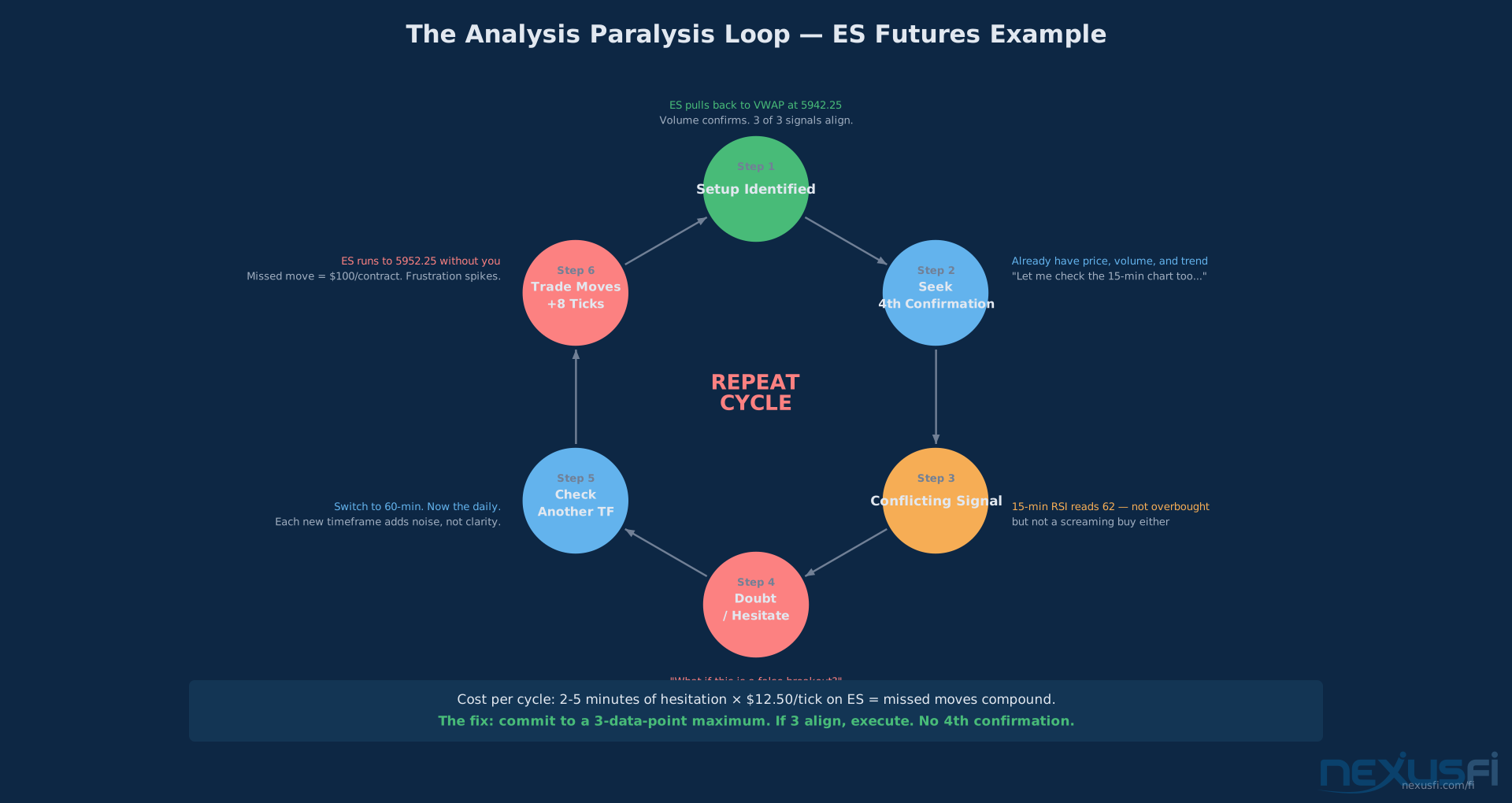
Here's the mechanism: you identify a valid setup, but instead of acting on it, your brain searches for one more piece of confirming evidence. Then another. Each new data point introduces the possibility of contradiction, and your brain latches onto that possibility harder than it holds the original signal.
This is distinct from simple indecision. Analysis paralysis specifically involves having a defined edge and still failing to execute. If you don't have a trade plan, that's a different problem. Analysis paralysis hits traders who know what they're looking for and still can't pull the trigger when they find it.
The Six Root Causes #
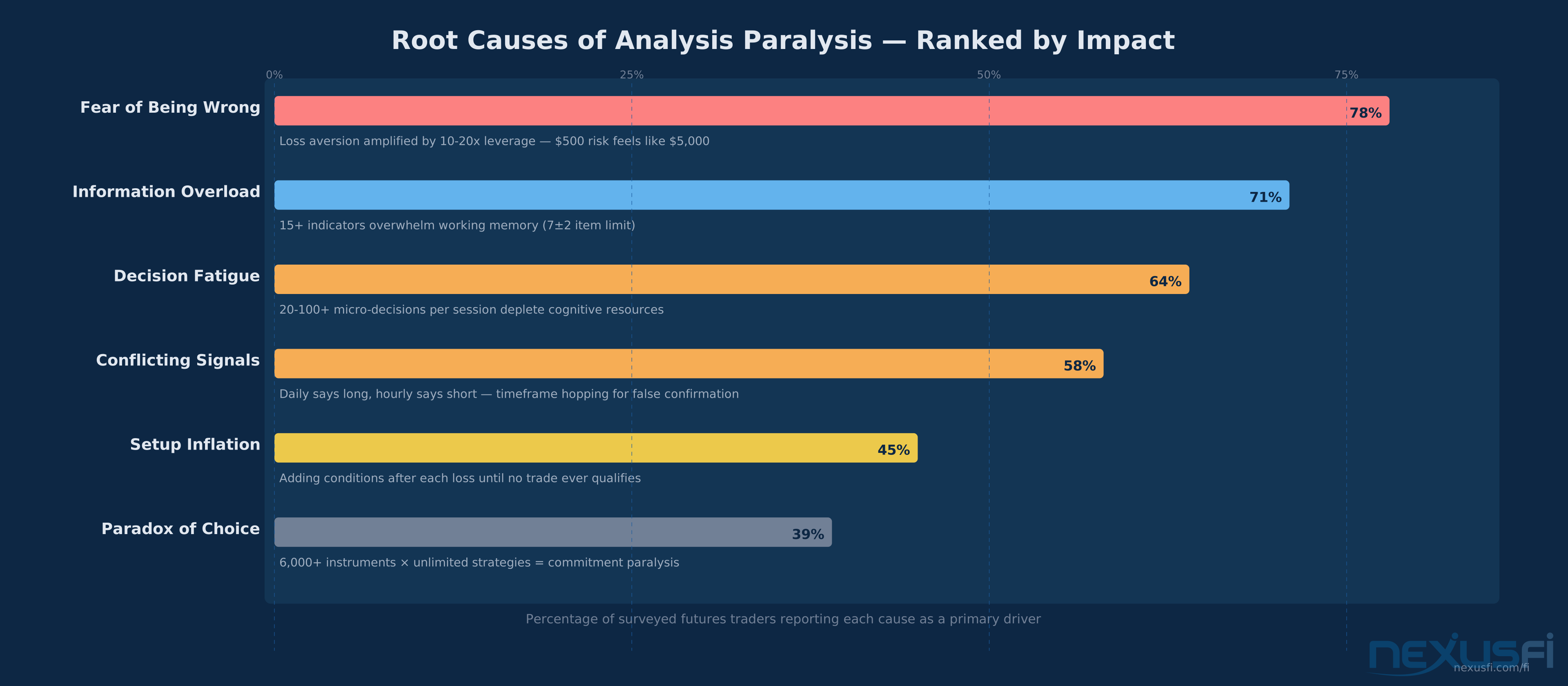
1. Information Overload #
Futures traders face an unusually dense information stream: tick-by-tick price data, order flow imbalances, spread relationships across contract months, correlation matrices with underlying cash markets, and macroeconomic releases on a 23-hour trading cycle. That's the reality of ES, NQ, CL, and most liquid futures.
The human brain can hold roughly [seven items in working memory] [1] at once. Stack 15 indicators on your chart, and you've created a system where conflicting signals are mathematically inevitable.
As one NexusFi member put it about information overload and chart clutter: ["The brain simply gets overwhelmed when you're asking it to process that many conflicting data streams simultaneously."]
The irony: traders add indicators to reduce uncertainty, but each additional indicator introduces another potential conflict. You're not reducing noise — you're multiplying it.
2. Conflicting Signals Across Timeframes #
A trader staring at a 5-minute chart sees bullish order flow. The 15-minute shows a bearish engulfing. The daily is in a range. The options market reflects elevated put skew. All of these are simultaneously valid, and a trader who tries to reconcile all four before pressing the button will never press it.
This is "timeframe hopping" at its worst. You switch from the 1-minute to the 5-minute to the daily seeking confirmation. What you're actually doing is expanding your search space until you inevitably find a reason not to trade. There's always a contradictory signal somewhere if you look hard enough.
The NexusFi community has extensive discussion on this trap. ["I think it's a repetitive loop people fall into that works like this: Analysis -> Fear -> Confirmation -> Late entry into what analysis told you to..."] [3]. The loop feeds itself until the trader stops trading entirely.
3. Decision Fatigue #
Futures traders make 20 to 100+ micro-decisions daily: when to enter, where to place the stop, how many contracts, where to take profit, whether to trail, when to re-evaluate. Research by Baumeister on ego depletion [12] shows that decision quality degrades meaningfully after roughly 3-4 hours of active decision-making.
This explains why your morning session feels sharp and your afternoon session feels like trading through fog. By 2 PM, you've spent thousands of units of cognitive energy on decisions large and small, and there's nothing left for the setup that appears at 3:30.
Decision fatigue doesn't announce itself. It manifests as increasing hesitation, wider stops, smaller position sizes, and a vague feeling that "nothing looks right today." A NexusFi member who studied this directly referred to ["decision fatigue as the silent account killer — you don't blow up from one bad decision, you bleed out from a hundred mediocre ones made on an empty tank."]
4. Fear of Being Wrong #
Kahneman and Tversky's loss aversion research [11] shows humans feel losses approximately 2.5 times more intensely than equivalent gains. In leveraged futures with 10-20x margin, that psychological amplification compounds. A trader risking $500 to make $500 on an ES trade psychologically experiences the risk as $1,250 against a $500 reward — the math is rigged against action before you even place the order.
This asymmetry drives perfectionist behavior. You want the "perfect" entry to justify the perceived risk. But perfection in markets is a fiction. Every entry involves uncertainty, and demanding certainty before acting means never acting.
The thread ["Not able to pull the trigger"][6] on NexusFi has 21 replies from traders who experienced exactly this: ["most it's due to simply not really owning your setup and not trusting your price action reading skills"] [5]. Fear of being wrong isn't about the money — it's about identity. Traders tie their self-worth to being right, and every losing trade feels like proof they don't belong.
5. Setup Inflation #
This is analysis paralysis in its most insidious form. After missing a trade, you add a filter to make sure you don't miss it that way again. After the next miss, you add another. Then another.
Before long, your setup requires 8 conditions to align simultaneously. Since markets are probabilistic, 8 conditions rarely align at the exact same moment. You've created a system that's theoretically rigorous and practically untradeable.
This is what one PATs journal contributor described: ["my biggest issue right now is the mental aspect: hesitating too much, doubting my own analysis skills and just not daring to pull the trigger"] [7]. The response from the community was revealing: ["Your biggest issue is not in hesitating, doubting, and not daring to pull the trigger. That's the thing you're doing right! That's normal behaviour"] [8]. The distinction matters — one is hesitation from incompetence, the other is hesitation from overengineering a process that was working fine with fewer inputs.
6. The Paradox of Choice #
Barry Schwartz's research [13] applies directly to trading: more options don't produce better decisions — they produce more anxiety and less action. When you can trade ES, NQ, YM, RTY, CL, GC, ZB, 6E, and another dozen liquid futures on any given day, the act of choosing which market to focus on becomes its own source of paralysis.
This is the trader who says "I'll trade the next setup" but never does, because by the time one setup arrives, they've identified three reasons the next one might be better.
Warning Signs You're Stuck #
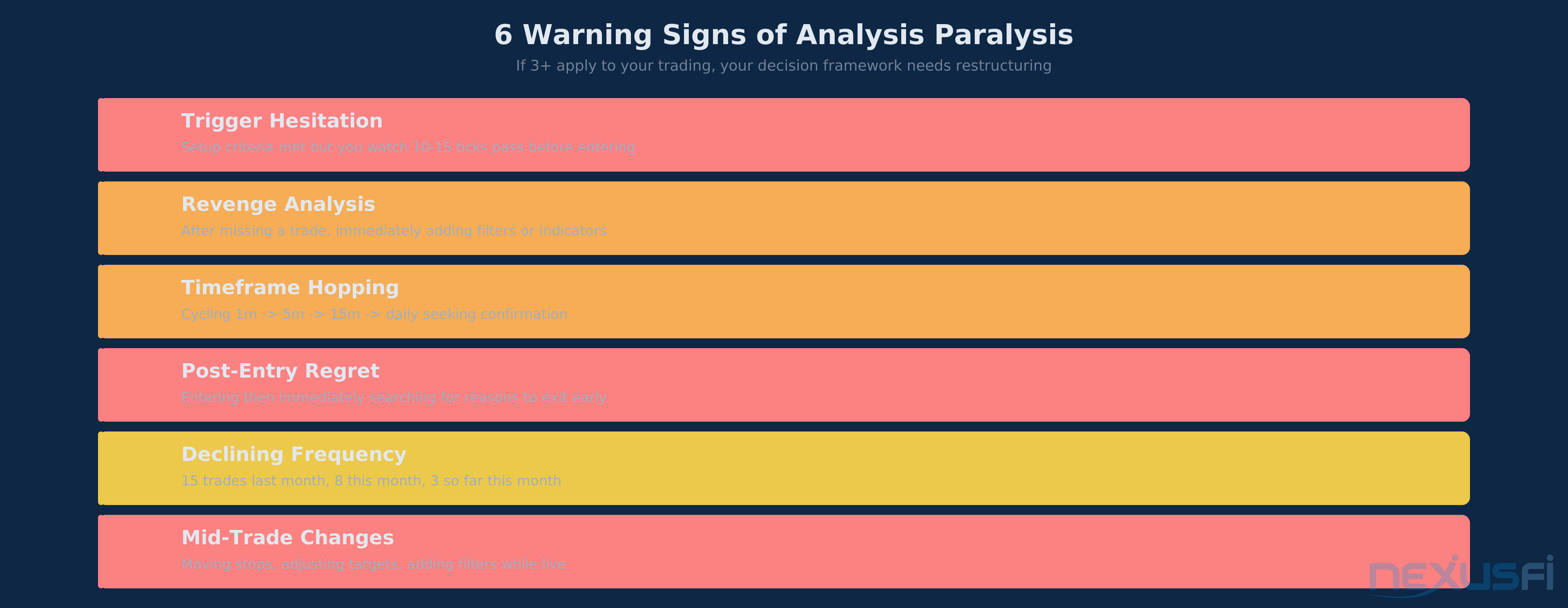
Not sure whether you have analysis paralysis or legitimate caution? Run through this checklist:
Trigger hesitation: Your setup criteria are met, but you watch price move 10-15 ticks in the expected direction before entering — or worse, not entering at all. Then you kick yourself for the next 30 minutes.
Revenge analysis: After missing a trade, you immediately start adding filters or indicators to "prevent" future misses. This is the opposite of solving the problem.
Timeframe hopping: You cycle from the 1-minute to the 5 to the 15 to the daily looking for confirmation. You're not confirming — you're searching for permission that the market will never grant.
Post-entry regret spiral: You enter, then immediately second-guess the entry and start looking for reasons to exit early. This leads to premature exits on trades that were correctly identified.
Declining trade frequency: You took 15 trades last month, 8 this month, and 3 so far this month. You tell yourself you're being "more selective." You're actually avoiding.
Mid-trade criteria changes: You move your stop, adjust your target, or add a filter while the position is live. Your pre-trade plan didn't survive contact with the market — because you never committed to it in the first place.
The Diagnostic: Finding Your Specific Failure Mode #
Analysis paralysis isn't one problem — it's at least five, and the fix depends entirely on which one is actually driving your hesitation.
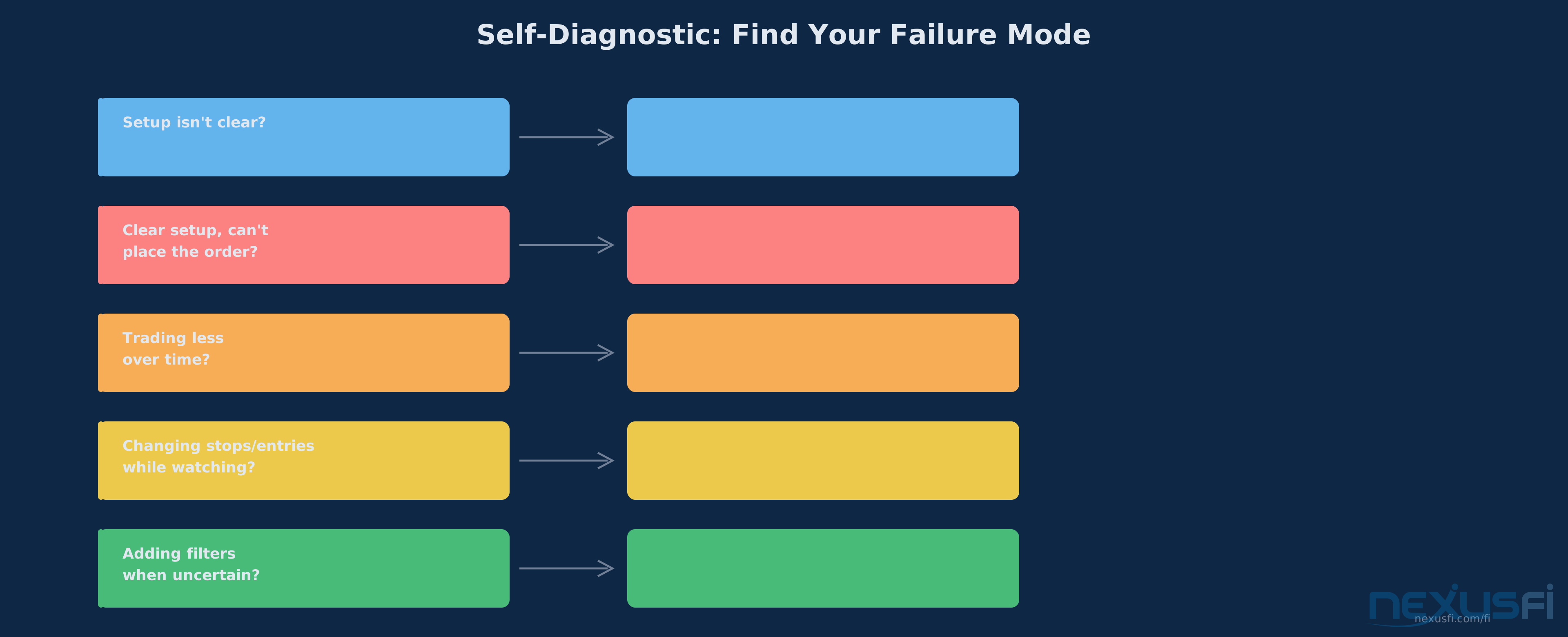
Question 1: Are you missing trades because the setup isn't clear? If yes: Too many criteria, not enough hard thresholds. Your setup is a suggestion, not a rule.
Question 2: Is the setup clear but you can't bring yourself to place the order? If yes: Fear of being wrong, or sizing too large for your risk tolerance. This is a psychological and risk management issue, not an analytical one.
Question 3: Are you trading less and less over time? If yes: Decision fatigue and loss aversion are accumulating. You're gradually training yourself to avoid rather than act.
Question 4: Do you keep changing stops and entries while watching the chart? If yes: Perfectionism with no pre-commitment. You're optimizing in real time when you should be executing a plan.
Question 5: Do you add filters when you feel uncertain? If yes: Paradox of choice and cognitive overload. More inputs won't help — they'll make the paralysis worse.
Fix the specific lever. Don't apply motivational band-aids to a structural problem.
Seven Frameworks That Actually Work #
Framework 1: The Three-Data-Point Maximum #
Limit every trade decision to three confirming factors:
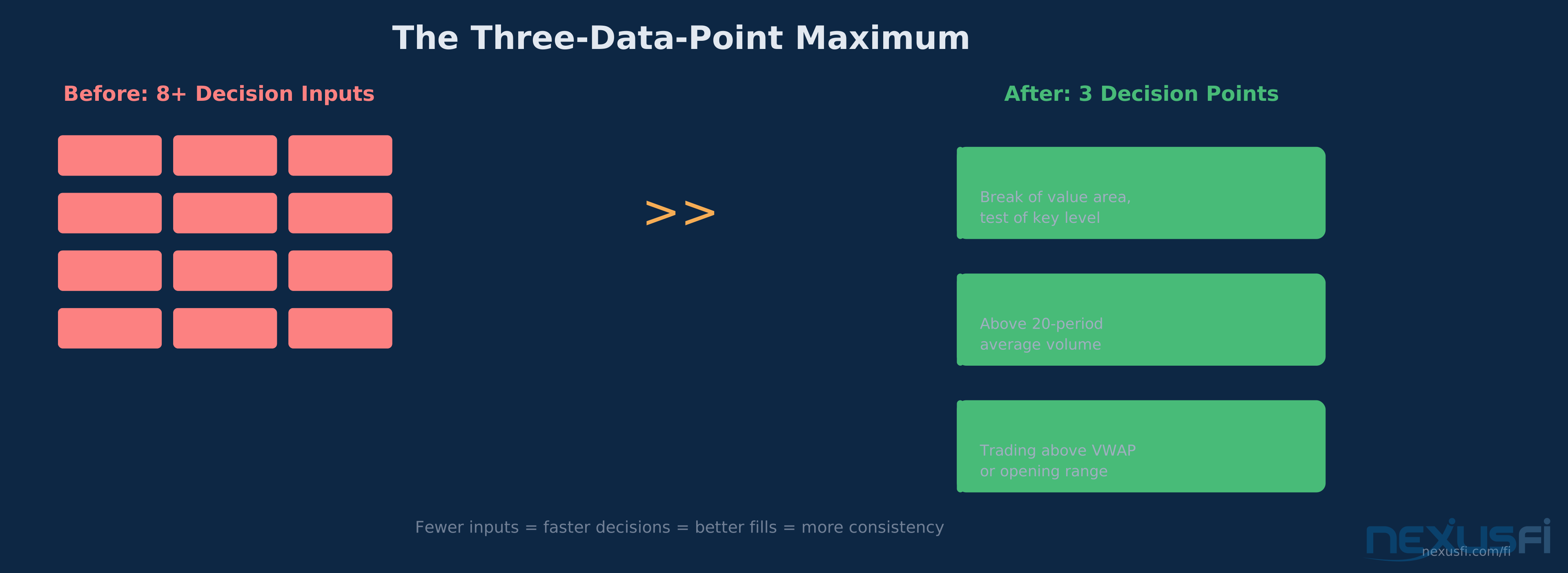
- Primary: Price action pattern (e.g., break of value area, test of prior day's high)
- Secondary: Volume confirmation (e.g., above 20-period average volume)
- Tertiary: Directional bias (e.g., trading above session VWAP, above opening range)
Write these three on a physical card or sticky note next to your screen. Before entering any trade, check the three boxes. If they're checked, you trade. If they're not, you don't. No fourth criterion. No "let me also check the TICK." Three data points. Period.
:::callout The 3-Data-Point Rule: Primary (price action) + Secondary (volume) + Tertiary (directional bias) = decision. If all three check out, you trade. No fourth criterion. No exceptions. ::: Why three? Research on expert decision-making shows that professionals in high-stakes environments (surgeons, firefighters, fighter pilots) make effective decisions using three or fewer key criteria. Adding more doesn't improve accuracy — it just slows down action and introduces conflicting signals.
Framework 2: The Qualify-Trigger Decision Model #
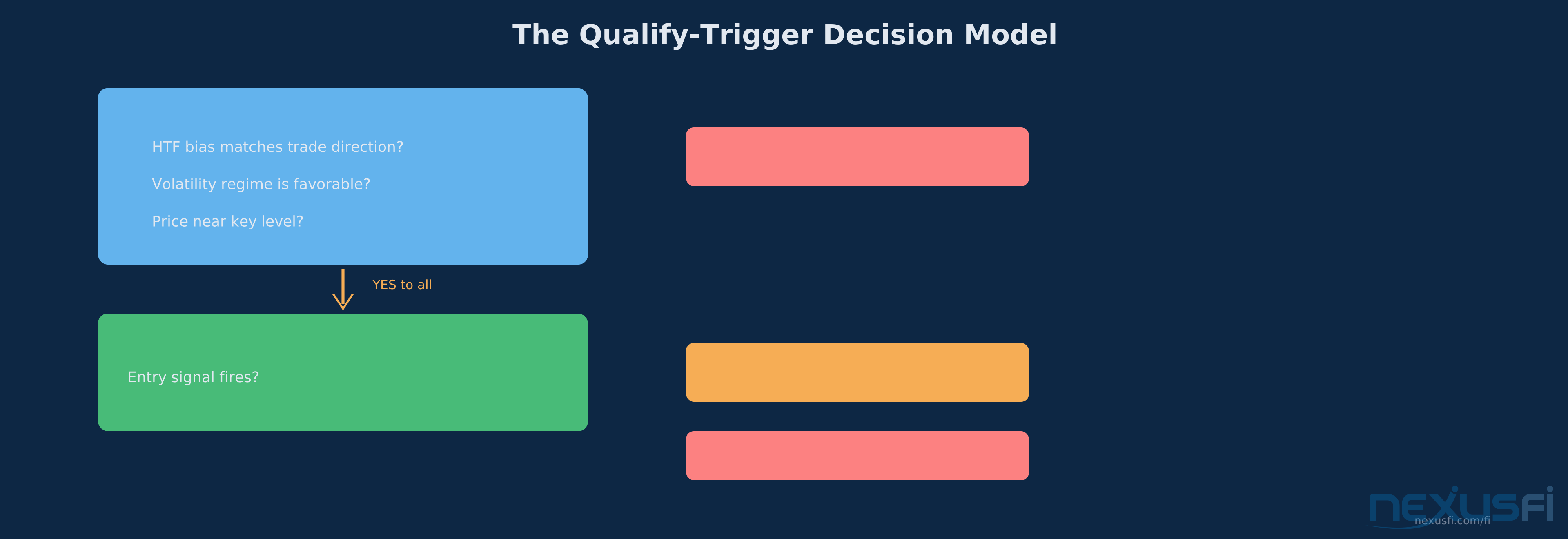
Split your decision into two stages:
Stage 1 — Qualification: Before the session, define what conditions make a trade valid. This is your analytical work — market context, key levels, directional bias, risk parameters. You do this when there's no money on the line and no pressure.
Stage 2 — Trigger: During the session, wait only for one mechanical event that fires the trade. A candle close above a level. A volume spike through a threshold. A break of the opening range. One thing — not five.
Once the trigger fires, you have a 5-second window to act. If you don't enter within 5 seconds of the trigger, you skip the trade entirely and wait for the next setup. No deliberation past the trigger point.
Framework 3: Pre-Session Scenario Planning #
As part of your pre-market preparation, write 2-3 specific if-then scenarios before the session opens:
- "IF ES breaks above 5,850 with volume exceeding 120K contracts in the first 30 minutes, THEN buy 2 MES at first pullback to 5,845, stop at 5,838, target 5,868."
- "IF CL fails to hold 68.50 after inventory report with a volume spike to the downside, THEN sell 1 MCL at the retest of 68.50, stop at 69.05, target 67.25."
This transfers cognitive work from real-time (high stress, threat-driven, noisy) to pre-session (analytical, calm, no money on the line). When the scenario plays out during the session, your only job is recognition and execution — not analysis.
Pre-session planning has the added benefit of creating a natural cap on daily trade count. Three scenarios means a maximum of three trades. When they're done, you're done.
Framework 4: Single-Timeframe Commitment #
Trade exclusively on one timeframe for a minimum of 30 trading days. Day traders: 5-minute chart only. Swing traders: daily chart only. No "checking the higher timeframe for context." No "zooming in for a better entry."
This is an uncomfortable prescription because multi-timeframe analysis feels sophisticated. It feels like you're being thorough. But for traders stuck in analysis paralysis, multiple timeframes are not tools — they're escape routes from commitment. Every timeframe switch is an opportunity to find a reason not to trade.
Commit to one timeframe. If the signal appears on that timeframe, take it. If it doesn't, don't go looking for it elsewhere.
Framework 5: The 90-Minute Reset #
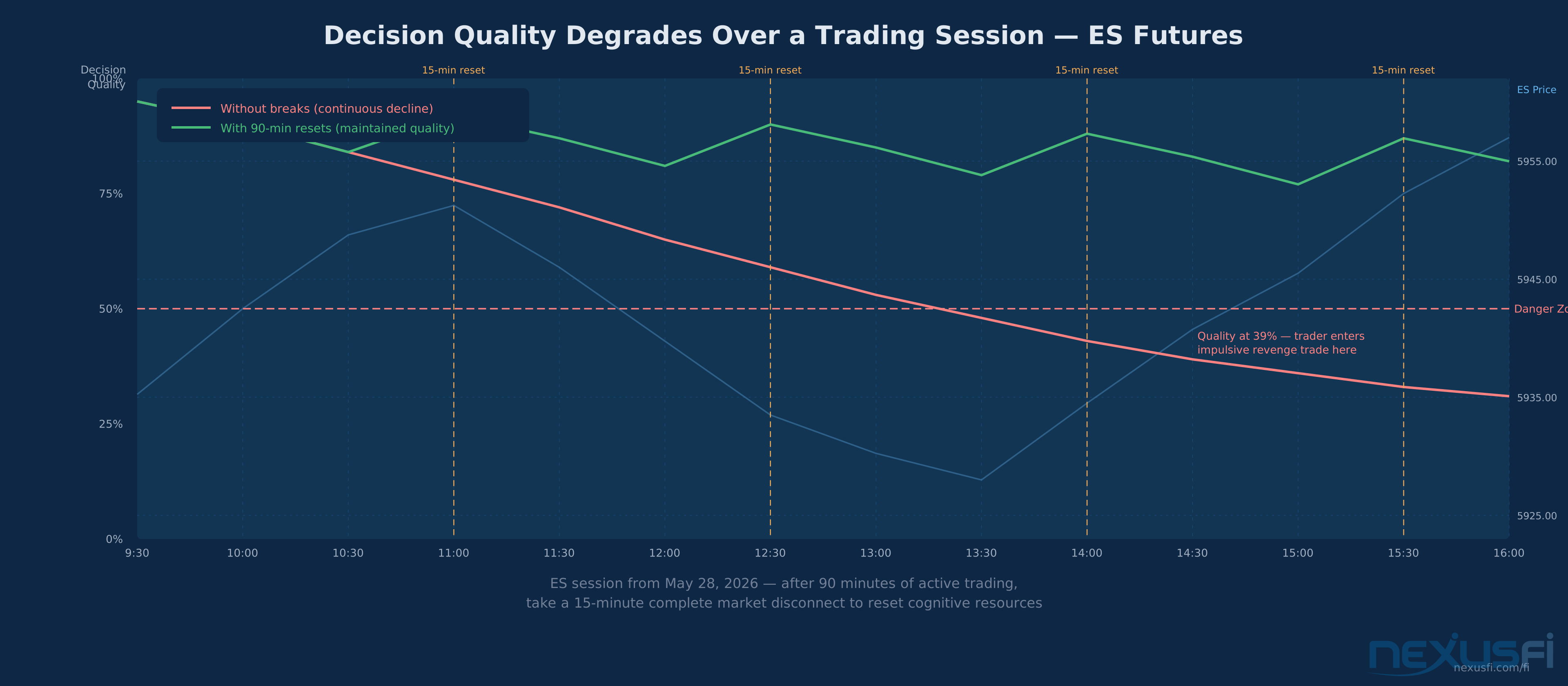
After 90 minutes of active trading, take a mandatory 15-minute complete market disconnect. Close your charts. Step away from the screen. Research on ultradian rhythms shows that cognitive performance naturally cycles in roughly 90-minute intervals, with clear degradation after sustained focus beyond that window.
:::callout The 90-Minute Reset Protocol: 90 minutes of active trading, then 15 minutes completely away from screens. No charts, no phone, no market talk. This isn't optional — it's cognitive maintenance that prevents the decision fatigue that makes analysis paralysis worse as the session progresses. ::: This isn't a luxury. It's maintenance. You wouldn't run an engine at redline for 6 hours without checking oil. Your cognitive capacity is no different.
The 90-minute reset also serves as a natural circuit-breaker against decision fatigue. Instead of pushing through increasingly poor decisions in the afternoon, you're recharging in structured intervals.
Framework 6: Bracket Order Staging #
Pre-set your order templates with stop and target already attached. When the trigger fires, you submit one bracket order — entry, stop, and target all in one click. No room for hesitation, no gap for doubt to creep in between placing the entry and setting the stop.
This eliminates the most stressful decisions (stop placement, target adjustment) from the execution moment, when fear is highest. You made those decisions during pre-session planning when you were thinking clearly. Trust the plan.
Framework 7: Intentional Imperfect Trades #
This one sounds counterintuitive: deliberately take 10 trades using only two criteria instead of your usual five. Trade smaller size — half your normal contracts or fewer.
Track the results. What you'll almost certainly find is that performance doesn't degrade meaningfully with fewer criteria. In many cases, it actually improves because you're acting faster, getting better fills, and spending less energy on deliberation.
This is exposure therapy for perfectionism. You're building empirical evidence that "good enough" setups produce "good enough" results — and the relief of actually trading again is worth more than the imaginary edge of two extra filters.
The Implementation Timeline #
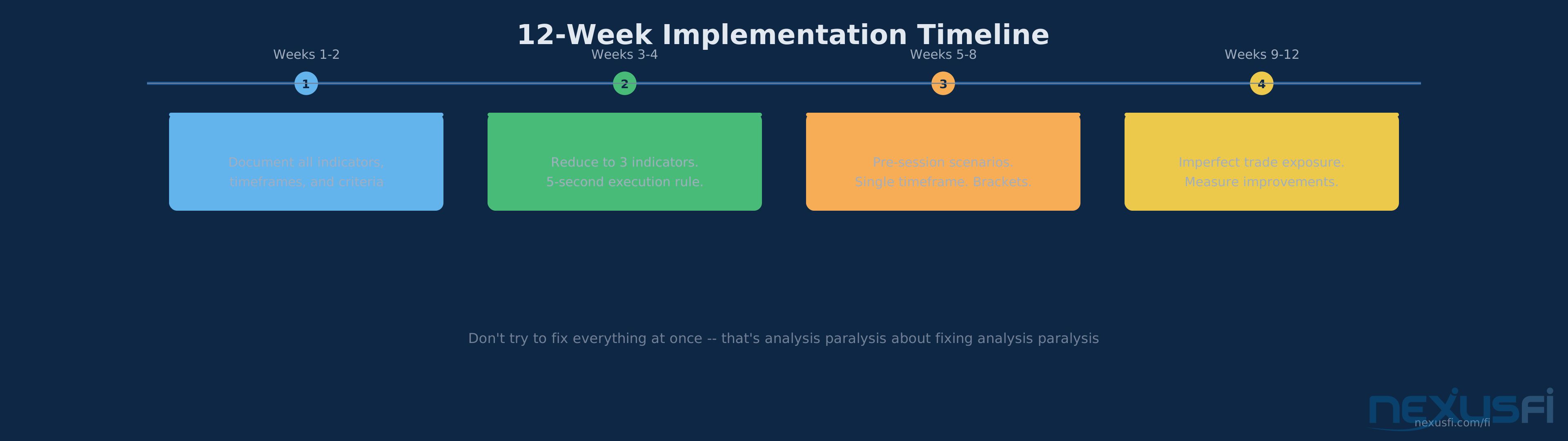
Don't try to fix everything at once. That's just analysis paralysis about fixing analysis paralysis.
Weeks 1-2: Audit your current process. Document every indicator on your charts, every timeframe you check, every criterion in your setup. Write it all down. Most traders discover they have 8-12 decision inputs when they thought they had 3-4.
Weeks 3-4: Reduce to a 3-indicator maximum. Remove one indicator per week until you're at three. Implement the 5-second rule: when your setup triggers, count down from 5. At zero, enter or consciously skip. No deliberation past zero.
Weeks 5-8: Add pre-session scenario planning. Commit to single-timeframe trading. Start using bracket orders exclusively. Begin the 90-minute reset protocol.
Weeks 9-12: Run intentional imperfect trades. Measure your decision quality weekly. Compare morning vs. afternoon performance to identify your personal fatigue threshold.
What to Track #
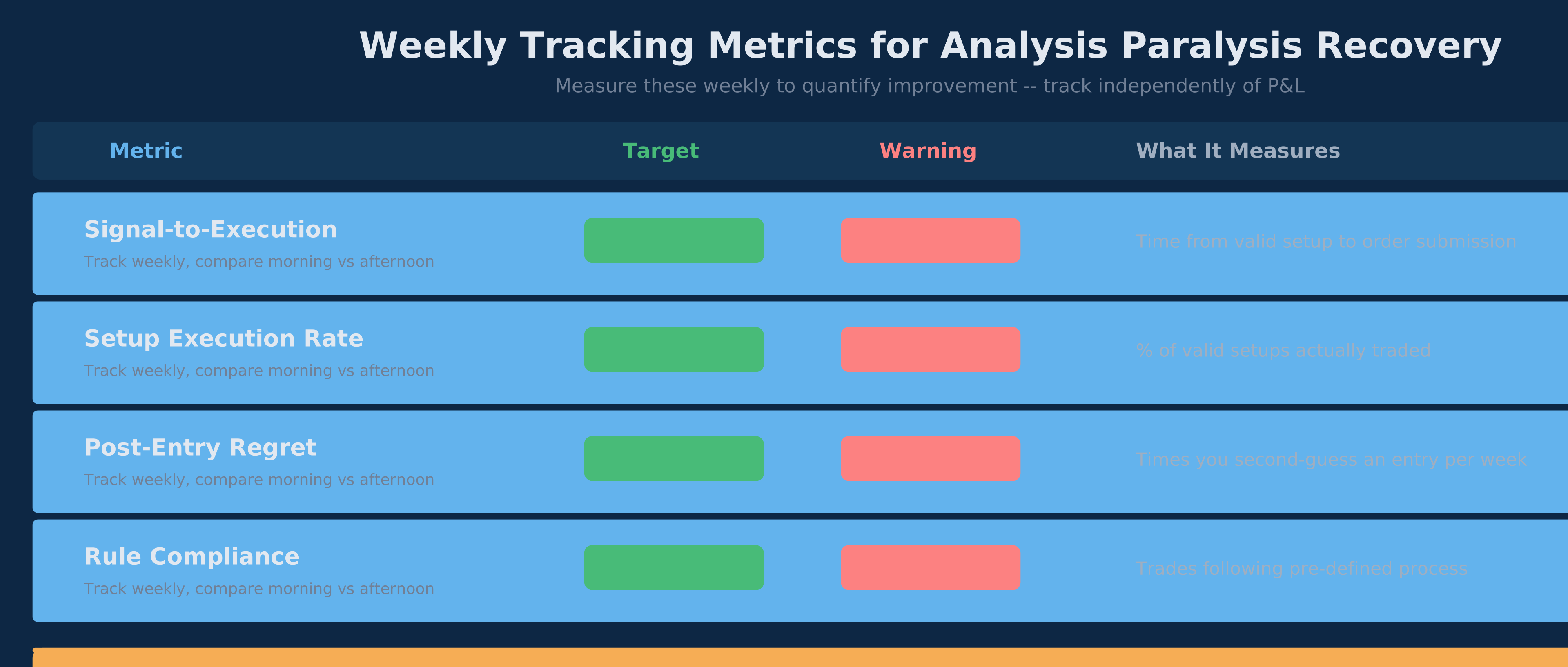
You can't improve what you don't measure. A trading journal is the most effective tool for this — track these metrics weekly:
Signal-to-execution time: How many seconds between identifying a valid setup and submitting the order? Target: under 30 seconds. If you're consistently above 60 seconds, your decision process is too complex.
Setup execution rate: What percentage of setups that met your criteria did you actually trade? Target: above 60%. Below 40% means you're consistently overriding your own system.
Post-entry regret count: How many times did you immediately second-guess an entry? Target: declining trend week over week.
Morning vs. afternoon quality: Compare win rate, average R-multiple, and execution timing between the first 90 minutes and the last 90 minutes of your session. A significant divergence confirms decision fatigue.
:::callout The Rule Compliance Metric: Track whether you followed your pre-defined process independently of P&L. A winning trade taken outside your rules is a compliance failure. A losing trade taken within your rules is a success. This metric matters more than your account balance for diagnosing analysis paralysis. ::: Rule compliance rate: Did you follow your pre-defined process? Track this independently of P&L. A winning trade taken outside your rules is a compliance failure. A losing trade taken within your rules is a success.
The Deeper Truth #
Analysis paralysis isn't about needing more information. It's about needing less.
The market rewards decisive action within defined risk parameters over perfect analysis with no action. Your edge doesn't live in the 12th indicator you added to your chart — it lives in the discipline to act on the first three.
As trader Jeff Castille wrote in one of the most-thanked threads on NexusFi: ["To me simple is better... I don't want to look at too many indicators. Besides, all indicators are doing is telling me what the price is doing so... why not learn to read price action?"] [9]. Or as tigertrader discovered after building the ultimate multi-screen workspace: ["I had inadvertently overwhelmed myself with too much information. The immediate corollary of my actions had left me feeling disoriented and disconnected from the markets"] [10].
The traders who overcome analysis paralysis don't become more confident — they become more committed to acting despite uncertainty. Confidence is a feeling that comes and goes. Commitment is a decision you make once and execute repeatedly.
Simplify. Pre-commit. Execute. Review offline. That's the framework. Everything else is noise.
See Also #
- Decision Fatigue: Why Your Afternoon Brain Destroys Your Morning Profits
- Loss Aversion in Trading: Why Your Brain Sabotages Every Stop
- Fear and FOMO in Trading: The Two Emotions That Freeze and Chase
- Trading Discipline and Rule Following: System Design Over Willpower
- Thinking in Probabilities: The Mental Framework That Separates Consistent Traders
- Trading Confidence: Calibrated Trust in Your Edge
- Cognitive Biases in Trading: The Mental Shortcuts That Cost You Money
Knowledge Map
Prerequisites
Understand these firstGo Deeper
Build on this knowledgeReferences This Article
Articles that build on this topicCitations
- — Trading Psychology and How The Mind Works (III) (2010) 👍 16“Once again some great words of trading wisdom from trader Denise Schull. Shivaya From the desk of Denise Schull: Did you know that if someone presents you with 12 cars to choose from that the odds of you buying any car at all plummet? In contrast, if...”
- — Making a Living with the Micros (2021) 👍 19“Trading Naked: Fighting Indicator Overload I have been posting for several days now, but I have only discussed one indicator ($Tick) in depth - for a reason. Everyone loves indicators! New traders think "more is better.”
- — The Scalper's Journey (2016) 👍 17“I think its a repetitive loop people fall into that works like this: Analysis -> Fear -> Confirmation -> Late entry into what analysis told you to do originally -> new Fear (too Late) -> sucked In -> Fear -> get out -> Watch your analysis come true -...”
- — Trade Journal (2016) 👍 5“I call this decision fatigue. (See the article I attached) Essentially its how the car dealers wear you down until you agree to anything....or any other sales type situation.”
- — Commitment to the trade (2011) 👍 7“Congratulations on the journal. It can really help you identify your problem areas. Now some observations. 1. You MUST always trade with a stop.”
- — Not able to pull the trigger (2012) 👍 33“Hi! :) And welcome on the forum, since it is your first post! :) I do not suffer from your problem, but I have the opposite (pull the trigger too often). I hope that another trader who knows your issue could help you better than I will do.”
- — PATs - Price Action Trading - Elite Members Common Journal (2014) 👍 8“I feel my biggest issue right now is the mental aspect: hesitating too much, doubting my own analysis skills and just not daring to pull the trigger when opportunities present themselves.”
- — PATs - Price Action Trading - Elite Members Common Journal (2014) 👍 11“Your biggest issue is not in hesitating, doubting, and not daring to pull the trigger. That's the thing you're doing right! That's normal behaviour, and in time, you will realize that, and it will become the norm.”
- — All you need (2009) 👍 74“To me simple is better..... I don't want to look at too many indicators. Besides, all indicators are doing is telling me is what the price is doing so....”
- — LESS IS MORE...MORE OR LESS (2010) 👍 4“Technology was supposed to make life simpler, but as Alvin Toffler warned in 1970, in his prophetic novel "Future Shock", rapid technological change made life even more complicated and increasingly stressful.”
- — Prospect Theory: An Analysis of Decision under Risk (1979)
- — Ego Depletion: Is the Active Self a Limited Resource? (1998)
- — The Paradox of Choice: Why More Is Less (2004)