



Prop Firm Tax Treatment: The Complete Guide for Funded Futures Traders
Overview #
You passed the evaluation. You're funded. Money is hitting your account. Then tax season arrives and you realize you have no idea what you owe, who you owe it to, or whether you can deduct that $500 challenge fee you paid three months ago.
This is the question that blindsides most funded traders. The prop firm didn't tell you. Your brokerage statement doesn't explain it. The usual futures tax guides don't cover what happens when you're trading someone else's capital on a profit split.
Here's the reality: prop firm trading creates a double-layer tax situation that most traders mishandle. Your futures trades generate one type of income. Your profit split payout generates another. These flow through different tax forms, receive different treatment, and require different planning. Get it right and you keep much more. Get it wrong and the IRS will sort it out for you — badly.
Understanding how prop firm evaluations work is the first step — but knowing how to keep more of what you earn after you pass is equally critical. The funded account consistency rules directly affect your payout structure, which shapes your tax situation. The futures contract mechanics determine which income qualifies for favorable Section 1256 treatment.
Important disclaimer: This article provides educational information about tax concepts for funded traders. It is not tax advice. Tax law is complex and fact-specific. Work with a qualified CPA who has experience with professional futures traders for your individual situation.
The Fundamental Question: How Does the IRS See You? #
Everything about your tax situation as a funded trader starts here. The IRS doesn't care what your prop firm calls you. It looks at the economic substance of the arrangement and asks: are you an independent contractor earning compensation, or a trader generating capital gains?
The answer is usually both — and that's where things get complicated.
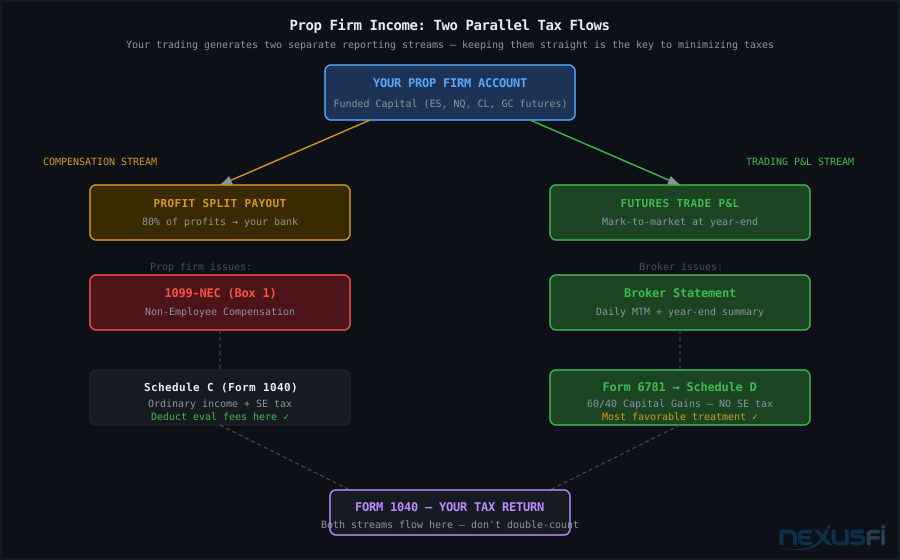
Most prop firm arrangements have two economically distinct components running in parallel:
- The trading activity itself — You execute futures contracts using the firm's capital. These trades are Section 1256 contracts (regulated futures) that receive the favorable 60/40 capital gains treatment regardless of holding period.
- The profit split payment — The firm pays you your percentage of profits. This is where classification gets contested. Most firms treat this as non-employee compensation and issue a 1099-NEC.
As @PonoTrading observed in the NexusFi "Trading is a Business" thread: the structure of your prop firm relationship at the core determines how your taxes work, and tracking it properly across multiple firms and accounts is the first challenge most funded traders face.
Section 1256: The Tax Treatment Futures Traders Actually Want #
Before getting into the prop firm complications, you need to understand what's at stake with Section 1256 — because it's the treatment you want to preserve as much of your income in as possible.
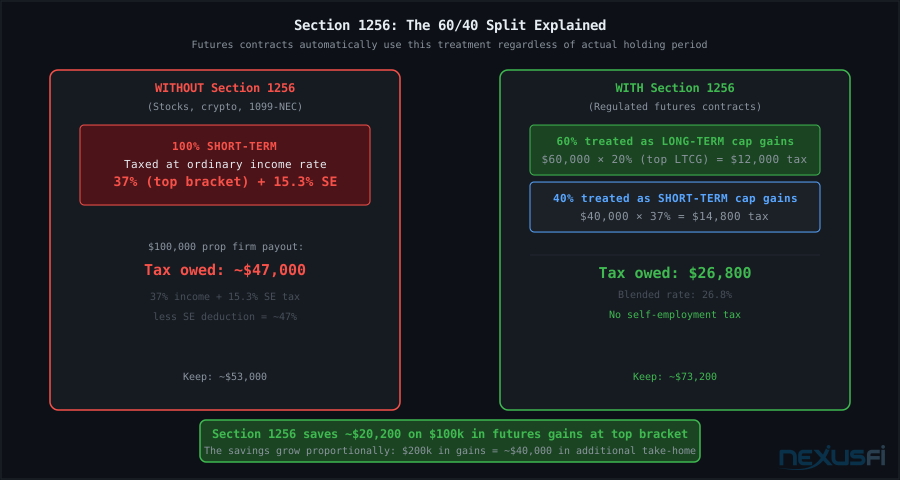
IRC Section 1256 applies to regulated futures contracts, certain foreign currency contracts, and broad-based index options. The law treats all gains and losses as if you closed every position at year-end (mark-to-market), and then splits that result:
- 60% treated as long-term capital gains — taxed at 0%, 15%, or 20% (plus the 3.8% NIIT at higher incomes)
- 40% treated as short-term capital gains — taxed at ordinary income rates
- No self-employment tax — this is the big one; capital gains are not subject to the 15.3% SE tax
At the 37% ordinary income bracket, the Section 1256 blended rate is approximately 26.8% versus 37% for short-term gains or a potential 47%+ for income subject to both ordinary rates and SE tax. The difference on a $100,000 gain is roughly $20,000 in additional take-home pay.
@SMCJB put it directly in "Selling Options on Futures?": "All futures are taxed as section 1256 contracts and hence are treated as 60% long term capital gains and 40% short term capital gains which for me is much more favorable."
As @booneyall noted in the "Senate Bill to revoke Futures 60/40 tax treatment" thread: Section 1256 contracts "aren't subject to self employment tax" — making the 60/40 treatment much more valuable than the headline rate difference suggests when you factor in SE tax on 1099-NEC income.
The 1099-NEC Problem: What Most Prop Firms Issue #
Most prop firms — including the major names in the funded futures space — issue profit-split payments as 1099-NEC income (Box 1). This means:
- The firm reports your payout to the IRS as non-employee compensation
- You owe ordinary income tax on the full amount
- You also owe self-employment tax (15.3% up to the FICA wage base, 2.9% above) if you operate as a sole proprietor or single-member LLC
- The 1099-NEC by itself does not trigger Section 1256 treatment
This creates what tax professionals call the double-layer situation: your underlying futures trades are still Section 1256 contracts, but the payment you received from the firm may be characterized as compensation rather than trading profit.
As @bobwest noted in "The Scalper's Path" journal: "You're an independent contractor, and your income is reported on a 1099." That framing — contractor providing services versus trader taking risk — drives much of the tax classification debate.
The Key Question: Who Owns the Trades? #
The IRS looks at economic substance. In most prop firm arrangements:
- The firm's capital is at risk (not yours)
- The firm owns the trading account
- You execute trades according to the firm's rules (position limits, instrument restrictions, drawdown rules)
- The firm pays you a share of profits as compensation
This looks more like contractor compensation than personal trading, which is why 1099-NEC is the common reporting form.
The Double-Layer Reality: Both Can Coexist #
Here's what trips people up: receiving a 1099-NEC doesn't necessarily eliminate Section 1256 treatment on the underlying trades. Both can exist on the same return, but they need to be handled separately.
The way this typically flows:
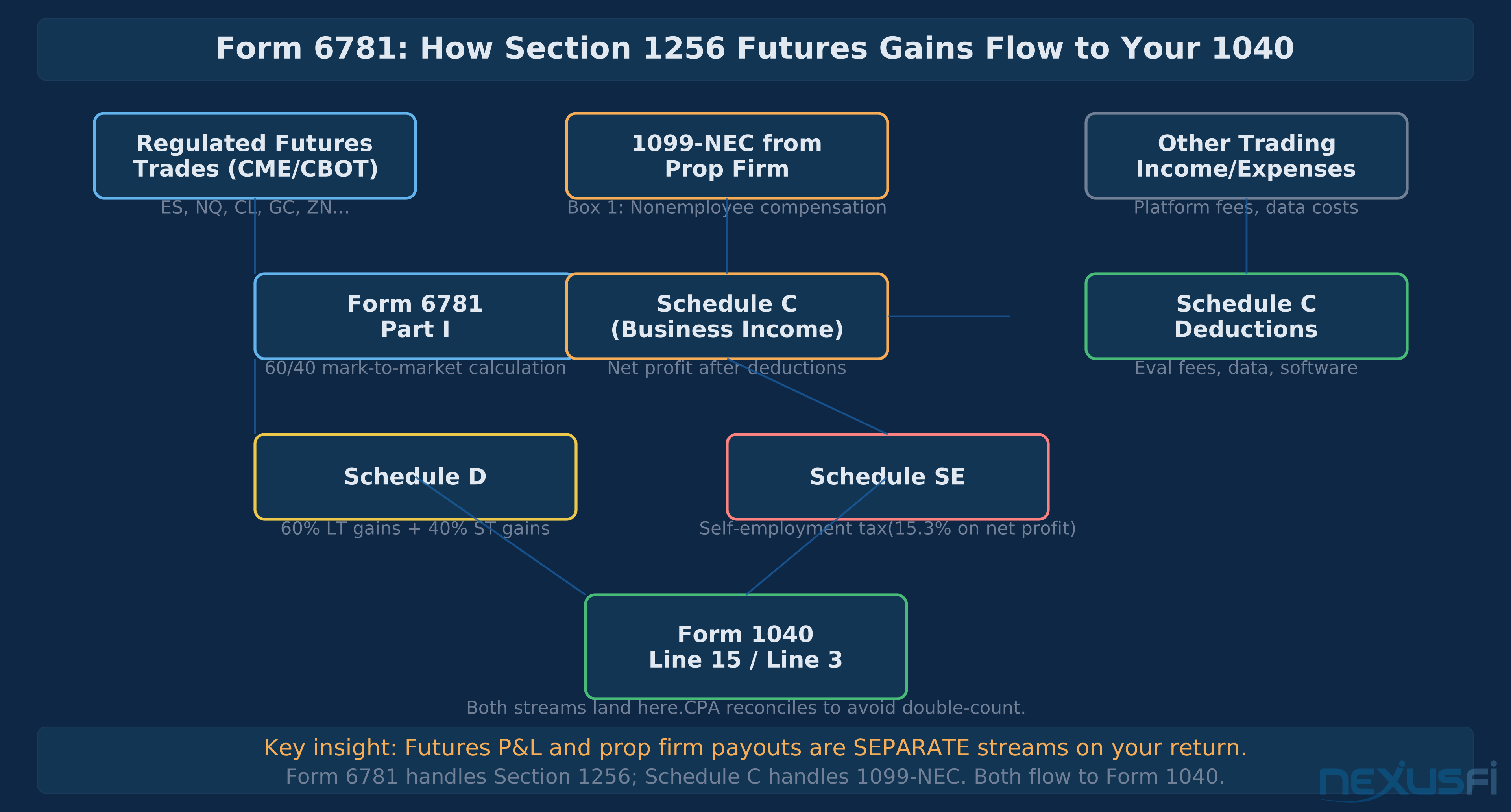
- Your broker (if you have a broker statement) reports the futures trade P&L as Section 1256 gains — filed on Form 6781
- The prop firm reports the profit split payout as 1099-NEC compensation — reported on Schedule C
- On your Form 1040, both appear: the 6781 gains flow through Schedule D, the NEC flows through Schedule C
A CPA experienced with professional traders can reconcile both to avoid double-counting while preserving each stream's proper characterization. The goal is to keep as much income as possible in the Section 1256 category and deduct evaluation fees against the Schedule C income.
Not all prop firms generate a separate broker statement. Some are pure revenue-sharing arrangements where the firm doesn't provide individual trader-level trade reporting. In those cases, the entire economic outcome may be captured by the 1099-NEC, and the Section 1256 layer may not be separately documentable. Know your firm's reporting structure before assuming the 60/40 treatment applies to your payout.
Most common scenario for a futures-only funded trader:
- 1099-NEC from prop firm — Schedule C — ordinary income + SE tax
- Broker statement showing futures P&L — Form 6781 — 60/40 capital gains
- Evaluation fees — Schedule C deduction — reduces ordinary income AND SE tax
Evaluation Fees: Are They Deductible? #
This is the question every funded trader wants answered. The short version: yes, but conditionally.
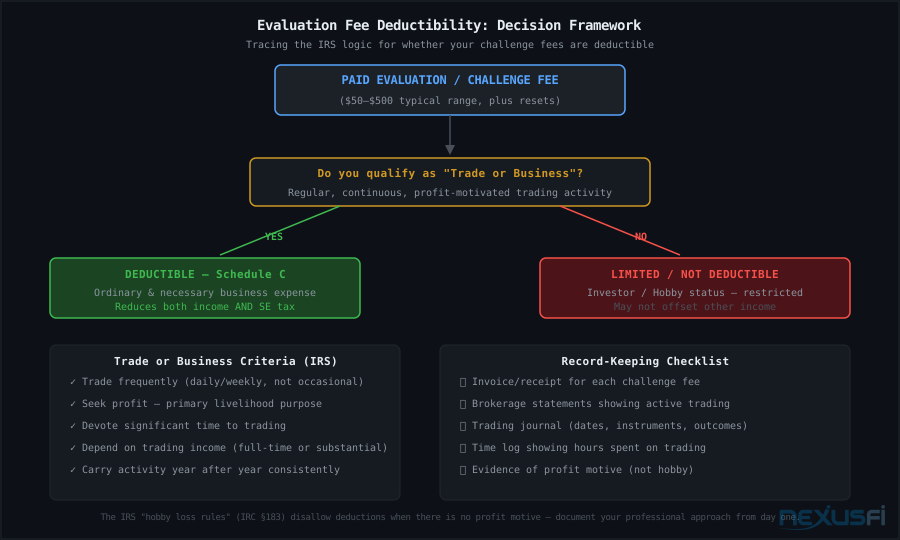
Evaluation fees (challenge fees, reset fees, platform fees) are deductible as ordinary and necessary business expenses on Schedule C — but only if you qualify as operating a "trade or business." The IRS doesn't hand this status out automatically.
As @PonoTrading noted in "Trading is a Business": "with prop firms and funding companies it's actually even easier to write off all of those losses because they don't allow you to lose their capital." The evaluation fee itself — not trading losses — is the deductible expense.
The Trade or Business Threshold #
To deduct trading expenses, including prop firm evaluation fees, you generally need to meet what the IRS considers "trader" status. The criteria:
- You trade regularly and frequently (not occasionally)
- You seek profit from short-term price movements (not long-term investment returns)
- Trading is a significant and continuous activity
- You devote significant time to trading activity
For most actively funded traders — especially those trading daily through an evaluation or funded account — these criteria are met. The challenge is documentation.
Documentation Requirements #
If you want to deduct evaluation fees, build a paper trail from the beginning:
- Keep every invoice and receipt with the firm's name, date, and amount
- Maintain a trading journal showing dates traded, instruments, results
- Save brokerage or platform statements showing trading frequency
- Track time spent on trading activity (market hours, research, analysis)
- Demonstrate profit motive — even passed evaluations show you're seeking gain, not running a hobby
The IRS "hobby loss rules" (IRC §183) are the danger zone. If your trading looks like a hobby rather than a business — especially if you consistently pay evaluation fees without ever generating income — you can lose the deduction and face assessments on prior years.
Entity Selection: Sole Proprietor vs. S-Corporation #
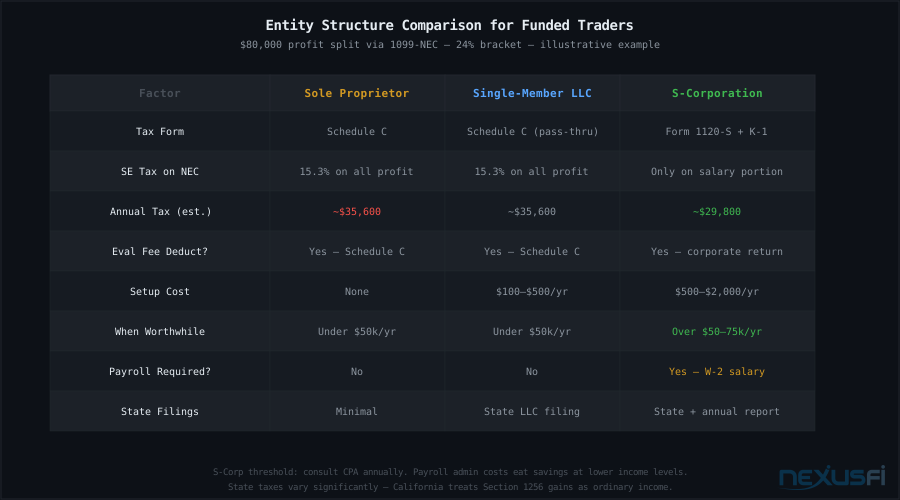
The entity question matters most when your prop firm income flows through as 1099-NEC, because that's when SE tax becomes a significant cost.
Sole Proprietor (Schedule C) #
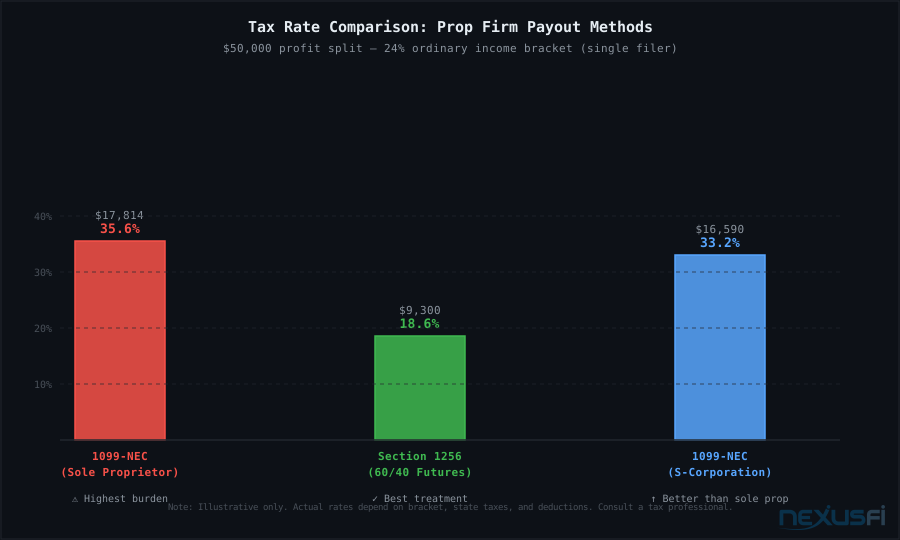
The default for most new funded traders. Easy, no setup cost, no ongoing compliance requirements. The problem: every dollar of net profit on Schedule C is subject to self-employment tax (15.3% up to the FICA wage base, then 2.9% above). On a $60,000 profit split, that's approximately $9,200 in SE tax on top of income tax.
Single-Member LLC #
A disregarded entity for federal tax purposes — treated identically to a sole proprietor. The LLC provides liability separation but doesn't change the tax math.
S-Corporation #
The tool worth considering when annual prop firm income exceeds roughly $50,000--$75,000 after expenses. The S-Corp structure allows you to:
- Pay yourself a "reasonable salary" — subject to payroll taxes (similar to SE tax)
- Take the remainder as a "distribution" — not subject to SE/payroll taxes
On a $100,000 profit split: if you pay yourself a $45,000 salary (reasonable for a trading role), payroll taxes apply only to that $45,000. The remaining $55,000 distribution avoids the 15.3% payroll tax hit — saving roughly $8,400 annually.
The S-Corp isn't free: you need to file Form 2553 by March 15 to elect S-Corp status, file Form 1120-S annually, run actual payroll with W-2 issuance, and pay an accountant to manage the structure. These costs typically run $1,500--$3,000 per year.
Entity selection rule of thumb: Below $50,000 in net prop firm income — stay simple (sole prop). Above $75,000 — model the S-Corp savings with your CPA. The break-even point on S-Corp administrative costs is typically $50k--$75k in annual net income from 1099-NEC sources.
As @iantg noted in "Personal or LLC?": entity selection for traders involves real gray areas in tax treatment, and the right structure depends heavily on your income level and how much you want to deal with the compliance overhead.
Quarterly Estimated Taxes: The Cash Flow Trap #
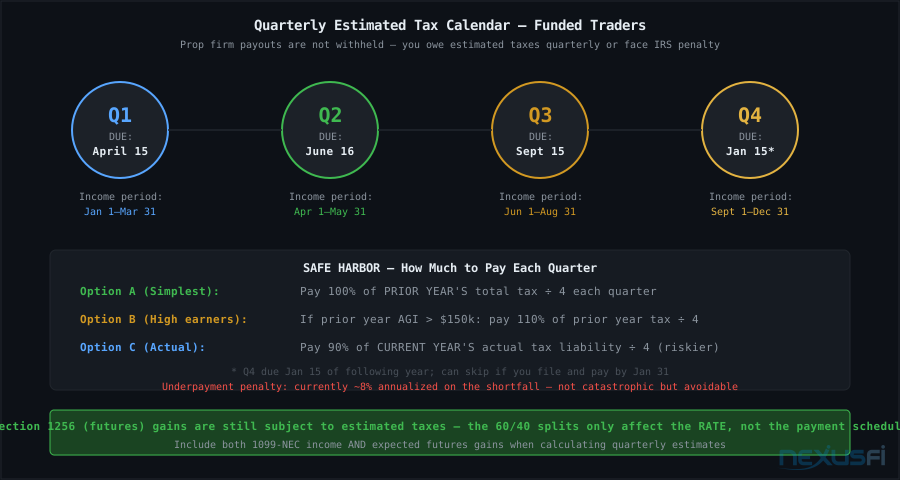
Prop firm payouts have no withholding. The firm doesn't take taxes out before sending you money. That means you're responsible for paying taxes to the IRS four times per year through estimated payments — or facing an underpayment penalty.
The standard quarterly deadlines:
- Q1 (Jan 1--Mar 31): Payment due April 15
- Q2 (Apr 1--May 31): Payment due June 16
- Q3 (Jun 1--Aug 31): Payment due September 15
- Q4 (Sep 1--Dec 31): Payment due January 15 of following year
The safe harbor rule that protects you from underpayment penalties:
- Option A (simplest): Pay 100% of your prior year's total tax, divided by four each quarter
- Option B (high earners): If your prior year AGI exceeded $150,000, pay 110% of prior year tax
- Option C (current year method): Pay 90% of your current year's actual liability — riskier if income is unpredictable
The quarterly payment obligation applies to both the 1099-NEC portion AND the expected Section 1256 gains from your trading.
Practical cash flow approach: every time a profit split payment hits your account, immediately transfer a portion to a separate tax savings account. For most funded traders, setting aside 30--35% of 1099-NEC income covers federal income tax and SE tax combined.
State Taxes: The Variable You Can't Ignore #
Federal treatment is one thing. State taxes introduce a new layer of complexity that many traders completely overlook.
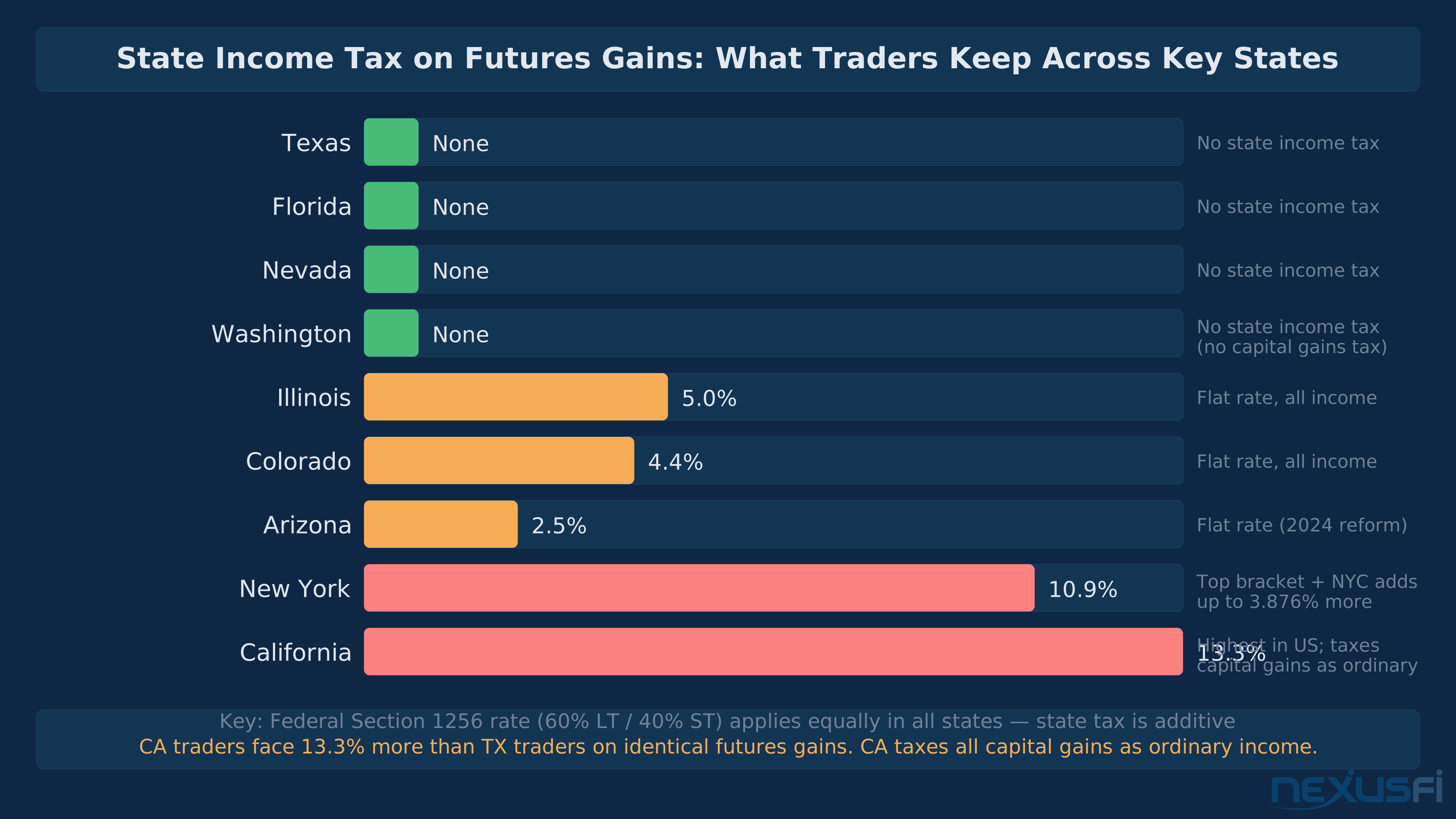
Most states follow the federal classification of income — a 1099-NEC is ordinary income at the state level, Section 1256 gains are capital gains. But several notable exceptions exist:
- California: Taxes all capital gains as ordinary income at the state level. Section 1256's favorable federal rate provides no benefit in California. State rate can reach 13.3% on top of federal.
- New York: Similar ordinary income treatment for capital gains. High combined rates for NYC residents.
- Texas, Florida, Nevada, Washington: No state income tax — Section 1256 savings are pure savings.
- Other states: Most follow federal, but the details vary. Check your state's specific treatment of Section 1256 gains and self-employment income.
A California futures trader and a Texas futures trader with identical federal income face dramatically different after-tax outcomes. The state factor is real and significant, especially at higher income levels.
The Form 6781 Obligation #
If you're trading regulated futures contracts — ES, NQ, CL, GC, ZN, 6E, or any CME/CBOT/NYMEX contract — you must file Form 6781 (Gains and Losses from Section 1256 Contracts and Straddles) each year, regardless of whether you made money.
Form 6781 has two parts:
- Part I: Section 1256 contracts — the 60/40 calculation that flows to Schedule D
- Part II: Straddle rules — applies to mixed positions; most individual traders don't need this
Key features of Form 6781:
- Reports mark-to-market gains/losses — including on positions still open at December 31
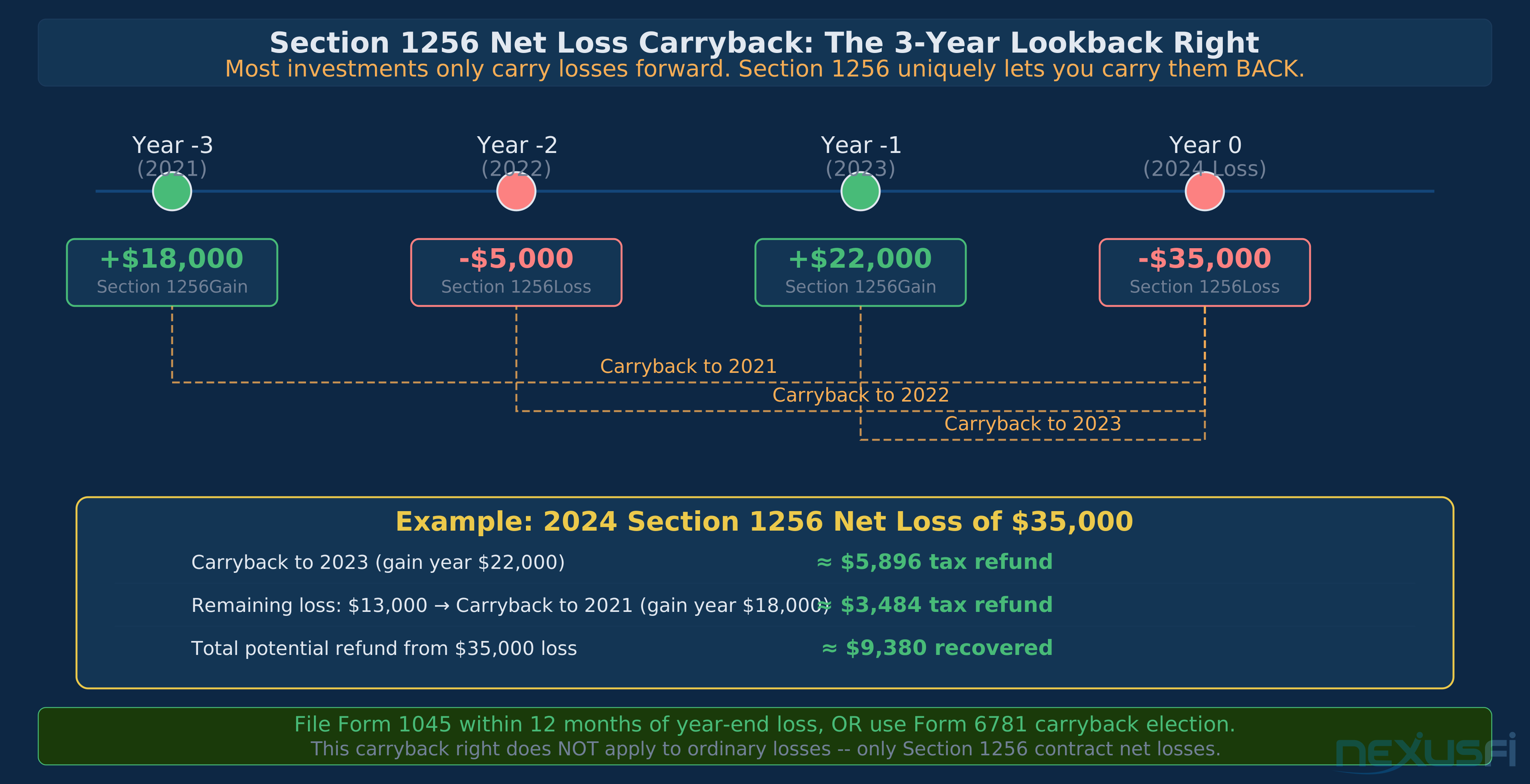
- Net loss on Form 6781 can be carried back up to 3 years (unusual carryback right under Section 1256(d))
- Net loss on Form 6781 can only offset Section 1256 gains in future years, not ordinary income
The Section 1256 carryback right is unusual — most losses can only be carried forward, not back. If you have a losing year in futures, you can carry that net loss back up to three years and recover taxes already paid on Section 1256 gains in those prior years. File Form 1045 within 12 months of the loss year. This is real money — on a $35,000 loss, you might recover $9,000+ in federal taxes from prior gain years.
Instrument Eligibility: Not Everything Qualifies #
Section 1256 treatment applies to specific instruments. Before assuming your prop firm trading qualifies, verify what you're actually trading:
Section 1256 eligible:
- Regulated futures contracts: ES, NQ, YM, RTY, CL, GC, ZN, ZB, ZC, ZS, NG, 6E, 6J, and other CME/CBOT/NYMEX contracts
- Broad-based index options on futures
- Foreign currency contracts regulated under the CEA
- Dealer equity options and dealer securities futures contracts
Not Section 1256:
- Individual equity options (puts and calls on single stocks)
- Narrow-based index options
- Cash equity positions (stocks)
- Cryptocurrency spot positions
- CFDs (most are not regulated futures under US law)
- Spot forex (unless specifically regulated under the CEA)
Most futures prop firms primarily trade CME and CBOT contracts — which qualify. If your firm also offers equity options trading, crypto, or forex CFDs in the same account, those positions get treated differently.
Checklist: What to Do Before Tax Season #
- Get the reporting confirmation in writing from every firm: "What form will you issue for my profit split? 1099-NEC, 1099-MISC, or other?" Get this before you trade.
- Set up your accounting from day one: Track every challenge fee, reset fee, data fee, and platform expense separately. Keep invoices organized.
- Open a separate tax savings account: Transfer 30--35% of every 1099-NEC payment immediately. Don't spend what isn't yours.
- Make quarterly estimated payments: Don't wait until April 15. Use the safe harbor method (prior year tax / 4) if your income is uncertain.
- Maintain a trading journal: Documents active trading intent. Useful for establishing trade-or-business status and defending fee deductions.
- Collect all year-end documents: Prop firm 1099-NECs (should arrive by January 31), broker statements (1099-B or equivalent), any platform or data fee receipts.
- Consult a CPA early: Tax season (February--April) is when CPAs are busiest. Find a professional experienced with active traders before year-end — not after.
Common Mistakes to Avoid #
Treating all prop firm income as Section 1256: The 60/40 rate applies to futures trading gains, not automatically to every dollar you receive from a prop firm. If the firm issues a 1099-NEC, that portion is ordinary income unless you can separately document the underlying Section 1256 treatment.
Not paying quarterly estimates: A common first-year mistake. Prop firm payouts have no withholding. Pay quarterly or face the penalty — currently around 8% annualized on the shortfall.
Forgetting Section 1256 losses get special treatment: A losing year in futures isn't all bad news. Section 1256 net losses can be carried back up to three years to recover taxes paid on Section 1256 gains in those years. If you had a losing year, file Form 6781 and discuss the carryback option with your CPA.
Missing deductions for failed evaluations: Every challenge fee is a potential business expense. Traders often only claim fees from accounts they passed. Track and claim all evaluation fees paid, assuming you meet the trade-or-business threshold.
Not verifying your firm's reporting: Some firms issue no 1099 at all for certain payments. Whether or not you receive a form, you are required to report all income. Don't assume no 1099 means no tax obligation.
Knowledge Map
Go Deeper
Build on this knowledgeCitations
- — Trading is a Business (2025) 👍 8
- — The Scalper's Journey (2018) 👍 12
- — Senate Bill to revoke Futures 60/40 tax treatment (2021) 👍 5
- — Senate Bill to revoke Futures 60/40 tax treatment (2021) 👍 4
- — Selling Options on Futures? (2021) 👍 6
- — The Tax Thread (2019) 👍 8
- — Personal or LLC? (2018) 👍 10
- — IRS Publication 550: Investment Income and Expenses
- — IRS Form 6781 Instructions