



The Commodity Exchange Act: The Law That Governs Every Futures Trade You Make
Overview #
Most futures traders have never read the Commodity Exchange Act. That's not an insult — it's 500+ pages of dense federal statute, and you have better things to do than parse congressional language before the open. But here's what matters: the CEA is the legal foundation for everything that makes futures trading viable. The clearinghouse guarantee your fills rest on, the segregation of your margin from your broker's operating capital, the anti-manipulation rules that keep the order book from being gamed — all of it flows from a single law passed in 1936 and amended four major times since.
Understanding the CEA isn't about becoming a compliance officer. It's about knowing why your broker has to do certain things, what protections you legally have, where those protections have historically failed, and what red flags tell you a platform isn't operating inside the law. That's practical trading knowledge.
This article covers the full arc: what the CEA is, the five major legislative phases that shaped modern futures markets, the six provisions that directly touch retail trading, how the CEA interacts with SEC jurisdiction, and what all of it means for your account in 2025 and beyond. For the broader regulatory framework, see Futures Market Regulation: CFTC, NFA, and the Rules Every Trader Must Understand.
What the CEA Actually Is #
The Commodity Exchange Act is the primary federal statute governing futures contracts, options on futures, and most commodity derivatives traded in the United States. Enacted in 1936 and codified at 7 U.S.C. §§ 1-26, it does four things that matter to every retail trader:
- Creates the Commodity Futures Trading Commission (CFTC) and grants it rulemaking authority over futures markets
- Requires that futures contracts trade on registered exchanges -- no unregulated bilateral futures dealing
- Prohibits manipulation, fraud, and deceptive practices in commodity trading
- Sets the framework for customer fund protection at registered brokers (FCMs)
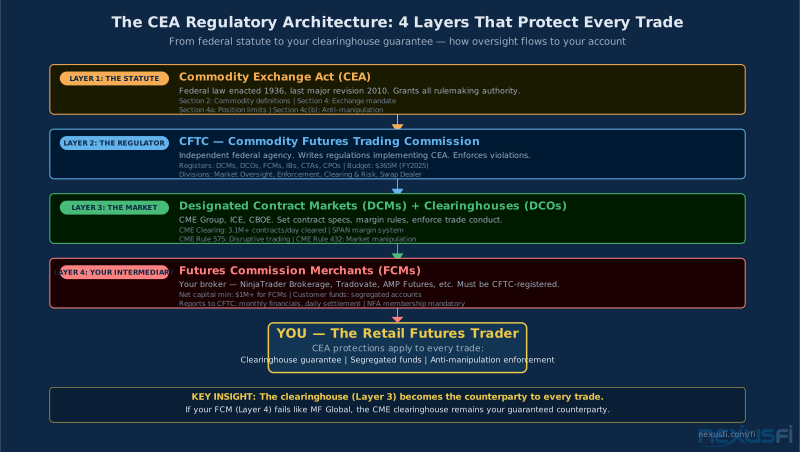
Everything else — CFTC regulations, CME rulebooks, NFA compliance rules, FCM net capital requirements — derives from CEA authority. The statute is the tree. All the rules and regulations hanging off it are branches.
When you wire money to a futures broker, the CEA is the reason that money has to sit in a segregated account your broker can't touch for operating expenses. When you execute an ES trade on CME, the CEA is the reason a clearinghouse — not your broker — becomes your counterparty. You feel the CEA every trading day. Most traders just don't recognize it.
90 Years of Legislative Evolution #
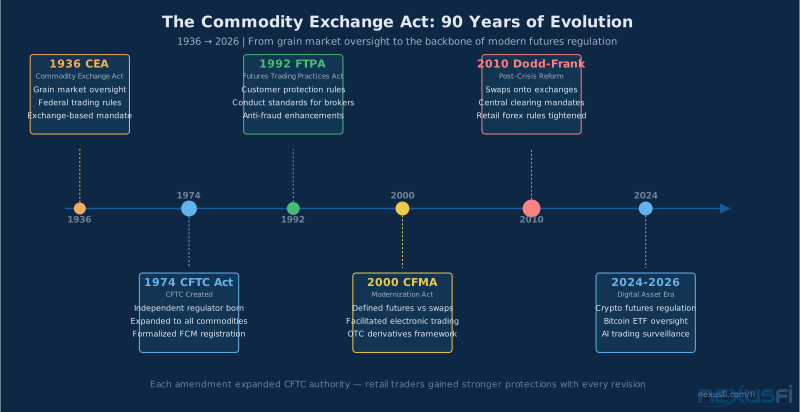
The CEA didn't arrive fully formed. It's been amended five major times, and each revision tells a story about what broke in markets and what Congress decided to fix.
1936: The Original Act
The 1936 CEA emerged from the regulatory chaos of the early commodity markets. Price manipulation, bucket shops, corner schemes — the grain markets of the 1920s and 1930s were genuinely lawless by modern standards. The original act created federal oversight of commodity trading by requiring that futures contracts in designated agricultural commodities trade on licensed boards of trade, and by establishing conduct standards for futures market participants.
The 1936 framework was narrow by design. It covered agricultural commodities — corn, wheat, soybeans, cattle. Financial futures didn't exist yet. But the architecture the 1936 act established — exchange-based trading, federal oversight, anti-manipulation authority — is recognizable in every version of the law that followed.
1974: Creating the CFTC
By the early 1970s, financial futures were emerging alongside the old agricultural markets. Treasury bond futures launched at the CBOT in 1977. S&P 500 futures followed at the CME in 1982. The existing regulatory structure wasn't equipped for financial derivatives. Congress responded in 1974 with the CFTC Act, creating the Commodity Futures Trading Commission as an independent federal agency with consolidated authority over all commodity futures markets.
The 1974 creation of the CFTC matters to retail traders for one specific reason: it established a dedicated professional regulator with surveillance, investigation, and enforcement capabilities focused exclusively on futures markets. The CFTC isn't a side function of a bank regulator or securities regulator. It exists solely to oversee the markets you trade.
1992: Futures Trading Practices Act
The 1992 FTPA tightened customer protection standards and conduct rules for futures brokers. It enhanced the legal basis for anti-fraud enforcement and clarified the liability framework for brokers that mishandled customer funds or engaged in deceptive practices. For retail traders, the 1992 reforms meant more explicit rights and clearer recourse channels when brokers acted improperly.
2000: Commodity Futures Modernization Act
The CFMA was the most controversial major revision. It explicitly deregulated OTC derivatives — the swaps market that would later implode in 2008 — while preserving the exchange-traded futures framework for retail participants. The CFMA also clarified the jurisdictional boundary between futures (CFTC) and securities (SEC), which had been a persistent source of ambiguity.
From a retail trading perspective, the CFMA's practical effect was mostly positive: it codified which products were regulated exchange-traded futures and which were OTC instruments outside CEA protections. When your broker tells you that your exchange-traded futures have clearinghouse backing and OTC products don't, that distinction traces back to 2000.
2010: Dodd-Frank Wall Street Reform
The 2008 financial crisis proved exactly what the CFMA's OTC deregulation had made possible: $50+ trillion in uncleared credit default swaps, no central counterparty, systemic risk concentrated in a handful of dealers. Dodd-Frank responded by requiring major swap categories to trade on registered swap execution facilities and clear through central counterparties — extending the CEA's exchange-trading mandate to the swaps market.
Dodd-Frank also tightened retail forex rules, enhanced position reporting requirements, and expanded the CFTC's enforcement authority. See Dodd-Frank Act and Futures Trading for the full breakdown.
Section 2: What Counts as a Commodity #
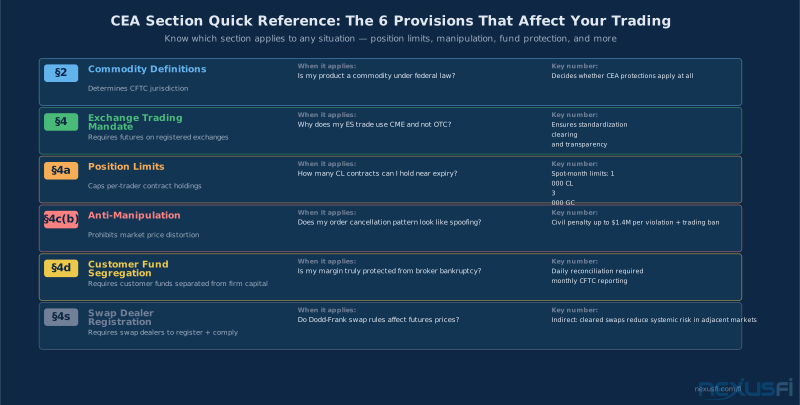
CEA Section 2 defines "commodity" — and that definition determines whether CFTC jurisdiction applies at all. Get this wrong and you're trading a product with different protections, a different regulator, and different enforcement mechanisms than you expect.
The CEA definition of commodity is intentionally broad. It includes agricultural products, metals, energy products, and financial instruments (interest rates, foreign currencies, equity indexes) to the extent they underlie futures or swaps contracts. The practical question for retail traders comes up most often with newer products:
- Bitcoin and Ether futures: CFTC-regulated as commodity futures (CME-listed). The underlying spot crypto is more ambiguous, but the futures products clearly fall under CEA.
- Single stock futures: Jointly regulated by CFTC and SEC as "security futures products." Different rules apply -- both CEA and securities law govern them.
- Event contracts on Kalshi: CFTC has jurisdiction over prediction market event contracts as commodity transactions. Kalshi operates under a DCM license.
- FX forwards: Generally not regulated as futures under CEA, but retail FX with leverage is subject to CEA through registered RFEDs.
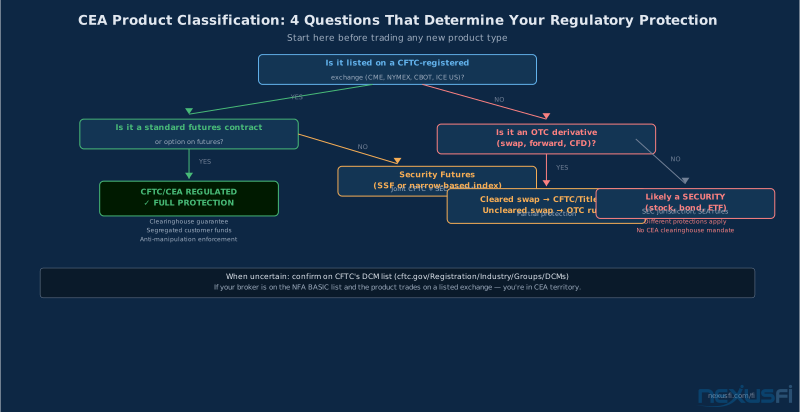
If you're ever unsure whether a product is CEA-regulated, the fastest check is whether it's traded on a CFTC-registered Designated Contract Market (DCM). CME, CBOT, NYMEX, ICE US, and Cboe Futures Exchange are all DCMs. If the exchange holding your contract is on the CFTC's DCM list, you're in CEA territory.
Section 4: The Exchange Trading Mandate #
CEA Section 4 is the foundation of everything that makes exchange-traded futures superior to OTC alternatives for retail participants. It requires that futures contracts in covered categories trade on or subject to the rules of a registered exchange. In practice, this means your ES trade isn't a bilateral agreement between you and your broker — it's an exchange-listed, clearinghouse-backed, standardized contract.
That mandate translates to four specific protections you don't get with OTC products:
Standardization. Contract specs — tick size, contract size, expiration dates — are defined by the exchange and can't be changed by your broker. When the ES tick is $12.50, it's $12.50 for everyone.
Central clearing. CME Clearing steps in as the central counterparty to every futures trade. You're not exposed to your broker's credit risk for the value of open positions. Your broker fails? CME Clearing still owes you the marked-to-market value of your positions.
See: Futures Broker Due Diligence Notes post PFG. The mechanics of how clearing works are in Futures Clearing and Settlement: What Actually Happens After You Click the Button.
Price transparency. Order books, settlement prices, and clearing prices are public. You can verify what you paid against the official settlement.
Daily mark-to-market. Gains and losses settle daily through variation margin. You can't accumulate unrealized losses that exceed your ability to pay. The daily settlement cycle keeps risk current across the entire market.
Section 4a: Position Limits -- Not Just for Institutions #
CEA Section 4a grants the CFTC authority to set position limits — caps on the number of contracts any trader or group of related traders can hold. The purpose is explicit in the statute: preventing excessive speculation and protecting market integrity from corner and squeeze attempts.
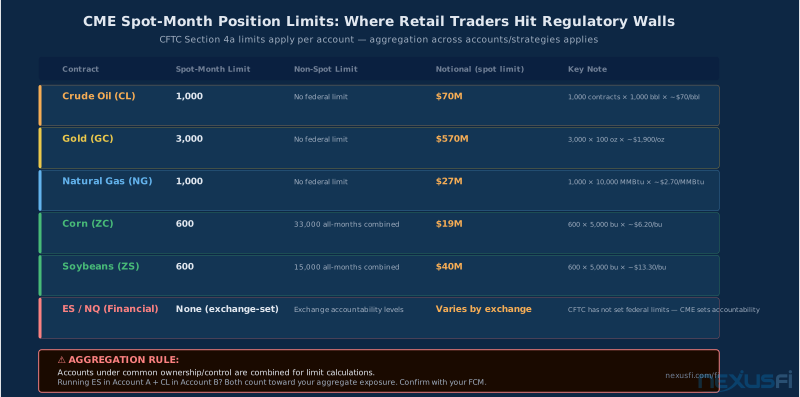
Here's what most retail traders don't know: federal position limits apply to you, not just to hedge funds and bank prop desks. The CFTC sets spot-month limits for physical delivery contracts like crude oil (CL), gold (GC), natural gas (NG), and agricultural commodities. For CL, the spot-month limit is 1,000 contracts — that's 1,000,000 barrels of crude oil, roughly $70M notional at $70/bbl.
For financial futures like ES and NQ, the CFTC has generally deferred to the exchanges rather than setting federal limits. CME uses an accountability level system instead of a hard cap — once you cross certain thresholds, the exchange contacts you for an explanation. For ES, that accountability level is 20,000 contracts. For NQ, it's 10,000.
The part that catches retail traders off guard is aggregation. @Schnook ran into exactly this issue trading a large CL position: "You're on the CFTC's radar... If I were in your position I would call your broker or clearing firm and speak to their compliance department." See: CFTC / Large Trader thread.
The aggregation rule means all accounts under common ownership or control are combined for position limit calculations. If you run multiple strategies across three accounts at different brokers, and they're all owned by the same LLC, those positions aggregate. The CFTC looks through entity structures to determine beneficial ownership. Full detail on how position limits and accountability levels work is in Position Limits, Accountability Levels, and Large Trader Reporting in Futures Markets.
Section 4c(b): Anti-Manipulation #
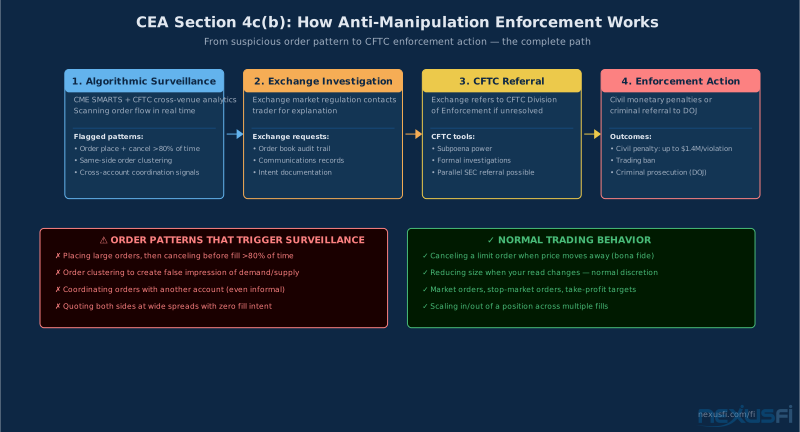
CEA Section 4c(b) is the CFTC's primary anti-manipulation statute. It broadly prohibits any scheme, attempt, or practice that manipulates or attempts to manipulate the price of any commodity in interstate commerce. The Dodd-Frank amendments in 2010 expanded this to cover attempted manipulation even without successful price impact — you don't have to succeed at manipulating the market to violate Section 4c(b).
For retail traders, the anti-manipulation provision matters in two ways.
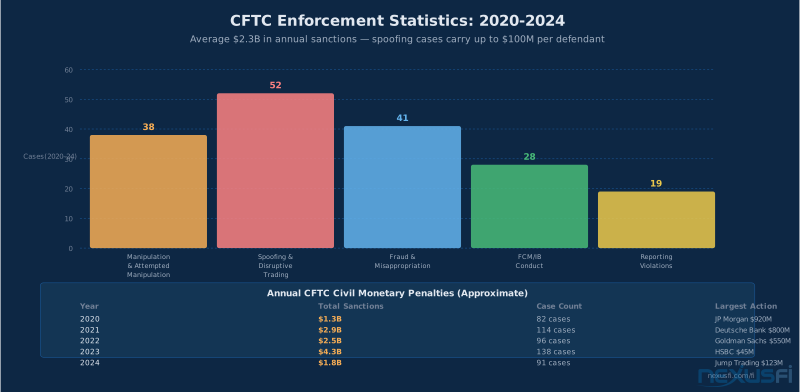
First, it's why the market you trade is (mostly) fair. The CFTC and exchanges use sophisticated surveillance systems — CME runs the SMARTS surveillance platform, which flags order flow patterns consistent with spoofing, layering, wash trading, and cross-market manipulation. The enforcement actions against firms like Navinder Singh Sarao (the "Flash Crash Trader") and multiple bank prop desks were built on these authorities. The specific tactics and enforcement history are covered in Spoofing and Layering in Futures Markets.
Second, it means your own order flow has to stay within conduct standards. The specific behaviors that reliably create problems:
- Placing orders with the intent to cancel before they can be filled (spoofing)
- Placing and canceling orders on both sides of the book to create false liquidity impressions (layering)
- Trading with yourself or coordinated accounts to create artificial volume or price movement (wash trading)
- Any coordinated conduct with other traders to influence prices through false market signals
Normal retail trading — canceling limit orders because your read changed, scaling positions, using stop orders — doesn't create CEA exposure. The distinguishing factor is intent to create a false impression in other market participants.
Section 4d: Your Money's Legal Protection #
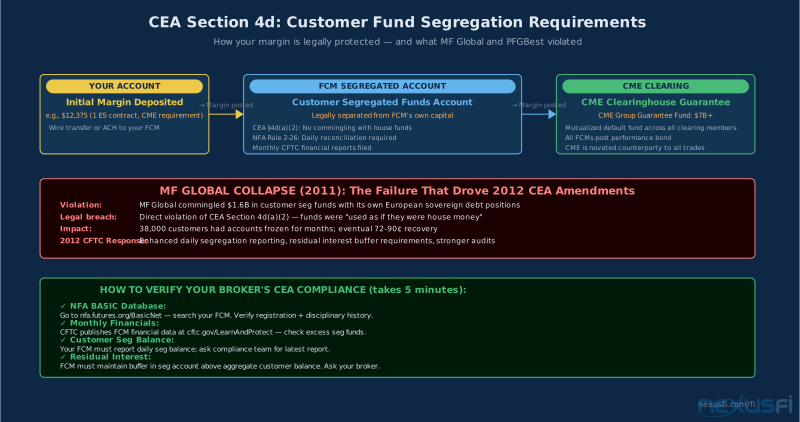
CEA Section 4d is the foundation of customer fund protection at futures brokers. It mandates that FCMs maintain customer funds — including margin deposits — in accounts that are clearly separated from the firm's own capital. This segregation requirement means your broker can't use your margin to fund its own operations, cover losses on proprietary positions, or collateralize the firm's borrowing.
FCMs file monthly financial reports with the CFTC and NFA showing their segregated fund balances and excess seg capital — these are public and searchable at cftc.gov. Section 4d also requires daily reconciliation: FCMs must calculate the total customer segregated fund requirement every day and verify they hold sufficient segregated assets. The financial metrics to watch are covered in FCM Net Capital Requirements and Financial Reporting: Your Early Warning System for Broker Health.
When CEA Protections Failed: MF Global and PFGBest #
Two broker collapses in consecutive years — MF Global in 2011 and PFGBest in 2012 — became the defining case studies for CEA Section 4d violations. Understanding what happened at both firms tells you exactly where the law's protection starts and ends.
MF Global (2011)
MF Global was the 8th-largest futures broker in the US when it collapsed in October 2011. The firm had made a $6.3B leveraged bet on European sovereign debt that went wrong as the European debt crisis deepened. As losses mounted, MF Global's executives authorized the use of customer segregated funds to cover the firm's obligations.
The final shortfall: approximately $1.6 billion in customer funds. The mechanism involved rehypothecation — MF Global's UK subsidiary operated under UK rules that allowed it to use customer assets as collateral for firm borrowing, and funds moved between US and UK entities in ways that obscured the true segregated balance from US regulators until the firm was already collapsing.
As members of the NexusFi community discussed extensively — see the Futures Broker Due Diligence Notes post PFG thread — the MF Global collapse exposed critical weaknesses: "The reason MF Global went down the toilet was because unlike the US, the UK had no limits in place on rehypothecation." The US CEA's segregation rules were the protection. The UK subsidiary was the hole.
Recovery for customers was eventually 72-90 cents on the dollar, but the process took years. Meanwhile, customers had accounts frozen for months during the resolution process. See the PFGBest Accounts Frozen thread for community discussion of how traders dealt with accounts frozen at the time.
PFGBest (2012)
PFGBest's collapse nine months later was more straightforward: Peregrine Financial Group's founder Russell Wasendorf Sr. had been forging bank statements for 20 years to show NFA that customer segregated funds existed when they didn't. The actual customer fund shortage was approximately $200 million. Wasendorf was sentenced to 50 years in federal prison — he had been directly violating CEA Section 4d since the 1990s.
The PFGBest fraud teaches the limits of regulatory oversight: the CEA creates the legal framework for fund segregation and establishes penalties for violations, but it can't prevent fraud by a sufficiently determined actor. The 2012 reforms added third-party bank balance confirmation requirements specifically to prevent this type of fraud from repeating.
The 2012 Reforms
In direct response to both failures, the CFTC adopted new regulations that strengthened Section 4d's implementation:
- Enhanced daily segregation reporting requirements
- Required FCMs to maintain a "residual interest" buffer above the minimum segregated requirement
- Improved third-party confirmation requirements for bank balances
- Expanded NFA examination procedures and electronic data sharing between FCMs and regulators
As the thread on U.S. customer protection rules noted at the time, these were new safeguards specifically designed to prevent the patterns that allowed both collapses. See: U.S. approves new rules to protect futures customers. The complete analysis of the segregated funds framework is in Customer Funds Segregation in Futures: How Your Money Is Protected and FCM Bankruptcy and Futures Trader Protection.
Verifying Your Broker's CEA Compliance #
Given the history, knowing how to verify your FCM's compliance status is practical risk management. The CEA creates public disclosure requirements specifically so retail traders can do this research.
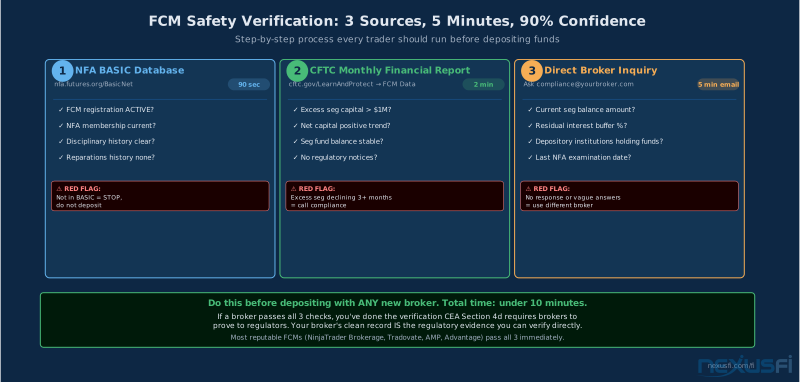
NFA BASIC Database. The NFA's Background Affiliation Status Information Center (BASIC) at nfa.futures.org/BasicNet allows any trader to look up the registration status and disciplinary history of any FCM, IB, CTA, or CPO. Every legitimate futures broker must appear in BASIC as a currently registered FCM. If your broker isn't there, stop trading with them immediately.
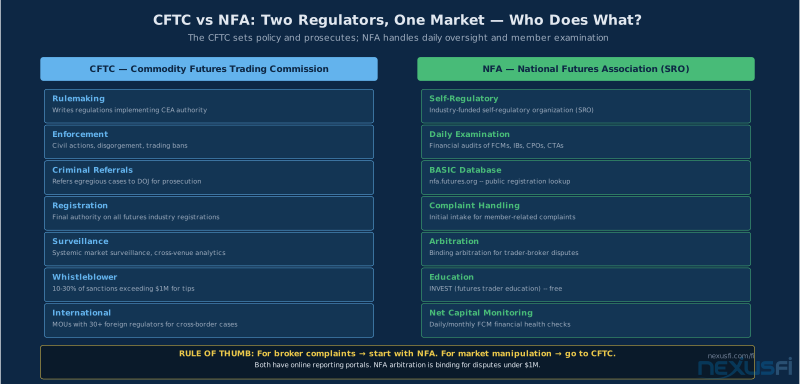
CFTC Financial Data. The CFTC publishes monthly financial data for all registered FCMs at cftc.gov/LearnAndProtect. This includes each FCM's customer segregated fund balance, excess seg capital, and net capital. A healthy FCM maintains significant excess seg capital as a buffer. Declining excess seg over multiple months is a red flag worth a call to your broker's compliance department. For a complete framework on reading these numbers, see Evaluating Futures Broker Financial Health.
Filing complaints. If you believe your broker has violated CEA rules, the NFA handles complaints for broker conduct issues.
See: How to file a complaint against a broker. The CFTC's whistleblower program pays 10-30% of sanctions exceeding $1M — full details at CFTC Whistleblower Program.
For a complete due diligence checklist, see Futures Broker Due Diligence: A Practical Verification Guide Before You Deposit.
CEA vs. Securities Exchange Act #
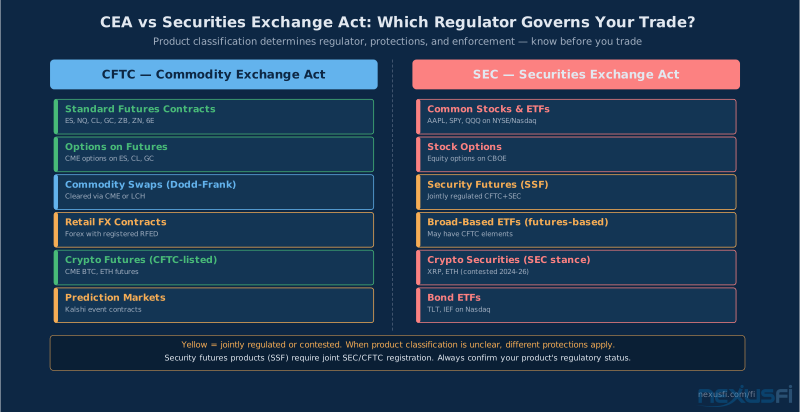
The CEA governs commodity derivatives. The Securities Exchange Act of 1934 governs securities. In practice, most futures traders operate entirely in CEA territory and never need to think about this. But the boundary matters when you trade products that sit in the gray zone. The full comparison is at SEC vs. CFTC: The Regulatory Divide That Shapes Every Futures Trade You Make.
The gray zone products worth knowing:
Security futures (SSF). Single stock futures and narrow-based stock index futures are "security futures products" under a specific provision of the CEA inserted by CFMA in 2000. They're jointly regulated by CFTC and SEC — the regulatory complexity contributed to relatively thin volume compared to broad-based index futures.
Crypto assets. Bitcoin futures (CFTC), Ethereum futures (CFTC), but the underlying spot tokens? Genuinely contested. The SEC has argued many crypto tokens are unregistered securities. The CFTC has argued Bitcoin and Ether are commodities. Spot Bitcoin ETFs received SEC approval in 2024 and trade under SEC jurisdiction, while CME Bitcoin futures remain CFTC-regulated. Same underlying asset, two different regulatory regimes for different products.
Commodity-linked ETFs. An ETF that holds oil futures (like USO) is a securities product under SEC jurisdiction, even though it derives its value from commodity futures prices. The futures inside the ETF are CFTC-regulated, but the ETF wrapper itself is regulated under the Investment Company Act.
The practical implication: before you trade any product that isn't a standard exchange-traded futures contract on CME, NYMEX, CBOT, or ICE US, confirm which regulator governs it. Exchange-traded futures backed by CEA's clearinghouse mandate are a specific risk/protection profile. OTC products, securities derivatives, and commodity-linked ETFs are different buckets entirely.
Dodd-Frank's Long Tail for Futures Traders #
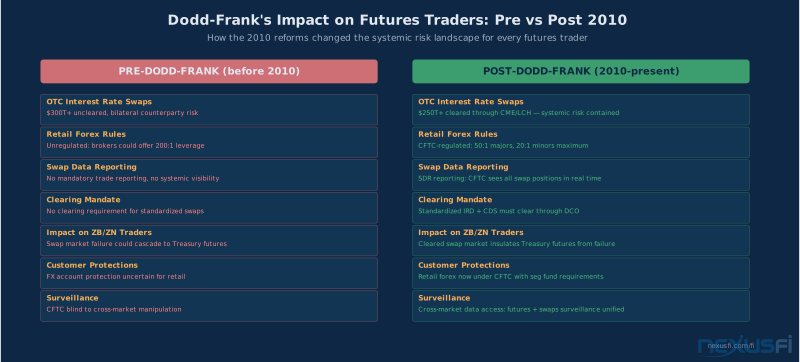
Dodd-Frank is most famous for its impact on banks and the swaps market. But its effects ripple into futures markets in ways retail traders often don't recognize.
The most direct retail effect is in forex. Dodd-Frank imposed leverage limits on retail foreign currency transactions — maximum 50:1 for major pairs, 20:1 for minors. It also required registration of Retail Foreign Exchange Dealers (RFEDs) and created clearer customer protection rules for FX accounts. Before Dodd-Frank, retail forex operated in a much more lightly regulated environment, which contributed to some spectacular retail forex broker failures.
The indirect effects are more diffuse but important. Swap clearing mandates moved significant portions of the interest rate and credit default swap markets into central clearing through CME Clearing, LCH, and ICE. This reduced systemic risk in the instruments most correlated to Treasury futures and corporate bond futures. If you trade ZB, ZN, or ZF futures, the health of the cleared interest rate swap market is a background variable in how those markets behave during stress events.
What This Means for Your Trading in 2025/2026 #
The CEA's evolution is ongoing. Three areas are actively developing:
Digital asset regulation. The regulatory battle over which digital assets are CFTC commodities versus SEC securities is unresolved. CME Bitcoin and Ethereum futures trade cleanly under CFTC jurisdiction. Spot crypto remains in contested territory. The FIT21 Act (Financial Innovation and Technology for the 21st Century Act) passed the House in 2024 and, if enacted, would create a clearer framework for when digital assets become CFTC commodities versus SEC securities.
Prediction market expansion. Kalshi's successful court battles against CFTC restrictions in 2024 opened the door for CEA-regulated event contracts on elections and other political outcomes. If you trade Kalshi event contracts, you're in CEA territory — your funds are regulated under CFTC rules, and the platform operates as a registered DCM.
AI trading surveillance. CFTC's Division of Market Oversight has much invested in machine learning-based surveillance that can detect complex cross-market manipulation patterns that manual systems miss. The surveillance net is broader and more sophisticated than it was five years ago. If your trading strategy relies on patterns that could be misread as manipulative, understanding the surveillance framework helps you manage that risk proactively.
For practical day-to-day purposes, the CEA impacts your trading through five touchpoints:
- Your FCM's registration status: Only trade with a CFTC-registered FCM. Verify in NFA BASIC before funding. See Futures Broker Due Diligence.
- Segregated fund health: Check your FCM's monthly CFTC financial reports at least quarterly. Excess seg capital trending down is worth investigating.
- Position limit awareness: If you trade commodity futures at significant size, know the spot-month limits and understand how your accounts aggregate. See Futures Position Limits.
- Product classification: Before trading any new product, confirm whether it's a CEA-regulated exchange-traded future or something else.
- Order flow conduct: Understand what patterns trigger surveillance flags. Treat order book behavior as regulated conduct, not just strategy mechanics.
The CEA's Bottom Line #
The Commodity Exchange Act is 90 years old and still doing its job. The clearinghouse guarantee, the segregated funds requirement, the anti-manipulation enforcement framework — these aren't theoretical protections. They're the infrastructure layer that makes it possible to trade futures with the counterparty confidence that leveraged contracts require.
The law isn't perfect. MF Global demonstrated that segregation requirements, however clearly written, can be violated by executives willing to break the rules. PFGBest showed that regulatory examinations can miss fraud carried out with sufficient sophistication. The 2012 reforms addressed those specific failure modes, but no statute eliminates execution risk entirely.
What the CEA does is set the floor. Exchange-traded futures on CFTC-registered markets, cleared through regulated clearinghouses, held at registered FCMs with public financial disclosures — that's the protection package the CEA creates. Understand what's in the package, check periodically that your broker is operating inside it, and you've done what retail traders can reasonably do to manage institutional risk in their trading infrastructure.
The rest is about making good trades.
Knowledge Map
Go Deeper
Build on this knowledgeReferences This Article
Articles that build on this topicCitations
- — Futures Broker Due Diligence Notes post PFG (2012) 👍 1“Any privately owned broker is a game of Russian roulette. You place your funds and hope you don't wake up one morning look at the news and find you have fallen victim to another MF Global or PFG Best. The exchange clearing structure is your actual backstop.”
- — Futures Broker Due Diligence Notes post PFG (2012) 👍 3“The reason MF Global went down the toilet was because unlike the US, the UK had no limits in place on rehypothecation of client funds. They sent client funds over to the UK and used them. That is why nobody went to jail -- it was legal in the UK.”
- — PFGBest Accounts Frozen (PFG scandal big thread) (2012) 👍 2“PFGBEST is in communication with regulators and exchanges to assist in any way with solutions for customers. The total amount of funds currently allocated is less than expected -- NFA is conducting an emergency inspection.”
- — U.S. approves new rules to protect futures customers (2012) 👍 1“U.S. futures regulators approved new regulations to shore up protection of brokerage customer funds following last year's collapse of MF Global. The Commodity Futures Trading Commission adopted rules implementing section 4d(a)(2) of the Act, and adopted part 22 to implement section 4d(f).”
- — How to file a complaint against a broker (2020) 👍 14“How to file a complaint against a futures broker: You can lookup the firms NFA Broker ID from within the complaint form. It will also ask for any details about your issue.”
- — CFTC / Large Trader (2020) 👍 10“You are apparently a big boy now. Congratulations. You're on the CFTC's radar. If I were in your position I would call your broker or clearing firm and speak to their compliance department.”
- — What's this confusion with margins? (2021) 👍 8“CME margin rules at all. Brokers can set margins wherever they like. Many set margins at around $500 or even $400 for contracts like the ES. What matters is when the exchange sets the close and open of the trading day.”
- CFTC — Commodity Exchange Act - Official CFTC Text (2024)
- NFA — NFA BASIC Database - Broker Registration Lookup (2025)