



CFTC Registration for Prop Firms: What Voluntary Regulation Actually Changes for Funded Traders
Overview #
Something shifted in 2025 that most traders missed. Three of the largest US-based funded evaluation firms — Apex Trader Funding, Topstep, and at least one other major player — began voluntarily moving inside the CFTC regulatory perimeter. Not because they were forced to. Because the regulatory climate after the My Forex Fund case made staying outside increasingly risky, and because legitimacy has become a competitive advantage in a market where traders have watched firms collapse without warning.
That's a meaningful change. But traders need to understand precisely what it means — and more importantly, what it doesn't mean — before making decisions based on "CFTC-registered" as a quality signal.
The short version: CFTC registration improves transparency, creates formal complaint channels, and constrains how firms can market themselves. It does not guarantee your payouts, lower your fees, reduce trading restrictions, or transform your contractual profit-share into a customer-protected brokerage account. The business model stays the same. The accountability layer gets thicker.
This article covers the regulatory shift in plain terms. What pushed firms toward registration. What the CFTC classification framework actually looks like. What changes for traders in a registered environment. And the due diligence checklist that matters regardless of where the firm sits in the regulatory spectrum. For the legal foundation — why most firms were unregistered in the first place — see Prop Firm Regulatory Status.
CFTC oversight primarily delivers transparency and accountability — not better economics. Traders who expect registration to mean "guaranteed payouts" or "customer-level protections" will be disappointed. Treat it as one credibility signal among many.
Why Firms Are Registering Now #
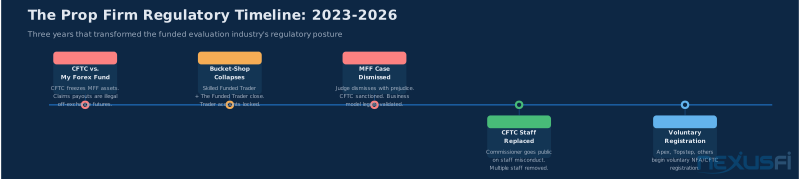
The timing isn't accidental. Three forces collided in 2024-2025 that made voluntary registration an attractive move for firms serious about longevity.
The MFF dismissal signaled CFTC overreach. The My Forex Fund case, dismissed with prejudice in 2025 after the judge sanctioned the CFTC for withholding exculpatory evidence, clarified something critical: the CFTC had tried to classify funded trader payouts as "illegal off-exchange futures." If that precedent had stuck, the entire evaluation-based prop firm model would have been under existential threat. The dismissal validated the business model — but it also showed that regulatory attention was intensifying. Getting ahead of that attention became strategically smart.
The 2024 collapses demonstrated existential risk. Skilled Funded Trader and The Funded Trader both collapsed in March 2024, locking accounts and denying payouts without notice. @Binkius explained the mechanism clearly on NexusFi:
The collapses damaged the reputation of the entire funded evaluation industry. Firms with legitimate FCM-routed live accounts needed a way to differentiate themselves from the bucket shops. CFTC registration is one such differentiator.
Legitimacy became a competitive advantage. As the prop firm market matured, traders got more sophisticated. NexusFi forum discussions show an increasing number of traders asking about firm registration status before signing up. Firms that can say "we're CFTC-registered" gain an edge with risk-aware traders who've watched competitors collapse.
What the MFF Case Actually Settled #
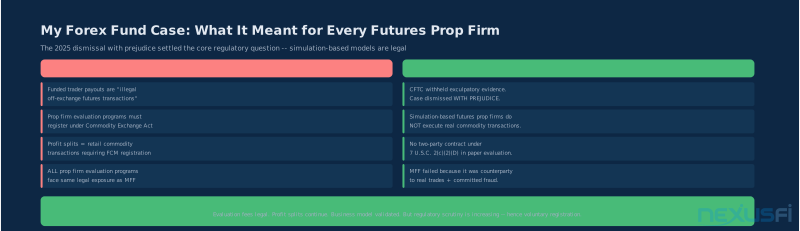
@Liberty88, who read the actual court documents carefully, summarized what the CFTC alleged:
The CFTC's theory was aggressive: it tried to classify funded trader payouts as illegal off-exchange futures transactions. @jlabtrades analyzed the legal structure and identified why that theory failed for simulation-based firms:
The critical factor was counterparty status. MFF acted as the actual counterparty to trades, executed real leveraged commodity transactions, and deceived customers about it. Simulation-based evaluation firms don't execute real exchange contracts during evaluations — there's no counterparty transaction under 7 U.S.C. 2(c)(2)(D). As Fi summarized in the NexusFi thread:
What CFTC Registration Means #
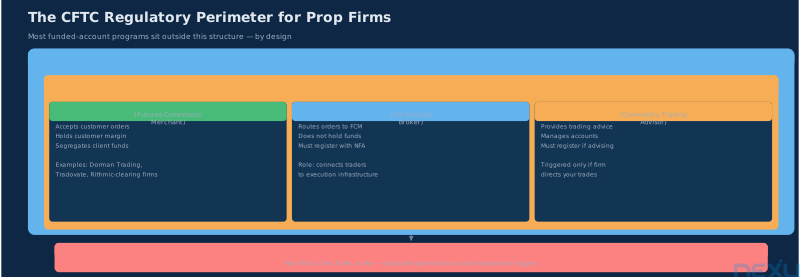
CFTC registration isn't a single thing — it's a category system with different obligations attached to each classification.
Futures Commission Merchant (FCM) — An FCM accepts customer orders for futures and holds customer margin. Every broker you use to trade futures is an FCM. FCM obligations are significant: segregated customer funds, minimum net capital requirements, regular financial reporting, NFA membership, and audit requirements. If a prop firm registers as or through an FCM, your live funded account trades get full FCM-level protections on the execution side.
Introducing Broker (IB) — An IB routes orders to an FCM but doesn't hold customer funds. IBs must register with the NFA and meet capital requirements. If a prop firm registers as an IB, it formalizes its regulatory relationship with the FCM it uses for live account execution — making the connection transparent and verifiable.
Commodity Trading Advisor (CTA) — A CTA advises others on commodity trading or exercises discretion over customer accounts for compensation. Most evaluation programs don't trigger CTA registration because they don't tell you what to trade. The evaluation rules (max contracts, no news trading) aren't trading advice. If a firm starts offering specific trade recommendations or managed accounts, CTA registration becomes relevant.
Most firms registering voluntarily are doing so primarily through IB relationships and NFA membership — formalizing the connection between their evaluation program and the regulated FCM that clears live funded trades. A firm with IB registration has specific compliance obligations to the NFA; a firm that merely discloses an FCM relationship without formal registration doesn't.
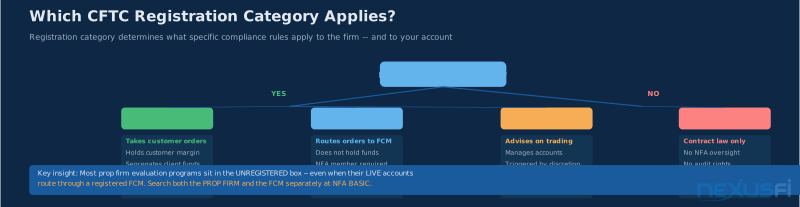
"CFTC-registered" does not mean the prop firm itself is registered as a CPO, CTA, or FCM. A firm can claim CFTC affiliation because its live-funded trades route through a registered FCM. Verify the firm's own registration status at NFA BASIC (nfa.futures.org/basicnet) — not just the FCM's status.
What Actually Changes for Traders #
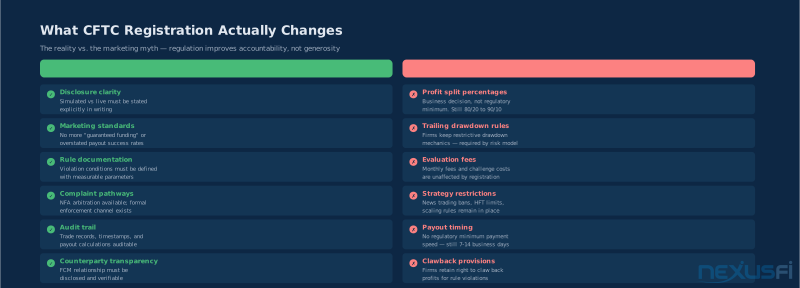
Six things genuinely change when a prop firm moves inside the regulatory perimeter:
1. Disclosure requirements become enforceable. A registered firm must clearly disclose whether trading is simulated or live, who holds the account, and how payouts are calculated. This becomes part of the firm's compliance record, subject to NFA examination. The gap between "funded account" marketing language and the legal reality of a simulated profit-share gets much harder to maintain when regulators review disclosures.
2. Marketing claims get constrained. Anti-fraud rules apply to registered entities' communications. Overstated payout reliability, misleading success rate statistics, and "guaranteed funding" language all become legally untenable. Much of the prop firm industry's customer acquisition runs through aggressive marketing that overstates outcomes. A registered firm has real exposure for misleading claims.
3. Rule documentation becomes standardized. Registered firms must document how rules are applied, maintain records of trader agreements and account histories, and create auditable trails for violation determinations. The most common prop firm complaints involve arbitrary rule enforcement — payouts denied for violations that weren't clearly defined or were applied inconsistently. An auditable record makes arbitrary enforcement harder to sustain.
4. Formal complaint pathways open. Traders at unregistered firms have limited recourse: arbitration under the firm's own contract terms (usually favorable to the firm), civil litigation, or credit card chargebacks. Registered firms are subject to NFA arbitration, which is more accessible than court for individual claims.
5. Counterparty transparency improves. The FCM relationship becomes formally disclosed and verifiable, not just mentioned in a marketing FAQ. Traders can independently verify the named FCM is CFTC-registered. This prevents the synthetic account problem where a firm claims live execution but routes nothing to an exchange.
6. What stays the same: Profit split percentages (no regulatory minimum). Trailing drawdown rules (part of the risk model, not regulatory arbitrage). Evaluation fees and reset costs. Strategy restrictions on news trading, HFT, scaling. Payout timing (no regulatory minimum payment speed). Clawback provisions. Your legal status as a contractor, not a customer with segregated funds.
The Account-Type Spectrum #
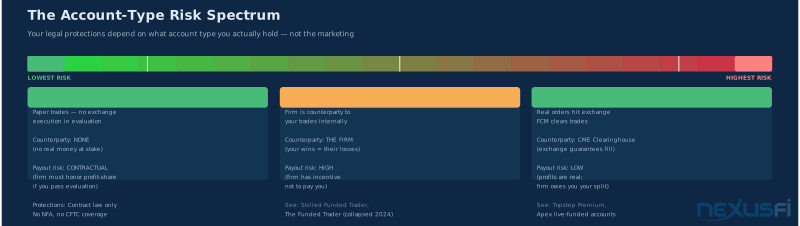
Regardless of regulatory status, the most important risk variable is your account type. There's a spectrum from simulated through synthetic to live exchange-routed, and each has materially different implications.
Simulated evaluation accounts are paper trading environments. Orders are generated in the platform with real-time prices, but no contracts execute on an exchange. There's no counterparty because there's no real transaction. Risk in evaluation accounts is purely contractual: will the firm honor its agreement to grant you a funded status if you pass?
Synthetic funded accounts are where counterparty risk becomes acute. In this model, the firm takes the other side of your trades internally. @josh explained the fundamental problem:
Synthetic accounts create a structural conflict: your profits are the firm's losses. When a cluster of traders profits on the same instrument move — a Bitcoin spike, a gold run — the firm's internal book gets hit from every direction simultaneously. That's how Skilled Funded Trader and The Funded Trader collapsed in 2024.
@MarketMage, drawing on backoffice experience at MT4 bucket shops, described the theoretical business model that separates legitimate prop firms from pure bucket shops:
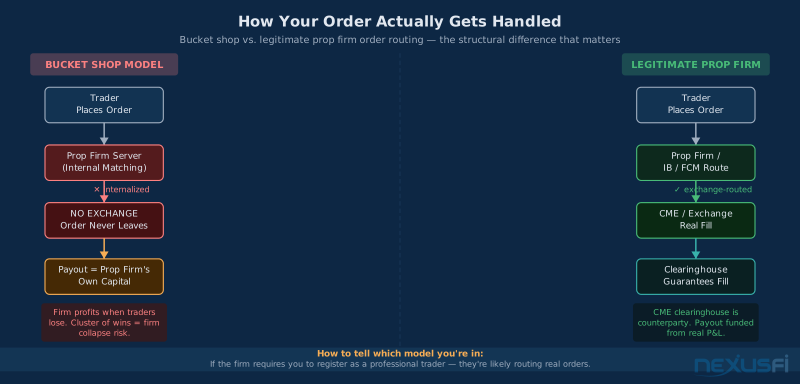
Live FCM-routed funded accounts are the gold standard. When you're in a Topstep Premium account or an Apex live funded account, orders route through a registered FCM to the exchange. The CME clearinghouse becomes the counterparty — your fill is guaranteed by exchange margin mechanisms, not by the prop firm's solvency. The practical test: are you required to register as a professional trader with the exchange? If not, your orders may not actually be hitting the exchange.
Registered vs. Unregistered: The Practical Tradeoff #
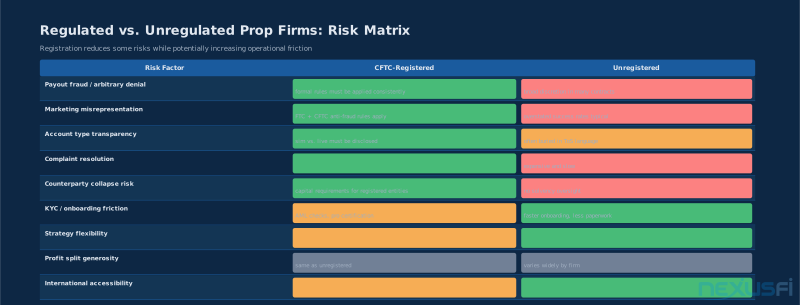
The regulated-versus-unregistered decision isn't uniformly better one way. Different traders with different priorities will land in different places.
Registration is unambiguously better for risk-averse traders — formal complaint pathways, auditable rule enforcement, marketing constraints that reduce misleading claims all reduce the probability of outcomes that have damaged traders at unregistered firms.
Registration may be worse for high-frequency or news-sensitive traders. Registered firms facing compliance obligations tend toward more conservative operational postures — stricter KYC/AML documentation, more rigorous professional certification requirements, and tighter strategy restrictions.
The counterparty collapse risk reduction is real. Registered firms face capital requirements and supervisory oversight that make sudden collapses harder to execute. The 2024 collapses involved unregistered firms running models that regulators would have flagged.
Unregistered firms with clean track records remain legitimate options. A firm that has paid traders consistently for three to five years, uses a named registered FCM for live execution, and has verifiable presence in a jurisdiction with meaningful contract law is a legitimate option regardless of registration status.
Treat registration as a risk reduction signal, not a quality certification. A registered firm with 80/20 splits and tight drawdown rules is still a worse deal than an unregistered firm with 90/10 splits, live FCM execution, and a five-year payout track record — if the latter firm's contractual terms are clearly documented and consistently applied.
How to Verify Any Firm's Regulatory Status #
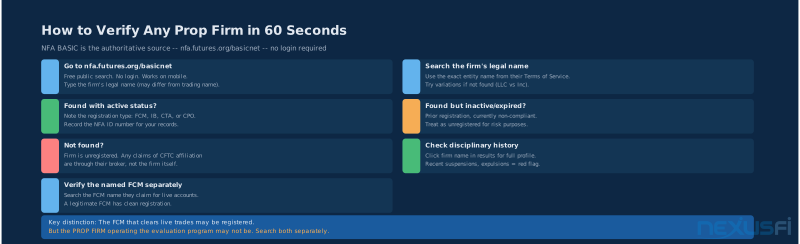
Claims are cheap. Verification is free. Here's how to check any prop firm's actual regulatory status.
NFA BASIC Search (nfa.futures.org/basicnet) — Lists every CFTC-registered entity by firm name. Search for the prop firm's legal entity name (which may differ from the trading name). If the firm appears with a current registration status in the IB, CTA, FCM, or CPO category, that's verifiable registration. If it doesn't appear, it's not registered — regardless of what the marketing says.
FCM Verification — If the firm claims a specific FCM for live account clearing, verify that FCM separately at NFA BASIC. A legitimate FCM will show current registration, financial statements, and any disciplinary history.
What to Do with Unclear Results — If a firm claims registration but doesn't appear in NFA BASIC, ask them directly for their NFA registration number. A registered firm will have one and will provide it readily. Resistance or vague answers about "regulatory compliance" without a specific registration number are red flags.
@Binkius offered the most practical on-the-ground test — one that doesn't require any paperwork or NFA lookup:
NFA BASIC is the definitive source. Not the firm's website, not its marketing materials, not its FAQ. If the firm is registered, it appears in NFA BASIC with a current status and a registration number. That check takes 30 seconds and cannot be faked.
The 10-Question Pre-Signup Checklist #
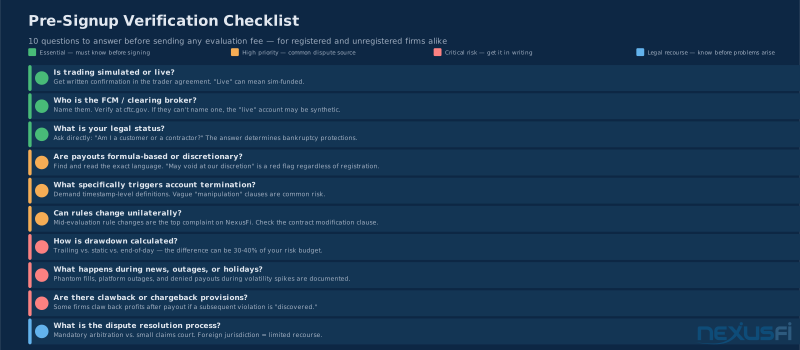
Whether the firm is registered or not, these ten questions determine your actual risk exposure.
1. Is trading simulated or live? Get written confirmation in the trader agreement. "Live sim," "SIM funded," and "paper funded" all mean different things.
2. Who is the FCM or clearing broker? Name a specific firm. Verify it exists in NFA BASIC. If the firm is evasive about naming a clearing partner, that's a hard stop.
3. What is your legal status? Ask explicitly: am I a customer with a segregated account, or a contractor in a profit-sharing arrangement? The answer determines your protection in bankruptcy.
4. Are payouts formula-based or discretionary? Language like "at our sole discretion" or "we may withhold payment for any reason" is a red flag regardless of registration status.
5. What specifically triggers account termination? Not "the drawdown rules" in general — the specific mechanism. Trailing drawdown that trails from intraday high vs. end-of-day close is a 30-40% difference in your effective risk budget.
6. Can rules change unilaterally? Contract modification clauses allowing rule changes with 24-48 hours notice mid-evaluation expose you to retroactive disadvantage. Know what you're agreeing to.
7. How is drawdown calculated? Trailing versus static versus end-of-day. Get the exact calculation method, not the marketing summary.
8. What happens during news releases, platform outages, or holidays? Ask specifically. Get written answers. Edge cases generate the most expensive surprises.
9. Are there clawback or chargeback provisions? Some firms include language allowing recovery of previously paid profits if a subsequent audit reveals a rule violation. Know if this clause exists before you earn profits.
10. What is the dispute resolution process? Mandatory arbitration in a foreign jurisdiction with the firm's preferred arbitrator is the worst-case scenario. Know your options before you need them.
What Smart Traders Do Now #
The regulatory shift in the prop firm industry is still in early stages. Most firms remain unregistered, most evaluation programs remain contractual arrangements outside the CFTC framework, and most of the risks that destroyed traders in 2024 still exist in unregistered environments.
Smart traders treat registration as a positive signal, not a sufficient one: verify at NFA BASIC before you fund, diversify across multiple firms rather than concentrating all funded trading in one account, request payouts promptly rather than accumulating unrealized gains in a funded account, track your own trade records independently, and check NexusFi forums for specific firm payout track records before committing. Consistent complaints over six to twelve months indicate financial stress that marketing won't reveal.
CFTC registration in the prop firm space is a net positive for the industry — it raises the floor on transparency, marketing honesty, and rule enforcement accountability. But it doesn't transform the fundamental business model. The contractual profit-share structure, the simulated-first evaluation process, and the absence of customer-level brokerage protections all remain. Treat registration as one credibility signal among many, verify it yourself, and apply the full due diligence checklist regardless of where the firm sits in the regulatory spectrum.
Knowledge Map
Prerequisites
Understand these firstGo Deeper
Build on this knowledgeReferences This Article
Articles that build on this topicCitations
- — Prop firm fraud in Futures? (on the back of My Forex Fund scam/CFTC ruling) (2025) 👍 1“The CFTC tried to classify funded trader payouts as 'illegal off-exchange futures.' If that precedent stood, every prop firm would've been shut down overnight. The dismissal means: Evaluation fees remain legal. Profit splits continue. Business model validated.”
- — Prop firm fraud in Futures? (on the back of My Forex Fund scam/CFTC ruling) (2023) 👍 6“This case is not only about forex. Both the Complaint and Statutory Restraining Order specifically and repeatedly include 'retail commodity transactions' as well. Traders Global also offered trades in Metals, Oil, Stock Indexes, and also Bitcoin and Ethereum.”
- — Prop firm fraud in Futures? (on the back of My Forex Fund scam/CFTC ruling) (2023) 👍 4“Do simulation-based future prop firms fall under those regulations? It appears the answer is NO, if you do not actually make the market for the trades and if you do not represent the trades as 'real.'”
- — Funded Trader platforms (2024) 👍 8“Skilled Funded Trader and The Funded Trader both just collapsed. Customer accounts locked, payouts denied. Looks like both were illegally using the bucket-shop model and not legally trading the actual instrument on their clients' behalf.”
- — Any long term success stories from funded traders in these get-funded programs? (2021) 👍 8“The funding company has every incentive to not pay you, and they do NOT have the capital in the event of a tail event to actually pay out. THEY are the counterparty.”
- — Any long term success stories from funded traders in these get-funded programs? (2021) 👍 5“You are correct about the prop firm BEING the counterparty. But in futures daytrading there are consistently enough profitable traders that as long as the prop firm has enough time for their algorithms to identify consistently profitable traders, they can mirror that trader's trades out to larger scaled 'master' accounts -- the prop firm still makes net profits and only pays out the much smaller profits from the trader's smaller account.”
- — Funded Trader platforms (2024) 👍 4“The easiest way to figure out what your online prop shop is doing is to fund with them. If they require you to register as a professional trader, they are probably trading your orders. If they let you coast along as a non-professional, they're probably bucket-shopping your orders.”