



EIA Energy Reports: Trading CL and NG Futures Around the Most Predictable Weekly Catalysts
Two reports. Two instruments. Same basic structure. Every week the EIA publishes the Petroleum Status Report on Wednesday at 10:30 AM ET and the Natural Gas Storage Report on Thursday at 10:30 AM ET — and for the hour surrounding each one, CL and NG become some of the most volatile, most directionally pure markets in futures trading. The rules for playing them are learnable. The risks are real and specific. This is a complete guide to both.
Two Reports, Two Instruments, One Weekly Rhythm #
The Energy Information Administration is the statistical agency of the U.S. Department of Energy. Its weekly storage and inventory reports are the most closely watched fundamental data releases in energy futures markets — not because they explain prices over months, but because they create measurable, recurring price events every single week. For a futures trader, that's rare. Most fundamental catalysts are one-offs — earnings, FOMC, NFP. The EIA reports are weekly and calendared, which means you can build a structured approach around them.
The two reports work differently and move different instruments:
- EIA Petroleum Status Report -- Released Wednesdays at 10:30 AM ET. Covers U.S. crude oil inventories, Cushing storage, domestic production, imports/exports, and refined product inventories (gasoline, distillates, jet fuel, propane). Primary market reaction: WTI crude oil (CL) and its micro (MCL). Secondary effects: refined product futures (RB gasoline, HO heating oil), energy equities.
- EIA Natural Gas Storage Report -- Released Thursdays at 10:30 AM ET. Covers U.S. working natural gas in underground storage, broken out by region and compared to the five-year average. Primary market reaction: Henry Hub natural gas (NG) and its micro (MNG). One-day lag from crude but structurally identical event risk profile.
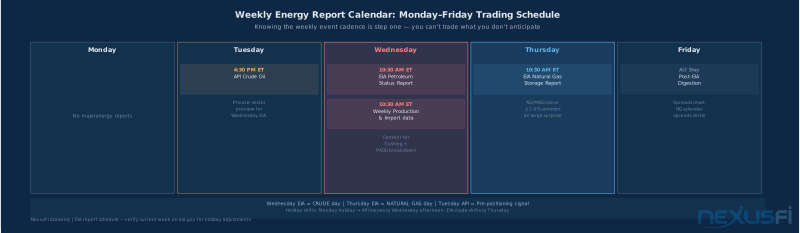
The EIA report calendar repeats every week. Tuesday API previews Wednesday crude; Thursday NG storage is the week's second volatility event. Holiday adjustments push API to Wednesday afternoon when Monday is a federal holiday.
He's not wrong. Technicals get suspended. Value areas lose their meaning. The five minutes before and after 10:30 AM are driven almost entirely by the number vs. consensus — and then by how the tape absorbs what the commercials and large operators do with that information.
The EIA Petroleum Status Report: Crude Oil Wednesday #
The Petroleum Status Report is published every Wednesday at eia.gov at exactly 10:30 AM ET. The full report covers multiple pages of data but the number that moves CL in the first 60 seconds is crude oil inventories — specifically, the week-over-week change measured in millions of barrels. The market immediately compares this to the consensus estimate (aggregated from surveyed analysts and traders) and trades the surprise.
The report data points, in order of market importance for CL traders:
- U.S. crude oil inventories -- Total change in barrels held in primary storage. Build (bearish vs. expected, unless already priced in) vs. draw (bullish vs. expected). Measured in millions of barrels (MMbbls). A 1 MMbbl surprise typically moves CL 20-40 ticks in the first minute.
- Cushing, Oklahoma stocks -- The physical delivery point for WTI futures. Cushing changes matter because they directly affect the logistics of the front-month contract. A big Cushing draw while total inventories build can narrow the spread between calendar months (contango compression).
- Crude oil production -- Weekly U.S. domestic output in millions of barrels per day. Usually moves markets slowly unless it shows a sharp unexpected shift.
- Gasoline inventories -- Important context. During summer driving season (May-September), gasoline draws get extra attention because they signal end demand is absorbing supply.
- Distillate inventories -- Diesel, heating oil, jet fuel. More relevant in winter and for HO/RB spread traders.
- Crude oil imports -- High import weeks can counteract or reinforce the domestic storage picture.
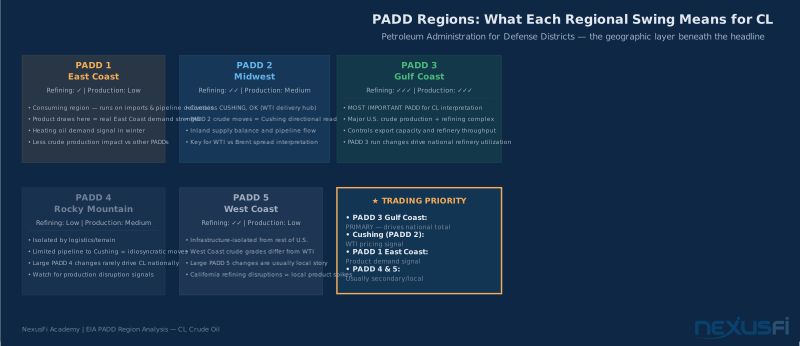
PADD 3 (Gulf Coast) is the epicenter -- it contains ~50% of US refining capacity and the largest crude storage region. PADD 2 (Midwest, where Cushing sits) is the futures delivery mechanism. The other PADDs matter for products but rarely move CL on their own.
The geographic breakdown uses Petroleum Administration for Defense Districts (PADDs) — five regional groupings that determine where storage sits and how crude flows. For CL traders, the two that matter most are PADD 3 (Gulf Coast, ~50% of U.S. refining capacity, largest storage volumes) and PADD 2 (Midwest, home of Cushing). When PADD 3 shows unexpected inventory swings, the effect on price is typically larger than equivalent moves in other regions. PADD 2 (Cushing specifically) directly affects the WTI forward curve.
Reading the Data: Cushing, PADDs, and the Number That Matters #
The headline number is crude oil inventories vs. consensus — but experienced CL traders know the Cushing print is often equally important, and sometimes more important than the headline.
Here's why Cushing matters specifically: WTI crude oil futures settle via physical delivery at Cushing, Oklahoma. When Cushing stocks draw, the front-month contract gets bid more aggressively than deferred months (backwardation pressure). When Cushing builds excessively, the front/back spread weakens and the overall price often follows. This is why a "mixed" report — crude headline build but Cushing draw — can still produce a bullish CL reaction. The market is trading the delivery dynamics, not just the aggregate supply picture.
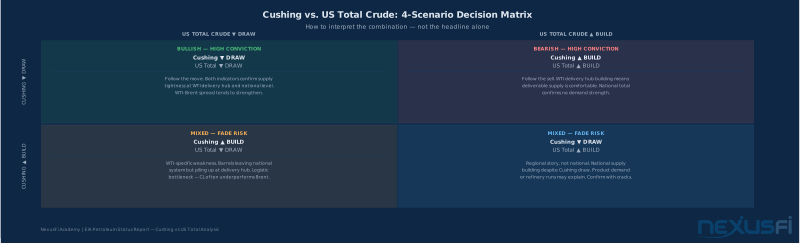
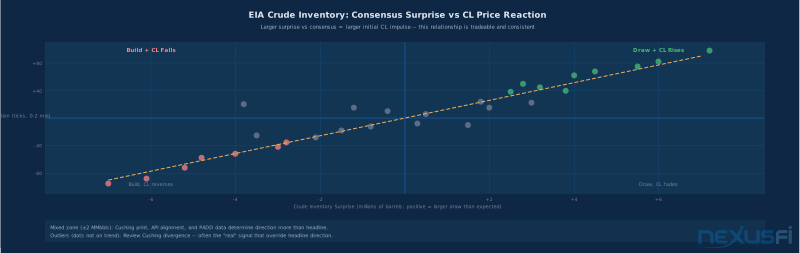
Cushing and total US crude don't always move together -- and that discrepancy is where the signal lives. When Cushing draws but total builds, you're often looking at a refinery throughput story, not a supply story. When both align with the tape's prior expectation, the move is more trustworthy.
The surprise vs. reaction relationship is tradeable and consistent: surprises beyond 3 MMbbls almost always produce follow-through in the first 2 minutes. The mixed zone (under 2 MMbbls either direction) is where Cushing data and PADD breakdown become the deciding signals.
The four-scenario matrix for reading the combined crude + Cushing data:
- Both draw more than expected -- High-conviction bullish. Initial impulse likely to follow through into Phase 2. The easiest trade environment.
- Both build more than expected -- High-conviction bearish. Same follow-through dynamics on the downside.
- Crude builds, Cushing draws -- Mixed. Market often reverses the initial impulse. Domestic crude is building but the delivery point is tightening -- crude is moving in but not reaching Cushing. Refinery throughput story. Wait for Phase 2 order flow.
- Crude draws, Cushing builds -- Mixed. Initial draw impulse may be faded. Crude is leaving the system but backing up at the delivery point. Logistical, not fundamental. Same caution applies.
Reading the products data adds another layer. During summer, gasoline draws alongside a crude build often produce a positive net reaction — the refinery is running hard to meet demand, which will ultimately draw crude inventories in subsequent weeks.
Traders who factor in the product draws read the petroleum report as a system, not a single number.
The API vs EIA Relationship: Previewing Wednesday with Tuesday's Print #
The American Petroleum Institute publishes its own weekly crude oil inventory report every Tuesday at 4:30 PM ET. The API report is industry-sourced (unlike EIA which uses government surveys) and is viewed as a rough preview of Wednesday's official number. The relationship between API and EIA is important for pre-positioning and for understanding how much surprise capacity is left in the official release.
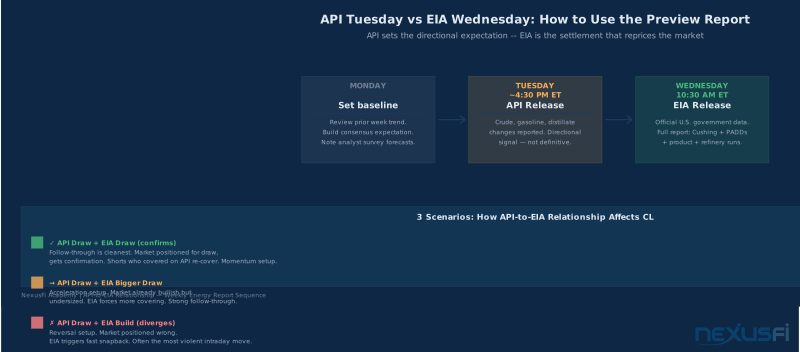
The API report (Tuesday 4:30 PM ET) is the private-sector preview. When it confirms the EIA Wednesday morning, market reaction is typically muted -- the trade already happened. When they diverge, Thursday and Friday become the correction window.
The three scenarios for API-to-EIA dynamics:
- API and EIA align (same direction, similar magnitude) -- Wednesday 10:30 reaction is muted. The surprise has already been priced on Tuesday. CL has usually already made a meaningful move. Chasing the EIA report when API already confirmed is a low-probability trade -- the market's reaction function is diminished.
- API and EIA align but EIA accelerates (same direction, EIA much larger) -- Acceleration trade. Price moves in the expected direction but with amplified velocity. High follow-through probability because the consensus has been reset toward the API signal but EIA exceeds it.
- API and EIA diverge (opposite directions or very different magnitude) -- Highest-probability trade setup. The market priced the API direction on Tuesday -- now EIA contradicts it. Forced covering or new-direction momentum. @mastadee described the tracking relationship: "Normally when API shows a build more than expected, EIA will also show a more than expected build." When they don't align, that divergence creates the cleanest EIA trade.
When API and EIA diverge in direction, the EIA Wednesday reaction often overshoots because both the Tuesday API traders and the Wednesday pre-position traders are caught on the wrong side simultaneously. This double-covering dynamic is why API-EIA divergence setups have the highest follow-through rate of the three scenarios.
Trading the Crude Oil Report: Three Phases, Three Skill Sets #
The EIA crude oil report produces a predictable reaction structure that repeats across most releases. Understanding which phase you're trying to trade is the most important strategic decision because each phase requires different skills, tolerates different position sizes, and fails in different ways.
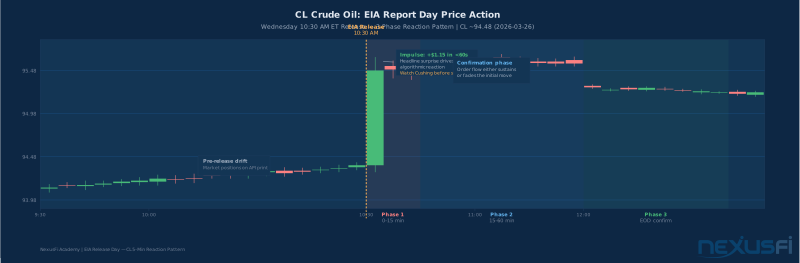
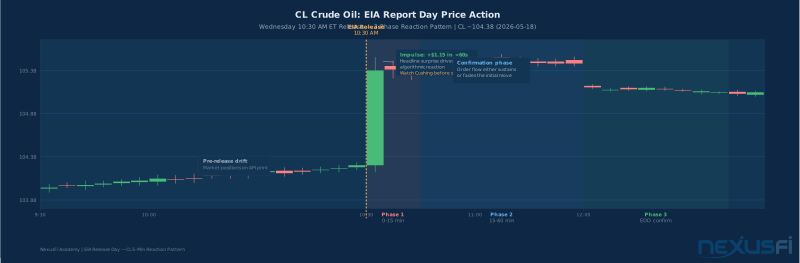
The classic EIA reaction in CL: a pre-report range compression, then the impulse at 10:30 AM ET, then 15-60 minutes of either confirmation or reversal. Phase 1 is the dangerous one -- initial impulse trades fail 40% of the time in the follow-through window.
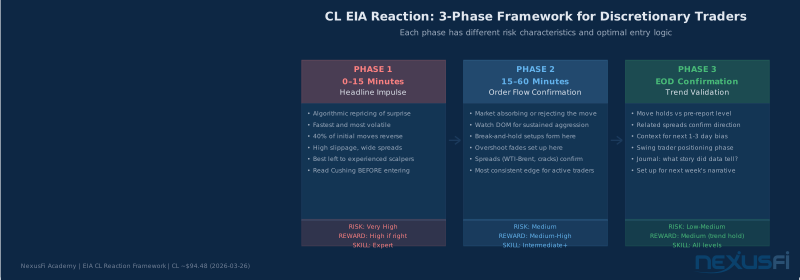
The three-phase framework determines which type of EIA trader you are. Phase 1 (0-2 min) requires speed and high tolerance for failure. Phase 2 (2-15 min) requires reading order flow for confirmation. Phase 3 (15+ min) is the swing trader's entry -- lower frequency, better R:R, still EIA-driven.
Phase 1: The Impulse (0:00 - 2:00 after release)
The market moves the moment the data hits the wire. CL will print 30-100+ ticks in the first 30 seconds on large surprises. Trading this phase requires co-location or direct market access, a pre-loaded trade plan for both scenarios (draw and build), and acceptance that you're trading against the commercial hedgers who already know what the number is.
Phase 1 is not for discretionary retail traders without significant infrastructure advantage. @mastadee's pre-release protocol: "When I'm in a trade just before the 10.30am EIA release, I normally scale back and only leave 1 or max. 2 lots on and wait for the data."
Phase 2: Order Flow Confirmation (2:00 - 15:00 after release)
After the initial impulse, price enters an order flow absorption period. This is where the money is for skilled CL discretionary traders. The question being answered: are the commercials confirming the initial direction or fading it? Read this through DOM and tape — look for large bid lifting on draws, large offer hitting on builds, sustained delta flow in the initial direction. When commercials confirm, Phase 2 produces high-quality follow-through trades. When they fade — aggressive selling into an initial bullish spike, for example — the reversal is fast and damaging to Phase 1 longs. Roughly 40% of initial impulses reverse much in Phase 2. @dctrade69's discipline applies: "On oil report days I am really only looking for one trade during RTH prior to the report and that needs to be close to the open."
Phase 3: Trend Establishment (15:00+ after release)
After Phase 2 settles, CL often establishes a directional trend for the remainder of the morning session. This is the swing trader's EIA entry — lower risk than Phase 1 and 2, but requires patience. Once the Wednesday range is established post-EIA, those extremes define the day's structure. A break of the post-EIA high with force signals an extended move; a rejection signals range containment.
The EIA Natural Gas Storage Report: Thursday's Volatility Event #
The EIA Natural Gas Storage Report is published every Thursday at 10:30 AM ET. Where the crude report covers a complex multi-variable system, the NG storage report is simpler: one number — the weekly change in natural gas working storage (in billion cubic feet, Bcf) — drives the reaction. The market compares this to consensus and trades the deviation.
The storage band puts the weekly EIA number in context. A 50 Bcf injection is bearish when storage is already 300 Bcf above the five-year average -- and neutral or bullish when storage is 200 Bcf below. Absolute storage level shapes the market's sensitivity to weekly deviations.
Natural gas storage works differently from crude oil storage. The storage system has a capacity ceiling (roughly 4,000 Bcf total working capacity) and an operational floor (roughly 500-700 Bcf, below which pipeline operations become unreliable). The market tracks where storage sits relative to the five-year average and year-ago levels, because these determine supply adequacy for the upcoming season.
The weather input is key — heating degree days (HDD) in winter and cooling degree days (CDD) in summer drive demand forecasts, which drive storage draw/inject expectations. Building a weather-adjusted consensus model gives you an edge over the published consensus numbers that most traders rely on.
Injection vs Withdrawal Season: Same Number, Opposite Meaning #
The single biggest mistake NG traders make when reading the storage report: treating the absolute number as directionally meaningful without applying seasonal context. The sign and size of a storage change means completely different things depending on the time of year.
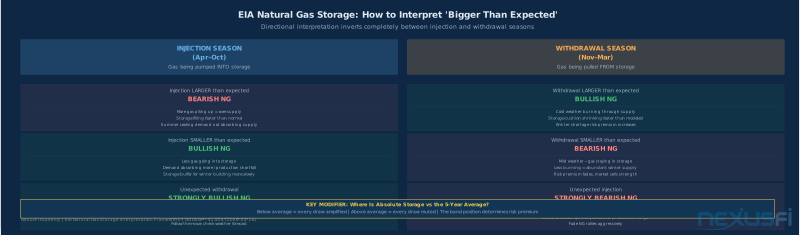
The NG storage number means nothing in isolation. A -50 Bcf withdrawal sounds bullish -- unless it's February and the five-year average is -110 Bcf. Context is injection vs withdrawal season, then the size relative to consensus, then the absolute level vs the five-year band.
The seasonal framework:
- Injection season (April-October): Storage should be building. The market expects positive weekly storage additions. A smaller-than-expected injection (+20 Bcf vs. expected +40 Bcf) is bullish -- demand exceeded supply and less gas made it into storage than expected. A larger-than-expected injection is bearish.
- Withdrawal season (November-March): Storage should be drawing. The market expects negative weekly changes. A smaller-than-expected withdrawal (-30 Bcf vs. expected -50 Bcf) is bearish -- demand was weaker than expected, meaning storage drew less than anticipated. A larger-than-expected withdrawal is bullish.
- Transition weeks (late March-April, late October-November): The five-year average is used as the benchmark. A net injection in a week when the market expects a small withdrawal can swing NG 15+ cents.
The five-year average context shapes how markets interpret absolute storage levels. If total working storage is 20% above the five-year average entering winter, a smaller-than-expected withdrawal is less bullish than it would be if storage is 10% below average — the abundance buffer reduces the urgency. The storage trajectory and absolute level provide the macro supply context; the weekly number provides the immediate trigger. To read NG properly, you need both.
Trading the NG Storage Report: Playing the Deviation #
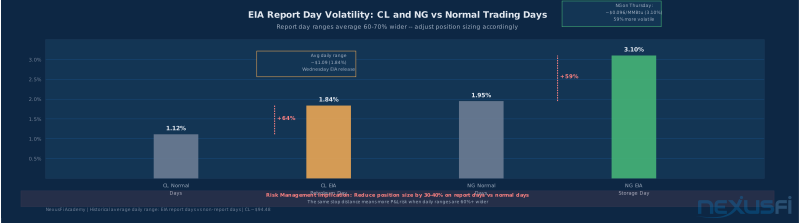
NG is more volatile than CL in percentage terms on report days — roughly 3.10% average daily range vs. 1.95% on normal days, a 59% increase. The contract is also thinner in depth-of-market than CL, which means slippage is higher and the impulse moves faster. The same three-phase structure applies but with different sizing discipline.
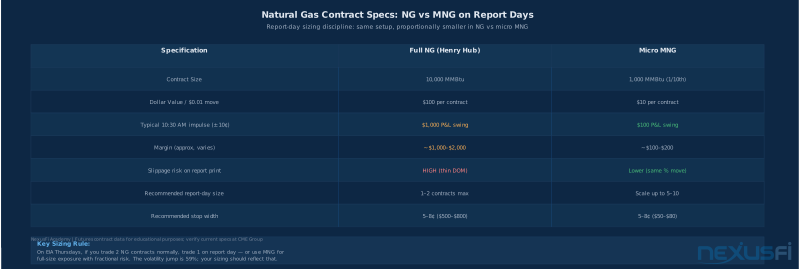
Same NG price move, one-tenth the capital risk with MNG. On EIA Thursdays, the micro contract lets traders participate with full market exposure at $10/cent rather than $100/cent per contract.
Key differences vs CL:
- The number is simpler: One Bcf vs. consensus, not a multi-variable matrix. The deviation is the trade. The larger the surprise vs. consensus, the larger the initial move.
- Thin liquidity amplifies velocity: NG front-month can move 10+ cents in the first 30 seconds on large surprises. At standard 10-cent moves, that's $1,000 per contract in 30 seconds. Micro NG (MNG) reduces this to $100/cent -- a meaningful difference for sizing.
- Phase 2 is shorter: NG tends to move faster and establish direction quicker than CL. Order flow confirmation happens in 5-10 minutes rather than 15.
- Weather forecasts matter for positioning into the report: Unlike crude where the API provides a Tuesday preview, NG traders pre-position based on updated weather models. A cold snap forecast revision two days before the Thursday report can pre-move NG 5-10 cents before the number releases.
The same principle applies to NG — clear before the release, re-engage after the impulse settles.
Spread Trades Around EIA: Reducing Directional Risk #
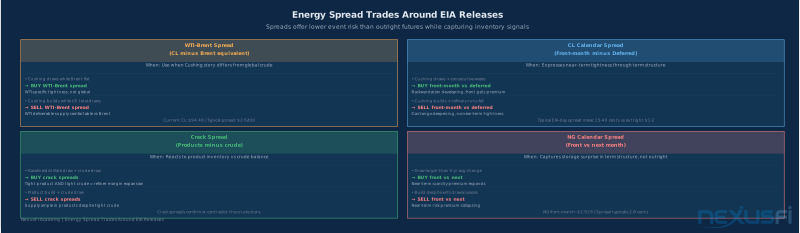
Spread trades reduce directional risk while still capturing EIA information. The crack spread (CL vs refined products) reflects refinery margin -- a big crude build with flat products means squeeze on margins; a gasoline draw means the refinery is running hard. Each spread tells a different part of the energy story.
Spread trades are the professional way to express EIA insights with reduced directional risk. Four energy spreads that respond to EIA data:
WTI-Brent spread (CL vs. BZ): Tracks the quality and logistics premium of Brent versus WTI. A large Cushing build without a corresponding PADD 3 build suggests pipeline constraints — WTI weakens relative to Brent. The spread narrows on domestic supply gluts and widens on Cushing draws.
CL calendar spread (front-month vs. deferred): The curve structure reflects storage economics. A large unexpected crude draw tends to compress backwardation or flip contango to backwardation — the front month rises faster than deferred months. A big build flattens or steepens contango.
Crack spread (3:2:1 — 3 CL, 2 RB gasoline, 1 HO heating oil): Measures refinery profitability. When EIA shows a crude build with flat product builds, refinery margins are getting squeezed. When EIA shows crude draws paired with gasoline draws, refinery throughput is high and margins widen.
NG calendar spread: Winter/summer NG spreads respond to storage trajectory more than the absolute weekly number. If storage is building faster than expected in injection season, the summer-to-winter spread tightens. If storage is drawing faster than expected in withdrawal season, winter spreads gain a premium.
Risk Management on Report Days #
EIA report days are structurally different risk environments. CL averages 1.84% daily range on report days vs 1.12% on normal days -- a 64% increase. NG shows similar expansion at 59%. Your position sizing and stop placement from a normal trading day will get you hurt on EIA Wednesday or NG Thursday.
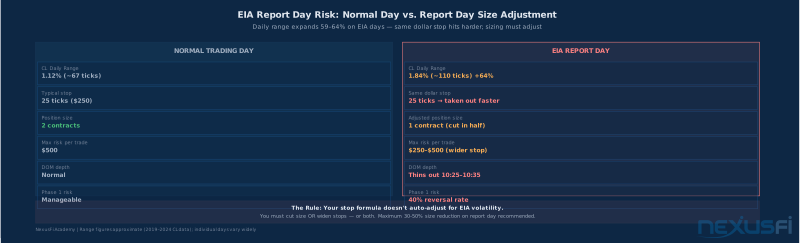
EIA report days require cutting size or widening stops -- or both. CL averages a 1.84% daily range on EIA Wednesdays vs 1.12% on non-report days. Your position sizing formula doesn't automatically adjust for this; you need to do it manually.
Specific risk adjustments for EIA report days:
- Position size reduction: Reduce size by 30-50% on EIA days if you're active in the 10:30 AM window. If you normally trade 2 CL contracts, trade 1 on EIA Wednesday. The same stop in dollar terms will be hit more easily when daily range is 64% wider.
- Pre-report positioning: Avoid carrying large existing positions into the report unless your edge is in knowing the pre-report setup. Most experienced CL traders trade the morning, take profits or cut positions ahead of 10:30, then re-engage post-report based on the number and tape reaction. @mastadee: "Best to wait for the release and then trade it."
- Stop placement adjustment: A 30-tick stop in CL might be adequate on a normal day but will be taken out by a typical Phase 1 reversal on EIA day. Tighter stops belong in Phase 1, where they're intentional -- you're out fast if wrong and re-assess immediately.
- Skip the report entirely: A valid strategy, especially for ES/NQ traders who don't want CL noise bleeding into their instrument. If you don't have an edge in reading EIA data, staying flat in the 10:25-10:40 window is a legitimate risk-management choice.
The EIA report is not a coin flip if you've done the homework. Understanding Cushing vs. total crude divergence, the API-EIA correlation, injection vs. withdrawal season context, and order flow confirmation gives you a structured edge on what looks like pure chaos to unprepared traders. The edge is in the preparation, not the reaction.
Bottom Line: Who Should Trade These Reports? #
EIA reports reward two types of traders: those who have done the work to understand what the number means (not just its sign, but its context — Cushing, PADD structure, seasonal mechanics, API preview), and those who are skilled enough at reading order flow to participate in Phase 2 after the number digests. Everyone else is just gambling on a coin flip with high volatility.
The reports are worth learning if:
- You already trade CL or NG as your primary instrument -- you need to manage your risk around these releases regardless, and learning to trade them gives you an edge on otherwise constrained Wednesdays and Thursdays
- You're interested in fundamental data integration -- the EIA reports are the most direct fundamental inputs available for energy markets at a weekly frequency
- You're a spread trader -- the EIA data creates multi-leg opportunities in crack spreads, calendar spreads, and WTI-Brent that are cleaner than outright directional bets
Skip the report if:
- You trade ES or NQ and have no CL exposure -- the EIA effect on equity indices is secondary and inconsistent
- You're still building basic CL trading skills -- learning to trade normal market conditions before adding report complexity is the right sequencing
- You lack access to real-time consensus estimates before the release -- trading the raw number without knowing what the market expected is guessing, not trading
The reports are weekly. They're not going anywhere. The edge in them compounds slowly — each week you track the data, compare it to price reaction, and build your model for what conditions produce follow-through versus reversal. After six months of watching these reports, you'll see patterns that no static article can fully convey. The learning is in the observation.
Knowledge Map
Prerequisites
Understand these firstCitations
- — The CL Crude-analysis Thread (2015) 👍 4“Every Wednesday morning at 10.30 am Crude Oil inventory report comes. Price reaction to the report is the ONLY thing which matters.”
- — The Scalper's Journey (2017) 👍 13“Just keep in mind, with these inventory reports the large operators always have a massive informational advantage over the rest of us. They've got eyes on every single tanker; every single port; every single major refinery out there.”
- — dctrade69 Daily Context Journal (2014) 👍 13“Oil Report Wednesday, never for the faint of heart! On oil report days I am really only looking for one trade during RTH prior to the report and that needs to be close to the open.”
- — $5,000 Live trading account challenge - CL & ES (2017) 👍 5“Nice big draw on gasoline which is in line with summer vacation demand. Will be interesting to see what we get tomorrow.”
- — Sody's Natural Gas Journal (2015) 👍 16“I wanted to share a forecast model for estimating the weekly storage number issued by EIA. The data sets I use are from EIA (for storage numbers) and NOAA for weather data.”
- — The Scalper's Journey (2016) 👍 8“In a normal week we have the API data at 4:30pm EST but if Monday is a holiday then on Wednesday at the same time. And the EIA will also typically shift one day.”
- — The Scalper's Journey (2016) 👍 12“When we don't have such a great beat on the API it is really hard to predict and just a gamble. Best to wait for the release and then trade it.”
- — The Scalper's Journey (2016) 👍 5“Normally when API shows a build more than expected, EIA will also show a more than expected build. There isn't much correlation how the market reacts right after the release -- it just depends on the size of the surprise.”
- — $5,000 Live trading account challenge - CL & ES (2017) 👍 6“I never hold positions going into the release anymore. I used to do so in the past but a couple times I lost a lot and therefore minimized my risk. Even if you have your stop on, I had days where slippage was 30-50T and with a couple of contracts it can produce a big loss.”
- — The Scalper's Journey (2017) 👍 5“On Wednesdays I always wait till 10:30 EST, the past has taught me that lesson as I usually got biased by API numbers and then tried to trade before the release.”