



Wyckoff Accumulation and Distribution Schematics: Reading the Composite Man's Footprints in Futures Markets
Overview #
Most traders who discover Wyckoff's method get excited about the schematics — the numbered phases, the labeled events (PS, SC, AR, ST, Springs, Upthrusts), the neat diagrams that seem to decode what price is doing. They memorize Schematic #1 and Schematic #2, paste them side-by-side on their monitors, and start hunting for matching patterns in the live order flow.
Then the market gives them something that looks like Phase B but doesn't follow the script, or they watch a spring develop only to see price never leave the range, and they conclude that Wyckoff doesn't work in futures.
That's a misreading of what Wyckoff was actually teaching.
The schematics aren't blueprints the market follows. They're conceptual summaries of how supply and demand play out when major operators are building or liquidating large positions. The specific events — Preliminary Support, Selling Climax, Automatic Rally, Secondary Test — are consequences of institutional behavior, not rules. Understanding why each event occurs is the difference between pattern-matching that fails and reading genuine shifts in supply and demand that actually precede sustained moves.
This article covers both schematics in detail: accumulation (Schematics #1 and #2) and distribution (Schematics #3 and #4), the logic behind each phase, and how to distinguish between what the schematic shows and what you're actually seeing in futures markets. ES, NQ, and CL provide the practical ground for the examples.
A note before diving in: if you haven't read the Wyckoff Method fundamentals article, start there. This piece assumes familiarity with the Law of Cause and Effect, the Composite Man concept, and the three laws of supply and demand.
The Composite Man: Why the Schematics Exist #
Richard Wyckoff introduced the Composite Man as a mental model for thinking about institutional accumulation and distribution. The idea: imagine a single large operator who controls enough capital to move markets and who operates methodically — buying in phases to avoid moving price against himself, then selling after engineering the markup that rewards his patience.
The schematics describe what price tends to do when this kind of activity is happening. They're not predictions. They're maps of behavior that emerges from the logic of institutional position building.
In modern futures markets, the "Composite Man" is distributed — it's the aggregate behavior of large traders, algos following similar logic, and commercial hedgers entering and exiting. The institutional signatures are still there. They just show up faster, with less clean structure, and with more noise from high-frequency activity layered on top.
@DbPhoenix — one of the most respected Wyckoff practitioners in the NexusFi community — put it plainly in the main Wyckoff thread (post #304994):
"What matters most is an understanding of the forces of demand and supply. It's not about schematics or 'laws' or any of the other layers of complexity which have been added for you or by you. It's about a level of simplicity that is foreign to what you're wrestling with."
That framing is essential. The schematics aren't the method — they're training wheels that help you recognize patterns of supply/demand interplay until you can read them directly from the chart.
Accumulation Schematic #1: The Standard Case #
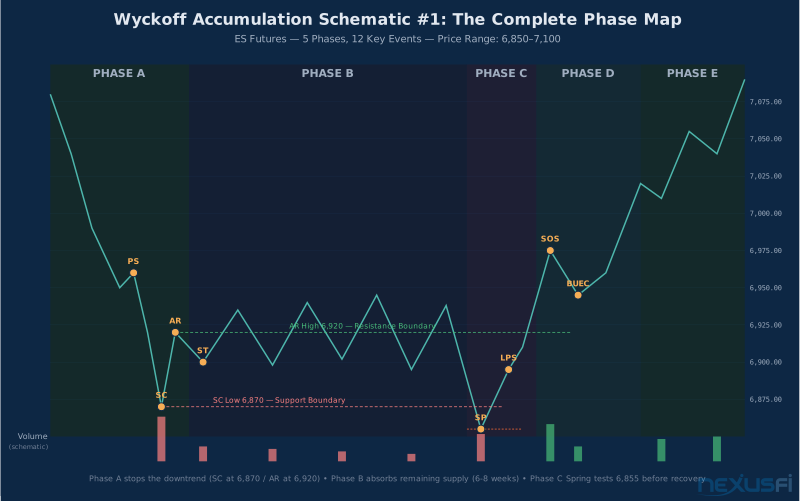
Accumulation Schematic #1 describes the most common sequence when major interests are building long positions after a sustained downtrend. The range has five phases (A through E) and specific labeled events within each phase.
Phase A: Stopping the Downtrend #
Phase A marks the end of the prior downtrend. Supply has been dominant; demand has been absent or weak. Four events typically appear in this phase:
Preliminary Support (PS): The first place where demand shows up in meaningful size. Price has been falling. Suddenly, volume spikes and spread widens on the downbar — but buyers absorb enough selling to produce a bounce. This bounce doesn't hold; price resumes lower. But PS marks where buyers first showed institutional-scale interest.
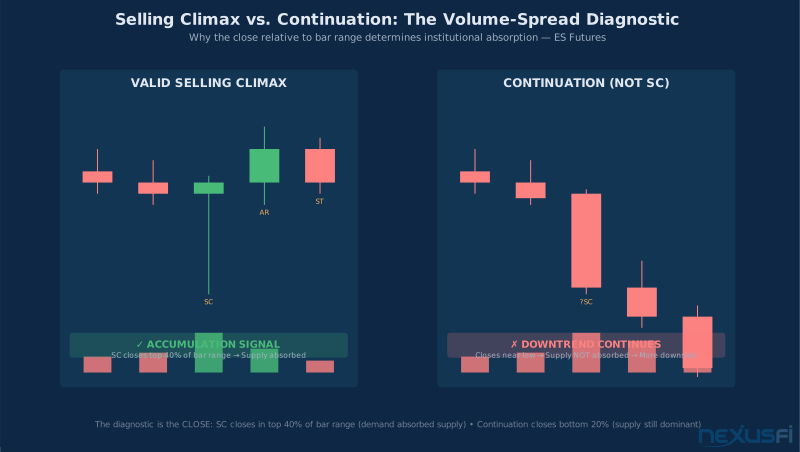
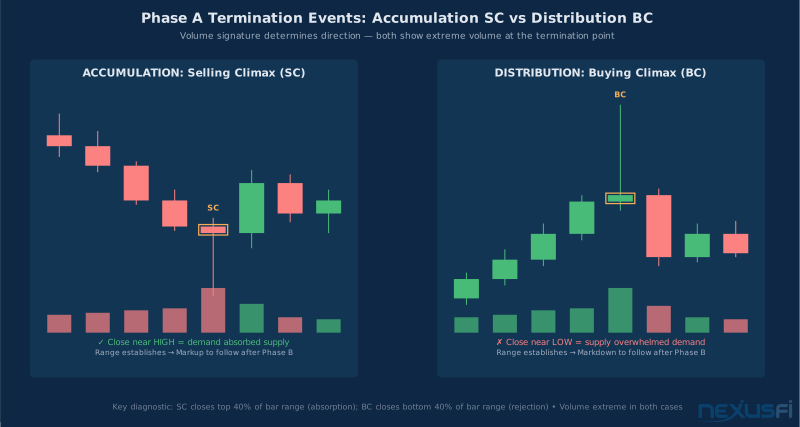
Selling Climax (SC): The most dramatic bar or series of bars in the downtrend. Volume is extreme. Spread is extreme. Price closes much off the lows — often near the high of the bar. This is the classic climactic reversal: panicked sellers dumping into institutional absorption. The key is the close relative to the bar's range. A SC that closes in the top third of a wide spread bar signals genuine demand.
Automatic Rally (AR): After the SC, price bounces sharply. Short covering combines with institutional longs. Volume is typically lower than the SC but decent. The AR's high sets the top of the trading range. This is important: the AR high defines where distribution would occur if this turns into a larger structure.
Secondary Test (ST): Price returns toward the SC low to test whether supply has been exhausted. The ST should show reduced spread and lower volume compared to the SC. That reduction is evidence that supply is drying up — the weak hands have been shaken out, and sellers can't push as hard as they did at the SC.
In ES futures, you'll often see the SC and AR compressed into a single session or even a 30-minute window during high-volatility drops. The micro-structure still follows the same logic. Look for the close relative to the bar's range — a bar that prints a new low but closes near its high is absorption, regardless of whether it looks "climactic" on a monthly chart.
Phase B: Building the Cause #
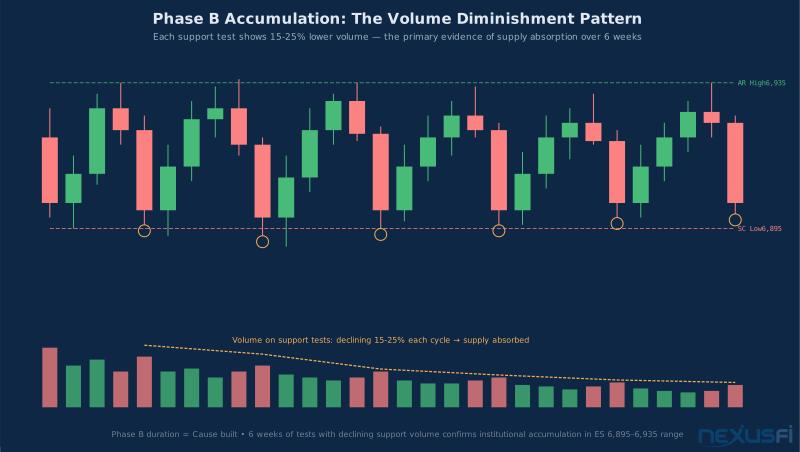
Phase B is the longest phase and the hardest to trade. Price oscillates between the SC low and the AR high — the trading range. Major interests are accumulating. The secondary tests continue. Price may dip below the SC low temporarily (shaking out late shorts and weak longs) before recovering.
What you're watching for in Phase B:
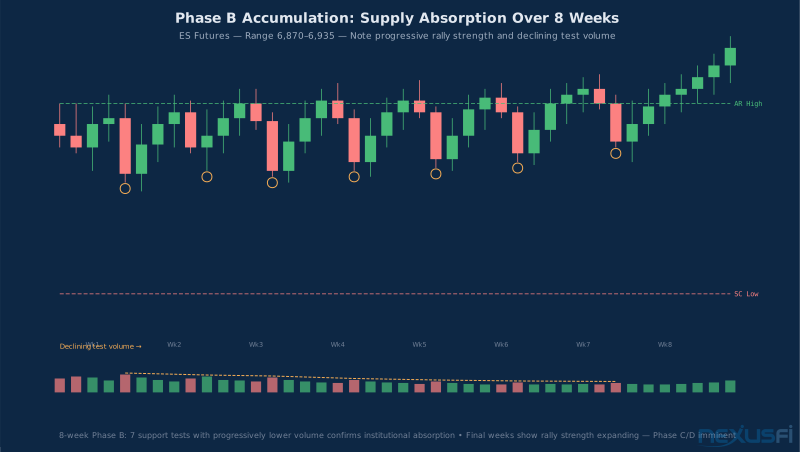
Volume distribution: Bars approaching the SC low should show diminishing volume. If every test of the low produces equal or higher volume, supply hasn't been absorbed. The range isn't ready to be resolved upward.
Rally characteristics: As accumulation progresses, rallies within the range should show increasing relative strength. Volume picks up on up-bars toward the top of the range; volume decreases on reactions. This is the early signature that demand is gaining control.
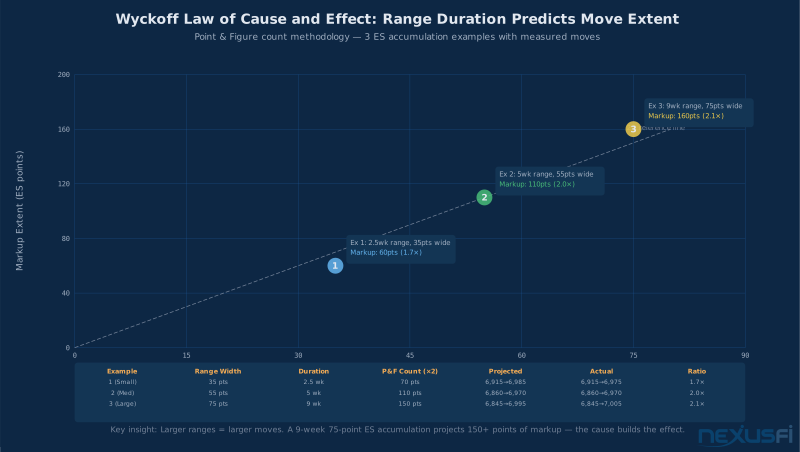
Duration = Cause: Wyckoff's Law of Cause and Effect states that the extent of a subsequent move is proportional to the cause built in the range. A range that lasts two weeks in ES will produce a smaller move than one that lasts two months. Patience isn't just psychological advice — it's embedded in the method's logic.
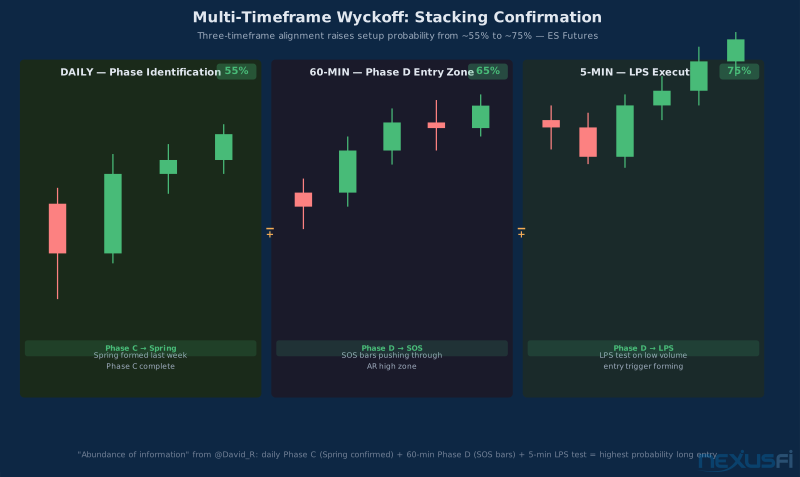
@David_R, who contributed extensively to the NexusFi Wyckoff thread (post #85532), described this phase in practice: you're watching for the abundance of information that confirms what price is doing across multiple timeframes — daily structure confirming the weekly, the hourly confirming the daily. Each timeframe needs to show demand gaining control before you're genuinely in Phase B of accumulation.
Phase C: The Test #
Phase C contains the event that makes or breaks Wyckoff traders: the Spring (or Shakeout).
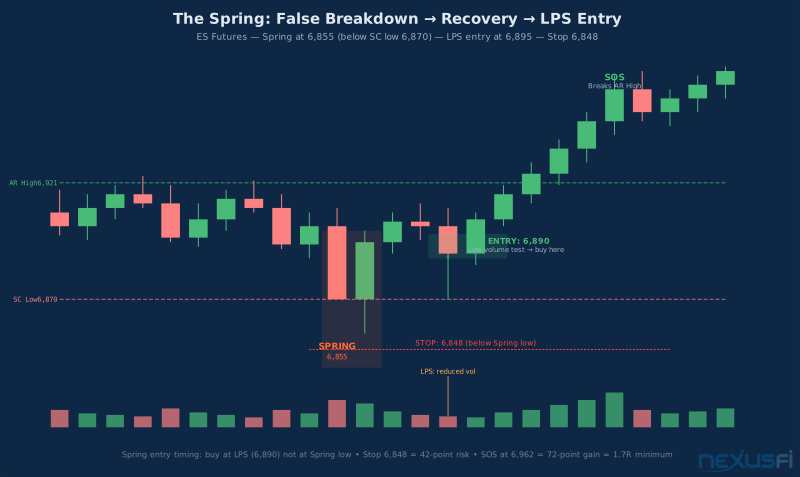
Spring: Price briefly breaks below the SC low — below the defined support of the trading range. It looks like a breakdown. Volume can be elevated on the initial move, but the key is what follows: a rapid recovery back into the range, often with a strong close. The Spring's purpose (from the Composite Man's perspective) is to trigger stop orders below support, shake out weak longs, and allow institutional buyers to accumulate additional inventory at the lowest possible price before markup.
Not every accumulation pattern produces a Spring. Schematic #1 includes the Spring; Schematic #2 shows accumulation without a pronounced Spring — a direct continuation into Phase D after adequate Phase B consolidation.
The Spring test: After the Spring, price returns toward the bottom of the range for a Last Point of Support (LPS). This test should show markedly reduced volume and narrow spread. If it holds above the Spring low and turns up, demand has genuinely absorbed remaining supply.
What kills traders at the Spring: they see the breakdown and short it, expecting the trend to continue. Then price reverses and they're trapped. Or they wait for the recovery and buy too late. The entry logic: buy the LPS, not the Spring itself, with a stop below the Spring low.
Phase D: Markup Begins #
Phase D is where the trade pays. Signs of demand dominance become unmistakable:
Sign of Strength (SOS): A strong move up, often on expanding volume, that breaks above the AR high. This is the first clear evidence that demand has overcome supply entirely.
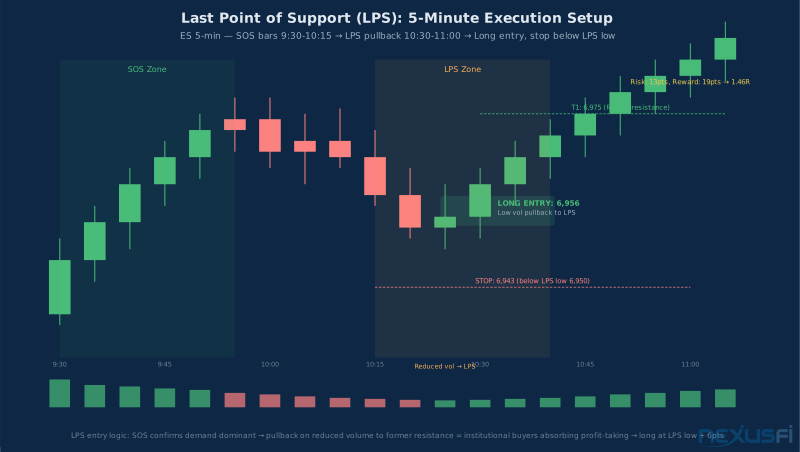
Last Point of Support (LPS): After the SOS, price pulls back on reduced volume to the former resistance (now support). This is the optimal entry for those who missed Phase C.
Back Up to the Edge of the Creek (BUEC): Some frameworks describe a final test of the former resistance zone. The "creek" metaphor: the trading range is a creek that price must leap across. The SOS is the leap; the BUEC is a minor pullback just above the creek's edge before continuing higher.
Volume behavior during Phase D is the tell: up-bars on wide spread with high volume, down-bars on narrow spread with declining volume. Supply is absent. Demand is in control.
Phase E: Extended Markup #
Phase E is the extended trend. Price leaves the trading range and doesn't return. There may be minor consolidations along the way — re-accumulation ranges that build additional cause before the next leg. These mini-ranges follow the same Wyckoff logic as the original accumulation, just compressed.
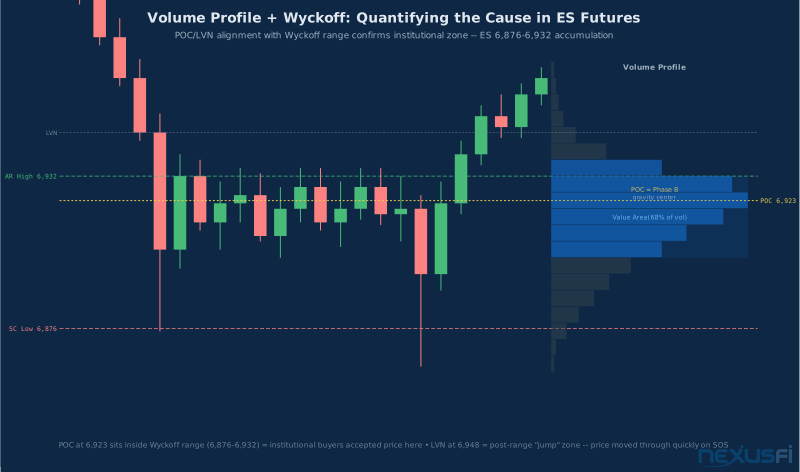
In NQ futures, Phase E moves can be dramatic. The Nasdaq index's institutional ownership concentration means major accumulation ranges can launch 15-20% moves without significant pullback. Volume Profile confirms the move: you'll see a thin value area between the accumulation range and the new trading zone — the market "jumped" through that zone with conviction, signaling institutional continuation buying.
Accumulation Schematic #2: No Spring #
Schematic #2 describes accumulation that proceeds without a pronounced Spring. The range still forms; Phases A and B still occur. But instead of a shakeout below support, Phase C is represented by a minor Last Point of Support within the range — price dips toward the lower portion of the range but doesn't break below the SC low.
The SOS comes directly from within the range rather than from below it. Phase D and Phase E follow the same pattern as Schematic #1.
Why does this matter? Because traders who are only watching for Springs miss legitimate accumulation when Schematic #2 is in play. They wait for the breakdown that never comes, and they watch the markup happen without them.
The practical way to avoid this: don't anchor your entry to the Spring. Instead, anchor it to the demand-supply evidence. Phase B with appropriate volume behavior, a minor test that holds above support, and an LPS showing demand dominance — that's your entry regardless of whether there was a Spring.
Distribution Schematics: The Mirror #
Distribution is the process by which major interests sell large positions built during accumulation into strength. Schematics #3 and #4 mirror the accumulation schematics with one key difference: the events are inverted.
Phase A: Stopping the Uptrend #
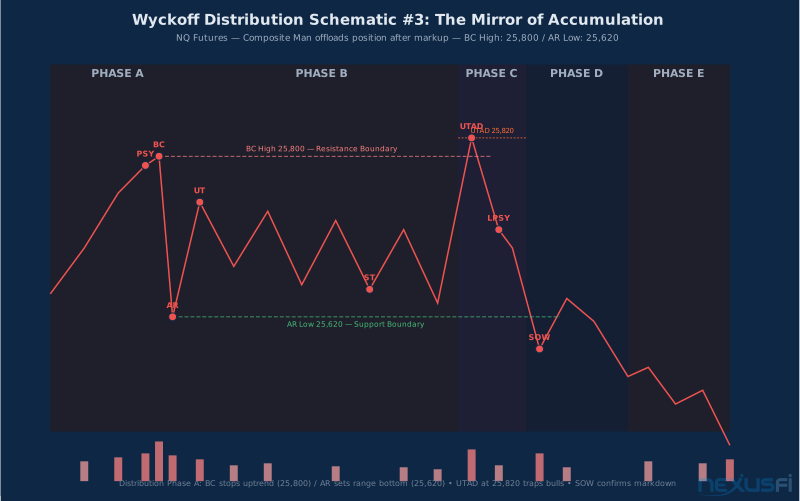
Preliminary Supply (PSY): Supply appears in meaningful size. Volume spikes on a wide up-bar but price closes off its highs, or a down-bar appears with heavy volume. Demand absorbs the selling but the price rise slows.
Buying Climax (BC): The exhaustion point. Volume is extreme. Spread is wide to the upside. Price closes near the low of the bar — deep in the bar's range, not near the high. This is absorption in reverse: institutional sellers are offloading into panic buying from retail. The BC high sets the top of the distribution range.
Automatic Reaction (AR): After the BC, price drops sharply. Buying has been exhausted; weak hands who chased the top begin selling. The AR low defines the bottom of the distribution range.
Secondary Test (ST): Price rallies back toward the BC high to test whether demand can absorb the supply that appeared there. A weak rally on reduced volume and narrow spread that fails to reach the BC high is a bearish secondary test — evidence that demand is genuinely depleted.
Phase B: Building the Cause for Decline #
The distribution range consolidates. Unlike accumulation, where you're watching for signs that demand is gaining control, in distribution you're watching for supply to reassert.
Key signatures in Phase B:
Up-bars with reduced volume: Rallies toward the BC high show decreasing volume and narrowing spread. Demand is diminishing. The market can't sustain the buying needed to challenge the BC high.
Down-bars expanding in volume: Reactions within the range show increasing volume and widening spread. Supply is asserting itself.
Upthrust action: Price briefly exceeds the BC high — an Upthrust (UT) — on a false breakout before reversing. This is the distribution equivalent of the Spring, and it's designed to trap longs who buy the "breakout."
Phase C: The Upthrust After Distribution #
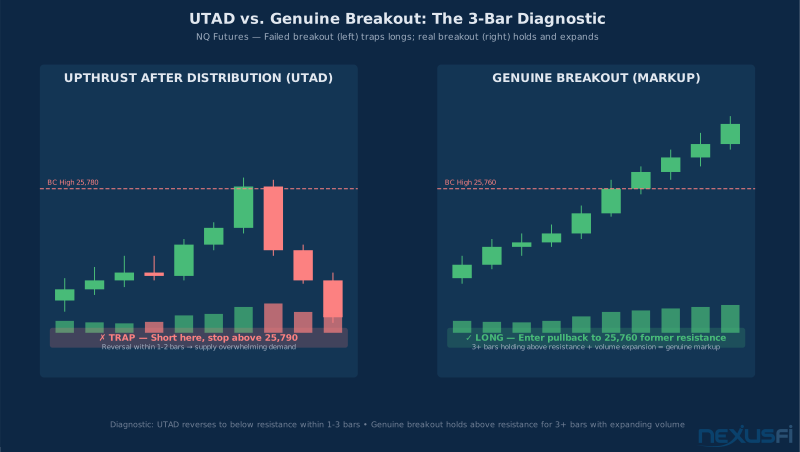
Upthrust After Distribution (UTAD): The precise mirror of the Spring. Price breaks above the BC high, triggering buy stops and encouraging trend-following longs. Then it reverses sharply below the range. Volume can be elevated during the initial move, but what matters is the reversal and the close — a bar that prints a new high and closes near its low is a classic UTAD.
The UTAD test: after the reversal, price retraces toward the top of the range for a Last Point of Supply (LPSY). Reduced spread and lower volume on this test confirms supply is dominant. This is the short entry: LPSY with a stop above the UTAD high.
@YertleTurtle described a similar pattern in the NexusFi Wyckoff 2.0 thread (post #338366), noting the value of tracking the "schematic checklist" across timeframes — seeing the UTAD form on the daily while the 60-minute shows the LPSY developing in real time creates conviction that isn't available from a single timeframe.
Phase D: Markdown Begins #
Sign of Weakness (SOW): A strong move down, breaking below the AR low, often with expanding volume. Distribution has been completed; supply is dominant.
Last Point of Supply (LPSY): After the SOW, price pulls back on reduced volume to the former support (now resistance). This is the short entry for those who missed Phase C.
Phase E: Extended Markdown #
The sustained downtrend. Re-distribution ranges may appear along the way — mirrors of re-accumulation — before the next leg down.
Reading the Schematic in Real-Time ES Futures #
The challenge in live trading is that the "textbook" schematic rarely appears cleanly. Here's how to work with messy real-world versions:
Start with the largest timeframe: If you're trading ES on a 5-minute chart, the schematic you're working from should be drawn on the daily or hourly first. The 5-minute shows execution context; the hourly shows the structure context.
Use volume as your primary confirmation tool: The schematic events have specific volume signatures. A Selling Climax without extreme volume isn't a SC — it's just a down-bar. A Spring without recovery volume isn't a Spring — it's a breakdown. Before labeling any event, check: does the volume behavior match what the logic requires?
Identify the range boundaries first: Before labeling phases, mark the SC low and the AR high. Everything happens in relation to those levels. If you can't identify clear range boundaries, you may not be in a completed Phase A — and you're not in accumulation yet.
Accept structural ambiguity: Real markets often show partial schematics. Phase B may not produce classic Secondary Tests; the Spring may be so minor it's hard to identify; the SOS may appear before you're convinced Phase C is complete. The discipline is to work with the evidence available rather than requiring the textbook to appear.
Multiple timeframe coordination: @David_R's point about "abundance of information" across timeframes is the practical key. A daily spring that has a corresponding hourly LPS forming, with the 5-minute showing demand absorption, is higher probability than a spring identified only on the 15-minute. The coordination across timeframes — each showing the same supply-demand evidence at its own scale — is what moves a trade idea from "maybe" to actionable.
Springs and Upthrusts: The Two Entries That Make the Method #
Springs and Upthrusts deserve expanded treatment because they're the highest-probability entries in the Wyckoff framework. Both follow the same logic: a false move below support (Spring) or above resistance (Upthrust) that shakes out weak hands and creates a directional opportunity for those who understand what's happening.
What Makes a Valid Spring #
- Prior range: Price must have established a clear trading range with defined support. A random dip below a level without a range doesn't qualify.
- Penetration depth: The penetration below support is typically shallow — a few ticks to a few points in ES. Deep penetrations that hold for multiple bars suggest a genuine breakdown, not a Spring.
- Volume on penetration: Volume can be elevated (aggressive stop running) or low (no follow-through selling). Both are valid. What disqualifies a Spring is heavy volume with sustained price acceptance below support — that's distribution, not a shakeout.
- Recovery speed: The Spring bar or the bars immediately following should show aggressive recovery. In ES 5-minute terms, that often means closing near the high of the penetration bar or the following bar taking out the penetration bar's high entirely.
- Test (LPS): After the recovery, price tests the Spring low area on reduced volume. This is the mechanical confirmation that supply has been absorbed. The test failing (new lows forming with volume) invalidates the Spring hypothesis.
A failed Spring — one that appears to develop but then doesn't recover — often means you're in a continuation of the prior downtrend, not in Phase C of accumulation. The stop below the Spring low keeps you out of that situation.
What Makes a Valid Upthrust #
The mirror criteria apply:
- Prior range: Clear resistance established, not a random level.
- Penetration depth: Typically shallow. Deep penetrations that hold above resistance suggest a genuine breakout.
- Volume on penetration: Can be elevated (bull trap with aggressive buying into supply) or low (weak-demand breakout). What disqualifies an Upthrust is strong volume with sustained acceptance above resistance — that's a markup.
- Reversal speed: The reversal should be aggressive. A candle that prints above resistance and closes back below it in the same bar is the classic signature.
- Test (LPSY): Price rallies back toward the Upthrust level on reduced volume. Fails to recapture it. That's the mechanical short entry with a stop above the Upthrust high.
Common Misreadings and How to Avoid Them #
Schematic hunting in trending markets: The biggest misuse of Wyckoff schematics is applying them to markets that are trending, not ranging. If price has been in a sustained uptrend without meaningful consolidation, you're not watching an accumulation range develop — you're watching continuation. Wait for a genuine range to form before applying schematic analysis.
Labeling every bounce a "SC": A Selling Climax requires specific volume and spread characteristics — extreme volume, a wide spread bar that closes off the lows. Every significant down-bar is not a SC. Loose labeling leads to identifying "accumulation" in the middle of downtrends and getting repeatedly stopped out.
Expecting Phase labels to sequence perfectly: Real markets often skip events, combine events, or show abbreviated phases. Phase B in ES might look nothing like the textbook because HFT liquidity smooths out the oscillations that appear more clearly in slower markets. The conceptual logic remains valid; the visual signature may differ.
Confusing the Spring with a breakdown: The most expensive mistake. A genuine breakdown occurs when price penetrates support with volume and doesn't recover. A Spring recovers quickly and shows reduced volume on the subsequent test. When the distinction is unclear — when the penetration is significant and recovery is slow — default to "unclear" and wait for more evidence rather than committing to a position.
Only trading perfect schematics: This creates significant under-trading. Most worthwhile opportunities have some structural ambiguity. The skill is calibrating confidence to evidence: how much of the schematic is visible, how clearly does volume confirm, how well do multiple timeframes agree. Trade size should reflect that confidence level, not the requirement that the textbook appear exactly.
Integrating Volume Profile with Wyckoff #
Modern futures traders can improve Wyckoff schematic analysis with Volume Profile data. The combination is powerful because Volume Profile quantifies what Wyckoff describes qualitatively.
Low Volume Nodes as Range Boundaries: Volume Profile low-volume nodes (LVNs) often align precisely with the SC low, AR high, or UTAD high in Wyckoff terms. These are zones where the market spent minimal time — the transitions between trading ranges. When a Spring tests an LVN and holds, it's double confirmation: the Wyckoff structure and the Volume Profile both say this level matters.
High Volume Nodes as Cause Measurement: The Profile Over Range (PoR) during Phase B accumulation shows you exactly where institutional interest concentrated. A thick Point of Control (POC) deep in the range is evidence that supply has been genuinely absorbed at that price — there's committed inventory there that won't re-sell until the market delivers a meaningful premium above POC.
Value Area as Phase Identification: A value area that expands upward each session during Phase B (daily Value Areas progressively shifted higher) is evidence of accumulation. Value areas that remain anchored in the lower portion of the range while price occasionally tests higher suggest the Composite Man is still buying rather than preparing to release supply.
Post-Breakout Confirmation: After a SOS or SOW, a thin-Volume Profile node between the trading range and the new area suggests the "cause" has been spent — the move through the thin zone was institutional. Thick nodes between the breakout zone and current price suggest re-accumulation or re-distribution in progress.
@brakkar's observation in the VWAP thread (post #715575) applies here: "large professional money managers use [VWAP] to assess the performance of traders." The same institutional logic that makes VWAP relevant in execution makes Volume Profile relevant in structure analysis — these are the tools that map institutional activity in the data.
Practical Application: ES Accumulation After a 5% Correction #
Using real ES prices (close 6,944.25, range 6,940.75--6,961.50 on the reference day), here's how schematic identification works in practice:
Scenario: ES sold off 5% from a high of approximately 7,250 over three weeks. Price is now testing the 6,900-6,950 zone. You're watching for accumulation structure.
Phase A identification:
- The final leg down produces a wide spread bar on extreme volume, closing in the upper 40% of the bar's range. SC candidate: 6,890 close on a 6,850--6,930 bar.
- Following day: ES gaps up, running through 6,950 before pulling back. AR high: 6,965.
- Secondary test three sessions later: Price dips to 6,895 on light volume, recovers to close at 6,925.
Range established: 6,890 (SC low) to 6,965 (AR high). 75-point range.
Phase B identification:
- Over the next two weeks, ES oscillates within the range. Volume on declines diminishes. Volume on rallies toward 6,950 shows accumulation signature: up-bars on increasing volume.
- Price tests 6,900--6,905 twice more, each time with lower volume.
Phase C — Spring:
- Overnight session: ES trades down to 6,878, breaking below 6,890 SC low. Volume moderate — stop runs, not sustained selling. Recovers to 6,910 by RTH open.
- LPS test: Two sessions later, price returns to 6,895 on light volume. Holds. Closes at 6,935.
Entry: Long at 6,895 LPS, stop at 6,872 (below Spring low). Initial target: 6,965 AR high (Phase D SOS confirmation), then extend toward 7,100 (prior range, Phase E target).
Phase D confirmation: SOS bar pushes through 6,965 on expanding volume. 7,000 becomes the first LPS for re-entry.
This isn't a cherry-picked example — it's the pattern that appeared in the Spoo-nalysis thread (thread #13452, 38,000+ replies) repeatedly throughout 2023-2024 during the major correction and recovery phases.
When Wyckoff Schematics Don't Apply #
Not every market is in a Wyckoff phase. Recognizing when not to apply the framework is as important as knowing how to use it when it's valid.
Trending markets without consolidation: During sustained trends, price may not form meaningful ranges. Applying accumulation analysis to a brief pause in a strong uptrend produces false Springs everywhere. Wait for genuine structure.
News-driven dislocations: FOMC reactions, NFP gaps, geopolitical shocks — these create volume and spread conditions that superficially resemble climactic events but may not represent genuine institutional accumulation or distribution. The follow-through is often absent because the move is informationally driven, not supply-demand driven.
Illiquid instruments: Wyckoff's observations were based on NYSE stocks with sufficient institutional participation to create genuine accumulation/distribution structure. In thin futures markets or thinly traded contract months, the "patterns" are noise, not signal.
After-market phases: Pre-market or overnight-only structure in ES/NQ may show schematic-like patterns without the institutional participation needed for reliable follow-through. RTH structure is the primary reference; overnight fills in the structural context.
Building a Wyckoff Observation Practice #
The gap between understanding the schematics conceptually and actually reading them in real-time is significant. Bridging it requires a specific kind of deliberate practice.
Annotate rather than trade: Spend a month identifying potential schematic structures in daily charts without taking positions. Label every SC, AR, ST, Spring, SOS, BC, UTAD. Date your analysis so you can review what actually happened.
Review wrong calls systematically: When you identify a Spring that turned into a breakdown, or a BC that turned into a Spring (accumulation inside what looked like distribution), document why. The volume signature at the failure point almost always contains the warning — weak recovery volume after the Spring, elevated volume on the retest of the breakdown level.
Use multiple instruments: ES, NQ, CL, and GC don't always move together. Studying Wyckoff phases across multiple instruments helps you see which structural signatures are strong (they appear reliably) and which are instrument-specific.
Read @DbPhoenix's contributions directly: The NexusFi threads — especially "Wyckoff In The Original" (thread #25336) and the main Wyckoff Trading Method thread (#7341) — contain the most practical Wyckoff education available in a free forum context. DbPhoenix's post #315955 on auction markets and his post #304994 on demand and supply fundamentals are worth re-reading regularly.
@David_R's point in post #85541 about "only looking at one or two things" captures the common failure mode: premature certainty. You see something that looks like a spring, the first confirmation looks right, and you commit — before checking volume on the retest, before seeing whether multiple timeframes agree, before waiting for the LPS. The schematic is a map; reading it correctly means using every feature, not just the most visually obvious one.
Summary #
Wyckoff Accumulation and Distribution Schematics provide a structural language for reading institutional supply and demand in futures markets. The schematics aren't the method — they're descriptions of patterns that emerge when the Composite Man's buying or selling dominates.
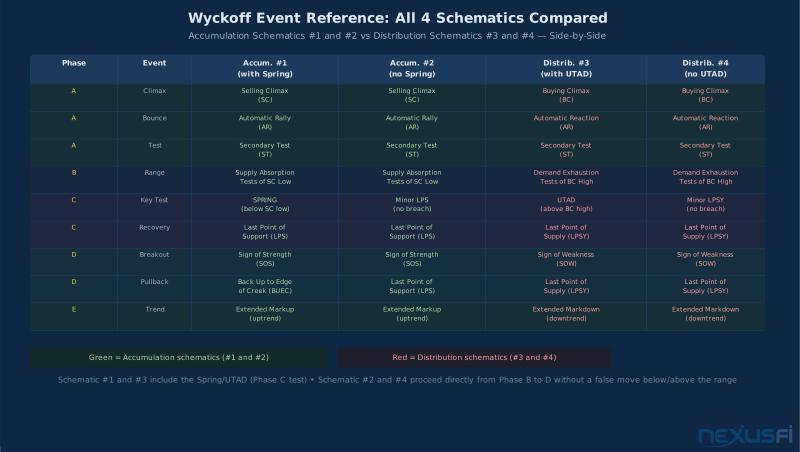
Accumulation Schematic #1 shows the most common sequence with a Spring in Phase C — a false breakdown below support that shakes out weak hands before the markup begins. Schematic #2 shows accumulation without a pronounced Spring, proceeding directly from Phase B consolidation to Phase D markup.
Distribution Schematics #3 and #4 mirror the accumulation schematics, with Upthrusts (UTAD) replacing Springs and the entire sequence running in reverse — building cause for a downtrend rather than an uptrend.
The practical keys:
- Volume confirms every labeled event — no volume signature, no event
- Range boundaries (SC low and AR high, or BC high and AR low) define the structure
- Multiple timeframe coordination increases confidence
- Springs and Upthrusts are the highest-probability entries, but they require clean volume confirmation on the test
- Schematic #2 (no Spring) is equally valid and produces more entry regret in traders who wait only for Schematic #1
The schematics take years to read fluently in real-time. That's not a flaw — it reflects the depth of market knowledge embedded in Wyckoff's framework. The traders who get there consistently report the same thing: once you can see the supply-demand story in the volume bars without hunting for labeled events, the method becomes natural. The schematics are the bridge to that fluency, not the destination.
Related Academy articles: Wyckoff Method in Futures Trading • Volume Profile Trading • Volume Spread Analysis (VSA) • Footprint Charts • Cumulative Volume Delta (CVD)
Knowledge Map
Go Deeper
Build on this knowledgeCitations
- — Wyckoff Trading Method (2013)“What matters most is an understanding of the forces of demand and supply. It's not about schematics or 'laws' or any of the other layers of complexity which have been added for you or by you. It's about a level of simplicity that is foreign to what you're wrestling with.”
- — Wyckoff In The Original (2013)“Traders who have a lot to buy or a lot to unload will avoid trying to catch the tops and bottoms and focus on "the middle", since "the middle" is by definition where most of the trading is going on.”
- — Wyckoff Trading Method (2010) 👍 46“In my search for success in this business I have realized that method takes a back seat to ones mental strengths and weaknesses. I don't doubt that for a minute.”
- — Wyckoff Trading Method (2010) 👍 28“Just because X, Y or Z takes place does not mean A,B or C will happen. Just because one or two things indicate something does not mean the outcome is determined. You need the abundance of information.”
- — Wyckoff Trading Method (2011) 👍 10“The S&Ps rallied strongly in the US morning session as a response to the spring. New highs were put in, as anticipated. This is a typical result of a good spring.”
- — Wyckoff Trading Method (2011) 👍 19“The Wyckoff Method has been around for over 100 years. Wyckoff was a broker and a trader in the early part of the 1900s. He was known for his publications and courses on stock speculation. His approach is different from most modern technical analysis.”
- — Wyckoff 2.0 (Trade Journal)Wyckoff 2.0 I've been studying the markets and trading fo (2013)“I've been studying the markets and trading for the last two years and I've decided to finally start a trading journal. My methodology is based on the Wyckoff method with modern additions for the equity futures context.”
- — MBOXX ( similar to Weis Wave )/Wyckoff (2019) 👍 18“Been using Wyckoff's/David Weis's work as part of my trading method since 2004 concentrating on currencies. The core demand/supply reading translates across all liquid futures markets.”
- — Richard Wyckoff and the Straight Line Approach (2015) 👍 15“Richard Wyckoff was a pioneer of technical analysis. While Dow contributed the theory that price moves in a series of trends and reactions, Wyckoff focused on the forces driving those movements -- the actual buying and selling behavior of large operators.”
- — Wyckoff Trading Method (2013) 👍 13“For those who know nothing about Wyckoff: The method focuses on the relationship between supply and demand as revealed by price and volume interaction. These forces are constant regardless of which decade you are trading in.”
- — VWAP for stock index futures trading? (2019)“VWAP is widely used in particular by big professional money managers to assess the performance of traders. These institutional flows are what create the price and volume structures that Wyckoff analysis identifies.”